![Word of Life April 2015]()
29 Mar 2015 | Non categorizzato, Word of
 Audio of the Word of Life
Paul offers us a superb way of being truly love for one another, by ‘making ourselves one’ with them.
In his first letter to the community in Corinth, from which the Word of Life for this month comes, Paul has to defend himself against the scant regard some Christians show for him. They called into question or denied that he was an apostle. After demonstrating fully his qualifications as an apostle because he had ‘seen Jesus Christ’ (see 9:1), Paul explained why he acted with humility and deference to the point of even giving up any payment for his work. While he could have asserted his authority and his rights as an apostle, he preferred to make himself ‘the servant of all’. This is his evangelical strategy.
He enters into solidarity with every kind of person, to the point of becoming one of them, with the aim of bringing the freshness of the Gospel. Five times he repeats ‘I made myself’ one with the other: with Jews, out of love for them, he puts himself under the Mosaic Law even though he said he was not bound by it; with non-Jews, who did not follow the Law of Moses, he lived as someone not under the Mosaic Law, because he had instead a more demanding law, Jesus himself; with those who came to be called the ‘weak’ (probably scrupulous Christians), who worried about whether they should eat the flesh of animals sacrificed to idols, he too became weak even though he was ‘strong’ and experienced a tremendous liberty. In a word, he made himself ‘all things to all people.’
Every time he repeats that he acts like this to ‘win’ each for Christ, to ‘save’ by any means at least someone. He has no illusions, is without triumphalist expectations, knows well that only a number will respond to his love. All the same he loves everyone and puts himself at the service of all according to the example of the Lord, who ‘came not to be served but to serve, and to give his life as a ransom for many’ (Mt 20:28). Who has made himself one with us more than Jesus? He who was God ‘emptied himself, taking the form of a slave, being born in human likeness’ (Phil 2:7).
‘I have become all things to all people.’
Chiara Lubich made this word one of the key points of her ‘art of loving’, summed up in the expression ‘to make yourself one.’ She saw in it an expression of the ‘diplomacy’ of charity. She wrote, ‘When someone weeps, we must weep too. And if someone laughs, we too rejoice . Thus the cross is divided and borne by many shoulders, and joy is multiplied and shared by many hearts…. Making ourselves one with our neighbour for love of Jesus, with the love of Jesus, so that our neighbour, sweetly wounded by the love of God in us, will want to make himself or herself one with us, in a mutual exchange of help, of ideals, of projects, of affections…. This is the diplomacy of charity, which has many of the expressions and features of ordinary diplomacy; hence it does not say all that it could say, for this would displease others and would be disagreeable to God. It knows how to wait, how to speak, how to reach its goal. It is the divine diplomacy of the Word who becomes flesh to make us divine.’
With the skill of a teacher, Chiara also discerns the daily difficulties we have in ‘making ourselves one’: ‘At times we are distracted, at times we have the unfortunate desire to be hasty in saying what we think, in giving our advice at the wrong moment. On other occasions, we are not really open to making ourselves one with our neighbour because we reckon that they do not understand our love, or we are held back by other kinds of judgements. In some cases we are hampered by a hidden wish to conquer the other person to our cause.’ For this reason ‘it is really necessary to cut with or set aside all that fills our minds and our hearts so that we can make ourselves one with others.’ It is thus a love that is constant and tireless, which carries on through thick and thin and is not on the look-out for anything for itself, and that in turn entrusts itself to the greater and stronger love of God.
These are useful ideas that can help us to live the Word of Life this month, by listening sincerely to the other person, understanding the other from within, identifying with what he or she is living and feeling, sharing his or her worries and joys:
‘I have become all things to all people.’
We cannot interpret this invitation of the Gospel as a request to renounce our convictions, as if we approved uncritically of any kind of behaviour in other people and did not have our own life-choices and our own way of thinking. If we have loved to the point of becoming the other, and if what we have shared has been a gift of love and has created a sincere relationship, we can and we must express our own ideas, even though perhaps they may cause pain, all the while remaining in an attitude of profound love. Making ourselves one is not a sign of weakness, nor of looking for a calm and easy way of living together. Instead, it is the expression of a person who is free who chooses to be at the service of others; it demands courage and determination.
It is important to bear in mind the purpose of making ourselves one.
Paul’s words that we are living this month, as we have already hinted, go on to say ‘by any means save some.’ Paul justifies his making himself one with the desire to bring people salvation. It is a way of entering into the other, to draw out the good and the truth within them, to put an end to any errors there may be and set down a seed of the Gospel. It is a task that for the apostle admits of no limits or excuses, that cannot be ducked because it has been entrusted to him by God himself, and he must do it ‘by all means’, with that creativity which only love can bring.
This is the intention that, in the end, motivates our ‘making ourselves one’. Politics and commerce also wish to come close to people, to enter into their way of thinking, to understand their longings and needs, but they always want some kind of return. Instead, Chiara would say, ‘Divine diplomacy has this greatness and this property, perhaps a property of it alone: it is moved by the good of the other and is therefore devoid of any shadow of selfishness.’
‘Making ourselves one’ therefore, to help everyone grow in love and so contribute to making people universally brothers and sisters, God’s dream for humanity, the reason that Jesus gave his life.
Fabio Ciardi
28 Mar 2015 | Non categorizzato
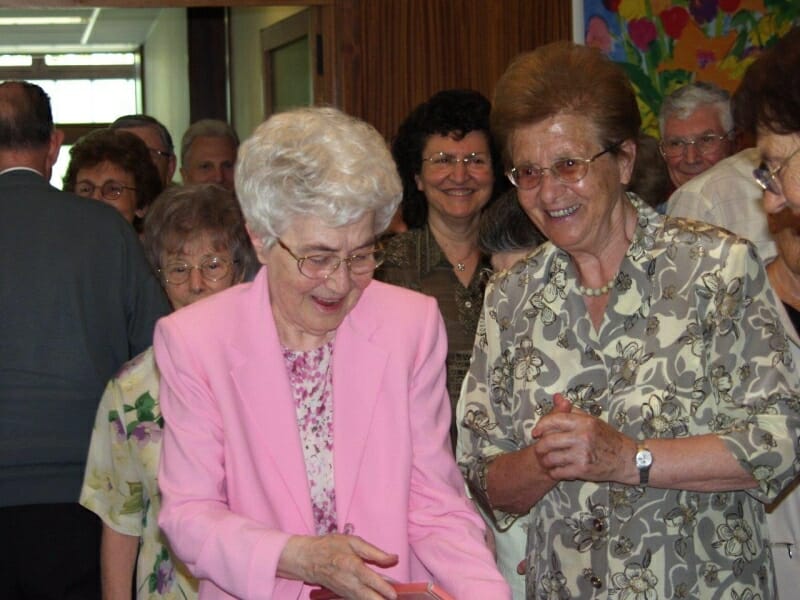
Palmira with Chiara Lubich
27 Mar 2015 | Non categorizzato
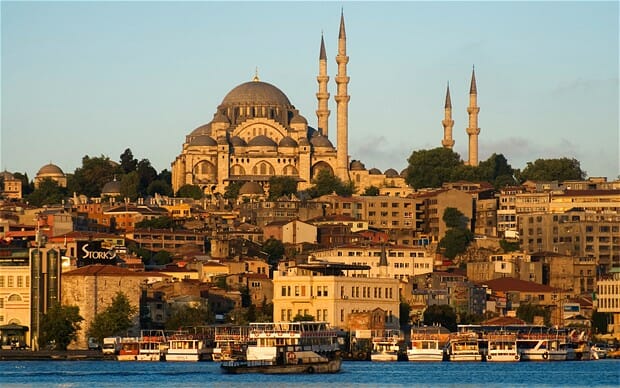
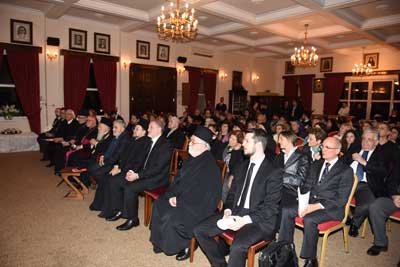
Istanbul: Patriarch Bartholomew does the honours in the Orthodox church of Aya Strati Taksiarhi, at an event involving more than a hundred representatives from the Orthodox and Catholic world, marking the 7th anniversary of Focolare foundress, Chiara Lubich. Attendees included the Metropolitans Ireneos, Apostolos and Elpidophoros; two Archimendrites, Father Vangeli who translated the books from Greek into Turk; and the Great Archimendrite Vissarion. Also attending: Armenian Catholic Archbishop, Levon Zekiyan and the Catholic Bishop, Louis Palâtre, as well as many others. The books were presented by Maria Caterina Atzori, linguist from the Focolare’s Centre for Studies who translated the books into Greek. The moderator was journalist Nikos Papachristou from Athens.
“During the course of the centuries, the divine epiphany of the Lord has been manifested in many ways, so that the human family could understand the things of God,” the Patriarch exhorted, after he opened the event with a prayer for Chiara, and intoning the hymn to the Holy Spirit. “He has never tired of raising up holy men and holy women who, through their example, with their love founded on divine philanthropy, and with their word inspired by the Holy Spirit, have continually solicited a metanoia, a conversion of heart for the whole of suffering humanity.”
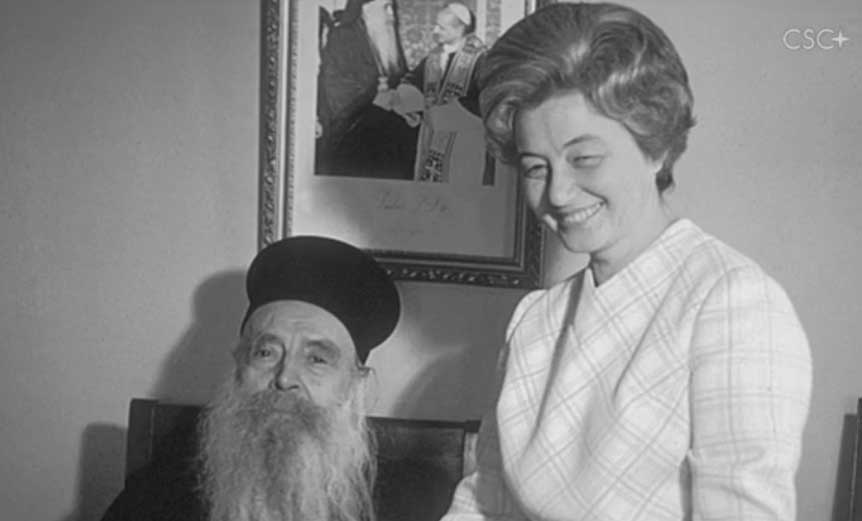
Video “Atenagora, Paolo VI and Chiara Lubich”
In his speech, he described the spiritual figure of Chiara, beginning with his direct testimony as an eye witness of the encounters between Chiara and Patriarch Athenagoras: “How could one not embrace the Wisdom of God in the blessed work that our sister Chiara has offered to our Churches, to our societies and to all people of good will? She whom our beloved Predecessor (. . .) lovingly called Tecla, the disciple of Paul, the woman who is equal to the Apostles.”
Then he outlined the salient points of the path of spirituality that she opened in the Church and beyond: “Gentle Chiara had answered God’s call, being totally conformed to her Master, but especially allowing herself to be made into a vessel that offers salvation, in order to bring all to Christ. Her life was spent in finding paths of encounter and dialogue with everyone, distinguished by a profound respect for every culture in which she knew how to conduct a journey of encounter, mutual understanding and mutual collaboration.”
“Chiara Lubich began her life journey, dedicated to the Lord, in the suffering of war. In this suffering she lived the Jesus Crucified and Forsaken, and understood that there is no Resurrection without passing through the downfall. And the suffering of Christ became her personal suffering, but never despair.”
“Her life was characterised by a zeal for Holy Scripture which, in her, became founding Word, living and exhilarating. She lived the Lord’s commandment to its depths: “As I have loved you, you should also love one another” (Jn 13:34). To the point of infecting countless people with this love, different among themselves, but united in a concrete ideal of communion.
 Chiara was ever faithful to her Church. And in this conviction, she felt the drama of the division, of the impossibility to receive from the same Chalice.
Perceiving the cry of suffering because of the laceration, she offered herself entirely for the charism of unity, becoming its instrument in the hands of God in meeting the heads of Churches and simple faithful. But she did not stop there: she sought, urged and invited us to find new paths of communion.”
“Chiara had a totally particular love for the Holy and Divine Eucharist of the Lord. In the Eucharist she perceived the gift of love from the One who was offered once for all, to draw man to himself. We can say that in her a Eucharistic conscience of unity was formed.” “There is still another aspect that we can see in the work of Chiara: the Unity of the Trinity, through the Eucharist, passes into the family (. . .) The place where mutual love can shine, which joins its members in a totally natural way (. . .) And in this context, the unity of the human family can be glimpsed in all of its aspects, in the society, in politics, in economy, in respect for the work of God for each one of us singularly and in all of His marvelous creation. The message and work of Chiara, therefore, turn out to be ever timely, especially with regards to the global context in which we are living.”
Hence, “the gift that the Focolare Movement today offers in presenting Chiara Lubich in the Greek language is particularly appreciated. We welcome it as a gift amongst brothers and sisters, which will surely be appreciated also by the Greek public. To the Greek-Orthodox faithful this wondrous message of unity and love!”
In conclusion, he turned directly to Chiara that she might intercede “so that the dawn of a new day for this wounded humanity might soon dawn, and that the sentiments for which she had spent her entire life, would produce abundant fruits, wherever today we do not find anything but darkness and bloody martyrdom.”
23 Mar 2015 | Non categorizzato
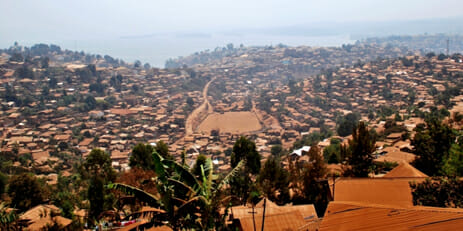
Bukavu, Democratic Republic of Congo
The Democratic Republic of Congo: a big country with immense natural resources. A population of 72 million with hundreds of ethnic groups. The difficult relationships with the West, the war for the exploitation of minerals, the drama of a forgotten people.
We interviewed the Congolese biologist, Pierre Kabeza, trade union member, a family man who, three years ago, had to leave his city in the Great Lakes region, and who now is at Sophia University Institute.
Why did you have to go on exile, leaving your wife and daughters? Bishop Munxihiwa, bisop of Bukayu who was killed for his battle for justice used to say: «At times there are things we don’t unde stand or see clearly, if not with eyes that have cried.” After his death we were all discouraged but Mons. Kataliko arrived, and decided to follow his footsteps, to speak out in the name of those who have no voice. Kataliko dried the tears of a population which was no longer heeded. On 24 December 1999 he wrote a message denouncing the unjust war, the occupation of Congo by the nearby countries, the exploitation and plunder of mineral resources. This was why they stopped him from doing his pastoral work for 7 months and 20 days. The bells no longer rang. We did sit-in protests every day until he returned to the Diocese. Muslims and Christians of Bukavu, went together to the cathedral where Bishop Kataliko offered mass and forgiveness for those who had made him suffer. He died in Italy a few weeks later.
To continue the work of our bishops – defence of the truth, battle for justice and liberty – a new group, the “Dauphin Munzihirwa Kataliko” (DMK) was formed. The initiatives to fulfil these aims irked their enemies. As head of the DMK, I was involved, together with the group in the field of education, to start with the education of children. The teachers in fact, were not paid by the State but financed by the parents. We took the steps to make the Congolese government assume all its responsibility for the country, and I spoke even to the President of the Republic, reminding him of article 43 of our constitution which recognizes the obligation for children to attend elementary school. He listened but sad to say, up to now nothing has changed. Because of my commitments however, I was threatened, arrested and tortured. My house was attached twice and they destroyed everything. This is why I had to leave to save my life.»
A forgotten war, 6 million dead and 2 million women and children escaping from their villages and cities. What else can you recount?
Yes, also Maria Voce, President of the Focolare said that it seems as if the dead in the “lands far from the Western world” are given less value in terms of humanity and “less political importance, thus weighing less on the conscience of the International community. This is the case of Congo. Our dead are of no interest to the international community because we are at the outskirts of the world. And yet, today, war is a common enemy for all. Mandela taught us that “we were born to be brothers.”
In Europe little is said of the war in Congo, and then without saying the whole truth. It is not only an ethnic war. It’s true that we have many problems in Africa, but I wonder: why is the fire lit only in the rich countries where minerals and oil abound? The situation is always fiery in places where we find coltan, gold and diamonds. And where do all these minerals end up? They are used for smartphones, air bags, navigators and so on. It is estimated that for every kilo of coltan extracted in Congo, two children die. Others are obliged to become “children soldiers.” It would important to let our children know that on using a videogame another child in the peripheries of the world loses his life.»
What does this intellectual and human experience at Sophia signify for you? What are your expectations for yourself and for the wellbeing of your country?
«Sophia was one of the gifts I received in Italy, I think it would have been better if I had made this experience before committing myself as a union member because I now understand the importance of fraternity. I think that the failure of our Congolese society lies in the fact that we have forgotten the principle of humanity, a force that unites us all, and excludes no one. Today I understand that the other is part of me, that his problems are my very own. Political commitment should help us understand that we are responsible for one another. We are equal but different and if mankind exploits this wealth, all would benefit. Sophia has taught me also to discern the path of dialogue. True dialogue which makes room for the other, where there is always a part of the truth.»
Video
![Word of Life April 2015]()
22 Mar 2015 | Non categorizzato
 When Pope Francis met the General Assembly of the Focolare Movement last September he spoke of Chiara Lubich as an “extraordinary witness” to unity who “brought the fragrance of Jesus to so many human realities and to so many parts of the world”. Today, seven years after the death of the founder, the Focolare Movement reaffirms its vocation to be a school of communion and a hive of unity for the whole Church as Maria Voce explains in the following interview with our paper.
Do you believe that Chiara’s charism of unity is destined to be fulfilled?
Do you think that if I did not believe this I would have given my life to the Movement? We believe that unity will be fulfilled because it is the very thing Jesus asked for in his prayer to the Father: may they all be one. And we cannot imagine that the prayer of the Son of God cannot be fulfilled. Of course, we don’t know how it will come about, we don’t know when, but we are giving our lives so that it can be achieved. We want it to happen and each day we take small steps forward so as to hasten the day when it will be completely fulfilled.
What does “being a family” mean according to Chiara’s legacy?
When I was elected the first time I said my hope was that the Focolare would give precedence to relationships. I believe that, at root, this is what we have tried to do, even though there is always the danger of individualism. Building relationships with people who are within the Movement means truly being interested in the others and having a love that can understand, forgive, take on board and help when there is a need: all that happens in a natural family. We want to live as a family, but a genuine family, one founded on true and authentic relationships….
What role do the movements have in the Church today?
It is a twofold role: on the one hand the movements are bearers of charisms, which are gifts of the Holy Spirit for the Church and the world. They have an influence on the whole Church, because they are available to everyone so as to build up the ecclesial body. … Within each movement there is also a drive towards a more radical gospel life.
Their members want to be more committed, to be open to the world around them. These are characteristics that the movements try to live but which really apply to all Christians. … In movements and associations people can help each other: we can discover the value of being alongside one another, so as to give each other a hand, encourage and support each other and also to help get up again if we fall. …
Pope Francis entrusted three words to the recent Assembly: to contemplate, to go out, to study. How are you doing this?
Pope Francis quoted something Chiara Lubich had said: this is the great attraction of modern times, to penetrate to the highest contemplation whilst mingling with everyone, one person alongside others. Chiara always taught us that we must become Jesus. So, to contemplate means being Jesus, becoming Jesus, living the Gospel to the full, managing to discover all that Jesus is doing in history, what he wants to tell us through all the people we meet. …
Regarding going out, this is one of our priorities. We felt it even more strongly when Pope Francis emphasised it and we felt the joy of being in harmony with what the Pope is asking of us today. To study means for us, above all, continually revisiting our charism, not so as to change it in any way but to see how it is responding today to the signs of the times, being able to understand the language, the approaches and the new questions arising in the world today. We take this on board so as to express the one charism in today’s world.
What priorities do you as President have for the future of the Movement?
I am not the one who decides on the priorities. I need to discern them through what is expressed by the Movement all over the world. The important thing which emerged from the recent assembly is to be very open and to go out towards the peripheries, the margins, which are not only geographical peripheries but wherever love is missing and where divisions block the way to achieving the spirit of unity of the charism Chiara left us. … This leads as a result to giving special attention to places where those divisions are most obvious. This means countries where there are huge differences in standards of living, or where religious differences become causes of conflict, war and terrorism. We would like to put resources and skills into these countries in particular so as to do all we can to help. But of course we must not forget Europe which has cut itself off from its spiritual roots. We want to continue to dialogue with post-modern culture, with the ‘dark night’ which seems to envelop people’s lives today.
By Nicola Gor, in the Osservatore Romano of 18th March 2015
The whole interview in Italian is available via the link below
![Word of Life April 2015]()
18 Mar 2015 | Non categorizzato
In 1968 a race towards heaven by a young girl who found the secret of happiness. Her cause for beatification is currently underway.  Sixteen years old and always on the move. At breakneck speed. Her destination: heaven. Maria Orsola Bussone (October 2, 1954-July 10, 1970) came from Piedmonte, Italy. She loved the pop music of the 1960’s and was interested in student protests. She played guitar and was taking voice lessons. A teenager like all the others, she was in love with nature, sport and music. She jotted down some of her thoughts in a diary, had many friends and wrote letters to the closest ones. She was the simple daughter of an old world that seemed on the verge of being overthrown by the winds of modernism. But her apparently serene life as the child of a tiny village in the Alps of Piedmonte, was hiding an extraordinary soul. A clear and genuine faith. With the support of their priest, and spirituality that gave her a head start, together with other friends, she brought to fruition the guidlines of the Second Vatican Council. Mariolina went into fourth gear and, in a short time, went through all the stages. In 1968 she was invited by the priest don Vincenzo Chiarle to take part in the first Gen congress, the new generation of the Focolare Movement. There Chiara Lubich presented to the youths of the 60’s another revolutionary model: that of a just man, who allowed himself to be immolated for the liberation of others. He also had his program: “That all be one”. Maria Orsola was fascinated, and this became the light of her life. When she was sixteen years old, her young life came to an abrupt end. But she left a stream of light behind her. She once revealed that she would give up her life, if that would help young people to discover God’s beauty. “And God took her at her word”, said John Paul II, speaking to thousands of her fellow citizens in Turin in 1988: “She accepted to transform her life into a gift, not a selfish possession” . “Hooray for life” was her motto.

Since 2 October 2004, Maria Orsola’s remains repose in the Parish Church of Vallo Torinese.
