17 Mar 2015 | Non categorizzato
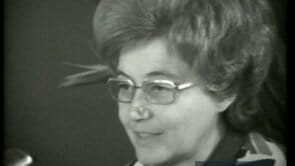
“Dearest Gen, I’m sure that what you’re expecting from me is a formula that sums up everything, that illustrates the truth and gives you the recipe to live a meaningful life. It’s actually something I’m meditating on during these days. I’m totally convinced that the only sure way to reach perfection is to follow the path of suffering embraced out of love. This is how the saints, throughout the centuries, perceived it. The fact is that to those who wished to follow him, Jesus spoke clearly: “Those who wish to become my disciples, let them deny themselves, take up their cross and follow me” (Mk 8:34). “…take up their cross.” Each of us, in order to follow Him, the Perfect One, needs to embrace our own cross, our own sufferings. We all have them, there’s no doubt about it. So let’s get up in the morning with a new heart, despite our human desire to put suffering aside and forget about it. Christians are asked to go that little bit further. Because they are followers of Christ, they know that suffering is precious, that it should be accepted as Jesus accepted the cross, and so they try to embrace it wholeheartedly. What will be the outcome? What will be the fruits? We will be rewarded with patience, purity, meekness, poverty, temperance and so forth. And along with all these virtues, we will attain perfection, the real life. Are you willing to give it a try? Every athlete who aims high must be willing to experience fatigue, sacrifices and struggles. Our goal is Jesus. In order to follow Jesus, we need to appreciate suffering. This is my ardent wish for you, that you may experience how to be worthy of Him.”
Chiara Lubich
(translation of the Italian text taken from “Gen,” October-November 1979)
Centro ChiaraLubich
12 Mar 2015 | Non categorizzato
12 Mar 2015 | Non categorizzato
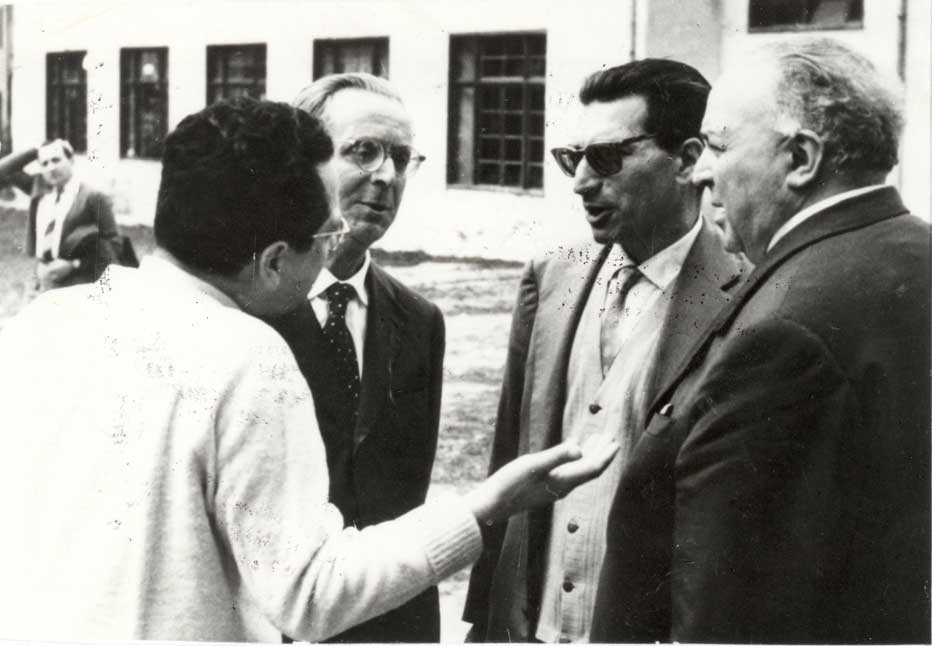
From the Italian Parliament to the world. This part of Igino Giordani’s journey began in the late forties when Igino had reached a rather problematic point in life. To the world he was a Christian intellectual, a brilliant expert on the Fathers of the Church, a writer and Catholic apologist who was always in line with the Church. But he began to experience ‘a certain boredeom of the soul.’ His encounter with Chiara Lubich, foundress of the Focolare Movement, awakened his faith and his love.
Their meeting was extraordinary and so were the circumstances surrounding it. Igino Giordani was a 54 year-old man with 4 grown children. Chiara was a young woman of less than half his age, who was requesting an appointment with him to discuss finding an apartment flat in the city of Rome.
Former member of the Constituent Assembly, Giordani was also a memeber of the Christian Democratic Party, one of those historical members because he was among the first of the 1920s to work for the nascent People’s Party, of Christian inspiration and founded by the priest Luigi Strurzo.
Chiara was a young laywoman and their meeting was taking place well before the Second Vatican Council, at a time when it wasn’t common that a laywoman would be recognised as having some sort of role in the Church.
Yet, despite the large differences between them, that meeting with Chiara completely transformed Giordani and from that moment on he strove to bring the Ideal of Unity into politics. Its announcement took place during a parliamentry session in which ideological differences were quite strong. It was March 16, 1949 when the North Atlantic Treaty was at stake.
“Just when I had known Chiara for a few months,” Giordani recounts, “there was a discussion in the House about the North Atlantic Treaty, and two blocs were formed: one that was headed by America, the United States; and one that was headed by Russia. They were paving the way to make a new war, a masssacre, the definitive war. I remember how very angry we were that night in the House; I was afraid someone was going to pull out a gun and beginshooting; there was much hatred between the two groups.
I had asked to speak and, just before I spoke, a Catholic deputy sat beside me, Mr Pacati. So he said to me: ‘Let’s keep Jesus in our midst, now, as you talk.’ I took the floor. Silence began to fall upon the previous noise and shouting. In the end, the House seemed to have become a church; there was perfect silence as I expressed the ideas that we learn in our Movement; namely, that war serves no good; war is the greatest stupidity; war only serves death. We don’t want war, we want life and life lies in love, in seeking agreement. (. . .)
All of us must react, from whatever part of the country, from whatever political party or faith, because beneath all the tears, beneath all the ugliness accumulated from the war and mud-slinging, it all really comes down to rediscovering the human face, which reflects the face of God.” The parliamentary stenographer concludes his account of that discussion by describing the applause that reached Giordani from all sides of the Chamber.
Soon, numerous parliamentarians joined Igino, desiring to follow the ideal of unity. We name only a few: Gaetano Ambrico, Palmiro Foresi, Tarcisio Pacati, Enrico Roselli, Angelo Salizzoni e Tommaso Sorgi, who became the main biographer of Giordani. With them, Giordani did things that went against the social and political climate of those days. For example, in 1951, together with 40 other parliamentarians – liberals and republicans, social democrats and Christian democrats – he worked for an “Interparliamentary Understanding for the Defense of Peace”
Always moving against the tide, in the midst of the Cold War, in 1949, he and the Socialist, Mr Calosso, promoted the first law on conscientious objection. Imagine the problems that arose when Giordani presented their proposal to the House! But his convictions were like steel: to kill the human being who is made in the image and likeness of God, is to commit deicide.
A new civic consciousness has been born,” Giordani wrote, “one that undoes the divisions of party and faction, current and privileged caste, race, and class. As it spreads, it surpasses national borders. The communitarian impluse that is aroused by Christian love and pushes to the point of incorporating Jesus is a religious and social awakening that, if successful, and we believe it shall be, will change the history humankind.”
Of course, to proclaim the ideals of love and communion in today’s politics seems extremely reckless, but it was even more reckless in Giordani’s times. Yes, Giordani lived within the prophecy; and while taking on the challenges of his times with deep seriousness and commitment, he never became entrapped by them.
He lived the prophecy of a great Ideal, the Ideal of unity, supported by the modern and compelling spirituality of Chiara Lubich who had brought it into the world; and it became the life of Giordani’s politics.
Alberto Lo Presti (Director of the Igino Giordani Centre)
11 Mar 2015 | Non categorizzato
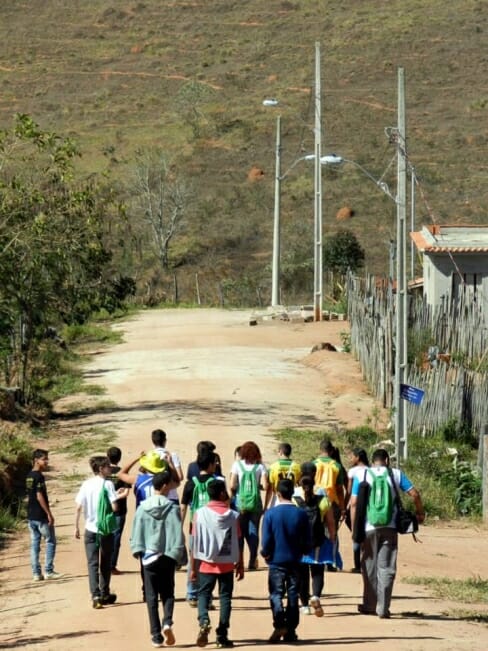
“Yesterday a man was shot 13 times.” This is what the first person who opened the door of his home to several young people who, on the weekend of February 20-22 always presented themselves to him with a smile. We are on the peripheries of Juiz de Fora, a deprived neighbourhood in the State of Minas Gerais (Brazil). After a few hours that same person said to those young people: “Whereas yesterday we experienced terror, today we feel only love.”
Those young people were from the Focolare, Charismatic Renewal, and Shalom Community – parish youth – a hundred in all. In just over a year they have visited ten cities and met some 5,000 families with whom they shared sorrows and joys, courageously announcing to them that God loves them immeasurably. The people expressed joy for their presence: priests are few and do not manage to reach everyone who is in need.
“It all began during World Youth Day 2013 and the meeting of millions of young people with the Pope on Copacabana beach,” the Gen from Minas Gerais recount. “During the final Mass, a girl in our group began to feel the central message of World Youth Day quite strongly: “Go out and make disciples of all the peoples.”
During the return trip to Juiz de Fora, Leticia – that’s the girls name – shared what she had felt with the other Gen and, together they decided that it would be an opportunity to speak with their archbishop, Don Gil Antônio Moreira.
Leticia went to visit him with the encouragement of her friends. The archbishop had already prayed that WYD would not only remain a great memory, but that the intense experience shared by so many young people from around the world might continue in some way.
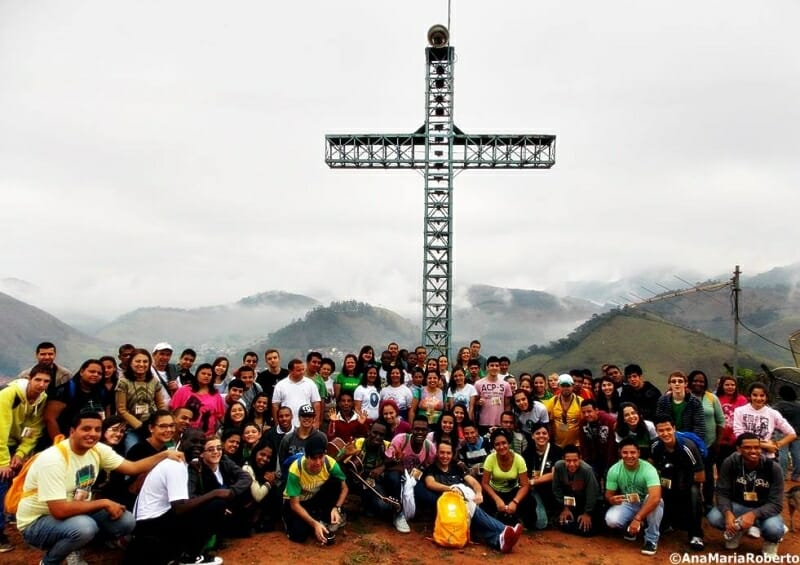 That is how the “Young Continental Missionaries” project began, a name proposed by the archbishop, with the goal of launching young people to reach out to others, to be a living Church that “goes out, together and prepared.” These three words are the three main points of the project: mission, prayer, formation.
“It’s just great to go together, young people from different parishes and Movements, but like brothers and sisters,” Vinicius explains, “respecting each other’s diversity in the way of praying and talking in intimacy with God. Also quite important is the dialogue that is generated with several families from other religions.”
“Going into the homes of the people,” Ana Paula adds, “many open their doors to us and invite us in, and we discover the most beautiful treasures, as when we visited an Evangelical Christian who had lost her husband only a few days earlier. After we were together for a while she said: “I can no longer be sad, because he’s with the Father in Heaven.”
Cristiano concludes: “We go into the peripheries of the city never knowing what we will meet but always trusting in God. We feel Him saying to us today: “Love one another as I have loved you.” Then, especially love those who are most in need, even when we are tired or make mistakes. You can always begin again!”

10 Mar 2015 | Non categorizzato
The first event will be held in Rome, Italy, on March 12th at the Aula del Palazzo dei Gruppi Parlimentari in the Italian Parliament. In the morning 300 Focolare youths from around the world – Christian, members of other religions, and some with no formal religious affiliation – will present experiences concerning the socio-political situation in their own lands, and universal brotherhood as a response to current conflicts, during an open dialogue with president of the Chamber of Deputies, the Honourable Laura Boldrini; Secretary General of the European University Institute, Pasquale Ferrara; and Luigino Bruni, Political Economics professor at the LUMSA of Rome. In the afternoon, another 300 people from the fields of politics and public adminstration will take part in a meeting of reflections, testimonies and dialogue in the light of Chiara Lubich’s thought.
Strasbourg, March 13-15: A three-day seminar examining fraternity as a political category, especially in relation to cities. Presenters will include Jean-Louis Sanchez, General delegate of ODAS (National Observer of Social Action); Jo Spiegel, Mayor of Kingersheim; and Antonio Baggio, politician and professor at Sophia University Institute, Loppiano, Italy.
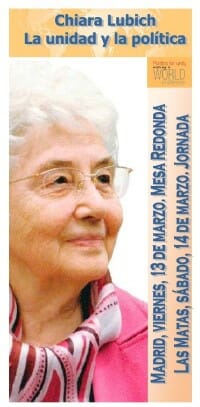 Two events will be held in Spain and Madrid on March 13-14. The first will be held at the Seat of the European Parliament where Chiara Lubich spoke on December 3, 2002 at seminar on The Role of the European Union in global peace and justice. Other thematic topics will be presented the following day at the Mariapolis Centre. One of those topics will be: “Opting for the least.”
On March 14th, a meeting will be held at the Seat of Parliament in Seoul, Korea with deputies and people from the field of public administration, to take stock of the march that was begun ten years ago towards a politics of fraternity.
On the same day, in Curitiba, Brazil, deputies, mayors and Brazilian citizens will hold a forum on The thought and political action of Chiara Lubich. Presenters will include the Mayor of the city, Gustavo Fruet; Federal Deputy, Luis Carlos Hauly; Secreatary of Justice and Human Rights for the State of Acre, Nilson Mourão; and the Mayor of Sorocaba, San Paulo, Antônio Carlos Pannunzio.
Meetings will also be held in Canada, Colombia, Honduras, Ireland, Germany, Portugal, Czech Republic, Spain, Tanzania, Hungary, USA, and more.
All the events will be a dialogue focusing on the essential value of unity, which is not ratification, but the result of confrontation. Chiara once stated: “I have a dream. Imagine what the world would be like if not only individuals, but entire peoples, ethnic groups, and states began to practice the Golden Rule: loving the other country as their own.” Her words are proven in the personal lives and political action of people across the world who have embraced her dream.
Focolare president, Maria Voce commented: “The upcoming anniversary will be an opportunity to highlight many positive experiences across the world, in which politicians, administrators, and ordinary citizens are working together for the common good.”
She expressed her hope that “it will be the young people – who often look upon politics with fear or disinterest –that will rediscover politics as a high calling that expands its heart to embrace all people, the most disadvantaged, the most alone, the most in difficulty or marginalized, not only from one’s own country, but from the whole world.” “May your participation in this event,” she concludes, “mark the beginning of a new and more conscious commitment to becoming actively involved in building with many other people of good will, a world that is better, a world that is new.”
Some events can be followed live at: www.politicsforunity.com . There is an online map of events and a summary of texts by Chiara Lubich, chosen by the research committee. The hashtag of the event is: #politics4unity
The 7th anniversary of Chiara’s death (March 14, 2008) will be remembered with a variety of events across the globe. From the biannual Art Event Chiara Lubich at Maracaibo, Venezuela, to the charism of unity through some masterpieces of European art in Cremona, Italy; to the 3rd edition of the Chiara Lubich Memorial Lecture, in Durban, South African Republic. There will be hundreds of Eucharistic Celebrations of Thanksgiving and suffrage for Chiara Lubich, whose Cause of Beatification was officially opened last January 27th.
![March 8, 2015: International Women’s Day]()
8 Mar 2015 | Non categorizzato
 Today, each of us will certainly be remembering the countless women who have been a part of our life beginning with the one who gave us life. Then there were the wives, fiancées, sisters, grandmothers, aunts, baby-sitters, teachers, nuns, catechists, schoolmates, professors, nurses, cashiers, housekeepers, and now astronauts. Today we would like to celebrate women by presenting some thoughts by Focolare president, Maria Voce that were shared in interviews to the Brazilian television network TVNazaré, and Cidade Nova. The interviews are from 2014 when Voce visited Brazil. “The woman’s role in the Church began with Mary, in the first community of Jerusalem where she had a very particular role among the Apostles. Men’s predominant role is traceable throughout the history of the Church, above all in the roles of governance and in the ministerial priesthood which is exclusively for men. This meant that priests identified themselves with the Church hierarchy and women were represented as somehow less important in the Church. Since then an evolution has taken place not only in the Church, but in human society where women have slowly gained important roles. Perhaps in some contexts and cultures they were already acknowledged, but in western culture women had to make their way on their own.” When God created humankind in his own image and likeness he didn’t make only one creature, he made a man and a woman, two different creatures. He created them in this diversity so that they might compliment each another and bear witness, even in the diversity of their roles and functions, to humankind’s God-given filiation and therefore equality. I think this is gradually emerging in politics and society. Never before have we seen so many women among the world figures, taking on important roles as presidents of countries and states. The presence of women in the Church needs to grow, above all the witness of her specific charism; that is, to show that love is more important than governing; that you cannot govern without love.” “A greater positive feminine influence could have important effects not only for the Church but also for society. You immediately notice the presence of a woman in business, for example, in state government, because it creates a contrast and shows up that complimentarity between men and women. Pope Francis is someone who appreciates the contribution of women. The sweetness and tenderness of which he often speaks are important traits that are more feminine than masculine.” “The ability to welcome, support and give are the typical qualities of a mother who brings children into the world and, when the time comes, let’s them go. The skills of attachment and detachment also influences positively on governing. Someone asked me: ‘How can you reconcile love and governance?” I answered that you cannot govern without love. You can’t. Whenever you exercise authority without love, it’s not governance, it’s oppression.”
