![With Benedict XVI]()
11 Feb 2013 | Non categorizzato
 “Dear Brothers, I have convoked you to this Consistory, not only for the three canonizations, but also to communicate to you a decision of great importance for the life of the Church. ” Pronounced in Latin, these are the words Benedict XVI used to begin his resignation speech. He continues: “After having repeatedly examined my conscience before God, I have come to the certainty that my strengths, due to an advanced age, are no longer suited to an adequate exercise of the Petrine ministry.
“I am well aware that this ministry, due to its essential spiritual nature, must be carried out not only with words and deeds, but no less with prayer and suffering. However, in today’s world, subject to so many rapid changes and shaken by questions of deep relevance for the life of faith, in order to govern the barque of Saint Peter and proclaim the Gospel, both strength of mind and body are necessary, strength which in the last few months, has deteriorated in me to the extent that I have had to recognize my incapacity to adequately fulfill the ministry entrusted to me. For this reason, and well aware of the seriousness of this act, with full freedom I declare that I renounce the ministry of Bishop of Rome, Successor of Saint Peter, entrusted to me by the Cardinals on 19 April 2005, in such a way, that as from 28 February 2013, at 20:00 hours, the See of Rome, the See of Saint Peter, will be vacant and a Conclave to elect the new Supreme Pontiff will have to be convoked by those whose competence it is.
“Dear Brothers, I thank you most sincerely for all the love and work with which you have supported me in my ministry and I ask pardon for all my defects. And now, let us entrust the Holy Church to the care of Our Supreme Pastor, Our Lord Jesus Christ, and implore his holy Mother Mary, so that she may assist the Cardinal Fathers with her maternal solicitude, in electing a new Supreme Pontiff. With regard to myself, I wish to also devotedly serve the Holy Church of God in the future through a life dedicated to prayer.”
The Pope’s words and gesture have brought about a great echo from the whole world. On behalf of the Focolare Movement, the president Maria Voce also sent the Holy Father a message of affection and gratitude:
“Your Holiness, the Focolare Movement draws close to You with heartfelt and extreme gratitude for all the paternal love with which you have always accompanied and supported us. We would like you to feel us at Your side, in profound and continuous prayer for the new phase that is now beginning in Your life and in the life of the Church, with sure faith in God’s love, to which You called us back in a special way this year. We love You and we will always love you!”.
![With Benedict XVI]()
10 Feb 2013 | Non categorizzato

The Focolare’s little town of Fontem
«The small town of Fontem in Cameroon deserves to be mentioned today. Its name could truly be this: “You did it to me.” It’s like a fairy-tale story. In the bush of the Cameroon there lived a people who were once very numerous. Almost all of them were pagans, but very dignified, morally sound and rich in human values. We could say that they were a naturally Christian people. They belonged to the Bangwa tribe, but the population had been decimated by sickness. In fact, ninety-eight percent of the children were dying in their first year of life.
Not knowing what to do, those Africans, with a few Christians who were among them, asked themselves: “Why has God abandoned us?” Then they acknowledged: “Because we don’t pray.” And so, all together, they decided: “Let’s pray for a year; who knows, maybe God will remember us!”
They prayed, day after day, with only one thought in mind: “Ask and you will receive; knock and it will be opened to you.”(Mt 7,7). They prayed the whole year long. At the end of the year, however, nothing had happened.
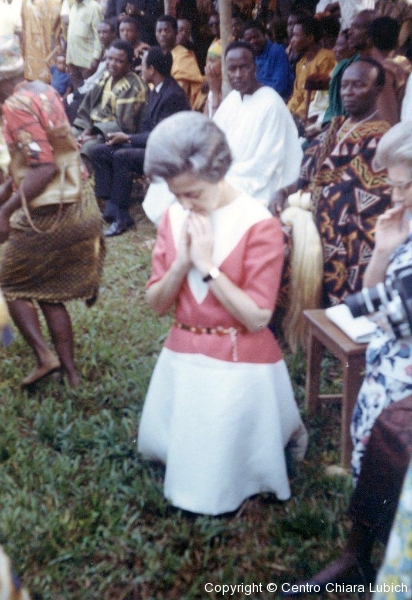
Fontem, 19 January 1969. Chiara prays during the Mass celebrated for the inauguration of the hospital “Mary Health of Africa”
Without becoming discouraged, the few Christians said to the people: “God didn’t answer us because we haven’t prayed enough. Let’s pray for another year!” And so they prayed for another year, the whole year long. The second year passed and still nothing happened. They met again and asked themselves: “Why has God abandoned us? Because our prayers don’t have any value in the eyes of God. We are too bad. Let’s collect some money; we’ll send it to the Bishop who can ask a more worthy tribe to pray, so that God will have pity on us.”
The Bishop was touched by this and began to take an interest. He went to them and promised a hospital. Three more years passed but there was no hospital. At a certain point, focolarini doctors arrived, and the Bangwa people saw this as the answer of God. The focolarini were called ‘the men of God.’
The focolarini understood that in this place what mattered was not to speak. They could not say in those circumstances: “I wish you well, keep yourselves warm and eat plenty” (Jas 2:16).They said: Here we need to roll up our sleeves and get down to work. And they set up a dispensary in the midst of unspeakable hardships.
I went there three years later. That large crowd of people gathered in a vast open space in front of the living quarters of their king, the Fon, appeared to me as being so united and eager to be dignified, that they seemed to me as a people long prepared by Mary for Christianity in its most integral and genuine form. Even then, the village was already unrecognizable. Not only because of the works, roads and houses that had been built, but also because of the people themselves.
The previous work of the missionaries, who could visit the region only rarely, had already laid very solid foundations. Small nuclei of Christians had already risen up here and there, like a seed waiting to develop. But now the movement towards Christianity had assumed the proportions of an avalanche. Although the priests effected a rigorous selection, every month they baptized hundreds of adults. A government inspector who had made the rounds of the zone to inspect the elementary schools, declared: “All the people are strongly oriented towards Christianity because they have seen how the focolarini live it in a concrete way.”

1974 – The inauguration of the Church attended
by the Fon of Fontem
And we must say that the work of evangelization carried out by the focolarini during those three years was almost exclusively based on witness. There was a lot of work to do, indeed, almost only work, and under the most difficult conditions: because of the inadequate means and ability of local workers, and the rough roads and difficulty in receiving supplies. So there were no regular meetings, no large day-meetings, no public talks. Just a few private talks in casual encounters. And yet, every Sunday, the tent-like church became increasingly crowded. Together with the group that was already Christian, there was an ever-growing number of Animists who wanted to know more about Christianity. Now the church was overflowing, with more people outside than the packed crowds inside. Thousands of people assisted at Mass, several hundreds received Communion.
Fontem was a unique experience for us. It seemed that we were re-living the development of the early Church when Christianity was accepted by all in its wholeness, without limitations and compromises. And the experience of Fontem already began to interest other African communities, like that of Guinea, Rwanda, Uganda and Kinshasa in Zaire[1],, so that Fontem increasingly assumed its role as a pilot center for the surging of a characteristic evangelization. Now Fontem is already a large town, with all the essential aspects of a town. And it is also a parish.The focolarini became credible because they did to Jesus what they did to the Bangwa, giving the witness of love first of all among themselves and then with all the people.»
Chiara Lubich
Excerpt taken from a talk at the meeting of the Men Religious Movement at Castel Gandolfo, April 19, 1995
_________________________________
[1] Current Democratic Republic of Congo.
1 Feb 2013 | Non categorizzato, Word of
We love our brothers and sisters, and with this we know that we have passed from death to life.
‘We know…’ The Apostle is referring to a knowledge that comes from experience. It’s like saying: ‘We’ve experienced it, we’ve touched it with our hands.’ It’s the experience that the Christians evangelized by John had at the beginning of their conversion. When we put God’s commandments into practice, in particular the commandment of love for others, we enter the very life of God.
But do Christians today have this experience? They certainly know that God’s commandments have a practical purpose. Jesus constantly insists that it’s not enough to listen to the Word of God; it must be lived (see Mt. 5:19; 7:21; 7:26).
Instead, what’s not clear to most, either because they don’t know about it or because their knowledge is purely theoretical without having had the experience, is the marvellous feature of the Christian life the Apostle puts into light. When we live out the commandment of love, God takes possession of us, and an unmistakeable sign of this is that life, that peace, that joy he gives us to taste already on earth. Then everything is lit up, everything becomes harmonious. No longer is there any separation between faith and life. Faith becomes the force pervading and linking all our actions.
We love our brothers and sisters, and with this we know that we have passed from death to life.
This word of life tells us that love for our neighbour is the royal road leading us to God. Since we are all his children, nothing is more important to him than our love for our brothers and sisters. We cannot give him any greater joy than when we love our brothers and sisters.
And since love of neighbour brings us union with God, it is an inexhaustible wellspring of inner light, it is a fountain of life, of spiritual fruitfulness, of continual renewal. It prevents the rot, rigidity and slackness that can set in among the Christian people; in a word, we pass ‘from death to life’. When, instead, love is lacking, everything withers and dies. Knowing this, we can understand why certain attitudes are so widespread in today’s world: a lack of enthusiasm and ideals, mediocrity, boredom, longing to escape, loss of values, and so on.
We love our brothers and sisters, and with this we know that we have passed from death to life.
The brothers and sisters the Apostle refers to here are, above all, the members of the communities we belong to. If it is true that we must love everyone, it is equally true that our love must begin with those who normally live with us, and then reach out to all of humanity. We should think in first place of the members of our family, the people we work with, those who are part of our parish, religious community or association. Our love for our neighbour would not be real and well-ordered if it didn’t start here. Wherever we find ourselves, we are called to build the family of the children of God.
We love our brothers and sisters, and with this we know that we have passed from death to life.
This word of life opens up immense horizons. It urges us along the divine adventure of Christian love with its unforeseeable outcomes. Above all it reminds us that in a world like ours, where the theory is of struggle, the survival of the fittest, the shrewdest, the most unscrupulous, and where at times everything seems paralysed by materialism and egoism, the answer we should give is love of neighbour. When we live the commandment of love, in fact, not only is our life energized, but everything around is affected. It’s like a wave of divine warmth, which spreads and grows, penetrating relationships between one person and another, one group and another, and bit by bit transforming society.
So, let’s go for it! Brothers and sisters to love in the name of Jesus are something we all have, and that we always have. Let’s be faithful to this love. Let’s help many others be so. We will know in our soul what union with God means. Faith will revive, doubts disappear, no more will we know what boredom is. Life will be full, very, very full.
Chiara Lubich
First published in May 1985.
![With Benedict XVI]()
30 Jan 2013 | Non categorizzato
“I’ve been a member of the Centro Igino Giordani (Igino Giordani Centre) for some time now. After many years of service to the Focolare Movement I was blessed with the gift of being able to continue working directly for Foco; indeed, I would call it working with him.
I was the last to join the Centre but I had the great fortune of being near to Foco from when I first entered the Focolare Movement. I got to know him at the end of 1957 when he came to my hometown of Milan for a conference. And I was able to spend a few hours with him and begin to appreciate his extraordinary personality that was so kind, simple, friendly and likewise rich culturally and transparent spiritually.
And then there was his secret, which it didn’t take long to discover: his total adhesion to the Ideal of Chiara Lubich and the particular unity he had with her. This was the first impact he had on me and my wife, Mariele. It was a decisive moment for us, for our future involvement and vocation which was to follow in his footsteps as married focolarini.
We were given the great and inestimable gift of being able to work closely with him, which allowed us to live in his atmosphere in a school of such exquisite charity, drawing on his many abilities and his intuitions about the family, sharing in his openness toward human society. “It was through Giordani,” Chiara Lubich states, “that the Focolare Movement felt particularly called to be dedicated to bringing Christ into the midst of the world, to permeate the things of the world with the spirit of God.” Now, working at the Centro Igino Giordani where all of his works are preserved along with the testimonies, entering into it as into some precious coffer that preserves his living memory for all of us, has meant entering into a much closer relationship with him and feeling him even nearer to me as a teacher, friend and companion on the journey especially at this time in my life, this time of settling accounts and preparing . . .
The last gift was being able to draw on his words and reflections that shed such sapential light on this final stretch that lies before us: old age “that seems like a losing”, says Foco, “and it is a gaining; seems like a sunset and it is a dawning. The silence of old age is a silence in which God speaks; the calm into which God pours certainty that undermines all fear. . . From within the solitude that expands with the coming of winter, God comes to the fore: God advances; and the relationship with Him is more intimate and spontaneous. For all that I lose in a human economy, so much do I gain in the divine economy. . . And when death comes, then, don’t be sad: open the sails to the Eternal Love: to the encounter with God, face to face; the end of pain and the beginning of enjoyment.” Because: “Life is nothing but a process of maturing through the purification that suffering brings: when the fruit is mature God will gather it and transplant the tree in Paradise.”
Compiled by Centro Igino Giordani
Taken from an unpublished writing by Pino Quartana: “Il mio rapporto con Foco” (3 March 2011)
![With Benedict XVI]()
23 Jan 2013 | Non categorizzato
In the face of a culture of individualism and consumerism, can we propose the value of human life as a gift to be received? In front of the emptiness of a childless couple, how can we show that fecundity does not necessarily coincide with fertility? How can we help the younger generations to discover the values of corporeity and sexuality, which deserve much more than the spontaneity towards which they are pushed by the media?
Does the child have a right? And in order to raise him or her, is it really necessary that the parenting figures be a mother and a father?

130 educators of the New Families Movement from over twenty countries reflected on questions such as these during the Study Seminar held at the Mariapoli Centre of Castel Gandolfo (Rome) from 10th to 13th January 2013.
The conference was part of a three-year project that began last year and aims at providing, to all those who are committed to the family, suitable means to deal with the new cultural challenges that touch all our lives.
The participants are mostly married couples, owing to the particular credibility they enjoy before other families, and the ability to grasp the needs thanks to their own lived experiences.
After last year’s reflections on the dynamics of marriage relationships, some issues of a particular relevance were identified: responsible procreation, artificial insemination techniques, homosexuality, the ideology of gender.
The proceedings brought into evidence the significance and value of human sexuality, based on the Christian anthropological vision, with specific in-depth analysis through workshops dedicated to dialogue and the exchange of ideas and experiences. These moments of discussion proved particularly efficacious due to the internationality of the contributions and the expertise of the participants, both on the professional front and their experience of training courses, shared with other couples and families from different parts of the world.
Thanks to the simultaneous translation in seven languages, the participants could be divided into three multicultural work groups in which a lively and effective comparison between the USA and the Philippines, between Eastern and Western Europe, between the Middle East and Africa, Brazil and Latina America was brought about.
![With Benedict XVI]()
22 Jan 2013 | Non categorizzato
 «Dearest all, Today I send you a greeting from Australia. Our Holy Journey continues, and we cannot pause, much less start going backwards. Jesus said: “Whoever puts his hand to the plough but keeps looking back is unfit for the reign of God” (Lk. 9:62). Here in Australia, the coat of arms of this young country reminds us of this, because it depicts two animals, chosen precisely because they can’t walk backwards: the kangaroo – the famous kangaroo! – and the emu, an Australian bird. We, too, must keep going forward courageously». More Fonte: Centro Chiara Lubich
