![Egypt from an ecumenical point of view]()
6 Sep 2012 | Non categorizzato
 In recent years, Hurgarda, on the Red Sea, and Luxor in the vicinity of Alessandria have been welcoming the Mariapolis of the Focolare Movement. These places are rich in natural and artistic beauty, symbols of the deeply religious, open, hospitable, and joyful Egyptian population who are also endowed with a basic human equilibrium which has resulted from their large capacity for suffering and bearing with adversity. They showed this to the world during the events of December 2011.
This history of the spirituality of unity in Egypt reaches back to the end of the 1950’s when Marco Tecilla disembarked in Alessandria for a meeting with one of the first Franciscans who came to know the Movement, Fr Nazareno Beghetto. At the end of 1960 some focolarini from Algeria spent just a few days in Egypt, but in 1975, Aletta Salizzoni went to stay in the land of the Pharoahs along with the Matta family from Lebanon. They had been invited by the Good Shepherd Sisters who, having attended the Mariapolis in that country had begun the first focolare community there.
In the late 1970’s Word of Life groups were spreading. It was through the life in these groups that a group of Gen were born who attended an international convention in Rome, Italy. When they returned home they asked that a focolare be opened there. Their dream came true on 26 January 1981. Aletta arrived in Cairo together with two other focolarine and they found a house in Shoubra. On 13 October 1983 a men’s focolare was also opened.
 In 1982 Fr Morcos Hakim was elected bishop of Sohag (Upper Egypt). This led to a blossoming community of youths and adults in the city and in the surrounding villages: simple poeple, some anable to read or write, who welcomed and lived the Word of Life with commitment. Meanwhile the focolarini and focolarine were taking more trips to other areas of the country. Mariapolises were held both in Cairo and in Sohag. A group of students began to spread the ideal of unity in Assiut as well and, noticing this blossoming of life, Bishop Morcos asked that a focolare be opened in the South as well. In 1995 three focolarine, among them the first Egyptian focolarina, moved to Sohag. From there they took many regular trips, spreading the spirituality of the Movement in Minia, Luxor and Assuan. In the 1980’s a community was begun in Alessandria around Sr. Cecilia, a Salesian. This community continued to flourish even after the death of this religious sister, the members continuing to gather around the Word and sharing how they were trying to live it in their daily lives.
But in the meantime many other elements of the Focolare were beginning to appear – many priests and seminarians embraced the spirituality of unity – Focolare families began to have an impact in their local areas that was much appreciated. A group for couples was formed around an Italian and Lebanese husband and wife that later led to the creation of a formation centre for engaged and young married couples. This centre offered courses in marriage life, motherhood, fatherhood, and welcoming the gift of new life. With the encouragement of the Conference of Bishops and of Patriarch Stephanos II, this centre was relocated within the walls of the Patriarchate.
The Focolare in Egypt today has a clearly ecumencial character: a community composed of members of the Catholic Church, several Eastern Rite Churches and the Coptic Orthodox Church. Many rediscover the beauty of their own Churches and become involved in making them more beautiful according to the design of God for them. This ecumenism demonstrates that the diaologue of life permits prejudices that have sometimes existed for centuries, to be overcome..
New relationships have developed not only among Christians (10% of the population), but also with Muslims, and this encourages and spreads hope and certainty that a united world is possible beyond our differences.
By Roberto Catalano
![Egypt from an ecumenical point of view]()
4 Sep 2012 | Non categorizzato
 My name is Sam and I come from Thailand. I am a Buddhist and I got to know Youth for a United World through a Buddhist friend of mine. Being and working with them, I saw how it was possible to be truly brothers and sisters, even though we have different faith beliefs.
In October last year, there was severe flooding in my country. The destruction was massive and incalculable. It will take a very long time to rebuild what was lost, because houses, factories, whole villages and cities were under water for various months in different parts of the country!
An extraordinary thing that happened was that this terrible calamity also brought about a great sense of solidarity among all the Thai people. It was an unexpected phenomenon. The country had just come out of a long period of political struggle which had at times been violent because of the elections. Perhaps you remember seeing soldiers shooting and dead bodies on the street. Instead, the flood reunited everyone.
 The floods affected me personally. The water had flooded the entire neighbourhood where I lived. I didn’t have much to lose because I lived in a small apartment, but others even lost their lives through electric shocks. People rushed frantically to escape the danger and found refuge at a reception point.
Together with the Youth for a United World we went to help the people who had found shelter in one of the reception centres. There elderly people as well as children. Some had left their homes in the clothes they were in, not being able to carry anything with them. Some were in a state of shock, a few were seriously ill. It was a terrible scene! So, we tried to help in practical ways, but also encouraging those who were demoralised, giving out food and toys to the children and playing with them; we tried to share in their hopelessness.
The most important thing at the time was to help save the city of Bangkok, the capital from the floods. Students and many other people set about strengthening the banks of the rivers and canals and building barriers to divert any water that overflowed. We too went to fill bags with sand that was delivered by big trucks… When we got to the place where the sandbags were being prepared we worked day and night in the mud. The sand was dirty and stank: it was a real race against time. People came from all over the city at all hours.
It was exhausting work and we also had to miss out on some meals and sleep. The ideal of a united world kept us going. We built and repaired the banks of the canals that protected the capital of Bangkok, but even better than this was the friendships and fraternity that was built amongst everyone and which still remains. In the end the flood passed but what remained was the joy of having given of ourselves to build a more united world. This might mean getting our hands dirty in the midst of the mud, but the greatest joy was in giving and in loving!
![Egypt from an ecumenical point of view]()
2 Sep 2012 | Non categorizzato
 Day 2 of Genfest was held in the Budapest Sports Arena with talks, presentations, music and dance, movement and colour all representing the metaphor of building bridges. The “Let’s bridge” hand sign was continually shared, and acquired an even deeper meaning by the end of the day. The first phase in building bridges is to make a plan. Bassem from Egypt told of the conflicts following the events in Tahrir Square. There was talk of social exclusion, as was highlighted by the experience of Plinio in Brazil. There was talk of protesting and violence calling for revenge. . . or for other ways of facing the problems of today’s world. Get your hands dirty digging through the mud is the next phase. The young people from Thailand took these words quite literally, telling how they went out to help victims of the flood that had devastated their country. This commitment involves reaching out personally to people who are in need. Ricardo from Chile and the young people from Indonesia and Sweden told the same story under different circumstances. Lay the foundations. Then it was time to talk about laying the foundations. Here the young people were given the opportunity to relive the experience of Chiara Lubich, through a theatrical monologue that included her words at the United Nations. The message was clear: a choice of God who is Love that stirs us to love others. The Golden Rule expressed by the Christian Scriptures: “Do unto others as you would have them do unto you” (Mt. 7:12). And this expressed in different ways by the sacred texts of the other Great Religions. It was confirmed by the experience of some Christian and Hindu youths from India, by a young married couple from Switzerland and by Nacho, a young Argentinian who left behind a promising career in football in order to dedicate his life to the service of others. These were courageous choices, often against the current, but always bringing the fullness of life. . .
  The completion of the bridge is the next phase. This is an image of the unity that flows through daily situations in life. It involves the cornerstone that keeps the bridge’s arch from collapsing: loving even when it is painful. This was illustrated by some young Italians who work at a centre that offers help to illegal immigrants. Their presentation also had photos and voice recordings of their friends. Adhelard and Ariane shared from Burundi about their work in a refugee camp on the outskirts of Bujumbura. And Kaye from the Philippines shared her experience of separation in the family. They were stories that have not yet had a happy outcome, continuing to be lived with love that allowed those involved to experience a fullness of life even in sorrowful situations such as these. Thus solid foundations are laid that allow safe crossing, the final phase of this metaphorical process. A bridge allows access to many roads. Issa, a Christian from Nazareth and Noura, a Muslim from Jerusalem know this is true. They meet regularly, together with other Christian, Muslim and Jewish youths to know one another more and to pray for peace. The joy was quite great among the 12,000 youths they flowed out of the Sport Arena in the evening, on a symbolic march towards the Chain Bridge. Thirty seconds of silence before the go-ahead was given to the biggest international flashmob in history. Someone shouted “Go!” and the young people exchanged the colourful scarfs on which they had each written a phrase along with their name. It was a moment of joyful and festive confusion. Then there was another shout: “Stop!” and they were allowed to unfold the scarfs and discover: “the gift that God wanted to give me,” as one tearful youth said after reading the message: “God loves you immensely.” “Today we begin to live for peace,” another said. “Let’s bridge” was written in all the languages. “The bracelet, the sign of our pact, I put on my wrist not to be a conformist, but because it makes me commit,” said one young man.
 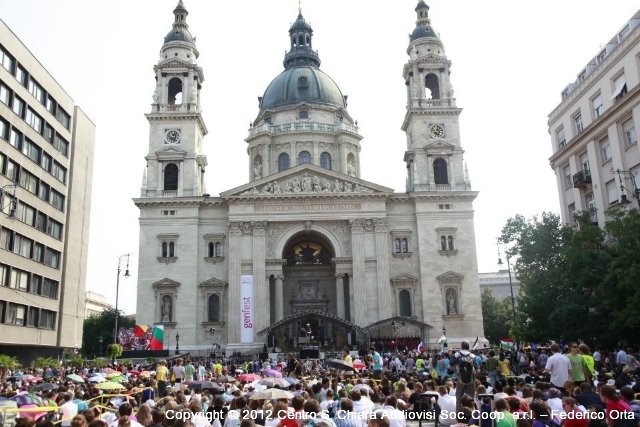 Looking into their faces, it was really possible to believe. Perhaps Budapest will be able to write in its history about this unusual and non-violent revolution that has been reborn from here. The final morning, 2 September was spent in St Stephen’s Square, at the very heart of the city where there was the Holy Mass for the Catholic young people. Youths from other Churches celebrated their services in other locations around the city and the 160 Muslim, Buddhist and Hindu youth also found a place prepared for each of them. At the conclusion they all gathered together for a moment of silence and recollection for peace: the Time-Out. The next appointment will be in Rio de Janeiro. Two Brazilian young people went on stage and invited everyone to World Youth Day 2013 in their country. Everyone left committed to building fraternal relationships among groups and individuals in the 104 countries from which they came. From Budapest to the world!
![Egypt from an ecumenical point of view]()
1 Sep 2012 | Non categorizzato
“Dearest young people, (…) Travelling around the world, I met young people of yesterday and today; I have seen the transformation of social conditions in which they live; I have seen the breaking down of so many securities; I have seen the sufferings of those who could not find work, of not being able to have more moments and places of encounter if not the empty noise of the clubs and bars or the maddening sound of motor racing…. Everything is in rapid evolution, in continuous change, so that it seems impossible to grip onto a foothold that will not collapse, or climb a step that will not wobble. I saw a generation grow with fear, a fear of being deceived and disappointed, a fear of giving something of oneself and to remain empty-handed; fear of finding oneself alone though in the midst of a crowd. But I have also met many young people, including many of you, who despite everything, know that in order to build a more united world, changes are needed, primarily personal ones, and therefore radical choices. And they make them”. (…) Read complete talk:  Maria Voce’s keynote address to Genfest 2012



