![Ecumenical Meeting of Bishops: Launching out in unity through the Word]()
8 Sep 2011 | Non categorizzato
 The meeting has drawn 31 bishops from 18 countries, representing 15 churches. It is the 30th ecumenical meeting of its kind sponsored by the Focolare Movement, the first of which was held in 1982. This year it’s taking place in Welwyn Garden City, a town about 40 km north of London. It is truly a garden city with tree-lined boulevards, parks and lakes. The city was founded by Sir Ebenezer Howard in 1920 and has about 40,000 inhabitants. The Focolare Centre for Unity began here after a visit to England by Chiara Lubich in 1983, when she felt the need for a “cradle”, a place where activities of the Focolare could take place. These annual ecumenical meetings of bishops take place in different places, allowing participants to get to know the ecclesial realities of the host country. This year their focus is the Church of England. In particular, the proposed “Anglican Covenant”, has been a subject of great interest. It proposes a pact to sustain the Anglican Communion, and it formulates an agreement, prepared by a group of Anglican theologians, binding churches of the Anglican Communion to commit the 44 autonomous Anglican churches into recognising principles held in common. It will be an important instrument for building communion which might even become a requisite among non-Anglican churches. Adherence to the pact will always be unrestricted and there are no legal sanctions envisaged for those who change their minds. The program of the conference includes visits to symbolic places of Anglicanism such as Lambeth Palace, the seat of the Primate of the Church of England, Dr Rowan Williams, who welcomed the participants, the visit to the shrine of St Albans, where the relics of St Alban, the first English martyr, are kept, and the meeting at Westminster Cathedral with the Catholic Archbishop, Msgr Vincent Nichols. The theme chosen for this year is “The Word of God and its Transforming Power”. Maria Voce, President of the Focolare Movement, gave an impassioned speech on the ecumenical spirituality of the Focolare Movement which came to life through living the Word. She recalled how the Focolare spirituality was born in a dark shelter, when Chiara Lubich and her first companions would read the Gospel by candlelight during the bombings of the Second World War.
  “In these times, the dark shelter can represent the world with all its challenges and its search for meaning,” explains Maria Voice. “The Truth is replaced by other truths, and what prevails is economic interest; the family seems to have no significance in the scheme of things. The dark shelter challenges us to have nothing but the Gospel. This is where we can start to re-evangelize ourselves and consequently humanity which surrounds us.” “We can start off by living the Word, moment by moment, and sharing our experiences, the fruits of living this life.” Even Martin Luther wrote: “The soul can do without anything, except the Word of God.” And, at this delicate time of transition,” Maria Voce says, “as we pass from the period of foundation of the Focolare Movement to the period of renewal and development, we need to go back to the basics, keeping in mind that the explosion of life within the Focolare came about through people living the Gospel”. It was in this way that communities centred on the Word were born, that the spirituality of communion was born, and the commitment to live the Word has even paved the way for ecumenical dialogue at all levels. “The faithful embracing of the one Gospel – written in the joint declaration “Road towards Communion” drawn up by the Catholic Church and the Lutheran World Federation – is an essential step towards full unity.” The unity to be pursued is not only between Christians of different churches “but also,” adds Maria Voice, “by widening the dialogue to people of other religions and by embracing those of other convictions.” From our correspondent Aurelius Molè [nggallery id=68]
![Ecumenical Meeting of Bishops: Launching out in unity through the Word]()
7 Sep 2011 | Non categorizzato
 In the face of the difficulties in western society, and also in other parts of the world, the bishops of various churches, friends of the Focolare Movement, upon the invitation of Cardinal Miloslav Vlk, Archbishop Emeritus of Prague, will reflect on their mission and will interrogate themselves on the impact of their pastoral work in transmitting the Gospel message. They will focus on the light and strength that emerges from the Word of God, which is the origin of the Church of Christ, in its various expressions, and which can give the Church, even today, a new vigour and illuminating power. Significant meetings are expected to take place with the Primate of the Church of England, Dr Rowan Williams, Archbishop of Canterbury, with the Catholic Archbishop of Westminster, Msgr Vincent Nichols, and with representatives of the Methodist Church and other ecclesial realities present in England. The keynote address of Maria Voce, President of the Focolare Movement, will be of particular relevance. She will underline the effects of living the Word, at the origin of the Movement, and on its spirituality that is purely ecumenical. The apex of the meeting is the “Pact of reciprocal love” that commits those present to place mutual love above all past divisions, in accordance with Jesus’ invitation to remain in his love and to love one another as he has done. On Friday 9 September, at the “Open Day” to which the Focolare Movement in Great Britain invites the Church leaders of the various churches, they will present the experience of fraternal communion lived by Bishops of various Christian churches, together with the prospect of an ever more profound and amicable unity amongst those responsible, in the spirit of the prayer of Jesus who asks for the unity of all.
Press Section: Focolare Information Service
![Ecumenical Meeting of Bishops: Launching out in unity through the Word]()
6 Sep 2011 | Non categorizzato
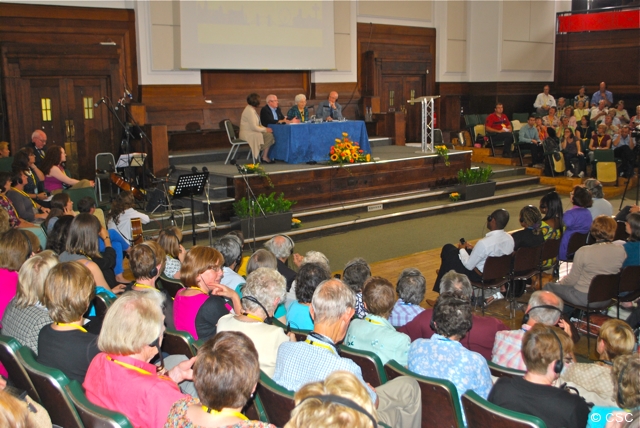 “I found the answers for my life.” “It’s a privilege to see how the charism of unity transforms people.” “Everyone was so easy-going.” It was certainly an unforgettable day in the history of the Focolare Movement in Great Britain. 500 people from England, Scotland, Wales, as well as a delegation from Ireland, gathered around Focolare President, Maria Voce, and co-President, Giancarlo Faletti, in the Quaker’s Friends House in Euston. Some participants travelled for up to 10 hours so as not to miss out on the opportunity. Lesley, an Anglican focolarina, in her introduction to a video documentary illustrating Chiara Lubich’s visit to the United Kingdom, described the shock that was experienced due to the recent riots in London neighbourhoods; she spoke of the disturbing events within the framework of a secularised culture, where the focus is only on self, leading to disastrous consequences. She then underlined how Great Britain contains the seeds of a different culture planted over 40 years ago, the roots of which penetrate profoundly through the message of Chiara Lubich who came to Liverpool in 1965. This was the first of eight visits and it left its mark in the history of the entire Focolare Movement. I twas Canon Bernard Pawley who had invited her to speak of the spirituality of unity in the Anglican Cathedral in order to move the mountains of incomprehension and to promote ecumenical dialogue. The program continued with testimonies shared by Eddie from Scotland, Lucy and David from Wales, and Ann from England. While their stories varied because of the different situations they lived in – ecumenical dialogue, interreligious dialogue, pastoral work with the elderly – they were profound and down to earth. A couple from Congo, now living in England, spoke about their adventure in fleeing from a war zone, the difficulty of settling in a new country, and how their life as a couple was resolved through the discovery of mutual love proposed by the Gospel. The climax of the afternoon’s program was the dialogue session with Maria Voce and Giancarlo Faletti who answered many questions put to them by the participants, touching on some sore points. Above all, they wanted to know to give a new push to ecumenism. “Perhaps, here we need to launch into action,” Maria Voce said, and she invited everyone to re-awaken in their own church, like a mouth-watering desire, “to experience the gift that God had given to us to reach universal brotherhood.” Throughout their trips around the world, Maria Voce and Giancarlo Faletti have found that the ecumenical movement usually goes ahead despite the differences that might exist. They recounted positive experiences in the area of ecumenism in Budapest, Chicago, and even in Tanzania, where representatives of various churches have expressed gratitude towards the Focolare for its support and commitment. The other hot topic were the riots and violence which shook London and which spread to other cities of England. After years of hard work in order to build unity in the community, to some it seemed as if all was lost, as if the violence had cancelled out all the positive that had been achieved. How is it possible to have hope in this situation? “And yet I continue to have hope,” Maria Voce responds confidently, “In my view, violence signifies a great void, a great need for love; it’s the ultimate need to be taken into consideration while resorting to the wrong means.” These episodes are challenging, “but if we respond with love, we can create a greater good”. This has happened to “people who have reacted, and who got together to transmit positive signs”. Giancarlo Faletti comments, “Society has to ask itself which values and cultural models it is putting forward. We can bring our own values. It’s an invitation to stretch the limits in our giving.”
 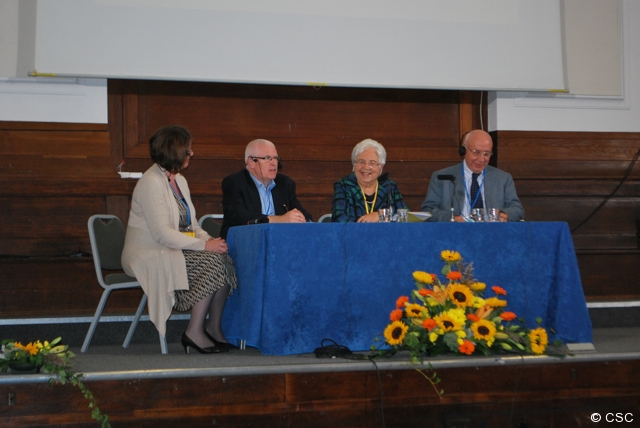 The questions seemed to go on forever. To the one relating to society’s negation of God, Maria Voce commented, “I have never found anybody who says they don’t want to be loved. God can only be given through love and we are called to live together this testimony which is for all people: for those belonging to the different religions and even for those who profess no belief in God. Those values that we deem valid can be offered to others to build the universal family.” Another important and relevant question dealt with the theme of sacrifice, the spirituality of unity’s concept of “knowing how to lose” which can have negative connotations in the Anglo-Saxon mentality. Maria Voce explains that in the Focolare spirituality “we speak of knowing how to lose, but we also speak of fulfilment. When you give something away, you lose it, but because you’ve shown love to somebody else, you are enriched. We give, but we also gain. It’s God’s arithmetic and God never lets us win in generosity.” The joy in the hall was tangible, so much so that Maria Voce wanted “the whole world to see this living cell of the Focolare in order to taste the fruits, the faithfulness and preciousness which has carried the whole Focolare Movement for over 40 years. The family of the Focolare family is alive through love, and through the presence of Jesus among us, we can take the love of God to the world.” Many gathered around Maria Voce and Giancarlo Faletti to greet them, to give them a hug, to have a photo taken with them. Here are some of their impressions: “It’s a new phase; the future is possible.” “The explanation of the meaning of personal sacrifice shed light on an incident which happened to me when I was young and which I never understood.” “At times I feel so pessimistic, but the optimism of Maria Voce and Giancarlo Faletti is catching!”; “It will be a new springtime.” from our correspondent Aurelio Molè [nggallery id=64] Press section: Focolare Information Service
6 Sep 2011 | Non categorizzato
![Ecumenical Meeting of Bishops: Launching out in unity through the Word]()
5 Sep 2011 | Non categorizzato
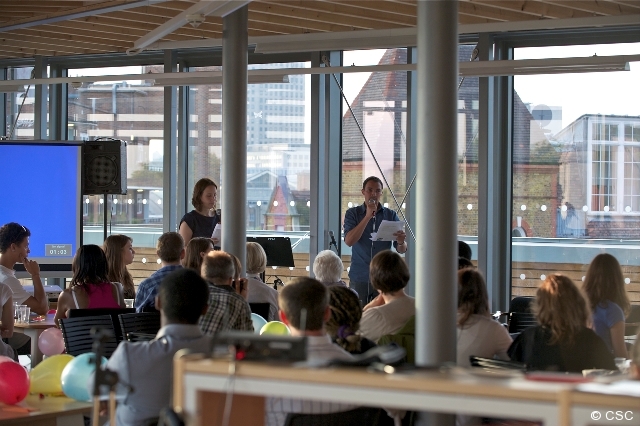 The view is breathtaking. From the fifth floor of the international headquarters of the Catholic Agency for Overseas Development (CAFOD), with a single glance one takes in the city of London’s financial district, with the Stock Exchange, the Bank of England and the distinctive “Gherkin” skyscraper. Looking from East to West, one can see the Dome of St Paul’s Cathedral, the masterpiece of architect Christopher Wren, and the “London Eye”, a giant ferris wheel situated on the banks of the River Thames from which one can admire a spectacular panorama of the city, including the Palace of Westminster, the Houses of Parliament and Westminster Abbey, the burial site of English monarchs, renowned for the celebration of Royal weddings. Yet it is not the view that strikes us, fascinating though it is, but the mix of ethnic cultures which composed the group of 85 young people, mostly Londoners, but also from other parts of Britain, who came together on the evening of Saturday, 3rd September, to discuss the theme “The Power of the Word” in the presence of Focolare President, Maria Voce, and co-president, Giancarlo Faletti. As the sun was setting on this warm day, its rays flooded the room lighting up the faces of the youth who, through games, songs and experiences, were able to amply discuss issues that were by no means simple or straightforward. The word referred to in the title of the meeting is the Word of God, which, Chris explains, “is capable of transforming our lives and the world itself”. The Gospel was proposed with courage and simplicity, without being watered down; the Word has generated life and light down the centuries, and it does so even today, in London, the city where riots recently erupted. The meeting exceeded all expectations, generating much interest and participation. “People seek the meaning of life and ask many questions,” says Joanna, a young English teacher, “but they don’t know where to get answers”. And Oliver adds, “It’s embarrassing at times to talk about religious matters with my friends because they’re so anti-religion.” But this is not so on the terrace of the CAFOD building. To hear these young people speak, and especially to see them so united, London can offer a hope for the future. There is depth, freshness and openness amongst this multi-ethnic group of young people who speak English in varying accents. “By reading the words of the Gospel in the morning and reciting prayers,” Ranjith says, “I am able to face my stressful job with more serenity and I’ve experienced a joy that I never knew before.” “Living the Gospel shaped my life without my even noticing it,” exclaims Carlos from Panama, “Some people criticise me because I give a lot of myself, but living the Gospel is not at all complicated. It is enough to love.” “I recently started a new job,” said Edel, a girl from Northern Ireland, “but I wasn’t happy. I started to live the art of loving, and after a few days the boss thanked me for being there.” Maria Voce freely shared some of her own experiences when as a young person she discovered that the words of the Gospel could be put into practice. It led her to change her life completely and she experienced joy, peace and freedom, even in difficult situations such as when she lived in Istanbul where the majority of the people were Muslims, and also in Lebanon during the war. “Living the Gospel,” she concluded, “not only changes your life, but sets in motion a revolution which was born 2000 years ago and which is not over yet. So many revolutions have taken place in history, but who remembers them? The Christian revolution is still alive because Jesus is alive, and his words are for everyone. We can embark on this wonderful adventure without fear or apprehension because Jesus is with us.” The young people then issued an invitation to the next Genfest to be held in Budapest on 2nd September 2012, and while sharing a pizza together on the balcony, they stuck several post it notes on the glass doors, some of which read: “I can always start again”, “Don’t be scared: you’re not alone” and “Think of the Gospel as a letter of love from God to you”. It is difficult to describe the joy, the warm atmosphere of unity amongst everyone and the desire to share with others the happiness experienced here. From our correspondent Aurelio Molè [nggallery id=63] Press section: Focolare Information Service
![Ecumenical Meeting of Bishops: Launching out in unity through the Word]()
4 Sep 2011 | Non categorizzato
 An emblematic aspect of the Focolare Movement is communion, unity. This is the consequence of living the Word and sharing its effects. Chiara wrote: ‘There was a time when the Movement didn’t exist and then it did. We know what made it be born was the Holy Spirit, which worked in a very precise way. He put the first focolarine in an attitude of being able to take on, in a big way, I would say in a unique manner, the Gospel; He enlightened them through its Words and gave them the push to live them. ‘What was the effect? We know, unthinkable and marvellous: due to the Word lived radically, the Word taken seriously, a big community was quickly born, and spread rapidly throughout more than one hundred villages in the Trentino region: it was the Focolare Movement. These people used to ignore one another and then became family; Christians, previously indifferent to one another, became connected into one. Therefore the Word of God makes this miracle, can make this miracle: give life to a visible community’. “Unity” is the word which most distinguishes the Focolare Movement. Unity which is both communion and communication. Unity needs constant communication to keep up to date. The means of communication are also useful for unity. The 38 editions of the magazine ‘Citta Nuova’ which is published in 24 languages, together with other journals such as Gen’s – for those in priesthood, Unita e Carismi – for those in religious life, are helping to reach unity. As are the audiovisual productions made by the ‘Chiara Lubich Centres’. In 2000, Chiara Lubich addressed an assembly of communicators and offered them 4 ‘principles’ of communication: The first thought: ‘Communication is essential. The effort to live the Gospel in everyday life, the experience of the Word of Life, has always been indissolubly united with communicating it, describing the various steps and the results, since it is a law that we love others as ourselves. We believe that what is not communicated is lost. So life generates light, both for those speak and for those who listen, and it seems the experience is fixed in eternity. They have almost a vocation for communication. The second thought: ‘To communicate, we feel the need “to make ourselves one” as we say, with the one who is listening. So when we speak or address some topic, we do not stop at merely relating the content of our thoughts. First we feel the need to know we have before us, to know the listener or the audience, their needs, desires, problems. Likewise, we make ourselves known as well, explaining why we want to give this talk, what has led us to do it, its effects on ourselves, thereby creating a certain mutuality. In this way the message is received not only intellectually but is also shared in and taken to heart by all. A third thought: ‘Emphasize the positive. It has always been our way to put what is good into light, out of a conviction that it is infinitely more constructive to point out what is good, dwelling on the good and positive aspects, than to stop at the negative, even though whoever is in a position of responsibility has the duty at the proper moment to point out errors, shortcomings and failures. Finally: the person matters, not the media, which are merely an instrument. Bringing about unity first of all requires the indispensable means, which is the person, St. Paul’s new self, who has welcomed the mandate of Christ to be leaven, salt, light of the world.’
