17 Mar 2021 | Non categorizzato
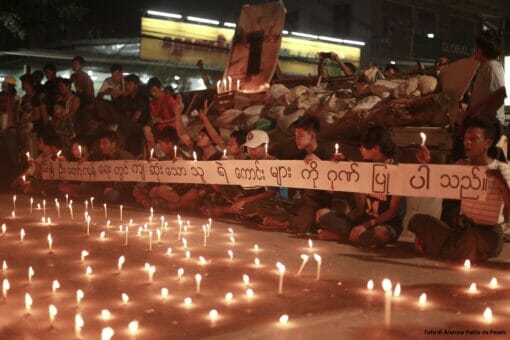
Joint Statement of SIGNIS, Pax Christi International and the Focolare Movement in Solidarity with the People of Myanmar Signis, the World Catholic Association for Communication, hears the cry of the courageous Burmese people as they nonviolently resist the Myanmar military coup overturning a legitimate and democratic election. We are joined by Pax Christi International and its members in the Asia-Pacific region who in their statement of February on the “State of Emergency” in Myanmar already expressed grave concerns about the situation in the country. Likewise, the international Focolare movement unites with us in solidarity with the Burmese people. Daily, courageous people return to the streets to protest peacefully even as soldiers beat them and shoot them, of which many young people. As a symbol of their protest, conforming to Burmese custom, a sign of the righteous anger of the people towards the military can be heard in the clatter of pots and pans banged together to protect against evil spirits, We witness the arbitrary detention on fabricated charges of members of the democratically elected government, as well as of civilian and religious leaders who have taken part in the long struggle for democracy. As truthful information is important in a democracy, we reject the disinformation campaign by Myanmar’s military justifying their actions. We call for the protection of journalists who are arrested and harassed for sharing news and information on what is happening on the ground with the rest of the world; instead they should enjoy press freedom. We deplore the extreme authoritarianism that saw fit to trample on the nation’s constitution, which in fact permitted limited democracy while maintaining much of the armed forces’ power. Despite the challenges, Myanmar was taking its first steps towards democracy, giving people hope for a new future. This hope should be restored. Above all, we listen to the message of the people of Myanmar: this coup is essentially about overthrowing them, their will. It is ultimately not about removing political opponents or supposed public order. It undoes years of patient work for the fundamental rights of citizens and crushes tenuous dreams of a free, democratic country. As Catholic organizations, we join Pope Francis and civil and religious leaders across the globe who have condemned the coup and call for “meaningful dialogue” to restore democracy. Also, we join other organizations in calling for:
- the release of Aung San Suu Kyi and other detained officials and leaders;
- the military to stop using violence and arbitrarily detention of peaceful protestors and journalists;
- justice and accountability for the atrocities committed by the army against the Rohingya people and other ethnic minorities, as well as prevention of such crimes and abuses in the future;
- members of the international community, especially in the Asia-Pacific region, to pressure the regime to step down and reestablish democracy, and not to exploit the situation for their own geopolitical interests.
We call upon the members of SIGNIS, Pax Christi International, and Focolare around the world to give voice to the cry of the Burmese people by reaching out to local and national media to report the situation, and by urging their governments to take strong diplomatic actions to oppose the coup and return democracy to Myanmar. Our mission as organizations is to promote peace. We therefore stand with the Archbishop of Yangoon, Cardinal Charles Maung Bo, President of the Asian Bishops Conferences, when he says, “Peace is possible. Peace is the only way. Democracy is the only light to that path.” Download the statement.
15 Mar 2021 | Non categorizzato
The choice to love Jesus in his abandonment on the cross and to prefer him to every other love had become like a compass for Chiara Lubich that gave direction to her life and freed her from many worries. […] We had noticed that the calling to follow Jesus Forsaken in a radical way did not happen only once, that is, only at the beginning of the Movement. In fact, from time to time, during these past years, the Lord has underlined that calling with episodes or special considerations. This happened to me in 1954. […] For the first time, a focolarino was becoming a priest, and I was going to Trent because the Archbishop there was ordaining Father Foresi. I wasn’t too well and it seemed to be wise to travel part of the way by plane. As soon as I stepped on board, a very kind flight attendant, wanting to make the trip easier for me, invited me into the cockpit. From there I was deeply struck by the beautiful panorama that could be observed, completely open in front of me because of the large windows. It was not the panorama, however, which struck me the most, but rather the brief explanation that the pilot gave me as to what is important in flying an airplane. He told me that if you want to have a good trip, you need, first of all, to set the needle of your compass in the direction of the point of arrival. Then all along the way, you must keep an eye on it to make sure that the plane does not go off course. As I was listening to this explanation, I made a comparison between an airplane trip in this world and the journey of our lives, which today I would call the Holy Journey. I had the impression of understanding that also in this instance it was necessary to decide our course at the moment of departure, that is, the pathway of our soul which is Jesus Forsaken. Then all along the journey, we need to do only one thing: to remain faithful to Him. Yes, the way to which God calls us all is this: to love Jesus Forsaken always. This means embracing all the sufferings of our lives; this means to live love by adhering always to His Will, doing away with ours. […] To love Jesus Forsaken always means to live all the virtues, which he lived very clearly in that moment in a heroic way. […] I think I can say that if we have set the needle of the compass of our souls – to use the same image – in the direction of Jesus Forsaken, we have done the best that we could do to continue and finish our Holy Journey and to do so with a certain ease. On that trip, I noticed that the pilot was very free in his movements because he had no reins, as you would need with a horse, nor steering wheel as you would need in a car. If we set the needle of our spiritual compass in the direction of Jesus Forsaken, we too will not need anything else in order to reach the goal safely. On an airplane trip, curves do not take you by surprise because the flight is in a straight line, neither do you encounter mountains because you have already reached a good altitude. In the same way, we too, on our journey, place ourselves at a certain altitude through love of Jesus Forsaken; thus, we are not frightened by unforeseen events, nor do we feel the effort of climbing. This is true because for Jesus Forsaken, surprises, efforts, and sufferings have already been foreseen and awaited. Let us set the needle of our compass in the direction of Jesus Forsaken and then let us remain faithful to Him. How? In the morning as soon as we wake up, let us direct the needle of the compass in the direction of Jesus Forsaken with our “Eccomi!” (“Here I am!”) During the day from time to time, let us glance at it; let us see if we are always on course with Jesus Forsaken. If we find that we are not, then with another “Eccomi!” (“Here I am!”) let us go back on the right course, and we will be able to continue the journey. […] If we proceed on the journey of life in the company of Jesus Forsaken, we too will be able to repeat that famous sentence of St. Clare, “Go safely, my soul, because you have a good companion for your journey. Go, because the one who has created you has always watched over you and has sanctified you. […]
Chiara Lubich
(From a telephone conference call, 5 January 1984)
14 Mar 2021 | Non categorizzato
Today, 14 March, marks the thirteenth anniversary of the death of Chiara Lubich, the founder of the Focolare Movement. Since that same date, 14 March 2008, the Focolare communities scattered across all the continents have been meeting to remember her and to pray together, remembering the legacy she entrusted to the Movement: ‘Be a family’. «If I should have to leave this world today and you were to ask me for a single word, one last word that sums up our Ideal, I would say – certain of being perfectly understood – ‘Be a family’». https://youtu.be/QKwgvxsUU2E

13 Mar 2021 | Non categorizzato
From the commitment of a small Focolare community to the most vulnerable, a Centre for the elderly has been opened in a village in the Peruvian jungle, named after the Movement’s founder.  Four years ago I, Jenny, my husband, Javier, and our three daughters travelled here from Argentina to live in deepest Peru, bringing the Ideal of Unity with us. Shortly after we arrived in Lámud, a town in the middle of Amazonia, hearing that the Bishop of the Diocese was passing through, we ran to greet him and introduced ourselves as members of the Focolare Movement. “How wonderful that the focolare has arrived in Amazonia!”, he said and gave us his blessing, with his wish that we go ahead. Then we made an agreement with the parish priest who asked us to be responsible for Pastoral Care and Family Catechesis in the villages forming part of the parish. We went to the outskirts of town to understand the social reality in the area, sometimes accompanied by our daughters and discovered a hidden Lámud, one that was full of suffering. We decided to start with the least and realised that they were the elderly. Some of them did not even have a decent bed to die in. Keeping Chiara Lubich’s meditation entitled “One city is not enough” in mind, we went around the suburbs of the country looking for those who were alone, abandoned, to caress them, bring them a word of hope, food, clothes, and we asked them to pray for us as we were just beginning our adventure in these areas which were completely new to us. After a while, we began to dream of being able to give the elderly a decent home, a hot meal and, most importantly, that they would feel accompanied and no longer alone. A dream which, on the one hand seemed far away, but on the other seemed almost within reach so much so that we said to ourselves: “Yes, we can! We must do something more concrete than a simple visit.
  Together we drew up a plan: just a few lines but each sentence encouraged us to go ahead. We also thought about what we would call the house. We looked into each other’s eyes and decided to call it: “Hogar y Centro de Día para Adultos Mayores, Chiara Lubich” (“The Chiara Lubich Home and Day Centre for Elderly People”). Gradually, our dream started to take shape. We organised a number of events and made contact with a few people who were really enthusiastic about the project. I, Jenny, already had some experience of volunteering for different projects in Argentina and an opportunity arose for her to be employed by the Lámud District Municipality to work for the elderly! Lastly, we felt encouraged by the words of the Pope who invited us lay people to work in favour of the most vulnerable, especially during this time of pandemic. In short, there were so many beautiful coincidences that made us think that Jesus would be happy to see the birth of a Work for the least in the Peruvian wilderness, namely a dignified home for the elderly of the third age in this Amazonian province. In the meantime, we saw how everything was going ahead at a dizzying pace. So, trusting fully in God’s Providence and the power of prayer, we became increasingly aware that Jesus would not leave us on our own, and we were certain that, with our small community, we would never be alone. During that time, we signed the lease for the house and went through the legal process of setting ourselves up as a non-profit association. A group of people from the community had already joined the project on a voluntary basis. They had responded with a very strong “Yes” to committing to work for the benefit of the most vulnerable people in the village of Lámud and the Province of Luya (Dipartimento Amazonas). We started preparing the place straight away so that we could start offering the elderly one hot meal a day, provided by the municipality. And now, little by little, we are assessing each step to be taken to reach our goal of offering the elderly, who are at risk of loneliness and abandonment, food but also the possibility of permanent residence in the Centre. But more than titles, names and statutes, our desire is that the atmosphere of unity, harmony and family that Chiara Lubich left us as her legacy should reign in the house which is why the Centre bears her name. Jenny and Javier, with the community of Lámud (Dipartimento Amazonas, Peru)
Experience received and translated by Gustavo E. Clariá

12 Mar 2021 | Non categorizzato
In recent days, many people have tried to take stock of Pope Francis’ trip to Iraq. I think it is difficult, if not impossible, to attempt an exhaustive one. There are too many issues involved and, above all, we are too close to this global event made up of so many other details that can only be read in the course of time. Obviously some elements more than others struck the imagination of those who followed the various events in a context that, in some ways, in its stark reality risked appearing surreal. In fact, if we think of the model of papal journeys, inaugurated with Pope John Paul II from 1979 onwards, we were accustomed to quite different scenarios and backgrounds: oceanic crowds, choreographic preparation that often bordered on perfection and, above all, events that left the image, especially in the early years of the Polish pope’s era, of a strong faith, at the centre of history, in contrast to the atheistic world from which the Polish pope came. Pope Francis, who at the beginning of his pontificate had introduced the idea of another Church, the ‘accidental’ and ‘field hospital’ Church, in recent years has been committed to transmitting this image of the Church and has done so practically everywhere he has gone. He has done so practically everywhere he has gone. From his first official trip to Lampedusa, the port and cemetery of migrants, to Bangui, where he opened the door that inaugurated his unexpected and extraordinary Jubilee, to Mosul, where the stage had only rubble and walls still perforated by bullets of various calibers as a backdrop. And we cannot forget Tacloban where he braved an impending typhoon to stand by the survivors of another catastrophic event, Lesbos where he spent unhurriedly precious time listening to the unspeakable stories of refugees of various origins. The lesson of Francis is not just about showing that the most precious face of the Church is the ‘accidental’ one. Rather, it is the way in which he shows the ‘proximity’, the warmth that needs to be felt by those who suffer in the Christian community. Above all, he is committed to projecting these communities onto the world stage to say that this is the true Church, which we should all cherish and which bears real witness to Christ. As he said on his return flight, Bergoglio is breathing at these junctures, because this is his Petrine call, the one for which the conclave elected him, without knowing and imagining where he would lead Peter’s boat. We are all seeing and experiencing this in recent years. And the voyages are probably the truest reflection of this, leaving no room for misunderstandings. On the other hand, this is nothing new. Like his predecessors, the Argentine pope has shown that he is able to read and decode the ‘signs of the times’ and offers credible testimony to the fact that the Church is a witness to its time and intercepts its problems and key issues, offering answers that are almost always against the current with respect to those that the political, international and, today, financial world impose. Faced with the reality that Francis found himself living, including the unprecedented one (at least in these terms) of the pandemic, the essential category of the pontificate, confirmed also in Iraq, is fraternity. Bergoglio’s personal and ecclesial testimony, his Magisterium and his relations, especially but not only with the Muslim world, now make fraternity a geopolitical element. This was also demonstrated by his meeting with the Grand Ayatollah al-Sistani. The implications of those forty-five minutes are fundamental. We all know, in fact, that the great knot that Islam must untie today is internal to its own world: the tension, never appeased but now dangerously acute, between the Sunni and Shiite spheres. It is here that the roots of many of the problems that Muslims experience and for which many also die must be sought. Bergoglio has shown great ‘political’ tact in wanting to meet al-Sistani, the most significant representative of Shiism, well distanced from the Iranian theocracy that since the Khomeinist revolution of the 1980s has pushed the Iranian world to be a champion of this fringe of the Muslim kaleidoscope. Al-Sistani has always distanced himself from the theocratic choice of the Iranian ayatollahs, and has been an acknowledged spiritual and religious leader for decades. Among other things, he was born in Iran. The meeting between the two leaders took place behind closed doors, but as Pope Francis described it on the return flight, it was a moment of spirituality, “a universal message. I felt the duty, […] to go and see a great, a wise man, a man of God. And only by listening to him do you perceive this. […] And he is a person who has that wisdom … and also prudence. […] And he was very respectful, very respectful in the meeting, and I felt honoured. Even in the greeting: he never gets up, and he got up, to greet me, twice. He is a humble and wise man. This meeting had a great positive impact on my soul”. Bergoglio ventured an appreciation that perhaps no pope had had the courage to say in the past: “And these wise men are everywhere, because God’s wisdom has been spread throughout the world. It is the same with the saints, who are not only those on the altars. They are the everyday saints, the ones I call ‘next door’, the saints – men and women – who live their faith, whatever it may be, with consistency, who live human values with consistency, fraternity with consistency”. All this did not go unnoticed. Positive comments poured down from many quarters, starting with the Muslim world itself. Sayyed Jawad Mohammed Taqi Al-Khoei, secretary general of the Al-Khoei Institute in Najaf, a prominent member of the Iraqi Shiite world and director of the Al-Khoei Institute which is part of the Hawza of Najaf, a religious seminary founded 1,000 years ago for Shiite Muslim scholars, was very clear in his appreciation. “Although this is the first meeting in history between the head of the Shia Islamic establishment and the head of the Catholic Church, this visit is the fruit of many years of exchanges between Najaf and the Vatican and will undoubtedly strengthen our interreligious relations. It was also a historic moment for Ira”. Al-Khoei affirmed the commitment to “continue strengthening our relations as institutions and individuals. We will soon travel to the Vatican to ensure that this dialogue continues, develops and does not stop here. The world faces common challenges and these challenges cannot be solved by any state, institution or person alone”.The AsiaNews agency also reports some of the positive comments that appeared in the Iranian press, which gave wide coverage and celebrated the historic meeting as an “opportunity for peace”. The news was the opening headline in the Islamic Republic’s newspapers and media outlets. Sazandegi, who is close to the reformist wing, emphasised that the two religious leaders are today “the standard-bearers of world peace”. He called their face-to-face meeting in the home of the Shiite spiritual leader ‘the most effective event [in the history of] dialogue between religions’.
Roberto Catalano
Source: Blog Whydontwedialogue

11 Mar 2021 | Non categorizzato
Community microcredit and microfinance to support the growth of expanding projects. Rose’s testimony on the importance of the initiative supported by Amu. BIRASHOBOKA means “IT CAN BE DONE” in Kirundi. It is from this conviction that the Community Microcredit and Microfinance project was born in Burundi (Africa). In spite of the great difficulties in which the country still finds itself – it is the second most densely populated country in Africa and one of the five countries with the highest poverty index in the world – Amu, Azione per un Mondo Unito-Onlus, a non-governmental development organisation inspired by the spirituality of the Focolare Movement, has been supporting the capacities of local communities for some time. Since 2007, in fact, in full synergy with the non-profit organisation CASOBU (Cadre Associatif des Solidaires du Burundi), it has been helping local families in a process of training and of improving their living conditions.  With the “It can be done!” project, it aims to create community microcredit groups whose members can support themselves to create jobs and, in a second phase, create a community microfinance group to support the growth of the expanding projects. Rose tells us: “We started our group 13 years ago. With the first loan I got, I remember very well that I didn’t do anything in particular, I bought clothes and goods that I needed, but the rest I wasted. At the beginning, I didn’t know how to start a business and what often happened was that I had difficulty paying back the loan I had received. Then I realised that I couldn’t keep taking out loans without a concrete project and I finally decided to start the restaurant project with the first 300,000 Fbu (150 €). I started buying pots and pans, dishes and gradually opened the restaurant. It was 2009, I didn’t have any workers yet. At that time, my children helped me in the kitchen and I went by bus to take the food to the city where I had my customers. As I became known, the number of customers increased and I was able to hire workers. I am proud that through the salary they receive I also participate in the fulfilment of their dreams.” Rose, who is happy to have embarked on this path, today manages to provide a salary for five other families besides her own. Now she would like to improve and expand her business, for example by renting a bigger premises, where she could cook and reduce the running costs of the restaurant and travel expenses. It is a very brave decision because there is a big investment involved and Rose does not have the collateral or the guarantees needed to access a loan from any bank. And it is for Rose and many other people who, like her, would like to expand their businesses that the AMU and CASOBU project was set up, supporting the start-up of a community microfinance institution to offer savings and credit services to people with big dreams but who still today cannot access banks. To support the project, click here
Lorenzo Russo

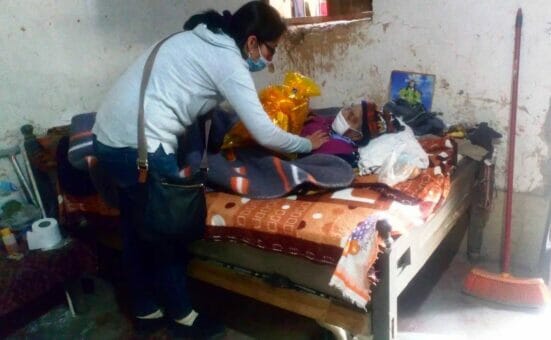
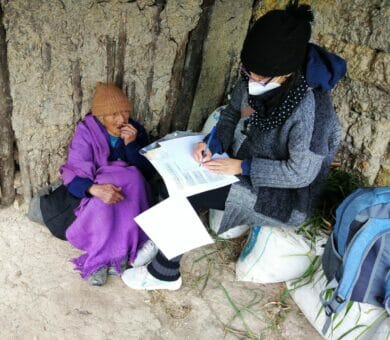 Four years ago I, Jenny, my husband, Javier, and our three daughters travelled here from Argentina to live in deepest Peru, bringing the Ideal of Unity with us. Shortly after we arrived in Lámud, a town in the middle of Amazonia, hearing that the Bishop of the Diocese was passing through, we ran to greet him and introduced ourselves as members of the Focolare Movement. “How wonderful that the focolare has arrived in Amazonia!”, he said and gave us his blessing, with his wish that we go ahead. Then we made an agreement with the parish priest who asked us to be responsible for Pastoral Care and Family Catechesis in the villages forming part of the parish. We went to the outskirts of town to understand the social reality in the area, sometimes accompanied by our daughters and discovered a hidden Lámud, one that was full of suffering. We decided to start with the least and realised that they were the elderly. Some of them did not even have a decent bed to die in. Keeping Chiara Lubich’s meditation entitled “One city is not enough” in mind, we went around the suburbs of the country looking for those who were alone, abandoned, to caress them, bring them a word of hope, food, clothes, and we asked them to pray for us as we were just beginning our adventure in these areas which were completely new to us. After a while, we began to dream of being able to give the elderly a decent home, a hot meal and, most importantly, that they would feel accompanied and no longer alone. A dream which, on the one hand seemed far away, but on the other seemed almost within reach so much so that we said to ourselves: “Yes, we can! We must do something more concrete than a simple visit.
 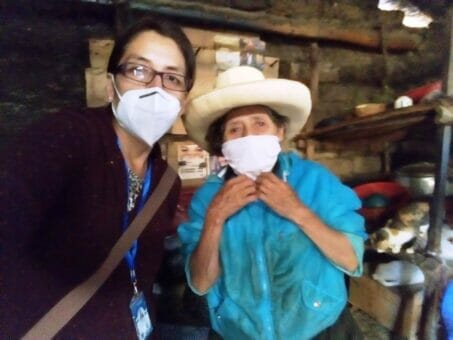 Together we drew up a plan: just a few lines but each sentence encouraged us to go ahead. We also thought about what we would call the house. We looked into each other’s eyes and decided to call it: “Hogar y Centro de Día para Adultos Mayores, Chiara Lubich” (“The Chiara Lubich Home and Day Centre for Elderly People”). Gradually, our dream started to take shape. We organised a number of events and made contact with a few people who were really enthusiastic about the project. I, Jenny, already had some experience of volunteering for different projects in Argentina and an opportunity arose for her to be employed by the Lámud District Municipality to work for the elderly! Lastly, we felt encouraged by the words of the Pope who invited us lay people to work in favour of the most vulnerable, especially during this time of pandemic. In short, there were so many beautiful coincidences that made us think that Jesus would be happy to see the birth of a Work for the least in the Peruvian wilderness, namely a dignified home for the elderly of the third age in this Amazonian province.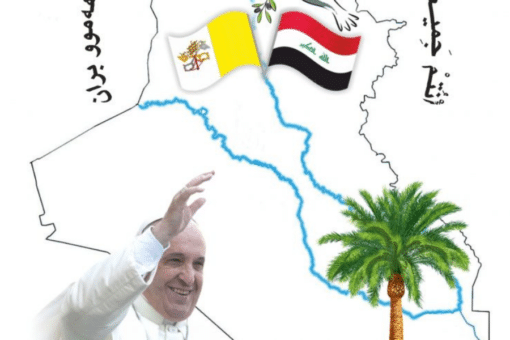
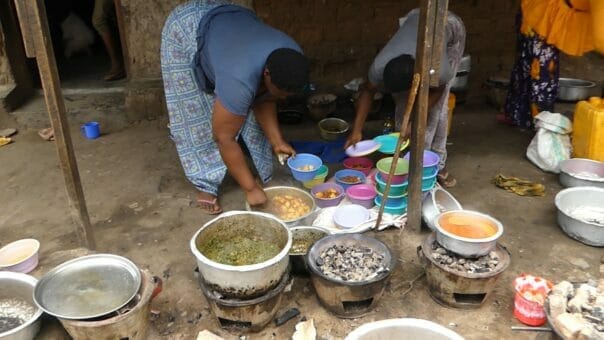
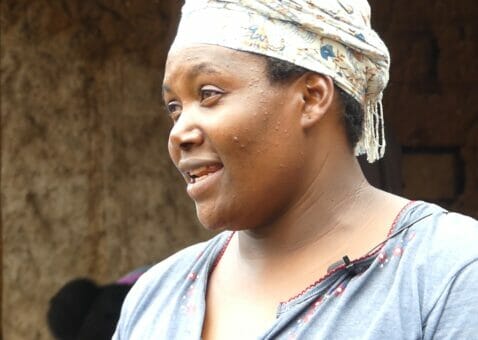 With the “It can be done!” project, it aims to create community microcredit groups whose members can support themselves to create jobs and, in a second phase, create a community microfinance group to support the growth of the expanding projects. Rose tells us: “We started our group 13 years ago. With the first loan I got, I remember very well that I didn’t do anything in particular, I bought clothes and goods that I needed, but the rest I wasted. At the beginning, I didn’t know how to start a business and what often happened was that I had difficulty paying back the loan I had received. Then I realised that I couldn’t keep taking out loans without a concrete project and I finally decided to start the restaurant project with the first 300,000 Fbu (150 €). I started buying pots and pans, dishes and gradually opened the restaurant. It was 2009, I didn’t have any workers yet. At that time, my children helped me in the kitchen and I went by bus to take the food to the city where I had my customers.