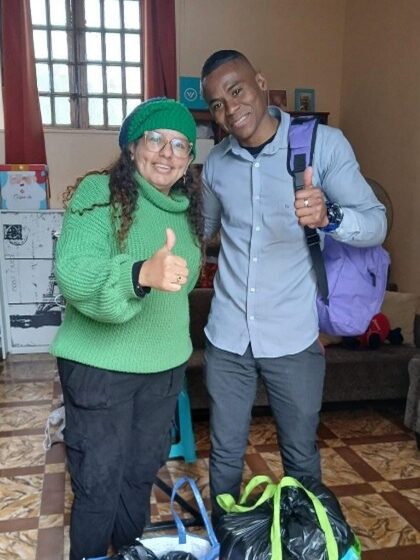
One Friday, Moisés, a migrant, arrived on the recommendation of another Venezuelan young man who was living in the same shelter and had told him to come to us, that we could help him. Moisés had arrived from Colombia a few weeks before Christmas and had only three changes of clothes, typically Caribbean, which he had brought with him on the journey. He was cold. Thanks be to God, he soon found work in a restaurant, washing dishes and helping in the kitchen. It was only a few days a week, but he receives lunch and dinner.
So we gave him winter clothes and a blanket, because he was sleeping on the floor on a thin mattress lent to him by the landlord, a man who also kindly agreed that he could pay the rent when he received his first pay check. He was truly fortunate, because shortly after arriving he had already found a job, a room and a very generous landlord. Not all migrants have the same luck. He began to cry when he saw what we were giving him and “the love of a family” (as he described it) that he was receiving.
He is a young professional, a commercial accountant. We prayed and asked God that in the future he may be able to practise his profession.
(S.R. – Peru)
True wealth
My relationship with my brother-in-law had always been difficult. First there were debts from a failed business venture, managed with inexperience and little prudence; then serious health problems that required costly treatments and operations and each time called for our intervention to find the necessary money for him at the cost of mortgaging the house and using the funds we had set aside for our two children’s education. It was not easy to go beyond the human limits in dealing with this relative, but seeing the state he was in, all that came to mind was that Jesus Forsaken whom my husband and I wanted to love. Perhaps no one would have blamed us if we had not continued to pay for the mistakes of another, yet, as Christians, we felt called to follow a different logic. When I spoke about it with my husband, he mentioned an account he had opened at the bank for emergencies: even though we would lose the interest, he would make it available to his brother. Immediately afterwards we felt more at peace and more united with each other. This is our true wealth.
(C. – South Korea)
compiled by Maria Grazia Berretta
(from Il Vangelo del Giorno, Città Nuova, year XII – no. 1, January–February 2026)
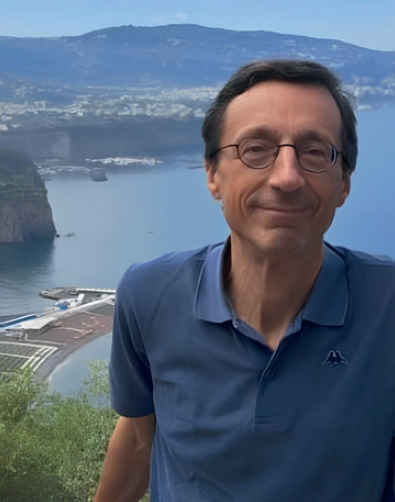
Gratitude and thanksgiving to God. These words encapsulate the multitude of messages that came from all over the world for Paolo Rovea. On 3rd July 2025, in a mountain accident, Paolo ended his earthly life. Married to Barbara, they have five children: Stefano, Federico, Francesco, Miriam and Marco.
He met the Ideal of the unity of the Focolare Movement in 1975. He said, “It radically changed my life”. That same year he took part in the Genfest in Rome, following which he wanted to live 100% with the gen, the young people of the Focolare and he dedicated himself wholeheartedly to this for 14 years, making the Gospel his way of life.
With Barbara, also a Gen, they began to plan to form a family. Engaged couples and young families increasingly began to see them as points of reference. One of them wrote: “With great sorrow for this loss, we are deeply grateful for the love, esteem and trust we received from Paolo. We are grateful for the many years of extraordinary ‘madness’ we all lived together. Together with Barbara, he had an impact on the history of New Families (the branch of Focolare that supports families) and on the history of many couples, including ours”.
Paolo distinguished himself more and more in his profession, with competence and sensitivity. He graduated in medicine from the University of Turin (Italy), specialising in oncology and oncological radiotherapy. At the same university he was a lecturer in a multi-year master’s degree. He worked as a hospital doctor eventually becoming head of the Oncology and Oncological Radiotherapy department in Turin, until his retirement in 2021. He also obtained a Master’s degree and attended advanced courses in Bioethics.
In 1989, he felt God calling him to the path of the focolare and he confided in Danilo Zanzucchi, one of the first married focolarini: “I am in a very important moment in my life: my work as a doctor should soon become permanent; 5 months ago I got married. (… ) I thank God for all the gifts he has given me: first of all for the Ideal of unity (…), for my family (…) for the gen life (…); for Barbara, my wife, with whom I am living beautiful months (…) I assure you that I set out with a renewed desire for holiness on this unique path that is the focolare”.
A life rooted in a constant growth of his relationship with God.
Many remember how Paolo rarely said no to a request or need; he stood beside anyone in need with concrete love. His talents and professionalism were always at the service of those around him: if there was a need to sing or play, he sang and played, if there was a text to write, he wrote it, if a medical consultation was needed, he was ready, if advice was required, he offered it with detachment, encouraging the fearful and urging on the hesitant. His ability to draw close to the life of everyone who crossed his path meant that over time many perceived him as a true brother, one of the family, a true friend.
“I thank God for all the gifts he has given me: first of all for the Ideal of unity (…), for my family (…) for the gen life (…); for Barbara, my wife, with whom I am living beautiful months (…) I assure you that I set out with a renewed desire for holiness on this unique path that is the focolare”.
Paolo and Barbara’s commitment to Focolare grew especially within New Families. One of the themes they were passionate about was education in affectivity and sexuality. It was thanks to them that in 2011, in synergy with the various educational agencies of the Focolare Movement, a pathway was born in this area, Up2Me, based on the anthropological vision typical of Focolare.
Maria and Gianni Salerno, from New Families said: “Although we knew Paolo and Barbara since we were young, we worked closely with them on a daily basis for the last 10 years at the International Secretariat of New Families. The passion, generosity, creativity and tireless commitment with which Paolo carried everything ahead, always attentive to relationships with each person, remain for us an immense testimony and have always been an incentive to go forward together, to always strive to be better at the service of families throughout the world. Often, when discussing with him how to face the challenges of families today, so as to be closer to everyone, he suggested innovative ideas, useful for keeping up with the times and with the needs of people. He and Barbara travelled a lot and left a trail of light everywhere in the world”.
Maria and Gianni continued, “Barbara and he suggested and coordinated many of the new initiatives of New Families. The Up2me programme, Family Format, a programme of dialogue and growth with other families at the Focolare’s international little town of Loppiano and not least of all, the Loppiano Family Experience, a three-week school for animators of New Families who come from all over the world, also in Loppiano. Despite the very painful separation, we know that we can count on his irreplaceable support, which now, from Heaven, will be even stronger…”
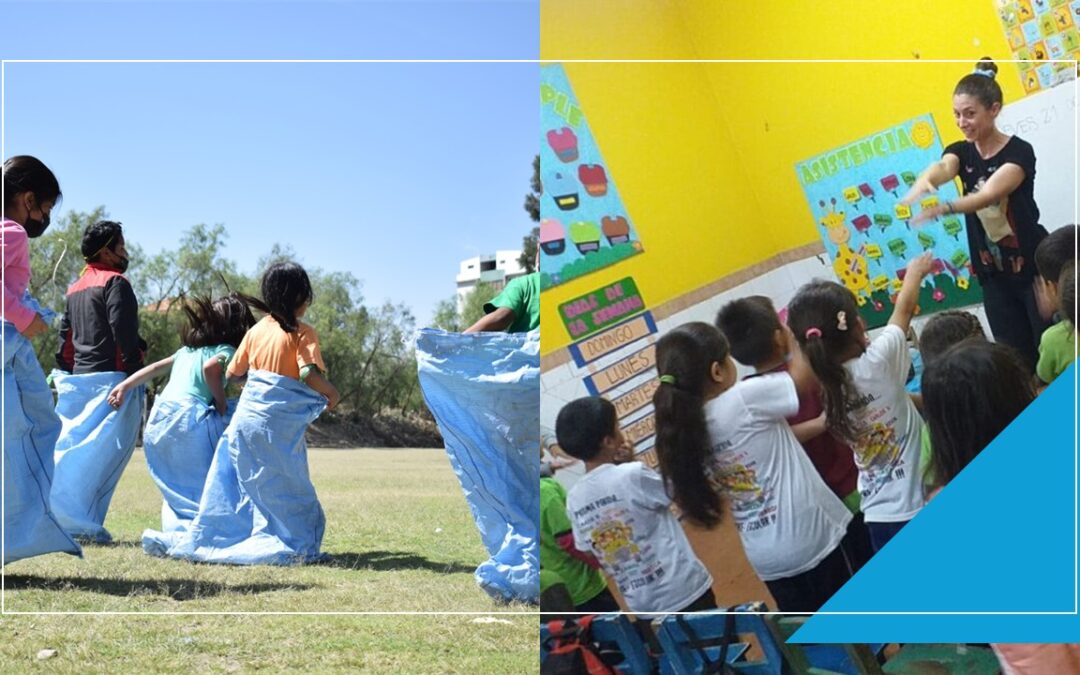
There are places in the world where fraternity is cultivated with a purpose. One of these is MilONGa, a project that has established itself as a key initiative in the field of international volunteering, aiming to promote peace and solidarity through concrete actions.
MilONGa offers a concrete alternative: to experience solidarity firsthand through experiences that transcend cultural, social and geographical boundaries.
Its name, which stands for “Mille organizzazioni non governative attive” (Thousand Active Non-Governmental Organizations) is much more than a project. It is a network that connects the youth with organizations in various parts of the world, giving them the opportunity to actively engage in social, educational, environmental, and cultural initiatives. Since its beginning, the program has grown by weaving a global community that recognizes common values: peace, reciprocity and active citizenship.
What distinguishes MilONGa is not only the diversity of its destinations or the richness of its activities but the type of experience it offers: a deep immersion in local realities, where each volunteer comes not to “help” but to learn, exchange, and build together. It is a comprehensive training journey that transforms both those who experience it and the communities that welcome them.
The countries where these experiences can take place are as diverse as the youth who participate, covering various latitudes: Mexico, Argentina, Brazil, Bolivia, Colombia, Ecuador, Paraguay, Uruguay, and Peru in America; Kenya in Africa; Spain, Italy, Portugal, and Germany in Europe; Lebanon and Jordan in the Middle East.
In each of these places, MilONGa collaborates with local organizations committed to social development and building a culture of peace, offering volunteers service opportunities that have a real and lasting impact.
Behind MilONGa is a solid network of international partnerships. The project is supported by the AFR.E.S.H.,initiative co-financed by the European Union, which allows it to strengthen its structure and expand its impact. It is also part of the New Humanity ecosystem, an international organization committed to promoting a culture of unity and dialogue among peoples.
A Story that Leaves a Mark
Francesco Sorrenti was one of the volunteers who traveled to Africa with the MilONGa program. His motivation was not just the desire to “help,” but a deeper need to understand and connect with a reality he felt was distant. “It was something I had inside me for years: a deep curiosity, almost an urgency to see with my own eyes, to try to get closer to a reality that felt far away,” Francesco recounts about his experience in Kenya.
His experience in Kenya was marked by moments that transformed him. One of these was a visit to Mathare, a slum in Nairobi. “When one of them told me: ‘Look, this is where my parents live. I was born here, my children were born here. I met my wife here and we will probably die here,’ I felt an overwhelming sense of helplessness. I realized that before doing anything, it was necessary to stop. That I wasn’t there to fix things, but to observe rather than turn away.”
He also experienced moments of joy while working with the children at a local school. “The joy of these children was contagious, physical. There was no need for many words: just being there, playing, sharing. It was then that I understood that it’s not about doing great things, but simply about being present,” he shares.
Two years after his experience, Francesco still feels its impact. “My way of seeing things has changed: I now value what really matters more and have learned to appreciate simplicity. This experience has also left me with a form of strength, an inner tenacity. You carry a kind of resilience, like what I saw in the eyes of those who, at dawn, wanted to do everything even if they had nothing.”
Meetings that Multiply Commitment
In April 2025, MilONGa participated in the international congress “Solidarity in Action, Builders of Peace” held in the city of Porto, Portugal. The meeting, jointly organized by AMU (Action for a United World), New Humanity and the Focolare Movement of Portugal, brought together young leaders from around the world linked to the Living Peace International and MilONGa programs.
For three days, Porto was transformed into a laboratory of dialogue and action, where young participants exchanged experiences, shared good practices, and built common strategies to strengthen their role as peace agents. MilONGa played a key role, not only through the active participation of its volunteers but also by creating synergies with other youth networks engaged in social transformation.
One of the most significant moments of the congress was the collaborative workshop space, where participants imagined and designed concrete projects with local and global impact.
MilONGa is defined not only by what it does but by the horizon it proposes: a fairer, more united and more humane world. A world where solidarity is not a slogan but a daily practice; where peace is not a utopia but a shared responsibility.
It was the birthday of a dear friend with whom I had shared ideals, joys, and sorrows. But it had been a long time since I had written to him or seen him. I hesitated a little: I could send him a message, but I didn’t know how he would take it. The Word of Life encouraged me: “Lord, you know everything; you know that I love you” (Jn. 21:17). He replied shortly later: “What a joy to receive your greeting.” And a dialogue began: messages went back and forth. He told me about himself. He was satisfied with his job, had an excellent salary and confided that he wanted to come visit me. I encouraged him and made myself available to welcome him and help organize his stay. One more reason to keep him in mind… and not wait another year to send him a message.
(C. A.- Italia)
Crushed by pride
I could forgive Miguel for the evenings he spent in the tavern, but not for the infidelity he once confessed. I was the good wife and mother, the victim. However, ever since he had been spending time with Father Venancio and others from the parish, my husband seemed like a different man: he was more present at home, more affectionate with me. I, on the other hand, remained distant every time he suggested we read the Gospel together and try to put it into practice. Once, because it was his birthday, I agreed to go with him to a family meeting. That was the first of many. One day, a phrase struck me: “Build peace.” How could I do that, having discovered how selfish, full of misery and resentment I was? Pride kept me from asking Miguel for forgiveness, while he, in our 28 years of marriage, had asked me for forgiveness more than once. Still, I searched for the right moment. Until one day, at a family group meeting, after asking God for help, I managed to share our experience as a couple and ask Miguel for forgiveness. That day, I felt a new, true love for him be reborn.
(R. – Mexico)
Caring for Others
Since I’ve been spending time in Havana, neck-deep in the daily struggles of our neighbourhood residents amid the country’s severe economic crisis, I’m still not used to the timely interventions of Providence. Among the many, this is the most recent. Someone from our community told me about a substantial donation of quality medicines, all related to the treatment of nervous disorders. I was a bit perplexed since they didn’t match the usual categories of medications needed by the poor who come to us but I went to collect them anyway. Then I remembered that once a month, on Monday mornings, a psychiatrist visits our neighbourhood to provide free consultations to those in need. So, at the first opportunity, I contacted him and showed him the list of medicines. As he read through, his face lit up: “These are exactly what I was looking for!” he exclaimed, astonished.
(R.Z. – Cuba)
Compiled by Maria Grazia Berretta (taken from The Gospel of the Day, New City, year X– no.1 May-June 2025)
As a “distributor of tasks”, over ten years I had managed, in collaboration with our parish priest, to form the Parish Pastoral Council and the Sacristan group. As time went on, I realized my role was shrinking. Many people, previously less active, came forward to carry out various tasks and I chose to step aside to leave them space. Initially, I accepted my reduced role with serenity. Later, however, feeling excluded, I understood how easy it is to become attached to a role, but also how important it is to know when to let go. Sometimes, the Lord invites us to take a step back to prepare us for something new. It’s not easy, because it means accepting change and trusting. Today, although I feel a little on the side-lines, I remain willing to make my contribution if and when I am asked. I am convinced that every service, even the smallest, has a value and that every phase of life is an opportunity to grow in faith and love for others.
(Luciana – Italy)
God sees me
When I lived in Brussels, I sometimes went to Mass in the church of St. Michel’s College. To get there, you had to walk along long corridors with an endless series of classrooms on either side. Above the door of each one, there was a sign that read: God sees you. It was a warning to the boys that reflected a message from the past, expressed negatively: “Do not sin because, even if other people do not see you, God sees you”. Instead, for me, perhaps because I was born in another era or because I believe in his love, it resonated positively: “I do not have to do good things in front of men so that they see me, or to be praised or thanked, but live in the presence of God”. In the Gospel of Matthew 23: 1-12 speaking to scribes and Pharisees who love to show themselves off, Jesus invited them not to be called “teachers” but to have only one concern: to act under the gaze of God who reads hearts. I like this: God sees me, as the signs in the boarding school said; God reads our hearts and that must be enough for me.
(G.F.- Belgium)
The first step
My mother and her sister had fallen out over a matter of inheritance. They hadn’t seen each other for a long time and the rift grew wider, especially since we lived in the city and my aunt in a remote mountain village. This state of affairs lasted until the day, stimulated by the Words of Jesus: “If you are about to present your offering at the altar, and there you remember that your brother has something against you, leave your offering there before the altar and go first to be reconciled with your brother; then return and present your offering”, I plucked up my courage. I sought the right moment and then broached the subject with my mother. I managed to convince her to accompany me to visit my aunt. During the trip we kept quite silent so all I did was pray for everything to go well. In fact, things took place in the simplest way: taken by surprise, my aunt welcomed us with open arms. But we had to take the first step.
(A.G. – Italy)
Curated by Maria Grazia Berretta
(taken from The Gospel of the Day, Città Nuova, year X– no.1 March-April 2025)
For over two years, on the initiative of NetOne, the international network of communicators of the Focolare Movement, a group of communication professionals, has been meeting online every month to explore themes related to the Synod of Bishops, in particular on synodality and communication. Key elements during these meetings include listening, silence, testimony and fraternal communication. In addition to these regular sessions, two webinars have taken place over the past two years: the first in April 2024 (an in-depth analysis is available online here) and the second in February 2025 entitled, “What kind of communication for synodality?” (VIDEO) This event was followed in various parts of the world with the participation of numerous communication experts connected from several countries.
Alessandro Gisotti, deputy director of Vatican Media, opened the series of interventions by citing three essential terms for a good communicator: Communication, Action and Community. He said, “In this Holy Year, we need a synodal communication that is able to accompany the people who will come, without the presumption of wanting to lead them but available to listen to them, to accompany them, to share a part of the journey together”.
From the United States, Kim Daniels, Professor at Georgetown University in Washington DC, Coordinator of the Synod of Study Group 3 explained, “Mission in the digital environment – our goal is to offer actionable recommendations to the Holy Father for the improvement of the Church’s mission in this digital culture, ensuring that it remains firmly rooted in our call to meet people wherever they are, leading them towards a deeper communion with Christ and with each other”.
Pál Tóth, a Professor at the Sophia University Institute in Loppiano, spoke from Hungary, explaining that “healing the deep wounds of the globalized world requires transversal collaboration including with those whose views differ from our own. The idea of differentiated consensus promotes a new type of social relationship: we collaborate for the realization of some values while remaining on different platforms for others”.
The starting point of the Synod is those on the margins. This emerged from the experience of Muriel Fleury and Beatrice Binaghi, respectively Head of Communication and Social Media Officer at the Dicastery for Integral Human Development. “Speaking for those who are exploited or marginalized by dominant processes means making these people visible. Without these countercurrent voices, everything would favour those who dominate, because silence supports those who mistreat, enslave, exploit, or render too many men and women invisible “. Binaghi described the collaboration network created among the “border bishops” responsible for migratory pastoral care in Colombia, Costa Rica and Panama, especially to address the critical situation in Darien through which hundreds of migrants pass every day. “Dialogue and communication have created communities, and the work that was previously fragmented is now more synergistic and impactful”.
The actress Stefania Bogo was asked to give two moments of reflection through an artistic reading of selected passages from the recent encyclical of Pope Francis, Dilexit nos and Chiara Lubich’s “The attraction of modern times”.
Erica Tossani, of the Presidency of the Synodal Assembly of the Italian Church, explained how important it is to listen, that “it is not merely a passive action, a silence waiting to be filled by the words of others. It is an active attitude that involves attention, discernment and a willingness to be challenged. Without listening, communication degenerates into polarization and sterile opposition”.
The experiences of synodality included that of Paolo Balduzzi, correspondent for the Italian Rai 1 program “A sua immagine”. He explained, “The stories told arise from a dialogue shared with the entire editorial team. For me, every interview is an encounter. And synodality begins with this encounter with my interlocutor, that is, entering into their story, into their lived experience and together seeking to grasp the most essential aspects of their story”.
The story of Mariella Matera, blogger of Alumera, a space for evangelization on social media, is the story of a communicator fascinated by the idea of transmitting the Gospel through the internet. She asked herself, “How can I be a little bridge between the web and Christ? In the Calabrian (southern Italy) dialect, the word Alumera refers to the old type of oil lamp. Just as the lamp, as long as it has oil, does not go out, so too I, as long as I have the love of Christ in me, cannot be silent”.
In conclusion, Anita Tano, head of communication for United World Project-NetOne Argentina recounted the experience of Genfest 2024 in Brazil, the youth event of the Focolare Movement which had the theme Together to Care. Featuring cultural exchanges, art and workshops, the aim was to recognise communication as a tool to take care of “one’s own life, that of others and that of the planet”. A message that emphasized the difference between simply being “connected” and being truly “united.”
The live broadcast was moderated by Enrico Selleri, presenter and author of the Italian Church broadcasters Tv2000 and InBlu2000, along with Sara Fornaro, editor-in-chief of the web version of the Italian magazine Città Nuova. The event was promoted by NetOne together with the General Secretariat of the Synod of Bishops, the Dicastery for Communication, the Dicastery for the Service of Integral Human Development, Vatican Media, the Synodal Way of the Church in Italy, TV2000, InBlu2000 and SIR (of the Italian Episcopal Conference), the Sophia University Institute, Weca (Association of Italian WebCatholics), the Città Nuova Editorial Group and the Pontifical University of the Holy Cross.