
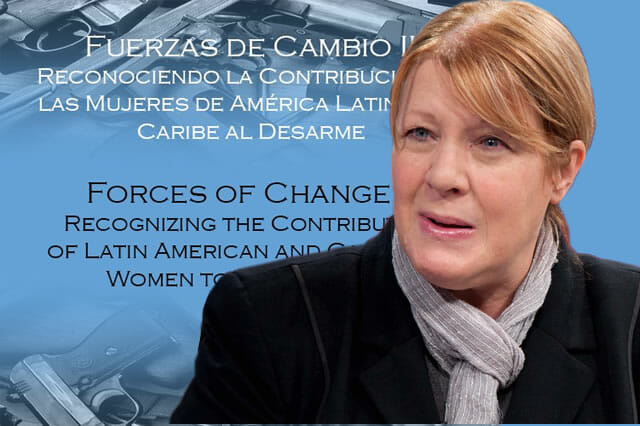
Margarita Stolbize
Latin America is made of unity and diversity and that is what makes it strong as it journeys towards integration. This is undoubtedly an achievement that has not yet been fulfilled with a comm-unity of sentiments, emotions and fraternal bonds based on shared history. This was the prophetic visioin that Chiara Lubich had intuited for this region of the world, and it is towards that vision that we are strenuously marching.
Latin American democracies, even though they little by little consolidated thanks to post-dictatorial processes of democratisation and regional integration, did not in terms of quality, follow a line of progressive improvement.
Latin America has to face a complex and uncertain future. The economic growth of the past few years has not been able to completely uproot poverty, nor did it make a dent in the social inequality or insecurity. It is here that the close link between politics and the idea of universal brotherhood becomes evident. The idea of brotherhood, especially in the testimony and in the words of Chiara Lubich, is related to two central poins of politics. The first is the idea of politics as a collective project of Latin America that reaches beyond our individuality, which implies a gesture of communion, an act of brotherhood since it consists in recognising the other and respecting his or her diversity. Dialogue is the chief means for constructing brotherhood.
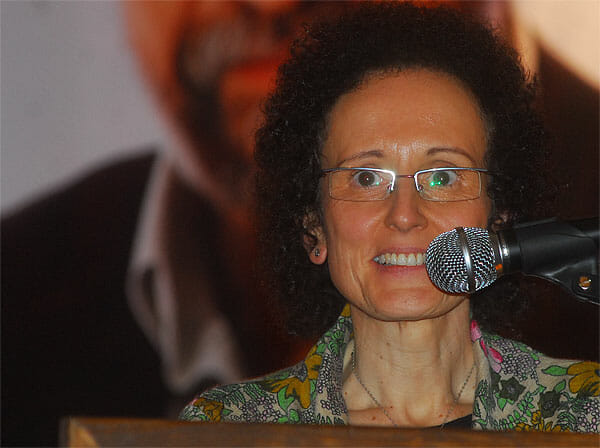
Cristina Calvo
The second element is the mid-term perspective. The idea of working for projects and never witnessing the final results, and this is the greatest gesture of greatness in politics. Chiara Lubich has given rise to countless projects not only in Latin America but across the world; mainly, in four areas: the state, social orgainisations, the private sector, and the field of knowledge. Access to basic rights, education and work must return to being the underpinnings of national identity.
The institutions need to be rebuilt not only as buildings, but as environments in which the rights of people are garunteed and exercised and not merely in rhetorical claims. Chiara Lubich also highlighted the ethical dimension of politics that has to do with transparency and is directly linked to the idea of brotherhood. Ethics enables us to become equally indignant in in front of corruption, poverty and inequality. We are certain that Latin America, from the political standpoint, must recuperate a model and economic development plan based on inclusion, garuntees access to human rights in their entirety and supports dignified conditions of life.
We need to regain a trustworthy, predictable and exemplary leadership. Above all, we underscore the idea of exemplarity, which does not discipline with money, or buying off, but with one’s own conduct and behaviour. This examplarity can not only be individual, but should also build collective, participative leadership,
A development project that does not give priority to finding solutions to the living conditions of the most vulnerable, of the poorest sectors of society, is no development project at all. The idea of brotherhood as a value that is linked to the priorities of the public agenda must also be regained. It is imperative that we regain a politics of convictions. This involves the acceptance of diversity.
In Argentina and in the rest of Latin America we need to regain the trust but, first and foremost, a culture of values, of ethical values that are incarnated in the practices and in political thought. And we hold up the principles and testimony of the person whose life we are celebrating today, Chiara Lubich. For Latin America, Chiara combines charism, knowledge, leadership, actioin and destiny. We are in that destiny and in that effort!
By Margarita Stolbizer (1) and Cristina Calvo (2)
(1) Avvocato argentina, deputato nazionale, presidente del Partito Generazione per l’Incontro Nazionale – GEN e candidata del centro-sinistra alla Presidenza 2015 della Repubblica Argentina.
(2) Economista argentina, dirigente del Partito Generazione per l’Incontro Nazionale – GEN)

0 Comments