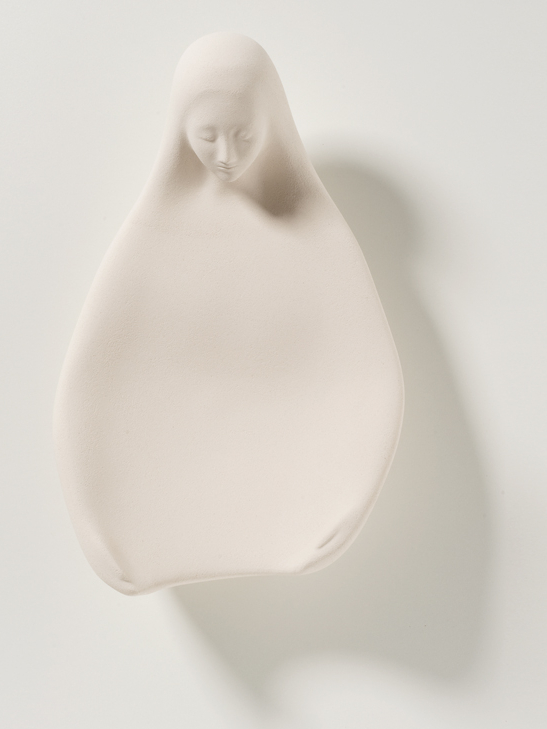
“Madonna della bella-accoglienza” © Centro Ave Ceramica
In a year dedicated to Mary, we would like to do all we can to honour the mother of God in the best possible way. There are many ways of doing this. We can talk about her, praise her and ask her help; we can visit churches dedicated to her, paint pictures and sculpt statues; we can sing hymns and bring flowers… There are many ways of imitating Mary, but one is better than all the others, which is to imitate her, to do as she would do on earth. I believe this is what she prefers, because in some ways it allows her to come and live on earth once more. Therefore, without neglecting the other ways of honouring her, we must focus on this: imitating her. How can we do this? What characteristic should we imitate? Let’s imitate her in what is essential. She is a mother, Jesus’ mother and spiritually our mother. On the cross, Jesus gave her to us as a mother in the person of John. We have to be other Marys as a mother. Practically speaking, we should state this intention: during the Marian Year, I will behave towards every neighbour I meet, or for whom I work, as though I were their mother. If we do that, we will notice a conversion happening in us, a revolution, not only because we will find our¬selves acting as a mother even to our own mother or father from time to time, but because we will have adopted a particular, specific attitude. A mother is always welcoming, always helpful, always hopeful, and covers over everything. She forgives everything in her children, even if they are delinquents or terrorists. The fact is that a mother’s love is very similar to the charity of Christ of which St Paul speaks. If we have a mother’s heart or, to be exact, if we decide to make Mary’s heart our own, as she is the most perfect model of motherhood, then we shall always be ready to love others in all circumstances, and keep the Risen Lord living in us. Moreover, we will do all we can to keep Jesus, the Risen Lord, present in our midst. If we have the heart of this Mother, we will love everybody, not only the members of our own Church, but also those of other Churches. Not only Christians, but also Muslims, Buddhists, Hindus, and so on. We will love all people of goodwill and everyone who lives on this earth, because Mary’s motherhood is universal, just as Redemption was universal. Even when she is not loved in return, she always loves, and loves everyone. This then is our intention: to live like Mary, as if we were everyone’s mother.



0 Comments