14 Jun 2011 | Focolare Worldwide
Montet, in the French-speaking Switzerland, is one of the Focolare Little towns, where youth from all over the world spend a period of their life, studying and deepening their knowledge of the spirituality of unity. The symposium in Geneva represented an important step in the study of the Social Doctrine of the Church, offering to all young participants a wide perspective on the nature and role of Non-governmental Organizations. The seminar was introduced by the president of New Humanity, Franco Pizzorno, who sketched its motivations, and all the practical initiatives of the different branches of the Movement, that work for families, youth, economics, politics, and international cooperation. Mons. Silvano Tomasi, permanent observer of the Holy See at the United Nations in Geneva, presented a wide and well-documented account on the constant committment of the Catholic Church for the defense of all fundamental human rights. Dr. Ricardo Espinosa, coordinator of all the NGOs accredited at the UN, underlined the contribution in terms of critical conscience, that civil society organizations can give in the relationship with institutions, whereas Dr. Shyami Pumanasinghe, a UN official, explained the work done in order to finalize the Declaration on the Right to Development and Solidarity. Impressive the speech by Alfred Fernandez, director of OIDEL (International Organization for the Right to Education and Freedom of Education), who summarized the main features of the NGOs, pointing out how trust relations with institutions are fundamental, in order to be both recognized and listened to partners. Alessandra Aula from BICE (International Catholic Child Bureau) gave evidence of the committment of the NGOs for the defense of human rights. All the speeches took place in an atmosphere of particular harmony among speakers and audience, also thanks to the effective and all-involving coordination run by Jorge Ferreira, representative of New Humanity in Geneva. In a lively and much-appreciated dialogue, every single participant had the opportunity to open a privileged point of view on the wide themes of Human Rights, rediscovering the important contribution in terms of values and experiences, which the civil society, also through the NGOs, can bring in the international discussion on the main themes on the civil living together.
![Bruna Tomasi in Colombia, Equador and Peru]()
14 Jun 2011 | Focolare Worldwide
 “I was five weeks in Colombia, Ecuador, and Peru. Such marvelous people, who seem made for Chiara’s Ideal.” These are among the first things Bruna said upon her return, and she is one of the first direct witnesses of the birth of the Focolare. After her trip, we received a the following letter, filled with gratitude and recognition from the hundreds of people who had the opportunity to meet her during these five weeks: “Chiara and her first companions considered themselves a constellation of stars: One of them, Bruna Tomasi, arrived here to share her divine adventure with us.”
  Colombia. From 26 April to 10 May there was a succession of appointments: from the visit to the 85 priests meeting at the Mariapolis Centre in Tocancipà, to the community meetings, with the youth, with focolarini, religious, and families. . . People came in large numbers from every corner of the country, overcoming flooding, closed roads, caused by the flooding.

Marita Sartori (centre)
 The journey then continued in Equador, from 10-23 May. Bruna remarked: “What came into evidence the most in this country is the cultural variety. Yet there is mutual acceptance, which appears very beautiful. What could have been an obstacle, has already been overcome.” There was a gathering planned at Simón Bolivar University (14-15 May) for Focolare members from different areas: Esmeraldas, Guayas, Imbabura, Santo Domingo de los Tsáchilas, and Pichincha. There were so many cultural expressions of this people so rich in its diversity. There was singing and dancing, from the coast to the central mountain range of the Andes – a special expression of thanks for the group that was visiting. One expression of diversity which was transformed into a gift was the “Afro Mass” animated by the community from Esmeraldas. “How can we spread the Ideal of unity in the whole country? This was a recurring question. Bruna charged the people of this land to “Strengthen what you’ve already begun and. . . revive the ‘fire’ of mutual love.” so that Ecuador might live fraternity to the full and offer it to the world.
  And finally, we reached Peru. Bruna Tomasi was in Lima from 23 May to 3 June. The Peruvians had always longed for a visit from Chiara Lubich, and “Through Bruna, God gave this gift to us,” they write. Bruna commented: “The Peruvians have ancestral dignity. It seems that also in the Incan religious tradition, there are traces of the Golden Rule. . .” There were numerous appointments in this immense land as well. The meeting with the entire community of Peru was especially beautiful. There were some 320 people coming from every part of Peru, some having travelled more than thirty hours. “It was a feast,” they write from Lima. “In 1989, there was terrorism in our land and many people fled the country, but precisely in that same year, the Focolare arrived in Lima, underscoring the fact that our revolution of love is stronger than all else.” There was a very important meeting with the Apostolic Nunzio, Archbishop Bruno Musarò, with the Cardinal of Lima, Juan Luis Cipriani and other bishops of the area. They all expressed their esteem for Chiara and her charism. In our interview with her Bruna concluded by saying: “Chiara’s Ideal is made for the ‘relationship’ with the other person, at whatever level, in whatever challenge, even at the cultural level. The challenge is there, yet, by living love, you can overcome all the differences.”
![Bruna Tomasi in Colombia, Equador and Peru]()
13 Jun 2011 | Non categorizzato
 “When someone weeps, we must weep with them. And if they laugh, rejoice with them. Thus the cross is divided and borne by many shoulders, and joy is multiplied and shared by many hearts. Making ourselves one with our neighbour is the way, the main way, of making ourselves one with God. (…) Making ourselves one with our neighbour for love of Jesus, with the love of Jesus, so that our neighbour, sweetly wounded by the love of God in us will want to make himself or herself one with us, in a mutual exchange of help, of ideals, of projects, of affections. Do this until establishing between the two of us those essential elements for the Lord to say, ‘Where two or three are gathered in my name, there am I in the midst of them.’ (Matt. 18:20.) Until, that is, as far as it depends on us, the presence of Jesus is guaranteed, so that we walk through life, always, as a little Church on the move – Church whether we are at home, at school, in a garage or in Parliament. Walking in life like the disciples of Emmaus with that Third among them, who gives divine value to all our actions. Then we are not the ones acting in our life, we who are miserable and limited, lonely and suffering. The Almighty walks with us. And whoever remains united with him bears much fruit. From one cell come more cells, from one tissue many tissues. Making ourselves one with our neighbour in that complete self forgetfulness which is possessed (without realizing it or specifically trying to do it) by someone who thinks of the other, their neighbour. This is the diplomacy of charity, which has many of the expressions and aspects of ordinary diplomacy, hence it does not say all that it could say, for this would not be liked by others or be pleasing to God. It knows how to wait, how to speak, how to reach its goal. The divine diplomacy of the Word who becomes flesh to make us divine. This diplomacy, however, has an essential and characteristic mark that differentiates it from the diplomacy spoken about by the world, for which to say diplomatic is often synonymous with reticence or even falsehood. The divine diplomacy has this greatness and this property, perhaps a property of it alone: it is moved by the good of the other and is therefore devoid of any shadow of selfishness. This rule of life ought to inform every kind of diplomacy, and with God it can be done because he is not only the master of individuals, but king of the nations and of every society. If all diplomats in the exercise of their duty were inspired in their actions by charity towards the other State as to their own, they would be enlightened by the help of God to such an extent as to contribute to the establishment of relationships among States as they ought to exist among human beings. Charity is a light and a guide, and the one who is sent as an emissary has all the graces to be a good emissary. May God help us and may we co-operate, so that from heaven the Lord may see this new sight: his last will and testament brought to life among the nations. It may seem like a dream to us, but for God it is the norm, the only one that guarantees peace in the world, the fulfilment of individuals in the unity of a humanity that by that point would know Jesus. Chiara Lubich (an extract from Meditations, New City London, 2005)
![Bruna Tomasi in Colombia, Equador and Peru]()
13 Jun 2011 | Non categorizzato
 9 June 2011 “We write these notes while on our return flight from Strasbourg. Just a few hours ago we were in the ‘Low N 3.4’ Hall of the European Parliament where a seminar was held, entitled: ‘Europe and Dialogue. A political value for a globalized world’. It was promoted by the Political Movement for Unity Thirty-two participants, seven of which were from the European Parliament and members of three different parties (PPE, S&D, Green) – five Italians, a German and an Austrian – along with three representatives of NGOs at the European Council and some parliamentary assistants. The meeting was significant: taking into account the typical “nomadism” of the European Parliamentarians who joined us in that small room of just 40 seats; they acted with true conviction; and deputies from other nations also desired to be present via email or by sms, regretting that they could not be physically present because of other committments. This revealed their searching and their interest and their esteem for this political community inspired by the charism of Chiara Lubich. Now it appears possible to start a small network of parliamentarians at a European level, corresponding to the membership of various national parliaments, particularly in view of the project ‘Together for Europe’. Each part of the programme was important in providing a sense of dialogue among the diverse identities, and it was all supported by a common belief in fraternity.
 Paolo Giusta (official of the European Union in Brussels) was the moderator, intoducing the program and presenting the guidelines of the Movement for Unity in Politics. This was followed by Marco Fatuzzo who shared some of its concrete implementations, dwelling, in particular, on the “laboratories of fraternity”, launched for some time in the national parliaments of Italy, Brazil, and South Korea. The keynote speaker was Jesús Morán, in charge of the Focolare Movement’s theological activities, who discussed some of the cultural and anthropological aspects of dialogue. Another valuable gift was the presence of Gérard Testard and of Severin Schmidt, both from the orientation committee of ‘Together for Europe’. They described the journey of ‘Together for Europe’ and the appointment in Brusells, following the thread of this extraordinary experience with Stuttgart 2004 and Stuttgart 2007 as the milestones. Italian MP Silvia Costa concluded: “. . . we are very interested in this dialogue and I’m certain that those who are ‘non-believers’ will also feel engaged by the Project that has been presented to us.” Austrian MP Ulrike Lunacek, from the Green Party, spoke saying that she had already known about the ‘Together for Unity’ project in Austria, and that she already considered herself invited to the 5 May 2012 event in Brussels. We will go back to the Parliament of Strasbourg, aiming solely for unity as our possible goal, so that the institutions of Europe might be ever more open to the power of the “charisms”, and certain that this meeting will be one of the engines for universal brotherhood for which Chiara Lubich spent her life. Indeed, as she would often say: “If a small group of people will be united, then the world will be one!”. Marco Fatuzzo Chairman, Movement for Unity in Politics
![Bruna Tomasi in Colombia, Equador and Peru]()
11 Jun 2011 | Focolare Worldwide

Isabella Barbetta
 I bought her medicines, and then I asked Fausto to visit her. We took him to the hospital where she was on drip. During the night I went to take her out of the hospital and back to the sisters, together with her husband who stayed in the waiting room. They still hadn’t found work. Winter was coming and, instead of returning to Bulgaria, as they were planning, the went back to sleeping on the streets. I brought them some candies that I had prepared with lots of chocolate, so they’d be more substantial. Christmas drew near. One night the temperature was 2° below zero, Fausto and I went by the supermarket. Valentina and Michele were seated on a carton, numbed by the cold. We tried to convince them to go somewhere where they could spend the night in warmth. Michele didn’t want it. Fausto asked them why they hadn’t returned to Bulgaria as was there intention. The answer was simple: “We don’t have money for the tickets.” Fausto and I looked at each other: If the problem is money, we thought, we will make do with a little less this Christmas. We asked when the bus would be leaving for Bulgaria: the next morning from the Tiburtine Station. We returned home and as Fausto fetched the money, I prepared a sack bread bread, cheese, ham, fruit, some sweets and water, which they could snack on during the two-day-long trip. We left with Valentina and Michele and arrived at Tiburtine Station at one-thirty. We exchanged addresses, glad that it would also be a happy Christmas for them in the company of their family. But the next day Valentina telephoned to say that the bus was already full and they would be forced to return to Aricccia. But they bought tickets for the following Friday. Valentina said to me: “Italy doesn’t wish, Bulgaria doesn’t wish, only you wish us well.” The sisters were happy to take them in, having experienced for themselves their courtesy and politeness. On Friday morning at six, Fausto took them to Rome – this time with an abundance of sacks filled with groceries, and a warm winter coat to replace the dirty and ice-covered coat of Valentina. I wasn’t able to provide my friends with a job, but I’m sure I provided them with a bit of love.” Editor’s note: This story was shared by Isabella in January 2008. We offer it again today, because of its timely significance.
![Bruna Tomasi in Colombia, Equador and Peru]()
10 Jun 2011 | Focolare Worldwide
a href=”https://www.focolare.org/wp-content/uploads/2011/06/20110610-02.jpg”> “Let’s get together again please!” wrote a German girl on her Facebook account, expressing the longing of many of the fifty participants of the Media Education seminar, which was aimed at young people and their coordinators. The course, sponsered by trade associations from six countries and prepared in detail by NetOne and the Charism Community Projects (UK), received financial support from the Youth in Action programme of the European Commission.
 The course provided a theoretical part – three lectures held by the Media Education Professor Luciano Mele from the International Telematic University of Rome (UNINETTUNO), who were the external project partners; evenings with professionals in the areas of communication: social networks, journalism and advertising , and four creative workshops for the remaining of the day. The quality of content was much appreciated by the young people as well as the creativity in the experimental groups on multicultural living.
Arco-Iris, the Focolare’s little town at Abrigada proved to be quite the suitable place for hosting the seminar, not only for the environment but also for the great hospitality and attentive service.
![Bruna Tomasi in Colombia, Equador and Peru]()
9 Jun 2011 | Non categorizzato
 “You represent an important component in the peace process that humanity is waiting for.” Maria Voce joyfully welcomed diplomats gathered at the International Centre of the Focolare Movement in Rocca di Papa, on 8 June 2011, the same centre which was visited by Pope John Paul II in 1984. Thirteen ambassadors attended and five diplomats representing their respective embassies. There were also representatives from some dicasteries of the Roman Curia, as well as the president of the Focolare and members of the General Council of the Movement.
  The recent beatification of Pope Wojtyla encouraged the Focolare and the Embassy of Poland to the Holy See to promote the meeting, in the desire to express their deep gratitude to John Paul II, who followed the Focolare with such great love ever since he was a bishop in Poland. This meeting follows a previous one directed to the Ambassadors accredited to the Holy See, which was held in 2010 on the second anniversary of the death of the Movement’s founder, Chiara Lubich. “We see you engaged in dialogue – continued Maria Voce, who was returning from a long trip to Eastern Europe -. immersed in a society characterized by tensions, conflicts, threats, and even wars, you play an invaluable role.” She also pointed out the “similarity” between the work of diplomats and that of the Focolare Movement: In fact, the Movement’s “precise purpose is to contribute to the realization of Jesus’ dream: ‘That all be one’.”
  Among the speakers, Ms. Anna Kurdziel, First Secretary of the Polish Embassy, underscored the affinity between John Paul II and Chiara Lubich, two extraordinary figures of the 1900’s, in an evangelization which starts from love. The Italian ambassador to the Holy See, Francesco Maria Greco, recalled the legacy of John Paul II for Italy, not least the importance he gave to the ecclesial movements, a cohesive force in the country and a moralizing strengthener of ethical standards in social life. Archbishop Joao Braz de Aviz, Prefect of the Congregation for Institutes of Consecrated Life and Societies of Apostolic Life, urged everyone “to know and appreciate the charism of unity as a very great sign of hope for today’s world. ” The voice of a direct and authoritative witness was also heard. Eli Folonari shared what the relationship of John Paul II and Chiara Lubich was like. There was the first invitation to a Mass in his private chapel a few days after his election to the papacy, the 30 hand-signed letters, the inevitable telephone calls of congratulations which always arrived on the feastday of Saint Clare (Santa Chiara), the 9 invitations to dinner … “Chiara wanted a confirmation (from the Pope), but above all, she wanted to give him joy.” And so it was, since several times the Pope remarked that at every meeting with her or with the focolarini he felt “a great consolation.” (www.centrochiaralubich.org)
  Two young people also offered their testimony on the meetings of John Paul II with the younger generations, and the Zanzucchi couple shared from their direct personal knowledge of the Holy Father, about his encounters with families. And space was also given to Chiara Lubich’s commitment to the communion among movements, as she promised to the Pope in Saint Peter’s Square on Pentecost 1998. Gabriella Fallacara, who worked in ecumenism for many years, then presented “Together for Europe” the path taken up by Movements and ecclesial communities in and for the European continent. It will take place again in Brussels on 5 May 2012, with simultaneous links to many European cities. Monsignor Vincenzo Zani, undersecretary of the Congregation for Catholic Education together with the secretary Archbishop Jean-Louis Bruguès, asked, as a conclusion to the meeting, to share about the significance of this encounter: “I’m reminded of the meditation of Chiara Lubich entitled “Diplomacy”. Chiara spoke of “the diplomacy of love, which, because of its simplicity is able to give a soul and start the flow of blood in the structures of social and political life, which so often feel like superstructures. Today, here, there was an expression of this structure of social and political life which the embassies and diplomats are called to be. If there is love, you understand that the world needs this invisible network – hidden, but at the service of the common good, at the service of unity.” [nggallery id=50]
![Bruna Tomasi in Colombia, Equador and Peru]()
8 Jun 2011 | Non categorizzato
 The conference offered a series of lectures by prominent figures of contemporary culture: Ugo Amaldi, there was Cardinal Marc Ouellet, Stefano Zamagni, Sergio Zavoli and Martha Nussbaum. Perhaps, few know her by name, but in 1986 she was the first to introduce the concept of “relational goods” – which has since become a stable component of economy. She also greatly influenced the United Nations in the development of the human development index. This was thanks to the capability approach (an approach that respects ability) which she drew up in cooperation with Nobel Prize winner Amartya Sen. And no, she is not an economist, but a philosopher, and like the American Martha Nussbaum, professor of Law and Ethics at the University of Chicago, she is known in academic circles – and beyond – especially for having introduced the topic of emotions in political and social reflection. And “public emotions” were at the core of the lectures that brought her to the Sophia Institute in Italy. At Loppiano she first met with the students of Sophia for an interesting discussion in which she was questioned not only by students, but also by Nussbaum. This was followed by a debate about the coexistence of different religions and cultures, and different educational systems, given the diverse religious, cultural, and geographic backgrounds of the students. But much of the debate focused on the relationship between philosophy and economics, beginning with the direct experience of Nussbaum with Sen, which led into the additional topic: the interdisciplinarity of knowledge and the need for collaboration among scholars of varying fields.
  Regarding the specific experience of Sophia, Nussbaum noted that it provides “a type of interdisciplinary education that is crucial in the formation of a ‘world citizen”. If we limit ourselves to just one field of knowledge, we are not sufficiently equipped in this sense.” She directed an invitation to the students to “try to understand how to put together the critical approach and the emotional,” essential elements of her thinking, to build a society that is respectful of every aspect of human life. The conference, open to the public and entitled “Public Emotions and the Decent Society”, was a journey through space and time – beginning with Europe after the French Revolution, with Comte and Mill, to India’s Tagore and Gandhi – to examine how the idea of a society built around a “civil religion”, which is in fact supported by emotions, was able to make headway and result in the experience particularly of the subcontinent. Emotions mainly understood in the sense of “empathy” for others, the ability to perceive a “common good” to be pursued, which embraces the entire society, and that the State itself is called upon to promote, beginning with the education of its young. Source: Città Nuova online
![Bruna Tomasi in Colombia, Equador and Peru]()
4 Jun 2011 | Focolare Worldwide
 “An opportunity to live brotherhood among us bishops, to deepen relationships of true friendship: this is the reason for the meeting”. This is how Archbishop Boniface Lele of Mobasa, Kenya introduced the meeting. Cardinal Emmanuel Wamala, Archbishop Emeritus of Kampala, Uganda, echoed his words saying: “To rediscover our task at the service of society, let us try to understand together God’s design on us. During these days we can feel how much He calls us precisely to unity, which is the charism of Chiara Lubich.” The first thing the bishops did when they arrived at the Focolare little town “Piero”, was to make the commitment to practise “the art of Christian loving” among themselves in order to have the presence of the Risen One in their midst. “It will be the Risen Jesus who will enlighten and who will give us the gifts of the Spirit,” said Cardinal Miloslav Vlk, convenor of the meeting. This same lifestyle is shared by more than 1000 bishops throughout the world, which is inspired by the “spirituality of communion”. Bishop Salutaris Libena, auxilliary bishop of Dar es Salaam, Tanzania, immediately affirms: “I’ve come to learn to serve, to love concretely. This is a way of life which fills the heart, which gives supernatural joy.” Bishop Salesius Mugambi, Bishop of Meru, Kenya remarks: “In a serene and joyful atmosphere, we reflected and delved more deeply into the spirituality of communion. We listened to updatings, shared joys and sorrows, but also enjoyed moments of relaxation.” These sentiments were shared by Archbishop Damiao Franklin of Luanda, Angola: “These were days spent in sincerity toward God and toward our brothers.”
  There were several moments for the sharing of experiences, both personal and pastoral, with a look at some of the challenges that the African continent must face: conflicts and violence, poverty, corruption; all challenges in which the members of the Movement are immersed, and which they want to respond to by living the spirituality of communion, which leads them to be workers of peace and unity in the environments in which they live. South African Bishop Patrick Mvemve of Klerksdorp, shared about his first contact with the Focolare during the period of the apartheid, as a young priest: “Having met two priests who truly lived the Gospel with facts, without giving a lot of speeches, I became curious. And so one day they spoke to me of Jesus crucified and abandoned. In that moment I was “healed” of my prejudices and became an apostle of unity. Another topic that was discussed was “the educational emergency”. The experiences of forming priests in the “spirituality of communion” was recognized by the bishops as “one of the valid contributions being made to the Church of today. At the conclusion of the meeting, the bishops wanted to formulate a “pact” of mutual love, declaring their desire to continue taking care of each other once they had returned to their diocese.
  Bishop Sithembele Sipuka of Umtata, South Africa, summarizes the experience they had: “I leave enthusiastic with a life programme. I pray the Holy Spirit will guide me to put it into practice in the daily reality of every day.” Meetings for Bishop Friends of the Focolare take place in various geographic locations around the world, which are inspired by the “spirituality of communion” proposed by John Paul II and practiced by the Focolare Movement since its began. Following the gathering in Kenya, similar events will take place in Madagascar and in Cameroon, in the Philippines, the Middle East and Europe. [nggallery id=49]
![Bruna Tomasi in Colombia, Equador and Peru]()
3 Jun 2011 | Non categorizzato
 This year, on this occasion, a group of young people decided to do something concrete for their city. Recently, they had taken part, in partnership with other youth groups of German and Italian schools, in a European project called “Heimat Europa” (Europe, Home to All). The project was begun in Germany in 2010 through the initiative of the German association Starkmacher, in collaboration with the Movement for Unity in Politics. It was a training course which lasted more than a year, where they worked and comparing their views on immigration in from the viewpoint of integration, the environment, the future of Europe, with particular reference to the development the Federal European Union which should be able to accomplish it. It was a compelling journey that left a mark in their hearts but also in their minds and, begun as a game, it gradually grew and became a true political experience. The Mayor of Solingen and other city authorities were enthusiastic about the project and immediately offered their support. Before the anniversary event even began, knowing that the memorial spot had to be cleaned, they offered to do it. In collaboration with their school, they got many other students involved. A working group assembled information on the tragedy of 1993 for the younger students. And, since the 20th of May occurred during “European Week”, they took the occasion to present the idea of Europe as home for all, including immigrants.
  The suggestions were many. After observing a minute of silence, a “tree of peace” was planted, and the young people present were invited to write on cards the values which they hold to be important (peace, brotherhood, unity, solidarity, responsibility …). Then the cards were symbolically placed in the hole in which the tree was planted. It was an apple tree. A young person: “The tree has many leaves, which symbolize Europe in its communion in diversity. The fruits, the apples, symbolize the new generations and new ideas.” And another: “The little apple stands for a great goal, peace in Europe but also in our city.” And what came out in the end, is something interior which confirms that “you can hope for a different world; the change depends on our personal sense of responsibility and our ability to work together.” “You could even become passionate about this kind of politics.”
![Bruna Tomasi in Colombia, Equador and Peru]()
2 Jun 2011 | Focolare Worldwide
 On 22 May, the Focolare’s little town in Mexico – “El Diamante” – was awaiting the appointment with Christians and Jews united in a sign of living dialogue among people who desire to rediscover their common roots. They are our “big brothers”, said John Paul II using an expression which has now become famous. And “What might happen,” asked Chiara Lubich, “as we deepen the brotherly relationship between us, Jews and Christians, who share the patrimony of the Bible, in what we call the Old Testament?” Today the relationship continues to develop in the Focolare Movement, upon this basis and the dialogue between Christians and Jews continues. The day at Acatzingo is an example. Following a brief introduction, focused on the discovery of God Love as the basis of our brotherhood, along with moments from the history of the Focolare in its dialogue with the Jewish world, Liviu Bleier, president of the new B’nai B’rith of Mexico, stressed that “the best religion is the one that is the closest to God” and he expressed his appreciation and joy for this occasion of mutual exchange. The group, composed of 23 people belonging to the Jewish faith from Mexico City and friends of the Focolare, visited the workshops and the school linked to the Mariapolis Centre, located in a rural setting, with the aim of training people in loving and forgiving, a culture of life and of giving. The inhabitants of the Mariapolis, youths, adults and children, presented an overview of a Christian witness in daily life, which was much appreciated by the guests.
  The ceremony around the olive tree – a symbol of peace, and a symbol common to Christians and Jews alike – was a moment of importance which brought out dimensions of the brotherhood among all: “Thank you for the way in which you welcomed us – said one of the attendees – for the spirit of brotherhood, as if you knew us for a long time. It makes me realize that we must be humble and at the service of others, to change ourselves and the world. ” The next appointment is set for 21 – 24 August in Buenos Aires, for another Jewish-Christian symposium, following the one last year in Jerusalem.
1 Jun 2011 | Focolare Worldwide
(ومُرْضي وكامل”. (رومية 12، 2
نقرأ هذه الآية في الجزء الثاني من رسالة القدّيس بولس إلى أهل رومية. فيها يصف القدّيس بولس سلوك الإنسان المسيحي على أنه تعبير عن الحياة الجديدة، والمحبّة الحقيقيّة، والفرح الحقيقي، والحرية الحقيقيّة التي وهبنا إياها المسيح. إنها الحياة المسيحيّة، إنه
طريقة جديدة تجعلنا، بنور وقوّة الروح القدس، نواجه الواجبات والمشاكل المختلفة التي قد تعترضنا. في هذه الآية، المرتبطة بشكل وثيق بالآية السابقة، يعلن الرسول عن الهدف والسلوك الأصيل اللذَيْن يجب أن تتّسم بهما كل تصرّفاتنا، وهما أن نجعل من حياتنا تمجيداً لله، وفعل محبّة دائم على مرّ الزمن، باحثين باستمرار عن إرادته وعمّا هو مرضي ومقبول لديه. ولا تتشبّهوا بهذا الدهر بل تغيّروا بتجديد عقولكم، لكي تميّزوا ما هو مشيئة الله، أي ما هو صالح ومُرْضي وكامل”. من المؤكّد أنه علينا أن نعرف قبل كل شيء ما هي إرادة الله، لنتمكّن من تحقيقها. ولكن القدّيس بولس لا يخفي علينا صعوبة هذا الأمر، إذ لا نستطيع أن نعرف جيّداً مشيئة الله من دون نور خاص يساعدنا على تمييز ما يريده منّا الرب في كل موقف، فنتجنّب الأوهام والأخطاء التي قد نقع فيها بسهولة. إنها موهبة من مواهب الروح القدس، تُدعى “التمييز”، والتي لا بدّ منها لبناء عقليّة مسيحيّة حقيقيّة عند كل واحد منّا. ولا تتشبّهوا بهذا الدهر بل تغيّروا بتجديد عقولكم، لكي تميّزوا ما هو مشيئة الله، أي ما هو صالح ومُرْضي وكامل”. ولكن ما العمل لإكتساب هذه الموهبة المهمّة إلى هذا الحد وتنميتها؟ مطلوب منّا من دون شك معرفة جيّدة للعقيدة المسيحيّة. ولكنّها وحدها لا تكفي؟ كما يقترح علينا الرسول بولس، إنها مسألة حياة وسخاء وإندفاع لعيْش كلمة يسوع، تاركين جانباً مخاوفنا وشكوكنا وحساباتنا الضيّقة. إنها مسألة إستعداد وإسراع في إتمام مشيئة الله. إنها الدرب التي تسمح لنا باكتساب نور الروح القدس وببناء العقليّة الجديدة التي تطلبها منّا هذه الآية. ولا تتشبّهوا بهذا الدهر بل تغيّروا بتجديد عقولكم، لكي تميّزوا ما هو مشيئة الله، أي ما هو صالح ومُرْضي وكامل”. كيف نعيش إذًا كلمة الحياة لهذا الشهر؟ فلنسعَ لنستحق نحن أيضاً النور اللازم لإتمام مشيئة الله علينا بطريقة جيّدة. ولنقترح على أنفسنا أن نتعمّق بمعرفة أفضل لإرادته علينا، كما تعبّر عنها كلمته وتعاليم الكنيسة وواجبات كلٍّ منا وإلتزاماتنا إلخ… ولكن، سنركّز أكثر من ذلك كله على طريقة العيْش، لأنه كما سبق وقلنا، من الحياة والحب يشعّ النور الحقيقي. فيسوع يتجلّى للإنسان الذي يحبّه إذ يعيش عمليّاً وصاياه (يو21,14). هكذا بإتمام مشيئة الله، سوف ننجح في أن نقدّم له أجمل هدية. هديّة مرضيّة لديه ليس فقط بسبب المحبّة التي تحملها، بل أيضاً بفضل النور وثمار تجدُّد الحياة المسيحيّة، التي سوف تولد من حولنا.
كيارا لوبيك (أغسطس 1993)
1 Jun 2011 | Non categorizzato, Word of
“Do not conform yourself to this age but be transformed by the renewal of your mind, that you may discern what is the will of God, what is good and pleasing and perfect.” It is clear, of course, that in order to carry out the will of God we need to know it. Saint Paul infers, however, that is not always easy. It is not possible to fully grasp the will of God without a special insight to help us discern what God wants from us and avoid the illusions and errors that we could easily fall into. This particular gift of the Holy Spirit is called “discernment.” It is indispensable to us if we want to acquire an authentic Christian mentality. “Do not conform yourself to this age but be transformed by the renewal of your mind, that you may discern what is the will of God, what is good and pleasing and perfect.” How can we acquire and allow this important gift to mature in us? Undoubtedly we need to know the tenets of our faith well. But that is not enough. Saint Paul affirms that it is above all a matter of living in a certain way, that is, it is a question of generosity, of determination in living the Scriptures, because it implies setting aside one’s fears, uncertainties and mediocrity. It is a question of availability and readiness to carry out the will of God. This is the way to acquire the light of the Holy Spirit and achieve the new mentality asked of us here. “Do not conform yourself to this age but be transformed by the renewal of your mind, that you may discern what is the will of God, what is good and pleasing and perfect.” How then can we live this month’s word of life? By trying to merit that light that is so necessary for carrying out the will of God well. Let us resolve, then, to know his will as it is expressed in his Word, in the teachings of the Church, in the duties required by our state of life and so on. Let us remember, however, the great importance of living our faith. As we have just seen, true light comes from living as we should and from loving. Jesus manifests himself to those who love him by putting his commandments into practice (cf Jn 14:21). We will then be able to do the will of God and, by doing so, offer him the most beautiful gift we can. It will be pleasing to him not only because of the love that it expresses, but also because it will spread around us much light and a spirit of Christian renewal. Chiara Lubich
![Bruna Tomasi in Colombia, Equador and Peru]()
31 May 2011 | Focolare Worldwide

Tininha Cavalcanti

Tininha with Chiara Lubich
![Bruna Tomasi in Colombia, Equador and Peru]()
30 May 2011 | Focolare Worldwide
 This year saw important novelties in the Gen4 world. There were two major events for the Philippine Gen4. The first was in Cebu – a Philippine island surrounded by 167 smaller islands – where sixty-eight Gen4 gathered with Gen4 from other islands. The second was in Tagaytay near Manila, where the Focolare’s little town in Asia stands. Seventy-five Gen4 gathered together there for their conferences with Christian Heisendorff from the World Gen Center in Rome, Italy. There was great attention to the main topic: The Golden Thread of God’s Love in the Old Testament, from Abraham to Moses. And then the life of Chiara Lubich – from whom the Gen4 were also born – as a loving response to the will of God. A fascinating story: her “great adventure”, as Chiara herself described it to the Gen4 in 1988, when at the Holy House of Loreto she understood her calling. It was a luminous discovery for all the children present: Doing the will of God truly makes life an adventure! The games, skits, songs and, especially the modern and traditional dances – in this atmosphere of mutual love helped to create a beautiful atmosphere. The children no longer wanted to leave!
  The Gen4 came from families of diverse social backgrounds, some in very difficult situations – but we are truly a family and seeing their need urged our hearts to search for new ways to provide them with at least the necessities of life, through the adoption at a distance programme and other projects developed by the Focolare Movement. The words of the children: “I was happy during this congress. I learned many things. I learned to love.” “A child struck me. It hurt very much and I cried, but then the child apologized and so I accepted and forgave. I was no longer angry and we are already friends again.” “Jesus, thank you for letting me go to Tagaytay. Thank you also for the blessings you gave to us, for my new friends. Thank you for my family and friends. Thanks also for the girl who lent me her slippers. And even if the other one bothered me so much, I love her just the same. . .”. Gen4 Centre
![Bruna Tomasi in Colombia, Equador and Peru]()
30 May 2011 | Focolare Worldwide
 Economy for the Future. Seventeen youths from different parts of the world read their in their own languages, their message to the world, which they had written together – “From San Paolo to the World” – a real work plan.: “May the economy of 2031 be one of communion, for all of us”. It shows what they believe in, what the dare to hope for, but it is also the result of the journey they have already taken up together. The seventeen hundred attendees at the meeting “The Prophecy Makes History. Twenty Years For the Economy of Communion” listened with deep attention and interest to the convictions and requests made by the youths who have lost patience with the capitalistic reasonings. “We youths of San Paolo in May 2011, with our roots in May 1991, but more than ever responsible for the economy and the world in 2031, believe that the EoC came on earth in this Brazilian land twenty years ago, also to increase and make our hope come true.” Their openly-proclaimed ideality was the seal on the reflections of the experts and the testimonies of entrepreneurs that marked this meeting, which was the closing act of the assembly, with 650 participants from 37 countries during the previous four days. What a happy choice it was to hold this great appointment of the EoC in Brazil. The assembly took place within the framework of Mariapolis Ginetta, 50 kilometres south of San Paolo, precisely in the place where Chiara Lubich shared her intuitions for the first time, intuitions which grew and increased in her after having seen the sorrowful circle of favelas encircling the great skyscrapers of the great metropolises of San Paolo. Not less significant was the decision to link the gathering of 29 May in the Simon Bolivar Auditorium in the America Latina Memorial, a centre, which was the idea of the great architect Niemeyer. It is meant to favor closer relationships between the peoples of the continent, through art. The EoC has “the potential to change economic life from within, not only of the businesses, but also the families, the finance instituties, and economic politics,” pointed out Maria Voce, president of the Focolare, during her closing address. Remember to keep an underlying condition in mind: “The EoC will have new momentum if it sets its horizons on a united world and it will be able to move the hearts, actions, and enthusiasm of those who are drawn to bet their lives on great ideals.” Then she had no doubt that “a new season of creativity will come, one in which everyone of you will be a protagonist in this great appointment with history.

Luigino Bruni
 Reversing the dominant formulation which puts the centre on capital, Bruni reminded everyone that “the primary and fundamental factor in any business or economy is the human person, and their creativity, their passion to make a difference.” Finally, “the EoC was born and is born each day from a charism: also for this reason there exists a profound link between the EoC and youths: the charisms and the youth have in common their hope, and their faith in the future, the great projects and ideals”. The new generations of the EoC are the precious fruit of these first twenty years, but also the guarantee for walking ahead with quick step into the future. Paolo Lòriga
![Bruna Tomasi in Colombia, Equador and Peru]()
29 May 2011 | Non categorizzato
 “What do you expect from the Focolare community in Hungary?” a Hungarian focolarina asked Chiara Lubich in 1985. The Focolare founder answered: “42 years ago there was nothing, or perhaps only one person who had this Ideal. Now we are spread all around the world. And so what do I expect from you? That the Movement, now present among a certain number of people and with a certain development, may spread through every city and town; that it may contribute to the renewal of the Church and of the whole society with its various instruments and movements in religious and social fields; and that it may, along with Our Lady’s other inventions, render the Immaculate Heart of Mary triumphant”. Who knows what Chiara would say today on seeing the development that has taken place on Hungarian soil since 1985. “We must give thanks to God because you are doing amazing work”, the current President Maria Voce stated at a gathering of the Hungarian Focolare family in Budapest on 28th May. The meeting was a chance to share experiences about activities in every field. The event took place in a former Russian army barracks and some of the 650 participants remarked that this seemed symbolic of the force within the Charism of Unity to transform society. The programme started with an original reconstruction of Chiara’s trip to Budapest in 1961- her first visit to the then eastern bloc. She was deeply struck by the effect that the regime was having on the country and its people. Whilst this made Chiara suffer, the impression that “Our Lady was at work” was just as strong. The presentation that Hungary’s local communities gave at Saturday’s event demonstrated that this was not a mere impression.
  Hungarians prove to be a proud population, with a well defined identity. At the same time they are looking for a balance between nationalism and openness on a universal level between a deep desire for freedom and the ability to take on responsibility. Maria Voce’s wish for them was that they may manage to “overcome their mistrust of other populations” which often impedes reciprocity. “It is right to affirm national identity but it must create a symphony of nations”, the president underlined, “The challenge is to realise Hungary’s talents, offer them as a gift, welcome those of other populations and learn more and more how to collaborate”. Maria Voce went on to underline that every member of the Movement is called to do their part: The Volunteers, for example, have an innate vocation to transform humanity, conscious that, “doing our small part where we are, contributes to bringing ahead the Kingdom of God all around the world”. Those involved in New Humanity are called on to “bear witness to the Gospel in an often heroic way, without letting themselves be crushed by certain situations but transforming them with love. As Chiara said in a mediation, ‘What do we do when we have loved a lot? Love even more’.” The families in the Movement are called on to respond to the many difficulties that undermine solidity with “an ever greater and ever renewed love, with an openness without limits, finding the roots of this love in God”. The children asked the president where they can find God and were happy to hear that one of the places we find Him is in others. The teenagers shared that they risk marginalisation because they don’t conform to the flock and they left the meeting feeling fortified because “Jesus also felt misunderstood by everyone. Don’t worry about this, worry about what God wants. The simple fact that you manage to bring ahead your idea is an example and a provocation to others”, said Maria Voce and Giancarlo Faletti in encouragement.

Maria Voce's meeting with the Hungarian young people
29 May 2011 | Non categorizzato
![Bruna Tomasi in Colombia, Equador and Peru]()
28 May 2011 | Non categorizzato
 At the opening, in the foreground: Blessed John Paul II whose pontificate gave “priority attention to the family.” Cardinal Ennio Antonelli, President of the Pontifical Council for the Family, pointed out in his speech that “for the Pope of the new evangelization, the family, that small domestic church, was not just a saying. It signified an actual implementation of the real and specific Church. In fact, the spouses – as is written in Familiaris Consortio “not only relive the love of Christ and become a community of the saved, but they are also called to pass on to others the same love of Christ and become a saving community “(FC 49). In the afternoon, the long-awaited meeting with the president of the Focolare, Maria Voce, who forged with the more than one thousand participants from all over the world, a profound dialogue, expressing her joy at being with families who offer themselves as instruments of unity in the environments in which they live. The testimonies highlighted how faith in Love can transform and illuminate daily life, and be a support and guiding force in difficulties: illness, separation, and widowhood. In collaboration with the youth section of the Focolare Movement, two moments were devoted to bringing up children. Topics related to educating were discussed in work groups: educating for a sober lifestyle, emotional education, and the use of media in relation to different age groups. A significant amount of space was dedicated to young families. Many followed the program via internet from various listening stations around the world, during which time there were discussions about affectivity, communication, and spirituality. Messages of support arrived from: Canada, Venezuela, Israel, El Salvador, Brazil, etc. “Infinite thanks for this concrete love which allowed us to take part in the congress via internet,” they write from Panama, “re-affirming the value of the family and the faith that Jesus helps us to construct it. Society gives the idea that the family is out of style – but today, listening to you, we feel that the family is so modern and relevant.” “You’ve illuminated every aspect of our married life,” they write from Slovenia. “Living the spirituality of the Gospel brings us to the fulfillment of our happiness and freshens the love that we want to bring to as many families as we can.”
![Bruna Tomasi in Colombia, Equador and Peru]()
28 May 2011 | Focolare Worldwide
 It is not situated in the main passageway used by the 650 people attending the Economy of Communion Assembly, but it is the most visited stand during work breaks. They sell women’s handbags, jackets, and women’s clothing. They are a mix of quality and modern design, with charming touches of originality, as is the source of raw materials: truck tarpaulins, scraps of leather, and old jeans – all environmentally friendly materials. But the striking thing about the business is the boys and girls, all of them minors except for a few who have recently become adults. They all come from difficult backgrounds. The product’s brand name “Dall Strada” (“From the Street”), is quite a good choice for the entrepreneurial project which opened in the Spartaco industrial park, five kilometres from Mariapolis Ginetta. Knowing the origins, it seems more like a challenge than a business production, but watching some ten young teenage boys and girls at work and hearing what motivates them, makes you understand the good results in production, which hold promise for the future of the business. The young workers come mostly from one of the poorest quarters, the Jardin Margaarida barrio, in Vargem Grande Paulista, 30 kilometres south of São Paolo. “This is more than a business. We help each other, because this is a group project, but tehre’s also a family atmosphere. We begin each day with the Word of Life which helps us to overcome the difficulties.” Divani is an eighteen year-old, who reached here after a year of professional training and a stay in the Northeast, in Recife, in the mother-business which began the Economy of Communion.
  Behind the business lies the meekness and determination of João Bosco Lima de Santana, an entrepreneur who went to Italy to specialize in producing handbags and then returned to the country to set up an acivity for profit. But something inside was urging him to do something greater. As a child, he had come to know the spirituality of the Focolare and was struck by the proposal of Chiara Lubich to “die for ones own people”. His life then went took another direction. But when he met Father Renato and his Home for Minors, which welcomes teens and children who live in the streets, it consolidated one of his desires: “To use my life and skills to provide youths with a profession.Work training is a form of development, and we’ve seen that living love for a great cause is capable of renewing things, ideas, and people who come from the streets.” From what he sees each day, João Bosco is able to credibly affirm that “here in the business, they are given the first place.” It is a paradox for entrepreneurial logic, but it bears fruit. A request arrived from the Ivory Coast to be trained in this production activity and to begin it there. And through the Youth for a United World, through the Equiverso Cooperative, handbags have begun to be imported in Italy. Tiny multi-nationals of the EoC are growing. By Paolo Lòriga
![Bruna Tomasi in Colombia, Equador and Peru]()
27 May 2011 | Focolare Worldwide
 The Hungarian leg of Maria Voce and Giancarlo Faletti’s Eastern European tour has brought them to the heart of a local community bursting with vitality. The first appointment on their busy schedule was a meeting with priests who know the Movement. Many of them are responsible for the diffusion of the Focolare in the area and their meeting with the president and co-president was a chance to share their countless experiences. Some told about their commitment to rebuild the Church; others about their service as parish priests, seminary directors and vicar generals; others about their role at university or diocesan levels or their simple, everyday relationships with people, building a sense of community and attracting young people and those without religious convictions. As well as concrete experiences they shared about the life of communion that sustains and nurtures everything.
  Next step: a meeting with the delegates of the various branches that make up the Focolare Movement in Hungary. The families spoke about their wide-ranging work with newly-wed and engaged couples, with divorced people and with families of all ages. The delegates of New Humanity- who coordinate the Focolare Movement’s work in the social arena- spoke about activities in the fields of economics, politics, health, education and sport. Lay people and priests told about renewal underway in parishes throughout the country’s 13 dioceses. The meeting was enriched by an open dialogue touching on many aspects. One of the concerns addressed was the balance between a local and universal dimension. “The ideal to fulfil Jesus’ last testament- ‘That all may be one’- was born in the small town of Trent and went on to assume a global dimension”, Maria Voce recalled, “This means that looking after smaller details is a school of love that opens our horizons. Opening our horizons to universal brotherhood does not mean, therefore, that we shouldn’t take care of the smaller details”. And later Voce underlined the other face of the coin: “We feel pushed to go beyond our boundaries. We can’t lose interest in the Movement’s big family spread throughout the world- let’s try to stayed linked with all means possible.” A Gen 2 girl asked a question about spiritual input, giving the president a chance to speak about one of the legacies that Chiara Lubich wished to leave her followers: “Leave the Gospel and only the Gospel to those who follow you”. All the other things are instruments that help us put that Gospel into practice and render it a concrete reality, Maria Voce explained but “the most important thing is to live the Word of God. We must always ask ourselves: ‘How Jesus would live?’”.
  Both during the meeting with the movement’s delegates and at the gathering the following day with the men and women focolarini who live in Hungary, questions arose about how to improve interpersonal relationships- an important subject for those who live a collective spirituality. An ever greater love became the leitmotif of the meetings: a love that demands our all; a love that’s free from perfectionism or the desire to reach a certain result; a love capable of going beyond differences between men and women, between big and small, between people with different roles; a love that generates, that puts your life at stake to the point of ‘allowing Jesus to live in you’. “I have been created as a gift for who is beside me and who is beside me has been created as a gift of God for me”, Chiara Lubich often repeated with conviction. Maria Voce underlined this to all present, reminding them of the model that always inspired Chiara: “The family of Nazareth or, even greater, the life of the Trinity”. This is the highest of relationships, the upmost love- a bold but inimitable model. From our correspondent Aurora Nicosia
![Bruna Tomasi in Colombia, Equador and Peru]()
27 May 2011 | Focolare Worldwide
Streaming: http://live.focolare.org/EdC2011/ Flickr Photo Gallery
 “Speak! Speak out loud! Have courage to speak about the Economy of Communion, even to the important economists of the world. Maybe they won’t give you credit right away, but since this project is tried and true, it will affirm itself in time.” The Archbishop of São Paulo, Cardinal Odilo Scherer couldn’t have expressed it in better terms to give encouragement to all participants of the International Assembly of the EoC, taking place in Mariapolis Ginetta, 50 kilometers outside the Brazilian metropolis. “I wanted to come here,” he confided to the 650 participants, representing 37 countries, “to get a feel for how this meeting is going, to see you all and to say something to motivate you and to encourage the work of this initiative.” He explained right away, saying, “Yours in an event that proposes something new for society. It isn’t new for you, because you’re involved in it, but for the wide public it is new.” one of the most listened to public figures in all of Latin America, and is increasingly recognized at a global level as well. He does not doubt the presence of a widespread question and the research underway. “Certainly, many people are interested in knowing what the expression ‘Economy of Communion’ means, what good it can bring to our times, for the economies of our countries, for our society, what it can say to help resolve the economic crisis that persists in many places.”
  He has no doubts about the foundation of the EoC. “I see that the EoC’s proposal is fully in line with what the Social Doctrine of the Church has been proposing for economy for some time.” He explains, “This proposal, elaborated at the beginning by the focolarini, gives a concrete experience that says that this is possible, that the issue of Social Doctrine of the Church is not utopian, not unfeasible, but can be translated into reality. That is why your experience, which is now present in many places, must be shared with society.” These are the considerations that led him to make his pre-emptory invitation: “Speak! Speak out loud!” The EoC certainly offers the possibility of a different way out of the world’s economic problems”, because “the economic system based on the binomial of socialism-capitalism will not bring about an economic solution, even more so if one considers population growth, diminishing natural resources, the development of scientific discoveries and technologies applied to production.” In fact, he commented that “If no new economic orientation emerges, one that is directed towards communion and solidarity, we – as Pope Benedict XVI warned in his encyclical ‘Caritas in Veritate’ – we’ll be walking decisively towards a disaster because the world does not offer goods in inexhaustible amounts. Wealth, if not shared, generates conflicts.” The core of his message seemed to be that, faced with a decidedly problematic picture, “the proposal of the Economy of Communion can certainly offer light for the economies of all the nations. This begins from something small, from the economy of families, from the economy of small local groups that, brought together, can truly give beginning to a great change. And that with the passing of time – maybe not in our time – it will bring a true transformation, even in the economy of the world.” In addition, the Cardinal recognizes that the EoC “is a proposal of the globalization of solidarity, as John Paul II called for many times and that the Church currently continues to call. The globalization of solidarity indicates a journey of solutions to problems, of the poverty of our time, and which also accounts for the environmental risks of an economy that does not consider the factor of solidarity or communion.” Referring to his eminent departure for Rome for a meeting of the Vatican’s Commission for New Evangelization, instituted recently, the Cardinal announced that he foresees in the EoC “a significantly suitable instrument for the new evangelization in the economic sphere.” The words of Cardinal Scherer, aside from instilling in the participants from all over the world a greater awareness of their task, also invested them with greater responsibility. “This is why I am very happy to greet you, to give stimulation, to encourage you. Keep going with much faith, with much hope in this journey, sharing these experiences throughout the world, until it can product an ever wider effect.” By correspondent Paolo Lòriga
27 May 2011 | Focolare Worldwide
Chiara Lubich wrote in her diary:
“The “crown of thorns” is what Cardinal Arns (then Archbishop) of São Paulo calls the girdle of poverty and misery stretching around this city of skyscrapers. It is one of the main problems of the developing countries and one of the greatest problems of the world. Even though we feelwe can do very little about it, God, our Father can find an answer if we have faith in Him as his children. Nothing is impossible to God. This must be our hope and our prayer. The city of São Paulo, in 1900 was a small village. What was once a forest of trees has become a forest of skyscrapers. Wealth owned by a few can achieve such great things and at the same time continue to exploit others. Why is potential like this not used to resolve Brazil’s enormous problems? It’s because when brotherly love is missing, selfishness and calculation take over. We must apply ourselves until goodness re-asserts itself, as I hope – no, as I am sure, it will”. On May 29, 1991, at a meeting of 650 or so entrepreneurs, workers and youth from all over Brazil, at the little Focolare town of Araceli (since renamed Ginetta) Chiara launched an idea which had begun to take shape in her mind. “We should see businesses starting up here whose profits would be freely shared with the same aim as the early Christian communities. Above all to help those in need, creating jobs and ensuring that no-one is left in poverty. Some of the profits could be used to develop the businesses as well as the infrastructure of the little town which has the task of helping to shape a new way of thinking, ‘new men and women’. Unless there is a new way of thinking, there will be no new society! We should involve as many people as possible as shareholders no matter how small the investment. Young people should organize activities to raise capital and become shareholders in this venture to build an industrial park here. Here in Brazil with this great wound of division between rich and poor, a small town like this with an industrial dimension, would be a beacon of light, of hope”.
![Bruna Tomasi in Colombia, Equador and Peru]()
27 May 2011 | Non categorizzato
 ‘God! God! God! Ring out this ineffable name, source of all rights, justice and freedom, in Parliaments, in town squares, in houses and in offices!’ Wishing to answer this heartfelt plea contained in Pius XII’s radio message on 10 September 1956, which had been provoked by the repression in Hungary, Chiara Lubich wrote a letter that was to become the ‘founding charter’ for a new vocation in the Focolare Movement: the ‘volunteers of God’. Men and women, committed to bringing God, with their own lives, into society, into all the places where they are active. ‘There has come to be,’ Chiara wrote on 15 January 1957, ‘a society capable of excluding the name of God… taking the love of God from human hearts. There must be a society capable of putting Him back in His place. (…) ‘May there be those who hallow Him with all their strength and who gather together with those who feel the very same call to form a bloc under the orders of that Eternal Word which no one can ever cancel from the earth.
  ‘There need to be people who follow Jesus exactly as he wants to be followed: denying themselves and taking up their cross. People who believe in this weapon: the cross, more powerful than the most powerful of bombs because the cross is a breach in the soul by which God can enter into hearts … Creating a bloc of people of every age or condition, linked by the strongest bond that exists: that mutual love left to us by the dying God become human as his last will and testament … Mutual love that forges Christians into a divine unity … which alone can oppose the unity that comes from selfish interests, from reasons of this earth, from hatred. ‘Mutual love which means: practical action, giving all our love to our brothers and sisters out of love for God. ‘In summary, there need to be disciples of Jesus, genuine disciples in the world not just in the religious houses. Disciples who voluntarily follow Him, motivated only by an illuminated love towards Him, in this hour of darkness… ‘An army of volunteers, because love is free….‘There needs to be … the building of a new society, renewed by the Good News, where justice and virtue shine out with love….(…)‘A society that bears witness to a single name: God.’
![Bruna Tomasi in Colombia, Equador and Peru]()
26 May 2011 | Non categorizzato
 From May 23 to 28 a large meeting of Bishop Friends of the Focolare took place at Mariapolis Piero, the “little city” of witness of the Focolare Movement in Kenya. The 21 Bishops came from South Africa, Angola, Tanzania, Uganda, Burundi and Kenya. Their desire was to “Rediscover God’s Plan in the Present Time”. The meeting was rich in its theological reflections and its updatings on the present situation of the Church. There was a presentation of concrete experiences of Gospel life. Interspersed throughout the event were times set aside for meditation, celebrations, and prayers in common.
  For a number of years, in the various geographical areas of the African continent, meetings of Bishops have taken place. These meetings have taken their inspiration from the “spirituality of communion” proposed by recent Popes and highlighted by the experience of the Focolare Movement. As a followup to the meeting in Kenya, two additional meetings will take place, one at Moramanga (Madagascar) and the other at Bamenda/Fontem (Cameroon).
![Bruna Tomasi in Colombia, Equador and Peru]()
26 May 2011 | Focolare Worldwide
Live streaming: http://live.focolare.org/EdC2011/

Luigino Bruni outlines the history of the Economy of Communion

Alberto Ferrucci
![Bruna Tomasi in Colombia, Equador and Peru]()
26 May 2011 | Non categorizzato
 “ “We are few priests in the Czech Republic and it nearly impossible for two of us to live togerher, but when the priest who had married my parents became old I suggested that he come and live with me so that I could take care of him. The presence of an elderly person had an influence on the architecture of the vicarage and the church, in order to be more adapted to his needs. Shortly afterward he had a stroke and was in need of even more care. But if I had to say what was the most beautiful experience of my priesthood, it wouldn’t be so much the number of persons I saw convert, as much as this deep sharing of life.” “After ten years of hard work as a priest I suffered a nervous breakdown. Then I was offered the possibility of living with one of my confreres. This was my salvation. I was able to continue helping in the parish and, little by little, I regained myself.” These are two of the testimonies that were offered during a group meeting for priests affliated with the Focolare Movement, on 24 May, during the conclusion of Maria Voce’s visit to Prague. Life is not easy for priests in the Czech Republic. In a land which is 25% Catholic and 14 % practicing Catholics the number of priests is also very low and they normally have to care for more than one parish at the same time. The priests gathered at the Mariapolis Centre, most of whom have been living the spirituality of comunion since Communist times, never fail to underscore how sharing the joys and sufferings, fatigue and successes of their confreres was such a source of strength for them, even their salvation, as some remarked. We do not fail to mention the Nuncio of Prague Archbishop Diego Causero, who visited and greeted the group: “I thank the priests who spoke. Two things pleased me in particular: the willingness to live with an elderly priest and the fervour with which you shared your life. Many of us are lacking this fervour; maybe we know many things, but we need to be passionate. This still happens among the focolarini and it gives energy, creativity, and provides an expansive force. The focolarini played an important role during the Communist years: I hope they will have that same force again now, because the Czech people are in need of leaders with a wealth of humanity, a capacity to enter into relationship. Let’s get working! The discussion with Maria Voce and Giancarlo Faletti involved various topics such as: the novelty of the collective spirituality which the charism of unity brings; involvement in the local church; the inner-workings of the Movement; youth vocations. One priest asked: “In lands with a higher standard of living the number of vocation drops; vice versa, in places that are less rich, there are more vocations. Do you think there is a spiritual or social motivation for this?” “There are certainly social reasons, because in places where you find more economic opportunity, there are more distractions that can suffocate the voice of God. I don’t believe that there are less vocations, because God continues to call; but there are certainly fewer positive responses. However, even though youths are able to have all kinds of experiences, at times, it is precisely because of such experiences that they feel even deeper disatisfaction. Everything can be an occasion for God to make us feel something more. So I think that the spirtual side needs to receive more attention than the social side. Let’s be occupied with showing a powerful spirituality and that we are happy. The contribution of priests turns out to be a determinant factor in the field of youth: it’s natural that they should be the reference point for youths. And great attention is being given by the Church to the new generations, everywhere in this country. There are active “Youth Centres” in the new diocese of the Republic, where a priest lives and works full-time, a family, and some youths. These are spiritual centres for organised groups and for travelers, the baptized, the unbaptized, and non-believers. Some three-thousand Czech youths will attend the upcoming WYD in Madrid. (They are) a hope or the Church and for the country. By Aurora Nicosia
![Bruna Tomasi in Colombia, Equador and Peru]()
25 May 2011 | Focolare Worldwide

(from right) Tanino with the first Hungarian focolarini

Grazia Passa, the first focolarina to go to Hungary

One of the first Mariapolis gatherings in the late '70s
![Bruna Tomasi in Colombia, Equador and Peru]()
24 May 2011 | Non categorizzato

Rome 1962. (from left) Pasquale Foresi, Igino Giordani, Canon Bernard Pawley and Mrs Margaret Pawley, Chiara Lubich, Eli Folonari

Chiara Lubich, Gabri Fallacara, Frère Roger Schutz (1978).

Istanbul, 2010. Participants of the 18th School of Ecumenism promoted by Centro “Uno” were received at the Fanar by Patriarch Bartholomew I.
![Bruna Tomasi in Colombia, Equador and Peru]()
23 May 2011 | Focolare Worldwide
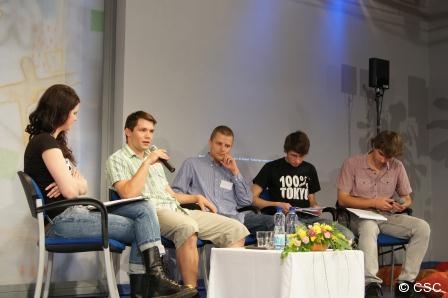 “In 2007 I was diagnosed with leukemia. At first it I reacted well to the news, but in a second moment I was fearful of dying. The support I received from the youth of the Movement, the Gen, which was expressed in so many ways, through sms, emails, and visits was important. During the third cycle of chemotherapy, there was a girl in the hospital with me who had just become a mother. Her condition was worse than mine, she was neither married nor baptized. Nevertheless we spoke about God, about faith, and matrimony. Athough an attempted transplant had failed to help her overcome the disease, just before her health began to deteriorate, she had expressed the desire to marry. So, when she was already dying, I proposed to her family that she receive baptism. A priest came to the hospital and she was baptized “Margherita Maria”. A few days later she died on the feastday of Saint Margherita Maria Alacoque.”
 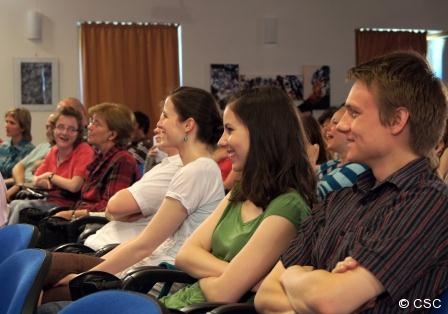 The day-long meeting began with this strong testimony given by Agnieska and it continued with experiences from daily life offered by the young protagonists of the Movement at the Mariapolis Centre. “Traveling the Road Together” was the title given to the day which, as the organisers tell us, was meant to offer an inside look into the “exceptional life of the ideal we believe in”. “To tell the truth, I was sceptical at first,” confesses Lukas, “I thought that there would be fifty young people at most, but that’s not what happened. Evidently the ideal of unity does have something to say.” The hall was barely able to hold the 150 youths who showed up from different regions of the Czech Republic. For most of them it was their first encounter with the Focolare Movement and they were not bashful about expressing their happiness at having found something so great. “I learnt about the Focolare from a friend and I didn’t know what to expect,” says 17 year old Kristina, “but it really surprised me a lot because of the great love you feel from the persons who talk here. I must say that I strongly felt the presence of God. This really moved me, because my father is not a believer and I felt very bad that he didn’t get to know this movement.”
 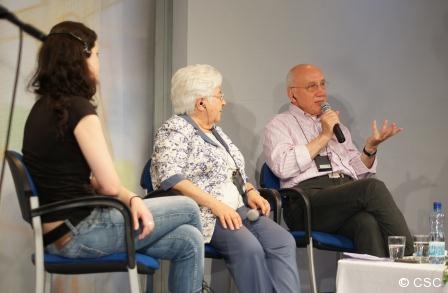 Maria Voce and Giancarlo Faletti share their own “journeys”, the way they met the Ideal of unity all the way to the point of deciding to follow God along the path of the focolare. Immediately questions began to rain down, and the answers were diverse and profound. To one girl who asked her where she could find the courage needed to make radical choices, free of conditioning, Maria Voce suggested: “The period of our life when we’re young is when we make important choices: if you don’t make them now, later you won’t have the opportunity. Yes, you need courage, but there is courage within you and you’ll find it in your relationship with God. If you choose out of love, then you don’t need to worry. Don’t put it off forever and don’t let others make your choices for you.” The invitation was to “love to the maximum”, as Jesus had done on the Cross, “always beginning again”, and never dwelling on “useless regret”. The audience listened attentively in silence. The 150 young people didn’t want to leave. Twenty-seven year old Elizabeth confided: “I’m very critical and at the same time I’m seeking to uderstand how and where to live the Christian life well. I’m searching for my path, and so I gladly agreed to find out what the Focolare Movement was about. What I heard spoken today has been a great enrichment for me and it’s encouraged me to decide to become part of something. I leave here with the understanding that whatever I do in my life, God is important and I can’t only keep him for myself.” Not only for Elizabeth, but for many of those present it really seemed like a new path had opened for them. By Aurora Nicosia [nggallery id=43]
![Bruna Tomasi in Colombia, Equador and Peru]()
23 May 2011 | Focolare Worldwide
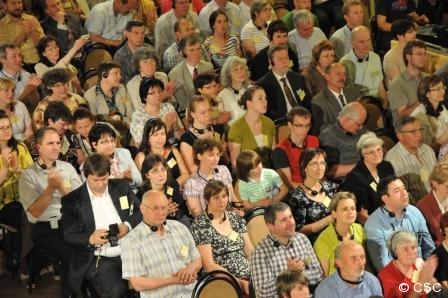 The history of the Focolare Movement in the Czech land has often been marked by heroism. The Ideal of unity first arrived there in the 1960’s when it was still Czechoslovakia and Soviet Communism was in power. Since 1968 and the Prague Spring, which was suffocated by occupation forces after which Communism became even more oppressive, until November 1989 when the regime was terminated, the history of the Czech people was marked by great suffering. But amid al the hiding and persecution many came to be part of the Focolare Movement and, today, more than 700 traveled from across the country to meet the president of the Focolare, in the Palace of Culture in Prague 5, one of the 10 municipalities which subdivided the city. There was excitement, joy and expectation. It was a feast for a family that was reminiscing and looking ahead.
 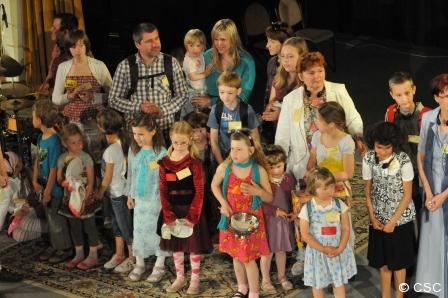 There were numerous questions for Maria Voce and Giancarlo Faletti. A Gen 4 asked: “What were your dreams when you were small?” and some Gen 3: “How did you come to know God? What would you do if you met a poor family? Why didn’t God intervene when Hitler killed so many people? ” Questions from the adults dealt with the significance of the president’s travels, how to pursue the involvement of some of them in the “reconstruction ” of the country, life in local communities of the Movement, and the danger of activism. “My travels bring me to find my family, and so they are a pleasure for me. I go to offer my support, to encourage, to see what everyone is doing,” says Maria Voce. And it doesn’t matter whether they are small or great things. “During a recent trip to North America, she continues, “where everything is huge and our community is small in contrast, I felt that Jesus among those who love each other is a “super-power”. And so the same invitation stands for the Czech Republic to believe in this power so that you can reach the entire nation. With this Ideal not only can we, but we must bring the message of the resurrection into the world, to bring Jesus into the school, the factories, the parliament. This is the greatest thing that we can do.”
 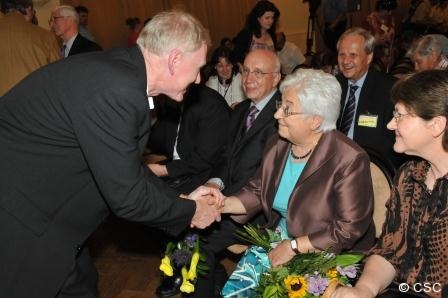 On the same afternoon (21 May) the meeting was opened to all those who wanted to know more about the Focolare “revolution”. The testimonies offered and the initiatives taken showed how this lifestyle has enveloped people of all ages. When considering the progress made since Chiara Lubich launched “Golden Prague” for the city in 2001, it was clear that the commitment to re-evanglize the city has never faultered, nor the fruits. Maria Voce proposed a new step to be taken: “In this country you breathe in history and spirituality which, even during the hardest times, were never destroyed, but perhaps only covered over and protected. Here we are not beginning from zero, we are beginning again from the deep roots left by those who built this society and this culture. The step that we must now take is to bring a new evangelization, a new proclamation, brought by people who have been made new by mutual love. We must commit ourselves to proclaim to others that Jesus is risen, that all the suffering has been redeemed: This is a time of joy.”
 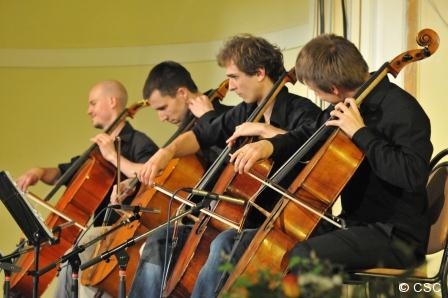 This was confirmed by Bishop Frantisek Radkovský, the Czech Republic Episcopal Conference delegate for the laity: “The Church has great expectations for the movements,” he affirmed during his remarks, “because they are her most dynamic part, a gift of the Holy Spirit for the modern times. Society today is secularized, but now there is an openness to spiritual things and it is important to show with (our) life that Christianity brings the humanism that is true. The movements have the ability to reach everyone and the most diverse fields of action are open to them, from the family to the school, from politics to the economy, from the mass media to sport.” As the meeting drew to a close, the musical quartet which had been offering some fine music throughout the day, began to play the theme song from “Mission Impossible”. It made everyone think that what is impossible for us will be possible for God. By Aurora Nicosia [nggallery id=42]
![Bruna Tomasi in Colombia, Equador and Peru]()
21 May 2011 | Focolare Worldwide
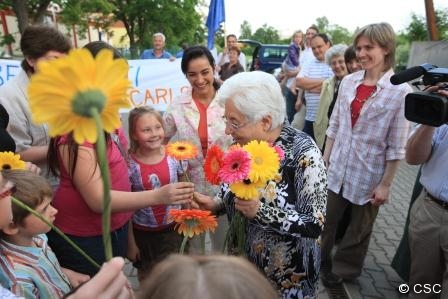 Maria Voce, president of the Focolare Movement, and co-president Giancarlo Faletti were welcomed by an unseasonably warm climate at their arrival from Moscow. And they arrived half an hour early, shortening the waiting time for the thirty people who were at the airport to receive them with applause. Their itinerary would be intense. It included meetings with representatives of the local Church, the archbishop of Prague, Archbishop Dominik Duka, as well as with priests who live the spirituality of communion. There was much expectation among the youths who planned a day meeting at the Mariapolis Centre in Vinoř, and among the entire Focolare community all over the country, which would converge in large numbers on Prague. An open meeting was planned to remember the 10th anniversary of the visit of Chiara Lubich to the Czech Republic and the launching of “Golden Prague”, promoted by Chiara herself on that occasion for the implementation of the “new evangelization”.
 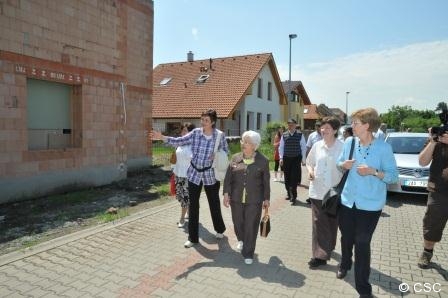 Maria Voce and the small group from Rome were offered hospitality at the small Mariapolis Centre, which was begin over two years, in the heart of the Focolare town which is under construction. “In 2001, when Chiara Lubich came to Prague,” some of the pioneers tell us, “she expressed a twofold desire: to provide a house for the family of the Movement and to have a place where people she had met – members of the political and ecclesial world – could meet.” Said and done, with much entusiasm and many initiatives, the latest being the “first Saturday projects”, which continue until now. Gradually the Mariapolis Centre has taken form and also the little town which is still under construction. Every first Saturday of the month people are invited to come and help in the work, brick by brick, to build a place that is bcoming a centre for the spreading of the spirituality of unity. Ten families have already built their own houses and moved in, others are planning to do the same. Before she left, in 2001, Chiara had buried medals of Our Lady at the various construction sites of the small town which is located in a suburb of Prague. “Some of our neighbors didn’t understand,” report those who were present at the time, “they thought we were burying money. But with time they came to understand the true sense of what was being born here.” Even people who seemed far from God drew near to us and now somehow belong to the family of the Movement. Oh yes, someone explained, because here it isn’t so much atheism, as much as a type of non-belief, which is the result of non-awareness. The desire to know God hasn’t diminished.

The Archbishop of Prage, Msgr Dominik Duka
19 May 2011 | Non categorizzato
![Bruna Tomasi in Colombia, Equador and Peru]()
19 May 2011 | Non categorizzato
 In 1986 a Hungarian family from the Focolare Movement, the Fialowskys, moved from Budapest to Dugna, some 130 Km from Moscow. Some families and youths immediately began to gather around them. In 1989 and in 1991, two centres of the Movement were opened in the capital. At that time, the community was comprised of around 40 people. In August of 1991 there was the first and long-awaited meeting between Chiara and the members of the Movement from Eastern Europe, in Katowice, Poland. It was an important milestone for the members of the Movement in Russia, because for the first time, they would go beyond their borders to meet Chiara and the other members of the Movement in Eastern Europe. In April 1992 the first puclic gathering was held, the Mariapolis, with 220 participants.
  In September of the same year a first journey was taken to Celiabinsk, a city beyond the Ural Mountains, some 1900 km from Moscow, which up until shortly before had been closed to foreigners. Little by little a community of the Movement developed and, already in 1995, a first Mariapolis was held. This was followed by the birth of new communities in Novosibirsk and Omsk. In 2001 a focolare was opened in Krasnoyarsk, dedicated to the Siberian region of the country. It was the first encounter with the people who had already been receiving the Word of Life for some time. The spirituality was welcomed by in several cities of Siberia. The first Siberian Mariapolis was held in 2004 at Divnogorsk, a city near Krasnojarsk. The participants came from different cities, after having travelled distances of up to 2000 km. Ninety were of different nationalities and churches. After the fall of the Soviet Regime, Russian society was in search of an identity. In this journey, the Movement’s way of acting was always appreciated, especially in the relationship with the Russian Orthodox Church. At times, official representatives of the Patriarchate of Moscow took part in Focolare gatherings. Focolare co-president Giancarlo Faletti’s presence at the enthronement of Patriarch Kirill, in February 2009 was of significant importance for the community of the Movement.Some members of Orthodox associations watched with great interest the “Together for Europe” project, and have been attending the event since 2004. Among the early Focolare pioneers in the then Soviet Union, we cannot forget to mention Guedes, a Portoguese focolarino wh died in January of this year, and lived for 20 years in Russia. His humble generosity is a characteristic that is very appreciated by this people, who abundantly reciprocated his love in many ways, especially the many Orthodox friends. Then there was Regina Betz, a German focolarina, who lived in Moscow from 1990 until 2008, establishing true and lasting relationships with many people. One episode that she tells of, seems to express what building unity in Russia has meant in these many years: « I taught German at the Lomosonov University of Moscow. One of my colleagues, Alla, wasn’t well with her health. She saw it as a punishment from God because she had given up living as a Christian. She told me that during an udating course in Lipsia she had returned to the Church, but coming back to Moscow, she drifted away. One day she asked me if she could go with me to Mass. I explained to her that I wasn’t Orthodox, but Catholic, so as not to create any problems for her. The following Sunday we went together to Mass at Saint Lousi Church, at that time, the only church in Moscow. Then I didn’t hear anything from her for quite a while. When we finally met again, she told me that she had been baptized ‘Russian Orthodox,’ she said almost apologetically. I told her that she had done well, since she was Russian!”
  Presently, the majority of the Movement’s members in Moscow are Orthodox. One of them, Nina Vyazovetskaya, spoke in Rome, at the Basilica of Saint Mary Major’s, on the occasion of the third anniversary of Chiara Lubich’s death. She said: “I come from Moscow, and I belong to the Russian Orthodox Church. I am a doctor and I did my internship at the Moscow Hospital. I grew up in a family of unbelievers, as many people are in Russia. In 1990 they baptized me a bit ‘by accident’ because, with the fall of Communism came a time of change and everyone was searching for something new. But after that day, I never went to church. The encounter with the Focolare Movement marked a change in my life. I met God and my life changed. In order to get to know Him, I turned to the focolarine, who are Catholics, and they brought me to my Orthodox church. This was how I began to disover the beauty and richness of the church, of the Christian life, of living for God. And now I have decided to follow God along the way of Chiara in the focolare.”
![Bruna Tomasi in Colombia, Equador and Peru]()
18 May 2011 | Focolare Worldwide
 The global economy is a very powerful machine yet it is fragile and unstable. This is one of the messages of the crisis we find ourselves in. Specifically, the globalized economycreates enormous opportunities of wealth but also produces new costs. Among them is the radical uncertainty of the financial systems and stronger social imbalances. Oftentimes the consequences of these crises are borne not by the social sector that caused it and normally the much poorer ones. This is why the theme of social justice today is also the dominant theme of the new economy. We are witnessing it in the mid-Orient (we should not forget that the revolution these months were triggered by issues relating to economic justice). I believe we will continue to see this in the coming years not only in the Arab countries but also in China and in India. When individual freedom and democracy takes over, the enormous inequality we find in these new giants will no longer be tolerated. It is my belief that the there is a growing intolerance for inequality, whether within countries and among countries. It seems as if the post-modern man, informed and global, after having achieved political democracy, is now seriously demanding economic democracy. It seems as if he’s become aware, with much struggling and with much delay, that economic democracy is an essential part of political democracy. In fact, the market, though being a venue of life in common, governed by rules based on mutual advantage, is not able to ensure a just distribution. Moreover, in the absence of other principles and institutions, the market tends to augment the inequalities in time. On one hand, the market is in fact a free place, of creativity based on individual talents and the talents are not evenly distributed across the population. On the other hand, we do not part from the same starting line in this market race. He who has more (resources, education, opportunities) tends to have even more tomorrow. What can be done then?
  May 29, 2011 marks the anniversary of the Economy of Communion (EoC), the economic project launched by Chiara Lubich in Brazil. It was the same month that Pope John Paul II published Centesimus annus, an encyclical that Chiara had meditated on during that trip. Representatives of the EoC from various parts of the world will come together in San Paolo ,from May 25 to 29, to celebrate this occasion. It will be a chance to review the first twenty years but more importantly, to look into the next twenty years. (www.edc-online.org). The message that Chiara launched during that trip remains alive today and continues to mature and grow in history. It has reached beyond the Focolare community where the EoC was born. Pope Benedict XVI has cited it in Caritas in Veritate as an experience that needs to be developed and propagated. The message is simple and clear: the enterprise has to be, above all, an instrument and a place of inclusion and of communion. While it produces wealth, it should also distribute wealth, thereby making it a place of justice. If we really want economic democracy and just redistribution, we cannot and should not rely on the States or on the governments. It should be the same enterprise, with the encouragement of civic society and the citizens of the world, which evolves and looks after the new things, of those res novae in the global context we live in. The enterprise cannot limit itself to operating legally, paying taxes (even when they pay) and to engaging in some philanthropic efforts to gain clients. In this new phase, there is so much more that is demanded from the enterprise, if we want civil society to consider the enterprise and economy as partners for the common good. If all enterprises remember this need to become more and to evolve into an economy for the person, we then welcome the anniversary of the EoC. Editorial published on Mondo e Missione n.5/2011
![Bruna Tomasi in Colombia, Equador and Peru]()
17 May 2011 | Focolare Worldwide
 Crossing the threshold of the church of “Mary, Joy of the Infirm” is to enter directly into the heart of the Orthodox faith. The praise expressed by the hymns and prayers, from inside the doors of the temple continued for two hours, and created among the faithful a climate of deep prayer. The liturgy was solemn; the vestments were splendid and rich, all of them red because of Easter. Maria Voce, wore a veil over her head, like the one all the Russian women wore who were attending the liturgy together with the Orthodox members of the Focolare Movement. It was a time of fellowship and respect for the different churches in attendance. At the conclusion, everyone exchanged three kisses to seal a pact of mutual love, as a witness to a bond of unity that recalls the words of Saint Paul: “there is neither Jew nor Greek” which, now, in front of iconostasis could be translated: “there is no Orthodox nor Catholic, but we are all one in Christ.” The celebration was followed by a greeting to Metropolitan Hilarion Alfeyev, who presides over the external relations department of the Patriarchate of Moscow. He was visibly pleased to see the president of the Movement and her Catholic delegation together with the Orthodox who accompanied her. Father Dimitri Sizonenko, acting head of the Secretariat for inter-Christian relations, was particularly overjoyed by the testimony of unity given by the Movement and called for a wider spreading of this spirit. T
 wo more meetings remained for the afternoon of May 15, with the families and with the young people. “How are we to convey the spirit of the Movement to our children? How can we help other families to appreciate the faith? What should we do when we feel overcome by our weakness?” These were some of the questions posed by the thirty persons – most of them young couples. Some were married in the Church after having encountered the charism of Chiara Lubich, while others came to appreciate the importance of fedelity in marriage after having had quite another kind of experience. Years of atheism have left their mark on the family institution. Marriages are often unstable and the decision to get married is often more a matter of tradition than of personal conviction. There are many divorces, unmarried couples living together, and alcoholism. “The messages is given by the testimony that you offer as a family,» Maria Voce responded, “by your capacity to say you’re sorry, to go back and look at the other with love after a moment of difficuulty. This is worth more than many words,” Giancarlo Faletti continued: “No one likes to suffer. But God meets us in our suffering and he allows himself to be met so that he can tell us something and give us something, to help us go on loving.” The meeting with youths began with an informal gesture. Neckties were removed, guitars began to play, and photographs were taken. There was open discussion about the challenges of Russian society, including corruption, excessive freedom, and the difficulty of finding a place for the upcoming Genfest (Budapest, September 2012). One young man would leave his job after he had unwittingly endorsed a fraud. “You need to take a decisive step give witness. In these places you can change if there are people like you,” is the encouragement of Maria Voce “You’re in an environment that needs to be Christianised,” Giancarlo Faletti affirms, “and Jesus is using you to convey a message. Inside a ruthless economist, there is always a man with a soul. We cannot give up, we must bear witness.” “Free choice is an opportunity that God gives us to exercise our freedom,” the president replied to Liza who could not find a sense of direction for his life. Considering your actions with your brothers can help to amplify what God is asking you and help you to give a firm response.” There was seriousness and fresh commitment during the two hours of discussions, concluding with Maria Voce’s words of trust: “I leave you to do, I trust in Jesus in you and among you. The Genfest will be a surprise and will be most beautiful because you will do it.” By our correspondent Maddalena Maltese [nggallery id=40]
![Bruna Tomasi in Colombia, Equador and Peru]()
16 May 2011 | Non categorizzato
 In 1977 Vita e Pensiero Pubishing House published “Sign of Contradiction”. The book is a collection of the spiritual exercizes preached in 1976 by Karol Wojtyla to Pope Paul VI and the Roman Curia. The following year, shortly after the election of Wojtyla to the Chair of Peter, Igino Giordani wrote a letter to the new Pontiff:
25 November 1978
Holy Father,
I am an 84 year old (!) focolarino.
I read your book: “Sign of Contradiction” and found it particularly enjoyable for two reasons: firstly, because of the way in which you dealt with the exalted topic with such rare wisdom and clarity; secondly, because I too, more than 40 years ago, with considerable presumption, wrote a book with the same title.
I take the liberty of sending you a copy of the latest edition of my book, as a humble tribute and expression of the joy that I, like all the focolarini and nearly every other living person feels, because of your election to the Pontificate and because of the depth and spontaneity of your daily apostolate.
Please forgive my boldness, and grant me your blessing.
Devotedly yours,
Igino Giordani
An immediate response from the Vatican Secretary of State:
1 December 1978
Dear Sir,
In a greatly appreciated gesture of courtesy, you sent as a tribute to His Holiness, a letter and a copy of the volume edited by you with the title, “Sign of Contradiction”, already in its fifth edition.
The Holy Father has asked me to share with you his feelings of deep pleasure and heartfelt gratitude for the delicate act of homage, which he greatly appreciated. The Supreme Pontiff, therefore, is happy to reciprocate such veneration, giving the desired apostolic blessing as a sign of appreciation for your long activity in the service of Holy Church and as a wish of heavenly graces.
I gladly take this occasion to confirm with distinct deference to your illustrious person.
Most devotedly yours,
+C. Caprio
![Bruna Tomasi in Colombia, Equador and Peru]()
16 May 2011 | Focolare Worldwide
 The trip will take place over three stages:
- 13th -19th May: Russia (Moscow)
- 19th – 25th May: Czech Republic (Prague)
- 25th – 31st May: Hungary (Budapest)
Maria Voce will visit the Focolare Communities in each country. In Moscow she will hold meetings of particular significance with the bishop Mons. Paolo Pezzi as well as with the Apostolic Nuncio Mons. Ivan Jurkovic. In Prague the Focolare President will meet Archbishop Mons. Dominik Duka. On May 21st there will be an event to commemorate 10 years since Chiara Lubich’s visit and the foundation of Operation “Golden Prague”: a project launched by Chiara in view of the ‘new evangelization’. The Focolare Movement has been present in the ex-communist bloc since 1961. In July 1960 the Bishop of Lipsia Mons. Otto Spulbek offered Chiara Lubich the possibility to send focolarini men and women who work as doctors to the hospitals in his diocese as a response to the lack of medical professionals in the region. Exactly 50 years ago on 13th May 1961 the first focolarini arrived in Lipsia. From Eastern Germany, thanks to personal contacts, the Movement spread immediately to Czechoslovakia, Russia, Lithuania and other countries of the communist bloc. Currently, the Focolare Movement is present in all the countries of the region.
16 May 2011 | Non categorizzato
![Bruna Tomasi in Colombia, Equador and Peru]()
16 May 2011 | Focolare Worldwide

Maria Voce and Giancarlo Faletti are given the official welcome

Regina Betz (right) was a pioneer of the Focolare Movement in Russia
 The president of the Focolare Movement then confided, “When I arrived in Russia I found myself immerged in a deeper union with God and I remembered the expression ‘Holy Russia’- that I perhaps heard when studying Russian literature. I felt carried along by this life of holiness that is in the air here in Russia as well as in its history of Christianity. And I understood that Russia’s gift to me and to the whole of humanity can be this holiness- thanks also to its martyrs of all denominations”. Giancarlo Faletti, using the image of the golden domes in many of the Russian Orthodox churches, underlined, “God is the gold of our cities, He is the gold of the Russian Orthodox and Catholic Churches and He guarantees the journey of communion that this country witnesses in many important ways”. Many participants were openly moved, experiencing the possibility to give new meaning to those dark years and at the same time they felt the challenge to give witness to the ever old and ever new Gospel “revolution”. Eduardo Guedes – a Portuguese focolarino who passed away last January- was remembered by many as a companion in this journey; someone who, without sermon, gave humble witness to a God who does not forsake, who does not forget, but who always knows how to welcome both the disadvantaged and the powerful and to expand the desire for a more modern sainthood, open to everyone in this “Holy Russia”. by our correspondent Maddalena Maltese [nggallery id=39]
![Bruna Tomasi in Colombia, Equador and Peru]()
15 May 2011 | Focolare Worldwide
13 May is a day of celebration for the Catholic world, the feast day of Our Lady of Fatima. And 13 May is also a symbolic date for the Movement, recalling the night of the “stars and tears” when, because of the bombing of Trent, Chiara Lubich had to evacuate her home and take refuge in Goccia d’oro forest. As she wept for hours, she observed the movement of the constellations and she realized that only love could overcome such a horrible tragedy. On this 13 May 2011 Maria Voce and Giancarlo Faletti landed in Moscow for a visit to the Focolare communities in Russia. This is a trip that Chiara Lubich was looking forward to since the 1960’s, as she mentions in a speech from those years. In fact, she was never able to accomplish her desire, although many of her first companions did spread the spirituality of unity in this land up until the 1970’s.  Landing at the Sheremet’evo airport, there was a tiny ray of sunshine trying to challenge the uncertain sky, which became rainy at times. The airport, modern and bright, easily be mistaken for a western city: the brands that fill shops and restaurants are the same. After passing through the regular checkpoints, which were bit tighter following the latest attacks, they were able to exclaim that they were in Moscow. A small group of focolarini with flowers and smiles stepped forward to welcome the visitors with a three-fold embrace. On the highway going to Moscow there were large construction projects, a sign of a growing city in both commerce and residents More and more Russians are moving there, and the population already stands at 15 million. “On this special day, we entrust to Mary our visit to Moscow, all the people we meet, and all those who are praying for this event.” This was the prayer chorally expressed by Maria Voce and Giancarlo Faletti before an icon of Our Lady, during a Mass dedicated to the Mother of God. There was much expectation for the meeting of 14 May with Focolare members from all over Russia. It is the first time since the beginning of the movement in these lands that Catholics and Orthodox Christians from Chelyabinsk, Novosibirsk, Krasnoyarsk, and St. Petersburg will gather to witness their living, cheerful, and active presence that has been able to win over mistrust, diversity and the long distances that challenge the eight time zones of the country. But some wanted to anticipate the first “face-to-face” meeting with the president. The little children, painted like colorful Matryoshka dolls, made the welcome festive and traditional, a reflection of the many souls of the people who live in the city, a mixture of modernity and history of national pride and unavoidable globality. From our correspondent Maddalena Maltese
13 May 2011 | Focolare Worldwide
“Lighthouse” is the prophetic name of the Croatian Little Town, a formation center for people of different countries, churches, religions, and for men of goodwill. This is how Chiara Lubich, founder of the Focolare Movement, envisioned it, when in the ’80s, a few-hectare piece of land with some buildings no longer in use was put at disposal of the Movement in Križevci, about 60 km far from Zagreb. Nowadays Lighthouse is known as a privileged meeting place for persons coming from all over the Balkans, in particular after the reconciliation effort among all the ethnic groups during the ’90s war. In this Little Town, in April a formation school organized by the New Humanity Movement took place, addressed to participants coming from 12 different counties of Eastern Europe. Some of these countries were at war with one another in a recent past, others were characterized by enormous economical problems and a difficult transition to democracy. These are delicate situations, not always easy to reconcile, and this is why from April 15 to April 17 the focus was on the knowledge of all the values that characterize the commitment of New Humanity, the social branch of the Focolare Movement. The aim was to provide a concrete expertise, in order to apply these values in the different challenges, which professionals have to face in all the social fields: from medical doctors, to youth workers, politicians, economists, judges. Everybody has his own specific job, but all together they are fraternity witnesses. Indeed this is mainly what came out of the intense dialogue among participants and members of the central New Humanity Secretariat, arrived from Rome and other regions of Italy. Delia from Split writes: “I think that for each of us this school was a new opportunity to feel like being a protagonist in living for fraternity in his or her environment, and to roll up one’s sleeves in order to improve the place where he or she lives. Indeed nothing of what we do for love is too small”. Sanja Jurić echoes her; she tells us: “Coming home, I told everybody what I had experienced: in my family, with my colleagues at work, and I started to live more intensely, trying to do as best as I can my share where I am“. These are just few validations to the message which Maria Voce, President of the Focolare Movement, had sent the first day of the meeting: “I wish you can draw on the strong and enlightnening presence of Jesus in your midst. His way of thinking and acting for the common good, knowing that – as Chiara has often reminded us : “The world belongs to all those who love it most, and can best prove it“.
12 May 2011 | Focolare Worldwide
The events of 20 years of EoC in Brazil are just around the corner. The final preparations are in full swing. People have been passionately working for several months in preparation for these 5 days which are important to all those who have EoC in their DNA. The preparations are being made on two fronts: one fof the EoC Assembly at the Mariapoli Ginetta of Vargem Grande Paulista and the Open day in Sao Paulo, where some 1600 people are expected at the Memorial of Latin America. The organizers inform us that for the Assembly, we have reached the threshold of 630 participants: a truly ambitious goal, especially for the diverse countries of origin of the people. Some 37 countries, coming from 4 continents, are expected to be represented. If the majority are obviously the Brazilians, with over 240 participants, Italy comes in second with 85 participants followed by Argentina with 62 participants. There is also a significant representation from Korea with almost 30 people! Following by order of numerical representation, are Spain, Chile, USA, France, Uruguay, Switzerland, Bolivia, Germany, Venezuela, Slovenia, Paraguay, Mexico, Portugal, Belgium, Ireland, Canada, Serbia, Panama, Philippines, Cameroon, Poland, Croatia, Costa Rica, Peru, Kenya, Slovakia, Hungary, Ecuador, Colombia, Ivory Coast, Nigeria, Congo and Romania. With our suitcases almost ready, we are now preparing a staff that will work actively to maintain the site as updated as possible — providing daily news, photos, documents and echoes of what’s happening in real time. The young people present will create a blog and will do their part through the social networks … Those who cannot be present in Brazil can still participate in events in real time through live streaming that is being prepared. The link to access will be published on the website once available. Live broadcasts will be made during the days of the Assembly at the Mariapoli Ginetta (25-28 May) on the final day in Sao Paulo on Sunday May 29. There will be an opportunity to organize listening points, especially for the final day, creating opportunities to get together in celebration of this important anniversary. We have already been informed of a listening point at the Business Park Lionello in Loppiano, the Business Park Giosi of Abrigada (Portugal), in Vienna, in Lugano, and perhaps in Madrid. The list may become longer in the following days. The live streaming during the days of the Assembly will be in the morning to allow everyone to take part in the themes of the Assembly. The language of the live transmission will be in Italian. On May 29 the live streaming will be on-going throughout the day. Further details will be published as soon as they are available. In the meantime, see you all in Brazil! by Antonella Ferrucci – www.edc-online.org
![Bruna Tomasi in Colombia, Equador and Peru]()
11 May 2011 | Non categorizzato
 “God loves me – God is calling me”, was the slogan printed on cards that identified the young people present at Loppiano (Italy), between 14 and 19 March 2011. This slogan expressed the goal of the days: to delve deeply into the vocation of a focolarino, someone who is called by God to become an “apostle of unity” – a beautiful expression used by John Paul II – and to follow Jesus by pursuing his prayer to the Father: “May they all be one” (Jn: 17: 21).
The thirty-three young people came from different parts of the world. There were students, labourers and entrepreneurs among them. But they were all united in the single desire to put aside everything for God, to renounce starting a family, in order to dedicate themselves to the building of the unity of the human family that Jesus prayed for. Many impressions were shared during those days, like Andrew and Jonas from Brazil. Andrew who just finished his master’s degree in history, said: “I left behind some nice things, some very nice things, only to find more beautiful things here.” Jonas, who is an airline pilot, remarked: “I’m left with the certainty of God’s call, because of the strong spiritual experience I had here.” Indeed, it is often the presence of the Risen Christ in the midst of the community who amplifies the voice of God and allows it to be heard in one’s heart. Stephen, an engineer from Rome, talks about the intensity of those days: “I will take home with me the relationships that I built with each one of you. I understood that Jesus Forsaken is the essence of our vocation.” He was referring to a central point of Focolare spirituality: Jesus dying on the cross for everyone and experiencing the abandonment of the Father, taking upon himself all the abandonment and suffering of humankind. The focolarini choose Jesus forsaken as a model of self-giving and the basis of their choice in life. Renzo, who is also Italian from Bari, added, with his face beaming, “I take with me the extraordinary beauty of life in a focolare”.  Jay is a journalist from the Philippines. He says he learned in Loppiano “to recognize in pains and difficulties the face of Jesus forsaken.” Not only: the real discovery for him was that he had tried “to love Jesus forsaken with joy, not merely to get through the difficulties.” Anthony a young Kenyan student summarizes the challenge: “To aim high. This is the vocation of the focolarino, it’s mine, it’s ours.” At the end of those days that they will never forget, they wrote the following to Maria Voce, President of the Focolare Movement: “It was Jesus guiding us deeper into our vocation, in order to take us to a new level of intimacy with Him. We asked him to help us to be always faithful to Him.” And they affirmed their decision to live this “divine adventure, trying to imitate the transparency of the Blessed Virgin Mary, who never thought about herself but only of God, the most perfect model for a Christian of today and always.” Here are some images of some of the highlights of these days, which speak louder than words. [nggallery id=38]
![Bruna Tomasi in Colombia, Equador and Peru]()
11 May 2011 | Focolare Worldwide

Silvana with Gustavo Clariá (Focolare Website)

Mariapolis Lia
 Chiara Lubich underlined the central role of young people as one of the characteristics of Argentina’s Focolare little town. I visited the whole little town and I met the focolarini men and women, the schools for young people and the local Focolare community. I was struck by the relationships of unity and the harmony among everyone. The stamp of reciprocal love left by Lia Brunet and Vittorio Sabbione- pioneers of the movement in Argentina- is truly visible. Chiara, during her historical visit in 1998, underlined this reciprocal love as a characteristic of the little town. I can truly say that I experienced the spiritual presence of Our Lady. I spoke about her in a talk I gave to the whole community, describing how she manifested herself in the story of our movement as a model for living the Will of God.
 I also visited the “Solidaridad” Enterprise Centre where some businesses inspired by the Economy of Communion can be found. Theses businesses are still small but they are pure and coherent with Gospel values that assure them of a promising future. The ‘hidden associate’- as they themselves call Divine Providence- accompanies them and intervenes faithfully. You spent Easter in Argentina…!
  I spent it at the Mariapolis Centre in Jose C. Paz, near Buenos Aires. They were intense days of deep spirituality spent with the focolarine women. There were about 90 of them including those who are married. At a certain stage the focolarini men and all the members from the local Focolare community came: there were about 400 people in all. When I was with them I felt an inner push to underline how, at the dawn of the movement, along with Chiara, we understood the realities of Jesus in the Midst and Jesus Forsaken. I was moved by the love and gratitude that they expressed in so many ways and was really touched by the harmony that reigns between them all. Of course this can always improve and grow but I think Chiara from Heaven is happy.
![Bruna Tomasi in Colombia, Equador and Peru]()
10 May 2011 | Non categorizzato
14th March 2009 was Chiara Lubich’s first anniversary. With a live event entitled “With Chiara – a dialogue that continues” people around the globe retraced the steps of her life. One of the most significant experiences shared at the event was that of Mons. Dziwisz, who closely accompanied John Paul II. He was ordained priest by Wojtyla in 1963 and was by his side as secretary for 40 years. He is now Cardinal of Krakow, a role once held by his friend Karol. The following is a transcript of what he said in the video-taped interview.

Video: Interview with Msgr Stanislao Dziwis (Italian soundtrack)
![Bruna Tomasi in Colombia, Equador and Peru]()
10 May 2011 | Focolare Worldwide

Liliana Cosi
In the 1960’s Liliana Cosi was a young ballerina at the beginning of her career. This interview retraces the steps of that period in Moscow.
“An Italian swan conquered the USSR”, was how an Italian newspaper headlined after your debut in Moscow back in 1965. What was the story behind this headline?
 I was in Moscow for my second year of apprenticeship at the Bolshoi Ballet Academy as part the historical cultural exchange between Milan’s La Scala and Moscow’s Bolshoi Theatre. My Ballet Mistress, Irina Tichomirnova, decided to teach me the role of prima ballerina for Swan Lake. It was a very new and very challenging experience for me. Ms. Tichomirnova was very demanding- she literally sculpted each of my movements, each of my gestures – but I was up for it!
As we draw closer to the debut (I think she was more nervous than I) she said to me, “Now forget everything I’ve told you and dance with your Italian soul!” Then in the changing room, a few minutes before going on stage, she took my head in her hands and made three signs of the cross on my forehead… she didn’t know that I was Christian; I didn’t have any outward signs.

Liliana Cosi and Rudolph Nureyev
I had just met Chiara’s Ideal and it had taught me that love of God was something to be lived out, not put on display. The next day the Soviet newspaper Isvietzia reviewed the performance and described my dancing as full of ‘spirituality’, an expression that had never before been used in that newspaper! That debut was the beginning of my career.
Did you go to Moscow alone?

Liliana with Valeria Ronchetti
No. Other than the small group of Italian ballerinas who lived in the Bolscioi School Residence and of whom I was group leader, there was also Vale: Valeria Ronchetti one of Chiara’s first companions who had come to Moscow to accompany me. It’s difficult to describe how important those months were for me: a phase of radical change of mentality that influenced (and continues to influence) my whole professional, spiritual and human life. Something that perhaps sums up that period is one of the things Vale said to me: “You don’t have to dance for Jesus; it has to be Jesus in you who dances”.
Did you go back to Russia afterwards?
I was invited back often by the Soviet government: right up until 1989 I went on tour not only around Russia but also in the various capitals of the Soviet Union. I did over 130 shows there and, as a jury member, I took part in three international ballet competitions in Moscow.
What did you take away from the experience in Russia?
From a strictly professional point of view it gave me a lot. At the time there were many dance masters and artists at a very high level. Right up until today they are models for me when I teach and coach at our dance school and ballet company. As a life experience it taught me that you can live the Gospel anywhere and that this Gospel based lifestyle fascinates even those who don’t know anything about it.
![Bruna Tomasi in Colombia, Equador and Peru]()
9 May 2011 | Non categorizzato
 And yet it was much more than a simple series of events around the globe: the thousands of young people from the most varied of cultures and traditions who took part in the week’s activities and projects were a visible demonstration of that united world that YPUW World (Young People for a United) live for. Even though taking an overview of each of the week’s events would be like going on a fascinating trip around the world, it would be too long to fit into one article! For now we’ll just take a quick glace at some of the activities. We’ll start from the Middle-East, a zone that’s experiencing a historical moment of change initiated by young people. The video that the YPUW from Egypt prepared (using the same title as the Meeting in Rome that kick started United World Week) was full of meaning: “Make visible change”. (link http://www.youtube.com/watch?v=uYr664g4b6g&feature=player_embedded#at=63)
  The YPUW from Lebanon held an ‘interreligious movie night’, a sports day, an ecological project and a social development day. The social arena was also a focus point in Latin America. In Cuba, for example, the YPUW visited children who live in a shantytown in Havana that sprouted up under one of the city’s bridges.
  In Guatemala, a series of events coloured each day of World Unity Week in a different shade: Giving, Being the first to love, Dying for your People, Forgiveness, Ecology, Weaving Relationships were the various titles of the 6 days of events. Our last stop in Latin America brings us to Rosario, Argentina where two groups of 25 young people did a variety of mimes- on the footpaths at traffic lights- about building a united world! In various countries events were held for Japan in the light of the country’s natural disaster last month. In Los Angels a “Hike a thon” was held to raise funds for the population of Fukushima. In Florence there was a dance marathon and the main square of Frascati (Rome) was livened up by an open workshop on Japanese culture.
  In Goa, India, a day was dedicated to Chiara Luce Badano. The local YPUW presented the life of this young member of the Focolare- who was beatified on 25th September last- through songs, choreographies, traditional Indian dance, experiences and videos. In Chiara Luce’s home town of Sassello, with 1200 young people present and others following via internet, United World Week had its official closure. A musical called ‘Living the dream’ was preformed by a group of young people from Genoa: fruit of an exciting workshop with Gen Rosso. The musical was inspired by the life of two boys from Genoa who are also on the road to beatification: Alberto Michelotti and Carlo Grisolia. Then there was a special tour of the Badano house with Chiara Luce’s parents Ruggero and Maria Teresa. The replay of the event is available on: http://media.focolare.org/ClSMU2011.wmv. To top the day off there was an exciting announcement: Genfest 2012 will take place on 1st and 2nd of September in Budapest. Watch this space for further news on this! Detailed articles on World Unity Week can be found in Italian and Spanish on the blog: www.mondounito.net.
7 May 2011 | Non categorizzato
![Bruna Tomasi in Colombia, Equador and Peru]()
5 May 2011 | Focolare Worldwide

(from left) Anna Fratta and Barbara Schejbal with Pope John Paul II
 Before his election to Pontificate, Karol Wojtyla only knew Chiara through her writings. As soon as he became Pope he wanted to meet her. I was visiting Rome in that period and I received a phone call from the Pope’s secretary Stanislaw Dziwisc who I knew very well. He told me that the Holy Father wanted to invite Chiara and I to his mass the next day at 7. Chiara, Eli Folonari and I left very early in the morning. As you can imagine we were very excited. When we arrived we saw that the platforms for the Conclave were still in place and so we had to take a longer path to get to the Pope’s apartment. That mass in the Pope’s private chapel is still vivid in my soul. There was such a special atmosphere of recollection, a presence of God. Along with the Pope, don Stanislaw and the three of us there were only 2 or 3 Polish sisters.
  After Mass the Holy Father greeted Chiara. I still remember with what high regard and great love he addressed her. He asked if he could have a map showing the different places where the Movement was present: “So that I can know where to lean on!” he said. It was the beginning of a special friendship, of an ever stronger unity between two people called on by God to do great works, two people to whom God gave two gifts for the Church and for all of humanity”. By Anna Fratta



