18 Oct 2021 | Non categorizzato
“We know that all things work together for the good of those who love God”, (Rom. 8:28) is the word of life that we are trying to put into practice during this month of October 2021. In this text, Chiara Lubich helps us understand better what St Paul was writing to the Romans. God makes all things work together for those who love Him. … So things don’t work together for the good of everyone, but only for those who love God and respond to his love. God’s love for each of us is not something generic, but is instead deeply personal and special. He makes all things work for the good – that is, for salvation, true happiness and spiritual progress – of those who love him. Everything. So it is not only the Words of God or the sacraments, or the various ministries and other means he has established in the Church that work for our spiritual good. They obviously do. The Apostle clearly means something more. For those who believe in the love of God, and love him, the many circumstance that influence our existence are not simply a matter of chance, nor the result of the blind laws of nature, nor of human planning. Rather they are guided by his love; they are the many opportunities and means that God uses to bring to completion the work of our sanctification. God hides behind all the events of our lives. He is hidden, for example, behind a particular state of health, or a setback, or a sudden change of plan due to circumstances. He hides behind the particular conditions of our state in life, or a sudden spiritual trial, or a problem of any kind at work. He’s behind the fact that we happen to be in a particular place or with a particular person. For those who love God, everything, even the faults of our past life, acquires a positive meaning, because in all these circumstances we experience the love of God who wants to guide us towards holiness. … Above all, we should never stop before the merely external, material or secular aspect of things, but believe instead that every event contains a message through which God expresses his love for us. We will then discover that our life, which may seem to us like a piece of material full of knots and threads woven together in a haphazard way, is actually a marvellous design that God’s love is weaving on the basis of our faith. Secondly, we must trustingly and totally abandon ourselves to this love at all times, both in small and large things that happen in life. Indeed, if we know how to entrust ourselves to God’s love in ordinary circumstances, he will give us the strength to entrust ourselves to him even in the most difficult moments, such as when we suffer or experience illness, or at the very moment of death.
Chiara Lubich
(Chiara Lubich, in Parole di Vita, [Words of Life] edited by Fabio Ciardi, Opere di Chiara Lubich, Città Nuova, 2017, p. 297)
16 Oct 2021 | Non categorizzato
Just days before “Time of Creation” closes, some reflections and experiences on the contribution that we as citizens of the world belonging to different religions can offer for the protection of our planet and humanity, seeing creation as a point of encounter. Like “a sister, with whom we share our life and a beautiful mother who opens her arms to embrace us “. These are the words with which the Holy Father, in describing our planet, introduces us to his Apostolic Exhortation Laudato Si. The Pope’s appeal is addressed to “all people of good will” and to believers of all faiths: “The majority of people living on our planet profess to be believers. This should spur religions to dialogue among themselves for the sake of protecting nature, defending the poor and building networks of respect and fraternity”.[1] Our home is in danger and the gravity of the ecological crisis we are experiencing requires a way forward for the common good. Digging deep, right to the essence of each faith is the way to discover, with wonder, that we are united in creation. It is the way to rediscover in the beauty of diversity that we are brothers and sisters living under the same roof. “Judaism teaches that we are God’s partners in creation,” explained Emily Soloff, Associate Director for Interfaith and Intergroup Relations at the American Jewish Committee. “We do not own creation,” she continued, “but we have a responsibility to care for and heal the world. (…) Shabbat is one day in the week when we intentionally reduce our energy consumption by completely turning off our computers, phones and other electronic devices. We don’t drive a car or shop on Shabbat. It is a day of rest.” Modernisation has gradually distanced us from seeing the earth as a manifestation of the divine, allowing man to triumph over nature. Mostafa El-Diwany, a Muslim doctor in the Department of Medicine at the University of Montreal in Canada said: “In Islam, as in the other Abrahamic faiths, the axis of being is the Unity of God; the Creator is the source of everything that exists (…). As such, every living organism and matter itself are imbued with the Sacred, and are consequently sacred. This notion in no way hinders the objective study of the physical world and humanity within it. (…) God has given men and women dignity over the rest of His creation by entrusting him with vicegerency. This is not a role that involves domination and exploitation but a position of responsibility (…)”. What appears to be an environmental crisis could therefore be seen as a spiritual crisis, an inability to reconnect with the divine and live in harmony with nature. Restoring order with creation “is at the heart of Buddhist precepts,” said Wasan Jompakdee, Co-founder Member and former Secretary General of the Dhammanaat Foundation for Conservation and Rural Development in Thailand. Recalling the work undertaken by Phra Ajahn Pongsak Techadhammo, founding monk, he said: “About thirty years ago he began to observe the disappearance of trees and soil in the mountains of northern Thailand. The high altitude reservoirs that fed the streams and rivers below were being damaged, causing the rivers to slowly dry up. (…) He took a radical step to reverse desertification, mobilising villagers to regenerate their barren land and restore the reservoirs. (…) Today, the arid yellow wastelands he protected are once again green with fruit trees. It is the logic of compassion for what surrounds us, for the space that has been given to us and that we must share. According to Hinduism, “nature,” said Meenal Katarnikar, a member of the Faculty of Philosophy at the University of Mumbai, “belongs to everyone, animals, people, gods and plants, and loves everyone equally. “In India,” he continues, “the rhymes of our childhood reflect our friendship with animals like cows, sparrows and crows. Every morsel with which the mother feeds the child is associated with ‘brother sparrow’ or ‘dear crow’, or ‘brother peacock'”. This brotherhood, so reminiscent of St Francis of Assisi’s “Canticle of the Creatures”, is only possible if we rediscover ourselves to be madly in love with creation. An impetus that concerns everyone without distinction, also in the Christian sphere where there are various Churches. Ecumenical Patriarch of Constantinople Bartholomew I at the Halki Summit (Turkey) in 2012 said: “We Christians are called to accept the world as a sacrament of communion, as a way of sharing with God and neighbour on a global scale. It is our humble conviction that the divine and the human meet in the smallest detail of the seamless garment of God’s creation, even in the last speck of dust on our planet”[2].
Maria Grazia Berretta
[1] Pope Francis, Encyclical Laudato sì, 201. [2] Ecumenical Patriarch of Constantinople Bartholomew I, Speech Global Responsibility and Ecological Sustainability: Closing Remarks, I Halki Summit, Istanbul, Turkey, 20 June 2012
15 Oct 2021 | Non categorizzato
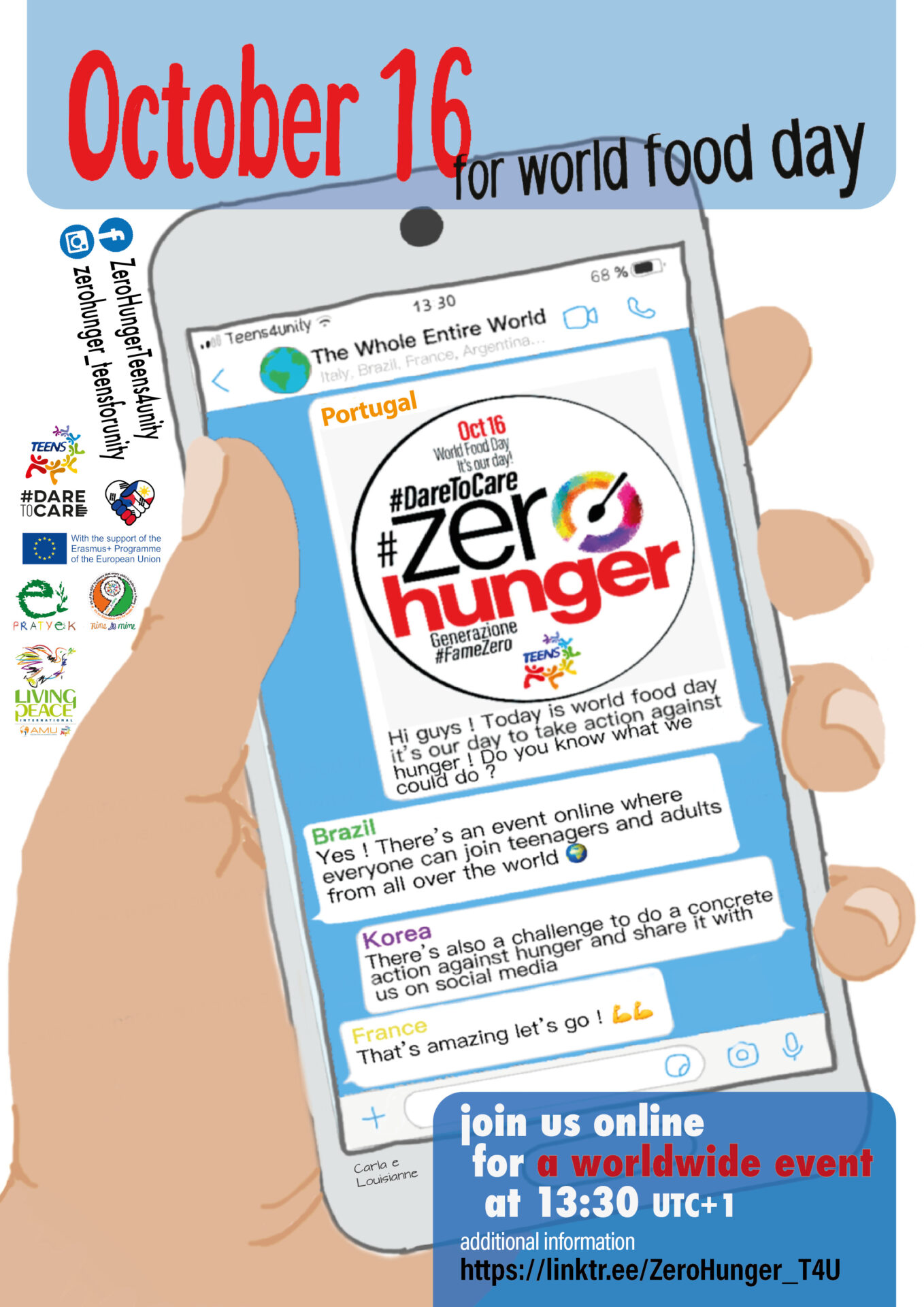
The project to defeat world hunger which was initiated by the Focolare Movement’s Youth for Unity is continuing. On Saturday 16 October 2021, hundreds of young people will gather together as a sign of their commitment to this cause. This event will be live streamed from 2.30 pm to 4.00 pm. (Italian time). “From now onwards, we commit ourselves to this goal with great confidence and enthusiasm. We feel that we are now part of the Zero Hunger generation. It’s like a dream to imagine that we are contributing to a world in which there will be no hunger in a few years time.” This is what Elena and Agnese, representatives of the Focolare Movement’s Youth for Unity said at the Food and Agriculture Organisation in June 2018. Elena and Agnese together with 630 other girls aged 9 to 14 from 16 countries sat in the large plenary hall (see video) of the headquarters of the United Nation’s FAO in Rome, Italy. The FAO had sent a very clear invitation to the Youth for Unity: “Young people, we need you: help us defeat world hunger.” On 25 September 2015, the 193 Member States of the United Nations approved 17 Sustainable Development Goals (SDGs) and committed to their implementation within 15 years, (2015-2030). The second goal is Zero Hunger Fame Zero: eradicating hunger from our planet. These girls signed cards, pledging their commitment to become the first Zero Hunger citizens. That day marked the start of a global race of love from Youth for Unity with the objective of Zero Hunger. In Venezuela, for example, the situation is daunting. Poor families are more afraid of hunger than of the Covid 19 pandemic. However, thanks to a Centre for Nutrition, the young people are able to help a group of families. Also, in 2017, a network of medical professionals, psychologists, nutritionists and a number of parish priests began a project to help others to build more positive and peaceful social relationships based on the Golden Rule: “Do unto others as you would have them do unto you.” A different initiative is happening in Thailand where young people distribute seeds to friends and their families to plant organic vegetables and help them save money as we suffer from this global crisis. In Argentina, Fran is part of a group called ‘Corazones solidarios’, young university students who go out onto the streets every day to offer breakfast to people who are homeless. He says, “When you approach these people, their faces change, they welcome you with open arms and make a place for you in their hearts. Every morning, we leave home with bags that are full of provisions: we come back with empty flasks and happy hearts.” In Portugal, the boys from Lisbon go to a neighbourhood where there are many families who are living in difficult and challenging circumstances. A “race of love” began to provide blankets and tinned food. Some people also offered to cook pasta and rice. As soon as this was delivered, providence arrived with more food to distribute to other families. These and other testimonies will be recounted during the live streaming – suitable for children, young people and adults – on Saturday 16 October 2021 from 2.30 pm to 4.00 pm.(Italian time). The live stream will be translated into 12 languages, just access this link. The #testacuoremani charter of commitment Youth for Unity have devised eight pathways to help others learn about this way of life. These pathways can be lived by individuals or groups. There is also a charter of commitment – to use head, hands and heart – to actively promote this way of life. Head. We use our heads to study and become well informed. The more I know about the reality in which poor people are living, the more effective my commitment will be. Heart. Let us listen with our hearts to the cry of those who suffer: let us increase awareness both in ourselves and in others. I cannot defeat world hunger alone, but I can involve as many people as possible in order to reach this goal. Hands. Let us open our hands to the gift of hospitality, let us take concrete action on a daily basis to defeat hunger. Let us commit ourselves to avoiding all types of waste.
Lorenzo Russo
14 Oct 2021 | Non categorizzato
A guarantee of love.The certainty that everything in life makes sense. In this sentence from the letter to the Romans (Rom. 8:28), Saint Paul, reveals to us how much every human experience, from the most beautiful to the most complicated, is part of a greater plan, a plan of salvation. The key to accepting this idea is to entrust ourselves to the Father and trust him. The road to happiness I played the violin on the street, not to make money, but because I had realized, playing during the holidays, that it makes people happy. So why not broaden the circle? One day a lady who from her dress, even though’ respectable, looked very poor, listened to me for a long time, apologizing for not being able to put even a coin in my violin case. She was shy when I suggested that she take what she needed, but in the end she accepted some coins: “I’ll buy bread”, she said and left in tears. The next day I played on the same street but put up a sign: “For those in need”. Many took a few coins, but many left banknotes. As I was about to leave, the lady who had given me the idea appeared. I told her what had happened and that if she would accept it, the sum raised was for her. She told me about the financial turmoil that had reduced her family to poverty. Then I met her sick husband and an unemployed daughter who is now my wife. Making others happy is the way to happiness. (O.A. – France) Trust in God On the occasion of the baptisms of our daughters, we usually had very simple parties, wasting nothing, welcoming friends and relatives to our home. Since we always received money as a gift, we allocated a part for a project in favor of newborn babies in an African country. I remember the baptism of our third child: at that time both my wife and I were out of work so it was difficult to decide whether or not to send the money we received (250 euros). Then we trusted in God and sent it. A few months later we heard that they had prayed for that very amount; moreover, that money, which arrived just when they no longer had anything to breastfeed babies, was enough for three months … We were very moved! At that time, not only did we lack for nothing, but my wife, who needed some clothes just then, received a gift of a coat, a dress, a jacket, two skirts and three times as much money! (D.P. – Italy) Memory of a friend A characteristic of my friend Urs was his strong communication skills: with a smile and with stimulating words, he shared personal experiences of his relationship with God. At work, on the train, in a hospital room, during sports or on vacation … every opportunity was good to establish relationships that were not superficial. Many remember his ability to listen, to be close to people, especially to those who suffer. He was an animator in Zurich, of a group of young people involved in an initiative in favour of drug addicts. Thanks to him over 30 of them have recovered and several have approached a life of faith. At the end of his life, when suffering due to a cancer, Urs did not let himself be discouraged. He repeated, “Everything is the love of God, everything, absolutely everything”. And despite such an uncertain future, he was calm and confident. He had two other friends in the same condition and they supported one another. He said: “I have given everything to God without ifs and buts… and he has fulfilled his promises in me: the hundredfold already on earth. I am happy”. These words sum up what he meant to us. (F. – Switzerland)
compiled by Maria Grazia Berretta
(Taken from Il Vangelo del Giorno, Città Nuova, year VII, n.4, September-October 2021)
12 Oct 2021 | Non categorizzato
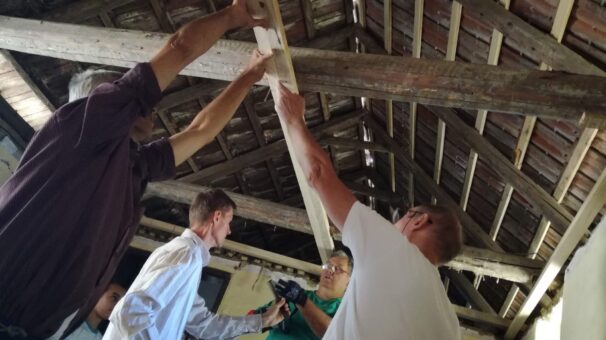
Although this father could finally afford to buy a house for his family, he did not have the physical ability or financial resources to renovate it himself. The community around him acted. 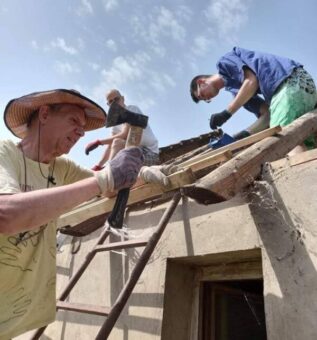 “Many people came to help me, and in three days we were able to redo the roof and replace the earth and straw ceilings with plasterboard ones.” These are the enthusiastic words of Janos Kalman, who is Serbian and a Hungarian citizen, a father of three. There is something extraordinary about the work being done on his home. Until recently, he lived in a dilapidated house without water in the middle of unused fields. His dream had always been to have his own property, but he could never afford it. Thanks to an injury payout and the generosity of many, he was finally able to raise the money to purchase a home. This gave rise to another problem, however – it badly needed renovating. “I wished I could have fixed it,” he says, “but I knew on my own I could never do it.” After an accident at work, Janos used crutches for 10 years. Lately he has started walking again, but he still can’t bend one knee. He needed help. This is how the Focolare community got involved, putting into practice the motto ‘Dare to care’ from Youth for a United World. (See unitedworldproject.org/daretocare2021.) “We decided to make a list of the people who were most in need,” explains Cinzia Panero, a member of the Focolare in Serbia. “Some were in financial difficulty, others sick, and still others without a home.” Among the latter was Janos. He says there is still work to do, “but the help I received is a great gift to me.” One other important fact sets this story apart: Janos’ house is located in Vojvodina, an autonomous region of Serbia made up of various ethnic groups (Slovaks, Ruthenians, Romanians, Croats, with the majority Hungarian-speaking). Some people from the Czech Republic contributed to the renovation works as well, collecting money for the necessary material and sending two volunteers to Serbia. They did this with some care. Those who contributed financially, for example, included a personal message addressed to those receiving the amount sent. Those benefiting responded with heartfelt gratitude. It was a gesture that helps to build a sense of family, beyond the distance – true teamwork between different cultures. “In addition to helping someone in need,” said one of the volunteers, “I felt that I was also helping myself get out of my comfort zone.” We can reach out to others to build a home. In doing so, we all become a home.
By Laura Salerno
Watch the video of the experience
11 Oct 2021 | Non categorizzato
We are in times that we must walk together, in the synodal style. In this passage we are asked to put love for our brothers and sisters first, with every brother and sister, but especially with those we work with, study with, live with. All our responsibilities can be … summarized in helping our neighbour. This is confirmed by one of those sentences of Scripture that centre on love and that strike a chord within us: “For the whole law is summed up in a single commandment, “You shall love your neighbour as yourself” (Gal. 5:14 NRSV). If that is how things are, then our striving towards holiness means focussing all our attention and all our effort on loving our neighbour. For us, striving towards holiness is not so much about trying to be rid of our faults one by one, as about loving, thinking of others, completely forgetting ourselves. … But we know that whoever loves their neighbour, whoever lives for others, soon realizes that it is no longer they who live, but Christ lives in them. Christ lives in their hearts. And who is Christ? Who is Jesus? He is holiness. We find holiness in Him, whose presence emerges within us because we love. Our holiness comes as a consequence of loving, and we cannot reach it any other way. If we were to seek after holiness for its own sake, we would never reach it. So let’s love then, and nothing else! Let go of everything, even the attachment to holiness, striving only, only, only to love. It’s the only way to be able to make a gift of our holiness to Mary one day. … Let’s set off again, as if today were the first day of our revolution of love, the first day of our Holy Journey. Let’s set off again, not thinking of anything else, because love sums up everything. Let’s try to love every neighbour as ourselves; and do so by “immersing ourselves” in every situation.
Chiara Lubich
https://vimeo.com/623446995 (From LUBICH, C; Edited by Michel Vandeleene, Conversazioni in collegamento telefonico, Cittá Nuova, Roma, 2019, pp. 120-121).
8 Oct 2021 | Non categorizzato
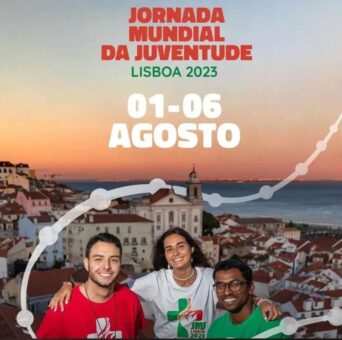
Preparations are underway at diocesan level for the World Youth Day. A journey towards 2023 when young people will gather around the Pope in Lisbon. That’s right. Young people are among those who have suffered most in this period of health emergency. Their external life and outreach were suddenly cut off. They could not go to school, university, work. They were cut off from social life and from friends. But it is also true that young people were the first to set solidarity in motion, to fight for life, to instil hope, to be builders of peace, to care for the environment. Pope Francis listened to them, he heard from them how much they have lived and are living at this time. A few days ago he issued his message for WYD 2021 with an invitation calling for action: “Stand up! I appoint you as a witness of what you have seen”. He says, “When a young person falls, in some sense all humanity falls. Yet it is also true that when a young person rises, it is as if the whole world rises as well”. He challenges them with the story of the young Paul, who while on his way to Damascus to arrest some Christians, was surrounded by a light “brighter than the sun” and heard the voice of Jesus calling him by name, “Saul! Saul”. Almost as if today Pope Francis wants to call every young person by name. And he retraces with them Paul’s path of witness of Christ. In conclusion, he says to them, Arise! Testify with your experience, to the love and respect it is possible to instil in human relationships. Arise! Uphold social justice, truth, human rights. Testify to the new way of looking at things that enables you to view creation with eyes brimming with wonder, that makes you see the Earth as our common home and gives you the courage to promote an integral ecology. Testify that we can always start again and that Christ is alive. “I see this message as a great challenge for us young people,” Klara María Piedade, 27 years old, a young woman from Brazil, confided to me. “I think it is an answer and a confirmation that we really must be responsible in becoming protagonists of the united world, of a more fraternal world”. Klara is one of the young people who this year are at the Focolare’s “Young People for a United World Centre” in Rome. Since last May they have been busy on various fronts in favour of caring for our common home, echoing the Laudato Sì. Dare to care – Dare to take care. This is their programme of which they are the main promoters. “We must be protagonists”, Klara reiterates, “not only in words but with our actions. We will change the world if we take this first step. It is very important to network with those who are already doing something”. The date of the next World Youth Day which will be held in Lisbon, Portugal in August 2023 has just been announced. Meanwhile, in November this year, on the feast of Christ the King, the WYD will be celebrated in all the dioceses of the world. A path of preparation open to the surprises of God, “for he wants to light up our path”.
Carlos Mana
6 Oct 2021 | Non categorizzato
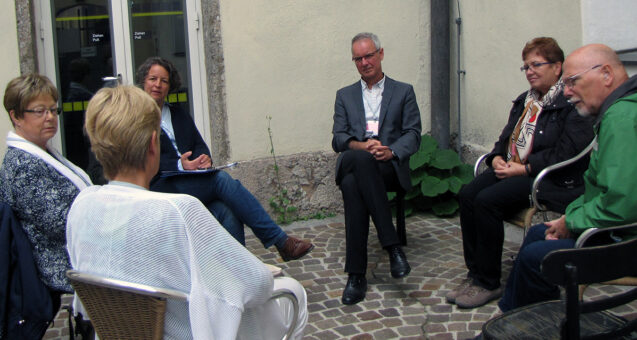
A conference held by the Faculty of Theology, Innsbruck, Austria that took place after several years of intellectual and existential preparation 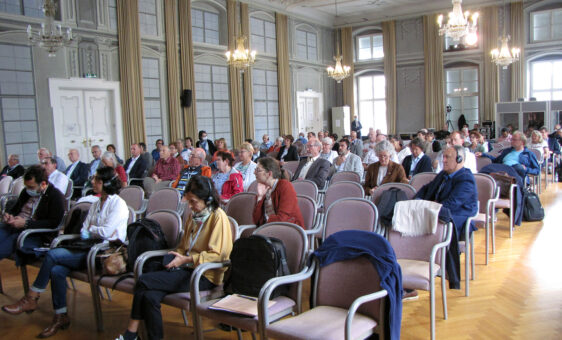 “Look at all the flowers” is an unusual title for a theological conference and, especially, in such a prestigious context as the Faculty of Theology in Innsbruck which many people identify with the name of Karl Rahner who is buried in the large Jesuit church that divides the two wings of the Athenaeum. It was significant that such a large number of people (about 100) attended this conference in the prestigious Leopold Saal and about 150 more were able to follow online from other continents. This was not an isolated event but the conclusion of a journey that began almost a decade ago on the occasion of an Islamic-Christian conference organised by the Focolare Movement and based on an exchange of experiences of dialogue of life. Two professors from the Austrian theological faculty – Roman Siebenrock and Wolfgang Palaver – present on that occasion showed great interest in this experience of dialogue. In the following months, in contact with the spirituality of the Focolare, they also visited the new Sophia University Institute and the Movement’s International Centre for Interreligious Dialogue. Hence the idea of forming a research group with academics from the two religions to explore aspects of spirituality from the two perspectives developed Since then, every year, at the end of August, this group – called cluster – made up of around twenty people from different backgrounds has met regularly for a few days. From the outset, it was not just an intellectual and academic activity but also an existential exercise that has gradually built up deep personal, cultural, religious and intellectual relationships. In recent years the group’s interest has focused on some of Chiara Lubich’s texts of a more mystiical nature. The passages, including the one that gave the conference its title, have been studied in depth from both Christian (Catholic and Reformed) and Muslim (Sunni and Shia) perspectives. At the end of this process, it was decided to organise an academic conference to share the richness of these reflections. The conference that has just taken place opened up this experience to an academic public. Whilst this event was Germanic in origin – the vast majority of the participants were Austrians, Swiss and Germans and this was expressed in the style, language and categories of thought prevalent in this part of Europe – the spiritual heritage of Lubich was very present and was able to bring together thinkers of different ethnic and cultural origins and both religious and non-religious people: Catholics, members of the Reformed Church, Muslims and Marxists. Stefan Tobler, a theologian from the Reformed Tradition offered a reflection on the passage that gave this event its title. This was followed by other reflections and round table discussions from which emerged the experiences of intellectual and spiritual communion that these Christian and Muslim academics have been living for years. An artist from Geneva who took part in the proceedings noted that the group who took to the stage to perform in different voices were a tangible witness to the communion among the participants. This is something that is rarely found in academia but which characterised the conference. It brought an important dimension: communion of thought and spirit. Moreover, the presence of Catholics, Reformed Church members, Marxists and Muslims offered a remarkable cross-section of schools of thought and of academic but also cultural and religious sensitivities which it is not easy to find in today’s world of strong polarisation even in academic and cultural spheres.
Roberto Catalano
5 Oct 2021 | Non categorizzato
Memories of Anna Fratta (Doni) from Lucia Abignente, an Italian Focolarina who joined her in Poland for several years. A life of complete “giving”, true to the name given her by Chiara Lubich. “An abyss of humanity”, “a ‘maestro’ of life”, “a small great woman”. Just three of the many reactions to the news that Anna Fratta, known throughout the Focolare Movement as ‘Doni’, reached the house of the Father on 24 September 2021. She herself would no doubt feel rather uncomfortable about these epithets, shying away as she did from any kind of praise. She was always measured in her own words, which, few as they were, came out as ‘distilled’ wisdom. Her temperament, reinforced by her life experiences, made them such. The youngest of six, in her childhood she was no stranger to the dimension of suffering, particularly when she lost of one of her sisters. From a very tender age, she already began to pose profound existential questions about the meaning of life, and gradually drifted away from belief in God, seeking her answers elsewhere. Later on, the study of medicine, which she undertook in a spirit of rebellion, showed itself to be providential. She found herself fascinated by biology, which had a significant impact on her interior progress. In nature she discovered a relationship of reciprocity and of service she could not explain, a law of love which she came to understand one night. “After a dramatic and painful interior struggle” she described how she accepted “there is a Being who contains love within”. It was a decisive turning point, followed by her meeting with God in the charism of Chiara Lubich. Not long after this, Doni perceived that God was calling her to follow Chiara in the way of the Focolare. Doni was among the group of Focolarini doctors who, at the invitation of the Catholic Church, went behind the ‘Iron Curtain’, where she lived for thirty years (1962-1992), firstly in the DDR (former East Germany) and then Poland. She worked silently and effectively in bringing Focolare communities to life there, following their growth and progress with awe and gratitude to God. From this region which suffered from lack of liberty and the impossibility of regular contact with the Focolare Center in Rome, Italy, she was then transferred right to its heart, living in Rocca di Papa, Rome, as part of Chiara Lubich’s own community house. With Chiara, she shared profound, luminous, eventful years, accompanying her at an international level and then, with great love and dedication also through the last part of her earthly journey. The design of God on Doni continued through her wise contribution as General Counsellor for the aspect of “spirituality and prayer life” of the Focolare Movement. At the same time, alongside Gis Calliari, Eli Folonari and others of the first Focolarine, she lived total self-giving in welcoming countless visitors to Chiara Lubich’s home, transmitting the light of the daily life they had shared with Chiara. Later she moved to the Focolare little town of Loppiano, Italy, due to an illness which progressively reduced her physical capacities. A profound interior coherence linked all her actions. “Love, we know, disarms. Our speaking was such that anyone could listen, friends and enemies alike,” she recalled, aware that in those years behind the Iron Curtain, the secret Police followed them assiduously. “Love, love, only love, and filling my suitcases with this love. It’s all I’ll be bringing with me!” she wrote in recent years, as she prepared herself for the final journey. No wonder then, that her professional activity had earned the respect of the authorities. In the DDR she was awarded three medals in honor of the work she did and for the “collective” she built up. Even clearer how her life transmitted the love of God to many. Perhaps the secret lies in her constant intimate relationship with Mary, particularly in the Desolation and ‘yes’ at Golgotha opening her arms and heart to humanity. This was the example Doni followed. On 15 September back in 1962, just after crossing the Berlin Wall, she wrote, “There’s nothing to lean on here. And if you don’t keep your gaze on Mary at the foot of the Cross, you’ll fall down. There are times I feel like I’m suffocating and the only thing to do is pray to Mary. It’s the only way so that slowly, slowly the emptiness becomes a fullness, and the pain is transformed into peace. These are the most beautiful, most precious moments of the day, because in suffering I find an ever more intimate and profound relationship with Mary, and through her with all her children”. Maybe here lies the secret of her fruitfulness, of her life of complete “giving”, true to the name Chiara Lubich gave to her – Doni (“gifts” in Italian).
Lucia Abignente
4 Oct 2021 | Non categorizzato
Today, 4th October, is the feast of St Francis of Assisi, the patron saint of ecology, and the concluding day of the “Season of Creation”, the annual celebration of prayer and action for our common home. Together the various Churches and ecclesial communities around the world unite to protect and defend creation. Chiara Lubich invites us in this text to have a right relationship with the environment. … Proposals are being made from many quarters to heal our sick world. … Young people are particularly sensitive to this issue and feel the need for radical changes in our relationship with the environment, in the relationship between individuals and states, and in the application of scientific knowledge. They also realise that environmental protection and peace-building are only possible if practised on a global scale. They are convinced that to reach the ideal of a united world, the primacy of people over science and technology must be highlighted. … This means making a practical contribution, even a small one, to solving major problems. Our young people have understood this and have already started various initiatives that express a personal and collective ecological awareness in many respects, for example in the purchase of products that do not have a negative impact on the environment, in removing waste that pollutes the environment and in all choices that derive from a deep respect for nature. It is by starting with small local problems that a moral conscience is formed, which can then tackle problems on a global scale. After all, ecology is a challenge that can only be met by changing mind-sets and forming consciences. Many in depth scientific studies have shown that there is no lack of technical and economic resources to improve the environment. What is missing, however, is the additional mindfulness, a new love for humanity, that makes us all feel responsible for everyone, in the common effort to manage the earth’s resources in an intelligent, just and moderate way. Let us not forget that God the Creator has entrusted the earth to all men and women, and not just to one people or one group of people. The distribution of goods in the world, aid to the poorest nations, solidarity between North and South and between rich and poor is the other side of the ecological problem. … The Bible, in its account of creation, teaches us that only in harmony with God’s plan do nature and human beings find order and peace. If people are not at peace with God, the earth itself is not at peace. … If we discover that all creation is a gift from a Father who loves us, it will be much easier to find a harmonious relationship with nature. At the same time if we also discover that this gift is for all members of the human family, and not only for some, we will be more careful and respect something that belongs to the whole of humanity, present and future.
Chiara Lubich
(Letter from Chiara Lubich to Nikkyo Niwano – 1990, in POLI, R. e CONTE, A., Vita, salute, ambiente tra speranza e responsabilità, [Life, health, environment: between hope and responsibility] Cittá Nuova, Roma, 2021, pp. 32-34) Good practice and activities: http://www.unitedworldproject.org/daretocare2021/
3 Oct 2021 | Non categorizzato
The Focolare Movement is a partner of the Laudato Si’ Movement for the Care of Creation. Tomas Insua, the Executive Director, speaks of the great synergy in the commitment to improve our common home. 4 October 2021 marks the end of “Time for Creation”, an initiative of prayer and concrete action to safeguard and protect our common home, which runs every year from 1 September till that date. An appeal is being made by 46 religious leaders from around the world – including Pope Francis – for concrete action on climate change and a worldwide initiative entitled “Faith Plans for People and Planet” is being launched. faith plans for people and planet – Bing . The Focolare Movement is a participant. We talked about this with Tomas Insua, Executive Director of the – Laudato Si Movement , a worldwide network of associations and movements working together for ecology and the environment. What is the synodal path that the Laudato Si’ Movement wants to lead towards ecological conversion? You used to be called “Global Catholic Climate Movement”, why the change of name? The Laudato Si’ Movement is a new reality in the life of the Church. It was founded only six years ago, in 2015, just before the release of Pope Francis’ encyclical Laudato Si’. The name “World Catholic Climate Movement” was too long, not everyone remembered it. Moreover, the climate crisis, which will continue to be a huge priority for the Movement, is not our only way forward. In the last few years, for example, we have also started to work on the biodiversity crisis and more. A synodal process of discernment and dialogue between the different realities that make up the Movement – among which is the Focolare Movement – has therefore begun. After two years of work, the new name, Laudato Si’ Movement, has emerged, because Pope Francis’ Encyclical and its contents are at the heart of everything we do. What are your plans for the future? Among the various projects, the most short term one is the “Healthy Planet, Healthy People Petition” Home – Healthy Planet, Healthy People Petition (thecatholicpetition.org). It is important to sign it because from 1 to 12 November 2021 there will be the big UN climate summit (COP26) in Glasgow, UK. World leaders can set meaningful targets to protect creation. It is our responsibility to make the voices of the most vulnerable heard and to mobilise on their behalf. During this “Time of Creation”, it has been wonderful to see how many activities have taken place and are still going on at the local level, around the world, thanks to Laudato Si’ circles. It is a sign of hope that is developing at grass roots level and growing partly because of the awareness of the crisis of our common home but also because of the the desire to take action. On 26 August 2021 you met the President of the Focolare Movement, Margaret Karram. What was your reaction to this meeting and how can the Focolare interact with your Movement? The meeting with Margaret was beautiful. I was with our president, Lorna Gold. For me it was wonderful to get to know the reality of the Focolare. What I really liked was the parallelism between the two movements. The Focolare Movement is obviously much bigger and has existed for much longer. We are a very young reality, but in some aspects we are similar to the Focolare: we share a commitment to dialogue between different Churches and dialogue between great religions. In fact, among us in the Laudato Si’ Movement there are those who live the Catholic faith, but at the same time we have animators belonging to different Churches and different religions. Learning from the Focolare’s experience of dialogue is a wonderful gift.
Lorenzo Russo

1 Oct 2021 | Non categorizzato
An example of integral ecology: young people and communities united for the protection of mangroves  “A habitat which has been destroyed, burned, attacked by waste and pesticides. This is what the mangroves here are becoming. We want to help our land and our people.” These are the words of Sirangelo Rodrigues Galiano, a 49-year-old focolarino of Brazilian origin, but now by adoption, Ecuadorian. He lives in the province of Esmeraldas, an Afro-Ecuadorian region in the north of Ecuador, known as the green province. Tropical climate, heavenly beaches, abundant biodiversity. It is above all the existence of the mangroves that create such a unique natural habitat, which is now in danger because of man. Mangroves are plant formations consisting of huge roots, periodically covered by the tides. These features allow the creation of a very original habitat, teeming with animals and plants which cannot be found elsewhere and which are now at risk of extinction. Sirangelo moved to Ecuador from Brazil in 2016 when this area was badly affected by an earthquake. Thanks to AMU (Action for a United World), FEPP (the Populorum Progressio Ecuador Fund) and Fundación Amiga, the Sunrise project was established, of which Sirangelo is responsible. This project brought aid to 3 villages destroyed by the earthquake, Salima, Ten August and Macará, whose inhabitants are still grateful for everything they received. Sirangelo recounts, “A few years after the earthquake emergency, other disasters are now looming: for example the climate crisis and the situation of young people who are often forced to leave because they are out of work or become victims of the drug trade.” This gave rise to the Sunrise+ programme which involves cleaning, mangrove reforestation and ecological education. “About 400 young people have taken part. We meet regularly to clean and raise awareness in the whole community. The activity started with young people, but now we want to involve everyone. “One of the main partners in this new initiative was the Ministry of the Environment, Water and Ecological Transition in the Muisne region, which is working together with the government and four other NGOs. It is interesting that it was the young people who suggested how to organize Sunrise+. Through the 6X1 methodology , 6 steps for 1 goal: observe the context and the problems; think of possible solutions; involve; act; evaluate the work; celebrate. All this in the quest for peace. Sirangelo concludes, “Our goal is to be alongside the population. Today it is mostly young people who ask us for help and we try to be there with and for them. They love their land, but often have to leave it. We want to help them stay and find new opportunities, starting from the preservation of the natural resources. Thanks to them, a change of mentality is being triggered for the preservation of our Planet, our common home.”
Laura Salerno
For more information, see the full article here
29 Sep 2021 | Non categorizzato
Helping hope to bear fruit. This was the seed that Pope Francis planted during his apostolic journey to Budapest on 12 September, at the concluding mass of the 52nd International Eucharistic Congress, just before traveling to Slovakia. The highlight of this brief stop was the Statio Orbis, “a pause for commitment and prayer” in which the individual churches united in communion with the pope around the Eucharistic mystery to deepen their faith. Some Focolare members who were present at the event tell of their experience. The famous Chain Bridge holds Buda and Pest together by leaping the Danube, an evocative image recalled several times by Pope Francis during his recent apostolic visit to Hungary. Among the themes of this trip, which concluded in Slovakia on September 15, were suppression and martyrdom, the evangelizing mission and, of course, ecumenical and interreligious dialogue. The latter are only possible if, at the foundation, there is ‘a great desire for unity,’ as the pontiff stressed in his speech during the meeting with representatives of the Ecumenical Council of Churches and Jewish communities. “We are not fully aware of how special the presence of so many Christian denominations is in Hungary,” says Eszter, 47, who is married and mother of 5 children. She is director of Città Nuova Publishing House in Hungary (Új Város) and editor of the column on spirituality in the online magazine of the same name. “The Focolare Movement here already does important work in terms of both ecumenical and interreligious dialogue, but we can and must do more. The pope’s joy spurs us on to make more use of this specific calling of ours. “Living for our brothers and sisters means rediscovering that unity and Jesus Forsaken are two sides of the same coin, and this journey can only be taken on by nourishing ourselves on the Eucharist.” It’s a shared uphill path to be followed together. This is the unity that this people has so badly needed to hear, explains Ágoston, a radio presenter who has worked in recent years as director of communications for the Eucharistic Congress. “I have never in my life had such a strong desire for unity as I do now. Unity understood, of course, as dialogue with the representatives of the various religions, but also as a rapprochement between us, members of the Focolare, Hungarian men and women. “It seems to me a great challenge to strive to defend values, and at the same time seek a relationship with the people around us. Recently it seems that these factors are mutually exclusive, but this is not true. We must have more courage in approaching one another, accepting the risk.” It is for this reason that Pope Francis in the heart of Europe, ‘ploughing’ through places that have suffered the violence of totalitarianism, invites everyone to become ‘roots’ – roots of peace that, by stirring the soil of memory, are capable of nourishing it and making the future sprout. This hope also lives in the heart of Gergely, a young Hungarian father, who is editor of Città Nuova. “I was very struck by a phrase the pope said during his final homily in Heroes’ Square in Budapest, at the conclusion of the International Eucharistic Congress. The Eucharist urges us to ‘break ourselves for others’. I need the Eucharist as spiritual nourishment. “It is a very powerful way to get out of ourselves, and thanks to it, we are less and less willing to ignore each other. When I come out of church and have a discussion with my wife after Holy Communion, I immediately feel the difference. “Jesus loves me no matter who I am, so how can I not see someone else with his eyes? The discussion becomes a deep conversation that ends in reconciliation. We should see the other as someone to serve, love and accept, and I am sure the Eucharist can help us in this challenge. “I have always experienced the presence of so many churches in Hungary as enriching, and my dream is to be united with all of them. I would always like to focus on what really binds us, and this is what Chiara Lubich’s charism has taught me over the years: to build bridges and find Jesus in every person.”
Maria Grazia Berretta
28 Sep 2021 | Non categorizzato
Lebanon: a group of Focolare youth are finding ways to support the Lebnenele (= “my Lebanon”) initiative, which emerged from the October 2019 protests. Through this initiatve, young students have set themselves to help families most in need. The Youth for a United World of the Focolare Movement in Lebanon have made a commitment to support families most in need in their country, in collaboration with the student-led Lebnenele (“my Lebanon”) initiative which grew from the popular protests of October 2019. At that time, thousands of citizens, including a high proportion of youth, took to the streets to protest against the government imposition of new taxes on goods and services such as fuel, tobacco and online telephone calls. The protests led to the resignation of Prime Minister Saad Hariri on 29 October 2019. During one of these protests, a group of youth – later to give rise to Lebnenele – noticed an obviously poor person handing out handkerchiefs to whoever needed them. This inspired them into action. Joelle Hajjar is one of those young people who were part of the Lebnenele project from the start. “In that moment,” she recalls, “we started to open our eyes to see the needs of families around us. We decided to start helping them with donations we could receive from friends or through social media”. After the terrible explosion in Beirut on 4 August 2020, which caused such damage to the surrounding population, this group of young people decided to extend the Lebnenele initiative to express true affection and care towards their own nation in difficulty. They set themselves a goal of collecting enough donations to provide food parcels for 50 families at Christmas. Thanks to the solidarity built up around them, they were able to go beyond that target and help 76 families. This convinced them the initiative must not end but should keep on growing so it can help more and more families. And so it proved to be. Fund-raising activity to provide essential goods to families in need is continuing to this day. George and Salim, two members of the Youth for a United World group in Lebanon, explain, “We decided to help Lebnenele by setting up a market for second-hand goods: bags, clothes, scarves, costume jewellery, and so on, all in good condition. By selling these things, we’re raising good money to buy essential items that we give to Lebnenele. In this way we know the items reach many Lebanese families who really need them”. Joelle concluded, “The Focolare youth are supporting us in many ways, raising money in their market activity and helping to prepare the goods to give out. With them, we share a desire to communicate the Ideal of unity to these families, to create a solidarity and unity among us which can last”.
Laura Salerno
https://youtu.be/zXS2fl4ytYU
27 Sep 2021 | Non categorizzato
The Word of Life for September invites us to be servants of all. It is the condition for being the first. If we want to be great, we must make ourselves small in front of our brothers and sisters, attend to their needs, be there for them. If he who is Lord and Master washed the feet of others (it was a task performed by slaves), we who want to follow him, especially if we are hold positions of responsibility, are called to serve our neighbours with just as much concreteness and dedication. This is one of the paradoxes of Jesus’ life. We can understand it only if we reason that the characteristic attitude of Christians is love, a love that leads them to put themselves in the last place, to become smaller than the other, as a father does when he plays with his little girl or when he helps his older son with his homework. Vincent de Paul called the poor his “masters” and as such he loved them and served them because in them he saw Jesus. Camillus de Lellis tended the sick, washing their wounds and making their beds “with the same affection,” he wrote, “that a loving mother has for her only child who is ill.[1]” Closer to our times how can we not remember Blessed Teresa of Calcutta who bent down to help thousands of dying people, making herself “nothing” in front of each one of them, the poorest of the poor? “Making ourselves small” in front of others means trying to enter as deeply as possible into their minds and hearts to the point of sharing their sufferings or their interests, even when these things might seem to be of little importance, or even insignificant to us, while for them they are everything at that moment. … “To live the other” means, therefore, that we cannot lead lives focused on ourselves, being filled with our own worries, our own concerns, our own ideas, and all that has to do with us. We need to forget ourselves, to put ourselves aside in order to pay attention to the other person, to make ourselves one with all our neighbours to the point of reaching them in their actual situation and lifting them up. We need to help them come out of their fears and worries, sufferings, complexes and disabilities, or simply to help them come out of themselves and go towards God and towards their brothers and sisters. This helps us find together the fullness of life and true happiness. People in government too, and those in public administration, (“leaders”) at every level, can also fulfil their responsibilities as a service of love, so as to create and safeguard the conditions that allow love in all its forms to blossom. … From the moment we get up in the morning until we go to bed at night, at home, in the office, at school and in our neighbourhoods, we can always find opportunities to serve and to be grateful when we ourselves are served by others. Let’s do everything for Jesus in our brothers and sisters, without neglecting anyone, but always taking the initiative in loving. Let’s serve everyone! It’s only then that we are “great.”
Chiara Lubich
(Chiara Lubich, in Parole di Vita, [Words of Life] edited by Fabio Ciardi, Opere di Chiara Lubich, [Works of Chiara Lubich] Città Nuova, Roma, 2017, pp. 717-719) [1] Cf. Scritti di San Camillo, [Writings of St Camillus] Il Pio Samaritano, Milano-Roma 1965, p. 67.
25 Sep 2021 | Non categorizzato
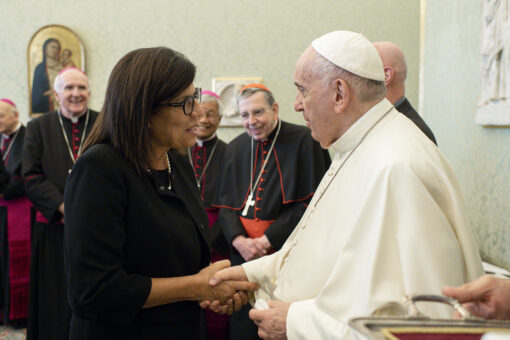
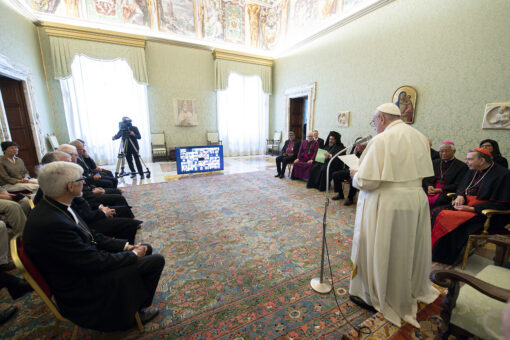
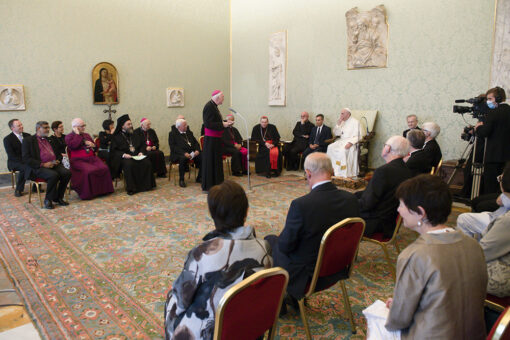
It was a decisive call to “dare to be one” in the current state of fragmentation that the world is experiencing; and to continue on the path of friendship that has already begun. The Pope’s words to the delegation of Bishops of various Christian Churches.
© Vatican Media
© Vatican Media
© Vatican Media
Stefania Tanesini
24 Sep 2021 | Non categorizzato
The second day of a meeting of bishops from various churches, friends of the Focolare, under the banner of unity 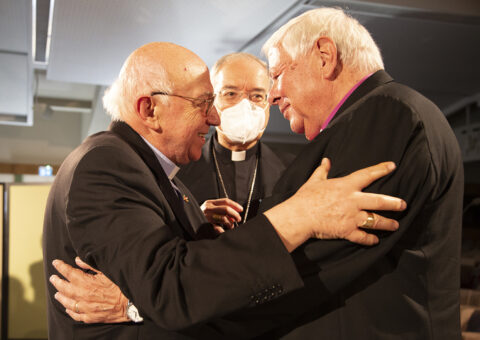 The darkness of the catacombs was brightened by the candlelight. People from various churches appeared in the corridors, walking as the words of a prayer of the first Christians resounded. They gathered around the altar of the small chapel, where the united community shared bread. Holding hands, with a spontaneous prayer they asked for the gift of unity. It was a foretaste of the ‘pact of mutual love’ that is renewed at every meeting of bishops who are friends of the Focolare. “The covenant strengthens our unity, our covenant, and urges us to maintain it in our relationships with brothers and sisters, in our countries or wherever we are,” said Bishop Nelson Leite of the Methodist Church of Brazil. “The covenant has changed my life. It has motivated me and led me to accept other people, to live with them, to learn to listen to them and to be able to establish a dialogue, even if we are different.” It was a sacred and moving moment, symbolically enclosed, as if in a chapel. The 170 bishops of various Christian churches participating in the “Dare to be one” conference are typically scattered throughout the world, yet here there were no more distances or electronic media, which allowed the connections. Those same catacomb candles gave light to their new commitment of unity. “We want the New Commandment of Jesus to be the foundation of our relationships – ‘that loving one another’, we want to be the foundation of our fraternal relationships,” said Brendan Leahy, Bishop of Limerick (Ireland), and one of the moderators of the meeting. With the awareness that, if it is put into practice, Jesus can fulfil his promise, “Where two or more are united in my name, there am I present in the midst of them” (Mt 18:20). “We long for Jesus to be able to give us this gift,” Leahy said, “so we would like to promise him that we want to continue to live in love with one another, to love each other’s diocese and community as I love my own, to love each other’s Church as I love my own.”
 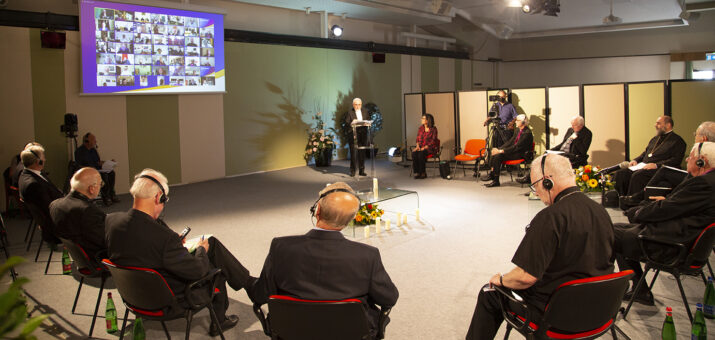 If there is mutual love among Christians, it is the strongest and most credible witness to the world around us. Jesús Morán, co-president of the Focolare Movement, said: “Yes, our unity, the unity of all Christians, could be a decisive contribution to the transformation of the world. This is an ethical imperative that cannot be postponed.” Margaret Karram, President of the Focolare Movement, concluded the two days by expressing the desire of many participants to keep moving forward – “to create a great network that will help us connect together, living cells united in the name of Jesus. “Who knows how many initiatives could emerge to renew the life of our churches in the one Church of Christ!” She invited everyone to join together to ask God the Father to enlighten the way forward by reciting the Lord’s Prayer. The words of the prayer taught by Jesus harmonised together in so many languages, like a symphony rising to heaven that floods the hearts and minds of everyone, sealing the pact of unity just made.
Carlos Mana
24 Sep 2021 | Non categorizzato
Messages from Card. Kurt Koch, President of the Pontifical Council for Promoting Christian Unity, Justin Welby, Primate of the Anglican Church, and Bartholomew I, Ecumenical Patriarch of Constantinople, to the Bishops of various Churches who are friends of the Focolare Movement during the conference “Dare to be one”. “Abide in me and I in you” (John 15:4). An eloquent image, that of the vine and the branches that accompanies Jesus’ invitation to His disciples. A call to “remain” in order to bear fruit, the same call that nourished the International Conference of Bishops friends of the Focolare, from different Christian Churches, held in Castel Gandolfo in these days, entitled: “Dare to be one. The gift of unity in a divided world”. In his message to this meeting, Cardinal Kurt Koch, President of the Pontifical Council for Promoting Christian Unity, said that receiving this gift in the context of an Ecumenical commitment, “is part of the mission of Bishops which is to be at the service of unity but not only of the unity of their own Church, but of the unity of all those who have been baptized in the name of the Triune God. Baptism unites us to Christ and makes us members of his one body”. Encouraging the Bishops of the various Churches who are united in following the way of mutual love to face the challenges of the world, he underlined the fundamental role that prayer plays, saying: “We Christians are not capable of achieving unity with our own strength alone. We Christians are capable of producing divisions, as history and, unfortunately, even the present still demonstrate. Unity, on the other hand, can only exist as a gift. (…) we must always reflect on the fact that that Jesus did not command unity from his disciples, nor did he request it from them, but he prayed for unity”. Aiming to be one in Him and with our brother means becoming a living flame, a lantern, a source of light that attracts whoever is next to us. This is the true meaning of this meeting: to bring that light out into the world. Such a hope is also expressed in the words of the Most Reverend and Honorable Justin Welby, Archbishop of Canterbury: “‘Dare to be One’ touches the lives of many Christians, encouraging them to grow in mutual communion. (…) The world has never needed Christian unity as much as it does today. In times of environmental crisis and global pandemic, not to mention the many economic and political challenges facing the world, it is increasingly clear that no one is safe until everyone is safe and that our actions really do affect each other. Unity among Christians can be the cement that consolidates the solidarity of human beings, to become, therefore, the foundation of lasting solutions”. In order for “all to be one” it is therefore necessary to make concrete choices, to live dialogue, to take care of others, recognizing them as brothers. The message to the Bishops at the meeting from His Holiness Bartholomew, Archbishop of Constantinople-New Rome, Ecumenical Patriarch, outlined a route which, thanks to the pages of the Gospel of Matthew (Mt.14:24-33) gives hope and comfort: “In the course of history the boat of the disciples of Jesus has encountered contrary winds and storms; even among the disciples of Jesus themselves, oppositions, enmities and persecutions often burst out and still arise. (…) In the parable, Jesus walks on the water going towards the disciples (…): “Courage, it is I, do not be afraid”. (…) If we have courage, then we will not be afraid to enter into dialogue with one another, because we all belong to Christ (…). When we are no longer afraid, we will not need courage, because we will be one of the only One, gathered around the banquet table with the Bread and Wine of He who will say to us, “It is I”.
Maria Grazia Berretta
24 Sep 2021 | Non categorizzato
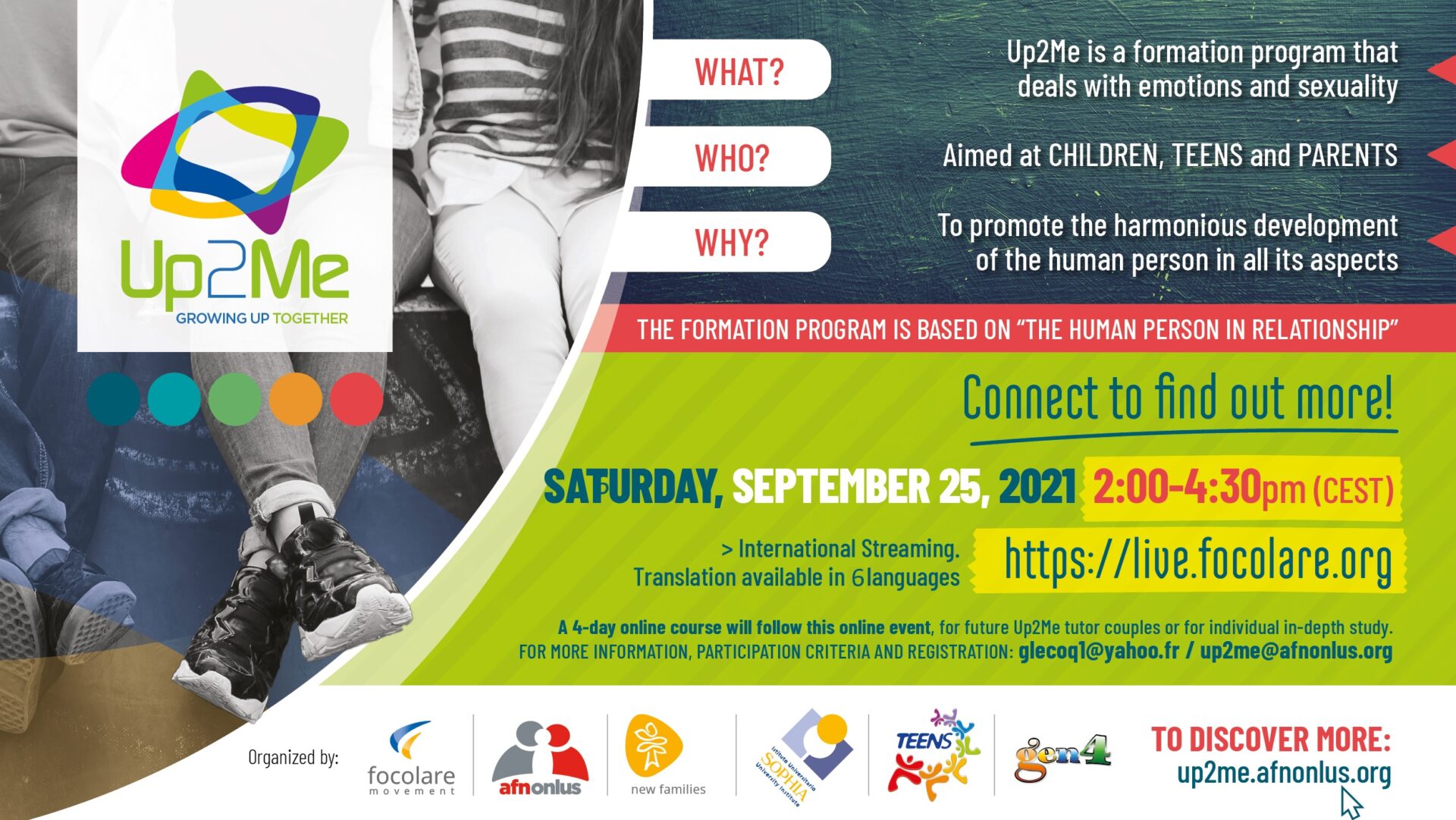
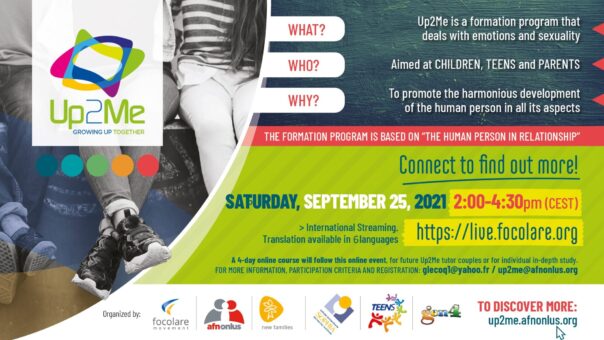
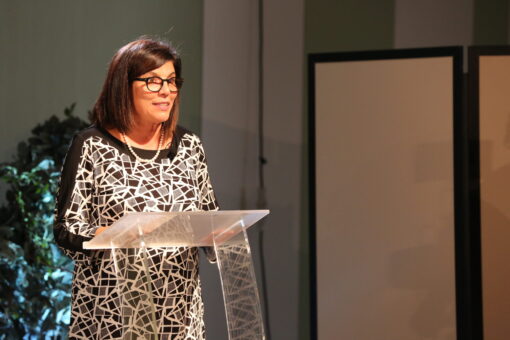
Announcing an international live streaming event, Saturday 25 September 2021, with a choice of six languages, to launch a new formation program – developed by the Focolare Movement – dealing with affectivity and sexuality, to promote harmonious human development in all its aspects, aimed at children, youth and parents. “Up2Me has given me a greater understanding of who I am, both emotionally and physically, and of the kind of life I want to build for myself, as well as showing me the importance of relationships with others”. “The program has really helped me relate to girls. It’s taught me to respect them. I’m more willing to help in the house, and I can work together with my mother and my sister now, without feeling I’m belittling myself”. “This experience allowed me to speak with others of my own age about issues which are important to us. I could express myself freely, without the fear of being judged badly”. This is just a taste of the feedback from the hundreds of youth in various parts of the world who have participated so far in Up2Me, the education pathway on affectivity and sexuality that aims at the harmonious development of the person in all its dimensions. The program is based on “person-relationship”. Being-in-relationship is part of the essence of being human, the ontological foundation to full growth, respecting the characteristics of their age group, which sees the children and youth as protagonists of conscious choices and capable of livng positive relationships. Saturday 25 September 2021, at 2.00pm (Italian time) offers the opportunity to find out more by joining a live streaming event through this link, with simultaneous translations in six languages: English, French, Spanish, Dutch, Portughese and Italian. Developed within the Focolare Movement, Up2Me has been piloted so far in 28 countries. It grew from the need frequently expressed by children and youth who find themselves facing big issues like life, health, sexuality, modern life styles, emotions, future life choices … without adequate tools to deal with them. Parents often feel unprepared to respond to these questions. So social media can become the main source of information, without addressing the value of the whole person. “I never found these things on the internet!” exploded one girl after an Up2Me session on knowing the beauty and complexity of one’s own body. Up2Me aims to respond to these challenges and help parents through this phase of accompanying children and adolescents in a program of integral formation. What are the main themes dealt with? For children: emotions, the body, friendship, life and death. For pre-adolescents and adolescents: the beauty and complexity of one’s own body, the wonder of birth, respect for human life and for the planet, personal hygiene, abortion, contraception, assisted reproduction techniques, addictions, pornography, gender studies, healthy life styles (sport, nutrition, rest), internet opportunities and issues, the importance of the spiritual aspect in human life, mass media, bullying, friendship, emotions, falling in love, one’s life project. For parents of pre-adolescents and adolescents: educating in times of crisis, authority and strictness, good communication, adoloscence, the age of opportunity, how to talk about sexuality with your children, addictions (substance, pornography, smartphone), life style (alcohol, smoking, food), new media. The formation program is also directed at those who hope to become Up2Me tutors via participation in an international training school covering theory and practical experience. Up2Me has a central coordinating team which works internationally with various local teams. An international multi-disciplinary Scientific Committee harnesses the professional expertise of academics in psychology, pedagogy, medicine, theology and law.
Lorenzo Russo
23 Sep 2021 | Non categorizzato
The meeting of the Bishops of various Churches that are friends of the Focolare began on Thursday 22nd September. On Saturday morning they will be received in audience by Pope Francis. “We must have the courage to take risks”, “The testimonies give us the courage to be one”, “We have witnessed an experience of lived ecumenism”: these are some of the initial impressions of the 181 Bishops from 70 Churches and 45 countries gathered on the first day of the meeting of Bishops from various Churches who are friends of the Focolare Movement. 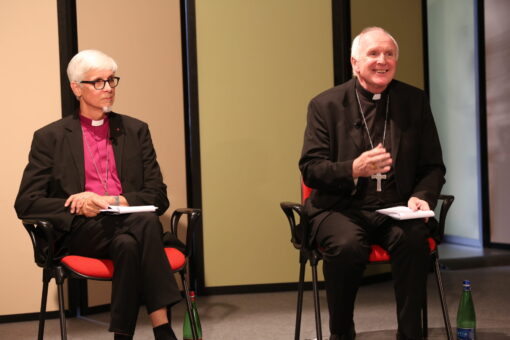 Brendan Leahy, a Catholic Bishop from Ireland and Matti Repo, a Lutheran Bishop from Finland are the moderators of the meeting. After greeting the participants, mostly connected through an internet link with 15 simultaneous translations, they gave the floor to Margaret Karram, President of the Focolare who said: “My wish, which is also a certainty, is that this meeting will strengthen among all those present, that wonderful reality of mutual listening and acceptance, in which the Holy Spirit becomes the protagonist of our relationships. He alone is capable of bringing about renewal in ecclesial and social structures, he knows how to pave the way and make every process of reconciliation constructive. Your presence at this Congress is in itself a sign of the times, it reveals the concern of each one for unity, a horizon that is not so far away because the life of the Gospel we share, makes it tangible among brothers”. Bishop Christian Krause, former President of the Lutheran World Federation explained the genesis of the meeting and then referred to its title: “‘Dare to be one’” (…) is a humble contribution to a dialogue and an ongoing initiative to share, to understand each other and to keep the message of Jesus among us on the road to peace”. He then invited everyone not to focus on protecting their institutional power, but “to open the doors to sharing the charism of unity and the Eucharistic hospitality of the children of God. Therefore, for heaven’s sake: ‘Dare to be one’!”. The programme included time to meet in linguistic groups to get to know each other and exchange first impressions. Then there was a presentation of the life of the Word of God in the Spirituality of the Focolare Movement. Sarah Finch, an Anglican focolarina read a passage from Chiara Lubich, which was then enriched by input from Lutheran bishop Dr. Matti Repo, Syrian Orthodox focolarina, Dr. Mervat Kelly, and Catholic focolarina, Dr. Sandra Ferreira. Then, some the Bishops themselves offered testimonies that illustrated what had been said. It was a series of personal experiences that demonstrated their commitment to building unity between the different Churches. In various pastoral situations, it was both moving and concrete. Chiara Lubich’s words which had just been read, resounded: “A fruit is that the Word makes us one: it brings about unity. As in plants that are grafted, two peeled branches, due to the contact of the two living parts, become one, so two souls, peeled of the human by living the Word of Life, are better consumed in one.” Four hours with participation from Australia to the USA, from Brazil to Ukraine, from Madagascar and through European and Asian countries, with a variety of time zones and of political and social conditions. The meeting continues for a second day on Friday, 24th September and then on Saturday 25th September, the participants will be received in audience by Pope Francis.
Carlos Mana
22 Sep 2021 | Non categorizzato
Synodality, ecumenism and peace are the themes that will engage 170 Bishops from 44 countries of the world and from 70 Churches and ecclesial communities who will meet from 23rd-25th September in Castel Gandolfo (Rome). Pope Francis will receive them in audience on 25th September. “Dare to be one. The courage of unity in a divided world” is the title of the next international conference of Bishops of different Christian Churches who are friends of the Focolare. The title aptly expresses the urgency that Bishops feel in these times when the pandemic has aggravated rifts, violence and old and new forms of loneliness all over the world. “To this we add the unjust distribution of wealth and poverty, the dramatic gap between freedom and oppression, the growing threats to the natural environment. All this prompted us to passionately formulate this appeal: “Dare to be one!”. We address it to ourselves and to our fellow Bishops so that it can be taken on in our respective Churches and communities”. This is how Bishop Christian Krause, former President of the Lutheran World Federation, one of the initiators of this event, summarized the significance of the conference. Mgr. Brendan Leahy, Catholic Bishop of Limerick (Ireland) who is the coordinator, explained, “This event is promoted by the worldwide network of Bishops of various Churches that are friends of the Focolare and who have been meeting regularly for 38 years to deepen their communion on the basis of the spirituality of the unity of the Focolare. The goal is to be united in Christ and if there is the presence of Jesus among us, the journey towards unity is assured ”. The meeting will have a blended mode: 10 Bishops will be physically present in Castel Gandolfo (Rome), while 170 will follow the conference online, alone or in small groups, in compliance with health rules. On 25th September they will be received in audience by Pope Francis, who, via streaming, will be able to communicate with all the participants, also those connected from afar. The following will intervene in the Conference: Margaret Karram, President of the Focolare Movement and Jesús Morán, Co-President of the Movement; Nelson Luiz Leite Campos, Bishop Emeritus of the Methodist Church in Brazil; Stefan Tobler, Reformed theologian, Professor of Evangelical Theology at the Lucian Blaga University of Sibiu (Romania); Piero Coda, Catholic theologian, member of the Joint International Commission for theological dialogue between the Catholic Church and the Orthodox Church, lecturer at the Sophia University Institute in Loppiano (Italy). The programme will offer insights into the spirituality of unity of Chiara Lubich, testimonies of life offered by Bishops of different Churches inspired by the Word of God, the mystery of Jesus Crucified, abandoned and risen, the charism of unity and its incarnation in the wounds of contemporary humanity. The central moment and certainly the most characteristic of the conferences of the Bishops who are friends of the Focolare is the “Pact of mutual love”. It is a solemn commitment to love one another on the basis of the invitation that Jesus makes in the “new commandment” (cf. Jn. 15:17). The Bishops will therefore undertake both to share the gifts offered by the Church of the others and to share their pains and joys, feeling them as their own in order to make the process of unity between the Churches ever closer and visible. Bishops friends of the Focolare: from the 1980s to today In 1982 Klaus Hemmerle, Catholic Bishop of Aachen (Germany) began promoting meetings of Bishops belonging to different Churches. Since the 1960s, many Bishops, who made the spirituality of the Focolare their own, were committed to walking together towards unity and promoting it at all levels. The words of the then Pope John Paul II to a group of Catholic Bishops friends of the Focolare on the occasion of an audience, represented a further encouragement to the organization of periodic meetings with Bishops of different Churches. Today these gatherings take place periodically in places that are symbolic of ecumenical dialogue. An itinerary that is not only spiritual, but also a concrete opportunity for the Bishops to get to know and welcome one another, offering each one the opportunity to experience the Christian life of the various Churches.
Focolare Communications Office
Stefania Tanesini
22 Sep 2021 | Non categorizzato
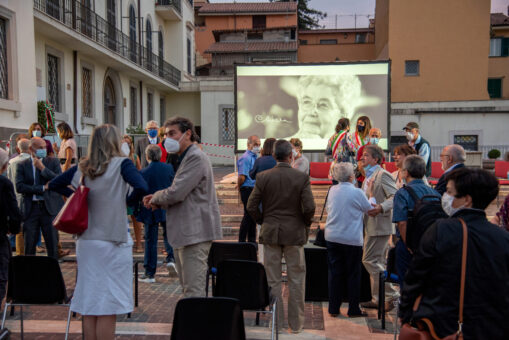
On 10th September the Municipality of Grottaferrata (Rome, Italy) posthumously conferred honorary citizenship on Chiara Lubich, an award that tangibly renewed the friendship between the founder of the Focolare Movement and this place she held so dear, where the first centres of the Movement were located. Margaret Karram, current President of the Movement received the plaque. A “mother city”, a place to “gather people with different vocations into a single people”. This was Chiara Lubich’s inspiration, which led her to perceive in the area of “Castelli Romani” a fertile ground where everything could flourish and, specifically, in the city of Grottaferrata (Rome-Italy), a new home for the Focolare Movement, after her hometown of Trent and Rome. In 1959, in Grottaferrata, a meeting room was inaugurated at Villa Maria Assunta, a beautiful house made available to the Focolare Movement by the Marquise Rossignani Pacelli, sister of Pope Pius XII. A house that soon became the heart of the Movement, the lively and fervent “Mariapolis” or “little town of Mary”. While continuing to reside in Rome, Chiara Lubich spent some periods in Grottaferrata during the years from 1956 to 1964. 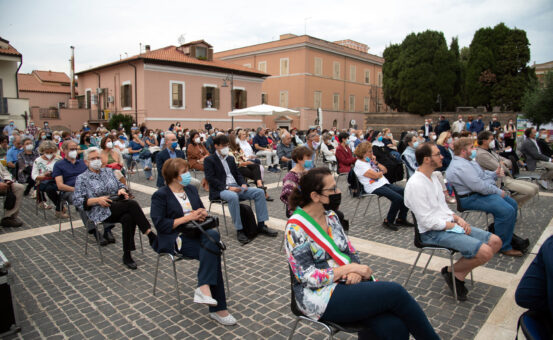 Images of a story guided by God and recalled by Margaret Karram, the President of the Focolare Movement, on the occasion of the ceremony of conferring the posthumous honorary citizenship of Grottaferrata on Chiara Lubich on 10th September. Present at the event: Luciano Andreotti, Mayor of Grottaferrata, Angelo Viticchiè, former Mayor of the city, Sergio Lubich, nephew of Chiara, and Veronica Cimmino, Mayor of Rocca di Papa. The ceremony was followed by the screening of the docufilm “Chiara Lubich: Love wins everything”. Also present were the director of the film, Giacomo Campiotti, the artistic producer Saverio D’Ercole, the producer Luca Barbareschi and the actress Valentina Ghelfi. A sense of community and fraternity pervaded the appointment, which had already been scheduled for 2004 and then postponed due to Chiara’s illness and death. As the Mayor of Grottaferrata recalled, these values, rooted in the life of the Movement, could also become a unique “means of communion” for the public life of a city, where the “search for the common good” remains the main objective. What seems an arduous journey finds its confirmation in “unity through love” and in the unpublished words that Chiara would have liked to use in receiving this recognition, which come back to us thanks to the voice of Margaret Karram: “I would like to propose the Art of Loving to all those present and in particular to the citizens of Grottaferrata so that, if they wish, we can help each other live it and spread it everywhere “. A legacy which is for each of us and of which each, in his or her own small way, becomes the guardian, today as yesterday; an experience that, as the President of the Focolare Movement concluded, “does not stop at the borders of our cities, but extends in relationships of collaboration with other Municipalities, creating an ever brighter network of cities which give a witness of fraternity”.
Maria Grazia Berretta
20 Sep 2021 | Non categorizzato
On 17th September 1948, Chiara Lubich met Igino Giordani, whom she later called Foco, for the first time, in Rome, Italy. She was a Franciscan tertiary and was accompanied by some religious from the various Franciscan families. Giordani was 54 years old and already successful in the political and cultural fields when he met 28-year-old Chiara Lubich and recognised her charism. Giordani immediately joined the Focolare and, because of his contribution to the development of the Movement, Chiara Lubich considered him a co-founder. Here is the story of that meeting from Giordani’s diary. “Seeing a Conventual, a Friar Minor, a Capuchin and a man and a woman from the Third Order of Saint Francis united and in agreement, seemed to me already a miracle of unity, and I said so. The young lady spoke; (…) and at the first words I felt something new. There was an unusual quality in that voice: the quality of a deep and sure conviction born of a life in touch with God. (…) When, after half an hour, she had finished speaking, I was caught up in an enchanted atmosphere, as if in a cloud of light and happiness; and I would have liked that voice to continue. It was the voice that, without realising it, I had been waiting for. It put holiness within reach of all; it removed the barriers that separate the lay world from the mystical life. It brought out the treasures of a castle to which only a few were admitted. It brought God closer: it made him feel like a Father, a brother, a friend, close to humanity.(…) Something happened within me. It happened that my juxtaposed pieces of culture began to move and become animated, joining together to form a living body, nourished by a generous blood: the blood with which Saint Catherine burned? Love had entered and taken hold of my ideas, drawing them into an orbit of joy. What had happened was that the idea of God had given way to the love of God, the ideal image to the living God. In Chiara I had found not someone who spoke of God, but someone who spoke with God: a daughter who, in love, conversed with the Father. (…) Everything was illuminated. Pain took on a salvific meaning, or was resolved into love. Life appeared as an adorable design of God’s will and every moment of it became full and had its own beauty. Nature and history unfolded in rich patterns of harmony and wisdom. And to live this new life, to be born in God, I did not have to renounce my doctrines: I only had to place them in the flame of charity, so that they might be enlivened. Through my neighbour, I began to live God. Grace flowed freely, the barriers between supernature and nature collapsed. Existence became a whole adventure, consciously lived in union with the Creator, who is life”.
Igino Giordani
(Igino Giordani, Memorie di un cristiano ingenuo, [Memoirs of a naïve Christian] Rome, 1984, pp. 147-154).
18 Sep 2021 | Senza categoria
People living in the Focolare Movement’s little town of Victoria in Man, Ivory Coast, have shown great tenacity during the pandemic. Covid 19 did not stop the activities of the Health Centre or the Nutritional Centre. The Movement’s extraordinary Communion of Goods has helped to support many people in need. Monica Padovani is an Italian focolarina, 53 years old, who has lived in Africa for twenty years. She has been working in the little town in Man for two years as a professional educator and activities coordinator at the Focolare’s Supplementary Nutrition Centre (CNSF). Before the pandemic she had shown great courage in rescuing and bringing new life to this project; when covid hit, her ingenuity and boldness enabled it to remain the “beating heart” of the area.. The creation of a workshop for the production of masks which could not be found on the market ensured indispensable services for the sick at the CNSF and the adjoining Medical Centre, and the financial aid received was essential for their continuation.. How has Victoria been affected by this emergency and how has it continued to be a chain of love during this time? There have been many challenges this year but we are really happy to be able to say that we have overcome many of them. The restrictive measures taken in the country at the beginning of the pandemic made it possible to contain the spread of the disease in the area surrounding the capital, Abidjian. In Man, where our little town is located, the consequences are mainly of an economic and social nature and have unfortunately affected an already fragile situation, making a particular impact on the poorest sectors of the population. Fortunately, the activities of the Health Centre and the Nutrition Centre have continued, albeit at a slower pace, and the aid received has supported various emergency activities, also allowing the employment of an additional nurse. With a strengthened team, cases of child malnutrition have been better addressed, a large number of mothers in need have been supported and concrete responses to the various challenges have been made. Helping seems to have been your way of “embracing” others. Is there any experience that is particularly close to your heart? Each case is unique but among the many, the one of the little girl born prematurely was particularly moving. After the birth, the baby weighed just one kg and the parents were referred to a paediatric department with the urgent need for a thermal cot. Due to various difficulties, it was not possible to meet this need and it was at the CNSF that they received first aid. The baby and her mother were helped to feed for the first time and they were assured of a calm and peaceful environment where they could stay warm and be carefully monitored. Thanks to these small gestures, the little girl is healthy; she has gained strength and weight and will soon celebrate her first birthday. Has the verb ‘to nourish’ taken on new meanings during the pandemic? The term “nourish”, in our daily experience at CNSF, certainly has a broader meaning. It is certainly about food, prevention and the fight against malnutrition. However, ‘feeding’ is also about giving what that person really needs at that moment, such as advice, encouragement, special attention. That’s what Covid emphasised: more attention to the other person. This is how we have understood that things that are often ‘simple’ in our eyes can be vital for others.
Maria Grazia Berretta
17 Sep 2021 | Non categorizzato
This is a call to us, too – to have an open mind and heart in order to recognize and care for the needs of others; to use our talents, our time, for the common good at home and beyond. It is an invitation to put ourselves last in order to be first, to encourage everyone toward the inevitable future: universal brotherhood. Listening for hours Loving a neighbour sometimes means simply listening… even for hours! It happened to me this morning, when around 9:30am a friend who spends most of the year abroad came to visit me. He told me about his father who had recently passed away, his caregiver, various family problems, and about how abroad, in order not to miss Sunday Mass, he travels two hours each way to reach the chapel where it is celebrated in Italian… It was after 12 noon when we said our goodbyes. Only then did I realize how much time I had spent listening to him. (Umberto, Italy) Kitchen competition Each time I came home from work, I would always see how tired my wife was. I asked God how I could help her, and one evening, during dinner, I came up with the idea of a weeklong competition in the kitchen. Each of us had to prepare a different dinner (together with my grandmother there are exactly seven of us). Even our third son, a teenager who was typically content with things as they are, got hooked on the competition. Once the week had passed, one of our daughters suggested we continue, even giving grades. Here it became even more fun. With great joy I noticed my wife relieved and happy to see her children in action. Once, talking about it among ourselves, she told me that she was discovering new and unexpected sides of our kids. (B., Slovakia) That look said it all I had retired earlier than I had planned to be near my wife, who had been feeling ill for some time. Unfortunately, she was suffering from a degenerative disease. Day after day I saw her abilities diminish, her speech, her movements… Where was the wonderful woman with whom I had dreamed of a happy life, a large and beautiful family, a commitment to be an open home for all? Now she was there, motionless. She moved her eyes, and that look said it all. My faith was not a living one, partly because, as a philosophy teacher, I know the tricks of the mind and how it deceives us. But since the conversation with my wife had become silent, I sensed that she was happy if I prayed beside her, for her, with her. Two months ago she passed away in silence. She left behind so much good, which both I and our children cannot quantify. She sowed a seed of light in us. When the illness initially appeared, she had said: “Life is now uphill. I would like to walk it with you. But God asks me to know how to say thank you with my life.” (P., Italy)
Edited by Maria Grazia Berretta. From ‘Il Vangelo del Giorno’, Città Nuova, year VII, n.4, September–October 2021
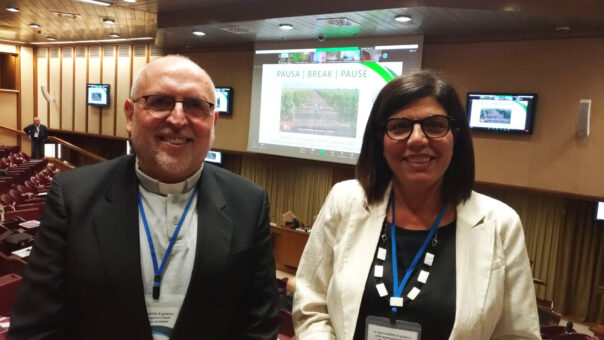
16 Sep 2021 | Non categorizzato
Those were Pope Francis’ words to the members of the various associations of the faithful, ecclesial movements and new communities on 16th September. We asked Margaret Karram and Jesús Morán for their impressions. It is about looking to the future while keeping our feet firmly set in the present. This is the beginning of a path of discernment suggested by Pope Francis to the members of the various associations of the faithful, ecclesial movements and new communities at the audience held on 16th September. 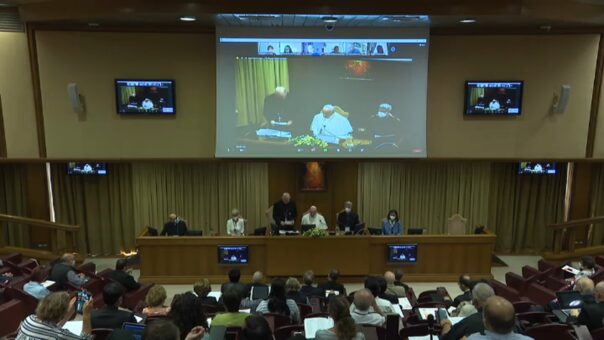 The Holy Father made a surprise appearance at the meeting with the moderators of associations of the faithful, ecclesial movements and new communities, organised by the Dicastery for the Laity, the Family and Life. Margaret Karram, president of the Focolare Movement, and Jesús Morán Cepedano, co-president of the Movement, also participated in this time of reflection on the theme: “The responsibility for governance in lay groups: an ecclesial service”. “It was a great surprise”, said Margaret Karram, “to see that the Holy Father came right at the beginning of the meeting. He gave a wonderful talk, which was very rich in content and clarified many things. He gave a precise interpretation of the general decree that was promulgated by the Dicastery last June on the renewal of positions of governance in ecclesial movements and new communities.
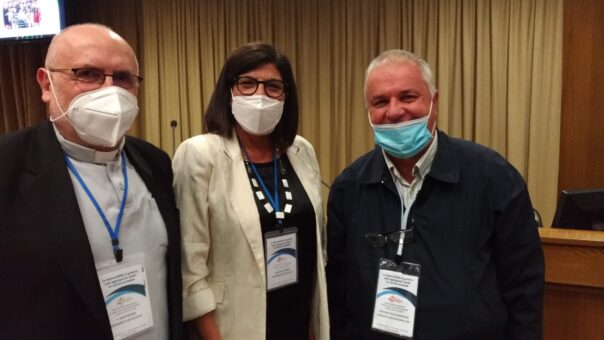
Jesús Morán, Margaret Karram and Giovanni Ramonda (Moderator of the Pope John XXIII Association)
13 Sep 2021 | Non categorizzato
Not only freedom and equality. Twenty years after the collapse of the Twin Towers, Chiara Lubich’s comments on the attack that changed the fate of the world are more relevant than ever, reminding us of the only possible way to peace. On the day after September 11 [2001], many of us felt the need to reflect deeply on the causes, but above all to work towards a true, responsible and definitive alternative to terrorism and war. … Today, whether we are in New York or Bogota, in Rome or Nairobi, in London or Baghdad, many of us are asking if it is possible to live in a world of peoples that are free, equal and united; peoples that not only respect one another’s identity but are also mindful of each other’s particular needs. … In many places around the world today, a cry of forsakenness rises up from millions of refugees, millions of people who are hungry, millions of people who are exploited, millions of workless people who are excluded and seemingly “cut off” from the body politic. It is this separation, and not only the hardships and economic difficulties, which makes them even poorer and increases their desperation. … Considering the challenges of the present and future of humanity, liberty and equality by themselves are not enough. Our experience teaches us, and we believe that there is need for a third, long forgotten factor in political thought and practice: fraternity. Fraternity can generate projects and action in the complex political, economic, cultural and social fabric of our world. Fraternity brings peoples out of their isolation and opens the door to development for those who are still excluded. Fraternity shows the way to peacefully resolving differences and relegates war to history books. Fraternity in action allows us to dream and even hope for some kind of sharing of goods between rich countries and poor countries, since the scandalous economic inequality in today’s world is one of the main causes of terrorism. The deeply felt need for peace in humanity today shows that fraternity is not only a value, not only a method, but is a global paradigm for political development. This is why a world that is ever more interdependent needs politicians, businesspeople, intellectuals and artists who put fraternity – as a tool for unity – at the centre of their thought and action.
Chiara Lubich
(Chiara Lubich, Message for the first World Interdependence Day, Philadelphia, USA, 12 September 2003 in Discorsi in ambito civile ed ecclesiale, [Talks given in civil and ecclesial contexts] edited by Vera Araujo, Città Nuova, Roma, 2020, pp. 111-113)
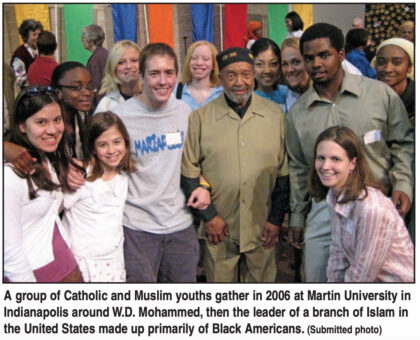
11 Sep 2021 | Non categorizzato
Solidarity shared on 9/11 by Catholics, Muslims in Indianapolis (USA) continues In the days following the terrorist attacks of Sept. 11, 2001, many American Muslims experienced an angry and sometimes violent backlash from their fellow Americans because the men who hijacked the airliners that day had been Muslim extremists. The Nur-Allah Islamic Center in Indianapolis had multiple bombing threats made against it in the days after 9/11. So, when the Muslims of the center gathered for prayer on the Friday after the attacks, they knew that they could become the victims of an attack themselves. But they weren’t alone. 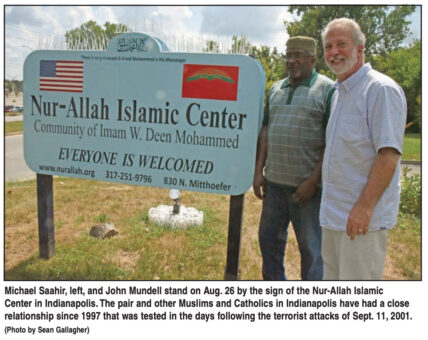 Joining them that day were some of their Catholic friends who were members of Focolare, an international lay ecclesial movement in the Church that, among other things, promotes greater unity in the broader human family. “It was a very emotionally moving experience,” said Nur-Allah member David Shaheed, who has also served as a Marion County judge since 1996. “They felt connected to us. They felt that we were friends and neighbors. They put their lives at risk to be with us at such a historically tumultuous and scary time.” John Mundell, a member of St. Pius X Parish on 9/11, was part of the Focolare group that came to Nur-Allah on Sept. 14, 2001. “That experience was probably one of the most sacred moments of my life,” he said. “When we walked in as a group and they saw us, you could tell by the look on their faces that they realized that what we had established was real. There was nothing fake or superficial about it.” The Focolare members knew that choosing to stand with their friends at Nur-Allah after bombing threats had been made against their center potentially put their lives in danger. But their mutual relationship was important enough to them that they accepted that risk. “Our Catholic faith called us to be there with them,” said Mundell, now a member of Our Lady of Lourdes Parish in Indianapolis. “This was where the rubber met the road. In your gut, you know what the right thing to do is, but you then have to say, ‘Yes, we’re doing it.’ ” Thankfully, no attacks happened on that day. But some members of Nur-Allah so appreciated the solidarity shown to them by their Catholic friends that they joined them for Mass two days later at St. Pius X Church. “It was reciprocal love,” said Mundell. “You reached out in love and then received this kind of wave [of love] back. It was a sacred feeling. Somehow there was the presence of God in this relationship we had established.” That relationship had started in 1997 and followed the example of Chiara Lubich, the Italian foundress of Focolare, who had reached out to W.D. Muhammed, the leader of a branch of Islam in the United States made up primarily of Black Americans. In the years that followed the start of the relationship in Indianapolis, the members of Focolare and Nur-Allah hosted meetings of Catholics and Muslims that drew people from across the Midwest. One had taken place in Indianapolis less than two months before 9/11. But the events of that day quickly deepened their relationship in ways that they could not have imagined. “There are times when God calls us to unity through pain,” said Michael Saahir, the resident imam of Nur-Allah. That, for him, is an enduring lesson of 9/11, one that he is concerned is being forgotten as the years pass. “Too often, when the pain subsides, we forget,” Saahir said. “We tend to forget too easily. Or we don’t even take time to study the lessons that come from it. And the oneness of the human family is the main one.” In recent years, members of Focolare in Indianapolis have become more aware of the pain experienced by their Black Muslim friends because of their race. “We’re not perfect as Americans, as Catholics in embracing this idea of universal brotherhood and sisterhood,” Mundell said. “We have a long way to go. There’s a racial aspect that we need to continue to work on and listen to.” Focolare and Nur-Allah members are making efforts so that the lessons of 9/11 and other lessons are remembered. In the months and years that have followed that day, people from both faith communities have been invited to parishes across and beyond the archdiocese and to universities to speak about their interreligious experience and relationship. When Mundell started receiving these invitations, he began to recognize a significance to the simple personal bonds that had been created with his Muslim friends in 1997. “It made us realize the uniqueness of that relationship and that it was no longer meant for just us,” he said. “It was meant to be shared with everyone.” “People need to see a model or example,” said Saahir. “I’m grateful that our relationship with Focolare is a model, not just for Muslims and Catholics, but for anyone to see that this is doable and has longevity.” Mundell and Saahir hope that the longevity of the relationship between their two communities will continue into the next generation. “It’s like passing on your faith,” Mundell said. “The next generation has to take it on as their own. They have to have their own experience. “This is something that we’ll be doing for the rest of our lives. The relationships have to be continually renewed and rebuilt”.
By Sean Gallagher for “The Criterion”, 3 September 2021
Serving the Church in Central and Southern Indiana Since 1960
10 Sep 2021 | Non categorizzato
Even though the disciples had many frailties and fears, Jesus had confidence in them and called them to follow him and to share his mission – to serve everyone. To serve, not so much as a slave who is forced into work but as a free person who generously offers his or her skills and strength. Solidarity in support of the Roma people The pandemic has exacerbated the social problems in our area. One of the most serious challenges is housing: many people do not know what to do and live in situations of distress and even serious degradation. When, as a parish, we helped a Roma family to move from a damp, dilapidated shack into a more dignified home, the action helped to overcome certain preconceptions.The gesture seemed to communicate the idea that if Fr Peppino and the other parishioners welcome Roma foreigners, it means that they are people like us whom we can and must help. This created a sense of solidarity and there was almost a “competition” to find ways to help. Some people donated furniture, others transported and assembled it, other people took care of the contract for the house and others the utility supplies. When M., a Roma mother of two beautiful children, came back from the hospital where she had been admitted for Covid-19, she told me: “I am touched and I wanted to thank you because I have never felt as loved as I do by you and the whole community.” (Don Peppino – Italy) Do unto others… At school, I had a classmate who never made any effort and very bad at maths. I repeatedly urged him to study harder but to no avail: nothing changed. He failed his first semester exam and was humiliated in front of everyone, so he cried. Although he had not listened to my advice and it was his own fault, I kept thinking of the sentence “Do unto others as you would have them do unto you” and I decided I would help him. I offered to tutor him in maths. He was surprised and delighted and immediately accepted. It was not easy to bring him up to an acceptable level, but a small miracle happened: he achieved a high mark at the end of the second semester! (Radu – Romania) Proximity About ten years ago, when living in Syria had become difficult for us Christians, we asked ourselves whether we should stay. Many relatives and friends had chosen to leave, and from the news we had received, they seemed to have found peace in other countries and were far from the noise of combat, terror and danger. Yet, even if we do little,we felt that that our presence here, day after day, corresponds to a real mission. It is not so much a matter of witnessing to faith or fidelity to one’s homeland, but of proximity, the proximity of which Pope Francis speaks. We are certain that for our children, too, this situation, even if it is not easy, will prove to be a great teacher of life. (V.M. – Syria)
by Maria Grazia Berretta
(taken from Il Vangelo del Giorno, Città Nuova, year VII, n.4, September-October 2021)
6 Sep 2021 | Non categorizzato
The Focolare Movement is involved in various countries around the world in welcoming Afghan refugees. In Italy, to date, about 400 people have offered to open their doors to the refugees. There has been an immediate response from individuals, families and entire communities, from the cities of Milan to Ragusa. The Focolare Movement in Italy has launched an appeal to welcome Afghan refugees brought to our country by the first air bridges. Since 26th August, through the local Focolare communities and many people involved at various levels in local or national networks, an invitation was issued for the reception and accompaniment of immigrants. The appeal calls for: an assessment of the possibility of opening not only the Centres of the Movement, religious institutes, rectories, parish buildings, but also private homes; the identification of those who would be willing to collaborate for this emergency by supporting the arriving refugees; collaboration with local authorities and organizations. It’s all work in progress, which aims to combine private initiative with the reception systems set up by the Ministry of the Interior, and which is already taking its first concrete steps in line with what Pope Francis expressed in the Angelus on Sunday 5th September, that all Afghans “whether at home, in transit or in the host countries”, may “live with dignity, in peace and fraternity with their neighbours”. It did not take long for responses to arrive: some people offered their professional experience, others their own homes, or empty houses. Among the first to respond to the appeal was a nurse from Bergamo who said: “In between my shifts, I am available to help in any way”. Others offered their legal, health, or education-related skills. A family from Lombardy, with five small children, offered to host a child. Not just families, but entire communities are responding to the Pope’s invitation to open rectories and churches. Religious orders are discerning how to participate: for example, a group of religious from the Vesuvian countries. Then there are entire focolare communities, such as in Pesaro, Milan, Cosenza, who have come together to join forces and find a suitable place where they can welcome people. Contacts continue with some organizations and cooperatives with similar ideals, which can support and sustain this family-like welcome with relevant means, such as the “Fo.Co. Cooperative” (Chiaramonte Gulfi, RG) and the “New Ways for a United World Association” (Rome). In Marino, (Lazio), reception is already underway by the cooperative and non-profit organization One city is not enough, which acted immediately. Since the very first days of the emergency, some Afghan families have been hosted at the Mariapolis Centre of Castelgandolfo. On 28th August, people in several cities in Italy took part in the initiative promoted by the Economy of Francesco in favour of the rights and freedom of Afghan women. Alongside all these actions, funds are being raised, small and big amounts: one person unable to open their home had their family jewels evaluated so as to contribute to associations that could use the money locally for specific needs that cannot be covered with State contributions. The bank account is the one already in use for the Covid Emergency. Contributions can be made with the indication, WELCOME AFGHANISTAN.
Maria Chiara De Lorenzo
6 Sep 2021 | Non categorizzato
Words such as perfection and holiness may seem like unattainable goals, but Chiara Lubich, starting from a statement by St Bonaventure, reflects on how it is possible to walk towards them, starting from the simplest gestures of everyday life. I found a thought on holiness attributed to St. Bonaventure, which many of us know, but perhaps we have not yet lived to the full. (…) This thought aroused in my heart a great desire to put it into practice with all of you. Aren’t we striving to become saints together? I’m referring to a statement made by a saint who was well versed in different ways to go to God. He boldly affirms that a person will go further on the way to God in forty days if they never stop, than another in forty years, who stops every now and then ‘in the vale of imperfections and venial sins’. Isn’t it wonderful? Of course, I asked myself: “What do imperfections and venial sins consist in?” We could make a long list of them. Undoubtedly, they are the opposite of perfection. And what does perfection consist in? In living charity: “Charity is the bond of perfection,” says Paul (Col. 3:14); “May they be perfect in unity,” we find in John (17:23). If charity is lived together, it becomes mutual: “I give you a new commandment,” says Jesus, “Love one another. As I have loved you, so you also should love one another” (Jn. 13:34). And so this is the way we should always live, so as not to remain in the vale of imperfection and venial sins, and if we forget or fail to do so, we can begin anew. (…) Where should we begin? At home. Yes, at home, starting in the morning so that we begin the day well. At home, also because at times we make the effort to live mutual love with others, at meetings and congresses, but then, when we go home, because we are tired we are sometimes impatient with our brothers or sisters. We lose control and… good-bye mutual love! Let’s keep it in mind. If we do this, then in forty days, on November 30th, we will certainly have progressed spiritually and made a noticeable contribution towards our holiness and that of the people.
Chiara Lubich
(Chiara Lubich, Conversazioni in Collegamento telefonico, Rome 2019, p. 561-562)
1 Sep 2021 | Non categorizzato
An interview with Stefania Papa, the new head of EcoOne, the Focolare’s environmental agency. She describes the Focolare’s participation in ‘Season of Creation” anche…’ and various ecology projects. From 1 September to 4 October, ‘Season of Creation’ will be held throughout the world. It features both prayer and concrete actions to safeguard and protect our common home. Stefania Papa is the new head of EcoOne, a cultural enterprise from the Focolare Movement that promotes a network of teachers, academics, researchers and professionals working in the environmental sciences. We interviewed her about the Focolare’s commitment to ‘Time for Creation’ and various ecology projects. What is ‘Season of Creation’? It is a specific period that goes from 1 September, the World Day of Prayer for the Care of Creation, to 4 October, the feast of Saint Francis of Assisi, the patron saint of ecology. It will be a time in which various churches around the world come together to pray and promote concrete actions to safeguard and protect our common home. This year’s theme is: ‘A home for all? Renewing God’s Oikos.’ And Oikos in Greek means home. Why is it important that it becomes more and more an event for different churches? To answer this question, I am reminded of an ancient African proverb that goes like this: ‘If you want to go fast, run alone. If you want to go far, do it together with others.’ Pope Francis himself in the encyclical ‘Laudato sì’ says, ‘We need a confrontation that unites us all, because the environmental challenge we are living, and its human roots, concern us and touch us all.’ We need to ‘unite the whole human family in the search for sustainable and integral development’.[1] We can only do this by coming together, seeking ever-closer collaboration and communion among the various Christian churches in the world. It’s been six years since the pope’s ‘Laudato si’’. Yet there is still a long way to go… Many other actions have been started and carried out, but much remains to be done. The task at hand may seem difficult, but we can still reverse some negative trends, adapt to minimize damage, restore crucial ecosystems and better protect what we have, starting with rethinking housing solutions and social mobility, sorted waste collection and in many other fields. But the road taken is the right one. And Pope Francis’ encyclical marks the point of no return. There is also a petition to sign. What does it include? It is an important opportunity that is offered to us to strongly ask world leaders to urgently commit to the climate crisis and the biodiversity crisis. In fact, two very important events will be held soon: 11–24 October 2021, the United Nations Conference on Biodiversity (COP15), where world leaders will set significant goals to protect creation; and 31 October–12 November 2021, the 26th United Nations Climate Change Conference (COP26), where countries will announce their plans to achieve the goals of the Paris Agreement. The Focolare Movement is a partner in the Laudato Si’ Movement. How does Focolare commit to ‘Season of Creation’? The Focolare Movement has always been committed to the environment. For the ‘Season of Creation’ in particular, it has participated and is participating in the initiatives of the Catholic Church, such as the Laudato Si’ action platform of the Dicastery for the Service of Integral Human Development (through the New Families Movement) and in events promoted by the Laudato Si’ Movement, formerly the Global Catholic Climate Movement, to which it adheres. In addition, the last General Assembly of the Focolare concluded in February 2021 and relaunched ecological changes for members and structures, with small, medium and large activities (such as financing international projects, and development partnerships with Action for New Families, United World Action, etc.). At the same time, there is an ongoing commitment by all Focolare members to divest from fossil fuels. Just this year, in fact, the youth of the movement committed to pathways entitled ‘DareToCare’. It’s a campaign that means to take charge, take an active interest and give importance to the most fragile, the planet, institutions, our city, our neighbours and the problems of our society. Last May, the NGO New Humanity was also accredited as an observer at the United Nations environmental governing body, United Nations Environmental Programme (UNEP), the United Nations agency that deals with all global environmental issues. New Humanity carries out its environmental protection activities in particular through the EcoOne cultural enterprise. In addition, I would like to mention the partnership created between the Focolare Movement and FaithInvest, an international organization that works to help religions develop long-term strategic plans for the environment. In the cultural and educational field, there are several conferences planned that are promoted by EcoOne. There is also EcoOne’s participation in the European Christian Environmental Network (ECEN) and projects in schools, such as the one recognized by the Italian Ministry of Education called ‘Giving to safeguard the environment’.
Lorenzo Russo
[1] Pope Francis, encyclical letter Laudato Si’, 13–14.
30 Aug 2021 | Non categorizzato
The pandemic is still ongoing, while the economic and social crises generated by it are worsening. The environmental situation in the world is dramatic and conflicts in some areas of the globe do not seem to diminish. And so, what can be done? For Chiara Lubich there is only one remedy: universal fraternity. To make humanity a single family and to do so by starting from the small, concrete, daily steps that each of us can take. In the face of the multiple difficulties in the relationships among people with such different mentalities, among peoples that are so different, cultures that are so distant from one another and religions distorted by the presence of extremists, there is only one remedy: universal brotherhood, to make humanity one family in which God is the Father and all people are brothers and sisters. How can this be done? Who is qualified for this task? There is no doubt about it: there is someone who also died for his ideal, but who then rose and made it possible for everyone. It’s Jesus. We must aim at bringing him back on earth, through us, by being another Christ, another incarnate Love, Holiness, Perfection, as he is. Now is the time in which to resolutely strive for perfection. But what does perfection consist in? Recently I re-read a paper on the spiritual life in which there were wonderful words of great Church Fathers and saints. Perhaps we already know these things, but it will be helpful to remember them now. All these eminent figures in the life of the Church agree that perfection consists in never stopping our growth, because whoever does not go forward, goes backward. And, considering that we are on a journey of love, perfection consists in always growing in charity. Let’s love, then and always love better, always better. How? By keeping before us our perfect model: … God who is Love. … St. Francis de Sales says: “St Francis de Sales says: “Whoever does not gain, loses; whoever does not ascend, descends; whoever does not win, is defeated”* We are struck by the radicalness demanded by love. But everything in God is radical. … Is it difficult? Is it easy? Try it and see. Give yourself to the will of God in each moment, to others, to the brother or sister you must love, while working, studying, praying or relaxing, while doing any activity. And we must continually improve in this: otherwise we will go backwards. To help us do this, we can say with every action, even the most simple and commonplace: “This is the most beautiful thing I can do in this moment.” … In this way we too will train ourselves for the task that awaits us and which is typically ours: universal fraternity.
Chiara Lubich
From “Conversazioni in collegamento telefonico” [Telephone link up conversations] Citta Nuova ed. p. 620 – Castel Gandolfo, 27 September 2001 * St Francesco di Sales, Trattato dell’amor di Dio, [Treatise on God’s love] III, 1, Città Nuova, Roma 2011, p. 222.
27 Aug 2021 | Non categorizzato
Loving first, selflessly, always, immediately and joyfully. This is an opportunity to incarnate the Art of Loving in our lives. It is from there that – as if drawn to it – fraternal communion springs forth, bringing new life and changing our world. Physiotherapists In the centre where I work, the number of requests decreased because of Covid, and many hours of the day were empty as a result. I obtained permission to help in a department of infected people. Other colleagues later followed my example. One day, one of them confided to us that his way of serving had never been so humane and engaging. “Only now have I realized what a gesture of solidarity means, a caress, even if you have gloves on. I feel like I’ve discovered a more human dimension to my work. I would like my children to do this service, because it is a real school of life.” (H., Czech Republic) Staying close When Pope Francis speaks of “closeness”, it seems to undo all the rules we have made for ourselves to live a certain way. For him, it’s all about the other person and our capacity to welcome them. I was talking about this once in the office. One of my colleagues was contrary to the idea, since according to her it is precisely this no-rules attitude that is ruining the Church. I listened to her, astonished and discouraged by how certain she was in condemning the pope, despite being an intelligent woman and, in her own way, a practicing Catholic. Since that day I avoided the subject, and whenever she would attack me with some article about the pope, I would try to deflect the conversation. The day before yesterday, on the phone, she told me that she couldn’t come to work because of problems with her anorexic daughter. As soon as I could, I went over. In fact, the girl’s life was at risk. My wife is a psychologist and, using various tricks, managed to spend time with her. Now the daughter is better, and she is often at our house. My colleague wrote me a message. “Now I understand what the pope means by the word ‘closeness’.” (C., France) I’ll go My elementary school teacher told us about a soldier, perhaps in the Alps, who was a bit exceptional: he would do any job, even the most unrewarding, saying to his superiors, “Vago mi” (I’ll go). This went on until “Vago mi” (as he was now nicknamed) never came back, killed in action. That death, the end of a life lived with altruism, struck my imagination as a child. I wished I could have been like him. In short, “Vago mi” became my model of someone who spends his life for others. And this was many years before I came across the one who gave his life for us and meaning to mine. (Joseph, Italy)
Edited by Lorenzo Russo
From “Il Vangelo del Giorno,” Città Nuova, year VII, n. 4, July–August 2021).
24 Aug 2021 | Non categorizzato
Prof. Sureshchandra Upadhyaya has recently passed away. Indian teacher and scholar, profound connoisseur of Hindu culture. He met Chiara Lubich in 2001. The face adorned with a white beard that reached his belt. A small man from whom clear and essential thoughts emanated. Prof. Sureshchandra Upadhyaya was a person with a vast culture and profound spirituality. He was an expert in Sanskrit and Hindu culture which he continued to study and spread also through his teaching activity. The meeting with Chiara Lubich and her charism in 2001 marked the beginning of a deep spiritual and intellectual friendship which included other Indian academics. Prof. Upadhyaya was a leading exponent of the “Bharatiya Vidya Bhavan” of Mumbai, the Institute of Indian Culture, present throughout India. He joined it in 1960 at the age of 28 as a Sanskrit teacher, then, in 1972, he was promoted to academic director and continued his career with great passion, guiding many students with their PhDs. He received numerous awards, including: the “Eminent Vedic Scholar” award of the University of Mumbai (India), the “Certificate of Honour” of the President of India, the “Eminent Sanskrit Scholar” award of the Government of Country and the “Best Teacher Award” of the Government of the Indian State of Maharashtra. On 5th January, 2001 in Coimbatore (India) in the hall of the Nani Kalai Arangam College, the award ceremony of the prestigious “Defender of Peace Award” to Chiara Lubich took place. There were 500 people present, mostly Hindus, a qualified audience including Prof. Upadhyaya. After listening to Chiara, he said, “As long as there are people like this, God is with us and one day the earth will become heaven. All faiths seek the truth and truth is nothing but love and peace as Chiara tells us ”. Another time he said: “Chiara Lubich tangibly reveals to me that God can be experienced through profound unconditional love. As soon as you love God, you also love yourself and others as God loves the whole of creation. As you spread your love, your experience of God deepens within you and overflows out of you. Loving then becomes your very nature, like the flowers that emanate their fragrance all around. Driven by love and compassion, it flows effortlessly, self-forgetful, like waves that dance in the divine ocean. Let us be inspired by Chiara’s commitment to live by loving one and all, to experience the presence of God inside and outside of us and to feel happy beyond all measure ”. On 12th August, 2021, Prof. Upadhyaya finally reached the bliss of “Ananda” (the pure state of joy and happiness) about which he often spoke.
A.M.A
https://www.youtube.com/watch?v=2ID42kDSgrY Here is the memory of Prof. Upadhyaya written by Roberto Catalano, professor of theology and practice of interreligious dialogue at the Sophia University Institute in Loppiano (Italy) http://whydontwedialogue.blogspot.com/2021/08/uppadhyaya-ji.html
23 Aug 2021 | Non categorizzato
Chiara Lubich reminds us that we are all called to dialogue. And if we spend parts of our day alone, we can do everything for the sake of our brothers and sisters, like true “apostles of dialogue”. … Each time we are in contact with one or more brothers or sisters, directly or indirectly, by means of a telephone call, a letter, a job carried out for their benefit or prayers said on their behalf, we all feel that we are involved in an unending dialogue, that we are called to dialogue. How? By being open to our brothers and sisters, by listening, empty of ourselves, to what they want, to what they say, to what worries them, to what they desire. Once we have done this, we give what is desired and what is appropriate. And if there are times and hours that I must dedicate to myself (eating, resting, dressing, and so on), I can try to do all these things in view of my brothers and sisters, always mindful of those who await my love. In this way and only in this way, by continually living the “spirituality of unity” or “of communion”, can I effectively contribute towards making my Church “a home and a school of communion”; I can further the unity of the Church with the faithful of other Churches or ecclesial Communities; and I can achieve, together with people of other religions or cultures, ever larger spaces of universal fraternity. … Let’s feel that we are “apostles of dialogue” and live accordingly. A 360 degree dialogue, certainly, but starting out on the right foot: by loving every neighbour we meet, and the measure of our love is the gift of our life.
Chiara Lubich
Taken from: “Conversazioni in collegamento telefonico” Citta Nuova ed. pag. 667, – 2004
21 Aug 2021 | Non categorizzato
A reflection by Anna and Alberto Friso. For decades they worked alongside Nedo in his generous and hugely competent commitment to serve the world of family life as a married focolarino.  “Two driving ideas conditioned my life growing up: the need to consecrate myself totally to God and an instinctive creative love for beauty and art, combined with the unshakeable conviction that I would do something truly important with my life”. This is how Nedo Pozzi described his ambitious life-project, which he confided to us too during the almost forty years we shared at the Focolare’s international centre. Firstly we worked together in the field of “Family Life”. Then his distinctive gifts as a communicator, man of culture and of rare sensitivity, led to him being entrusted with other even more arduous and complex tasks. In 2000 he played a key role in developing a Focolare network (NetOne) for those active in the field of communications and media. Later, he was asked, with Vera Araujo, to coordinate the Focolare Movement’s dialogue with contemporary culture. Throughout this period, he wrote articles and books for Città Nuova publishing, he contributed research for Focolare founder Chiara Lubich’s public discourses, and delivered presentations at numerous international conventions. Nedo was born in Mantova, Italy on 6 July 1937 and grew up along the shores of Lake Maggiore. He never lost his capacity to dream bold dreams. At barely 20 years of age, he met Angela and thus began a passionate love story. Years later, at the many courses for engaged couples they animated, Nedo would candidly declare that quite obviously it was he and Angela who had invented falling in love! They got married early one morning with only 2 witnesses present. No need for expensive tastes, their wedding banquet was two sandwiches and a beer at Milan station! In this way their life’s adventure together joyously took off under the station’s arcades, which still today evoke the feeling of a cathedral in the world. All too soon, however, reality failed to live up to the dream and the first signs appeared of a crisis to threaten everything. At this point Nedo was introduced to Focolare by a married couple he knew. This proved to be the discovery of true Love, with a capital ‘L’. Love which gives of itself freely, a love composed of forgiveness, of living for the other person, a love with God at its root. From this moment on, the ideal of unity became the essence of their love for one another. They discovered how giving oneself to God and to their neighbors can open up the possibility for married people too to consecrate themselves to God. At separate times, both Nedo and Angela responded to the calling to become married focolarini. And this marked the fulfillment of the first of Nedo’s two yearning desires: to be all for God. He seemed to let go of his second passion – beauty, because he couldn’t imagine how to reconcile these two apparently contradictory callings. His life became a crescendo in love as he daily dedicated himself to others and humanity. He found himself called “directly and vitally to pay in person in each moment”, as he described it. And it was precisely through this process that Nedo’s thirst for beauty became satisfied, in the discovery that Beauty with a capital ‘B’ is hiding within every neighbor, be they famous or forsaken. All of us who have been fortunate enough to be around Nedo and penetrate, through his intuitive reflections, the mystery of his and our own life, can testify that in Nedo the profound contrasting passions which dominated his adolescence have truly been reconciled. With his departure on 12 August, 2021, after eight years of an illness which gradually eroded his intellectual and relational capabilities, we have lost a giant of wisdom and of charity, a man of profound faith and passionate openness to others. But we, like Angela and as their daughter Paola declared on behalf of siblings Pierpaolo and Daniela, will remember him as the tenderest spouse and father, loyal friend and an intellectual who lived and worked, as he himself said, to open up “a glimpse of the Absolute”.
Anna and Alberto Friso
formerly responsible for the New Families Movement
20 Aug 2021 | Non categorizzato
When in suffering, you recognize the face of Jesus abandoned on the Cross by his Father and, with all your limitations, accept it, then that suffering is transformed into joy. Life takes on another meaning; it improves, because it is lived with love. Losing your father I was already an adult when my father left home to have another family, yet the loss of your father always leaves you with a void that nothing can fill. Memories, words come back to me and I remember him. The saddest thing is when you don’t know who to share a joy or a success with. Now I’m married, we’re expecting a child, but that sense of being an orphan persists. My wife, on the other hand, resents her father who left the family when she and her little sister were little. For this reason, talking among ourselves about the father figure brings out our great diversity. But precisely because we know what love and its absence mean, we are committed to being sources of true love for our future children. This is one of the things that the parish community which we are joining emphasizes a lot: the nature of true love, the kind of love that overcomes self-centeredness and which is explained to us by Jesus, who with his life and death gave us the measure. (PI – Switzerland) My humorist friend In my opinion, compared with the limited, deficient, sometimes tragic aspect that man finds in his fellow men, as well as in himself, humour is the new vision of life from God. For years I collaborated as a designer with Nino, a dear friend, on some of his comical publications. Everyone, absolutely everyone, stumbles as they walk. As for Nino, every time he stumbles, he stops to think about it for a moment and then starts laughing about it. Then he tells us and everyone smiles. If you think about it, this is the pattern of his humour. A humour that has become more and more refined over the years, without the grit of satire, yet penetrating; an amiable mockery not of people, but of the “old man” who is always lurking in everyone. Nino himself wrote about it a few years ago: “According to me, humour is an unexpected dimension, which in addition to the four traditional measures of a person: height, length, width and depth, reveals four anti-measures: shortness, lowness, narrowness and superficiality”. (Vittorio – Italy) Irina and Ecumenism I am Orthodox, born in Russia, and married to an Anglican priest. There were never any theological difficulties between my husband and I; he loved the Orthodox Church very much. As time went on, we discovered how much we also have in common with the Catholic Church. My husband directed an Ecumenical Centre in Rome, to which he dedicated all his energy. After his death, I taught Russian at the Gregorian University for five years. Then I returned to England, and took on the role of President of an Ecumenical Centre in Oxford. In my book entitled “The path of unity” I speak about my husband and about the contacts I had with important personalities of different Churches who appreciated our ecumenical work. Of course, there is still a lot to do for unity to be achieved, but there is no lack of prophetic spirits who work for this aim. They are a minority, it is true, but they exist and they are the great strength of the Church. Even if it saddens me to see that there are still many prejudices to overcome, we must continue to work and hope, because the commandment of Christ is “that all be one”. For me the Church is already one.
Compiled by Lorenzo Russo
(Taken from Il Vangelo del Giorno, Città Nuova, Year VII, no.4, July-August 2021)
16 Aug 2021 | Non categorizzato
Chiara Lubich reminds us that the kingdom of God belongs to those who are like children. This is because children trustingly abandon themselves to their father and mother: they believe in their love. In the same way, an authentic Christian, like a child, believes in God’s love, and throws him or herself into the arms of the heavenly Father. Jesus’ way of acting and speaking is always a little puzzling. In this case, he breaks with the commonly held view of children as socially insignificant beings. The apostles don’t want them around him in their “adult” world, where children are only a nuisance. Even the chief priests and the scribes seeing the children crying out in the temple, “Hosanna to the Son of David,” become angry. And they ask Jesus to scold them (see Mt 21:15-16). Instead, Jesus has a completely different attitude towards children: he calls them to him and embraces them; he lays his hands on them and blesses them; and he even holds them up as models for his disciples. “For the kingdom of God belongs to such as these.” In another passage of the Gospel, Jesus says that, “Unless you change and become like children, you will never enter the kingdom of heaven” (Mt 18:3). Why does the kingdom of God belong to those who are like children? Because children confidently abandon themselves to the care of their father and mother; they believe in their love. When they are in their arms, they feel safe and unafraid. And when they sense danger, they hold on even more tightly to their mum or dad, and immediately feel protected. At times, we see a parent put a child in a high place, for example, and then tell him or her to jump. And the child jumps with complete trust. Jesus wants the disciples of the kingdom of heaven to be like that. Authentic Christians, like children, believe in the love of God. They throw themselves into the arms of their heavenly Father, and trust him unconditionally. Nothing frightens them anymore because they never feel alone. Even when a time of trial comes along, they believe in God’s love, for they believe that everything that happens is for their good. Are they worried about something? They put it in the Father’s hands, and with child-like trust believe that he will resolve everything. They abandon themselves completely, as a child does, without calculating the risks. Children are totally dependent on their parents for their food, clothing, a home, care, education, and so on. So, too, do we “children of the Gospel” depend completely on the Father. He nourishes us just as he nourishes the birds of the air. He clothes us as he adorns the wild flowers. He knows what we need even before we ask him for it (see Mt 6:26), and he gives it to us. The kingdom of God, too, is not something that we ourselves achieve; we receive it as a gift from the hands of the Father. Furthermore, children do not do evil, for they don’t even know what it is. … The “children of the Gospel” believe in God’s mercy, and, forgetting the past, they begin a new life each day in openness to the promptings of the Spirit, which are always creative. Children do not learn to speak on their own; they need to be taught. The disciples of Jesus do not follow their own reasoning; they learn everything from the word of God to the point of speaking and living according to the Gospel. Children are inclined to imitate their father. If you ask them: “What do you want to do when you grow up?” they often say that they want to follow their mother or their father’s profession. The same applies to the “children of the Gospel.” They imitate their heavenly Father who is Love, and they love as he does. They love everyone because the Father makes the sun rise and the rain fall on the just and unjust alike (see Mt 5:45). They are the first to love because He loved us while we were still sinners (see Rm 5:8). They love freely, without selfish interests, because this is what the heavenly Father does… This is why Jesus likes to be surrounded by children and puts them before us as models. …
Chiara Lubich
The Word of Life, October 2003 From: Parole di Vita, a cura di Fabio Ciardi, Opere di Chiara Lubich, Città Nuova, 2017, pag. 702
13 Aug 2021 | Non categorizzato
St Augustine said, “Once and for all, I give you this one short command: love, and do what you will. If you hold your peace, hold your peace out of love. If you correct someone, correct them out of love. Let the root of love be in you: nothing can spring from it but good”. Put love … I could never have believed that my husband would turn into a stranger. His behaviour demonstrated such selfishness that he alienated all those around him. Actually this hid a deep sense of inferiority on his part. But it got to the point that I couldn’t even celebrate our two children’s successes without offending him. Yet when we first met, I had felt so supported by him! But now I felt my world had fallen apart and I was at crisis point. Around this time, I heard from an old school friend who had entered the convent but had just decided to leave. I went to see her and she shared her experience of loneliness, of disappointed idealism, of jealousies within the community, a community which existed for the best of humanitarian aims. As she spoke, I seemed to see myself in a mirror. We began to meet regularly and a phrase she quoted from St John of the Cross illuminated me on what I needed to do to try to save my family: “Where there is no love, put love and you will find love”. I decided to try. It wasn’t easy. But today things are different, both for me and for my friend. (M.d.A. – Albania) Staying in Syria Ten years ago, as life was becoming very difficult for us Christians, we asked ourselves if it was really the case to stay in our own country. Many had chosen to flee, and apparently had found safety, far from the sounds of gunfire and from the fear. However, even if we can’t do much, we realise that our presence here has become a true mission. Not so much about giving a witness of loyalty to the land or keeping the faith, but rather of being close to people, as Pope Francis has described. We’re sure that this situation, difficult as it is, is offering a great life lesson to our own children. (V.M. – Syria) Learning from the smallest Kanna comes from a Christian family and goes to a nursery where the teacher and many of the other children belong to different religions. At the end of the year, the teacher greets each of the children one by one. When she reached Kanna, she said, “Thank you because you’ve taught us about Jesus. When you speak about him, we can feel he’s close to you. You taught us the prayers you learned at home and they’re beautiful. This morning I saw you when you gave the prize you’d won to one of your friends. This gesture really moved me! I’m about to get married, but before I do I want to be baptized. I’m taking preparation because I want to believe in Jesus like you do.” (Z.J. – Japan)
Edited by Lorenzo Russo
(translated from Il Vangelo del Giorno, Città Nuova, anno VII, n.4, luglio-agosto 2021)
10 Aug 2021 | Non categorizzato
Sister Antonia Moioli departed this life on 30th July, 2021. She was calm, had a beautiful smile and was surrounded by affection and prayers. Born in Alzano Lombardo (Bergamo, Italy) on 13th June, 1949 to a deeply Christian family, at the age of 19 Antonia Moioli got to know the Focolare Movement: the discovery of God Love inspired her to love everyone: from the members of her family to those at the nursery school. “I was wondering what God wanted of me. A priest advised me not to worry, to continue living the Ideal and to trust Jesus who said: To those who love me I will manifest myself. I trust him and I count on that. In the meantime, I realize that many of my colleagues at work were lively, free nuns. They gave me a book of their Founder. When I read it, I experienced a joy as it was so much in harmony with the Ideal”. In 1971 she entered the Institute of the Sisters of the Infant Jesus. She made her first vows in 1974 and her perpetual vows in 1980. She threw herself into education with enthusiasm; everyone remembers her for her vitality, love and passion for children and young people. In 1977 she went to Rome, to the school of Santa Maria degli Angeli where she taught and became Head of the Institute. She was a reference point for many students. Her institutional duties did not distance her from the students, they allowed her to show them the beauty of following Jesus. In 1993 she was the only nun in the youth ministry consultancy for the Diocese and the Prefecture. A former student testifies: “Sister Antonia was a real woman, able to give an example to the Church of the wonderful vocation of women: she knew how to be a mother, constantly generating her children to the faith, to the encounter with Jesus. … as a mother who knows potentiality of her children, she did not stop at our complaints. … She was a strong woman, able to show her humanity. In the year 2000, welcoming the pilgrims who came to Rome for the World Youth Day, Sister Antonia said to me: “you will clean the bathrooms in the gym”. I would have preferred to engage in other activities. Before starting, Sister Antonia, told me that to truly serve people you had to get your hands dirty. And then I realized the most beautiful thing that made me recognize that she was a true educator: she started cleaning the bathrooms with me. … I was faced with a strong woman, happy to be a nun and educator, a complete, fulfilled woman ”. She hoped that everyone could experience that to love is to give life, moment by moment. Another trait of her, typical of her congregation’s charisma was love for the poor and she was sensitive to those who struggled, the simplest people. She also had a great love for her older sisters. In 1996 she was responsible for Italy and she inspired the communities with the same enthusiasm as ever. At the end of her mandate, for two years, she dedicated herself to the service of the International Centre for Sisters of the Focolare Movement and thereafter continued to hold other positions. Celebrating 25 years of consecration she wrote: “In these 25 years I have experienced His fidelity stronger than my infidelities. God’s immense love heals, encourages, supports, it is Paradise”. And even more: “In starting over all the times I have struggled or failed, I have always felt enveloped by an immense love, Mary and the charism of Unity were essential to make me a true daughter of my founder, with a heart open wide to all the aspects of the Church and humanity ”. In recent years she encountered weakness and illness; she was spared nothing, she was asked to give up everything! What her founder Nicola Barré said was realized in her,: “This night is a splendid day”. As Margaret Karram, President of the Focolare Movement, wrote, “Sister Antonia leaves an example of a true disciple of Jesus, faithful to living the Word and constantly following Him. She worked tirelessly at many levels for the realization of “May they all be one ”.
Sister Tiziana Longhitano
9 Aug 2021 | Non categorizzato
Chiara Lubich invites us to look at Jesus as if he were a mirror, just as St Clare of Assisi did when writing to her sisters in religion. This mirror reflects divinity in its humanity. Today we can ask ourselves: are we, in some way, mirrors of Jesus? Are we this for others? In St Clare’s letters to Agnes of Prague*, that form part of several writings in which she speaks of her need to be radically faithful to the Gospel, she invites the sisters to look at Jesus as if they were looking in a mirror, a mirror that in its humanity reflects back divinity. She wrote: “Fix your eyes on the mirror of eternity, (Jesus)… and be totally transformed in the image of his divinity” (FF 2888). Saint Clare was inviting Agnes to look to her Spouse, and also to imitate him, making the same choices he made, doing his same actions, his same deeds. … Today, we could ask ourselves: are we in some way a mirror of Jesus? Do we mirror Jesus also for others? In this regard I’d like to mention one of our dreams from the early days of the Movement. We used to say: “If, for some absurd hypothesis, all Gospels were destroyed, we would like to live in such a way that, by seeing how we behave, people would in some way see Jesus in us and could therefore re-write the Gospel”: … ‘Love your neighbour as yourself” (Mt 19:19); ‘Give and gifts will be given to you (Lk 6:38); ‘Do not judge’ (Mt 7:1). ‘Love your enemies’ (Mt 5:44); ‘Love one another’ (Cf Jn 15:12); ‘For where two or three are gathered together in my name, there am I in the midst of them’ (Mt 18:20).”
Chiara Lubich
The Mirror – Feast of St Clare, Berne, 11 August 2002 * A religious sister in St Clare’s Order
6 Aug 2021 | Non categorizzato
Jesus asks us to become small, like children, who confidently entrust themselves to their father and mother and believe in their love. Chiara Lubich said, “We too, “evangelical children”, depend on the Father for everything . He knows what we need, even before we ask him and he gives it to us”. Adoption at a distance In January 2017, I remotely adopted a girl from Kenya. However, for about a year my life took an unexpected turn and I did not have a fixed income, so sometimes I wondered if I would be able to continue supporting the child. The words of Jesus, “Whatever you do to the least, you do to me”, were always a stimulus to continue to take care of her. Then, like a confirmation, after each moment of hesitation, I was offered a new work project. I thank God who loves me immensely and proves this to me all the time. (Anny from Romania) An innovative model I was in my last year of Dentistry, the most challenging. I shouldn’t have been thinking of anything else but to graduate quickly. Instead I agreed to give tutorials to Fabio, who was not doing well at school, as a favour for his mother, a lady I met by chance. I’m was doing it for free, because their finances were not good. One day when we were studying science, by chance, I had to teach him about teeth! To help him understand the masterpiece that is our chewing system, almost without realizing, I invented a model with a technical device which was simple but very practical for teaching. I communicated the discovery to the Professor of my thesis. He was very enthusiastic about it. Even more, he offered to include it in a lecture he was going to give at the University of Caserta, describing not only the technical aspect, but also the circumstance that made me think of it. In the following months, I was also given the opportunity to talk about it to 70 students. The latest news from the Professor is that a book will also be published about my discovery. And all because I listened to a mother’s request. (Tonino – Italy) Temptation I’m married and have three daughters. I am a carpenter. I have a small bank account, but our financial situation is not thriving. One day, when I went to make a deposit, I found a credit in my account of 235 bolivares: an amount we would really have needed! I ignored it and with my wife, we decided to wait for a week. While waiting, I imagined the most bizarre things about that money; maybe someone was suffering or could lose their job because of me. A few years ago, I didn’t think about love of neighbour at all, but now! Back in the bank, I explained the situation to the person in charge, who said to me, “You are the most honest person I have met”. Since they needed to investigate to see what had happened, she gave me an appointment three days later. When I went back to the bank they had discovered the error. I was relieved to learn that the money belonged to a man who participates in the Word of Life meetings in my very Parish. Luckily I hadn’t succumbed to that moment of temptation. (Jose from Venezuela)
Compiled by Lorenzo Russo
(taken from Il Vangelo del Giorno, Città Nuova, year VII, no. 4, July-August 2021)
2 Aug 2021 | Non categorizzato
Chiara Lubich quotes St Francis and his “perfect joy”. When faced with the pain of something we must give up, a detachment, a trial or an illness, she invites us to experience the full meaning of the words, “You are Lord my only good”. One day St. Francis, who was truly in love with his Lord, while traveling barefoot and half frozen towards Assisi, explained to Brother Leo where “perfect joy, perfect happiness” could be found. It was not so much in working miracles and raising the dead; nor was it in prophesying and speaking all languages. It was to be found in keeping charity while bearing with the abuse they would receive from their brothers in the Friary they were going to. Because, he said, “Above all the graces and gifts of the Holy Spirit, is that of overcoming oneself and suffering willingly, for the love of Christ, all pain, abuse and hardships”. That, for him, was “perfect joy”. Let’s try to do the same. When we realize that a suffering is approaching (something we must give up, a detachment, a trial, an illness) let’s say with St. Francis, “Here is perfect joy”. This is the fullness of what we mean when we say, “You, Lord, are my only good.” It’s a very challenging thought, isn’t it? But it is with actions such as these that we can make progress, indeed, we can fly ahead in life, leaving behind a trail of light and bringing many others with us.
Chiara Lubich
Perfect joy, CH Conference Call – Castel Gandolfo, 17th December 1998
29 Jul 2021 | Non categorizzato, Tutela minori
With regard to the case of child abuse at the hands of J.M.M., a former consecrated member of the Focolare Movement, on July 26, 2021 the Movement appointed a Supervisor to play the role of an Independent Oversight Function (IOF) on the ongoing investigation carried out by the company GCPS Consulting, an independent body appointed by the Focolare Movement in December 2020. Focolare President Ms. Margaret Karram and Co-President Fr. Jesús Morán appointed Mr. Alain Christnacht as Supervisor in the role of Independent Oversight Function. This function was set up primarily to guarantee the victims and to supervise the proper conduct of the investigation by GCPS Consulting, to whom the movement renews its total confidence and who remains the only body authorised to carry out the investigation. For those who wish to contact the Independent Oversight Function regarding the ongoing investigation, this is the email address: superviseurac@gmail.com By the end of December 2021, GCPS Consulting will produce a public report detailing its findings and recommendations as the Independent Investigating Commission. In this line, the supervision of the Independent Oversight Function, external both to the Focolare Movement and to GCPS Consulting, is an additional guarantee for the victims and an additional support in the search for the truth. Who is Alain Christnacht Alain Christnacht, French citizen, is a senior State official; he has held positions at national level as Prefect and State Councillor. Today, he is president of Samusocial of Paris, a public interest organization that helps homeless people. A former president or administrator of youth organisations, since 2016 he has chaired an independent national commission of experts on paedophilia, made up of magistrates and medical doctors, consultor of the French Catholic Bishops’ Conference.
Stefania Tanesini
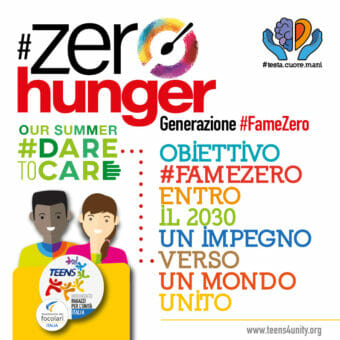
29 Jul 2021 | Non categorizzato
The Earth’s resources for this year run out on July 29. How can we reverse all this waste? Luigi Muraca, a member of the international Focolare youth formation team, appeals to us to face the challenge. Overshoot Day is a symbollic date indicating when we, the inhabitants of this planet, have consumed all the resources the Earth can regenerate within one year. To take a simple illustration: just say there were 100 new trees growing each year, and we humans cut down more than 100 a year.. Overshoot Day marks the day we cut down tree number 101. This year, Overshoot Day falls on 29 July. So from this date until the end of the year, we’ll consume more resources than we should allow ourselves. Despite this, I predict it won’t feel any different to yesterday. As you read this you’re probably not too worried about it, and I guess you’ve not noticed the people around you so far today anguished about this fact, nor the people you’re still to meet. I just want you to know one thing: it’s not your fault. It’s not that you’re insensitive, or that you couldn’t care less about the environment or the planet. You’re not too worried because, like me, you’ve got used to this kind of news on climate crises. And when you get used to something, you stop experiencing it as an emergency. News about the climate crisis has more or less become part of our daily routine. And there’s the real danger that getting used to hearing about it, makes us lose the will to change things. It happens to me too and that makes me sad. But it’s not all bad news. Not everyone remains passive in the face of these uncomfortable facts. Some actually try to change things. Here I’d like to draw attention to two projects launched by the youth of the Focolare Movement, striving to contribute to tackling the issues of ecology and our use of resources. PATHWAYS – People, planet and our ecological conversion The first project, called PATHWAYS – People, planet and our ecological conversion is an awareness and action campaign, launched as part of the 6-year Pathways for a United World program. In the year 2021-22, those behind the initiative – Teens for Unity, Youth for a United World and New Humanity NGO – are launching actions at local and global level, in a three-phase program: 1) Learn – study and get informed, as a solid foundation to any action 2) Act – moving for change 3) Share – using the hashtag #daretocare ZERO HUNGER The second project is directed at our planet’s food resources. For several years now, the youth of the Focolare Movement have collaborated with the United Nations Food and Agriculture Organization (FAO) in a shared commitment towards achieving “Zero Hunger”, supporting the goal of reducing famine in the world. While an international team works to coordinate global activity, local actions and initiatives are underway in many local territories. Luigi Muraca – Redazione Teens
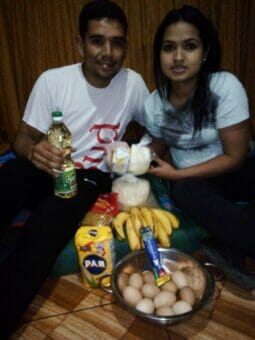
27 Jul 2021 | Non categorizzato
Every day large numbers of Venezuelan migrants try to reach Chile via Peru. The solidarity of the Focolare community in Lima with concrete gestures thanks to Providence that doesn’t wait. “A few small gestures are enough to save the world,” says the writer and poet Edith Bruck. And this is what we try to do every day to help those in need, especially the Venezuelan migrants who pass through the Juan Carlos Duque Centre linked to the Focolare community in Lima, Peru. On the way to Chile C. is one of those who helps out at the Juan Carlos Duque Centre. A few evenings ago she was able to embrace her sister again after not having seen eachother for four years! She is on her way to Chile with her husband and child, hoping to cross the border through the really cold desert. We were able to give them a suitcase of warm clothes, which we received through Providence. There are many Venezuelans trying, not without risk, to get into Chile to join their relatives. The solidarity among these people is so strong despite the suffering that accompanies them. So we can clothe Jesus Another person who works at the Juan Carlos Duque Centre told us about a Venezuelan couple who were in Peru for four years and have been in Lima for almost three months. All they had was a mattress to sleep on, a bedspread that was not warm enough for this season’s cold weather (winter has started) and a small cooker they borrowed but needed to return. They needed sheets, dishes, glasses, clothes and size 12 shoes! To our amazement, amongst the Providence that had arrived we found a pair of size 12 shoes! We received so much Providence and it was just what they needed. “Now we can clothe Jesus so that he doesn’t suffer from the cold…” we said. Thanks also to donations from UNHCR (UN refugee agency) we have been able to meet this family’s needs. You can imagine their joy. Just 40 minutes after their request for help, we were back in contact with them and able to give them everything they needed. Barbara, one of our group dies But then we received a phone call from Arequipa: ‘We are really having a very hard time. Our tenant and great friend Barbara from Venezuela has died unexpectedly. She was about to turn 29. We were in shock but my mother, my brother and I immediately said our YES to God’s will in that moment that was so difficult when it is not easy to understand God’s plans. It was about loving this suffering and being able to pass on the Father’s Mercy and Love to her brother and cousins”. Barbara had visited our Arequipa office just a few days earlier to collect a heavy blanket and a kitchen kit donated by the UNHCR, and we had added something else. She was delighted with the Providence and we were sure that He would continue to help us from up there with His Providence that is never lacking. And as we were speaking of Providence, the Juan Carlos Duque Centre’s bell rang again unexpectedly. It was the UNHCR giving us much more than what was requested for our migrants: 100 washable face masks; 216 bars of soap and 5 parcels with 72 blankets… the hundredfold!
Silvano Roggero
26 Jul 2021 | Non categorizzato
Extract from the talk given by Chiara Lubich in Lucerne, Switzerland on 16th May 1999, on the occasion of the 19th International Congress on the Family If we observe the situation of the society that surrounds us all over the world, our brief reflections on what the family is and should be may appear to be a naïve utopia. The Western world is permeated by an individualistic culture that is particularly focused on categorizing and defining men and women according to what they use and need. … In a cultural context marked by individualism and the pursuit of profit, the family has become very fragile. And those who are socially marginalized are the ones whose families most often break up.”[1] … Faced with the overwhelming mystery of suffering, we often feel bewildered and lost. There is a passage in the Bible that describes a person who reached the climax of suffering, and cried out to heaven, “Why?” The evangelist Matthew, who recounts the passion and death of Jesus, wrote: “At about three o’clock Jesus cried with a loud voice (…), ‘My God, my God, why have you forsaken me?’” (Mt 27:46). … In experiencing the abandonment, which was the final and greatest sign of his love, Christ reaches the point of total annihilation of self. He reopens for every person the path to unity with God and with one another. In that “why,” to which he received no answer, every man and woman finds an answer to his or her own cry. Is not the person in anguish similar to him? And the one who is alone or a failure or condemned? Is not every division within the family and among groups and peoples, a reflection of him? Can’t we see his countenance in those who have lost all sense of who God is and of his plan for humanity, or in those who no longer believe in love and instead accept whatever surrogate comes their way? There is no human tragedy or failure within a family that is not contained in that dark night of the God-Man. … Through that emptiness, that nothingness, grace and the life of God flowed back to humanity. Christ re-established the unity between God and creation, he restored the design, he made new men and new women and, therefore, new families. The great event of the suffering and abandonment of the God-Man can therefore become the reference point and the secret wellspring capable of transforming death into resurrection, shortcomings into opportunities to love, and family crisis into stages of growth. How can this be done? … If we believe that behind the events of our lives there is God with his love, and if, strengthened by this faith, we recognize in our small or larger daily sufferings, and those of others, a shadow of the pain of the crucified and forsaken Christ, a sharing in his suffering that redeemed the world, then it is possible to understand the meaning of the most absurd situations and put them into perspective. I would like to mention two real-life examples that illustrate this. Claudette was a young French woman abandoned by her husband. She had a one-year-old son. The narrow-minded environment of the province she lived in and of her family convinced her to ask for a divorce. In the meantime, she came to know a couple that spoke to her about God, who is especially close to those who suffer. “Jesus loves you,” they told her. “He, like you, was also betrayed and abandoned. In him you can find the strength to love and to forgive.” Little by little, her feelings of resentment dissipated and she began to behave differently. Her attitude also had an effect on her husband. In fact, when Claudette and Laurent presented themselves before the judge for their first hearing, they looked at one another in a new way and agreed to put off their decision for six months. Having reopened the lines of communication between them, when they were called back to court to finalize the divorce, they said, “No!” and walked down the steps of the courthouse hand in hand. The birth of two more daughters gave new joy to their love, which had become deeply rooted through their experience of suffering. And another. A beautiful Swiss family one evening learned from their son that he was addicted to drugs. They tried in vain to cure him. One day he did not come home. They were overwhelmed by feelings of guilt, fear, shame and the sense of being unable to do anything about it. It was the encounter with Jesus Forsaken in a “wound” that is so common in our society. Embracing Jesus Forsaken in this suffering they seemed to comprehend: “True love makes itself one with others, it enters into the reality that they are living…. ” In a spirit of solidarity, they opened themselves to others who were suffering because of drug abuse. They organized a group of families who would bring sandwiches and tea to all the youth of the Platzpitz, which at the time was known as the drugs hell of Zurich. One day they found their son there, dressed in rags and exhausted. With the aid of other families, they were able to help him embark on, and complete, his long journey to freedom. … Sometimes the traumas are resolved and families are reunited, but at times they are not. Externally the situations may remain as they were, but the pain takes on meaning, the anguish is eased and the fracture is overcome. At times, the physical or spiritual suffering lingers on, but it acquires meaning because the family unites its “passion” to the passion of Christ, who continues to redeem and save the family and all of humanity. And thus their burden becomes lighter. Therefore, the family can attempt to reacquire its original beauty in its creator’s design by drawing from the source of love that Christ brought on earth.
Chiara Lubich
[1] Chiesa Locale e Famiglia, (CLEF) Agenzia di informazione e documentazione di pastorale familiare, 49, anno XIII, marzo 1995, p. 15.
25 Jul 2021 | Senza categoria
- Date of Death: 26/07/2021
- Branch of belonging: married focolarino
- Nation: Italy
23 Jul 2021 | Non categorizzato
Pope Francis instituted this day on July 25 to highlight the vocation of the elderly, which is ‘keeping the roots, transmitting faith to the young and taking care of the little ones’. For the occasion, we collected some experiences of grandparents and grandchildren that bear witness to the love between generations. ‘When everything seems dark, like during these months of the pandemic, the Lord continues to send angels to console our loneliness and to repeat to us, “I am with you every day.”’ In his message for the first World Day for Grandparents and the Elderly, to be celebrated on July 25, Pope Francis aimed to give a message of hope and closeness to grandparents and the elderly around the world. I would like ‘every grandparent, every elderly person, every grandmother – especially those among us who are most alone – to receive a visit from an angel’ through a grandchild, a family member, a friend. During these times of pandemic, we have realised how important hugs, visits, gestures of love are. These signs are experienced daily between grandparents and grandchildren or with elderly neighbours. Martin, for example, is 8 years old and is a Gen 4 – the youngest children of the Focolare – who lives in Uruguay. He lives near an elderly grandmother who grows flowers in her garden. Some children sometimes throw a ball in her garden, making her angry, then laugh at her. Martin thought that this was not good, so he decided to help the lady. He got a wheelbarrow and took the weeds and trash out of the garden. The lady thanked him, and every time he helps her, she gives him some money, which he donates to the poor in the community. Nicola, on the other hand, is a grandfather of eight grandchildren. One day he was invited by a Gen 4 to speak at catechism class about the family. On his way to the meeting, he asked himself how he could interest the children in this topic. While walking, his gaze was drawn to a nest that had fallen from a branch and was now abandoned. He picked it up and brought it to the class. What a nice idea; he was able to explain how a nest is made, as well as how a family is. Everyone had something to add, and the hour of catechism passed quickly. Rosaria is 70 years old and a grandmother, who is so dedicated to both her grandchildren and the Gen 4 of her local community. ‘I always feel like I’m doing very little,’ she says, ‘but I notice that something is happening – they’re having experiences I didn’t expect. ‘For example, Tommaso received a scratch on the cheek from a little girl at school. When the teacher noticed it, she asked why he hadn’t told her. He answered by apologising for his classmate because she hadn’t done it on purpose. When the teacher told his parents, they were positively amazed because such behaviour had never happened before.’ Grandma Rosaria has a secret: she prays every day for all Gen 4 and all the children of the world. ‘I think this is the most important thing.’ Grandma Mary from New York tells Living City, ‘A few years ago before Christmas our granddaughter Cecilia, then 11, came home from school with a bag full of gifts she bought with money her mom had given her. She was so happy as she showed us what she had gotten for a couple of friends and some family members. I marvelled at how lovingly she had chosen those gifts! ‘I started to tell her what my Christmas was like when I was a little girl living in the Philippines. We were quite poor. After midnight mass, we went to our neighbours’ house to have dinner together. We each received a delicious red apple as a Christmas present. It was something really special! ‘Hearing this, Cecilia said: “Really? A delicious red apple?” ‘“Yes,” I said, “a delicious red apple!” ‘And as soon as her dad came home, she told him: “You know what Grandma got for Christmas? A delicious red apple!” ‘On Christmas Day, we were celebrating in our New York home with some of our children and their families. My daughter-in-law brought a basket marked “Happy Holidays” with a dozen apples in it, saying, “Cecilia called me and asked, ‘Would you buy 12 apples for Grandma so she doesn’t just have one but 12 for Christmas?” ‘What a Christmas gift! We have found over and over again that we don’t need many gifts to love God and others at Christmas. Sometimes all it takes is one red, delicious apple.’
Lorenzo Russo
You can see the pope’s video message for the first World Day for Grandparents and the Elderly at youtu.be/1qhzDGFl-6w.