The coronavirus – a crisis that calls for a new commitment to build one family
The testimony of those who are on the front lines and those who stay at home: many ways of living for others. https://vimeo.com/402903328

The testimony of those who are on the front lines and those who stay at home: many ways of living for others. https://vimeo.com/402903328
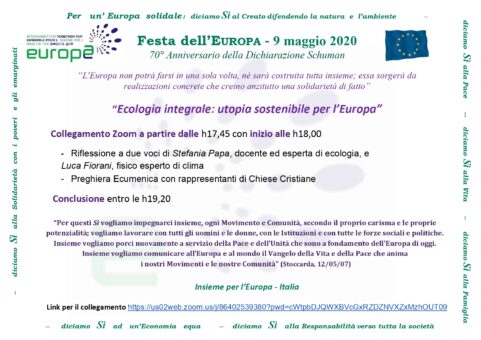
A day for communities, movements and countries to meet and witness peace and solidarity among peoples May 9 is the feast day of the European continent, celebrating peace and unity among peoples. This year the Covid-19 pandemic prevented people from seeing each other in church, city squares, gatherings or conferences and prayers. This does not mean that this day’s activities were cancelled. On the contrary: with a lot of creativity, digital conferences, prayers, discussion groups and online dialogues between communities, movements and political representatives were held, for example, in Utrecht, Graz, Rome, Lyon or Esslingen. 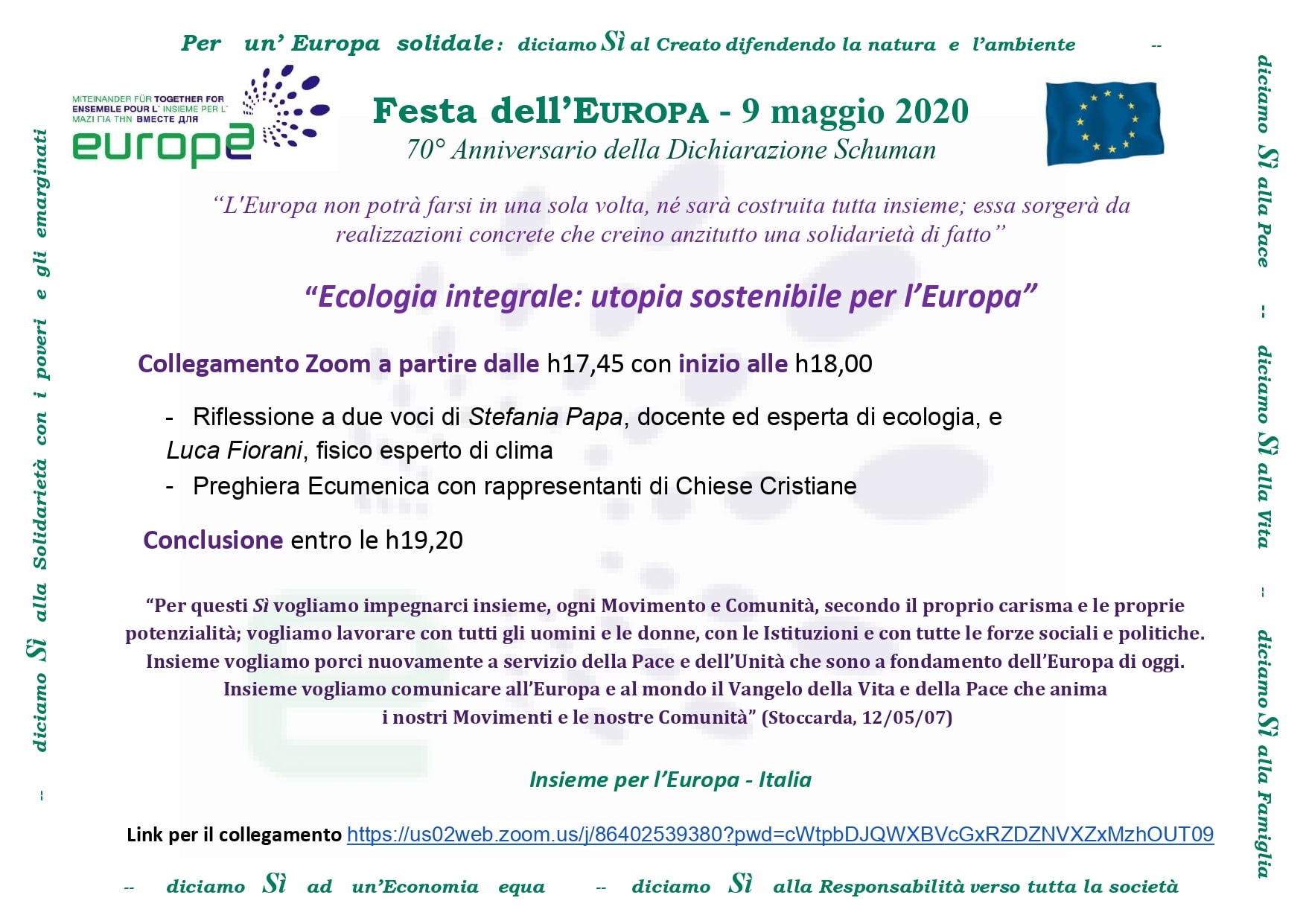 This year’s events had the papal blessing, through a letter from Pope Francis that arrived on 22 April. The pope appreciates the service to the common good that the Together for Europe network operates through committed communities and movements, inspired by the values of solidarity, peace and justice. The Together for Europe network emerged from the historic signing on 31 October 1999 of the “Joint Declaration on the Doctrine of Justification” between the leaders of different Evangelical and Catholic movements and ecclesiastical communities from Italy and Germany. It has been a journey together to rediscover the old continent’s values of peace and fraternity. For the Feast of Europe, together with Graz, the Together for Europe committees in Italy organized and promoted an online event dedicated to a “yes to creation,” defending nature and the environment, entitled “Holistic Ecology: A Sustainable Utopia for Europe” on May 9. Through the reflections of Stefania Papa, professor and ecology expert, and Luca Fiorani, climate physicist, and a video of three messages from Pope Francis, Patriarch Bartholomew I and Antonio Guterres (UN) for the 50th World Earth Day, we are becoming more aware of how we can work together for a better present and future, respecting our Earth, in a culture of respect, cooperation and reciprocity. One of the objectives of Together for Europe, in fact, is a “culture of reciprocity”. In it, different individuals and peoples can welcome each other, get to know each other, reconcile, and learn to esteem and support each other. This includes many activities in favour of reconciliation and peace, the protection of life and creation, a fair economy, solidarity with the poor and the marginalized, the family, the good of cities and brotherhood on the European continent. Diversity should not be a reason for fear or separation, but rather a wealth that is developed and harmonized for a united, living, fraternal Europe.
For more information visit together4europe.org.
Lorenzo Russo
https://www.youtube.com/watch?v=-p39HC8PmYM&feature=emb_logo
He was one of the first members of a religious order to adhere to the spirituality of the Focolare Movement. A contemplative in full action; a man of God immersed in humanity. What does “contemplation” mean and what is the point of contemplation today? And how does one contemplate in the 21st century? In times like these, closed in for Covid and pressed by concerns about the future, taking time to get in touch with the Absolute may not seem a priority. A few days ago, however, I had to think again: I encountered the extraordinary character of Father Ermanno Rossi, an Italian Dominican, a pioneer of the Focolare Movement in the ’50s who left for heaven last Easter Monday. His existential parable says that only an intimate relationship with God could make it possible. This is confirmed by one of his writing, on the occasion of his 90th birthday: “The events of my life have been many! I only remember an inner conviction that guided me in all my choices: ‘Ask for nothing and refuse nothing’. This meant for me: evaluating well the task entrusted to me, putting all my strength into it with the certainty that God would take care of the rest. For this reason, I never asked for anything or refused anything, whatever task was asked of me, even though it was almost always contrary to my feelings. At this age, however, I can assure you that it was worth trusting God. (…) Along with the difficulties I have had some extraordinary graces. Among these, the meeting with Chiara Lubich and her Movement has a very important place. This meeting was the beacon of my life“. And his life was intense to say the least: from 1950 to 1955 he was in charge of the young aspirants to the Dominican Order; he wrote that his cell was his car: “I was always travelling around central Italy”. It was in those years that Father Ermanno came to one of the first Roman communities of the Focolare Movement and met Graziella De Luca: “I asked only one question: ‘Now while you are alive, everything is all right; but when the first generation has passed, won’t there inevitably be decline, as happened to all the foundations?’. Graziella answered me: ‘No! As long as Jesus is in the midst, this will not happen’ “. From that moment his life intensified even more, if that’s possible: he was rector and bursar of a seminary; he taught Moral Theology at Loppiano; he travelled around Europe to make the spirit of the Focolare known to many members of religious orders. He was responsible for the Missionary Centre of his Order’s province, then parish priest in Rome and superior of a small community. With what spirit did Father Ermanno live all this? He himself explains: “In all these events one thing was constant: every time I had to start over; I had to “recycle “myself. It was as if they had entrusted me with a new job every time. Another constant: at the first impact, the new situation always turned out to be painful, then I saw it as providential. Now I have the certainty that what Providence arranges for me is the best that can happen to me”. In the spirituality of Unity Father Ermanno found the way to a new relationship with God. Until then, God had been sought in solitude. From Chiara Lubich he discovered that the brother is the direct way to go to God; a way that does not necessarily require solitude: it can also be achieved in the midst of people.
Stefania Tanesini
The following writing by Chiara Lubich leads us to the heart of the Christian faith. “We have come to believe in God’s love: in these words the Christian can express the fundamental decision of his or her life” [1] It is a choice that proves to be very daring in these times, but no less true for that. This time we want to speak about prayer once again. It’s the life of our soul, the oxygen of the whole of our spiritual life, the expression of our love for God, the fuel for every activity we do. But what kind of prayer will we speak about this time? We will speak about the prayer that – with its infinite and divine riches – is completely contained in one word, in just one word which Jesus taught us and the Holy Spirit put on our lips. But let us go to its origins. Jesus prayed. He prayed to his Father. For him, the Father was “Abba” and that means “Daddy”, his “Dad”, to whom Jesus spoke with words of infinite trust and boundless love. He prayed to the Father from within the Trinity where he is the second divine person. It was precisely because of this special prayer that he revealed to the world who he really was – the Son of God. But since he came on earth for us, the fact that only he could pray in this privileged way wasn’t enough for him. When he died for us and redeemed us, he made us children of God, his brothers and sisters. Through the Holy Spirit he also gave us the possibility of being taken into the heart of the Trinity, in him, together with him, through him. So we too can make the divine invocation “Abba, Father” (Mk 14.36 and Rm 8:15) – “Daddy”, “my Dad”, “our Dad” with all that this entails. We are certain of his protection, we feel secure, we are able to abandon ourselves blindly to his love, we have divine consolations, strength and ardour – an ardour that is born in the heart of those who are certain that they are loved. This is Christian prayer, an extraordinary prayer. It cannot be found anywhere else, or in any other religion. At the most, if people believe in a divine being that can be venerated, adored and beseeched, they do this from outside the divine being, so to speak. For us it is different: we enter into the heart of God. And so? Let’s remind ourselves, first and foremost, of the dizzy heights to which we are called as children of God, and, as a consequence of this, of the exceptional possibility we have of praying. Naturally, we can say “Abba, Father”; with all the depth of meaning of this word only if it is the Holy Spirit who pronounces this word in us. For this to happen, we have to be Jesus, nothing other than Jesus. How? We know how. He is already living in us through grace but we have to do our part. This means to love, to be in an attitude of love towards God and our neighbour. The Holy Spirit will put this word on our lips with a greater fullness if we are in perfect unity with our brothers and sisters wherever Jesus is among us. Let’s make “Abba, Father” our prayer. … In this way, we will fully correspond to our calling to believe in love, our calling to have faith in the love which lies at the root of our charism. Yes, Love, the Father, loves us. He is our dad: what should we fear? In the plan of love he has for each one of us, a plan which opens up for us day by day, we cannot fail to see the most extraordinary adventure to which we could be called. “Abba” is the most characteristic prayer of the Christian and, in a special way, of us in the Focolare Movement. So, if we are sure that we are living our Ideal, that is, if we are living love, let’s speak to the Father in the same way as Jesus did. What will the effects be? We will experience them in our hearts.
Chiara Lubich
(Taken from a telephone conference call, Rocca di Papa, 9th March 1989) [1] Benedict XVI, Deus Caritas est, 1.
United World Week (May 1–7) has never been such a local and global event at the same time. More than 400 micro and macro events are being held in 65 countries, all strictly online. Live streaming of the #InTimeforPeace event will be Saturday 2 May at 12 noon (UTC +2). This United World Week sees us spoilt for choice: you can start by participating in Run4Unity in Australia or Texas, then join a prayer for peace in Cuba, before checking out the “political café” in Argentina. There’s an interesting webinar series promoted by the United World Project, and for lovers of World Music, there are concerts in various African countries. The great thing is, you don’t even have to choose: you can participate in everything from the comfort of your own home. Covid-19 could have driven this year’s United World Week, and instead it isn’t just about that. The title and motto for the more than 400 events in close to 65 countries around the world is #InTimeforPeace. This means that for at least one week, peace, human rights and legality will be the topic for reflection and action, for 24 hours a day at the different latitudes. It also means that an increasing number of people believe that building a world governed by rules, economies, and cultures inspired by peace in all its forms can no longer be put off. It all starts on May 1 and goes until May 7. As the young people say, peace is for everyone. The United World Project’s homepage shows a wide choice, which says that there is no single way to support peace, to fight for human rights, to practice legality. Whether we make masks, distribute food, keep company with those who are alone or simply do our part by staying at home, every neighbourly gesture of solidarity and support at a distance falls under the great umbrella of peace. Among the key activities this United World Week is a petition calling for an end to the embargo against Syria, promoted by the NGO New Humanity and signed by many celebrities. The appeal will be sent to the UN Secretary General and to the President of the European Parliament. It has the force of a global call to save a country that is already on its knees after 10 years of war and now risks falling into an abyss because of the Covid threat. HOW, WHERE AND WHEN TO FOLLOW UNITED WORLD WEEK EVENTS The place for the #InTimeforPeace multimedia marathon remains unitedworldproject.org, where you can also see a calendar of local events. The main events On Saturday 2 May at 12 noon (UTC +2), the #InTimeForPeace web event will be live streamed and connect a number of cities across the planet. There will be sharing of stories and actions, as well as hosting debates and artistic performances. On Sunday 3 May from 11am–12 noon in each time zone, there will be a virtual Run4unity, a non-stop sports relay that will embrace the globe, with games, challenges, experiences and commitments to symbolically spread a rainbow of peace on Earth.
Stefania Tanesini
It all depends on how we view “the other”, brother or sister: situations can completely change if we choose to love. Hard times Krystyna told me about hard times in Poland in a state of war: “There was a shortage of food and toiletries. We were getting stuff from friends in what was then East Germany while our neighbours were often having parties with an abundance of alcohol. One day, however, we noticed how it was unusually quiet in their apartment, and we discovered from the little girl who was on her own that the mother was in hospital. I went to see her, bringing soap and toothpaste with me, items that were hard to find at that time. When she saw me, she was amazed: “I can’t believe that you, whom I have always given so much grief, have come to see me? None of the friends who hang out with us has come.” As soon as she was discharged from hospital, she invited me to her house. She welcomed me warmly. Then she started telling me about her sad childhood, the meaninglessness of her life and how she needed to get out of a certain situation. I listened to her with love and assured her of my prayers. Not long afterwards, the man who had been living with her left and the noisy company stopped coming to the house. The mum was now able to offer her little girl a “normal” life.” B.V. – Poland Young couple from the South The young couple from Southern Italy had moved to the North to get out of a small village which was dominated by the Mafia. They needed to find a home and work for both of them. My financial situation was rather precarious but with faith I started to help them look for somewhere to live. Unfortunately, a lot of people closed their door on me when I said they were from the South. I cried with them and it made me realize once again that only a poor person can really understand another poor person. I shared so much humiliation with that young couple and, when we finally found a house and a job, I felt I had been enriched by what we had shared together. V.M. – Italy The stolen tablecloths I work as a cashier in a restaurant and I have no qualms about asking for leftovers from the kitchen to take to the children who live on the street. I always meet so many on my way home every day. One day, as I was getting off the bus, someone snatched my bag from my hands and ran off! I was stunned: the bag contained ten tablecloths from the restaurant which I had just picked up from the launderette. What was I to do? How was I going to tell my employer? Buying fabric to make new ones was out of the question because I couldn’t afford it. I didn’t know how I was going to tell my mother or the restaurant manager, but I was sure the Eternal Father would help me. The following day I told my employer what happened to me and, without getting upset, he tells me he wants new tablecloths as soon as possible. Just at that moment, a customer who had overheard our conversation approached us and said he was willing to buy the fabric needed to make new ones. I couldn’t believe it! I was so happy and immediately thought of the children I would still be able to help with the food. D.F. – Philippines Trust I met Alvaro in a trattoria. He was 35 years old, scruffy and unkempt. When he asked me to help him fill in some job application forms, I offered him an appointment in my office the following day. He arrived as night was falling and told me he was really just looking for friendship. I felt sorry for him and, trying to overcome the disgust I felt because of the smell he was giving off, I offered him a brandy. He understood that I didn’t judge him and started to tell me his problems, from when he was abandoned by his mother as a child and his father had ended up in prison. The hours went by and, as if in confession, he continued to tell me about himself. He eventually got up when he realized it was daytime and, apologizing, he said goodbye to me. I met him again on other occasions and introduced him to my friends who welcomed him with equal warmth. He reciprocated by doing various jobs in the house: a real jack-of-all-trades. He eventually managed to find a stable job, built a career for himself, got married and became the father of two children. When he told me all this, years later, he was a completely different person. He had regained his dignity thanks to the trust we had shown him. B.C. – Italy
by Stefania Tanesini
(taken from The Gospel of the Day, Città Nuova, year VI, no. 2, March-April 2020)
In his homily on Good Friday 2020 in St Peter’s Basilica (Rome) the Capuchin Father, Raniero Cantalamessa, said that “there are things that God has decided to grant us as the fruit both of his grace and of our prayer”. The following writing by Chiara Lubich is an invitation to collaborate with God by asking for graces and putting ourselves in the best situation to obtain them. “So when you are offering your gift at the altar, if you remember that your brother or sister has something against you, leave your gift there before the altar and go; first be reconciled to your brother or sister, and then come and offer your gift” (Mt 5:23-24). With this Word of Life, Jesus has told us clearly that there can be no union with God, real worship or authentic prayer unless we are reconciled with our brothers and sisters. So let’s hope that his message has entered deeply into our hearts. It is with this hope that I would like to speak to you about prayer, which, if we live this way, is certainly acceptable to God. I would like to speak, in particular, about the prayer of petition: that is, our asking for help and for favours. I have the impression that some of us may not stress it enough, and perhaps this is for very noble reasons: now that we have become more deeply involved in our faith and have begun to practice our religion much more, we have understood that religion is not simply a matter of going to church and repeatedly asking for things, but of loving God and, therefore, of giving. And to do our part, as we say, we have committed ourselves to living out all those principles of the Gospel that our spirituality emphasises. Certainly this is all well and good. Nonetheless, we must realise that loving God means many things. It implies keeping all his commands. And one command that Jesus repeats insistently is to ask: “Ask, and it will be given you; search, and you will find; knock, and the door will be opened for you.” (Mt 7:7). So what should we do, then? We should ask more and ask in a better way because this is what Jesus wants. It’s another way to show him our love. … Certainly we pray and that means we don’t rely only on our own strength. Nonetheless, we can improve in two directions: first of all, not by multiplying the number of our prayers, but by becoming more fully aware of what we are already asking for. If we reflect for a moment, we’ll see how many graces we ask for in the prayers [we already say]. … Secondly, we can improve, as the saints point out, by praying in such a way that we receive what we ask for. Our prayers are heard if we ask with humility, aware that we can do nothing on our own; with trust, confident that with God we can do anything; and with perseverance, lovingly insistent, as Jesus wants us to be. In short, we must focus on the requests we already make, giving them greater attention, and expressing them better each time, praying with the same effort that we put into living our Ideal. In this way, everything we do will be more fruitful. And let’s pray while we still have time! I always remember the advice given us by the mother of one of the first focolarine just before she died: “Pray during your life, because at the end you won’t have time”.
Chiara Lubich
(From a telephone conference call, Rocca di Papa, 16th February 1984)
Chiara Lubich wrote “Faith is a new way “to see”; it is, so to say, the way Jesus sees” [1]. Faith helps us meet Jesus in every neighbour and understand deeply even his inner feelings. Never lacked anything One day, the owner of the company where I work called a meeting for all the employees. After enumerating the problems that the company was facing, he proposed reduced ours of work with a 30% decrease in salary to avoid redundancies. What did this mean to me ? I was faced with a very difficult decision , because I have a large family and a lot of expenses…. but since this meant that many of us would still be working, I accepted the proposal. My wife and I were determined to trust in God’s providence. We also involved our children, asking them to pray not only for the needs of our family, but also for other families who were facing difficulties. We soon found out that God was listening to our prayers; I received a sum of money that I lent to a friend of mine. I gave this money to him quite a long time ago, and I thought that I would never get it back. Now, that so many months have passed, we realize that we never lacked anything, and our children have acquired a greater sense of responsibility. S.d.O. – Brazil Teleshopping Most of the time I find myself in the awkward position of having to say no to a telemarketer. These unwanted phone calls often arrive at the least appropriate time of the day. Over the years, I’ve adopted a variety of answers that range from faking foreign accent and pretending not to understand to the usual “I don’t have time” while hanging up quickly. However, every time I use these or other similar tactics I feel uncomfortable because I know that I am causing more unpleasantness to someone who has no other choice but to work in teleshopping. What can I do? Reject gently but firmly before any proposal is made to avoid wasting time ? When I remember that the person doing this work is always a neighbour to love, the more I listen, the more miserable I become when I finally declare my refusal. I’m trying to say at least a quick “Good day!” before I hang up. C.C. -USE Perceiving love A 52 year old man who shot himself in the head because of family problems was admitted to my ward. Fortunately, his brain was not damaged, but his eyes were, and he had to undergo very complicated surgery. In the visits that followed, he kept on saying that he wanted to die. After a period of intensive care, he was brought to my ward, where I took every opportunity to stop and greet him. One day I asked him, “Do you know who is next to you?” He answered: “I can’t see, but I think it’s the doctor who operated on me. During the operation, I felt so much love”. I promised him I would do my best to save at least one eye. One morning he told me that he was beginning to see a glimmer of light. His eyesight improved daily. A few months after he was discharged from hospital, he came to see me. He was a totally different person: he started a new life, even a new married life. But above all, he told me that he discovered faith. Jokingly I said to him that the loss of an eye gave him better sigħt ! F.K. – Slovakia
Edited by Stefania Tanesini
(from Il Vangelo del Giorno, Città Nuova, year VI, n.2, March-April 2020) [1] C. Lubich, Word of Life, April 1980, in Parole di Vita, compiled and edited by Fabio Ciardi (Works of ChiaraLubich 5; Città Nuova, Rome 2017), pp. 169-170.
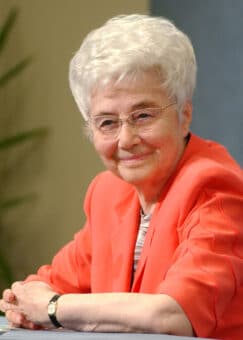
An unexpected way of living Chiara Lubich’s centenary. Maria Voce’s talk in the Osservatore Romano . 2nd April 2020  “Celebrate to meet” is the motto that we in the Focolare Movement have chosen to commemorate in 2020, all over the world, one hundred years since the birth of our foundress Chiara Lubich. Until a few weeks ago, this motto seemed a fitting choice through which to celebrate, in the most varied ways, the person of our foundress and the charism that God gave her, which she generously communicated. In fact, we would like people to meet her alive today and not think of her as a nostalgic memory; We would like people to find her in her spirituality, in her works and above all in her “people”, in all those who are now living her spirit of family, fellowship and unity. And beginning with 7th December 2019 we have rejoiced in the many events that have taken place throughout the world. We would have liked these celebrations to continue. But in a very short time the scenario has changed and the motto “celebrate to meet” might even seem anachronistic. We too have put all kinds of celebrations or events on hold. The pandemic caused by the coronavirus is forcing more and more countries all over the world to take drastic measures to slow down contagion. For now, isolation and physical distance are the most effective ways. This is shown by the information coming to us from China, which we accompanied with trepidation for weeks. But here in Italy and in a number of other countries around the world the situation is still very serious.
© Horacio Conde – CSC Audiovisivi
By Maria Voce
Source Osservatore Romano – https://www.vaticannews.va/it/osservatoreromano/news/2020-04/radicarci-bene-nel-presente.html
Regina Betz, a German focolarina, professor of sociology, pioneer of the Focolare Movement in Germany and Russia, who was passionate about ecumenism and fully commited to the Christian renewal of society, passed away on March 17, at the age of 99 years. Ever since I met her, I have always known her to be a very busy person, yet she never made you feel that she had no time for you. She rather gave one the impression that she had a goal to reach and was reluctant to waste time. When she stopped to have a word with you, she was fully present; her smart lively look and her broad mischievous smile brightened your day. Regina led a very full life. The elder of two children born into a Catholic family, who lived in Göttingen (Germany), she grew up in area where the majority of the people were Lutherans; so she practised natural ecumenism, strengthened further by the common resistance to Hitler’s nationalism. Having spent a few years in Italy during the Second World War, after finishing her studies in Social Economy, she settled in Rome where she worked at the Pontifical Council for the Laity for three years (1955-1958). During this time she met the Focolare Movement, and when speaking about this encounter in a book (1) she wrote later on, she revealed that she was struck by “a light and a force”. Being eager to discover the secret behind all this, she decided to participate in the Mariapolis of 1958. There she met “Christians, who freely chose to live unity” and the model of a “new and human society” and she remarked: “After a long time, I found what I have been looking for and my heart sang a song of great joy”. When Regina returned to Germany, where the Focolare Movement was not yet present, she continued to work for the Church and made important trips to Asia and South America. In 1966 she was among the volunteers of the Focolare Movement, and she was invited to teach sociology at the formation school in Loppiano (Italy). There, at the age of 46 she felt the call to be a consecrated member of the Focolare. From ’68 to ’90, Regina was a professor of sociology in Regensburg (Germany) and a collaborator of the “Institute for Eastern Churches”. She had the opportunity to meet Christians from Eastern Europe and to travel to various countries in the Balkans, to Bulgaria and Romania. She was particularly impressed by the enthusiastic behaviour of young communists and their concern for the lower class. In 1989 she was offered academic work in Moscow, and thus the first Focolare was opened there. She related: “Life in Moscow turned out to be a life of togetherness: together in the focolare, together with so many Russians who came to know our way of life. I discovered the great generosity and cordiality of the Russian people, and experienced great hospitality and sharing. No structures, but many friends”. Life around the Focolare flourished; however this happened at a price. Confiding to me personally, Regina expressed her wish that the “dark” part of her life would also be communicated after her death. In a diary of that period she wrote: “I have nothing more to give, but it is consoling to know that He is with me in this emptiness … I feel exhausted all the time, I am afraid and I feel that I cannot manage to conclude anything anymore”. When Regina returned to Germany in 2008, she went to the small Ecumenical town of Ottmaring. The years she spent there were marked by the relationships she established with so many different people; she kept these relationships alive through visits and through thousands of handwritten letters, full of wisdom. She followed the events of the Church and society with attention and participation. In spite of her fragility, she remained faithful to the personal Word of Life she recived from Chiara Lubich, which said: “Whoever wants to save his life will lose it; but whoever loses his life for my sake will find it” (Mt 16:25). “Many times I had to leave everything and go to start all over again somewhere else! But what a lot I have gained from this: so many experiences, so much knowledge about the life and culture of people in different countries, so many relationships with a countless number people!”. On March 17, Regina Betz ended her race; she definitely left everything. I’m sure she discovered an unimaginable life.
Joachim Schwind
1) Regina Betz, Immer im Aufbruch, immer getragen, Verlag Neue Stadt, München 2014.
The following text by Chiara Lubich touches on a subject that the current pandemic has brought much into evidence: suffering. It helps us to perceive a mysterious presence of God in suffering, since nothing escapes his love. This genuinely Christian approach instils hope and encourages us to make every suffering our own, those that affect us directly or that of the people around us. … Suffering! The suffering which at times affects our whole being and the suffering which crops up and blends bitterness with sweetness in daily life. Suffering: an illness, a misfortune, a trial, a painful circumstance… Suffering! How should we … consider the suffering which is always ready to appear in all our lives? How can we define it, how identify it? What name can we give it? Whose voice is it? If we consider suffering from a human point of view, we are tempted to look for its cause either within us or outside of us, in human wickedness for example, or in nature or other things. And all this might actually be true. But if we think only in these terms, we forget what matters most. We forget that behind the story of our lives there is the love of God who wills or permits everything for a higher purpose, which is our own good. That is why the saints take every painful circumstance they encounter directly from the hands of God. It is impressive how they never go wrong in this regard. For them, suffering is the voice of God and nothing else. Immersed as they are in the Scripture, they understand what suffering is and must be for a Christian; they grasp the transformation that Jesus worked in suffering, seeing how he changed it from a negative factor into a positive one. Jesus himself is the explanation of their suffering: Jesus crucified. For this reason it even becomes lovable, it even becomes something good. That is why they do not curse suffering, but bear it, accept and embrace it. If we too open the New Testament, we will find this attitude confirmed. Didn’t St James say in his letter, “My brothers and sisters, whenever you face trials of any kind, consider it nothing but joy” (Jas 1:2)? So suffering can even be a cause for joy. After having invited us to take up our cross and follow Him, doesn’t Jesus then affirm, “Those who lose their life” (and this is the height of suffering) “will find it” (Mt 10:39)? Suffering therefore is hope of salvation. For St Paul, suffering is even something to boast of, indeed the only thing to boast of: “May I never boast of anything except the cross of our Lord Jesus Christ” (Gal 6:14). Yes, for those who consider it from a Christian viewpoint, suffering is something great: it even makes it possible for us to complete in ourselves the passion of Christ, for our own purification and for the redemption of many. So then, what can we say to those who are struggling with suffering? What can we wish for them? How can we relate to them? First of all, let’s approach them with the greatest respect. Even though they may not think so, at this time they are being visited by God. … Let’s assure them of our continual thoughts and prayers, so that they may be able to take all that distresses and causes them suffering directly from the hands of God, and unite it to Jesus’ passion so that it can bear the greatest fruit. Let’s help them to always have the value of suffering present before them. And let’s remind them of that marvellous Christian principle of our spirituality, in which suffering, when loved as a countenance of Jesus crucified and forsaken, can be changed into joy.
Chiara Lubich
Taken from a telephone conference call, Rocca di Papa, 25th December 1986) Published in C. Lubich, On the Holy Journey, New City Press, New York 1988, pp. 162-164
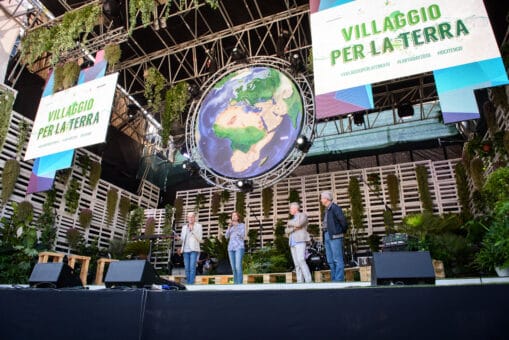
In Italy the “Villaggio per la Terra” (Village for the Earth) event is transformed into a multimedia marathon.  Everything is connected. The 50th Anniversary of Earth Day, celebrated on 22 April, cannot be viewed in isolation from the coronavirus pandemic challenging humanity. At the time of this year’s Earth Day, the current health emergency is giving rise to a global community demanding different economic and social models which are fairer than before. This Earth Day coincides with the 5th anniversary of Pope Francis’ encyclical Laudato Si on the theme of integral ecology. Events in 193 countries will be hosted online. In Italy, the Villaggio per la Terra, traditionally held at Villa Borghese in Rome, is being transformed into a multimedia marathon live on Rai Play and reports on other broadcast platforms. We spoke with President of Earth Day Italy, Pierluigi Sassi. The 50th anniversary of Earth Day is taking place as humanity faces the coronavirus challenge which is forcing us to review our priorities, values and objectives … Today, more than ever, we feel the urgent need to change the economic and social model which has governed development for decades. We want to give a message of hope, to offer a perspective which focuses on the person and the need to respect the planet. We’ve raised awareness about these subjects in the world, reinforced by Pope Francis’ Encyclical Laudato Si expounding the principle of integral ecology. There is a new sensitivity to this topic in the world, but it has to transfer into action. The coronavirus makes the need for this change even stronger.
VILLAGGIO PER LA TERRA, Earth Day Italia, Villa Borghese, Roma 21 April 2018
© Lorenzo Gobbi/Smile Vision Srls
Claudia Di Lorenzi
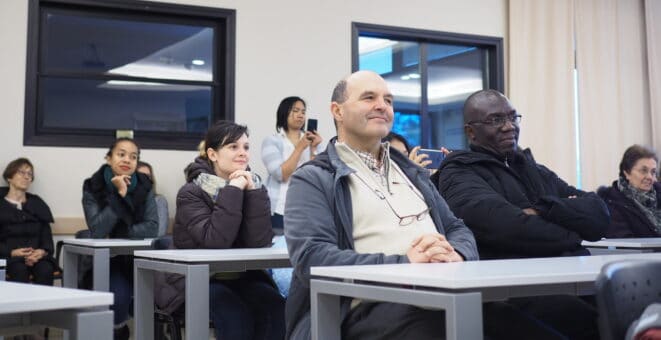
How the idea of creating the Sophia University Institute came about, and how it has developed to date, showing the cultural scope of Chiara Lubich’s charism of unity The Sophia University Institute was born from a Christian spiritual heritage that is in constant dialogue with the principles upon which various civilizations flourished and developed. It is located in Loppiano, Italy, a Focolare little city that since its founding in 1964 has trained families, young people and adults in a Gospel-based lifestyle. 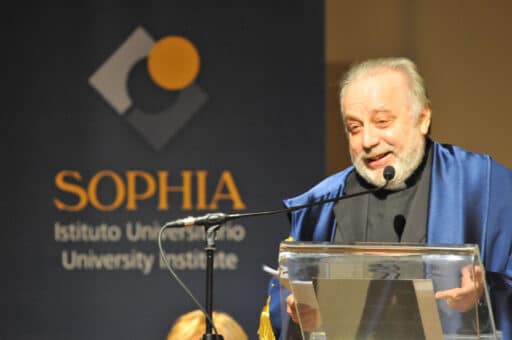 Professor Piero Coda, Dean of Sophia from its birth until last February, explains how the project has developed over the years. How did Chiara Lubich come up with the idea of creating a university? The idea has been there since the beginning. This was confirmed in 2008 at Sophia, when Fr. Casimiro Bonetti, the Capuchin who was with Chiara in the early 1940s, inaugurated the university. It is in the DNA of the charism of unity, because it is a charism that unleashes a culture: a tangible vision of the human person and the world. In concrete terms, its start came after the Abbà School’s breakthrough in the 1990s, when together with Chiara they began to study the cultural scope of the charism by drawing from the heritage of light from Paradise ’49. When did Sophia start? How did it develop? The initial stage of the university was the Superior Institute of Culture, which was aimed at the youth of the Focolare Movement (Gen). It was inaugurated on 15 August 2001 by Chiara with a speech that constitutes its Magna Carta. In 2005, given the success of the experiment and at the urging of cultural critics such as Stefano Zamagni, President of the Pontifical Academy of Social Sciences, the planning of a true and proper university institute began. It was true to original form, according to the concept that sprang from the charism, and completed by the Holy See on 7 December 2007. What is the link with the Holy See? It was Chiara’s premeditated choice to build a university that was not formally recognized by a country, but rather by the universality of the Catholic Church. This also meant, for Chiara, recognising the fact that the charism of unity, like the great charisms of Christian history (from Benedict to Dominic and Francis, to Ignatius of Loyola and Don Bosco), is a charism in which the Church recognizes a project in action of human and social formation that expresses the Gospel. With the extension of the Bologna Process (the bilateral recognition of degrees at the European level and beyond, in which the Church participates), we could see viable scenarios for the institution that was being born. How has it changed over the years? Sophia began and developed on three pillars: academic-level teaching and research; formative experiences shared in community life between teachers and students of various cultures; and a relationship with the tangible expressions that embody the values inherent in the charism of unity in the various areas of social, political and economic life. In all these respects, great strides have been taken forward. Suffice it to say, for example, that we started with a single degree course and now there are four. The original program in the “culture of unity” blossomed into the theological and philosophical, economic and political fields, as well as education, dialogue and communication. What is Sophia today? It is an important confirmation, a certain hope, a strategic investment. It is a confirmation of the value and relevance of Chiara’s intuition. It is a hope that the search for the new cultural paradigm that our change of era asks of us is not a utopia. Finally, it is an investment to promote with seriousness and vision the development (not only cultural) of the charism of unity and its historical impact. In the past there has always been a dean, but today there is a rector; what does this mean for the university? The fact that the Vatican department for studies and the university wanted this change underscores the validity of the path taken. It is also recognition of the institute rising to the status of university. One can also see an echo of what Pope Francis told us in our audience with him last 14 November: “I am happy with the journey you have made in these 12 years of life. Forward! The journey has just begun.”
Lorenzo Russo
Maria Voce, President of the Focolare Movement, sends her Easter greetings: to experience a continuous passing from death to resurrection through love of neighbour. Only in this way will we overcome this painful time of pandemic and any other suffering. Easter 2020 Dear All, This year, Jesus’ passing from death to a completely new life challenges us and puts us in an attitude of listening. And it is here that faith and our charism come to our aid: we find the answer in Jesus crucified and forsaken, the God of these present times that are so hard to understand. Even the loneliness we are now perhaps forced to experience, if lived with him, can be inhabited and filled by His Kingdom.[1] Only by choosing him, embracing him in all that is painful, and loving him in an exclusive way, will we and the whole of humanity find the path towards the light, towards a new birth. JESUS IS RISEN! Let us have this experience of passing continually from death to resurrection and share it with many, with everyone. This is how we can prepare for tomorrow and lay solid foundations for the world of the future, when we will go back to meeting one another and embracing one another once more. HAPPY EASTER! [1] Vedi Chiara Lubich, “Dov’è la schiavitù?”, [Where is slavery] Fermenti di unità, pg. 130, ed. 1963.
The Coronavirus crisis has caused a range of restrictions in many countries and people cannot leave their homes. Isolation can be a real problem. But the power of solidarity and the desire to remain united and linked through social media are even stronger. Here are just some of the Easter greetings circulating the globe. https://vimeo.com/406318544
New Humanity, a Focolare NGO, says the time for peace in Syria is now. An appeal has been sent to the Secretary General of the United Nations, the Commission and the European Parliament. Many political, civil and religious authorities have expressed their support. “We call for a suspension of economic sanctions against the Syrian government so that the people have access to international markets and financial services and can receive the medical supplies and funds necessary to defend themselves against the COVID-19 virus.” This is the gist of the appeal promoted by New Humanity, an NGO of the Focolare Movement, in response – first and foremost – to the cry of the Syrian people who have reached the tenth year of civil war and are heavily affected by the pandemic that has now spread to their country. But that’s not all: well-known figures from all over the world are supporting the cry of the people. A few days ago, Antònio Guterres, UN Secretary General, sent a message referring to the current situation that is uniting us in the fight the common enemy: “The virus is not interested in nationality, ethnic group or religious belief. It attacks everyone indiscriminately. Meanwhile, armed conflicts are raging in many parts of the world. And it is the most vulnerable – women and children, people with disabilities, marginalized, displaced people – who pay the price and risk the greatest suffering and devastating loss because of Covid-19.” “Hundreds of humanitarian appeals have been made for Syria,” explains Marco Desalvo, president of the NGO, “but now we are in an exceptional situation. We are equally vulnerable to Covid-19 but the response that each state can give is very different. We have drafted this appeal for the Secretary-General of the United Nations and for the European institutions, calling for the suspension, at least temporarily, of the embargo on all medical and financial transactions so that Syria can obtain supplies of drugs and medical equipment.” “This is not an issue regarding political division,” explains the Hon. Lucia Fronza Crepaz, former member of the Italian Parliament and one of the promoters of the appeal. “On the contrary, it wants to go beyond party membership because the objective of safeguarding the Syrian civilian population is above any political or ideological orientation.” The appeal already has the support of several well-known political, academic, scientific and religious figures in Italy and beyond such as Romano Prodi, the Undersecretary for Labour and Social Policy, Sen. Steni Di Piazza, Patrizia Toia and Silvia Costa, Don Luigi Ciotti, founder of Gruppo Abele Onlus and LIBERA, Giovanni Paolo Ramonda, General Manager of the Pope John XXIII Association (APG23), Michel Veuthey, professor of international law at Webster University, Switzerland, Andrea Olivero, president emeritus ACLI, Cornelio Sommaruga, former president of the International Red Cross and P. Bahjat Elia Karakash, ofm, superior of the Franciscan Friars in Damascus. Join the petition on change.org
Stefania Tanesini
“This year for many Christians the days of the Holy Week and Easter – which the Western Churches celebrate on April 12, while the Orthodox Churches and the Eastern Orthodox Churches celebrate on April 19 – will be a special experience because the coronavirus pandemic will prevent them from participating physically in the liturgical celebrations. In the following text that Chiara Lubich wrote during Holy Week in the year 2000, she suggested how to live these “holy days”. Today is Holy Thursday! We feel that today is truly special because of the spirituality that flowed from the charism given to us by the Holy Spirit. So we want to pause for a moment to meditate, contemplate and try to relive the mysteries it reveals, together with those of Good Friday, Holy Saturday and Easter Sunday. To begin with, each of these days could be given a title that expresses or, I would say, has proclaimed within the Movement for over 50 years what we should be: Love on Holy Thursday; Jesus forsaken on Good Friday; Mary on Holy Saturday; the Risen Lord on Easter Sunday. Today, then, it is Love. Holy Thursday, this day on which, over the years, we have often experienced the sweetness of a special intimacy with God. It reminds us of the abundance of love that heaven has poured out over the earth. Love, first of all, is the Eucharist, given to us on this day. Love is the priesthood, which is a service of love and which among other things, makes it possible for us to have the Eucharist. Love is unity, the effect of love, which Jesus, then as today, implored from the Father: “That they may all be one, as you, Father, are in me and I in you” (cf. Jn. 17:21). Love is the new commandment that he revealed on this day before dying. “Just as I have loved you, you also should love one another. By this everyone will know that you are my disciples, if you have love for one another.” (Jn. 13:34-35). It is a commandment which enables us to live here on earth a life modelled on that of the Holy Trinity. Tomorrow: Good Friday. Just one name: Jesus forsaken. I’ve just written a book on him entitled The Cry. I dedicated it to him with the intention of writing it also on your behalf, on behalf of the entire Work of Mary “as – and this is the dedication – a love letter to Jesus forsaken”. In it I speak of him who, in the one life God has given us, and on a day, a particular day that was different for each of us, called us to follow him, to give ourselves to him. You can understand then – and I say so in the book – that what I want to say in those pages cannot be like a talk, however informal, warm, and deeply felt; but is, rather, a song, a hymn of joy and above all of gratitude toward him. He had given everything: the life he lived beside Mary, in hardship and obedience. Three years of mission, three hours on the cross, from which he forgave his executioners, opened Paradise to the good thief, and gave his Mother to us. Only his divinity remained. His union with the Father, that sweet and ineffable union with the One who had made him so powerful on earth, as Son of God, and so regal on the cross; that feeling of God’s presence had to descend into the depths of his soul and no longer make itself felt, separating him somehow from the One with whom he had said he was one. And he cried out: “My God, my God, why have you forsaken me?” (Mt. 27:46). The day after tomorrow: Holy Saturday. Mary is alone. She is alone with her dead son-God. Is this a depth of anguish that cannot be filled, an infinite agony? Yes, but she remains standing, thus becoming a sublime example, a masterpiece of virtue. She hopes and believes. During his lifetime Jesus had foretold his death, but also his resurrection. Others may have forgotten his words, but she never forgot them. She kept those and other words in her heart, and meditated on them (cf. Lk. 2:51). Therefore, she doesn’t give in to suffering: she waits. And finally: Easter Sunday. It’s the triumph of the Risen Jesus whom we know and relive in our own small way after having embraced him forsaken; or when we are truly united in his name and experience the effects of his life, the fruits of his Spirit. The Risen Lord must always be present and living in us during this year 2,000. The world is waiting for people who not only believe in and love him in some way, but people who are authentic witnesses and who can truly say, as Mary Magdalene said to the apostles after having seen Jesus near the tomb, those words we know so well but which are always new: “We have seen him!” Yes, we’ve discovered him in the light with which he enlightened us; we’ve touched him in the peace with which he filled us; we’ve heard his voice in the depths of our heart; we’ve savoured his incomparable joy.” Let us keep these four words in mind during these days: love, Jesus forsaken, Mary, the Risen Lord.
Chiara Lubich
(Taken from a telephone conference call, 20th April 2000)
Their live streaming sessions from Loppiano keep alive the hope that fraternity can reach everywhere. Their new single is coming out any day now. During the Coronavirus emergency, we all need to stay home as much as possible. Gen Rosso, the international performing arts group began live streaming from their home on March 20th.Here we report a short interview with Tomek Mikusinski, spokesman for the group. 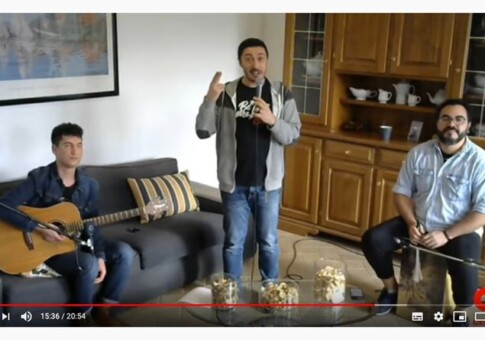 How did the idea of live streaming come about? “It began because we wanted other people to know that we are close to them during this time – close to the people who are giving their own lives each day as they try to save others and close to the thousands of people we have met at our concerts. We also wanted to share something positive and beautiful during this time of almost total isolation. I think that all of us, at least once, will have asked ourselves: ‘Why is this happening?’ It’s not easy to give answers, but we have sung ‘We believe in love’ so many times. We believe that love is behind everything that is happening.” Your broad and varied audience confirms the universality of your message. “The essence of our message is love, unity and a culture of sharing. It is a message that has no labels, it’s universal and everyone can understand it. We would like the people who watch us to experience the good and the longing for happiness and unity that there is in each one of us.” Your audience interacts with you a lot during streaming: which message has impressed you the most? “We get a lot of messages from people who work in hospitals: here are three of them. ‘I work in Covid Resuscitation. Our faces scarred by the masks, our eyes are our only recognisable feature and we no longer have timetable to follow but we are not giving up.. Please continue to bring us joy. My colleagues and I promise you that we will do all we can and persevere to the end.’ ‘A huge thank you to Gen Rosso. I saw them today before I left for my shift at the hospital here in Asti. It was a breath of fresh air for my soul.’ ‘I’m a Covid ICU nurse and I listen to your CD in the car on the way to work. It gives me the energy and inner peace to get through the shift… Thank you!’ Your new single “NOW” is coming out: can you give us a foretaste? How did it begin and what is it about? “Actually it’s not just a single, we’re planning a whole new album but we want to release it song by song over the next two years. ‘NOW is a song that blends the most current electro pop sounds with the vintage sounds of the funky 70s. The lyrics of the song, in English, express our belief that even if we make serious mistakes, we can always start again, because the voice of God-the-Father who is Love can be heard. On April 15th the single ‘NOW’ will be released on the most popular digital stores like Spotify, iTunes, Google Play, etc.”. The next live streaming appointment is April 8th 2020, at 16:00, Italian time, with some songs and special greetings on the @YouTube channel. Here is the link: https://www.youtube.com/watch?v=o17WFM3tos4&feature=youtu.be Don’t miss us! #Distantiuniti
Lorenzo Russo
Dialogue with Vincenzo Buonomo, Rector of the Pontifical Lateran University; Luigino Bruni, an economist; Amy Uelmen, a lawyer and professor at Georgetown University. https://vimeo.com/402934400
In these times of the coronavirus, often it is no longer possible for us to visit relatives, friends or acquaintances that we know are in need. The media seem to be the only way to express our concrete love. The following text shows us another way in which we can respond. It is wise to spend the time we have by living God’s will to the full in the present moment. Sometimes, however, we worry about the past or the future. We are concerned about situations or people for whom we cannot do anything at the moment. This is when it becomes difficult to steer the ship of our lives. It takes great effort to keep to the course that God wishes us to have in that particular moment. At such times we need strong willpower, determination, and especially trust in God, sometimes to a heroic degree. “Can I do nothing to resolve a certain complex situation or for a dear person who is sick or in danger? Then I will concentrate on doing well what God wants from me in the present: study, homemaking, prayer, taking care of the children … God will take care of the rest. He will comfort the suffering and show a way out of that entangled situation”. This way the task is being done by two in perfect communion. It demands from us great faith in God’s love for his children. And in turn it gives God a chance to trust that we do our part. This mutual trust works miracles. We will realize that Another has accomplished what we could not do, and that he has done it far better than we could have. Then our trust will be rewarded. Our limited life acquires a new dimension: we feel near the infinite for which we yearn. Our faith invigorates and gives our love new strength. We will know loneliness no longer. Since we have experienced it, we will be more deeply aware of being children of a God, who is a Father and who can do everything.
Chiara Lubich
Taken from: Here and Now, New City Press, 2005
How the many children who are members of the Focolare Movement are living this moment of global emergency. A new website designed for them goes online. “We have to stay at home at the moment, but we have a secret to stay happy: loving. So every morning we throw the dice and do what it says”. Gen 4, children who are members of the Focolare Movement, are not giving up. Even in isolation, they start each day with their ‘dice of love’. Each of the six sides bears one point of the ‘art of loving’ and they try to live it during the day. In some cities, the Gen 4 boys and girls have been busy writing letters and cards offering help to the older residents in their apartment blocks. They’ve drawn their parents into the activity too. “None of our neighbours has actually asked us for practical help,” explained one mother, “but it’s been a great opportunity to get to know each other and they’ve all been calling us to say thank you”. “What if some of the children here don’t have as many toys as we do?” reflected Niccolò and Margherita, two Italian Gen 4. So they filled a box and left it in the hallway of their apartment block, with a sign saying: “Ciao! We found these toys at home and we’re not using them. You can take them if you like and keep them. Courage!” While it may be true that “home” in these times is coming to signify “limits”, in Rome the Gen 4 have welcomed a proposal to build their own small houses out of cardboard and fill them with accounts of their acts of love. As the cardboard houses fill up with notes and pictures, the adults confined with them are learning how everyone can fill their home with small acts of love. The Gen 4 are present all over the world. As the pandemic spreads to all countries, it’s natural for them to feel solidarity with those who are suffering the most. Two Gen 4 in Asia sent a video-greeting with the image of a rainbow, as they called out “Courage Italy!”. Another greeting from Africa encouraged everyone “We can get through this together!” Alongside the children, Focolare animators are actively accompanying them through this delicate period. From Brazil to Congo, new ideas are springing into action. In Bilbao, Spain, they wrote, “We had the idea of holding meetings for the Gen 4 and their families every week via the web. We share how we are living this new situation, highlighting our acts of love. We encourage each other by promising to pray for peace, for the sick and for all who are suffering”. A group in Portugal is preparing a video about each Sunday’s Gospel reading which they share on social media every week. Being part of a network is proving valuable at this time. And a new website (https://gen4.focolare.org/en/) from the international Gen 4 Centre has just gone online, for children and their educators, offering material and formation programs in the Focolare spirituality, designed for this age group. The timing is significant. On 29 March 1972, Chiara Lubich gave life to the Gen 4, as the youngest generation of the Focolare Movement. A few years later, comparing the whole Movement to a large tree, she defined the Gen 4 as “the buds of the tree. (…) Something so very precious, very precious. It is the very future of the tree” .
Anna Lisa Innocenti
Gen Verde live streaming from Loppiano… #distantimauniti Riccardo, Anna, Cristian, Paola … the list is unending. They are just some of the over 4,000 fans who watched Gen Verde live streaming directly from their home last week. This is not the time for concerts, as public gatherings are banned, yet some questions just keep coming back to haunt us: how can we support those who are lonely, or are in the front line facing this pandemic, to be bearers of peace and of hope where we all are right now? This is where the idea of “Gen Verde from Home” was born: no longer live from town squares and concert halls but the living room at home. The instruments are there: a guitar, a keyboard, a flute, microphones and … a computer helping us reach the homes of all those who connect. But this is not a concert, it is quite an extraordinary appointment: we sing, we tell real life experiences, we present the fruits of the creativity born of this moment and … as Hans Christian Andersen wrote, ‘Where words fail… music speaks.’ In real time everyone from home can express a thought, send a message and literally the chat explodes and it is impossible to contain the gratitude and enthusiasm of those connected from all 5 continents. Nobody is missing from the roll call: from Argentina to Korea, from Canada to Hungary, from Italy to Australia. Suddenly, through the miracle of technology, the living room open to so many at the same time becomes an intimate place where singing and praying are synonyms, where celebrating a birthday and remembering those who have lost the battle against COVID-19 take on the same importance and everything is a gift of love. “Recently – Colomba says – I have heard a lot of news, not only from TV, but also from our neighbours, family and friends. Unfortunately, it is often quite painful news. I feel so much fear, worry, and an almost overwhelming sense of helplessness … of not being able to do anything for those who suffer. And I ask myself “why? and for how long?” In the past few days, one morning, while cleaning the house, I heard a voice speaking within: “be at peace, if you do small things well with love where you are, this is a contribution to support humanity”. A simple experience for Colomba who, like the other women of Gen Verde, seeks a meaning to stay at home, to deal with household chores like so many women all over the world. “Since that day the situation has not changed much – Colomba continues – but I can change my attitude by believing that this can change the world”. Here then is the recipe for transforming the 4 walls of the house (which sometimes appear very narrow) into a living room wide open for all humanity, a recipe to try and live. And Colomba is already at work and between a phone call and housework her experience has become music … and it is ready to be shared during the live streaming April 3 at 4pm (Italian time). An opportunity not to be missed. Just connect by clicking on https://youtu.be/NLsPTyuITu0
Tiziana Nicastro
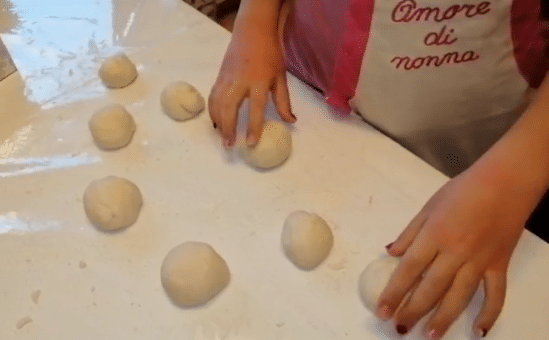
Fraternity, tenderness and creativity: the right ingredients to face the coronavirus emergency, with thousands of experiences of love for others Struck particularly hard by the Covid-19 pandemic, Italy is experiencing one of its greatest ordeals since World War II. Despite this, Italians are facing it with countless gestures of solidarity, fraternity and tenderness. “At the beginning I was afraid of contagion, so I was very quick in my nursing duties,” writes I.V., a nurse in the ward for patients testing positive for Covid-19 in the province of Naples. “A patient asked me for a coffee from the machine. At first I told him I couldn’t. But then, by involving a colleague, we found two coffee machines for all the patients.” Having to stay at home changed life for Salvo and Enza’s family in Viareggio, with their children Emanuele and Marco. “Until a few days ago,” says Enza, “the children, taken by so many commitments, could barely say a quick hello to their sick and bedridden grandmother. Now they stop more and try to help me, even just by giving her a glass of water. At lunch and dinner we have more time to talk and to laugh, too.” 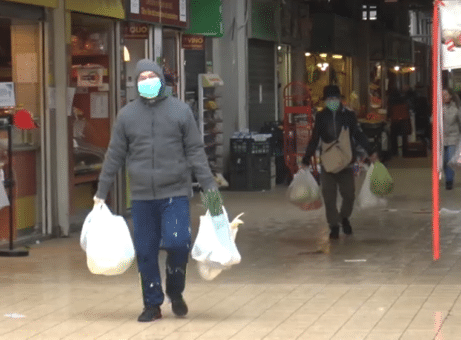 In Lucca, Paolo and Daniela offered to do the shopping for all their neighbours, and they donated some masks too. Also in Lucca, Rosa and Luigi, a young couple of teachers with two children, all at home at the moment, lent their car to a family with a serious financial situation. In Siena, Giada and Francesca offered their services as babysitters for the children of nurses living near home to support them. In Pisa, Carla and Giacomo prepared food for some families near home, while in Arezzo there was a race of solidarity between Rosanna, Rita and Mario to support two people who cannot go out, through shopping and preparing meals. In Latina, in order to support her young colleagues away from home and forced into isolation, Barbara began to record videos to share her recipes. They thanked her very much, because by doing this she makes them feel at home, like family. Emanuele and Simonetta from Sardinia have been in quarantine for two weeks with their three children. “It immediately seemed to us an opportunity to build deep relationships as a family,” they write. “Since we came into contact with the virus, we started sharing our experiences in a chat group with other people who are experiencing the same suffering. “One day some of them needed food. Since we couldn’t do the shopping ourselves, we found another couple who immediately were able to provide. And we realized that we should never give up when faced with someone else’s needs.” “In my work in the cardiology intensive care unit, I found myself with a young patient who had a complicated heart attack,” says Orsolina, a nurse from Sicily. “In her eyes I saw fear and despair, because she did not have the comfort of her family and small children with her. “I felt that I could be her family. So I helped her with her personal hygiene, thinking about what I would have wanted if I were in her place – making her bed just right, fixing her hair. Her eyes changed, and we felt a great joy together. At that moment we were a family.” In Rome, Mascia, Mario and their son Samuel are discovering that “this virus, as well as reminding us that we are all interconnected, is giving us the opportunity to appreciate small things, to put family and affection first, to give free rein to creativity against the frenetic schedules and rhythms we are used to.” As class representative, Masha is looking for the best way to love families and teachers, keeping relationships vibrant through online chats and phone calls. As Focolare’s co-president, Jesús Morán, said a few days ago: “This is truly a moment of wisdom… It leads to an awareness of reality enlightened by love and… triggers a formidable movement of fraternity. “Truly God can do exceptional things, even in the midst of evil. He defeats it with his plan of love.”
Lorenzo Russo
Many people are wondering, while a pandemic is afflicting humanity, where God is in all this. The following writing by Chiara Lubich invites us to believe that nothing we experience, even if it is very painful, escapes his love and that behind everything there is a positive purpose, even if for the time being we cannot see it. We talk about a Holy Journey and encourage each other to live our life as a Holy Journey, … and we often think of it as a series of days in which we want to make each day more perfect than the last: doing our work well, studying, resting, spending time with the family, attending gatherings and meetings, doing sport and relaxing, and all of this done in an orderly and peaceful way. That’s how we think of it and both humanly and instinctively we are inclined to expect it to be like that, because life is a continual tending towards order and harmony, health and peace. … We act like this because everything else is of course unforeseeable, but also because there is always hope in the human heart that things will go like that and not any other way. In reality our Holy Journey turns out differently, because God wants it to be different. He himself brings other factors into our programme that are either wanted or permitted by him so that our existence may acquire its true meaning and reach the goal for which it was created. This is where physical and spiritual sufferings come in, the illnesses and the thousand other sufferings which speak more of death than of life. Why is this? Is it perhaps because God wants death? No, on the contrary, God loves life, but a life that is full and fruitful in a way we could never have imagined, even with all our efforts towards all that is good and positive, and towards peace. A Word of Life explains it: “Unless a grain of wheat falls into the earth and dies, it remains just a single grain; but if it dies, it bears much fruit” (Jn 12:24). If the grain of wheat does not die, it stays nice and healthy, but remains alone; if it dies it multiplies. God wants that during our life we experience a kind of death, or sometimes many kinds of death. It’s because for him the Holy Journey means bearing fruit, doing works that are worthy of him and not just of us simple people. For him this is the meaning of our life, a life that is rich, full and superabundant; a life that can be a reflection of his. So we have to expect these deaths and get ready to accept them in the best possible way. Therefore, the choice of Jesus forsaken that we renew every day, and our preferential love for him, is wise and indispensible and nothing other than genuine Christianity. It prepares us … to accept these deaths, whether great or small, but also to see that all we had planned to achieve has been far exceeded, strengthened and made fruitful. … They are passive purifications: illnesses, the death of people dear to us, the loss of goods or of our reputation, problems of all kinds. They are dark nights of the senses and dark nights of the spirit, where body and soul are purified in a thousand ways through temptations, spiritual dryness, doubts, a sense of being abandoned by God; and it’s when the virtues of faith, hope and charity waver in us. They are real anticipations of purgatory if not almost of hell. What should we do? Give up the holy journey, thinking that by living a more ordinary life, in the way of the world, we could avoid many or at least some of these trials? No, we cannot turn back! Here, I have only listed the purifications; we’ve also got to look at the consolations, the “beatitudes” (cf. Mt 5:3-11) that life lived as a Holy Journey already brings to this earth. Jesus’ death actually calls for the resurrection. The death of the grain of wheat calls for “much fruit.” In a way, “resurrection” and “much fruit” stand for an anticipation of paradise, the fullness of joy, the joy that the world does not know. And so, let’s go ahead! Let’s look beyond every suffering. Let’s keep going rather than stopping when things are uncertain, when there is anguish, illness or other trials. Let us look forward to the harvest that will come from it … foreseeing and having a foretaste of the abundant fruit which is on our doorstep.
Chiara Lubich
(From a telephone conference call, Rocca di Papa, 25the February 1988)
A couple from Croatia and their experience with the Focolare Movement’s “Paths of Light” project “Like small children who start learning, we too learned to understand ourselves first, understand feelings, recognize them, understand each other, and learn that thinking differently doesn’t always have to end up in conflict. We understood that the couples around us enrich our relationships, and that we need to avoid isolating ourselves.” Melita and Slavko have been married for close to 20 years and are parents. They live in Croatia. They tell their experience as a couple candidly, without glossing anything over, or omitting those trying moments that made their path a challenge. Their marriage was a “house” to build every day, often without knowing what tools to use. It wasn’t a straight highway to drive with a powerful car, but a dirt road to be covered by bike with only one’s legs, lungs and heart as the engine, with tiring climbs and then descents to recover on. Theirs is a story that perhaps resembles many couples, yet it offers a key to understanding family that should not be overlooked. It came to light when they participated in the Percorsi di luce (“paths of light”) project in Italy, which the Focolare Movement has created for couples, especially those who are going through moments of division. In one of the darkest moments of their relationship, they explain, it was thanks to meetings like these that they found the tools to “use each day so that our family can be happy and our relationship can grow. The tools facilitate the climb that awaits us all in life as a couple, to realize God’s plans for our family.” Through their words, it becomes clear that the image of the “perfect” couple is a painful illusion. The expectation of a linear and sunny path, nourished by the enthusiasm that follows meeting the “right” person, clashes with the reality of a “game” that everyone must play. In this game the outcome is unknown, your teammate sometimes turns into your opponent and you win only if you both win. It is a game with no written rules, but one that has to be played with a clear goal, or at least, if it fades away, rediscovering that goal. It is a game where everyone is called to contribute and face adversity, without shortcuts. “Seen from today’s perspective,” they say, “we can testify that marriage is not a fixed and static thing, and that a course like this is not a magic wand that solves all our problems forever.” Rather, here “we have learned that our first child — our marriage — needs the greatest care and priority, because only when we are in peace and harmony can we be able to give love to the children and people around us. Only in this way can we become fulfilled as people.” In fact, their relationship went from feeling already fulfilled straight to the “starting blocks”. Melita tells about their beginnings: “It was a very beautiful time. I finally fulfilled my dream of having a man who could listen to me, console me, understand me. A person with whom to share similar views on life, faith, love. We soon realized that we wanted to crown our love with marriage.” Soon, however, the first test emerged: the loss of a pregnancy forced Melita and Slavko to review their plans and focus on the practical organization of life, work and home. It was a productive time, where they experienced a growing unity between them and with their respective families. They shared everything, says Slavko, finding “the strength, the will and the desire for common things”. “We idealized our lives,” Melita explains, “by completing the tiles in our mosaic and waiting for the family to expand.” After three years came the joy of their first child, but with it also the need to find a less demanding and more rewarding job. Employment for Slavko came, but the new situation produced tensions, misunderstandings, deep wounds in the couple. “The security we had built up and the trust in each other disappeared,” says Melita. “A period of dissatisfaction in our relationship began, with blame for the mistakes made. Slavko was not aware how dissatisfied I was, and I didn’t know how to make him understand the things that were bothering me.” “I was content with life, thinking, ‘What more do you want?’” he says. “We love each other, we are married, life goes straight ahead. Why do I continually need to show my fidelity and affection? She’s the one who doesn’t understand that I love her and stand by her. “I was deaf to her cries and I thought that she was the one who had to change and accept the new circumstances. In us there was a growing feeling of powerlessness and despair. We fell into an abyss from which we did not see a way out.” The thought of separating went through their minds. They had reached the bottom. But in that desert, life gradually began to flourish again. “At that moment the Lord sent our godparents and friends on our path, who, like others we had once erased from our lives, sent us directions to follow through them,” Slavko remembers. By comparing their situation with other couples participating in the project, they finally managed to glimpse a way out. “Facing each other, and before God, we began to understand and know each other again. We learned that having a different opinion does not mean that my partner does not love me; on the contrary, we have learned once again how diversity enriches us – it completes us as a couple.” Learning, discovering, growing and coming together as a person and as a couple: perhaps this is the unexpected result of an authentic and courageous journey, one that is unpredictable and full of tests, but also satisfying goals. Melita and Slavko have discovered that God’s plans for them as a couple and their family are not at all predictable, but it requires a determination to love each other. And they have learned that it is through this commitment that they each fulfil themselves as people.
Claudia Di Lorenzi
He passed away recently at the age of 53. His passions were building bridges between peoples and cultures, and forming the new generations. Young people were the primary focus of Fr Silio Naduva’s work as a priest in the Fiji islands, in the South Pacific. He died recently at the age of 53. He dedicated his profoundest energies to ensuring a human and spiritual formation and education for the youth of one of the most remote islands of the archipelago. He realised that globalisation which brings the world into their homes cannot equip these young people with the knowledge and instruments needed to continue their lives in an informed, free and fruitful way. He got to know the charism of unity of Chiara Lubich in the late 1990s. What fascinated him was “the capacity of the ideal to create a sense of family, forge union between people, and in particular with the flock the Lord entrusted to him,” so described Roberto Paolini, a volunteer member of the Focolare, who collaborated with Fr Silio in a series of formation weeks in his parish of St Anne, at Napuka last summer. “In the spirituality of unity,” Roberto continued, “he discovered an incredible driving force” which helped him face moments of great pain and suffering. Born on 28 February 1967 in Serua province, in the small village of Namuamua in the interior of Fiji’s main island, Silio was the seventh of nine brothers. From an early age he demonstrated great generosity, resilience, resoursefulness and a caring nature towards his family members and everyone else. He attended a Marist school and at the age of 17 was conscripted into the Fijian armed forces. Silio was posted on two missions which involved traumatic experiences, but he never lost his profound sense of humanity. Only after the death of his father in 1996 did Silio enter the regional Pacific seminary to start his formation. The very next year he met the Focolare Movement. Silio was ordained priest on 1 January 2005, at the age of 37, beginning his ministry in the parish of Vudibasoga, in Nabala. He was diagnosed with a serious illness in 2013, but this did not hold him back in serving and using all his energies for his parish. In 2018 Silio accompanied a group of young people to the Genfest at Manila in the Philippines. He returned with the ardent desire to encourage his young parishioners to follow this pathway. He guided and educated them, he encouraged them to join him in building bridges towards the youth of other communities, who despite having different cultures and languages, are part of our same family. One of the last things he did was to promote a meeting for youth from his own parish with young people from other parishes nearby, organized last August in collaboration with Focolare and with the local Caritas agency. In such a fragmented community, where the social network is lacerated by poverty and violence, Fr Silio worked to unfold a wider horizon to these youth. He offered them a vision and experience of how living alongside each other can nurture solidarity, and how peoples separated by large distances, by differences in traditions, cultures and language, can meet together in mutual respect and with a shared desire to build real relationships as brothers and sisters of the same family.
Claudia Di Lorenzi
To better understand what to do for others, Jesus invites us to put ourselves in their shoes; just as He did, when, out of love for us, he took on our human nature Are you doing it for yourself or for others? I found myself in a strange situation: I prayed every day, I attended Mass regularly, I was engaged in works of charity… and yet I didn’t have a living faith. It was as if a veil was preventing me from seeing clearly. One day, as I was accompanying my grandmother to the doctor, we got into a profound discussion; knowing how strong her faith was, I told her the state of my soul. She looked me in the eye and said: “Son, everything you do, do you do it for yourself or for others?” That simple question shocked me and called for a complete change of situation! I began to reflect, noting that even acts of charity were done out of a sense of duty. Now and then, I would visit an old man. When I visited him after that encounter with my grandmother, instead of talking about paperwork or medicine, I asked him what was in his heart. He told me about the war, the comrades that had died, his wife’s illness… At the end, he thanked me for the great gift he said he had received that day. (U.R. – Argentina) Loyalty Having fallen in love with a colleague, my wife left me with four children. I could not show them my despair as this would made their suffering worse but I could not help wondering where I had gone wrong. My own faith was being tested. Now the challenge was to minimise the impact of this drama on the children and make sure that she did not feel judged by them. Sometimes I would bring her our youngest child of four years old, sometimes I would make sure she attended parent meetings with the other children’s teachers. Slowly, a situation arose in which it seemed as if the mother, despite living away from home, somehow continued to be present in the family. But when she asked for a divorce, I felt like I was back at zero. I had to take a new step with the children. It was the oldest who, seeing me sad and thoughtful one day, gave me courage by saying: “Dad, don’t worry. We’re learning to take charge of life.” (B.d.P. – Croatia) The baby grow Used to having money, clothes, luxury ever since I was a child, I gradually had to drastically reduce my expenditure after the wedding. A few days ago I received an extra sum of money from work: I immediately thought about our baby that was about to be born and the baby grow I could buy him. But then, remembering how many poor people there are in the city, I told myself that the money could be used to help some of them. For the birth of our baby I received loads of second-hand clothes as a gift. Of course, I would have liked a brand new baby grow, but the things I received out of love were much more valuable and beautiful to me. (Anita – Venezuela)
Edited by Stefania Tanesini (taken from Il Vangelo del Giorno, Città Nuova, anno VI, n.2, march-april 2020)
Jesús Morán, Co-president of the Focolare Movement, in his homily during the Mass celebrated behind closed doors and transmitted via streaming shared the following thoughts: (…) In these last few weeks, which have also been during Lent, a thought overwhelmed my soul: the vanity of all things, the insecurity of our ability to deeply understand reality, life and the course of history. In fact, it only took a virus, a non-cellular microorganism, to put in jeopardy all our great reasoning and our security, our economic plans, our political strategies; to trigger panic worldwide and highlight the woes of so-called globalization. As a newspaper headlined a few days ago, using football jargon: Coronavirus 1 – Globalization 0. That is the sad truth. When thinking about the things that have been written in recent years on the phenomenon of culture in our times, the countless analyses and counter-analyses about the evolution of history and so on, I felt dismay and an almost paralyzing sadness. But it was then that I made a formidable rediscovery: Revelation, the Word of God addressed to humanity in human words and intelligence; the thought of God expressed in human words about the depths of life and history; a breath of understanding. In fact, I think that only the Word of God can provide us with answers for the period we are living in, because it alone preserves an eternal wisdom that goes beyond the times without losing its meaning. In the light of Revelation we realize something as overwhelming as it is paradoxical: that we are living a time of grace. Wisdom! This is the right solution. This is indeed the time of wisdom, a time for wisdom; a vision of reality that moves on other tracks, which is extremely imperative and indispensable today. (…) Wisdom that leads to an understanding of reality enlightened by love and that, precisely for this reason, triggers a formidable movement of living as one family. Truly God can do prodigious things, even in the midst of evil. He defeats it with his plan of love. Chiara’s life spanned almost a century and she lived it like a river of wisdom that watered the earth. She was attentive to the events of history and did not stop at what was on the surface of things, but went into depth and looked above to draw on the thought and vision of God and from God. That is why she paid no attention to anything but His Word. Unity, in fact, is God’s plan for humanity; it is the testament of Jesus, the Incarnate Word. Now we can see how much this word, unity, because it is anchored in Revelation, goes beyond the passing events, times and eras of history. It represents a vision of meaning that involves the past, present and future. It is a prophetic perspective that can activate the best energies of men and women of all latitudes, cultures, ethnicities and social conditions. Strengthened in unity we can transform the “globalization of indifference” into the “globalization of fraternity”. The match is not over. Of one thing we are certain: God’s mercy will triumph.
A message from Maria Voce, Focolare President, to the Movement’s communities around the world, for 14th March, the anniversary of the death of Chiara Lubich. Text of the message
An event dedicated to one of the “founding fathers” of the Italian Constitution, a writer, journalist, politician and co-founder of the Focolare Movement, Igino Giordani. The event, promoted by the Movement’s General Archives and the Igino Giordani Centre, was the first in a series aimed at getting “to the roots” of fraternity as a political element. At a time when values such as respect, coherence, loyalty are engulfed in a misleading narrative often resulting from an artificial communication system, the aim of these talks which were the inspiration of the Focolare Movement’s General Archives and the Igino Giordani Centre is to extract certain “pearls” from the heritage safeguarded by the two centres that characterized the life of political figures who were guided by the values of fraternity typical of the charism of unity. “If everyone was like Giordani, there would be no wars, no discrimination, no hatred. This great man must be a reference point for humanity. It’s up to us now to promote his ideas”. These words spoken by Gaia, a seventh grade student, give us an idea of how relevant Giordani’s message is and what an inspiration he is for the new generations. More than 300 people met together on 15 February 2020 in the Auditorium of the International Focolare Centre in Rocca di Papa, including politicians, mayors and local administrators. The event, which was viewed via livestreaming by people all over Italy and Europe, forms part of the year marking the 100th anniversary of Chiara Lubich’s birth. During the evening Giordani’s charm clearly emerged from words spoken by those fortunate enough to have met him such as Argia Valeria Albanese who recalled: “From those meetings, even personal ones held in the garden of the Mariapolis Centre in Rocca di Papa, I was greatly inspired to make a long term commitment to a political party and its institutions. There was another phase in my life where I felt a strong relationship with Igino Giordani not so much as a teacher or someone to follow but as an older brother to whom I could open my heart in those moments of failure… The misunderstandings and often the resentment, the denigration and not managing to achieve the objectives I’d set myself, however noble and disinterested, electoral defeat, losing friends”. Pietro Rossellini who served the community of Montecatini as Councillor affirmed how he was guided by “the radical mutation of this man as he got older, considered to be the strongest defender of the Christian faith par excellence, who allowed himself be transformed by Chiara Lubich by changing his controversial verve into Fire of Love. His being was not distorted, but made more sublime, elevated.” For Patrizia Mazzola, who worked passionately as a teacher in the Ballarò and Brancaccio neighbourhoods of Palermo, “some of Giordani’s writings have changed my idea of political and social commitment and given me courage in some of my battles in favour of the least of the city”. Chiara Zanzucchi and Lucia Zurlo from the General Archives and Alberto Lo Presti from the Igino Giordani Centre observed that the desire to organise this series of events lies in a growing awareness that the Archives are alive and kicking. These meetings dedicated to “witnesses in politics” enable us to appreciate how much the charism of unity has influenced political commitment through their moral coherence and political passion, their contribution to fraternity and peace.
Gianna Sibelli
A gathering entitled “Back to the future for a more humane economy” was held March 4 at the Italian embassy to the Holy See. Entrepreneurs, scholars and economists came together for a more just, inclusive and sustainable economy, in line with the upcoming “The Economy of Francis” event. “In 2000 we opened a small cosmetics company in a 60-square-meter space, with only one employee. Today we work in a building that is 7,500 square meters with 43 people working, and we produce about 100,000 pieces per day. “People are our profit and our strength.” So says Marco Piccolo, 45, an entrepreneur from Turin, Italy, who has four children and also finds time to educate young people in his parish. He and his company joined AIPEC, the Italian Association of Entrepreneurs for an Economy of Communion. The association is linked to Focolare founder Chiara Lubich’s insights of an economic model that puts people and a “culture of giving” at the heart of business. Reynaldi is a company that has bet heavily on young people and women (currently 70% of their employees and managers), as well as environmental sustainability: the company does not emit CO2, does not waste water or harm the environment. These attributes mean many large companies in northern Europe and the United States buy their products. “With entrepreneurial vision you can transform an economic system, do things well and focus on caring for the people in the company,” he says at a gathering in Rome at the Italian embassy to the Holy See called “Back to the future for a more humane economy”. The event was promoted by Catholic University of the Sacred Heart, the Focolare Movement and the Italian Embassy to the Holy See. It came from an idea to offer an opportunity to reflect on today’s economic system and the need to start a global renewal so that the economy of the future will be more just, inclusive and sustainable. It is in line with the “The Economy of Francis” event called for by the Holy Father, to be held in Assisi next November. Piccolo’s company is a virtuous example of a more humane economy in action. It is an economy that, in the words of Pope Francis, “brings to life and does not kill, includes and does not exclude, takes care of creation and does not plunder it”. Reynaldi was one of the first companies in Italy to transform its legal structure from a for-profit firm to a ‘benefit company’, which means it integrates in its corporate mission, alongside its objective of profit, the goal to have a positive impact on society and the biosphere. “We take care of the people who work with us, and that’s why we don’t want working hours to be overwhelming,” says Piccolo. “We want there to be time to live for family and for people to be well.” There have been many virtuous companies or cooperatives in the wake of Piccolo’s. Take Conad, a cooperative Italian large-scale retail company, which involves Caritas offices so as not to waste food from its supermarkets, allocating it to those in need. Or when buying products from other companies, they verify whether they exploit child labour or illegal hiring. “If each of us does our part, both in our actions and by injecting wellbeing into the community, this can contribute to an overall improvement in society,” says Francesco Pugliese, CEO of Conad, who spoke at the conference. If we want to redefine economic progress for the future, we need to involve young people who know how to ask questions, speak out and find important answers. And the popes intends them to be the architects of the Economy of Francis. “We know that St. Francis of Assisi is a source of inspiration for a way of understanding the economy and finance,” says Sister Alessandra Smerilli, Councillor of State for Vatican City. “We hope that the November event will help us rediscover this. “In Assisi the young people will try to make proposals and work in 12 thematic villages, where we will try to cover all the important issues and present a proposal for each village. It is a personal commitment, but also a commitment to institutions, business and politics,” she concludes. There is certainly a need for networking, dialogue between institutions, businesses and universities to find solutions to help young people find work. As Ambassador Pietro Sebastiani reminded us: “Today’s world is more complex than it used to be, and many societies have been experiencing the scourge of youth unemployment for too long. But opportunities exist, and everyone must pursue his or her own talent.”
Lorenzo Russo
Owing to the Coronavirus outbreak in many countries of the world, the International Focolare Centre at Rocca di Papa, Italy, issued a number of safety measures to prevent the spread of this contagious virus. The International Focolare Centre, located at Rocca di Papa (Rome – Italy), announced a number of preventive measures to help control the spread of the Coronavirus epidemic and have it stopped as soon as possible. These measures issued on March 9, are in accordance with the Italian Government decisions and as indicated by the Italian Bishops. They are in line with the nationwide coronavirus lockdown announced by the Italian Presidency of the Council of Ministers, when Italy has been declared a “protected zone” from March 10 until April 3. The measures issued are the following:
Focolare Communication Office
Jesus’ teaching:“Do unto others as you would have them do unto you” is known as “the Golden Rule”(Mt 7,12), a universal principle found in different cultures, religions and traditions . Authentic human values, that build peace, lead to solidarity and contribute towards just personal and social relationships, are all based on this ethic of reciprocity. The hundredfold I live in a small town, where there are only a few shops, and you don’t always find what you need. One morning a poor, sick neighbour of mine knocked at my door and with a big smile on her face asked for some cooking oil. I needed the little I had for my own cooking, but I felt that I had to give it all to her. When I came to prepare lunch, I realized that I had to make do without oil, but I was happy. I was just going to handle the pot when someone knocked at my door. It was a nun; I have not seen her for quite some time because she lives far away. When I opened, she told me: “Come, I’ve something for you in the car.” And she gave me three boxes full of oil containers: a total of 54 litres. (G.V. – Burundi) If you give love… After 20 years of absence from our country, my wife and I were faced with the difficulties of settling again. At first, we felt like strangers; we had to start all over again, but we found strength in the words of the Gospel to open ourselves to others, rebuild old relationships and make new friends. As we were not young when we got married, we decided that if we would have no children, we would give the warmth of a family to those who do not have one. So we started the process of adoption. Some months ago we received the news of the arrival of Veronica and Carlos, two little siblings from Brazil. We shared their photos with our new acquaintances, and we went to Rio to pick them up. When we came back, a great welcome awaited us; a huge banner with a welcome sign for Veronica and Carlos was put up in our street, and there were lots of balloons and messages on the veranda of our house. We were also given clothes and other necessary things for these two children. How can we ever forget the great support we have received! We are more than ever convinced that if you give love, you receive love. (M.S.F. – Spain) A Conspiracy of love My mother-in-law was living alone; then she came to live with us, even though she had daughters who could welcome her. Her presence, very well accepted by my children, was an additional commitment for me, as I already had the family to look after. She suffered of some form of arteriosclerosis, that made her talk to herself without realizing that she was being heard, and she often spoke ill of me. My children laughed at this situation, even though it really hurt me. Was this the thank you for the care I was giving her? One day, when she was down with flu, our conversation at table fell on grandmother’s odd behaviour. My husband was very upset, but together we decided to live “a conspiracy of love”, which meant a greater effort to love grandma more and better. This was one of the most educational and fruitful moments in our family life.The many relatives, who often come to visit grandmother, are amazed at the atmosphere that reigns in our family. (C.S. – Italy)
Stefania Tanesini (taken from “Il Vangelo del Giorno”, Città Nuova, anno VI, n.2, March-April 2020)
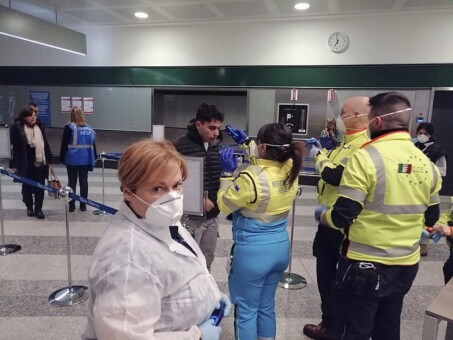
Practical help, community building and stories of hope from all over the world are spreading the “antivirus” of fraternity. “It is no longer ‘I’m afraid of catching this virus’ or even ‘I couldn’t care less about catching the virus.’ I need to take care of OTHER PEOPLE. I worry about you. I keep my distance for you. I wash my hands for you. I give up that trip for you. I’m not going to the concert for you. I’m not going go to the shopping centre for you. This is an opportunity to turn an emergency into a time of solidarity.” A young Italian woman from the Focolare Movement posted this message on Facebook. She is appealing for a radical change of mentality and action as her country rises to second place in the world ranking of nations affected by the Coronavirus. As this virus continues to spread, it is affecting countries across the world in a variety of different ways – health care systems, schools and the economy are in crisis in some areas. The economist, Luigino Bruni, international coordinator of the Economy of Communion wrote, “Although we understand the concerns of many leading economists at the moment, we believe that the task of “civil enterprises” does not end in merely calculating the damage and in contributing to the spread of alarm. This is the moment to demonstrate that the State is us and that corporate social responsibility is not only a marketing tool but is a genuine practice that is activated especially during times of crisis. It pays attention to common goods (health, work), practices correct communication, formulates concrete and sustainable proposals with an overall vision, initiates practical action in support of the most vulnerable people and enhances a system made up of companies, families, schools, universities, organizations and bodies that become protagonists of a new and indispensable proactive solidarity.” Bruni referred to a recent example of social responsibility. Mahmoud Ghuniem Loutfi, who works as a delivery man in Turin, Italy, bought masks for the local Red Cross out of gratitude to the city that welcomed him and which has become his home. He did not think about the impact this would have on his finances but asked himself what he could do for his community, and, therefore, also for himself. Mahmoud’s story is typical of the many examples of cooperation, sharing and solidarity we are seeing at the moment. Gloria, a young girl who knows the Focolare in Hong Kong explained how technology is helping people to stay in contact. “We try to organize meetings by videoconference so we can stay united during this special period. Also, the fact that we have to spend more time at home with our family means we have the opportunity to understand one another better and share problems more.” Caritas Lee lives in Ulsan, Korea. He told us about a fundraising activity at his university. “The goal was to raise 500,000 won (€380). Everyone was making small donations but I kept thinking about the 1595 people who had been identified as suffering from the virus at the time. Then a wonderful thing happened: a total of 46 million won (€35,360) was collected. This was donated to the diocesan hospital and the Daegu health district, the region most affected. After this initiative, other universities wanted to raise funds to help the health system. In addition, many volunteers as well as doctors and nurses began to offer their services for free in the hospitals. Another thing is that some landlords are not expecting their tenants to pay their monthly rent and some people are leaving food in front of houses for those who can’t go out.” Yopi lives right in Daegu. His house is near a hospital so you can hear ambulance sirens all the time. “At first, when I heard them, I prayed for the patients. Then I started to feel anxious. With the beginning of Lent I decided to pray the rosary every day. Slowly the anxiety has given way to peace in my heart.” Micaela Mi Hye Jeong wrote from Gumi, also in Korea. “Here we’re preparing 150 masks to be distributed where the need is most urgent. We thought that instead of getting disposable masks that pollute the environment, we could make them ourselves from washable cotton. During a time when we are frozen with fear, it’s as if my heart is beginning to feel warm again because of the opportunity to practically live what the Gospel teaches.” In Brazil, Armando, an Economy of Communion entrepreneur, has a company that supplies the health sector. “During this period, the cost of masks and disinfectant has risen by up to 500%,” he said. “I asked myself how, in this situation, I could witness to what I believe in and live for? I decided to go against market prices by selling my products at prices 50% (or more) lower than my competitors. What is more, my employees have all supported this policy.” In Italy, some young people from the Castelli Romani area have offered to go shopping in local supermarkets and provide free home delivery. “If you are over 70 years of age or have health problems and, as a precaution, you prefer to stay at home, we will take care of your shopping,” the WhatsApp message reads. “Don’t think about shopping, let’s get over this quickly.”
Civil Defence volunteers engaged in health checks at the “Milano Malpensa” airport.
Lorenzo Russo
Paolo Balduzzi continues his journey looking at the story of Chiara and the Focolare. This time he goes to Rome where Chiara met Igino Giordani, the first co-founder of the Movement. With him the charism opened up to ecumenism, politics and a thousand different applications in society. https://vimeo.com/389431555
400 young people, 56 countries, 16 languages, 4 days: WeGENerate! Last January, myself and Luisa (a friend of mine from Brazil) spoke with 400 Gen (young people of the Focolare Movement) in Trent, Northern Italy. We asked them a question: did they want to be the United World Generation? Did they want to be the generation who will deliver a united world by 2050. 77 years earlier, Chiara Lubich and her friends made a phrase of the Gospel ‘that all may be one’ (Jn 17:21) the aim and mission of their life. When I was at the International Gen 2 Congress ‘WeGENerate’ last month, with a group of young people the same age as Chiara was when she said this ‘Yes’ to the Gospel, I thought for the first time that this Ut Omnes prayer might be a question, rather than a simple statement of prayer. A question, because, this prayer requires an answer. A question because they are not only nice words to pray, but they challenge the reader to live the answer. A question because ‘Ut Omnes’ is a questionable subject and it’s not ‘a given’ that it’s even possible. The question that Luisa and I asked last month (do you want to be the United World Generation?) was only, then, a reformulation of the question that Chiara Lubich answered in 1943. We put a date on the end of the question to see if we, the Gen, really wanted to answer this question. Instead of answering the question with words, the Gen decided to organise. On one of the afternoons, 400 Gen from 56 countries with translation in 16 languages planned local and global actions to fight corruption, lessen inequality, stop climate change, reactivate dialogue and prevent conflict. We answered this Ut Omnes question by planning advocacy training and global formation activities to protect democracy, prevent conflict, fight corruption and stop inequality. We answered this Ut Omnes question by promoting the #CleanPlate, #GreenDay #ClearPlasticJarChallenge and CarPooling campaigns to combat environmental problems. We answered this Ut Omnes question by imagining platforms and apps to unlock dialogue; by breaking down ignorance and building relationships. Mark from Syria answered this question by affirming his intention to return to Syria and help rebuild his country. Victor answered this question by challenging himself to be a living realisation of the charism of unity in Venezuela. Joelle answered this question by promising to bring this message of unity and love back to Lebanon. Contexts which are not dissimilar to the context in which Chiara answered this question in 1943. Many people, like Mark, Joelle and Victor, will make their way to Trent this year to encounter the city that shaped Chiara Lubich. They will visit the exhibition, they will take the tour of the city, they will encounter a community of people who are living to build unity in that beautiful city. They will travel to Trent hoping to understand the roots of Chiara’s story and the story of the Focolare Movement. From my experience at this congress, if you really want to travel to the roots of the story of Chiara Lubich, you need to ask yourself the question that she answered in 1943: that all may be one? And then ask yourself, do you believe it’s possible to be one? And if yes, what am I going to do about it?
Conleth Burns
We went to Great Britain a few days before Brexit, when the United Kingdom leaves the European Union. We met many people, including the community of the Focolare, to see what has happened and what their hopes for the future are. https://vimeo.com/389431416
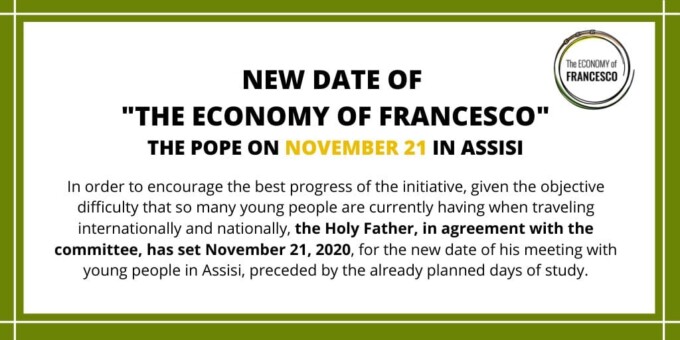
Luigino Bruni, economist and scientific director of “The Economy of Francesco” said, “Postponing the event will allow us more time to prepare. Young people from all over the world are responding with a great sense of responsibility and even more commitment. The setback could be a blessing.” In agreement with the Holy Father, we are going to postpone “The Economy of Francesco” to 21 November but the work of the scientific committee and of the young people involved in the organization does not stop. On the contrary, it proceeds with great commitment and enthusiasm as we read in the press release of 1 March. The decision was taken “given the travel difficulties for the approximately two thousand young people from 115 countries who are expected to participate” and because of the corona virus. The appointment, however, has only been put back and Pope Francis will be in Assisi in November to meet the young people who, during the preceding days, will take part in workshops, discussions and dialogue regarding new approaches to various economic issues. The general focus of the meeting was outlined in the letter that on 1 May 2019 Pope Francis addressed to “young economists, entrepreneurs and business men and women all over the world”, inviting them to “re-animate” the economy – in the literal sense of giving it back a soul – to be among those who respond to the cry of the poor of the earth and do not look the other way. “This is why I would like to meet you in Assisi,” wrote the Holy Father, ”to work together to promote, through a common “pact”, a process of global change engaging not only with those who have the gift of faith but also with all people of good will, beyond the differences of creed and nationality, united by an ideal of fraternity and attentive above all to the poor and excluded.” In a post on Facebook, Prof. Luigino Bruni, scientific director of the event, thanked the Pope for the new date. “We will be more prepared,” he said. “Young people from all over the world are responding with a great sense of responsibility and even more commitment. The setback will be a blessing. We must be realistic dreamers, and therefore live through the anxieties and crises of our time. We must do everything possible not to ‘ lose anyone” of the 2000 young people who have already been selected, many of whom have already bought air tickets. I was impressed that none of the young people have complained about the postponement – they just want to continue the race. We have already held 230 “Towards Assisi” events and these extra eight months will allow us to hold another three hundred.”
Stefania Tanesini
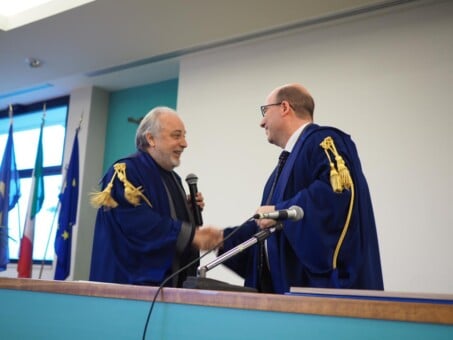
After twelve years of presidency, Prof. Piero Coda, who has led the Sophia University Institute since its foundation, passes the baton to Prof. Giuseppe Argiolas, Professor of Management at the same Institute. This is the first change of guard for the Sophia University Institute (I.U.S.), which also coincides with the attribution by the Congregation for Catholic Education of the title of “Rector” to the former Dean of the Institute. Therefore, Prof. Giuseppe Argiolas is the new Rector of Sophia. He succeeds Prof. Piero Coda who , since its foundation, has guided the Institute with wisdom and a spirit of prophecy. The election by the Academic Council of the Institute, took place on January 9th. On February 20th , 2020, the Congregation for Catholic Education, wrote a letter, appointing Prof. Giuseppe Argiolas Rector of the Sophia University Institute for a four-year term. This morning, in the Aula Magna of the Sophia University Institute, the ceremony for the inauguration of the new Rector was held. Argiolas was born in Cagliari in 1969. He has been a permanent lecturer at the I. U. Sophia since 2016, when he left his post at the University of Cagliari to dedicate himself to developing the degree course in Management and to directing the Institute’s Doctoral School. His research activity is mainly focused on topics of Corporate Social Responsibility and Organizational and Mission-Driven Business Management (see Biography). “First of all, I want to express my deep admiration for Prof. Piero Coda and a big thank you for what he has done so far – commented Prof. Argiolas – for my part, I will try to do my best to carry out the task entrusted to me, interpreting this responsibility as a service of unity”. He went on to say: “The founding phase ends and that of consolidation and development begins with the generational transition. But the charismatic dimension must remain. Sophia will continue to carry out, with creative fidelity, the mission for which it was founded by Chiara Lubich, travelling together with many companions – as Pope Francis told us – with always new “joy, vision and decision the journey just begun”. Professor Piero Coda, who leaves after twelve years of presidency, adds: “I am happy with this new stage in Sophia’s journey which begins under the expert and inspired guidance of Giuseppe Argiolas, the fruit of constant and consolidated maturation at all levels. The appointment no longer as Dean but Rector by the Congregation for Catholic Education comes unexpectedly and is welcome as a seal and further impetus. The occasion is propitious to renew with enthusiasm and joy with the Rector and with the whole academic community that pact of unity that qualifies the spirit that animates us and which is relaunched today with vigour by Pope Francis’ Global Compact on Education”. Maria Voce, Vice Grand Chancellor of the Institute and President of the Focolare Movement, expressed her wish : “I am happy to renew my congratulations to Prof. Giuseppe Argiolas, the new Rector of the Sophia University Institute. His election undoubtedly marks a change of generation and of academic scope compared to the outgoing president. I am sure that Prof. Argiolas will bring you the gift of his personal characteristics, remaining faithful to the charismatic origin of the culture of unity and updating it to respond in the best possible way to the questions of the present time”. Source: Ufficio Stampa Istituto Universitario Sophia

In Aachen, Germany, the Focolare presented the Klaus Hemmerle Prize to Metropolitan Anastasios Yannoulatos of Tirana, Albania  He is not a familiar face on newspaper front pages, this white-bearded, gentle 90 year old who received the Klaus Hemmerle Prize from the Focolare Movement on February 14 in Aachen, Germany. But Anastasios Yannoulatos, Greek Orthodox Archbishop of Tirana, Albania, is a well-known and respected figure, both at the international religious and political levels, especially in Eastern Europe. In his acceptance speech, Yannoulatos said he hoped for a “peaceful coexistence in a multireligious world”, and expressed his fascination with Albert Einstein’s phrase about the power of love: “Each individual carries within them a small but powerful generator of love whose energy is waiting to be released… because love is the quintessence of life.” Yannoulatos recalled that it was this same love that encouraged Bishop Klaus Hemmerle (1929–1994) to commit tirelessly to world peace and reconciliation. One can see this same commitment in the actions and life of Metropolitan Anastasios. Bishop Helmut Dieser, current Bishop of Aachen and successor of Klaus Hemmerle, welcomed the 300 guests to the imperial cathedral of the city of Charlemagne, presenting the award in honour of this “pioneer of faith and ecumenism”. Metropolitan Augoustinos Lambardakis, president of the Orthodox Episcopal Conference in Germany spotlighted the esteem that Metropolitan Anastasios enjoys in the Orthodox world, where his words are heard despite tensions between the various autocephalous churches. Focolare president Maria Voce emphasised Metropolitan Anastasios’s tireless commitment to dialogue between Christians and Muslims in her message for the occasion, thanking him for his ability to inspire communion, brotherhood and sharing. Cardinal Kurt Koch, president of the Pontifical Council for the Promotion of Christian Unity, paid tribute to Metropolitan Anastasios. He retraced his path from Greece through Africa to Albania, where Yannoulatos showed how “interreligious dialogue and missionary commitment did not have to be in conflict”. The cardinal also emphasised how Yannoulatos has been carefully committed to rebuilding and reinvigorating the Orthodox Church in Albania since 1992, helping to reduce strong tensions in the Balkans. Every two years the Focolare Movement in Germany honours key individuals in the field of dialogue between churches, religions and ideological beliefs with the Klaus Hemmerle Prize. Previous winners include the former president of the World Lutheran Federation, Bishop Emeritus Christian Krause (2006); Ecumenical Patriarch of Constantinople Bartholomew I (2008); Muslim doctor Noorjehan Abdul Majid of Mozambique (2016); and German Rabbi Henry Brandt of Augsburg, Germany (2018).
Andrea Fleming
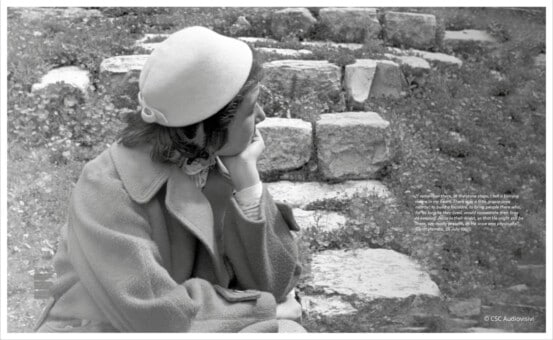
The “Chiara Lubich City World” exhibition has been inaugurated in the Holy City, the first of the exhibitions outside Italy to be opened. It includes a section dedicated to Chiara Lubich’s visit to the Holy Land in 1956. “I didn’t think Jerusalem and its Holy Sites would affect my soul like that (…) every stone said a word, much more than a word, so that, in the end, my soul was all bathed and entirely filled with the presence of Jesus” . Chiara Lubich’s diary expressed her profound experience during the only journey she made to Jerusalem and the Holy Land, in 1956. Several black and white photographs and a video journal recall that journey, but the greatest testimony is the active presence of the community of the Focolare Movement in this city, which on February 29th, 2020, inaugurated the “Chiara Lubich City World” exhibition housed in the Curia of the Custody of the Holy Land. The exhibition is open until March 14th, 2020. The exhibition reproduces the one currently open to the public at The Tunnels Gallery at Piedicastello in Trent (Italy), curated by the Chiara Lubich Centre in collaboration with the Trentino Historical Museum Foundation. It is the first of the international sections of the Chiara Lubich City World exhibition, which will also be held in Mexico City, Sydney, Mumbai, San Paolo, Algiers and Nairobi in the year dedicated to the centenary of Chiara Lubich’s birth. Jerusalem’s primacy is symbolic as the city-cradle of the three great monotheistic religions, and home to many peoples. The community of the Focolare Movement has been here since 1977 with the mandate to contribute to the fulfilment of the unity for which, in this very land, Jesus prayed to the Father. The Jerusalem exhibition reflects the original while being someone reduced and adapted. It conveys significant moments in the life of the founder of the Focolare Movement, her thought and work, through documents, handwritten texts and photographic material. But this edition has its own specific characteristics, available only to those who visit it here: a section dedicated to the relationship between the founder of the Focolare Movement and Jerusalem, as Claudio Maina, jointly responsible for the Focolare Movement in the Holy Land, explained. “We wanted to bring this exhibition to Jerusalem to make Chiara’s life, spirituality and work better known, but also to bear witness to her relationship with this city. Actually, Chiara only came to Jerusalem once, just for a few days. But from that visit a story began that continues today. Indeed, here in the Holy Land, there are people who have welcomed Chiara’s spirituality and are living it”. Part of the exhibition is dedicated to Chiara’s great dream for this city so deeply marked by divisions and historical wounds: to create a centre of spirituality, study, dialogue and formation to unity. “It’s a dream, an intuition that gradually took shape – said Terese Soudah – in the project for the International Centre for Unity and Peace, a project that we have been working on for years and that, despite many difficulties, is progressing and we hope to be able to conclude soon”. Dignitaries attending the inauguration included the Nuncio and Apostolic Delegate to Jerusalem, Archbishop Leopoldo Girelli, the representative of the Latin Patriarchate, Father Stéphane Milovitch, director of the Cultural Heritage Office of the Custody of the Holy Land, as well as Christian, Jewish and Muslim friends, who make up the Focolare family in the Holy Land. Due to the Coronavirus emergency, the Italian delegation was unable to attend, but sent video contributions. In this way, the President of the Autonomous Province of Trent, Maurizio Fugatti, wished every success to the exhibition; to bring to the world the message that Chiara Lubich gave to the Trentino Region and to Italy. The Custos of the Holy Land, Father Francesco Patton, expressed his hope that, through this exhibition, Chiara’s spirituality would remind this troubled land of the value of unity, the fruit of Jesus’ prayer, which is still so relevant today. In a video-message, Anna Maria Rossi and Giuliano Ruzzier, curators of the exhibition in Trent, along with Maurizio Gentilini, presented the exhibition itinerary: “We created a project that isn’t limited to the city of Trent, but, as happened in Chiara’s life, can reach the ends of the earth, encompassing all five continents”. At the ribbon-cutting ceremony, the Nuncio, Archbishop Girelli, recalled the extreme relevance of Chiara’s message: “Here in Jerusalem, we could invert the words of the exhibition’s title and call it: “Chiara Lubich World City”, because this exhibition has come from the world to the city par excellence, the Holy City, the city of unity, of fraternity, of dialogue among religions and among peoples”.
By Stefania Tanesini

On 5 February 2020, Juan Carlos Duque, a Colombian focolarino died in an accident in the Fiore Centre in Lima, Peru where he lived in the focolare. A few days earlier, in preparation for the priesthood, he had been ordained a deacon during a joyful community celebration. We bring you a letter of farewell written by Gustavo Clariá, who lived with him in the focolare. Dearest Juan Carlos, Just as I had done so many other times, I asked you to help me. Even though I had the password, I couldn’t get into my e mail account to answer some messages. It was lunch time but, as always, you took on my problem and solved it in your usual speedy way. Lunch was no different from any other day: we talked about some serious matters but there was also a lot of joking and laughter. Your laugh was unmistakable; you were happy when we were altogether. At the end of the meal, you were the first to stand up and collect the dishes. And then you left in a hurry to go to “your” Fiore Centre. You wanted to adjust the large water tank which had been unused for some time. I, on the other hand, went to rest. After a few minutes, my mobile rang. It was Pacho: “Juan Carlos has had a serious accident … he made a false move on the roof and fell down … he died instantly …”. I couldn’t believe what I was hearing. Everything in me was refusing to believe what my ears were hearing. I only managed to say, “My God”, “My God”, “My God”, “My God” … I don’t know how many times I repeated it and I continued to do so, in silence, while Mario and I ran to the nearby Fiore Centre. When we arrived, we couldn’t believe what we saw. That moment, 3.15 pm on 5th February, changed our lives. Nothing was as it had been before before and we had to accept reality. You know, I went to the chapel three times. I was confused and asking for some explanation, “Why has this happened?”, “We have given our lives to follow you – and you – whose side are you on…?” Silence. The third time you answered me, “You still have so much to lose.” I came out almost feeling humiliated because I realized that I was far away from where you, Juan Carlos, had arrived. We thought that you were preparing for the priesthood… in reality you were preparing for the most important meeting in life. As the hours went by and we continued to ask “help my unbelief,” that tragic fall that we had seen with our own limited vision, was gradually transformed, with the eyes of faith, into a masterful “flight” upwards. Yes, friend and brother, it wasn’t a fall, it was a Flight. You had already told us at your ordination to the diaconate on 25th January. You reminded us of Philip Neri, that wonderful saint from Tuscany who, when he was appointed monsignor, threw his hat in the air, exclaiming, “Paradise, Paradise.” He was not interested in the title, only the encounter with God … And that is where you are now, together with those who have gone before you. Goodbye, dear Juan Carlos till God wants us to gather again, altogether, never to be parted. We will miss your joy, your laughter, your cooking – arepas and salted chicken – your readiness to help and your concern for each one of us. We will miss your ability to solve problems and to “make life exciting”, your transparency and radicalness as a simple focolarino, a friend of Jesus. You remain a beacon of light that accompanies and guides us always.
Gustavo E. Clariá

Circulating the gifts embodied in different religious families is good for the health of the Church, a process favoured by the spirituality of unity of Chiara Lubich. A Church which ‘Goes Forth’, a ‘field hospital’. Pope Francis has used many different ways to express how he’d like to see the Church today. A church capable of warming the hearts of the faithful, healing their wounds and going out towards ‘existential peripheries’. To be able to respond well to the demands of today’s fragmented and wounded world, the Church must surely draw on all the talents and strengths it contains. This is particularly true in the case of its charisms, those ‘forces for renewal’ born in the Church throughout its history in response to precise circumstances and events, which then took permanent shape in a host of religious families. But how should they turn to each other, find ways of being together, of acting in a united way, when the Holy Spirit created them all distinct?! A convention entitled “Charisms in communion: the prophecy of Chiara Lubich”, 8-9 February at the Mariapolis Centre, Castel Gandolfo, near Rome, Italy, aimed to demonstrate some of the tools which Chiara Lubich’s charism of unity can offer to achieve this end. The 400 participants included members of religious orders, consecrated men and women, and Catholic laity, together with some members of the Orthodox Churches. Representing 100 different religious families and 33 countries, they engaged in dialogue and benefitted from the different perspectives which emerge when placing in communion their own identities, and in so doing, recognizing a more beautiful, gift-laden, attractive Church. According to Focolare President, Maria Voce, in her address, the title of the meeting “stimulates us to listen and live as reciprocal gifts, because by offering the richness of each specific charism, we experience authentic sharing (…) to give to the world a credible face of the Church”. Cardinal João Braz De Aviz, Prefect of the Congregation for Institutes of Consecrated Life and Societies of Apostolic Life affirmed, “when consecrated men and women come into contact with the Focolare Movement, they are helped and incentivized to value the originality of their own charism, to renew relationships of fraternity within their own Institutes, to appreciate and love other charisms as their own”. The two day meeting produced a dynamic environment for discovering how these treasures within the Church can become ever more beautiful and fruitful, in announcing the Gospel and in enhancing the credibility of the Church. The presence of around fifty lay members of various religious families made a significant contribution in this context. “The charisms are a source of joy and express the beauty of the Church,” explained Padre Fabio Ciardi, Oblate of Mary Immaculate and theologian of consecrated life. “They make you exclaim, ‘How beautiful this is!’” “When I was a novice, I heard Chiara encourage us to ‘love the other congregation as our own’,” recalled canon lawyer Sr Tiziana Merletti, of the Franciscan Sisters of the Poor. “And I understood that unity really is a fundamental value.” “We no longer talk about adapting the indispensable contribution of charismatic realities to the mission of the Church, but rather of circulating the gifts of all for the benefit of all (…) to discern the most suitable ways of serving the proclamation of the Gospel” asserted Piero Coda, President of Sophia University Institute, Loppiano. “We have to arrive at a radical conversion,” he added, “to reach the point of loving the other, their charism, their religious family, more than our own charism and religious family. Only in this way can the Church truly be charismatic and missionary!”
Lorenzo Russo
In a letter dated 1 February, Maria Voce, President of the Focolare Movement, convened the next General Assembly of the Focolare Movement which will begin on 31 August 2020. What is it? Who will take part in the Assembly? What must it do? What is happening in preparation? https://vimeo.com/389431349 The Act of Convocation in pdf format

Maria Voce was one of the speakers at the International Conference of pastoral care of the elderly, “The Richness of Many Years of Life” To cultivate dialogue between generations and establish a relationship of mutual love between youths and adults, we need to realize that the other person, in all his diversity, is a gift for me. And we also need to build fraternal relationships based on authentic listening, that puts aside stereotypes and prejudices and opens new pathways. This was the core of the message offered by Maria Voce, the Focolare president, when she was invited to be one of the speakers who addressed the first International Conference of pastoral care for the elderly. This conference, that took place at the Augustinianum in Rome from 29 to 31 January, was promoted by the Dicastery for Laity, Family and Life. In the presence of an audience of about 550 experts and pastoral workers from 60 countries, Maria Voce proposed a reflection on dialogue between generations. She said that in today’s current situation, one can notice that there is “an atmosphere of new understanding between generations” that reigns on a global level. She quoted the example of peaceful demonstrations that recently mobilized both young and old who joined forces to express their ideas and ask for a renewed commitment towards “common good, human rights, solidarity and peace”. The young people have been the promoters of a message of rebirth, while the more mature, driven by the enthusiasm of the younger ones, have chosen to share its challenges and commitment. When speaking about the outcome of this allegiance between generations, Maria Voce quoted Chiara Lubich, the Focolare founder. Lubich related: “I would not hesitate to define as Trinitarian the relationship we had with young people from the very start. In our generation of adults we perceived all the weight, the value of incarnation and concreteness, while in the young generation we saw ideality, authenticity, revolutionary power and certainty of victory. The first generation seemed to us to be like the Father, while in the second generation there seemed to be the beauty and splendour of the Son, the Word of the Father. And between the two there was a relationship of mutual love, almost a current of the Holy Spirit that gives a great witness to the world”. The Focolare President traced out various pathways that lead to this allegiance between generations. First of all, she underlined the need for deep listening, which means having “minds and hearts free from prejudices and stereotypes”. Then she spoke about the necessity of abandoning fixed concepts that depict the adult as boring and stuck to the past, and underestimate and judge the young person negatively. Finally, she highlighted the great importance of being open to new schemes to be able to overcome difficulties together. Maria Voce concluded by re-proposing the image of the Church offered by a young man during the Synod dedicated to them: “The Church is like a canoe, in which the elderly help to keep its course by interpreting the position of the stars and the youth row hard while imagining what awaits them further ahead”.
Claudia Di Lorenzi
The Focolare Movement recommends adopting scrupulously the precautionary and safety measures stipulated by the health authorities of each country Following the detection of cases of Coronavirus infection (COVID-19) also in Italy, the International Centre of the Focolare Movement, having its headquarters in Italy and being the organizer and venue of events attended by people from many countries, invites the great Focolare family around the world to handle this health emergency with the required caution and with a great sense of responsibility in view both of personal health and the common good. In particular, the Focolare Movement recommends adopting scrupulously the precautionary and safety measures stipulated by the health authorities of each country and carefully following the relevant communications. With regard to events organized at the International Centre, the Centre itself is in close contact with the local health and civil authorities to follow developments and take the necessary measures. The International Centre recommends doing the same with regard to large events in other countries. However, what remains valid is the invitation made by Maria Voce (Emmaus) on 1st February, to have – precisely as a worldwide Focolare family – an unconditional love for everyone, a love “that makes no differences between people, and is fearless. Because even a person who can give you the infection is still your brother or sister and you must take care of him or her”.

With a statement of March 1, the Organizing Committee of “The Economy of Francesco” has postponed the event to November. The Side Event, scheduled in Perugia for the end of March, will be postponed from 20 to 22 November. Why a parallel event? When dealing with “appointments with history”, the mission in question needs to be supported in some way! Behind the CVs of the young people who responded enthusiastically to the Pope’s invitation there are not only brilliant profiles, innovative research and projects, but also the clear aim to redesign theory and practice of the economic system, working to reverse world trends, together. And this represents a global challenge much too serious and important for us to remain mere passive spectators. Hence, the parallel meeting that will take place in Perugia from 20 to 20 November 2020 is an opportunity for all those who cannot participate directly in “The Economy of Francesco” (due to issues of age and logistics) but still wish to be part of this new process, closely following and supporting the work carried out by the under-35 gathered in Assisi. We will maintain the same structure scheduled for March, reprogramming the meeting, in support of the work of young people, from Friday, November 20 to Sunday, November 22, 2020 (from the night of Thursday, November 19 to lunch on Sunday, November 22): registrations are open again, to proceed in the best possible way with the organization of the work and continue on our path with the energy and responsibility placed so far. Promoted by the Economy of Communion, the Side Event is essentially a space open to anyone who believes in the need for a different economy: an inclusive place, functioning as a spokesperson for multiple realities. In the awareness that the current economy often fails, since it can work well for some, but clearly does not work at all for (many) others, while also threatening the social and environmental ecosystem, we will dialogue between young and old, between different cultures and backgrounds, experiencing the event through 3 generative dimensions: feeling-conceiving-acting. By alternating plenary moments with parallel / group sessions, we want to testify how important it is to let networks flourish, while learning from past failures and converting ideas into action. Under the guidance of a group of facilitators (similarly to what will happen in Assisi) and with the contribution of some important keynote speakers, which the young people in the Franciscan city will work simultaneously on 12 macro-themes, focusing on some contrasting key concepts, such as wealth / poverty and more. As in the case with Assisi, the wish is that these days spent in Perugia will serve to bring together visions, desires, skills and commitment: both on an individual as well as a collective scale. Yes, because, more than profit, the economy is really about vocation and if you believe in something alternative, you need to make your voice heard, empowering it, by putting it in relation to the ideas of others. In order for it to turn into actual collaboration, thereby creating a spirit of community. A community capable of creating real impact, by starting a necessary process: this is the aim of the Economy of Francesco in Assisi, and this is the cause that the event in Perugia aims to sustain. But in order to achieve this objective, it is not enough to merely make words like ethics and sustainability become fashionable, taking a real step of discontinuity, while breaking away from what is currently the dominant line of thought, will also be required. The Economy of Francesco will leave its mark thanks to its youthful nature, but it will be surrounded by a heterogeneous chorus of voices strengthening its opening of the passage, fertilizing this terrain of change together.
By Francesca Giglio
source www.edc-online.org Download flyer (1.06 MB) For further information: edcperugia2020@gmail.com For registration requests: https://www.umbriasi.it/pacchetto/side/