15 Jul 2020 | Non categorizzato
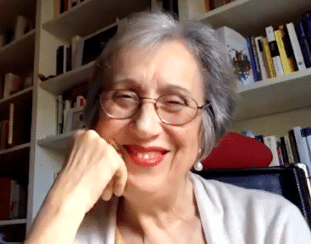
The Focolare Youth launched the #daretocare campaign, a new campaign which aims at care of our societies and our planet Earth and at active citizenship that contributes towards building a more united world. Elena Pulcini, professor of social philosophy at the University of Florence, Italy has been interviewed on this subject. Elena Pulcini, Professor of Social Philosophy at the University of Florence, who has dedicated many years of research on the subject of care, was one of the speakers during the first livestreaming #daretocare, organized by the Focolare youth on June 20th How has the experience of the pandemic, we are all going through, influence your vision on the subject of care? “To me it seems that care has emerged mainly as an aid”, Pulcini explained. “Think of all those involved in the medical and health services. This has given rise to positive elements; it has stimulated feelings such as gratitude, compassion, the feeling of our vulnerability, feelings that somehow we have neglected. All this is very positive because we really need it, and it is essential to arouse those which I call empathic emotions. At the same time, however, care has been restricted to its meaning of assistance, to what the English call “cure” and not “care”. Care must become a way of life”. We dream of a society where care is the backbone of local and global political systems. Is this utopia or is it feasible? “Care means responding to something. In this case it means responding to the awareness that others exist. The moment we realize that others exist and we are not closed in the shell of our individualism, the empathic abilities in us function; this means that we are able to identify and understand the emotions of others. But, today, who is the other? New forms are emerging about those we consider as others. Today, the one that is different is considered as the other, and so are future generations, nature, environment and the Earth we inhabit. If in our relationships we manage to care through our empathic abilities, then care can really become the complete answer to the great challenges of our time. I cannot say whether this is really feasible or not, but I think we can’t lose the utopian perspective. Responsibility is not enough, we need to cultivate hope as well”. What do you suggest that we do to behave in this manner and to lead our societies, starting from our institutions, to move towards care? “I believe that wherever we are we have to behave in a way that care does not remain confined to the private sphere (…). I have to live care in my family, in my teaching profession, when I meet a poor outcast in the street, when I go to the beach; I have to take care of everyone and everything. Care must become a way of life, that crushes our unlimited individualism which leads not only to the self-destruction of humanity, but also to the destruction of world life. Therefore, we must try to respond with care to the pathologies of our society, and this means that we have to educate for democracy. Alexis de Tocqueville, a 19th century philosopher I like, used to say: “we must educate for democracy”. This is a lesson we still need to learn, and I think it means that we have to cultivate our own empathic emotions so that we are stimulated to care with pleasure and gratification, and not with compulsion”.
The Focolare Youth
14 Jul 2020 | Non categorizzato
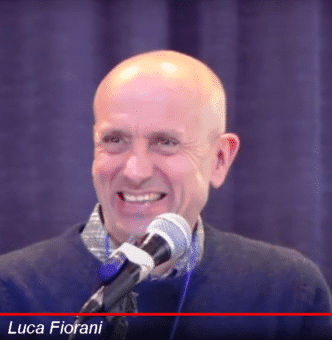
Five years have passed since the publication of Laudato Si’, Pope Francis’ encyclical on the care of the planet. Here we discuss it with Luca Fiorani, professor at the universities of Lumsa, Marconi and Sophia; ENEA researcher; and head of EcoOne, the Focolare Movement’s ecological network. In these times of pandemic, what lessons can come from Laudato Si’ and its paradigm of integral ecology? I am thinking of how “everything is connected”. The pope, before the pandemic, made us savour its positive side, the wonderful relationship that exists between elements of nature, including people. The pandemic, on the other hand, has brought out the dark side of “everything is connected”, because human activity, which led to the destruction of natural habitats, and the virus’s leap of species from animal to man are linked. What is the evangelical foundation of being committed to care for creation? It is “Love thy neighbour as thyself.” One of the key concepts of Laudate is, “Listen to both the cry of the earth and the cry of the poor”. It is true that for the Gospel, nature has value in itself, but it is also true that caring for nature means ensuring a healthy planet for the most disadvantaged and for our children. It means reminding us of the “lower billion” – those billion people who are victims of a “chronic pandemic” due to 17 neglected tropical diseases. Can the concept of integral ecology guide the future? This is the fundamental concept of all Pope Francis’ teaching, which invites us to overcome the current socioeconomic system. Today we still live with the paradigm of the industrial revolution, which considers natural resources unlimited. Yet resources are indeed limited, and therefore we need to find a different model of development that also takes into account the needs of peoples forgotten by so-called “evolved” societies. Laudate calls for a change of attitude. What does it mean to live the principles of integral ecology? Integral ecology concerns not only the environment but all aspects of human life: society, economy and politics. Therefore each of us must try to change our lives, starting, for example, with consumer choices. Then we can choose leaders who are sensitive to caring for nature and campaign to apply pressure to disinvest from fossil fuels in favour of renewable energy. In this special year of Laudato Si’ celebrations, how will the Focolare Movement participate? The movement participates in initiatives of the Catholic Church and in events promoted by the Global Catholic Climate Movement, to which it adheres. In addition, it is organising a “New ways towards integral ecology” conference, to be held at Castel Gandolfo (RM) from 23–25 October, details of which are available at ecoone.org. Your latest book is entitled Francesco’s crazy dream: a small (scientific) manual of integral ecology. Why do you speak of a crazy dream? Because it truly seems impossible to change the course of this planet towards a world where we all feel like brothers and sisters, and build more bridges than walls. But as Focolare’s founder Chiara Lubich said, “Only those who have great ideals make history!”
Claudia Di Lorenzi
13 Jul 2020 | Non categorizzato
Being in lockdown has often tested our love of neighbour. In fact, it is not easy to live shut up in a house and find ourselves always so close to one another. When this happens we push against each other’s limits and this calls for a “supplement of love” called “bearing with”. It is consoling to know that Chiara Lubich also encountered this type of difficulty in her community life. Some days ago I started reading a book called The Secret of Mother Teresa; Teresa of Calcutta of course. I opened it at the chapter that speaks of the “mystic of charity”. I read that chapter and others, immersing myself in those pages with great interest: everything to do with this future saint is of personal interest to me since, for years, she was a very dear friend of mine. I was suddenly struck by the extreme radicalness of her life, by her totally committed vocation, which was awesome, almost frightening. Above all, however, it urged me to imitate her in the particular, radical and total commitment that God asks of me. … Prompted by this conviction, I began to read our Statutes, sure that I would find there the measure and type of radicalness that the Lord is asking of me. I opened it and immediately, on the very first page, I received a small spiritual shock, like when you discover something in that very moment (although I have known it for almost sixty years!). It was the “norm of norms, the premise to every other rule” of my life, of our life: to generate – as Pope Paul VI put it – and maintain first and foremost … Jesus among us through mutual love. … I decided to live this norm first of all in my focolare and with those around me. We know that Jesus said: “Let anyone among you who is without sin be the first to throw a stone at her” (Jn 8:7). Not everything is perfect in our focolare either. There might be an unnecessary word said by me or by others; too long a silence, a rash judgement, a small attachment, a suffering not borne patiently, which undoubtedly makes Jesus among us feel uncomfortable, even if it doesn’t prevent his presence altogether. I understood that I had to be the first to make room for Him, to pave the way, smoothing things over, seasoning everything with the greatest charity, bearing with everything, both in the others and in myself. “Bearing with” is not a term we generally use, but the Apostle Paul advises us to do it (see 1 Cor 13:7). Certainly, to bear with everything requires not just an ordinary kind of love. It is a special love, the essence of love. I began doing this. And there were positive results! Other times, I would have immediately invited my companions to do the same, but not this time. I felt I had to be the first to do all my part, and it worked. Besides, it filled my heart with happiness maybe because, in this way, He came back into our midst and remained. Later on I will tell them, but I still felt the duty to carry on doing this as if I were alone. And my joy was immense when I thought of Jesus’ words: “I desire mercy, not sacrifice” (Mt 9:13). Mercy! This is the super-refined love that is asked of us and that is worth more than sacrifice, because the most beautiful sacrifice is this love that can bear with everything, that can forgive and forget when necessary. This is the radicalness and total commitment we are asked to live.
Chiara Lubich
(From a telephone conference call, Rocca di Papa, 20th February 2003)
11 Jul 2020 | Non categorizzato
Maria Voce, President of the Focolare Movement, says Chiara Lubich’s interreligious dialogue, “was a true prophecy that is now being fulfilled as a concrete response to the needs of humanity”. Co-President Jesús Morán explains how the ethics of care is at the basis of the new Pathway that will be launched on June 20, 2020 by the young people of the Focolare Movement. https://vimeo.com/429994085
10 Jul 2020 | Non categorizzato
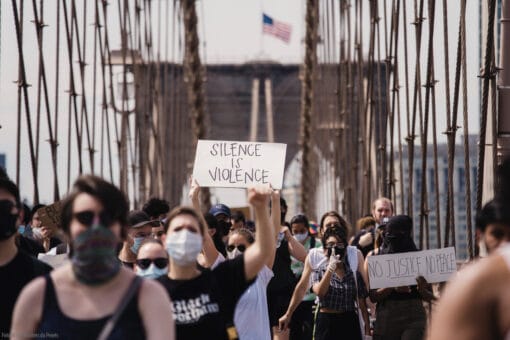
Can the two major crises currently rocking the United States – the pandemic and racism –lead to a better future? Susanne Janssen, editor of Living City Magazine, reflects. Racism is a virus that has never been eradicated in the United States. After the Civil War (1861-1865), slavery was legally abolished, but still today people of color and white people are not treated in the same way. The death of George Floyd has shone a light on this problem. The fact that those 8 atrocious minutes of George Floyd pleading for his life were captured on video means it could no longer be blamed on the victim. This video, together with the large number of people (not only Afro-Americans) who united to protest against racism, are a sign that this time something is different. Our hope is all that has happened will not end with a wave of protests but will lead to real change. The role of the Catholic Church After a few days’ silence, the Catholic Church positioned itself alongside the anti-racism protestors. The Cardinal of Boston, Seán O’Malley wrote that the killing of George Floyd “is painful evidence of what is and has been at stake for African Americans – the failure of society in too many ways to protect their lives and the lives of their children. The demonstrations and protests of these days have been calls for justice and heart wrenching expressions of deep emotional pain from which we cannot turn away”. The United States Conference of Catholic Bishops has described racism as the “original sin” of their country, persisting through the nation’s history, festering to this day. Reflection on the issue is now gaining ground in the Church and society. The first steps The slogan “defund the police” calls for something more than a simple restructuring of police departments. It demands a completely new start, to create a police force which is more accountable to its citizens. In recent years much has been said about the increasing militarization of the police; but to tell the truth, much of what they do, should actually be the role of social workers. What differentiates today from the violence suffered by Afro-Americans in the past, is the way many people are striving to learn from, listen and face up to the past, focusing on those structural issues which have lingered since the time of the abolition of slavery and segregation, such as the so-called “Jim Crow laws” and the 1964 Civil Rights Act. Yes, because the first step has to be facing up to those prejudices within everyone, and the social privileges generally afforded to white people. Authors Ibram X. Kendi and Robin DiAngelo declare that “being a good person” is not enough in this regard. The step required is to oppose the very structures of oppression, as even now, in a routine police check, the color of your skin can make the difference between life and death. The contribution of the Focolare Movement Firstly, Focolare communities are looking hard at themselves for traces of discrimination and racism. The Focolare’s thinking on racial justice is an essential starting point before entering in sincere dialogue with one another and with people around us. We create space to listen to the painful testimonies of racism endured, and also to the experience of those raised in predominantly white environments who are striving to engage in a process of recognizing their own limits. These are not easy conversations, but they are necessary in order to build relationships that are more real. “If we’re not careful, we risk reinforcing the principles of popular rhetoric on diversity which too often support the privileged and accentuate the differences,” affirms an academic of color. Another Focolare member now more than 80 years old, he too an academic, admits that throughout his life he has had to learn to become more open, particularly when one of his daughters married a Jamaican. “I was worried their children would suffer discrimination. But now I see they are a shining example for many”. The role of youth Young people are in the front line demanding a change of mentality. One young girl of mixed race said, “I want to help my brothers and sisters to be listened to more, otherwise I will regret it for the rest of my life…” The very “Black Lives Matter” slogan which united many people, drawing them out onto the streets in huge numbers, has itself been targeted to provoke polarization. It’s not rare to come across messages which strive to discredit those campaigning for more justice. However, there are also signs of a gradual change in public opinion. In fact, many have condemned President Donald Trump’s handling of the recent crises: the pandemic and structural racism. At time of writing, the Democratic Party candidate, Joe Biden, has a 13% lead in the polls, but it’s far too early to predict the situation come November when Americans go out to vote.
Susanne Janssen, Editor, Living City magazine
9 Jul 2020 | Non categorizzato
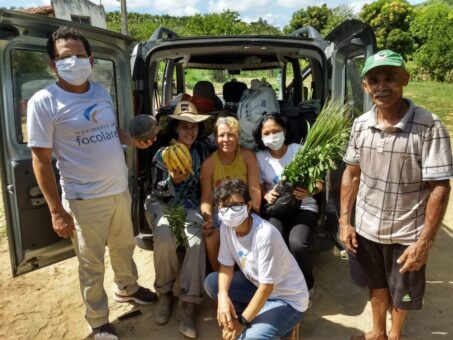
The Focolare social organizations serve more than 3,500 families and create networks of solidarity during the pandemic. Distributed throughout the country, the twenty-one social organizations inspired by the charism of the Focolare Movement are giving an important witness of solidarity and fraternity during this pandemic.
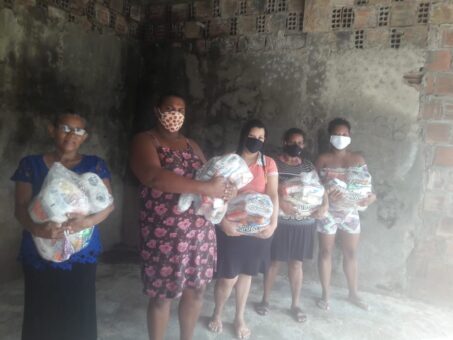
Foto: Obra Lumen
Foto: Instituto Mundo Unido
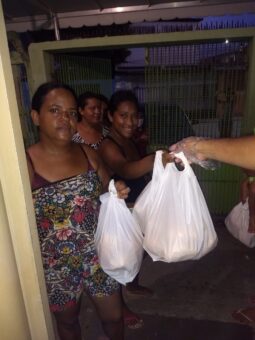
8 Jul 2020 | Non categorizzato
If, on the one hand, the government shows its inability to lead Brazilians towards overcoming the crisis, on the other, an impressive humanitarian network is being woven. An in-depth study by the editor-in-chief of Cidade Nova. When I started writing this article from March, when the disease arrived in the country, more than 51,000 people had already died in Brazil, victims of Covid-19. In addition, it has been estimated that over 1 million people have already been infected. This is without considering the cases not officially reported. In cities where circulation has recently been allowed once more, the number of new cases has increased significantly. Apart from the good news that most of these people have survived this further spread of coronanvirus, the number of deaths is appalling. For specialists this disastrous situation can be explained by the position of the Federal Government in the fight against the disease and also the lack of awareness of many Brazilian citizens about the seriousness of Covid-19.
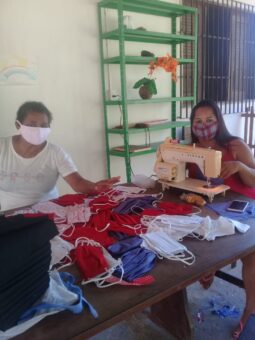
Foto: Magnificat
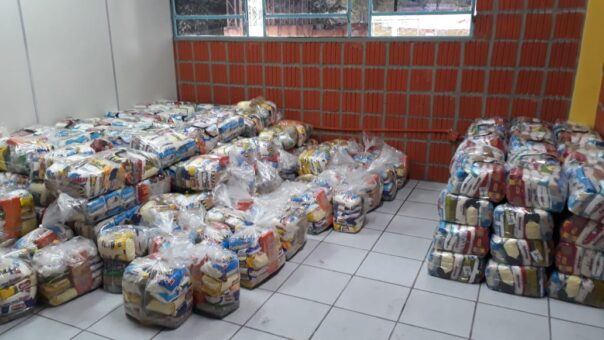
Foto: Centro Social Roger Cunha Rodrigues
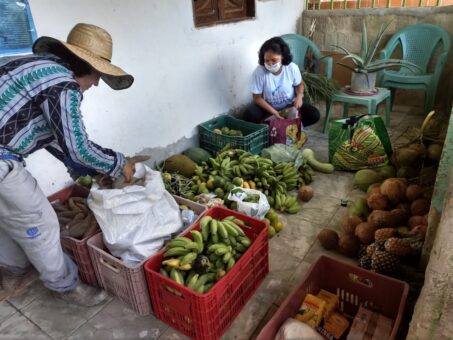
Foto: Instituto Mundo Unido
Foto: Associação de Atendimento a Criança e ao Adolescente
Luís Henrique Marques
Editor-in-chief of Cidade Nova magazine
7 Jul 2020 | Non categorizzato
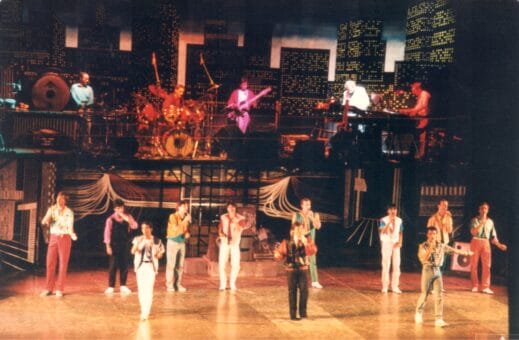
Getting back to the historical roots of this international performing arts group The coronavirus and the ensuing lockdown upended everyone’s routines and schedules. Even the international performing arts group Gen Rosso had to reinvent its days after having to stay locked indoors. 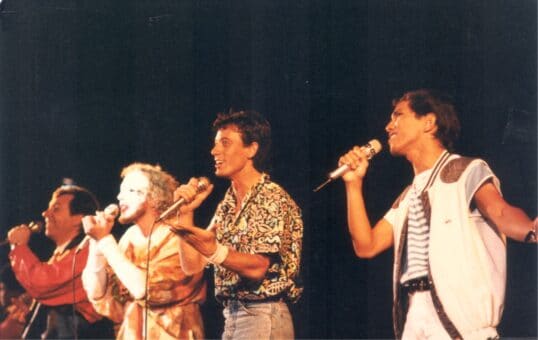 “This lockdown has given each of us the chance to go even deeper into those messages that we have been singing for more than 50 years,” says production manager Massimiliano Zanoni. “We’re used to traveling the world, meeting people and bringing music to stages on five continents, but we found ourselves locked inside the four walls of our house. Instead of cities, seas and mountains, we now had a computer and few windows to look out of. And instead of the thousands of people we met on each tour, we now had three, four people living with us. All 25 of us could not work, create and play together as we had done for 53 years. And so, after a first series of live streams called “Gen Rosso a casa tua,” in which they joined people virtually in their home, they thought they would get back to their roots with some historical live shows. The “Discovering Gen Rosso” project started to bring people back into the band’s home. “Many people don’t know that we don’t just do concerts,” Zanoni says, “but projects with schools too. There’s also the “Village,” which are weeks of living together with young artists to give them the experience of unity as they create artistically. “So just as when you invite someone to your house for the first time and, as a sign of welcome, show them around the house, Discovering Gen Rosso is a way to show some pages of our album of memories. This includes the musical Una Storia che Cambia or Streetlight, and helping them participate in our current projects, like the Village and Forti Senza Violenza, as well as revealing some small ideas for the future.” Discovering Gen Rosso is a new step towards that evolution that has allowed the international group to be builders of unity all over the world, over so many years of history. Here what’s next on the schedule, from the band’s YouTube page: On 16 July, there will be live streaming about the Village (artistic performance courses with Gen Rosso). On 28 July, they will launch their new single, “Shock of the World.” (It’s actually much more than a single, since there’s a whole new album in the pipeline that will be unveiled soon.) Finally, on 2 August the live stream series will conclude with their LIFE concert, the latest production by Gen Rosso, live from Loppiano in Italy.
Lorenzo Russo
6 Jul 2020 | Non categorizzato
Every day we hear statistics about the spread of the pandemic in the world and see coverage from the most affected countries. These give rise to feelings similar to those expressed in the following prayer by Chiara Lubich. Even our planet, which is suffering more and more, is calling out for and awaiting our active and determined love. Lord, give me all the lonely… I have felt in my heart the passion that fills your heart for all the forsakenness in which the whole world is drifting. I love every being that is sick and alone: even – plants in distress cause me pain… even animals left alone. Who consoles their weeping? Who mourns their slow death? And who clasps to their own the heart in despair? Grant me, my God, to be in this world the tangible sacrament of your Love, of your being Love: to be your arms that clasp to themselves and consume in love all the loneliness of the world.
Chiara Lubich
Written on 1st September 1949
3 Jul 2020 | Non categorizzato
“To achieve the goals of the fathers and mothers who founded a true covenant in which mutual trust becomes a common strength, we must do the right things together and with one big heart, not 27 little hearts”. Thus writes Ursula Von der Leyen, President of the European Commission, in a letter to the international NGO New Humanity and the Politics for Unity Movement. The leaders of the NGO New Humanity and its political section Politics for Unity Movement, civil and political components of the Focolare Movement, had in fact written to the President of the European Commission to encourage joint work in addressing the impact of the COVID-19 pandemic and to ensure the support of ideas and planning also during the preparation phase of the Conference on the Future of Europe. In her response, President Von der Leyen stressed how the EU has ensured the greatest response ever given to a crisis and emergency situation in the Union, with the mobilisation of €3.4 trillion (about €3400 billion). The President also said that “the current change in the geopolitical context offers Europe an opportunity to strengthen its unique role as a responsible global leader” whose success ” in this era of rapid disintegration and growing challenges will depend on adapting to the changing situation while remaining true to Europe’s values and interests”. In fact, the President underlines in her letter Europe “is the main provider of public development aid, with €5.2 billion in 2019. In its global response to the fight against the pandemic, the EU has also pledged financial support in excess of €15.6 billion to partner countries, to be used for external action. This includes €3.25 billion to Africa. The EU will also support Asia and the Pacific with €1.22 billion, €918 million to support Latin America and the Caribbean and €111 million to support countries overseas “. Furthermore, the President of the EU Commission continues, “the European Union and its partners have launched the Coronavirus Global Response, which so far has commitments of €9.8 billion from donors around the world, with the aim of further increasing funding for the development of research, diagnosis, treatment and vaccines against Coronavirus”. President Ursula Von der Leyen’s letter to New Humanity and Politics for Unity Movement concludes with an invitation to mutual trust between the countries of the European Union and to be one big heart.
Stefania Tanesini
3 Jul 2020 | Non categorizzato
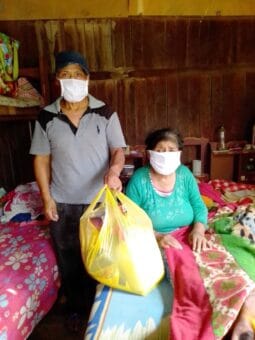
A first hand account from Ofelia, who herself emigrated from Venezuela to Peru with her family and now works with the Focolare community to help her fellow-Venezuelians who are suffering even more since the pandemic. As members of the Focolare Movement, we have been running a solidarity program supporting Venezuelans in Peru for some time. The pandemic has forced us to seek new strategies to reach them where they are staying. 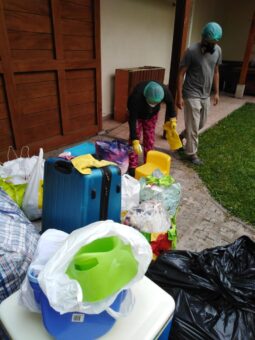 What we discover is that more than anything else, they need someone to listen to them. It’s not always easy because we’re not talking about one or two families, but many and the number is increasing every day. The monthly Word of Life always helps me because it encourages me to go out to my neighbours and recognize that I’m meeting Jesus in each one of them. One morning a Venezuelan mother called me in tears about her daughter who was due to give birth in the next few days but was being threatened with eviction. I listened to her for at least an hour until she began to calm down. Whenever I felt like saying something, I reflected, “The only thing I need to do here is to love her, and she needs to talk this through”. Eventually she said to me, “Good, I’ve really unburdened myself”. That was the point at which I could tell her where to find the help she needed. Initially, I thought that during quarantine, our work with the migrant community would slow down. But in fact it’s been exactly the opposite! For example, the work we carry ahead with CIREMI (The Inter-Religious Commission for Migrants and Refugees) keeps us very busy and has been a way to get to know each other better. The Commission members include some Scalabrini fathers, Christians from various Churches, the Jewish community, some Muslims, a Catholic reverend sister and a group from the Focolare Movement. As we were considering how best to reach the most vulnerable, we began to receive requests for clothing and blankets. Because of lockdown restrictions, we arranged for a taxi to transport the clothes we had collected from the local Focolare community to a place in Lima city where they could be collected. And some baby clothes arrived just in time for two families with new-born babies. We regularly work in collaboration with the United Nations Agency for Refugees and they provided us with a supply of blankets which meant we could meet the needs of even more people. It’s amazing to see how often we receive just what our people in need are asking us for. God doesn’t miss a thing! One day I received a phone call from Carolina, a Jewish Community leader. She told me some of their families were transferring to Israel, and so had clothes and other items they’d be leaving behind. She was so happy when she heard we were collecting such things to benefit the Venezuelan community that she herself paid the taxi expenses to transport them over to us. During this telephone conversation, we also asked about each other’s families, and it called to mind a phrase from the Word of Life: “It’s friendship – which can become a network of positive relationships and helps to bring the commandment of mutual love to life – that builds true fraternity”. The exchange with this my Jewish sister showed me the truth of this. It’s wonderful to see how contagious fraternity is. The people who received clothes and blankets from us, in turn sent us photos and one of them wrote, “My next door neighbour was in need of clothing, so I shared what you sent with her”. A chain of remembering the needs of others has been forged. In this way fraternity finds a way of growing – even during quarantine!
by Ofelia M. as told to Gustavo Clariá
1 Jul 2020 | Non categorizzato
A diagnosis that left no hope and a mother who courageously chose to say “no” to euthanasia. But how could she explain this decision to her daughter who was only two and a half years old? During the last days of her life, she wrote a letter that her daughter could read when she grew up. This mother is no longer with us but her family who found help in the spirituality of the Focolare Movement throughout this experience, has allowed the publication of her words. They offer them as testimony and food for thought on a complex, painful and very topical issue. My darling, I haven’t written in a while. A lot has happened recently and, unfortunately, the situation is not good at all. My health has deteriorated in just one month. I was waiting for some results but the pain worsened very quickly. I was hospitalized for three weeks and then I completely lost the use of my legs. It is very hard to write this letter to you. I want to talk about euthanasia and that is a difficult topic. I want to leave this for you for when you are grown up and maybe you’ll think about death and ask yourself questions about dying. Next week I’ll have one last chemo treatment even though it doesn’t seem to be helping now and maybe I will have an operation that should enable me to eat because I can’t do that anymore. If this surgery doesn’t work, there’s not much more to do. The options are how and where to die. In short, I have decided that I want to die at home. I won’t go into all the painful details, but it’s where I feel most comfortable. Dad will explain everything else when you’re older. I’ll keep to the point – I want to tell you why I have decided not to die through euthanasia. I have been thinking a lot but in the end I have decided that I will ask God to accompany me on this journey and, if it means facing death, then that is the way it is – there are no shortcuts and this is no time for cowardice. I am convinced that God teaches us something in that moment of passage and that we must face it just as we face the passage of birth. I am writing to you because I wonder if you will ever think about these things and since I have spent so much time analysing everything from different points of view, maybe one of my ideas could help you. Everything started with me thinking that if death is imminent, why should we wait so long for it? If there is no hope of recovery, why should we let human beings suffer and leave them to a game where there is no one to join in with them? I have learned that it’s because this is a process – a preparatory process – and without it we would not be able to take the next step and go where it will take us. We should let God guide us because he knows everything. Lately, I have been thinking about those people who have not been able to take this step in the right way. To me it seems as if they were lost in limbo, between our earthly existence and the afterlife, unable to move forward towards heaven or return to earth, to their loved ones. So I finally realized the road to euthanasia isn’t for me. I am afraid to die in pain and I pray to God to be merciful and forgiving when the time comes. Hopefully, he’ll take me away, freeing me from pain and from my body. And this is the part that concerns me, the part that I alone will have to face. This is where I find myself today my love: the path ahead is difficult. And yet, I have the support of so many people who help me and my family. I receive lots of spiritual help from a priest friend but there are still moments of fear and dismay – although, I must say, there are not as many as I thought there would be. I feel supported by a strength without knowing where it comes from. I see clearly that my days are ending – nonetheless, I don’t feel downhearted. It is not easy, obviously, but fear is not part of my day.”
Edited by Anna Lisa Innocenti
29 Jun 2020 | Non categorizzato
In recent months, many people, including influential ones, have pointed out that one of the effects of the pandemic is that we have all been confronted with what is essential, what is valuable and what remains. Many of us have lost relatives or friends and have experienced the nearness of death. The following writing by Chiara Lubich touches on these two topics so close to what we are experiencing in the world today. …The very beginning of the divine adventure of our Movement … is set in a specific circumstance: the war – the war with its bombs, its destruction and death. … I don’t think we will be able to live our Ideal with perfection and in an intense way unless we always bear in mind that atmosphere, that environment, those circumstances. Even today, after more than 40 years, the Lord doesn’t leave us short of opportunities. The frequent “departures” of members of our Movement … are a constant reminder that “everything passes”, that “everything crumbles” and this is the necessary backdrop to understand what really matters. We are greatly impressed by what these brothers and sisters of ours who are “about to depart” constantly say to us. Just as when it is dark, you can see the stars, so they, in their particular situations, could see further. Because of a special light, they perceived the absolute value of God, and they declared that he is Love. We too, if we want to make of our life a real Holy Journey, while we are on this earth, then like them we should have clear ideas: we should consider everything that is not God as transitory and fleeting. However, our faith and our Ideal don’t stop at the goal of death. The great proclamation of Christianity is “Christ is Risen” and our Ideal calls us always to go “beyond the wound” so as to live the Risen Lord. And so we are called to think above all of “afterwards” and it is about this “afterwards”, this mysterious but fascinating “afterwards”, that I would like to speak today. I find that I often ask myself, and maybe you do too, “Where are all the members of our Movement who have died? … These thoughts go through my mind because, here on earth, until recently I knew where they were and what they were doing. Now I don’t know anything about them. Certainly, faith gives the answers to these questions of ours and we know them. But there is one expression of Jesus that recently has given me light and comfort, great comfort. It is what Jesus said to the good thief: “Today you will be with me in Paradise.”[1] Today, straightaway, immediately after death. … So what should we draw out from these thoughts? Let’s try to live in such a way that the word “today” can be said to us too. “Today you will be with me in Paradise”. We are familiar with the words, “To those who have, more will be given”.[2] If here on earth, out of love for God, we are Paradise for our brothers and sisters; if we are joy, comfort, consolation, help for individuals, for our Movement, for the Church and for the world, the Lord will give us Paradise.
Chiara Lubich
(Taken from a telephone conference call, Rocca di Papa, 10th May 1990) [1] Cf. Lk 23:43 [2] Mt 13:12
27 Jun 2020 | Non categorizzato
All Christians, like the original disciples, have a mission. It’s to bear witness humbly, first with their lives and then with their words, to the love of God that they themselves have found. This way it can become a joyful reality for many, indeed for all. In a society often marked by the search for success and selfish autonomy, Christians are called to show the beauty of fraternity, which recognizes others’ needs and sets reciprocity in motion. The bill that was immediately approved I work as a surveyor for the city prefecture, and also participate in a human development project in a poor neighbourhood. Thinking about the precarious conditions of the people living there, I realized that when it came to widening a street or demolishing some buildings, the leftover material was often simply just used to level the ground. Why not use it to improve the homes of the poorest people? However, a special municipal law was needed. My manager liked the idea and, after visiting the location and realizing the need, made the necessary contacts on the spot. Once the city prefect accepted our proposal, a bill was presented and immediately approved. Thanks to this, the mayor is now authorized to donate materials that are being discarded for technical reasons to social welfare institutions. These materials are precious for those who live in the shacks, who have no possibility of improving their situations. A., Brazil Knowing how to forgive The civil war in my country caused grief and suffering in my family. My father and brother were among the victims of the guerrilla war. My husband was still suffering the consequences of a beating. As a Christian I should have been able to forgive, but only pain and resentment grew inside. It was only thanks to the witness I received from some genuine Christians that I was able to pray for those who had hurt us so much. When peace returned to the country, God put my integrity to the test when we moved back to my hometown from the capital. It had been at the mercy of the government and guerrillas for 12 years. The children had particularly suffered, so we organized a party that many people attended. I realised that among the authorities present there were some that had been involved with the guerrillas. Perhaps there were even those responsible for the death of my parents among them. Overcoming the initial rebellion inside me, I felt a great peace in my heart. I went to offer them a drink too. M., El Salvador The nuances of pain Back in Italy after an overseas experience as a doctor in Cameroon, I was drawn to people suffering from incurable illnesses and debilitating chronic diseases. Some deep convictions had emerged in me over the years. The first concerns the infinite nuances of pain, which is never monotonous. Every pain, like every person, is unique. Another strong impression I had was that the small daily moments of waiting were all part of the great expectation of the “final appointment”. But the most important thing I understood was: these patients, stripped by suffering, seemed to me like living building blocks in the construction of humanity and its values. Outwardly you see exhaustion, but also transparency; they are bearers of a particular light, the light of God. He seems to become incarnate in those disjointed existences. Often he seemed to dictate the final words of the dying. More and more I have become convinced that – as Simone Weil says – humanity, if it were deprived of such people, would have no idea of God. C., Italy
by Stefania Tanesini
(from Il Vangelo del Giorno, Città Nuova, year VI, n.3, May–June 2020)
26 Jun 2020 | Non categorizzato
It will be convened from January 24 to February 7, 2021. Due to the health emergency caused by Covid-19, the General Assembly of the Work of Mary (Focolare Movement), scheduled for September 2020, will now be convened from January 24 to February 7, 2021. This postponement has been approved by the Dicastery for the Laity, Family and Life. The ordinary General Assembly is convened every six years; it is extraordinarily convened when matters that require its deliberations arise (General Statutes Art. 73, 75). What happens during the General Assembly The General Assembly is entrusted with four main tasks (SG, Art. 74): 1) it elects the President, the Co-President and the general Councillors; 2) it deliberates amendments to the General Statutes of the Work of Mary, which are then submitted for the approval of the Dicastery for the Laity, Family and Life; 3) it deliberates amendments to the Regulations of the different Branches of the Movement and to the Regulations of the General Assembly itself; 4) it deliberates on topics gathered by the Centre of the Work of Mary; these topics will be presented in a well-structured manner on behalf of the President, the General Council, a section, a branch or a movement. Every member of the General Assembly may propose for discussion other issues that relate to the life of the Work of Mary. Chiara’s premise Chiara Lubich wrote a premise to the General Statutes to give meaning to all its contents and therefore also to the General Assembly: “The premise to every other rule – continual mutual love, which makes unity possible and generates the presence of Jesus among those gathered in His name, is for the members of the Work of Mary the basis of their life in all its aspects: it is the norm of norms, the premise to every other rule”. (SG, p.7).
Focolare Communication Office
25 Jun 2020 | Non categorizzato
Anna Moznich from AMU – Action for a United World explains the educational peace project, Living Peace International. https://vimeo.com/416354861
23 Jun 2020 | Non categorizzato
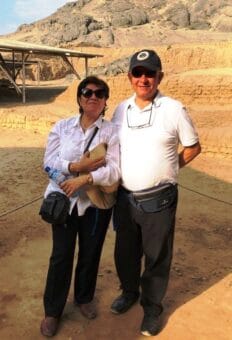
Jully and Ricardo, a couple from Peru, and their domestic: a story of sacrifices and challenges that soon turned into pure love through the hand of God. After our family experience at the Loreto School, which is an international school for families in Loppiano, the Focolare community in Italy, we returned to Peru aiming to live the Gospel ideal we had found there. We settled in Lambayeque, a small and quiet town in the northwest of the country. We hired Sara as a domestic. After a while she informed us that she was expecting, explaining that she had hidden her news after being fired from previous jobs for that very reason. Listening to her brought to mind something we had learned at the school for families: that in his forsakenness on the cross, Jesus took on every painful situation and redeemed it, turning pain into love. We could see that the situation presented us with a face of that forsakenness. We responded by consoling her and assured her that we would help with the birth of her child. Apart from the pregnancy, she also had other challenges, because the father of her child was a soldier in the army who had left her. She had fled her parents’ house out of fear as well. At the barracks we discovered the soldier had been transferred to a distant barracks in the Amazon jungle. There was no way to contact him. To allow her to give birth at the hospital, we asked social services for help so that she could have the prenatal check-ups and delivery. But she was desperate and thought she would give the baby away, feeling lonely and unable to raise her child. We helped her understand that her child was a gift from God, and that his providence would always help her. Together with our children, we helped her to reconcile with her father and reunite with her family, awaiting the arrival of her child with hope and preparing for the birth with medical check-ups. Sara stayed with us until her son was born. Then she was able to return home. Through this experience we saw the hand of God, guiding us to help a mother to not separate herself from her son, reconcile with her family and receive their support. Here in Lambayeque, she would visit us with the child so we could see how he grew up. We continue to help her with clothes and supplies. She and her father always expressed their gratitude to us and – which was the most beautiful thing – we saw her happy being a mother. We were left with an immense joy in our souls for loving this young woman as Jesus asks us, seeing how a painful situation turned into pure love.
Ricardo and July Rodríguez, Trujillo, Peru
22 Jun 2020 | Non categorizzato
The following writing by Chiara Lubich helps us to see our reality as it is, in God’s eyes, regardless of the external circumstances in which we find ourselves, which can also be very painful. During his passion, Jesus too was always “turned to the Father” and conformed to his will. With this attitude he became the Risen One, the Saviour. … We have understood that each one of us is a Word of God from all eternity. In fact, St. Paul says: “He chose us in Christ before the foundation of the world.” (Eph 1:4-5). And in another passage, still speaking of us, he adds: “For those whom he foreknew” (Rm 8:29). And we understood that because we are Word of God, we must adopt just one attitude, which is the most intelligent: just like the Word, the Second Person of the Trinity, we must always be “turned” towards the Father, which means towards His will. Moreover, this is how we can fulfil our personality and attain our total freedom. In fact, by living in this way, we allow our true self to live. Now, since we want to do all this, we should ask ourselves: when do we need to have this attitude? We know the answer: it is now, in the present moment. The will of God is to be lived in the present. It is in the present that we must live turned towards the Father, in that present moment which is an essential aspect of our spirituality and of our “asceticism”. We cannot disregard it. This way of living is pure gospel. In his gospel, St Matthew quotes these words of Jesus: “So do not worry about tomorrow, for tomorrow will bring worries of its own. Today’s trouble is enough for today” (Mt 6:34) … Let’s go back, then to our commitment to live God’s will in the present moment as much as possible. Let’s also remember that the will of God to be fulfilled before any other, and in every moment of our day, is that of mutual love, loving one another as Jesus loved us. This is what guarantees our constant renewal.
Chiara Lubich
Taken from a telephone conference call, Rocca di Papa, 21st December 1996
20 Jun 2020 | Non categorizzato
Chiara Lubich wrote “Jesus was the manifestation of the Heavenly Father’s fully welcoming love for each one of us and of the love that, consequently, we should have for one another. (…) The welcoming of the other, of the one different from us, is the basis of Christian love. It is the starting point, the first step in the construction of that civilization of love, of that culture of communion, to which Jesus calls us especially today”[1] . Research Worker I was working on a research project for which there was a deadline, when my neighbor knocked: she asked me to keep her sick husband company while she went shopping. I knew their situation and I couldn’t say no to her. He started talking to me about his past, about his years of teaching… While I was listening, from time to time I was distracted thinking of the work I had interrupted. Then I remembered the advice of a friend: being able to listen to a neighbour out of love is an art that demands emptiness. I tried to do this by being entirely present to the man. At a certain point he, in turn, took an interest in me in turn, asking me about my work. Knowing what I was dealing with, he suggested that I look in the library for a notebook in wihch he had taken notes at a conference on the very subject I was dealing with. I found it and we started discussing the subject. In short, I acquired new elements to see more clearly how to conclude my research. And to think that I was afraid of wasting time! (Z. I. – France) Prepare to live… When the doctor announced to me that there was nothing more to be done, it was as if every source of light switched off and I was left in the dark. On the way home, I took the road to the church. There I paused in silence, while my thoughts swirled in my head. Then, like a voice, a thought formed in my mind: “You must not prepare for death, but for life!”. From that moment on I tried to do everything well, to be kind to everyone, without being distracted by my pain but ready to welcome others. My days became filled with life. I don’t know how much time I have left, but the announcement of death was like waking from a sleep. And I’m living with unexpected serenity. (J.P. – Slovakia) The Transfusion I’m a nurse. I happened to know of a patient who was seriously ill. In order to try to save her, we needed blood of a certain group that had been unavailable for several days. I tried to find a donor among my friends and acquaintances and then I continued my research at work. There was nothing to do. I was about to give up when I decided to ask Jesus: “You know I’ve tried to do my part, but if you want, you can do anything.” After my shift , the doctor I was assisting had just left when a young woman arrived for a consultatio. I couldn’t let her leave, who knows how far she had travelled. I rushed to call the doctor, who unlike on other occasions was willing to return to the clinic. I started to write the prescription and, asked for an identification document. The lady handed me a card from the Association of Volunteer Blood Donors. With bated breath, I asked myself: what if she has that blood type? What if she’s willing to donate blood? She agreed, and a few hours later, the woman was at the patient’s bedside for a direct transfusion. (A. – Italy)
by Stefania Tanesini
(taken from Il Vangelo del Giorno, Citta Nuova, year VI, n.3, May-June 2020) [1] cf C . Lubich , Word of Life December 1992
19 Jun 2020 | Non categorizzato
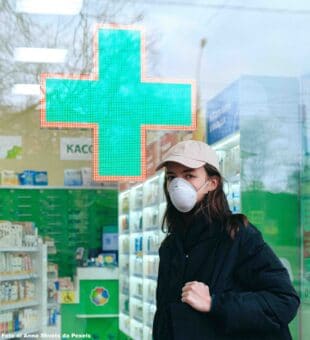
We continue to share stories of solidarity from Focolare communities in countries that are still facing the battle against covid-19. While in some countries we have “almost” returned to normality, in others the level of the pandemic is still high. Nonetheless, stories of fraternity continue to arrive from Focolare communities around the world. Brazil is currently the country most severely affected by covid. The Focolare community has continuously shown concern for the people in the greatest difficulty and has collaborated with other organisations in offering help. The various communities scattered throughout the country have also tried to assess who was suffering amongst their own members. They made a quick census and calculated that needs can be met for 2-3 months through a “communion of goods” and some extra economic support. Economy of Communion entrepreneurs have also begun a fundraising campaign to help some of the most disadvantaged communities. From the United States Matteo reports: “When covid-19 began its terrible and rapid diffusion here, we, the staff of Living City magazine and New City Press, asked ourselves what we could do, besides following all the guidelines of the civil authorities? How could we help people to overcome the crisis? It was immediately clear that “social distancing” should not prevent us and others from loving. So we created a series of videos, webinars and interviews with the hashtag #DareToCare, to inspire and encourage everyone to get in touch during these challenging weeks. We asked people to share in a 1-2 minute video how they “dare to care”. One woman said that while she was shopping she saw people panicking. So, instead of buying two large packages of chicken that had just arrived at the supermarket, she only took one to leave some for other customers. One pharmacist decided to stay open to serve his customers, but he had no protective equipment. ‘When the crisis started, we had almost no masks and gloves,’ he said. He shared his concerns with his customers and they brought him masks themselves and so saved him money. Another family of five people recorded their new daily routine: they work and follow lessons online from home, the daughter trains to keep fit for next year’s track and field events, and everyone is trying new recipes to share with one another. And the videos keep coming!” Ulrike, a psychiatrist, says, “I work in a clinic in Augsburg, Germany. At the moment, my job entails responding to phone calls from the public. When one lady called, I realised that it was going to be very difficult to respond to her requests and I needed to make a special effort. Eventually, I was able to give her the important information that she wanted.. An e-mail arrived in the afternoon: ‘Dear Doctor, my husband and I would like to express our heartfelt thanks for your extraordinary efforts. If everyone was as helpful as you during these difficult times, there would be fewer problems.’” From Buenos Aires, Argentina, Carlos tells us, ” Following the death of a homeless person from the cold, in July 2019 the Bel El Jewish community began a campaign to help the poor: the campaign was entitled ‘Don’t be cold in front of the cold.’ Our Christian friends, especially from the Focolare Movement, have come to help us distribute food to the homeless people. We are not talking about “dialogue” here – it’s a matter of sharing our lives. Then the coronavirus meant that homeless people could no longer live on the streets, so what were they meant to do? This was the beginning of the project ‘Another meal for hungry people in lockdown.’ Once again, Jews and Christians together, the Bet El Community and the Focolare Movement have embarked on the sacred task of loving our neighbours and not neglecting them.” The head of a junior school in Montevideo, Uruguay, tells us, “State funding enables us to provide free school meals for children from 48 different families who attend our school. Feeding these children became a big problem when classes were suspended due to covid. I started to pray and have more faith in God. Then, thanks to a foundation and some friends from Inda (National Institute for Food), resources arrived and we are able to distribute food baskets that will last for at least a month.”
Lorenzo Russo

18 Jun 2020 | Non categorizzato
Gen Verd’s new music video dedicated to Chiara Lubich Saying thank you to someone is a simple yet profound gesture. That’s the reason behind Gen Verde’s new video of the song entitled “Che siano uno” (May they be one). In this centenary year of her birth, the song is dedicated to Chiara Lubich and her ideal: universal fraternity. “With this video – says Adriana from Mexico – we don’t want to just celebrate Chiara Lubich by simply flipping through a family photo album and remembering the stories behind them. Instead we want this to be a living encounter with her today for many people, a chance to get to know her ideal which has permeated various aspects of life in civil, religious and political spheres. We want to dedicate the song to her because she is the one who gave life to Gen Verde, guided us in our first steps, and gave us the band’s first instruments from which it all began. Many of us have been fascinated by her words, actions and most of all by her life. Today we feel that we need to be authentic and credible witnesses of her message.” This powerful ideal, born during the destruction of the Second World War, is still very much relevant today when we see waves of racism and discrimination on TV and social media. While the emergency of Covid-19 has been handled with apparent success in some countries, it is also true that in some it has also widened the gap between the rich and the poor, between people of different races, between those who can afford necessary medical care and those who have nowhere to bury the bodies of their loved ones. “We are convinced – says Beatrice from Korea – that universal fraternity is possible and is not a utopia; this is what we experience everyday, and we try to translate those experiences into music. Often it is about doing simple acts that tear down cultural barriers and prejudices.” Since 1943, the year in which the Focolare Movement was founded, this is what Chiara Lubich did. Step by step with great tenacity, together with her friends she built new and profound relationships that became revolutionary, first in her city (Trent, Italy) and all over the world. Gen Verde’s music video captures some important images of historical moments: Chiara together with Jewish, Sikh, Hindu and Muslim people, or between the leaders of two different tribes in Cameroon. “Surely the best way to say thank you to Chiara – explains Nancy from the United States – is to live for her ideal; but with this video we also want to express our immense gratitude to her. She’s the one who formed us. Without her Gen Verde simply wouldn’t exist.” To see the video, click here! https://youtu.be/A3xuaqtkOj8
Tiziana Nicastro
16 Jun 2020 | Non categorizzato
Maria Voce is also among the signatories to the appeal promoted by the Community of Sant’Egidio to re-humanize our societies. An invitation to spread it and to sign it in order to draw attention to the serious condition of the elderly following the “massacres” carried out by the pandemic. No to selective health care, no to a “culture of abandonment”, no to any expropriation of individual rights; yes, instead, to equal treatment and the universal right to care. “The value of life remains the same for all. Whoever deprecates the fragile weakness of the elderly, prepares to devalue all lives”. The international appeal “Without the elderly, there is no future, to ‘re-humanize’ our societies – Against ‘selective health care'” supports a culture of life without exception and it was on June 15th , on the occasion of the World Elder Abuse Awareness Day , which Sant’Egidio celebrated in all the countries where it is present. Among the many high profile endorsements is that of the American economist Jeffrey Sachs, the Italian-British writer Simonetta Agnello Hornby, the German philosopher Jurgen Habermas, the Spanish sociologist Manuel Castells and then Stefania Giannini, UNESCO’s Deputy Director General, as well as the founder of the Community of Sant’Egidio, Andrea Riccardi, who is also the first signatory. The president of the Focolare Movement also joined in and signed, inviting the communities of the movement worldwide to do the same, to draw attention, especially in Europe, to the condition of the elderly. “I share what the appeal denounces, namely the emergence, in the face of the dramatic health conditions that Covid-19 has brought to light, of a dangerous model that promotes selective health care that would in fact justify choosing to care for the young, sacrificing the elderly. A society without the elderly cannot be said to be such; a society that cannot benefit from the indispensable intergenerational relationship is a poor, monotonous society, incapable of planning and achieving a better future for all, of being inclusive, because it is the result of the diversity that one encounters”. In a note circulated by the Community of Sant’Egidio we read: “The appeal stems from the bitter observation of the very high number of victims of Covid-19 among the elderly population, in particular among people in institutions and nursing homes, and it proposes a radical change of mentality that leads to new social and health initiatives”. A WHO report noted, as early as 2018, that precisely “in institutions abuse rates are much higher than in community settings” including various maltreatments including “physical restrictions, deprivation of dignity, imposition of daily chores, intentional provision of insufficient care, neglect and emotional abuse”. The situation worsened during the Covid-19 pandemic resulting, as is known, in a very high death rate in institutions, about twice as high as among the elderly living at home, according to data held by the Higher Institute of Health. For this reason, on the World Elder Abuse Awareness Day , the Focolare Movement joined the Community of Sant’Egidio in supporting the international appeal and the promotion of a “moral revolt to change direction in the care of the elderly”, proposing to the state and local administrations the implementation of a system that privileges home care and assistance for the elderly population.
Stefania Tanesini
Sign the appeal here
16 Jun 2020 | Non categorizzato
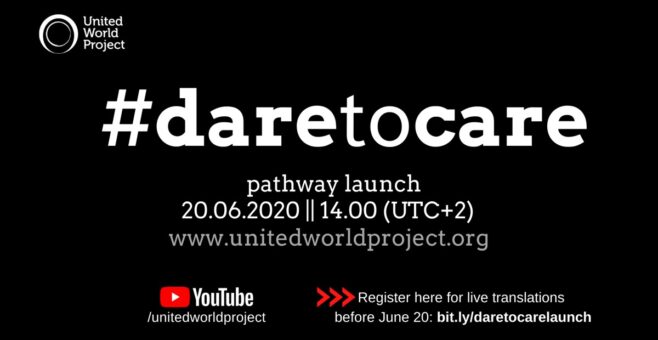
This week on 20th June the young people of the Focolare are launching #daretocare via YouTube livestreaming – their new campaign to “take responsibility” for our society and the planet. Jesús Morán, co-president of the Focolare Movement commented as follows: “We need a new ethical agenda; care has a strong political vocation and a strong planetary dimension. “#daretocare“. The young people of the Focolare Movement have taken seriously the words of Pope Francis and many other religious and civic leaders to find concrete ways of working together to care for our Common House. Through this new pathway they want to be active citizens, taking an interest in everything that is happening in the world to try and build a little bit of united world. As Jesús Morán, co-president of the Focolare Movement explained: “In this time of deep humanitarian crisis due to the Coronavirus, a new vision is emerging which is the need for a new way of behaving and living, a new kind of ethical agenda, as some experts call it. And one category which is proving central to this context is caring, taking responsibility and taking care of others, society and the planet”. Daring to take care therefore means being protagonists in everyday life to solve problems, initiating dialogue for a better society and being attentive to the environment and to all people whatever their colour, religion or culture. Especially today where racism is re-emerging, where human freedom is once again being undermined by totalitarian regimes, where weapons and wars are trying to impose their dominion on peace and unity among peoples. “Care is a vast, beautiful and multifaceted category,” Morán continues. The ethics of care has to do with the dignity of the person. This is fundamental. It is at the very heart of caring; it is not an intimate, private thing. On the contrary, care has a distinctly political vocation and a strong planetary dimension, whilst not forgetting the local dimension because it is at a local level that we take care of others, in personal relationships, in society and in the local environment. Neverthless, the planetary dimension is important.” Pope Francis spoke about this on 24 May on the fifth anniversary of Laudato si’, calling for a special year of reflection – ending on 24 May 2021 – to bring the theme of caring for creation to everyone’s attention. And by creation we mean not only the environment that surrounds us but also the people, the economy, politics, the social aspect, etc. Chiara Lubich, the founder of the Focolare Movement, defined politics as “the love of all loves”. A politician is someone who is at the service of their people, and Morán concludes, “today more than ever there is a need for this kind of love, and the category of care expresses it well. It is precisely a concentration of this love we are talking about. So the proposal of the young people of the Focolare Movement is this: to put care at the centre of politics and of our lives as citizens”. So, after a year dedicated to actions and projects on peace, human rights and legality, the young people of the Focolare will add another tile to the mosaic on 20 June with the #daretocare campaign, that of “care”, developed and refined around five main themes: listening, dialogue and communication, equality, fraternity and the common good, participation and care for the planet. And will this be done? By following the typical “pathways” methodology, the paths they have been following for three years: learn, act and share. So: let’s take courage and dare. Make an appointment for 20 June at 2pm (GMT + 2) with a worldwide online event on Youtube channel to launch this great idea #daretocare. For more information, visit the United World Project website.
Lorenzo Russo
15 Jun 2020 | Non categorizzato
One of the things that the pandemic has drawn to our attention is the importance of the bonds that form the social fabric in which each of us is located, the quality of the relationships that unite us with one another. They are an antidote to loneliness, poverty and discouragement. The following writing by Chiara Lubich is an invitation to strengthen these bonds. There is a page of the gospel which resonates with us in a special way. Jesus says, “If you keep my commandments, you will abide in my love. … This is my commandment, that you love one another as I have loved you”. (Jn 15:10 and 12). Therefore, everything depends on mutual love. … Just as you have to poke the fire in a fireplace occasionally so that it doesn’t get smothered in ashes, so too, in the great brazier of our Movement, it is necessary from time to time to deliberately revive mutual love among us, to revive our relationships, lest they become smothered with the ashes of indifference, apathy and selfishness. In this way we will truly love God and be the living Ideal. We will be able to hope that charity lived like this will generate solid virtues in us which, almost without noticing it and with God’s grace, will reach the point of heroism. In that way we will become saints.
Chiara Lubich
Taken from a telephone conference call, Rocca di Papa, Rome, 26th May 1988
13 Jun 2020 | Non categorizzato
An independent film producer, a citizen of the world, a fan of cinema, television and universal fraternity. In the middle of the night in Italy, 11 am in Melbourne, we greeted Mark Ruse for the very last time via streaming. Mark was an Australian film producer who died after a very short illness at the age of 64. Mark was not only a highly respected and greatly loved independent producer on the Australian film and television circuit, but he was a citizen of the world who, through his work, but above all through his humanity and simplicity, had built authentic and deep ties with many people outside the film industry. Mark Ruse began his career as an independent producer and went on to found Ruby Entertainment with his partner, Stephen Luby. Over the last 20 years, they produced many films and TV series: their comedies received awards, recognitions and ratings that were among the highest in Australia. He also produced films and documentaries about social engagement, sometimes linked to the tragic history of his country: Hoddle Street about the 1987 Melbourne massacre earned him a major international award. Nonetheless, above all, Mark was a simple and kind person, passionate about his work, who faced difficulties – which for an independent producer are many – with a lightness of touch and a good dose of humour. We had met more than 40 years ago in Italy. We were among the many young people from different countries in Europe and from around the world, gathered together in a small town on one of the hills near Rome. It was the 70’s and we had come to hear what Chiara Lubich was proposing to the Gen, the young people of the Focolare Movement. It was an ideal that was revolutionary in many ways: at heart, it was strongly spiritual and personal, but at the same time, community and global aspects were not lacking. Our youthful dreams and passions (cinema and television) eventually became our work – I became a TV director and Mark a producer – and our desire to create a “space” where we could share the ideas and beliefs that we had in common was fulfilled. At the beginning of this millennium, we worked together in establishing NetOne, a large worldwide network of professionals in various fields of media and communication: directors, producers, screenwriters and journalists. Today as then, NetOne want to contribute to creating new and different ways of working, not only as regards the relationships among people involved in production but also in respect of the public, the final recipient of our work. Mark worked tirelessly in establishing this network. Every time we saw each other in Rome or Melbourne or somewhere else in the world, the conversation picked up exactly where we had left off, even after a gap of months or years. This continued till he sent a message a few months ago confiding in me about his illness: “I am beginning a journey I know, but I want to share it with you and everyone in NetOne. I have welcomed and embraced this new phase of life with love.” He left us within a few months, even though during our last Zoom call, a few days before his death, he was cheerful and full of plans for the future. Mark used to say, “The idea of wanting to love our neighbours is at the basis of my faith. Whatever we do should improve society in some way, people should be enriched by watching our films: that is another way of bringing love into our society.” Australian cinema has lost a good producer, we in NetOne network have lost a friend, a travelling companion who left us with his smile… “We’re crazy, we’re crazy people, but we need to feel part of a family”. That’s right, Mark, that’s right.
Marco Aleotti
Courtesy of Cittanuova.it
12 Jun 2020 | Non categorizzato
Maria Voce, President of the Focolare Movement, at the “Elijah Interfaith Institute” in Jerusalem “Everything that happens in life is directed by an Author of history who is God, and God wants the good of people […] So even if sometimes it seems the freedom of human beings leads to negative consequences, God is capable […] of bringing good even out of these negative situations”. According to Maria Voce, President of the Focolare Movement, this is the greatest lesson that the Covid-19 crisis can offer. In an interview with Rabbi Alon Goshen-Gottstein, director of the “Elijah Interfaith Institute” in Jerusalem, the President of the Focolare Movement also speaks of the possible benefits that the pandemic can bring to the world. The interview is part of the Coronaspection project, a series of video interviews with religious leaders worldwide, sharing wisdom and spiritual advice as we jointly face a global crisis (here you can see the project’s trailer, which summarizes the spirit of the project). “There are values that are more evident than others at the moment – says Maria Voce -, such as solidarity, equality among all, concern for the environment. The world will come out better from this crisis if we know how to overcome the divisions linked to prejudice, to culture, to see everyone as brothers and sisters belonging to the one family of God’s children. This certainty is based on a profound trust in the human person: ” there is always a spark of good in every person and you can count on it”; a person responds “because ( good) is inherent in him/her”. It is an inner conviction that stirs hope: “God is Love and loves all creatures”. She continues ” In fact, it is enough to look around to see examples of solidarity. The efforts of doctors and nurses who try to awaken trust, a smile, and their pain for the people they failed to save, have had the effect of “edifying” the patients who recovered. In our Movement many people were able to make themselves available for their neighbors, to bring them what they needed; many children offered toys to others that were a comfort to them”. At the level of international relations – observes Maria Voce – “we see examples of solidarity in those doctors and nurses who have come to Italy from other countries to help. […] Even at the level of economic thinking, we are trying to do everything so that countries do not think only of defending their own goods but of integrating their own vision with that of other countries”. Nevertheless all this does not hide the challenges that the crisis brings. Alongside the personal ones she says there are those that come from leading an international movement: “making decisions that involve difficulties both on a personal and economic level. I felt I had to call my direct collaborators, so that decisions could be shared, so that people’s interest would prevail over all other interests”. She observed “Even fear should not be ignored, but accepted in order to overcome it: I would say that we should learn to live with fear and at the same time not to let it stop us – following Chiara Lubich’s example – “to remain anchored in the present. She concluded, quoting the founder of the Focolare Movement, ” Only lovedrives away fear, and there is no fear where there is perfect love. So increasing love diminishes fear because love helps you to carry out actions that fear, instead, would try to condition “. To watch the full interview click here
Claudia Di Lorenzi
11 Jun 2020 | Non categorizzato
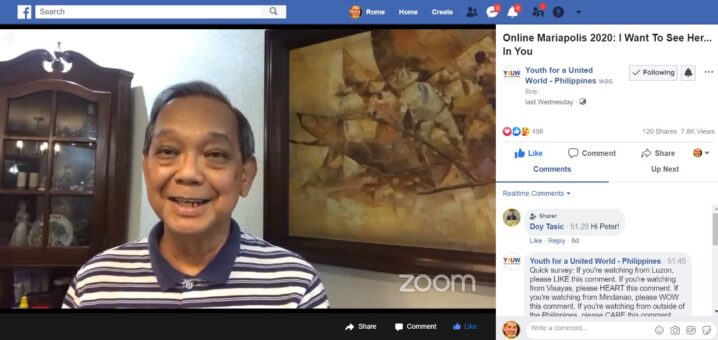
“Necessity is the mother of invention.” Following this slogan, the Focolare community of the metropolitan area of Manila, Philippines, organized the very first Online Mariapolis on May 14 and 15. 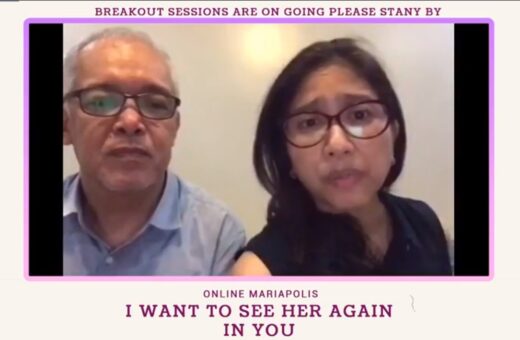 “We were on the verge of separation. With just the two of us together once the lockdown began, we felt we had to confront our issues, set aside our differences and start again. Thank you for all your love.” This was just one among many of the feedback we got from those who registered and participated via Zoom for the first ever Online Mariapolis held on May 14 and 15, 2020 in the Philippines. The unexpected Enhanced Community Quarantine due to Covid-19 pushed us to look for means to connect our people and sustain them through the spirituality of unity. The whole idea was an offshoot of the online Mass that we began live streaming privately to a small group of focolare members. Soon after, it became a daily appointment, with our Facebook group for the Mass reaching the homes of around two thousand people. We felt that if God hindered the possibility to carry on our big plans to “celebrate and meet” Chiara on her centenary, He opened this way, to do the same, in small bursts! From the outpouring of our Mass attendees through comments on Facebook Live, it was crystal clear that even for 30 minutes on a virtual platform, people are able to make an experience of God! In the meantime, we had our first experiences with Zoom, for example during the United World Week and the Run4Unity. We felt we had to go for the Online Mariapolis, in order to be with and beside our people, in this very difficult moment. We were against very big odds: the “Mariapolites” would be with all the distractions at home, and would most probably be multitasking – there would be children to look after, meals to cook, chores to finish, etc. Another major challenge would be the disparities in internet connectivity and service in a developing country like ours. Because of this, our Mariapolis were held for 2 days only, and just for 2 hours each time. We also considered to call it another name, not Mariapolis, so as to manage the expectations of people. But in the end, we all wanted it to be Mariapolis – just like every other Mariapolis we have had. And we wanted it not as a webinar, but a Mariapolis, a City of Mary, because we felt that we needed Mary now and that we have to be Mary, as Chiara taught us, to bring Jesus-in-our-midst, to our people, so that this experience may help give light to their experience of the pandemic. Registered Mariapolites reached about 950, not only from the Philippines, but also from other Asian countries, from Latin America, Canada, the United States and some even from Europe. The program, which was made available via live streaming for an unlimited number of participants, was composed of songs, Gospel-based experiences related to the current pandemic situation, spiritual inputs and an hour of in-depth communion during the breakout groups. One participant meaningfully expressed what this Mariapolis was: “For me it was really a very concrete sign of Mary’s love for all of us! As our mother, she really knows our personal and shared needs. Through the well-chosen theme, talks, experiences, and songs, she nourished us with the right food and vitamins both for the body and the soul.”
Romé Vital
9 Jun 2020 | Non categorizzato
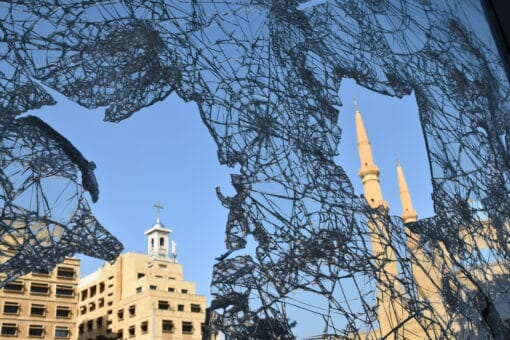
The land of cedar trees, discusses ways that may help the country emerge from the serious political-economic crisis that hit it recently. Hope never dies in a country that has passed through so much hardship. During the recent United World Week, the Lebanese Focolare community opted to discuss, with both youths and adults, the difficult way foward in a country gripped by tensions and facing several crises. The political-social crisis has been going on since last October 17, when the “thawra” movement in Lebanon started protesting against a government accused of corruption and bad administration. The economic crisis exploded last March, when the government declared it could not repay its1.2 billion dollar debt to the European Union. In recent weeks there was also the collapse of the Lebanese pound, set at 1500 pounds to one dollar up to a few weeks ago and now trading for more than 4000. Lebanon is also facing a health crisis due to the coronavirus. The spread of the virus has not been excessive (less than a thousand people have been infected and there were less than 30 deaths) but the extended lockdown measures also hit the country. Owing to lack of prospects, this situation seems to be encouraging people, especially young ones, to go back to an old tradition, namely expatriation. It is good to know that for every 4 Lebanese living in the Middle East, there are about 12 others living in other different parts of the world. This is happening also in other neighbouring countries, especially with Jews, Palestinians and Armenians. Emigration is particularly painful for the Lebanese, who believe (and it is true) that they have an amazing country, rich in history and natural beauty, a Middle Eastern crossroads for every kind of traffic and commerce, home of Nobel Prize winners and great merchants, filmmakers and writers, saints and scientists. One needs to highlight the fact that the diaspora is very painful for the Lebanese, especially when one considers their strong family ties. In this context, the local Focolare Movement organized a Webinar with the specific title “Building a future by living for fraternity”. About 300 people from different countries, from Canada to Australia, to Spain and Italy, participated. The two lawyers, Mona Farah and Myriam Mehannan spoke about one of the most serious threats that Lebanon is facing, namely the dangerous lack of certainty about the rule of law. Yet, Lebanon has a remarkable capacity to find the best solutions in complex situations and boasts of a very ancient legal tradition. Therefore one can understand the young people’s desire to leave the country and at the same time the will of many who want to remain to build a more united and fraternal Lebanon, where 18 confessional communities are united by a political system of “confessional democracy” unique in the world. Then came the testimonies of two young couples, who decided to return to Lebanon twelve years ago, after working abroad for some time. They came back to contribute towards rebuilding their country after the so-called civil war. Imad and Clara Moukarzel,who work in the social and humanitarian field and Fady and Cynthia Tohme, who are both doctors, testified that it is possible to stay or return to Lebanon not to leave such a rich country in the hands of the most reactionary forces. Tony Ward, an entrepreneur in the field of high fashion, recounted his decision to return home twenty years ago, even though he was working in an established world fashion environment. He also spoke about his production change during the coronavirus crisis; for a few weeks he decided to produce sheets, masks and protection suits needed at Lebanese hospitals caring for Covid-19 patients. Tony Haroun, who has been working as a dentist in France for more than thirty years, spoke about the difficulties of expatriates, especially cultural ones, while he strongly affirmed that the willingness to listen to God’s voice allows one to overcome all sorts of obstacles. Michele Zanzucchi, a journalist and a writer based in Lebanon, highlighted three qualities of the Lebanese people, qualities that can really be of great help in the current situation.He spoke of their resilience, that is their ability to face setbacks without being crushed by them; their subsidiarity, namely their ability to replace the State when it fails to provide essential services; and finally he mentioned creativity to which the Lebanese attribute great value while creating an infinity of projects: humanitarian, economic, commercial, political and so on. Youmna Bouzamel, the young moderator of the Webinar, concluded by emphasizing that Lebanon seems to have all the qualities needed to welcome the message of fraternity and that this is the only real possibility that the country possesses. If John Paul II said that “Lebanon is more than a nation, more than a country, it is a message”, today’s message is above all one that proclaims fraternity. Great ideals and realism combined together.
Pietro Parmense
8 Jun 2020 | Non categorizzato
The Gospel is the Word of God expressed in human words and for this reason it is a source of ever new life, even during the pandemic. But in order for this life to develop, we need to put Jesus’ words into practice, to translate them into concrete acts of faith, love and hope. … “If you say so, I will let down the nets” (Lk 5:5). In order for Peter to experience the power of God, Jesus asked him to have faith. He asked him to believe in Him and to believe in something which was impossible from a human point of view, indeed absurd: to let down his nets during the day after a fruitless night. If we want life to come back to us, if we want to experience a miraculous catch of happiness, we too must have faith and, if necessary, take the risk of believing in the absurd things that at times his Word requires. We know that the Word of God is Life, but we obtain this life by going through death. We gain this life, but have it by losing it; it is growth, but we reach this growth by becoming less. So what must we do? How can we come out of the state of spiritual tiredness in which some of us may find ourselves? By taking on the risks that his Word implies. We are often influenced by the mentality of the world in which we live and end up believing that happiness is found in what we possess, in asserting ourselves, in enjoying ourselves, in lording it over others, in being noticed, in satisfying our senses by eating or drinking. But in fact it is not like that. Let’s try taking the risk of cutting away all these things. Let’s allow our ego to run the risk of a complete death. Let’s risk it, let’s risk it! Once, twice, even ten times a day. What will happen? In the evening we will find that love has gently blossomed in our hearts once more. We will find union with God in a way we could not have hoped for. The light of his unmistakeable inspirations will shine out again. His peace and consolation will fill our hearts and we will feel that we are enveloped by His Fatherly love once more. Enveloped by his protection, we will find that strength, hope and trust grow in us again and will be sure that the Holy Journey is possible. … We will be sure that the world can belong to God. But we need to take the risk of dying to ourselves, nothingness and detachment. This is the price to pay! Take courage then! Let’s take risks based on his Word in order to obtain a miraculous catch of happiness in our hearts, and in the hearts of many who love God.
Chiara Lubich
Taken from a telephone conference call Rocca di Papa, 17th February 1983
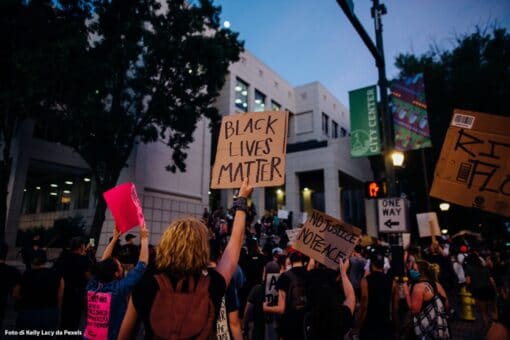
7 Jun 2020 | Non categorizzato
After the events in Minneapolis and the demonstrations worldwide we feel powerless and outraged, yet we continue to believe and work for a spirit of openness and participation so as to address the deepest needs of our time.
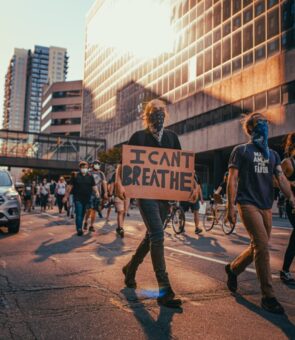
Foto: Josh Hild (Pexels)
Foto: Kelly Lacy Pexes)
Stefania Tanesini
[1] [1] Statement of U.S. Focolare Movement: our commitment to racial justice – https://www.focolare.org/usa/files/2020/06/Focolare-Statement-on-Racial-Justice.pdf [2] ibid
6 Jun 2020 | Non categorizzato
Testimony from Congo after difficult months fighting the Ebola virus. https://vimeo.com/402904193
5 Jun 2020 | Non categorizzato
The Focolare’s Movement’s ‘universal vocation’ to build universal fraternity without distinction of race, religion, social or economic status. Part two of our interview with self-declared ‘non-believer’, Luciana Scalacci, member of the International and Italian Commissions of the Focolare’s Center of Dialogue with people of non-religious convictions. As a non-believer, how did you come across the Focolare? What impact did it have on you? One day our daughter wrote that she’d found a place where she could put into practice the values we had passed on to her. She had met the Focolare community in Arezzo. We’d never heard of the Movement and were naturally rather concerned. So we went along to see what it was all about. Immediately we had the impression of being in a place where other people’s ideas were treated with respect. We found a rare kind of openness among the people there. Meeting the Focolare Movement was like a light which allowed me to hope again in the possibility of building a better world. You met Chiara Lubich several times. How important has this personal relationship been for you? In an open meeting in 2000, Chiara answered one of my questions saying, “for us too, humanity has the solution for humanity. But precisely who in humanity? For us, it’s Jesus, the man Jesus. So take him for yourselves too, because he’s one of you, he’s a man”. That’s when I understood the Focolare Movement was a place where I could be active. I also understood why, even as a non-believer, I’ve always been fascinated by the figure of Jesus of Nazareth. As this dialogue has progressed over the years, how have you moved from a “them” and “us” to feeling united together in “us”? Our initial scepticism is the first thing to overcome. On our side, as non-believers, there’s the fear that it’s all aimed at proselytizing us. On the side of the believers, I think there may be a concern that we’ll try to shake their certainties and their faith. The only one who never had any kind of worry about it was Chiara herself! We’ve increasingly experienced that the one great resource for advancing towards the goal of universal fraternity is dialogue. Gradually we’ve established trust between both “sides”, until we no longer feel “them and us” but “united in us”. How do you find young people responding to this option of dialogue? Not all young people are well informed about such openness towards those who don’t adhere to any religious faith. But those who’ve had the opportunity of getting to know about it show a real interest in this reality. After meeting us recently, one girl wrote, “I see this dialogue like a face in a precious diamond, entrusted to us by Chiara … let’s be sure to keep it shining!” Click here to read Part 1 of the interview
Claudia Di Lorenzi
4 Jun 2020 | Non categorizzato
Building a united world without distinction of race, religion, social or economic status. “As a new Movement within the Church, we have a universal vocation. In fact our motto is ‘May they all be one’. We can’t do this without you, because this ‘all’ includes you. Otherwise we cut ourselves off from a third if not half of the world. How can we exclude all these while at the same time saying ‘May they all be one’!” This is how Focolare foundress, Chiara Lubich in May 1995 explained why her Movement was reaching out to dialogue with people who do not acknowledge any religious faith. We talk to 73-year-old Luciana Scalacci, from Abbadia San Salvatore, Italy. A self-declared ‘non-believer’, she is a member of the Italian and International Commissions for the Focolare’s Center of Dialogue with people of non-religious convictions. The Focolare Movement’s interest in dialoguing with people who have non-religious convictions goes back a long way. What are the most significant steps? The Focolare’s Center for Dialogue with ‘non-believers’ was opened in 1978. A year later, for the first time, people of non-religious convictions participated in a conference organized by the Focolare. Chiara encouraged the whole Movement to embrace a new openness towards ‘non-believers’, maintaining that as we’re all ‘sinners’, we can embark on a common journey of liberation to build universal fraternity together. In 1992 the Center organized its first international convention, entitled “Together to build a united world”. Chiara told us, “Your participation in our Movement is essential for us. Without you (as without its other parts) it would lose its true identity”. A second convention followed in 1994. At that meeting, Chiara affirmed, “our goal is to contribute towards the unity of all, starting from Love for every single person. Therefore we’ll try to see how strong the aspiration for universal fraternity and unity is among humanity at all levels”. After Chiara’s death in 2008, Maria Voce, as President, confirmed on various occasions that people with non-religious convictions are an essential part of the Movement. In the 1970s it was quite unusual for a Christian-inspired movement to open its doors to ‘non-believers’. Why do you think they did this? For the unity of the human race. To make the goal “May they all be one” more solid, because a united world can only be built with others, not despite or against them! What are the foundations needed to build a dialogue between ‘believers’ and ‘non-believers’? The existence of common values, like fraternity, solidarity, justice, help for the poor. We also share an understanding that we all have a personal conscience, which permits us to reflect on these values on our own and also together in a collective way, so they become a shared patrimony for everyone. What difficulties have you encountered along the way? To engage in dialogue when holding very different positions is not always easy. Connecting together to achieve something practical is simpler, because action doesn’t distinguish between colour, religion or ideas. The difficulties start when you move from action to values, to ideologies, to the super-structures. At this point, dialogue can risk running aground. But this hasn’t happened. Chiara has challenged both believers and us ‘friends’ to open ourselves up as much as possible, not as an ‘act of charity’ but to enrich and be enriched as we journey together towards a better world.
Claudia Di Lorenzi
2 Jun 2020 | Non categorizzato
Gabriela Bambrick-Santoyo is an Internal Medicine physician. She was born and raised in Mexico City and has been an active and committed member of the Focolare community since 1987. She currently works as an Associate Program Director of the Internal Medicine department in a hospital in northern New Jersey, currently a hotspot in the current COVID-19 coronavirus pandemic. Here is an excerpt of the interview made by cruxnow.com Gabriela, can you say something about how your Catholic faith and Focolare spirituality informs your calling to a be a physician? My calling as a Catholic and part of the Focolare movement and my vocation as a physician are inseparable. I was born Catholic and I found the Focolare movement when I was about eighteen. This encounter changed my life because it was the first time, I was pushed to concretely live the gospel of “love your neighbor as yourself.” This profoundly changed me and has been what has guided my actions, both as a person and as a physician. What has it been like to be on the front lines of the COVID-19 pandemic in a hotspot in New Jersey? It has put my faith to fiery tests. Especially the fear of death. It becomes a very real possibility when you see so much death around you. Once you say yes to the calling that we all have as Christians to lay our lives down for others the graces come pouring in and out of you! They really do! I also had to ask myself what it meant to “love others as yourself” in this COVID pandemic. When I first started seeing patients, I was full of fear. I wanted to go in quickly…and leave the room as quickly as possible. Then a twist: my daughter, a healthy 18-year-old, was hospitalized with COVID. During the evenings, she would call me crying from her hospital room saying “Mom, I have lost all my dignity. I need to go to the bathroom, and they won’t let me out. They don’t want to come in and keep pushing me back into my room and at some point I thought I was going to have to go to the bathroom on the floor.” That just crushed me, Charlie, and it made me wonder if I was doing something similar to my patients. At that point I resolved to change to fully give my life to my patients, to pour out more mercy and never let them feel abandoned. It must be so hard to deal with death on the level you’ve had to see it during the last few weeks. It is so difficult for the rest of us to even imagine it. That’s true, but at times there are graces too. One of my patients was a very sick 91-year-old that essentially knew she was going to die from COVID-19 and was at peace about it. My act of mercy consisted in being there in the last moments of her life. In spending time not only with my patient but also with her family over the phone. I will never forget when I told her that her family loved her very much and that they were at peace and they know you are ready and she just squeezed my hand. That is mercy. I had another patient with whom I had what I call “the double whammy” situation. Besides being a COVID patient, he was very aggressive, not completely stable and stated he would punch me if I did not do X or Y. It took two or three moments to remind myself that this person is also a child of God and that I needed to look on him with patience, love and mercy. Once he saw this in my eyes his anger began to evaporate. On his way to being admitted to a different ward, he turned to me, smiled and said, “You and [nurse X] have been the only ones that have taken the time to explain things to me.” What difference does your robust prayer life and theological commitments make for how you practice medicine under these circumstances? Prayer has been a central pillar of my life and has allow me to get through this crisis. It is in prayer that I find peace and solace. It is in prayer that I find myself in God. Lastly, I participate in weekly meetings (zoom meetings) with my Focolare community. All those things together are the armor I count on to live through this crisis. Here you read the full interview: https://cruxnow.com/interviews/2020/04/doctor-balances-faith-work-in-coronavirus-hotspot/
1 Jun 2020 | Non categorizzato
One of the many consequences of the coronavirus in all countries, but especially in the poorest ones, is to have taken away the means of subsistence from many people who had insecure or casual jobs. At this time, therefore, it has become even more important to look around and take the most varied initiatives for the benefit of those in need. This is Gospel: Jesus is there, in the least, waiting for us. … Jesus has a preference for the poor, for the “least”. After Peter had denied him three times[1], Jesus asked him the same question three times, “Do you love me more than these?” To Peter’s first affirmative reply, Jesus said, “Feed my lambs”. Instead, to the other two replies, he said, “Tend my sheep”. According to bible scholars, by “lambs” he meant the little ones, the poor, and the needy; whereas by “sheep” he meant everyone else.[2] In this way, Jesus showed his option for the poor long before many bishops, for example, especially in developing countries, formulated and put forward this option. Besides, we know that Jesus came to evangelize the poor.[3] He said so clearly, “Just as you did it to one of the least of these who are members of my family, you did it to me.”[4] While Jesus had already demonstrated this preference with words and works while he was living on earth, his Spirit has very frequently instilled it, down through the centuries, in those who would become his instruments for many, like St Francis, for example, St Philip Neri, St Ignatius of Loyola, St Camillus de Lellis and so on. It was the same for us. At the beginning of the Movement, when we were still at home with our families, the charism drew our attention first of all to the “least” of those around us: the poor, the sick, the wounded, prisoners, the homeless, the elderly, and children. And later on, in the first focolare in Piazza Cappuccini, to those who were the “least” among us. We tried to solve the first problem (the least around us) through works of charity, which were the seeds of the many social actions and works that would begin in later years; and the second (the least among us) through the communion of goods among all of us. Later on, we felt urged to look at everyone, to love every neighbor as ourselves, whether or not that person was one of the least of our neighbors, and to love one another. Now this way of living is so deeply inculcated in everyone that it has become the basic life-style of the whole Movement. But during this recent period … we have been reminded anew to give first place in our hearts to the “least” of our neighbors. How can we put this into practice? Above all, by looking with special attention to those among us who could be the least and by meeting every need through a freely given but intense communion of goods, extended to the Movement throughout the world. … And then by looking around us. … A motto? A question for our hearts: “Have I preferred today, among all my neighbors, those who were most in need?”
Chiara Lubich
(From a telephone conference call, Rocca di Papa, 27th June 1991) [1] Cf. Jn 18:15-27. [2] Cf. Jn 21:15-17. [3] Cf. Mt 11:5 [4] Mt 25:40.
30 May 2020 | Non categorizzato
Supportive actions, mutual help, prayer and sharing generated by the Focolare communities all over the world. https://vimeo.com/402904028
29 May 2020 | Non categorizzato
An experience from Rolando, manager of a company in San Salvador: concerns and expectations for his country during this time of pandemic and the decision they made, as a family, to live for others. In San Salvador, we are under lockdown, just like the rest of the world. Fear which is understandable but, in my opinion, exaggerated, has taken hold and measures to contain the virus are being introduced which contravene human rights. The emergency is being exploited to undermine democracy and, once again because of fear, much of the population is calling for strong leadership. The pandemic has consequently generated a return to authoritarianism as a way to combat the virus. This in turn has led back to intolerance and a break in dialogue which has generated feelings of anger and revenge. On top of this is the negative impact that the closure of non-core activities, the high percentrage of informal economy and the reduction in remittances is having on the economy as well as the high level of debt caused by the emergency. This situation is a huge desolation for me. I experienced civil war as a young man and, despite many illusions, the arrival of dialogue and the signing of peace. I followed the slow process towards democracy, never completely satisfied but always hopeful. I never imagined that I would see armed forces dominating the political stage again and the collapse of constitutional order. It is a personal suffering and a suffering for society which has at times impacted negatively on my optimism. I think we are heading for an economic and social crisis in the near future that will affect democracy and especially the most vulnerable. The spirituality of unity we try to live as a family urges us all to take concrete action in favour of those close to us. On a personal level, as I am now working fulltime from home, I try to love Irene, my wife, in the first place by appreciating all her efforts to cope in this difficult situation, helping her and covering the gaps caused by the pandemic because there is noone to help us at home. With joy I try to prepare the dishes that Roxana, our youngest daughter, likes, and I offer encouragement to Irene Maria, our oldest daughter, who studies abroad. Every day I hear from my parents and take care of their needs. We try to support and offer reassurance to the people who normally help us at home, by guaranteeing their salaries, for as long as we can… Together with employees of the company where I work and other managers, we are introducing policies offering economic support and making it easier for employees to work remotely to secure their jobs. I am committed to dealing with my team as best I can and being understanding about their lower productivity. With a number of experts in different fields we share experiences, study the crisis, economic models, market development and politics, aware of the opportunity this is offering to learn new things and find innovative ideas to face the future. Without realizing it, the days pass quickly, and a feeling of peace often floods my soul. I continue to worry about the country’s health situation, its precarious democratic situation and the economy but I feel an ever-increasing strength to continue fighting for the values in which I believe, despite the fact that the storm is raging outside.
Rolando, El Salvador (received by Gustavo E. Clariá)
27 May 2020 | Non categorizzato
One way to remain united with Jesus is to welcome his Word. It allows God to enter into our hearts and purify them – cleansed of selfishness, they are able to produce an abundance of quality fruit. Giving confidence He was a man in his 40s, a bit sad, who didn’t look so good: dirty, shabby clothes smelling of alcohol and nicotine… But he didn’t ask me for money, just work, any job. He clearly needed help. What would Jesus have done in my place? I decided to invite him to my house, where I needed some repairs. He had told me that he just got out of prison and had expenses while on probation, but he had nothing. His wife had left him, too. He did the job I asked him to do, which I paid for. Before taking him back to where he was spending the night, he asked me if I had any other work. After we talked to some friends, we found other things for him to do. He came back several times, and our mutual trust and respect grew. After about a month or so, he never showed up. I was afraid he had ended up back in prison. Then one day he called me on my mobile. “Thank you for everything you’ve done for me, for the trust you’ve given me. I was able to pay my probation and buy a phone. Now I have a steady job. I’m very happy!” W., U.S.A. What I believe I’m a hairdresser, and I do home service. One day I was called by a young recently married lady who was expecting a baby. Sadly, she confided in me that she was planning to divorce her partner. Her mother-in-law made life impossible for her. I listened to her for a long time, then I advised her to wait. After a few days, her mother-in-law called me to get a haircut. Immediately she spoke badly of her daughter-in-law. “How strange,” I replied, “just two days ago I was at her house and only heard her say nice things about you.” When I met the daughter-in-law again, I told her, “Your mother-in-law spoke well of you, she loves you very much.” A few days later, the family got together at a party. After months, mother-in-law and daughter-in-law were meeting once more. As they described it, it was a beautiful moment. And they thanked me. “Who teaches you the beautiful things you tell us?” they asked. So I was able to explain to them what I believe in: a Gospel that teaches us to be peacemakers. F., Pakistan Practically for fun My husband and I noticed that our children lacked knowledge in the basics of Christianity. So we asked ourselves, “Why not start a sort of catechism course at home?” I began with Mary, Jutta and Ruben, making sure that the concepts were simple and related to daily life. Then we added Jeroen and Rogier, Rose and Michel. The result was a new experience that was both fun and engaging. It was truly fun to prepare a sort of lesson each week, which some of the children wrote out on the computer and copied, while others put together some nice folders to keep the handouts in. Our children were so enthusiastic that many times they spontaneously would invite their friends to participate, which they did. When we covered the sacraments, we saw again how little they had understood. Yet now they have become a treasure in our life of faith. And this catechism course, which started practically for fun, continues. W., Holland
by Stefania Tanesini
(from “The Gospel of the Day”, Città Nuova, VI, n.3, April–May 2020
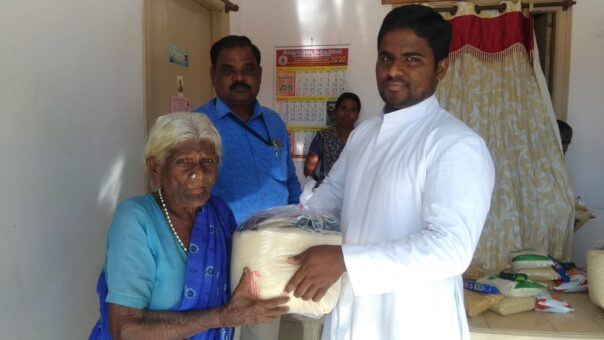
26 May 2020 | Non categorizzato
The experience of a community in Bangalore, India, during the covid-19 lockdown. What do you do when you suddenly find that everything is closed for three weeks and you don’t know what the near future will be like? What do you do when the work that has kept you going up until now ends and you don’t know if it will start again? I think this is an experience that is not limited to India at the moment but is being lived by many people in different countries all over the world. The Italians, unfortunately, were the first to experience this sense of bewilderment and now here in India we are in the same situation. However, here, as you may have seen on the news, there are 450 million people who work as day labourers, without any security, and most of them without any savings. Therefore, not being able to go to work means eating less every day and trying to survive. 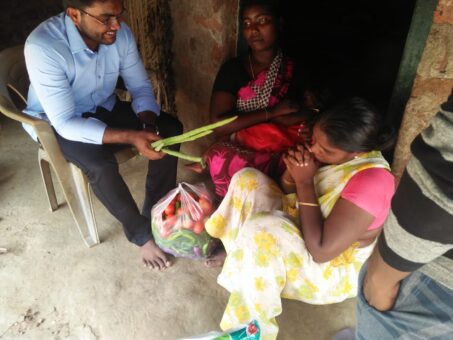 The Focolare community in Bangalore asked themselves how they could help people in need and how they could involve others people who were at home during lockdown. It all started with a WhatsApp message that someone in the community sent to Kiran who is a seminarian and lives in a village we visited a while ago. “Are there families in need in your village?” we asked. The village, which is in the Indian state of Andhra Pradesh, has a population of about 4560 families of which about 450 are Catholic. That same evening, Kiran (which means “ray” in the local language) had been out walking and visited various families who had confided in him and spoken about their fears for the future. They were already eating kanji (boiled rice with lots of water: you eat green chili pepper with it to give it some taste) and did not know what they would do during the 21 days of lockdown. It’s not normal for adults to talk to a young person about their problems and so Kiran had come home feeling worried. When he looked at his phone and saw the message, he realized that God was giving him a solution for those families who needed help. And so, we set to work. Kiran knew how many families were in trouble. We prepared a message to send to all the people we know, with details and information about where to send help. Our target was to help at least 25 families by providing a 25 kg bag of rice and a bag of vegetables – enough food for a family for about two weeks. This would cost about 1500 rupees, about 20 euros. The response was immediate. Many people participated – families and many young people. Some gave a thousand rupees, others three thousand, and others five thousand rupees. Within a few days we reached the target set. But the contributions continued and so we were able to help more than 30 families. There was an average of four people per household and so this support has reached at least 120 people. However, there are many other villages where people we know are in need and so we started to help in other places too. Now there are three villages that we are supporting. We always work in collaboration with local people who know the situation well and know how to help in the most appropriate way. Chiara Lubich taught us to love people one by one and it seems we are doing just this: we are trying to love one village at a time, but without stopping! What we are doing is very small – it’s only a drop in the ocean – but many people have become involved. Here in the diocese of Bangalore, the Archbishop has worked extremely hard to help workers blocked in the area due to the lockdown. We have also collaborated in this initiative. Now Bangalore is asking Mumbai, New Delhi and Goa to take up the challenge and do everything possible to help circulate whatever we have so that no one is in need. We are all realizing that, in the end, everything passes and all that remains is the love we share: this love fills our hearts.
The Focolare community Bangalore, India
25 May 2020 | Non categorizzato
To cope with the pandemic, individuals and associations, health workers and scientific communities, governments and international organizations are responding in a variety of ways. Creativity and generosity, which are often heroic, are never lacking. To all these efforts should be added the decisive contribution that comes from prayer that is able to move mountains. […] Just as each child in this world trusts his or her own father, believes in him, relies completely on him, lets him take care of every worry and feels secure with him, even in difficult, painful or impossible circumstances, the very same thing is what a “child” of the Gospel does and should do with our heavenly Father. This childlike attitude is very important, always, because we are often overwhelmed by circumstances, by things that happen or trials that we cannot overcome only with our own strength, but which call for help from above. At this very time we are particularly aware of our need to have a great faith in the Father’s love and in his Providence. … We have been worried and we still are; and we have been wondering what we could do. … The first answer that took root in our hearts was to pray: to unite all together and pray so as to avert disaster. And everyone – to a greater or lesser extent – has surely begun to do this. … To pray. But we need to pray in a way that will obtain results. … In the first letter of St John we find a very beautiful and encouraging expression: “… If we love one another, God lives in us, and his love is perfected in us (1 Jn 4:12). “His love is perfected in us.” But if His love is perfected in us, and as long as his love is perfected in us, we are perfect. Therefore, we have this perfection of love by living mutual love. In the last few days … we have introduced [into the Regulation of the focolarini] a norm which is basic and essential for them. It’s the duty … to make a pact with the other focolarini, to be ready to die for one another, as required by Jesus’ commandment. But this decision, this pact, is certainly not the monopoly of the focolarini who live in community. It is the law for all the members of our Movement. Living out this pact ensures that love in us is perfected and that we are perfect in love. Thus we are pleasing to God and in the best condition to obtain the graces we desire, even the ones needed to move mountains. I think that if we want to work effectively for a united world, then in the next few days we need to renew with one another and with all the people we meet who know our Movement, our readiness to give our lives. Of course, we must first prepare the ground and create the right atmosphere, so that we can courageously say to the other person: “With God’s grace, I want to be ready to die for you” and so that we can hear the other person say: “And I for you.” Then we must act accordingly, stoking up the fire of love with regard to every neighbour. … On this basis, we can pray being sure that our prayers will be answered.
Chiara Lubich
(From a telephone conference call, Mollens, Switzerland, 13th September 1990)

24 May 2020 | Non categorizzato
A global campaign that involved thousands of faithful through interactive and educational seminars on the care of our common home. Launched by the Pope, it was organized by the Department for the Service of Integral Human Development with the support of a group of Catholic partners. From May 16th to 24th the Laudato Si’ Week was held under the title “Everything is connected”, a global campaign on the occasion of the 5th anniversary of Pope Francis’ encyclical on the care of the common house. The event engaged Catholic communities worldwide involving dioceses, parishes, movements and associations, schools and institutions to deepen their commitment to safeguarding Creation and promoting an integral ecology. Strongly desired by the Pope, it was organized by the Department for the Service of Integral Human Development with the support of various Catholic partners including the Global Catholic Climate Movement which includes more than 900 Catholic organizations worldwide among which the Focolare Movement. During the Week there were various online initiatives following the indications of Laudato Si. In fact due to the Covid-19 emergency, the event took place entirely online through interactive and formative seminars. On Sunday, May 24th the event concluded with a world day of prayer: at 12 noon (local time in each time zone), everyone was invited to pray for the Earth with this prayer. In March the Pope sent a video message in which he encouraged the faithful to participate in protecting our common home. Together, through action and faith, we can solve the ecological crisis. “What kind of world do we want to leave to those who will come after us, to the children who are growing up? – says the Pope – I renew my urgent appeal to respond to the ecological crisis. The cry of the earth and the cry of the poor can no longer wait. Let us take care of creation, a gift from our good Creator God “. In these 5 years, the Pope’s encyclical has stirred the consciences of many citizens. People have formed communities with the aim of doing something for the environment, driven by the Pope’s words on a more attentive ecological vision of our Common Home. Yet after five years these words resonate very topical in today’s world torn apart by the Covid-19 pandemic. The Vatican Department for the Service of Integral Human Development also stresses how the teachings of the Encyclical are particularly relevant in the current context of Covid-19 that has brought life to a standstill in many parts of the world. “The pandemic has struck everywhere and teaches us how only with the commitment of all can we rise up and defeat even the virus of social selfishness with the antibodies of justice, charity and solidarity. To be builders of a more just and sustainable world, of an integral human development that leaves no one behind”- underlines Don Francesco Soddu, director of Caritas Italiana – During this week we have not only talked about ecology. The organizers asked themselves: what role does the economy play in terms of safeguarding Creation? In fact, on Thursday May 21st an online meeting was held with the English economist Kate Raworth, from Oxford University and Cambridge University, one of the most influential economists internationally. This meeting was also part of the preparation and formation process for “The Economy of Francesco”, the event wanted by the Pope to be held in November in Assisi for which 3000 young entrepreneurs from all over the world have already registered. On the subject of safeguarding Creation, ” the economy is responsible for at least 50% if we consider each individual’s economy, the economy of enterprises and the economy of States and the effects that all this has on the pollution of the Planet . Then there is politics, our lifestyles, etc…. (…) If we also look at what has contributed to the the failures of these decades , global warming, for example, we realize that in short, the capitalist economy really has a great responsibility. So if we want to make a change we have to change the economy”- says the economist Luigino Bruni – Therefore, to live Laudato Si means to show our sensitivity to the theme of safeguarding Creation but it also means we make life choices in the economic sphere. We can contribute to a profound economic and ecological conversion through practical experiences. We also need to understand what political change we need to promote in order to truly listen to the cry of the earth and of the poor.
Lorenzo Russo
23 May 2020 | Non categorizzato
The testimonies that Card. Désiré Tsarahazana, President of the Madagascar Episcopal Conference and Mgr. Christoph Hegge, Auxiliary Bishop of Munster ( Germany) shared during the internatiional meeting that brought together 7 cardinals and 137 bishops, friends of the Focolare Movement. The meeting was held last February in Trent and at the international small town of Loppiano. https://vimeo.com/415940273
20 May 2020 | Non categorizzato
When we live the Word we are bound to go out of ourselves and meet our brothers and sisters with love. We start with the ones closest to us: in our cities, our families, wherever we are in everyday life. This friendship becomes a network of positive relationships, that aims at living the commandment of mutual love, which builds fraternity. Finding the right words My two children, seven and five years old respectively, were out playing without any thought of danger. I was not quick enough to reach them, when a grenade exploded and both were bleeding. We picked them up and ran off to hospital. I felt a great turmoil inside me: dismay, fear, pain ….. but I had to take care of the children and instil peace in their hearts. My son had splinters in his head and he had to be operated on immediately; my daughter was not in such a bad state. At night, I watched over their bedside. Every now and then they complained and had nightmares: “Why did they do this to us?” I looked for the right words to explain to them that the one who threw the grenade was someone who had suffered a lot, who might have no parents, and who just wanted to destroy the weapons on our side… When the children dozed off, I began to pray. I entrusted them to God while I prayed that they would be free from any hatred in their hearts. Decades passed since that painful episode, and today my son considers it as an incentive to contribute towards world peace. (R. S. – Lebanon) Change of apartment When we asked the owner of the apartment where we were staying for permission to make some renovations at our expense, she said nothing about her intention of selling the flat. Of course, when we finished the work and came to know about her decision, we felt bad and betrayed. Moreover, the new owner asked for a much higher rent. So, from one day to the next, we found ourselves on the street. But we trusted in providence; we were certain that God would not abandon us. In fact, shortly afterwards, we were offered a possibility that fitted our family needs even better. But the most important thing was to have no hard feelings and maintain a good relationship with the former landlady. We could feel that she was sorry about what happened, even though she did not express it outrightly. We were friends again and forgot all about the past. (E.V. – Turkey) Disorder I am enrolled in the Faculty of Psychology and I live with other colleagues in the students’ quarters. When we do not go to the canteen, we share the use of a common kitchen. One of us, who is quite messy, never bothers to clean the kitchen after making use of it. This morning when I went to the kitchen to make myself a coffee, I found that there was a big mess. He had guests the night before and he did not bother to clear up. I wasn’t the only one to notice the disorder in our kitchen. Someone, who was furious about it, suggested that we should leave everything until our colleague realizes it and does something about it. However, shortly after when I went back to my room to study, I was not at peace with myself; the thought of the mess in the kitchen kept coming back to me… What should I do? Should I teach a lesson or do an act of love? I wasted no time, I went back to the kitchen and started clearing up: I washed glasses and dishes, I took the garbage out ….. When I returned to my room, it seemed that I could understand better what I was reading. Life with others is a form of education that completes the lessons I listen to at university. (G. T. – France)
Edited by Stefania Tanesini
(see Il Vangelo del Giorno, Città Nuova, anno VI, n.3, April–May 2020)
18 May 2020 | Non categorizzato
This reflection by Chiara Lubich reverses our usual way of interpreting the joyful or painful events that are woven together in the fabric of our life. She invites to see things in a completely different way, with new eyes, trusting in the fact that nothing escapes God’s love. This deep inner conviction fills us with hope and helps us be more courageous. … If we love God, our life and its many circumstances become a divine adventure in which we are astonished every moment by the newness it brings. This divine adventure is full of treasures to be discovered that enrich us all the time and are like little pieces added to the mosaic of our holiness. In fact, [Scripture] tells us. “We know that all things work together for good for those who love God” (Rom 8:28). All things… for those who love God. All things. Nothing — and we must believe this — happens by chance. No situation, whether joyful or indifferent or sorrowful; no meeting or situation, in the family, at work or at school; no state of physical or moral health, is without meaning. Instead, all things, events, situations, and people, are bearers of a message from God, which we should know how to read and accept with all our heart. All things work together for good for those who love God. God has his own design of love for each one of us. He loves us with a personal love, and—if we believe in this love and respond with our own love (that is the condition!) — He leads all things toward the fulfilment of his plan for us. It is enough to look at Jesus. We know how much he loved the Father. If we think of him even for a moment, we can see how he lived this Word to the full all his life. For Jesus, nothing happened by chance. Everything had a purpose. However, we see this Word personified in him in a unique way during the last days of his life; nothing in his passion and death happened by chance. For Jesus, even the extreme trial of feeling forsaken by the Father worked together for good, because by overcoming it he brought his Work to completion. His passion was caused unknowingly. Those who made him suffer and die did not know what they were doing. They didn’t know who it was they were torturing and crucifying; they did not know that they were conducting a sacrifice, the most perfect sacrifice that would bring about the salvation of humankind. Jesus suffered at the hands of people who did not have this end in mind. But since he loved the Father, he transformed all these things into means of redemption, seeing in those terrible moments the hour he had so long awaited and the fulfilment of his divine, earthly adventure. Jesus’ example enlightens our own life. We should understand that everything that comes to us, all that happens, all that is around us and all that causes us to suffer, is either the will of God who loves us, or has been allowed to happen by God, who loves us still. Then everything will take on new meaning, everything will have a purpose and it will all be extremely useful. Let’s take heart. We are still alive. We are still on the journey. Our life can still be transformed into a divine adventure. The plan of God for us can still be fulfilled. It’s enough to keep on loving and look out for his ever splendid will.
Chiara Lubich
(From a telephone conference call, Rocca di Papa, 2nd August 1984)
16 May 2020 | Non categorizzato
The testimony of those who face social challenges by rediscovering the potential of the Internet. Some initiatives supporting those who are alone or in situations of poverty. https://vimeo.com/402903671
13 May 2020 | Non categorizzato
On the occasion of the day of prayer and fasting for humanity on 14th May, the prayer of Maria Voce, President of the Focolare Movement In this time of trial, loneliness, anguish and dismay, we feel the need to re-discover the meaning of life and of death, of what does not pass and will remain forever. Our hearts, purified and disarmed by suffering, unite in prayer to You, Almighty, Compassionate, Merciful God and Father of us all. Strengthen in us the faith that everything You allow to happen is for a greater good, and that nothing of all that happens is outside Your infinite goodness. Help us continue this journey of life with renewed trust and hope, rooted in Your divine will in every present moment. Comfort those suffering the loss of family and friends; grant them strength to go ahead, and patience in adversity. Grant that in the face of anxiety about the future, the loss of work and the social and economic consequences of the pandemic, we are able to discover in them opportunities to practice solidarity and greater justice. Forge in us, more and more, a spirit of concrete love, to share the pain of those who are weeping and rejoice with those who are glad. Grant that we may consider others as ourselves and want for them what we want for ourselves. Help us experience, Most High and Almighty God, that the more we love our neighbor, forgetful of ourselves, the more our burden of pain lightens and in our hearts remains the ineffable and tangible sweetness of Your presence. Grant strength, health, safety and wisdom to the doctors, nurses, health personnel and all those doing their utmost for their brothers and sisters who are sick or in need, so that they can be Your instruments in accompanying those entrusted to their care. O God, Light of the world, grant that scientists may be illuminated by Your Wisdom and make their knowledge available for the good of all humanity. Sustain the leaders of nations and all those who decide the fate of peoples, so that they know how to make forward-looking decisions and find social and economic solutions in favor of the weakest. Enlighten their minds, so that they may find every possible means to avoid conflicts and promote peace. Make each one feel that they are responsible not only for their own people, but for all humanity. May Mary, who is loved and venerated by many, help us to stand firm in faith and bring consolation and hope to all. Amen. Download the prayer
13 May 2020 | Non categorizzato
The exhibition dedicated to Chiara Lubich in her hometown in Italy is enriched with a multilingual virtual tour that will allow visitors from all over the world to visit the exhibition composed of images and documents. May 13th marks the launching on the web , a significant date for Trento and Lubich. “Chiara Lubich Città Mondo“, the exhibition set up at the Gallerie in Trento, the birthplace of the Focolare Foundress, is now transformed and enriched with a virtual tour. The exhibition, closed for a period due to the pandemic and now extended until the beginning of 2021, can also be visited online. (http://mostre.legallerietrento.it/chiaralubich) The exhibition in Trent, which is part of the events linked to the Centenary of Chiara Lubich’s birth, continues in this way to implement the motto of the centenary: “Celebrate to meet with this extension on the web, “. Winding its way through history, life, images and color, it offers an opportunity to ‘meet’ with Lubich, and now the tour extends beyond the Galleries’ exhibition venue , to offer access to visitors from all over the world. Moreover, the date chosen for this launch on the web is no coincidence: on May 13th , 1944 Chiara Lubich’s story intertwined significantly with that of her city. That day when Trent suffered the second heavy bombardment also marked a turning point for the emerging Focolare Movement. Chiara Lubich was among the people displaced from the city towards the Gocciadoro woodland, after the family home was damaged. “I remember that night,” she would write years later, “on the outskirts of the city, lying with the others on the ground, just two words: stars and tears. Stars, because, throughout the night, I saw them all passing over my head; tears, because I was crying, realizing that I could not leave Trento with my loved ones. By then I saw with my companions the movement coming to life: I could not abandon them. And it seemed to me that the Holy Spirit, in order to make me understand His will, suggested words to me that I had studied at school: “Omnia vincit amor[1], Love conquers all”[2] .The next morning, Chiara Lubich informed her parents of her decision to stay in Trento, and soon afterwards, with her first companions, she set up the first focolare. The little house that housed the first focolare is one of the stages on the virtual tour that the visitor takes “Chiara Lubich city world” from the birth of the founder of the Focolare Movement in 1920 to the current worldwide expansion of the Movement. Even in the virtual setting, it is Chiara herself, through images and documents, who “tells her story “: her life as a young teacher, her consecration to God on December 7th, 1943, the growth of the first Focolare community. And then the summer of 1949, the beginning of a period of light for Chiara Lubich from which will flow the charismatic novelty that would give life to a new Work in the Church. Light and colours are the protagonists of the last part of the tour which, through words and images, allows us to know experiences of unity, spaces of fraternity born of the Charism of Lubich which continue to grow and develop in the present day in order to contribute to the fulfillment of what she considered the “testament” of Jesus: “That all may be one” (Jn 17:21). “For that page of the Gospel we were born,” Lubich wrote, “to bring unity in the world, unity with God and unity among all our brothers and sisters”.
”Even though we were aware” – she explained –“ of the divine audaciousness of the program that only God could carry out, kneeling around an altar, we asked Jesus to make his dream come true using us too if it was part of his plans”[3]. A dream also formed on that night of May 13th 1944 when, faced with the collapse of everything, bewilderment, the anguish of the unexpected drama of the moment, among stars and tears, she chose to believe that “Omnia vincit amor, love conquers everything”.
Anna Lisa Innocenti
[1] Virgil, Ecloghe, X, 69 [2] Chiara Lubich, Nascita di una spiritualità, in Michele Zanzucchi, Enzo Maria Fondi, Un popolo nato dal Vangelo, San Paolo, 2003, pp. 9-10. [3] Ibid., p.17
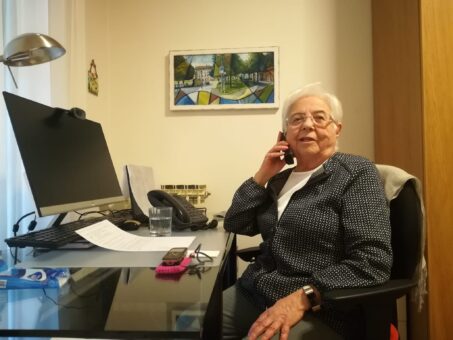
12 May 2020 | Non categorizzato
What effects has this pandemic had on life in society and in the Church? What did it bring about in the Focolare Movement? How can we live these new and as yet unknown times that await us? An open dialogue with Maria Voce. From an interview with Radio Inblu (Italy). From 18th May, Mass can be celebrated again [with a congregation], by taking all necessary precautions of course. Could you comment briefly on this? Maria Voce: We have always followed the Pope’s Mass and there have been very many opportunities to pray together online. But we cannot hide the fact that Christianity is an embodied religion. We feel the need to be physically present at the liturgy, to participate more directly and actively in the sacraments of Christianity. So we certainly missed participating in the Eucharist in a real way and this gift is now being given back to us. So we are ready to do all that is required, to take precautions in order not to miss this opportunity. Q: Of course, many things have happened during this time. We have had to review our behaviour and what we buy. What do you think the pandemic is bringing out in social life and therefore also in church life? Maria Voce: It is bringing out beautiful things but there can also be bad things. A first thing worth emphasizing is equality among all. The pandemic has shown that faced with this small virus that we have been hit by, we are all the same. It has affected the powerful as well as the poor, the rich and those who have nothing, children as well as adults, those in prison and those outside. So in this sense we are all truly equal. At the same time the pandemic has also revealed many inequalities that are not created by the fact of being human, but are created by different cultures, by prejudices and by lifestyles. So some people can afford treatment and others cannot; some people have homes where they can isolate themselves and others are forced to live with several people in a very small space. Some people have lost their jobs and can draw on savings set aside in a bank account; others don’t have anything to draw on and when they lose their jobs, they and their families are in danger of going hungry. So, unfortunately, inequalities have become even more obvious. And this should make us reflect, because it’s clear that these inequalities are not wanted by God, nor are they willed by human nature. They are due to the ill will of people who have not been able to manage correctly the gifts that God has given us all. We need to make up for these inequalities so as not to find ourselves, when the pandemic is over, in a worse state than we were before. Instead, we want to come out of this having gained from realising the need for equality and make programs that respect the equal dignity of all. Q: What about the church community? Maria Voce: For the church community, I feel this period has highlighted what is essential, because so many things have fallen by the wayside. We have seen that church walls are not essential but that living the Church as communion is essential. We’ve seen that going every day to visit Jesus in the sacrament of the Eucharist is not essential, but it is essential to love our neighbour; it is essential to answer with love to the people near us; it is essential to seek out inspiration for our lives from Jesus’ words in the Gospel. Many things have fallen away even on an ecclesial level. However, this has done us nothing but good, because it spurs us towards the rebirth of which Pope Francis continually speaks, to the resurrection and the completely new start we can make in truly reforming the Church in a vital way, not in an institutional or formal way. Q: Which of these essentials is most essential? Maria Voce: The most essential thing is to keep in mind that we are one human family. Being part of one human family must push us all to take care of each other and take care of creation, which is the only house this one human family is living in. We must care responsibly, attentively, precisely because Christianity makes us look at this reality also in a responsible way. We are all members of a family but we are all responsible for this family. Therefore, every person in this family is important; everyone has rights but they also have duties. There is a collective responsibility. I think this must push us to make proposals, to put forward programs, to see what can be done to truly include everyone. We must propose ways forward both in the economy and in politics, ways that can truly look to the common good, not to the good of one group or another, not to the interests of one side or the other but to the good of all. So proposals should be put forward that aim towards a communion of goods on a more universal level. Then the Church itself – and we too, in fact, as Focolare Movement – is universal, it has no boundaries. In a certain sense, the Church competes on equal terms with the virus. The virus is not afraid of borders but neither is the Church; the Church is universal because it is God’s family on earth. We must look to this, God’s family, to see how to make it truly be one family. We must see how to create structures that enable the integral development of all, which respect the history, culture and way of life of each people, without coercing them into developing according to our models or our plans. At the same time, we should make available to each other all the talents with which God has endowed every people, every culture and every person. We can make them available to each other so that all together we can make the world become a common home that is ever more beautiful and ever more worthy of being inhabited by the children of God. Q: Maria Voce, what reactions has this time brought about in Focolare Movement? How have you been reflecting on this? Maria Voce: The same reactions as everyone, in the sense that we too, from one day to the next, found ourselves not being able to organise our lives, neither personally nor as a Movement. So we had to change all our programs. It is an important year for us because it is the centenary year of Chiara Lubich’s birth. We have the General Assembly of the Movement planned for the month of September and several preparatory meetings for the Assembly were scheduled. All this ground to a halt from one moment to the next, from one day to the next, so we found ourselves completely unable to foresee, plan and think what could be done. Naturally, this was a shock. At the same time, Chiara Lubich taught us to live the present moment, wanting to do only what God asks us to do. Therefore we want nothing other than His will and to seek together – precisely by listening to each other and trying to understand the needs of all – to hear together what God wanted to tell us through this circumstance. In doing this, first of all we changed all the programs, thinking always not only of the needs of the people who were supposed to participate in the programs, but also of the needs of those who would perhaps suffer economic losses from the changes, who would experience upheavals; there were many things of this kind. We did this and did it joyfully, without letting ourselves be overwhelmed by the situation. And now we are seeing that it was all in God’s plan, because it has led us to greater simplicity in life, to reviewing our lifestyles, to a greater sense of moderation when deciding whether to buy something now or not. We have put off acquiring something we had planned to buy, delaying or deciding against it entirely in order to make that sum of money available for more immediate needs. It led us to seeing how all our families are and how they are coping at the moment. Many of our people, like others, have lost their jobs and don’t know how to manage. This has brought about a more complete, open and transparent communion of goods among all. So we have communicated more about the various needs but also about what Providence has sent us. Truly we can say that Providence has shown us once again that it is true, that it is a reality, that the Father sends what is needed to his children if his children want to live for him and in mutual love. So, in a way, he has given us the light to see the driving force that moves us, this love which is the love that God has placed in our hearts, not as focolarini but as people, as human beings. For us focolarini, this light takes on many colours because it becomes love that leads to unity, a love that enables us to give our lives for one another and risk everything. This really is something that has energised the Movement throughout the world. The Movement, like the Church, is also universal, so we suffered what our people in China were suffering, what those in America, the Middle East, everywhere, or in Italy were suffering. And we lived all these things together so that people who had more gave to those who had less. Aid has come from China, Korea, Japan, the Middle East and Syria. Maybe it was aid in terms of encouragement and good wishes, but everyone said that this great family that lives the Ideal left to us by our founder, Chiara Lubich, wants to be one. Through unity we want to help the world become one. From an interview with Alessandra Giacomucci for the Ecclesia (Radio InBlu) column, 8 May 2020
11 May 2020 | Non categorizzato
“With the day of interreligious prayer on May 14th, the Higher Committee for Human Fraternity reminds us that the current pandemic has marked a point of no return: our future will be secure only by looking to the common good, not to the good of one group or another, not to the interests of one side or another but to the good of all.” Thus, Maria Voce, president of the Focolare Movement, affirmed the Movement’s full participation in the day of prayer for humanity, which was proclaimed also by Pope Francis on Sunday, May 3rd, asking that: “On this coming 14th May, believers of all religions should unite spiritually for a day of prayer, fasting, and works of charity, to implore God to help humanity overcome the coronavirus pandemic.” “We are one big family – Maria Voce added – formed by Christians, by believers of various religious traditions, together with people without specifically religious beliefs. I encourage everyone to live Thursday, May 14th, in a spirit of prayer – according to their respective faiths and traditions – of fasting and concrete commitment to help those close to us, especially the weakest and marginalized. We will do this at the local level, as every community deems best, always abiding by the directives in force, and in a spirit of true and effective fraternity.” “We are certain that the prayers lifted up to God by his sons and daughters will be heard, for the good of the great family of humankind; and that the trial we are all experiencing will truly make us stronger in the shared pilgrimage of life.”
Stefania Tanesini
11 May 2020 | Non categorizzato
Our relationship with nature, whether as individuals, organisations or nations, is ever more the focus of attention. We have a duty to protect the environment and repair the damage already done. The pandemic we are currently experiencing has highlighted this duty of ours and also given the natural world some breathing space. Chiara Lubich’s spiritual experience leads us to the One who is at the root of all things: God. … While taking a short break, I watched a documentary on nature. Unlike some other TV programmes, that film had a great effect on my soul. Contemplating the immensity of the universe, the extraordinary beauty and power of nature, my mind rose spontaneously to the Creator of it all, giving me a new understanding of the immensity of God. It made such a new and strong impression on me that I felt like falling on my knees to adore, praise, and glorify God. I felt a need to do that, as though it were my vocation in that moment. It was as if my eyes had been opened, to understand as never before who it is that we have chosen as our ideal; or rather, who has chosen us. I saw God as so great and so immense that it seemed impossible he should think of us. This impression of God’s immensity stayed with me for several days. Now, when I pray, “Hallowed be thy name,” or “Glory be to the Father and to the Son and to the Holy Spirit,” it’s different for me: it has become a need of the heart. … We are all on a journey. When people are travelling, they are already thinking of the place they will be in on their arrival and getting ready to be in that environment or that city. We need to do the same. Up there in heaven will we be praising God? Then let’s start praising him right now. Let our hearts cry out with all our love to God and proclaim him, with the angels and saints: … “Holy, holy, holy.” Let our heart and our lips tell his praises. Let’s take the opportunity to revive some of our daily prayers which have this purpose. Let’s give God glory also with our whole being. We know that the more we empty ourselves (imitating Jesus Forsaken who made himself nothing) the more our lives cry out that God is everything, and in this way we praise him, glorify him and adore him. When we do this, our “old self” dies and out of its death the “new self” comes to life, the new creation. During the day let’s be on the lookout for many opportunities to adore God and praise him. Let’s do it during our meditation [or other prayer times]. …Let us praise him beyond nature or in the depths of our hearts. Above all, let’s live dead to ourselves and alive to the will of God, to love of neighbour. May we too, as Elizabeth of the Trinity used to say, be “praise of his glory.” In this way we shall have a foretaste of Heaven and make up for the indifference to God in so many hearts living in the world today.
Chiara Lubich
(Form a telephone conference call, Rocca di Papa, 22nd January 1987)
