20 Jun 2017 | Non categorizzato
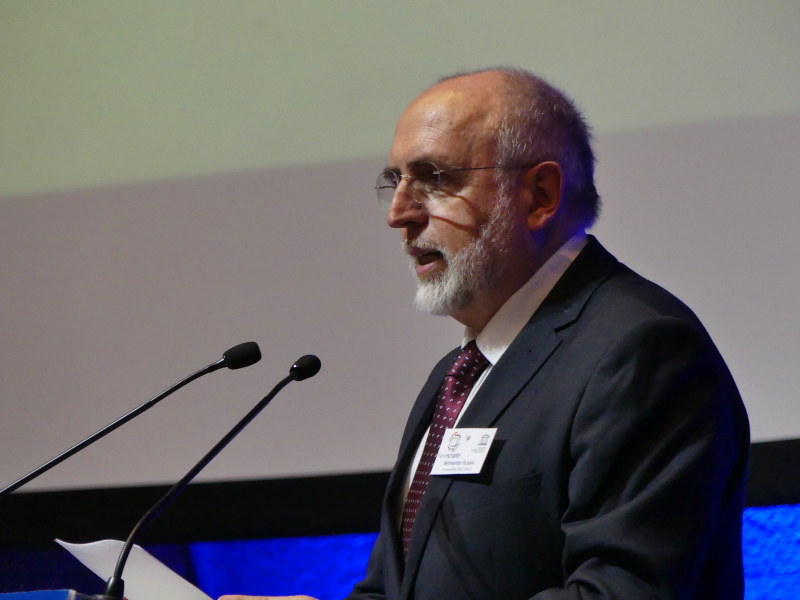
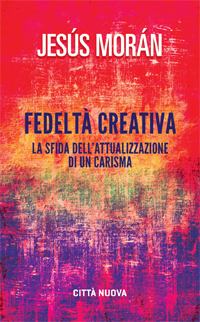 With a radio transmission emceed by Alessandro De Carolis, Radio Vatican journalist, the author dialogued with Fr. Julián Carrón (president of the Communion and Liberation Fraternity) and Maria Grazia Vergari (vice president of the Adult Section of the Catholic Action). Here are some excerpts of the interview that Giorgia Bresciani, journalist of “InBlu Radio,” held with Jesús Morán on 30 May: G. B.–The presentation of your book was the occasion to experience a moment of dialogue and fraternity between the ecclesiastic movements. In the Pentecost of 1998, John Paul II and at that time, Cardinal Ratzinger initiated a joint pathway of communion between all movements. What do you think happened that day and what point of that journey have we reached? J.M.–I think that 29 May was really blessed by the Holy Spirit, and was a grace for us. I remember that Feast of the Pentecost of 1988 vividly, and it was one of the most beautiful days of my life. It seemed as if the first Pentecost had become a concrete reality, due to the presence of many people, and an unforgettable day! I had arrived from Chile where I was living. It was effectively a historic moment, an ecclesial event because for the first time, the new movements had gathered in St. Peter’s Square all together. It was a fundamental encounter between the charism of Peter and the charisms created by the Holy Spirit in our epoch. It was like going public, giving visibility to the ecclesial charisms, and an “acknowledgement” of this fact. Since then the journey has progressed with ups and downs. This experience extended also to ecumenical levels and saw the creation of “Together for Europe.” We thus committed ourselves to the unity of all Christians. Then there were other joint encounters between the movements. Over the years, however, some of the founders passed away, and obviously this slowed things down: the deaths of Fr. Giussani, Chiara Lubich and other leaders, had an impact because this reality of unity and communion of the movements had been decisively their idea. An occasion like that of 29 May is a push to continue their work. We are now in a post-founding phase and have to restart from that “prophecy.”And the presentation of my book is oriented in that direction. G.B.–You mentioned the death of some founders. Precisely you, Maria Voce, and Fr.Carrón, are in that “post-founding period,” the “second phase” which is a tricky one: you have a complex and exciting task. In the light of your position, what do you think an ecclesial movement needs most in this phase? J.M.–I believe that the “post-founding” phase isalso a charismatic one.There are different types of graces from those bound to the founding moment, and lies in the perspective of the incarnation: the great challenge is that the charism, following the trail of the founder, increasingly becomes “history.” It is thus a phase of service to the Church and to humanity. This calls for a different kind of maturity. We have to work together, bringing to light personal and community talents, because when the founder is present, the light of the charism is very strong, and the founder “incarnates”it almost by herself. Now God wants us to start up our charismatic intelligence and our forces. And we have to do it together! This is the great challenge. This is what I tried to say with this concept (already used by John Paul II) of “creative fidelity”: faithfulness to the charism, and at the same time, capacity for innovation and creativity, always a fruit of the Holy Spirit, and greater insertion into the Church and society.

19 Jun 2017 | Focolare Worldwide
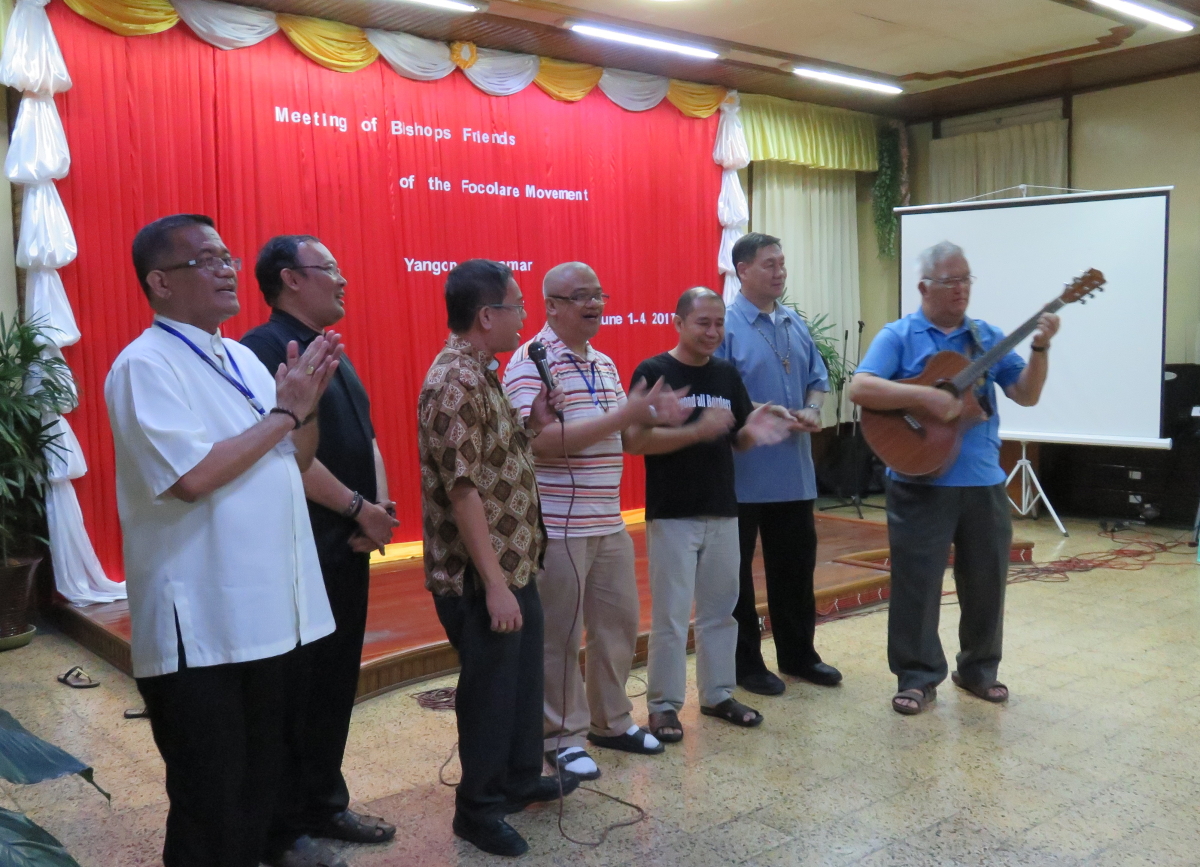 “That all may be one. We were born for these words of unity, to contribute to making it a reality in the world.” The words of Chiara Lubich, commented on by Bishop Felix Liam, President of the Episcopal Conference of Myanmar, on the first day of the meeting (1- 4 June 2017), well evidenced the aim of the convention held this year in Yangon, Myanmar, a country in Southeast Asia, on the western side of Indochina. These conventions held every year at international, ecumenical and regional levels,began about 40 years ago on the initiative of Chiara Lubich and Klaus Hemmerle (1929-1994), then Bishop of Aachingen, (Germany).. In Yangon, with a strong presence of the episcopate of Myanmar (19 bishops), there was a warm family atmosphere. Among the 31 participants,a good number came from the Philippines, India, Malaysia and South Korea. In communicating his experience on his encounter with the spirituality of unity, Cardinal Francis Xavier Kriengsak of Bangkok, moderator of the bishop-friends of the Focolare, invited the bishops to discover and deepen one of the fundamental points of the spirituality of unity: Jesus crucified and abandoned, and place it in the centre of their lives in order to become instruments of communion in the Church and humanity. This was also testified to by the experience of the members of the local community of the Focolare who had prepared to welcome the bishops in the best way possible. But also some bishops, like the Irish Bishop Brendan Leahy, see in the mystery of Jesus forsaken, the “countenance of mercy, key to dialogue and unity, and pathway to the sanctity of the people.” The life of Bishop Klaus Hemmerle was conveyed through a PowerPoint presentation and brief videos that showed the amazing fruitfulness of love for Jesus Forsaken even in the most “critical” situations. The themes on Evangelisation and Inculturation in the spirituality of unity were very actual and trigged particular interest in a country which is mostly Buddhist.
 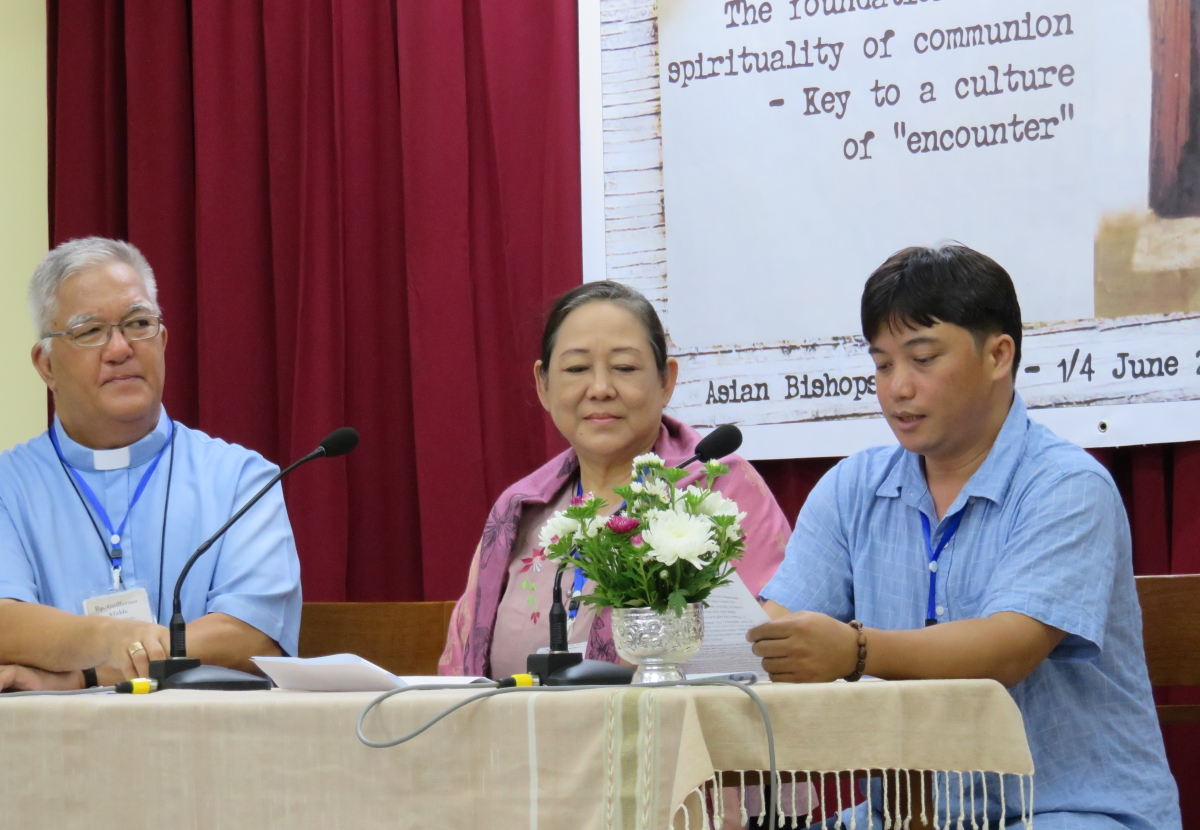 The story of Chiara Lubich and the Movement she had given life to, along with the experiences of the members of the local community, was very moving. Cardinal Carlo Bo, archbishop of Yangon said: “I was very impressed by the story of the charismatic and prophetic life of the founder of the movement. More than ever the Church needs movements like the Focolare. While the arrogance of power divides people according to colour and race, Chiara created a global communion for worldwide peace.” Bishop Matthias (Myanmar) commented: “When one usually participates in the meeting of bishops, we listen to many things, but on an intellectual level. Instead, here we talk about life and we see happy people.»And Bishop Isaac (Myanmar):“The life of a bishop is not easy, and we ourselves often feel abandoned. Now that I have met Jesus Forsaken, I will have the strength and the light to go ahead.” From Korea, Bishop Peter added: «It is the first time for me to participate in a meeting of bishops. Here I saw people who try to love Jesus Forsaken in every difficulty; people who are behind the wings, try to serve all of us,» referring to the members of the local community of the Movement. Openness to cultural and interreligious dialogue was assumed in the golden colours of the Pagoda of Shwedagon, the most important and renowned in the capital, and in which the relics of the four Buddhas are jealously guarded. The visit to this sacred place on the hill of Singuttara, to the west of Royal Lake, was a symbol of respect for the Buddhist soul and the culture of the place. At the top of the Pagoda, a banner-like anemoscope scattered with precious stones, displays the direction of the wind. If sufficiently supported, its fluttering is accompanied by the sound of tiny bells. The Myanmar bishops are certain of which direction the wind is blowing: in the direction of unity, towards a Church which is increasingly a witness of “communion”.
18 Jun 2017 | Non categorizzato
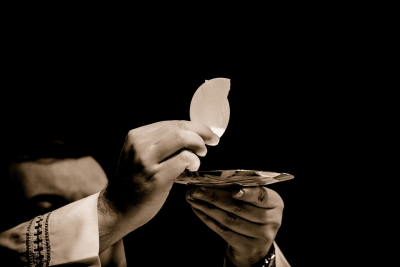
“A piece of bread, transformed by Jesus to satisfy the hunger of every heart: this is Jesus’s story reduced to the bare bones. It’s ours: the little path for his love, love strong in weakness.” (From an article, May 1980) “Every time we celebrate the Eucharist, what takes place is not only a pleasant communion with others in the spirit of Jesus as a mere idea or feeling. No, every time we celebrate the Eucharist the most radical wall of existence is brought down, the wall of death; what happens to us is pure gift, gift that is truly conferred to us. It’s proximity, proximity within which the mutual distances – both interior and exterior – are obliterated. In the Eucharist, not only do we become one body with each other, but we become His body for the world. For anybody who is truly permeated by the Eucharist this world and this society can no longer remain indifferent. They now have this dynamic in them, dynamics of God who offers himself, who gives himself, who carries with humanity as something of his very own and intimate to him, all that humanity carries, all that it does.” (Conference, August 31, 1977) “What’s important is not only that we have the Eucharist here in our community. We retain the spirit of Jesus only if and when we concretely love the other’s community as our own, if and when our communities open beyond the barriers that separate them and if in the midst of the communities lives the Lord.” (From an article, May 1979) Source: La luce dentro le cose, Klaus Hemmerle (Rome: Città Nuova, 1998), 190, 186, 187, 192.

17 Jun 2017 | Focolare Worldwide
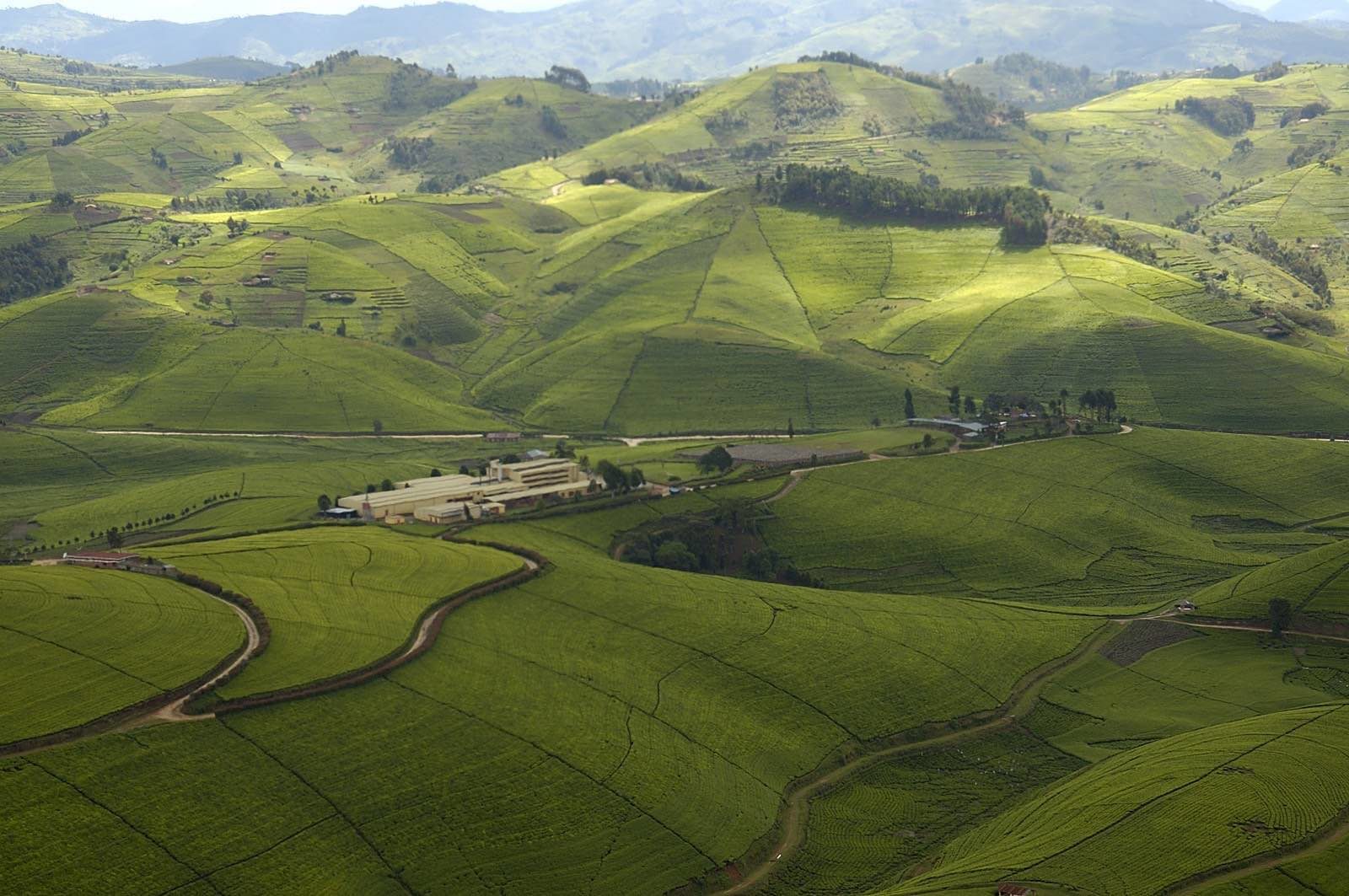 My path began on the last day of the Rwandan calendar, the day in which we remember the massacre that happened in 1994. I know that Jesus Forsaken can give meaning to every human suffering, especially the ones that leave the deepest wounds in our hearts. I sense a profound bond between the sacrifice of Jesus and the pain and suffering of the Rwandan people. Under the guidance of Father Telesphore, a local priest, he became acquainted with the capital city of Kigali known for its attractiveness. The signs of economic growth, however, can especially be seen in the centre of the city which looks like a European capital. But not far from the modern buildings there are the common folk, bound to agriculture and selling their products at market: fruit, vegetables, chickens, and so forth. Due to my white skin and tall stature, my presence doesn’t go by unnoticed. I encounter many surprised faces, but it’s enough to offer a greeting of “muraho” or a smile and the ice melts into a nice smile. We visit the main cities of the country by car, stopping now and then to give someone a ride. I was particularly struck by one young woman around 20 years old. Behind her pretty smile was a painful story. Fr Telesphore tells me that her parents were killed in the 1990 genocide. She had just been to their tomb where she went to pray. She and her young brother have been visiting Father Telesphore since they were young. They found a family that filled them with love. I met many other people in situations that were similar to theirs. We spent Saturday at the seminary school of theology which takes in 130 seminarians from around the country. At the Mass, which was imbued with Rwandan culture, I was very touched by the Thanksgiving After Communion with songs that engaged the whole assembly. It was like a sacred rythm, not perfectly synchronized, but incredibly harmonic. At one seminary we held a “school” for seminarians who wanted to know about the spirituality of unity. Right from the start, Father Telesphore clarified for everyone that “this school is not run with books, but with life” and that “we’re here to build the unity Jesus desired, through our reciprocal love.” The Gospel love among everytone could be felt in very strong and concrete ways throughout the meeting. After a basketball match, I found myself asking who had won? The answer: everybody. Where there’s love, competition becomes an occasion to live the Gospel. We focused on the mystery of Jesus Forsaken, which is one of the points of the spirituality of unity. We were all moved by the testimony of two priests, one from Rwanda and the other from Burundi, lands that are marked by mutual misunderstandings. But through love towards Jesus in his abandonment, those misunderstandings gave way to unity between the two priests. One of the seminarians spoke for everyone: “When you speak with the heart, you touch us in the heart.” The last days were dedicated to meeting with families and young people, but also other people who share the ideal of fraternity. We concluded with a pilgrimage to the Shrine of Our Lady, which was not far from the seminary. We wanted to thank her for this trip and for the immeasureable gifts we all recevied. (Armando A. – Brazil)
16 Jun 2017 | Senza categoria
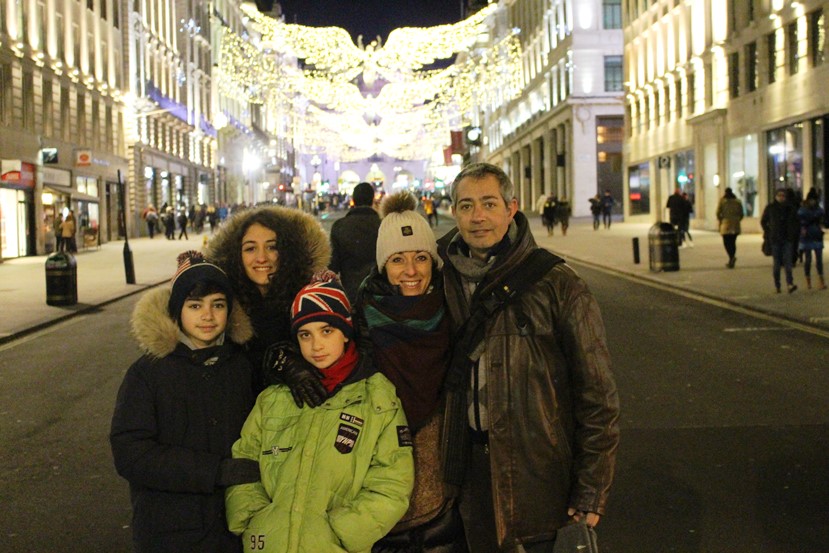
When we started seeing each other, Hani and I were very much aware of the differences that existed between us, especially with regards to doctrine. But we felt that our love was stronger than any difference; this gave us the courage to believe that there was a special plan of God for our marriage that went beyond us. Through the spirituality of the Focolare Movement, which we had both got to know in our youth, we learnt that in order to reach unity we had to aim at what unites us – which is considerable – rather than looking at what divides us. Of course, when we go our separate ways for Sunday Service, it’s always a suffering, as when unintentionally we might refer to “us” and “you” in our discussions, or when our human reasoning wants to criticise the Church of the other. When this happens, we realise that unity isn’t built once and for all, but that each day God asks us to choose to love the church of the other as our own. Furthermore, we have learnt that each time we experience disunity, it’s an opportunity for us to offer this pain to God for the complete unity among Christians. There are times, however, in order to live unity more fully among us and in our family, when we might attend either one Church or the other all together, and to take part in some of the spiritual practices, such as fasting for example. An important moment for us was the baptism of our first child. We discussed the issue at length, but we could not decide which was the right thing: whether to have a Catholic or Orthodox baptism. While the Sacrament was the same for both Churches, the consequences would have been profoundly different. Hani, in fact, is a deacon and he was temporarily removed from his Church because of his mixed marriage. A Catholic baptism for our child would have put him in a difficult situation. We found it hard to make a decision, but then I realized that I should consult my bishop about it. I went to him and told him the whole situation. I felt welcomed by him and listened to in depth. The bishop was grateful that I had sought his advice and he assured me that he would understand and support any decision that Hani and I took, following our conscience. At that point, it was clear to me that, for the sake of Hani and his Church, it was best to have an Orthodox baptism. On this occasion, as in many others, it was not a question of making compromises, but to discern God’s will in that circumstance. Naturally this entails making an extra effort, which sometimes costs blood, sweat and tears, also with the children who, when still little, could not understand why they could receive Communion in the Orthodox Church, but not in the Catholic Church. In fact, in the Orthodox Church, the sacraments of communion and confirmation are administered simultaneously during baptism. We went through a rather difficult time last year with our eldest daughter, who was then 15 years old. She started demanding to be more independent and was being aggressive about it. We were unprepared for this sudden change. There were daily quarrels, often quite heated. We wanted to protect her from situations which we considered precarious, but the more we checked up on her, the more she rebelled. I spent so many nights crying for this daughter I felt I no longer knew. It was not easy between us either, because I thought the way Hani handled the situation was not optimum and so we argued a lot. But in all this confusion, we always tried to be faithful to some practices that seemed important to us, such as praying all together, or having the humility to ask pardon when necessary, even with the youngest ones. At a certain point, we realised how important it was to maintain unity between us. We decided to show complete trust in her. The situation improved significantly at home, which confirms that even in a mixed marriage it’s possible for the married couple to “be one in God” and to give this witness to the children and the world around us.
