18 May 2018 | Non categorizzato
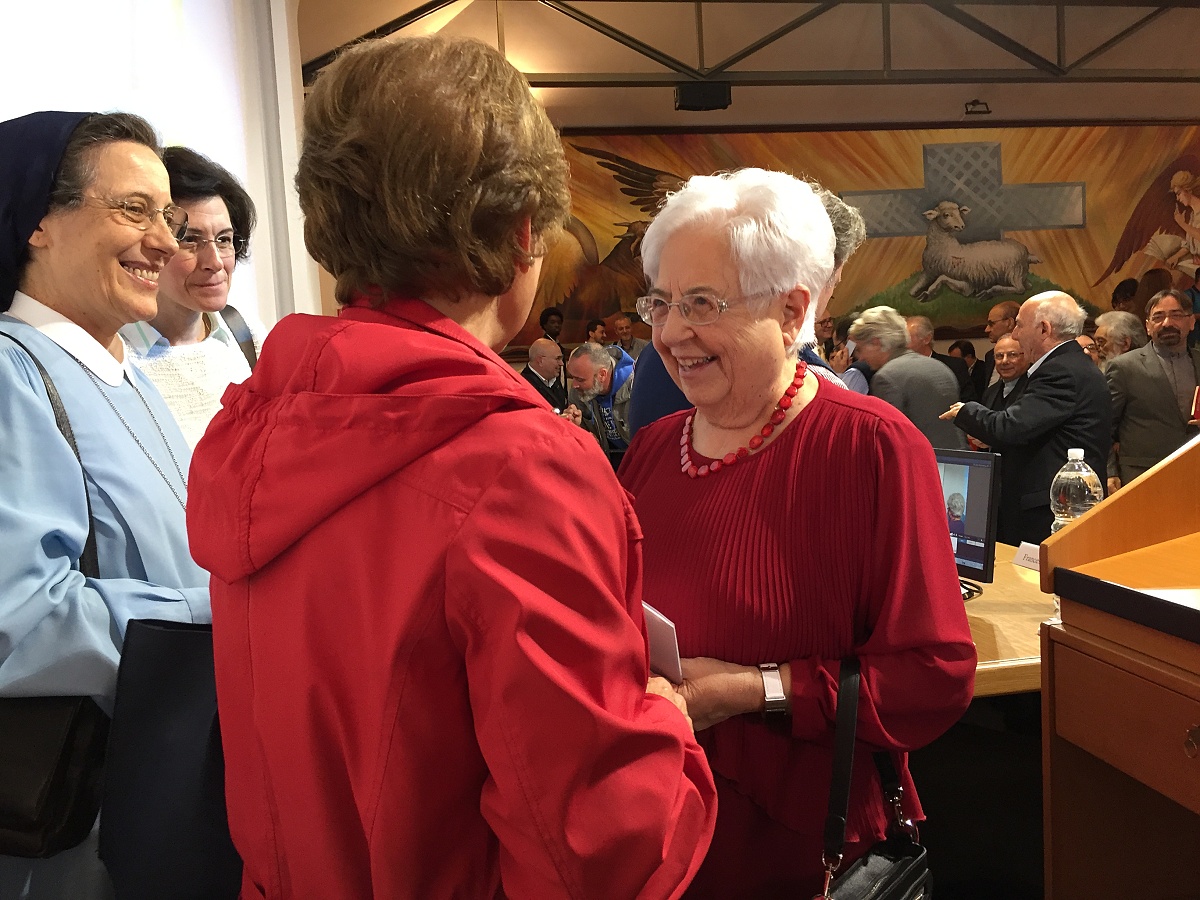
“When Jesus was no longer physically present on earth, Mary lived with the Church, the continuation of Jesus. To outward appearances, she would have seemed to be the mother of John, representing all disciples, rather than the mother of Jesus who was no longer to be seen. So Mary was found in the heart of the Church, in the cenacle, the “upper room”. She had withdrawn there from Mount Olivet with the Apostles, disciples and pious women after the ascension. The Apostles “were constantly devoting themselves to prayer, together with certain women, including Mary the mother of Jesus” (Acts 1:14). The first Church – according to Saint Luke – formed “one heart and one soul” and “none of them was in need”, all gathered around the one table. How was such communion possible, making them all one? It was because Mary was there, hence the Holy Spirit was there. So the ideal of the Son was fulfilled and the Father reigned there. His kingdom had come, with the presence of “our Father who art in heaven” and “our daily bread on earth”. The Magnificat was being expressed again and diakonia – service, was being lived out. The function of Mary – a function of love, and therefore of the Holy Spirit – was and is that of unifying, putting heavenly and earthly goods in common. In this way the mystical body of Christ is raised to life; generating Jesus for the world; and in him she unifies souls together, setting them in wisdom. She is the model for mothers of Christian homes, with a heart that unifies, a mind that enlivens […], igniting the atmosphere of warmth (of “focolare” = fire place), where all feel as one, cells of the one body. Aware of this mission, which is to participate in the work of Christ, woman – associated more than any other creature with the work of creation – finds it easier to turn to the Creator. She can confide more tenderly with Mary. Following her example she can endow her intimate home life with both virginal purity and maternal warmth. In this way she can come to resemble the Virgin Mother. In the cenacle, Mary represented Jesus and hence bore the highest dignity, spiritually sustaining the juridical pre-eminence of Peter. But what came to light in her way of being was a soul who completely identified herself with the Church, making it her own, blessed fruit of her womb, hidden, losing herself within it, as a true ancilla Domini, handmaid of the Lord. In fact, all the faithful, laity included, must live the Church, in the Church, with the Church, always with this same sentiment. In this way the Church will no longer seem to be something extraneous, but will be their own, their life, the centre of their sanctification. Neither words nor special attire are needed. It is sanctity that needs to be lived within the Church. And the first fruit will be its unity. Mary inspires “many different forms of apostolate by the laity. … There are souls yearning to live the doctrine of Jesus more openly and more completely. There are souls burning with the desire to make him known to others, particularly to their work colleagues. There are those desiring to re-establish justice and charity within social institutions and to introduce into the temporal order of society a reflection of the perfect harmony that unites the children of God. To all these souls, Mary obtains the grace of the apostolate. She places on their lips words which can convince without wounding …” (Pope Pius XII). Mary is a social reformer, a credible model of apostolate, a symbol of charity, font of justice. No small number of lay movements look to her in order to contribute towards building unity, that ideal testament of Jesus, in a “Mary-like” manner, preparing for the city of God on earth. Mary, in fact, has been viewed by the saints as the “city of God”. Igino Giordani, Maria modello perfetto, Città Nuova, Roma, 1967 2012, pp.150-152.
18 May 2018 | Focolare Worldwide
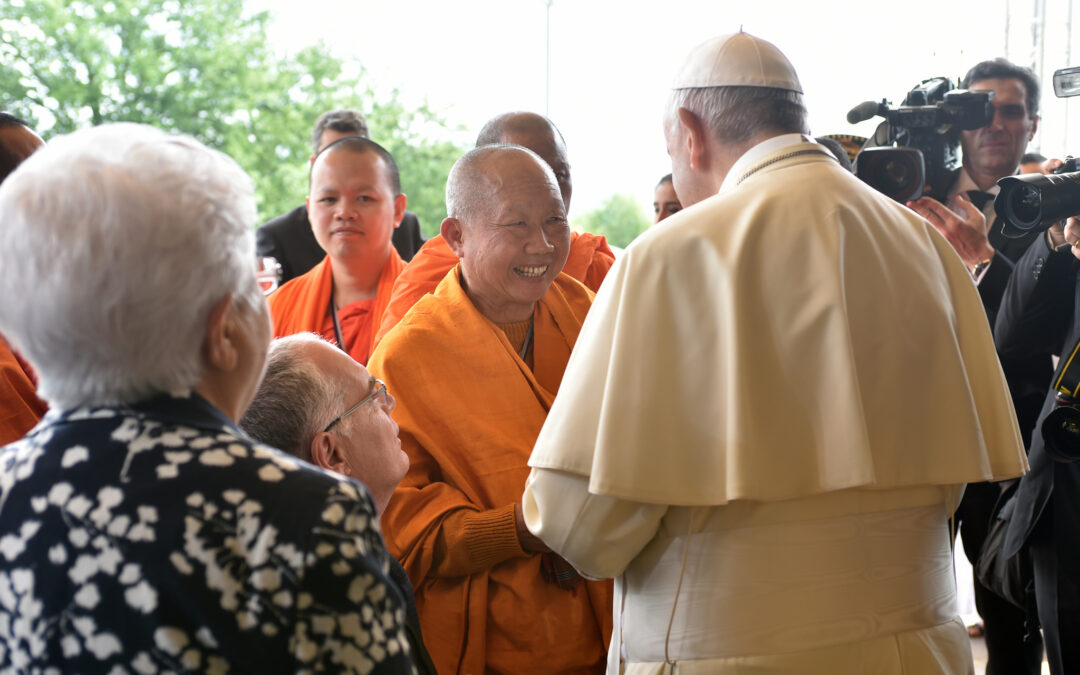
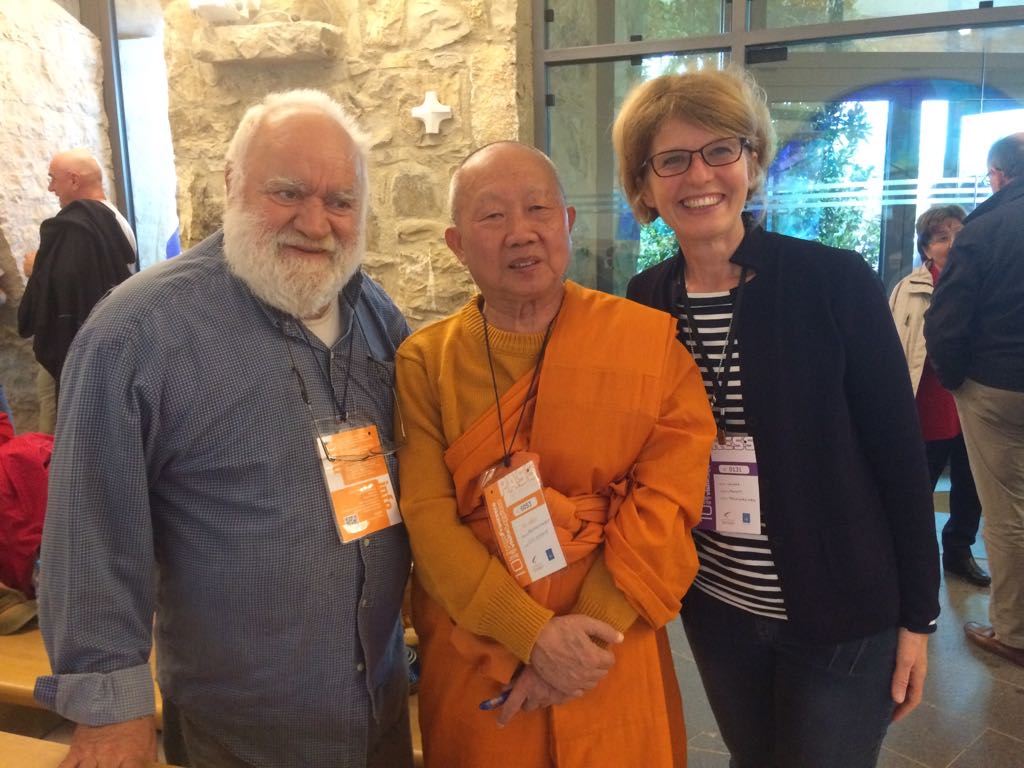 “Recently, just before the Holy Father visited Loppiano, I was in close contact with five Buddhist monks from Thailand,” says Luigi Butori. Originally from central Italy, Butori has lived in southeast Asia for close to 30 years. “I speak their language, and for the occasion I was their interpreter. It’s been an intense, profound, and demanding experience. “When they visited the Focolare Movement’s international center for religious near Rome, they were struck by way two religious brothers, who are no longer so young themselves, served them concretely and did everything they could for them. That’s when the monks began to perceive a light, a harmony, or as one of them put it: a unique ‘voice’ within and around them.” “The monks’ stay continued with a visit to the capital, accompanied by a guide who is a focolarina. The monk’s saw that her eyes ‘had that same smile as the brothers we met earlier.’ Then they spent a day in the city of Lucca, with the Focolare community there – close to 80 people ages 2 to 94. ‘You could see the same light in their faces,’ they said. “The monks briefly stopped for a few hours in Pisa, where the Leaning Tower is, and there was someone from the local community there. They had the same smile. “At this point one of the youngest monks exclaimed, ‘This child of Chiara Lubich has the same type of smile that we found in Rome, Castelli and Lucca – how is that possible?’

Buddhist monk Phramaha Thongrattana Thavorn (Luce Ardente) greeting the pope – Foto © R. Orefice – CSC Audiovisivi
16 May 2018 | Focolare Worldwide
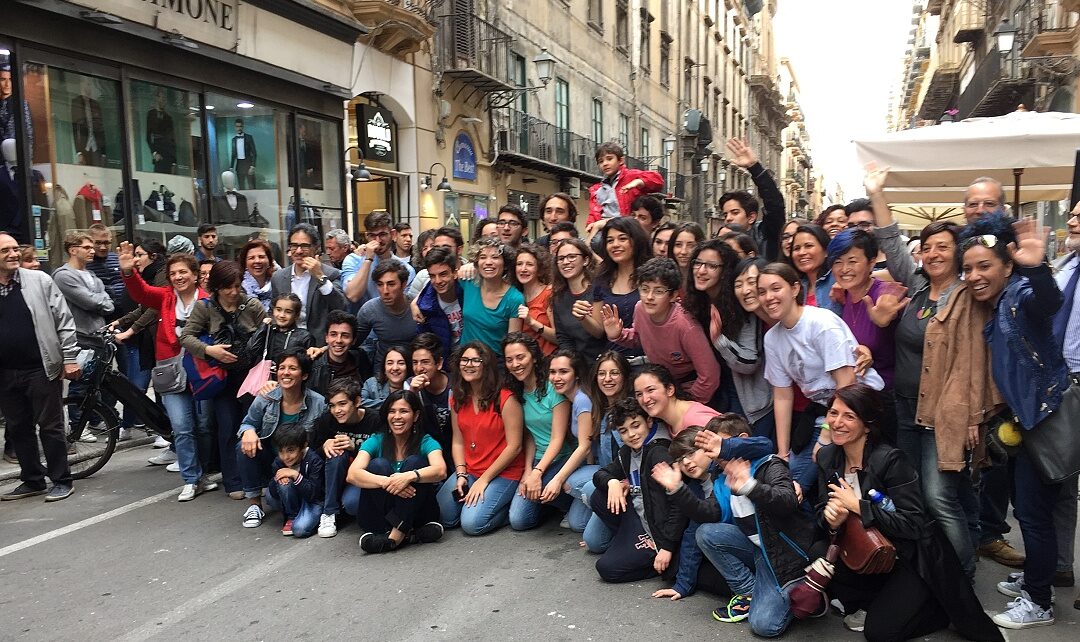
 Focolare president, Maria Voce, concluded the event dedicated to the culture of unity and brotherhood, with a meeting of the family dedicated to the Focolare in the capital of Sicily, by offering a challenge: “That Palermo may become the capital of the culture of Resurrection, capital in the sense of “il capo”, (head city) from which the culture of Resurrection flows into the whole world.” Twenty years ago Chiara Lubich had received honorary citizenship in the Sicilian capital. Sincne then, the community has continued to follow this journey of striving to incarnate the words she spoke on that occasion: “Let us promise that Palermo will be forever in our hearts, until, through the audacity and courage of its citizens, it will become a model for many other cities within and beyond Italy, a true city on the hill.” The event, which was part of the Palermo, Capital of Culture 2018, promoted by the Municipality, embraced several fields: Law and Order, ecumenical dialogue, music and show with Gen Verde, workshops, flashmobs and roundtables promoted by the young people. More than 120 people took part in the Relationships and Law Meeting at the Regional Pariliament Building on May 11th. The gathering included presenations by several leaders from the world of Law and Justice, lawyers, students and scholars. Maria Voce concluded the discussions saying that the field Law and Justice is in extreme need of “poeple whose hearts are open to the grand ideal of the unity of the human family, and that for this reason put their whole self into working concretely for the healing of relationships, without fear or comprimise.”
 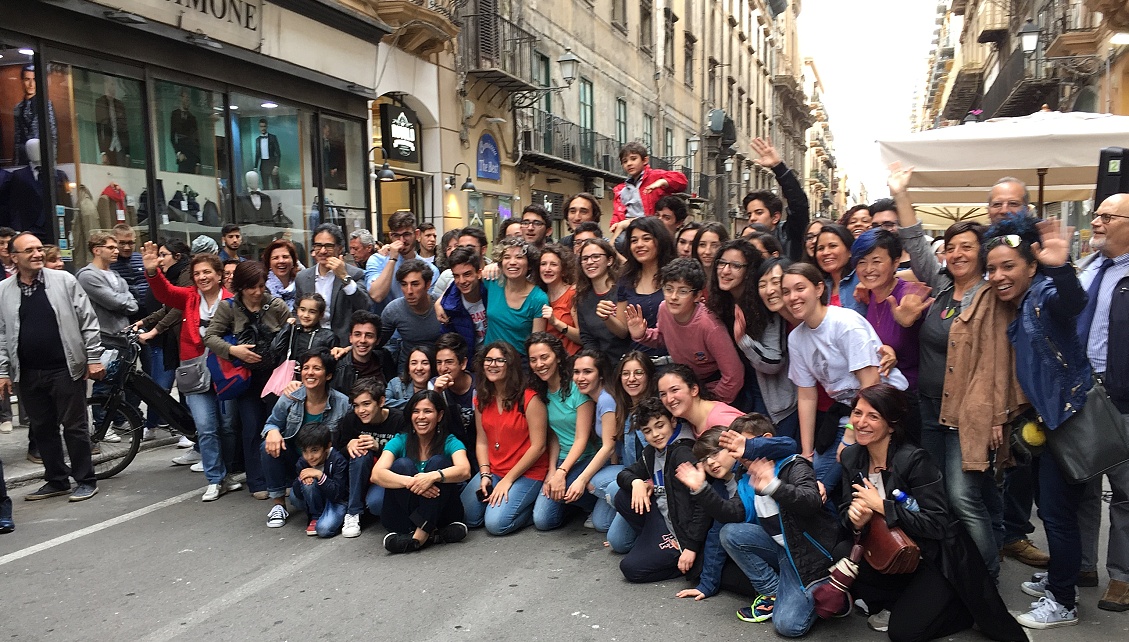 In the afternoon more than 300 young people held a programme on titled Digital Identity, promoted by IUS, and We are the choices we make” presented by Jesus Moran, co-president of the Focolare, and Mayor Leoluca Orlando. The young people presented testimonies of the choices that sometimes place them in crisis: whether to stay in Sicily or put their lives on the line and move to other cities or countries. Jesus Moran encouraged them to find the way to give of themselves. The choice falls back on “where can I give myself more and where can I develop my talents. […] Of I leave, I can’t just go to escape. If I stay, I can’t just stay our of fear.”Mayor Orlando stressed how difficult it can be to change a city that comes from years of submission to mafia rules and behaviors, and redeem oneself through a change of culture. In the morning of May 13th, there was a family moment at the celebration of the Mass, followed by a meeting for families in the historic neighbourhood of Albergheria/Ballaro with an artistic event for children. In the afternoon 500 representatives from more than 20 Christian Churches took part in Together in Charity, from Dialogue to Collaboration, at the Golden Theatre. The regional archbishop, Corrado Lorefice, Maria Voce and the director of the Director of the Regional Office for Ecumenism, Erina Ferlito made presentations. The testimonies described the journey begun by several cities of Sicily: from assisting prison inmates, to caring for the poor, the homeless and immigrants. Then there was the “On the Other Side” concert with Gen Verde and more than 800 people. In the preceding days there were exhibits by young people, workshops run by the band and a flashmob on one of the main thoroughfares of the city. This was also an overwhelming experience that excited by the youth and adults with the message of brotherhood that the international band brings around the world.
15 May 2018 | Non categorizzato
The month of Ramadan started on 15 May and will end on 14 June. In this period of 29 or 30 days, the Muslims recall “the month in which the Koran was bestowed on mankind as a guide with clear teachings showing the Right way and a criterion of truth and falsehood” (Koran, Sura II, verse 185). During this period, prayers and acts of mercy are intensified. All those who are able shall fast from dawn to sunset, constituting the fourth of the five pillars of Islam. According to many theologians the spiritual meaning of fasts, together with prayer and meditation, sexual abstinence and renouncement in general, refer to the capacity of man to exercise self-control, patience and humbleness and remember to help the needy and less fortunate. Ramadan is thus a sort of exercise of purity against all the worldly passions, the benefits of which fall on the faithful all year long.
