21 Feb 2018 | Focolare Worldwide
In preparation for the 9th World Meeting of Families, the Pontifical Council for the Laity, Family and Life has published seven catecheses which are available on its site in five languages (English, Spanish, French, Italian and Portuguese). The meeting will take place in Dublin from 20-26 August 2018. Card. Kevin Farrell, Prefect of the Council defined the catechesis as “A catechetical program in the light of what Pope Francis donated to the entire world with the post-synodal Apostolic Exhortation Amoris laetitia.” The themes to be presented are: “Families today,” “Families in the light of the Word of God,” “God’s great dream,” “The culture of life,” “The culture of hope” and “The culture of joy.” Card. Farrell explained: “Each catechesis is introduced by some prayers drawn from the pontifical magisterium or from patristic tradition, and concludes with the requests for a moment of sharing that starts from the family, the first domestic Church, to then extend to the Christian community.” The catecheses are accompanied by a musical itinerary sung by the renowned Italian singer, Andrea Bocelli, in a concert at the Sagrada Familia Basilica of Barcelona in May 2015, and is the first of a series of repeated concerts within the ambit of the project entitled “The Great Mystery. The Gospel of the Family, School of Humanity for Our Time,” and also in the shrine of St John Paul II in Cracow, and in the St. Stephen Basilica in Budapest. (www.laityfamilylife.va/)
20 Feb 2018 | Non categorizzato
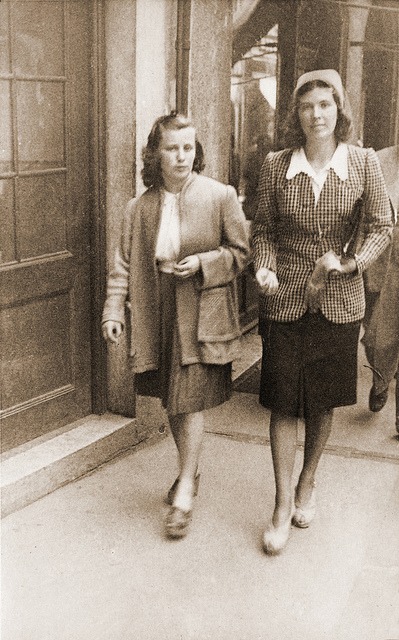
Gis and Ginetta
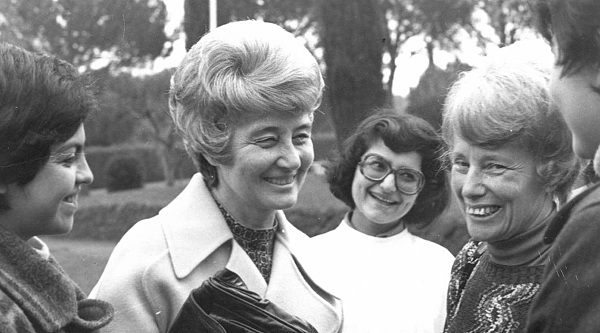 When the war ended Gis and Ginetta asked their mother to let them live in the focolare. Ginetta got permission, but the little one no. She didn’t give up: she knew that her decision was final and it would only be a matter of time. The solution was found by Igino Giordani who, knowing Mamma Calliari to be one of his passionate readers, offered Gis a job in Rome. On December 6, 1949, the mother was happy to opt for Giordani. She let Gis leave for Rome, oblivious to the fact that besides being the judges secretary, she would open the first focolare at the capital of Italy with Chiara and others. From then on Gis lived at Chiara’s side with a few short interruptions to start up focolares in several places around Italy. Speaking of those 25 years with Chiara, in 2005 she confided: “It’s very simple, limpid, profound: all that is hers is mine, all that is mine is hers.” It was a remark that fully represented who Chiara was for everyone in her focolare: “Philadelphia is more than a reality,” says Chiara. “It’s here where I take strength to face the daily crosses (after the personal union with Jesus). Here you go from Divine Wisdom that’s shared spontaneously, to practical advice on health, a dress, the house, the food; to constant little helps, every day, with sacrifices that could never be counted. Here […] The blood that flows between us is of a home, but a heavenly home.” “In her office,” Gabri Fallacara recalls, “she telephoned everybody, building a network of love, incisive, open and understanding. With absolute trust she placed herself in the most favorable conditions for discerning what the charism of unity asked, day after day, of Chiara and of us.” Following Chiara’s death Gis continued living for everyone, in spite of her failing capacities, she was a gushing fountain of tenderness and affection. In July 2017 her worsening health transformed her room into a crossroads of heavenly encounters. On January 2018, Gis peacefully left this world. “Right to the end she continued to give of herself in order to make Chiara continue to live in the Movement today. She gave me a big lesson of simplicity, radicality, trust in God’s plan and unity with all.”
20 Feb 2018 | Non categorizzato
In remembrance of persecuted Christians around the world, on Saturday 24th of February the Help to the Suffering Church (ACS) will colour the Roman Colosseum red. In the same context, two other symbols of the recent persecutions of Christians will be painted the same colour: St Paul Cathedral in Mosul, Iraq, and the Maronite Church of St Elia in Aleppo, Syria. After the Trevi Fountain lit up in red on April 29, 2016, ACS returns again to offer this “sober provocation” in the capital, as the director of ACS-Italia, Alessandro Monteduro explained during the press conference held for the event. The main event will be held in Rome, in Largo Gaetana Agnesi, starting at 6 pm. The general secretary of the Italian Bishops’ Conference, Mgr. Nunzio Galantino, and the president of the European Parliament, Antonio Tajani confirmed that they will be present. Source: SIR
19 Feb 2018 | Focolare Worldwide
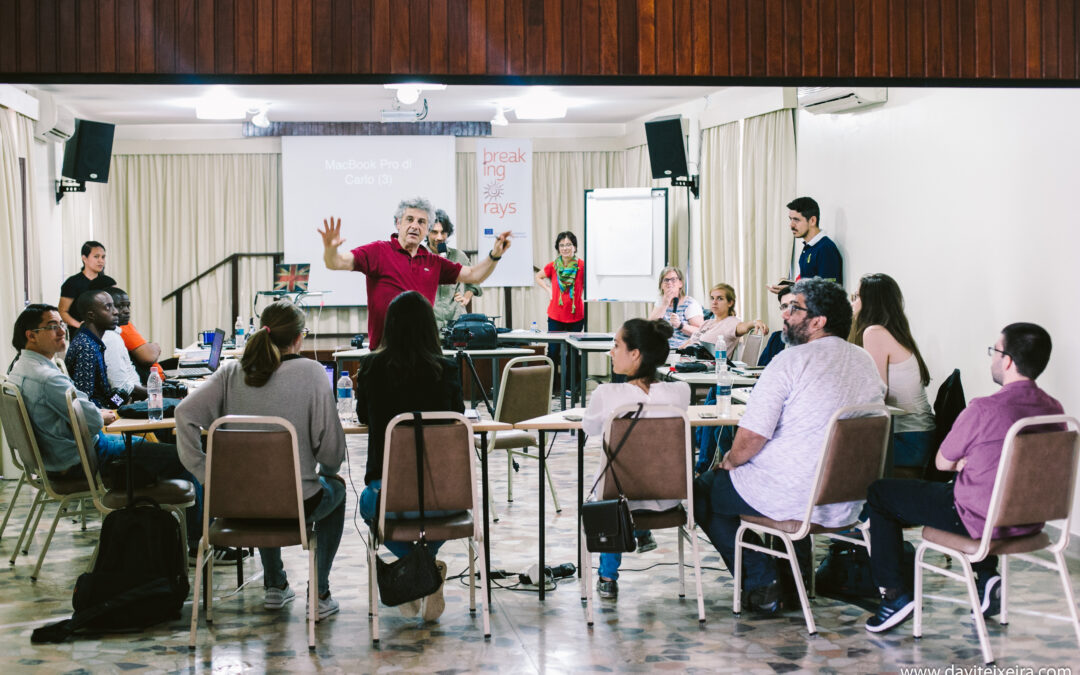
 “Breaking Rays” is a play on the words “Breaking News” which are used to describe the interruption of some latest sensational news story. The sensational news this time was a project for the promotion of fraternity and a group of young communication workers who, with passion and skill, are stepping up to produce some maximum results. Breaking Rays aims at building an international network where experiences inspired by the charism of the Focolare Movement can come out of isolation and “break” onto the global scene, creating a widespread domino effect in other communities. Co-financed by the European Comission through the Erasmus+ and promoted by the international New Humanity Association in collaboration with CSC Audiovisual Centre, Italy, and other NGOs, the project is for young filmmakers and collaborators of the bi-monthly telephone CH Link-Up with news of the Focolare Community around the world. They already got through the first and second stages in Castelgandolfo, Italy, last July; and at Mariapolis Ginetta in San Paolo, Brazil on February 3-10. The next and final stage will take place concurrently with the Genfest, July 2018 in Manila, Philippines.
 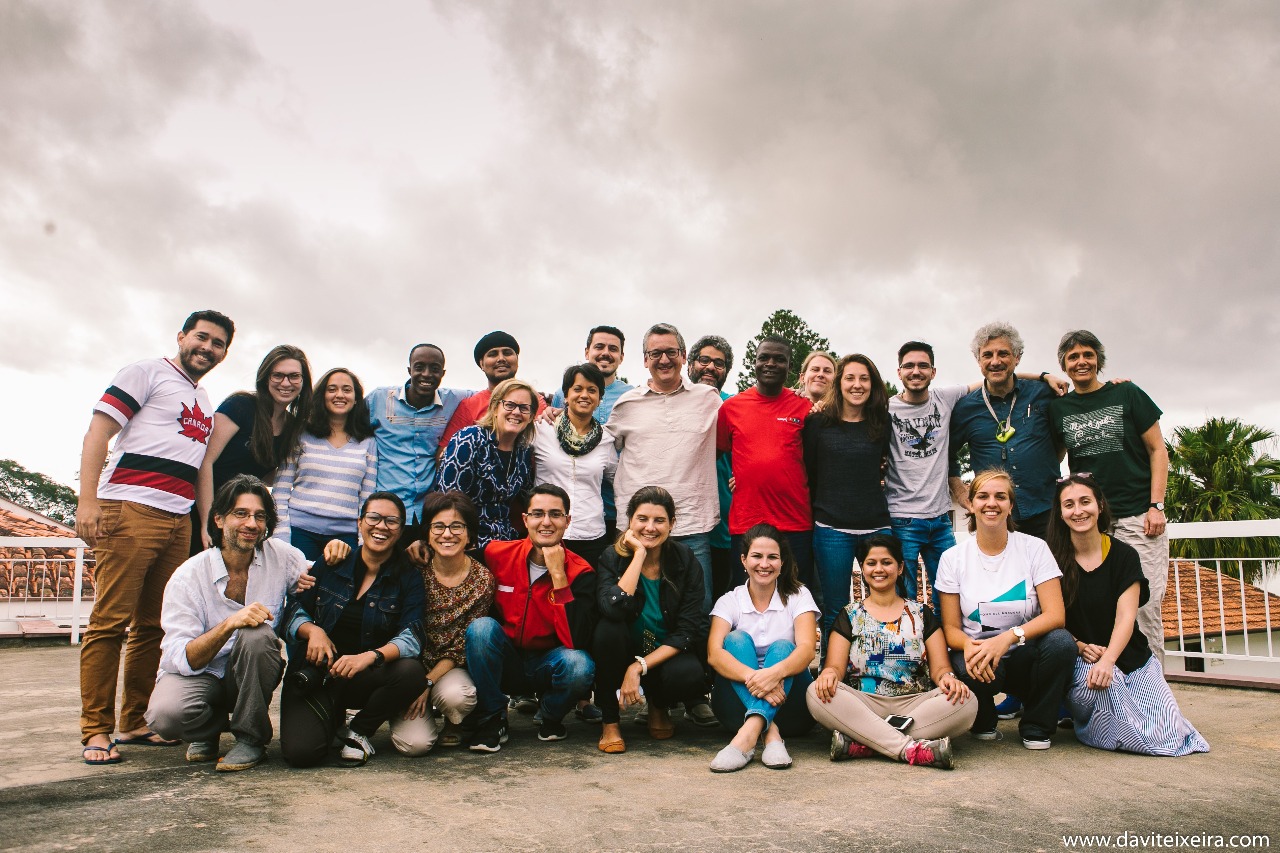 Twenty young people from different countries (Brazil, Italy Hungary, Indonesia, Philippines, India, Kenya and Burundi) have already arrived in Mariapolis Ginetta with a variety of skills, to be coordinated by professional tutors: Italian film director from RAI-TV, director of photography, Carlo Sgambato, project director, Kim Rowley from CSC audio-visuals, along with Isabela Reis, producer and curator of cultural audio-visual projects. With them there is also Paolo Cipollone from CSV Audiovisuals and coordinator of the project. Theoretical and practical training, along with experimenting with new techniques will alternate with work and a common life that will support a communion of talents and openness to constructive criticism. The group has made several visits to social projects of the region, making videos and interviewing. During other sessions, several experts in the field of communications (dreicting, television and radio journalism) have told their own experience and answered questions from the participants.
 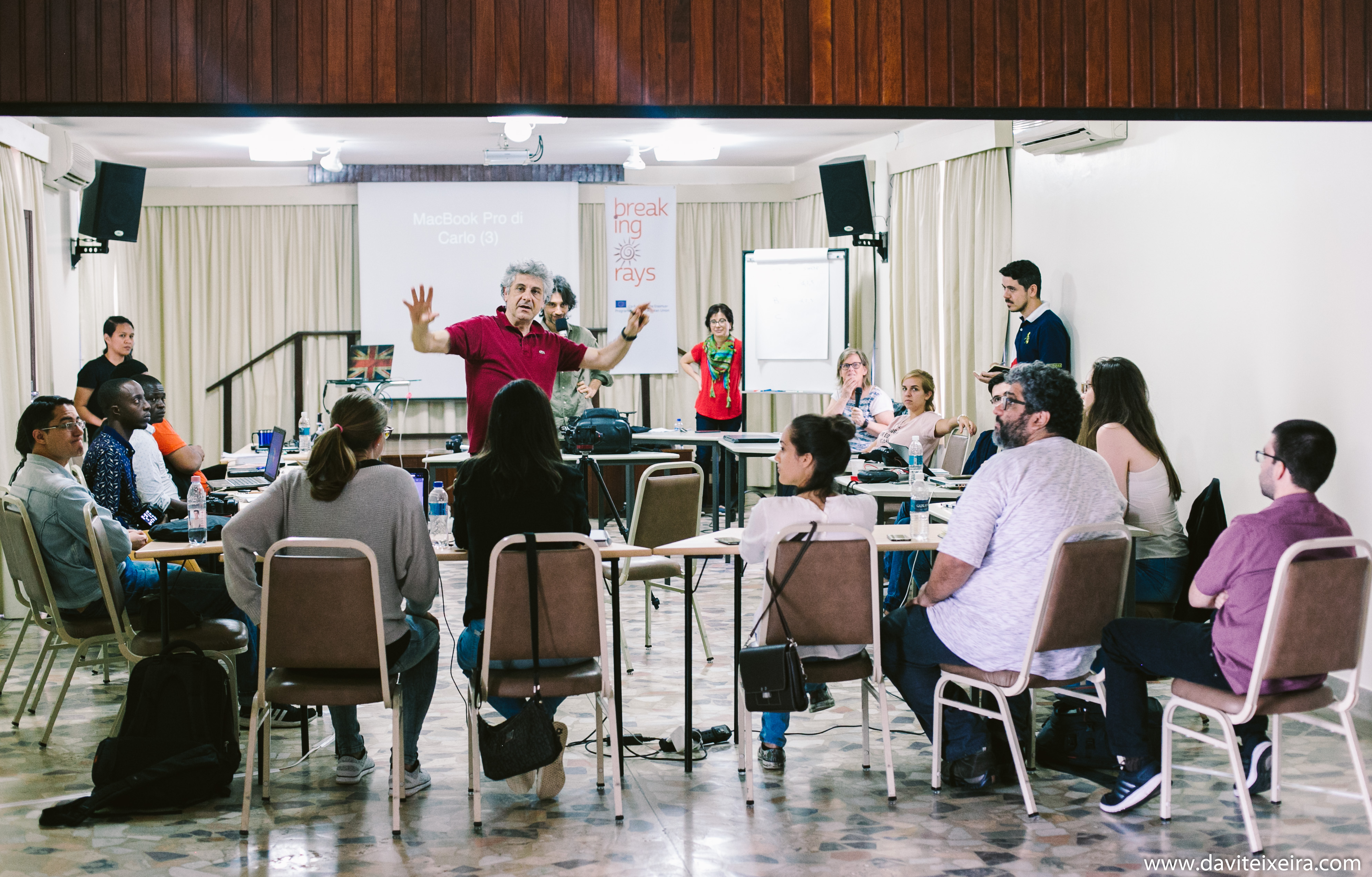 A unique experience in which to learn and go deeper into the profession of a journalist from a new perspective,” said Lewis from Burundi. “More than a course on film-making, powerful stories shared about how to make a better world,” said Donald from India. The team and experts helped me to develop an eye for detail and how to shatter stereotypes and cultural cliches, using audiovisuals.” Full-time tutor Isabela Reis from Brazil explains: “I think it’s a project we can be proud of. It was a strong experience that engaged us for eight days. It was useful for improving the ability to communicate among the young people. It was also important to discuss the various ways of taking advantage of the possibilities offered by technology.” Rafael from Brazil has been in Manila for several months helping to prepare the Genfest: “An important step towards Manila. It was beautiful to spend a whole week in contact with such incredible professionals. Their videos spread hope.” Kyle Venturillo from the Philippines: “We come from different parts of the world. We have different languages, cultures and personalities. In spite of this, we were able to establish a relationship of openness among us, which turned us into a family. We’re a group of people “a bit folly,” with different thoughts and perspectives, but with one main objective: to make this world more united.” Other participants in the project included: Starkmacher, Germany, Opus Mariae, Kenya, Focolare Ireland,, UJ Varos, Hungary, Pag-asa, Philippines, Civitas, Brazil, Focolare Society Bombay, India and YayasanDuniaBersatu, Indonesia. Chiara Favotti
17 Feb 2018 | Non categorizzato
Since the deadline is set for 1 March, there is still time to participate in the #FraterniTALES contest organised by the United World Project, and become “United World Ambassadors.” The Ambassadors selected will cooperate with UNESCO’s National Commissions in the presentation of the good practices promoted during the United World Week in their respective countries. “Besides promoting peace actions and projects, the youths will have to show their talents in tracking down facts and choices for brotherhood,” explained Marco Desalvo, president of the NGO New Humanity, promoter of the contest, and the more extensive United World Project together with the Youth for a United World of the Focolare. Young people aged 18 to 24 may participate in the selection, and must have the skills, passion and interest in issues like universal brotherhood, global citizenship, sustainable development, education in human rights, functions of international institutions and ethical leadership. All the #FraterniTALES will be published on the contest’s Facebook and Instagram pages. The 30 most outstanding candidates will become true and proper spokespersons of the United World Project in their countries of origin after a training course to be held in two phases, the second of which will be at the Genfest in Manila. For information and sending of documents (video or text) see United World Project
