
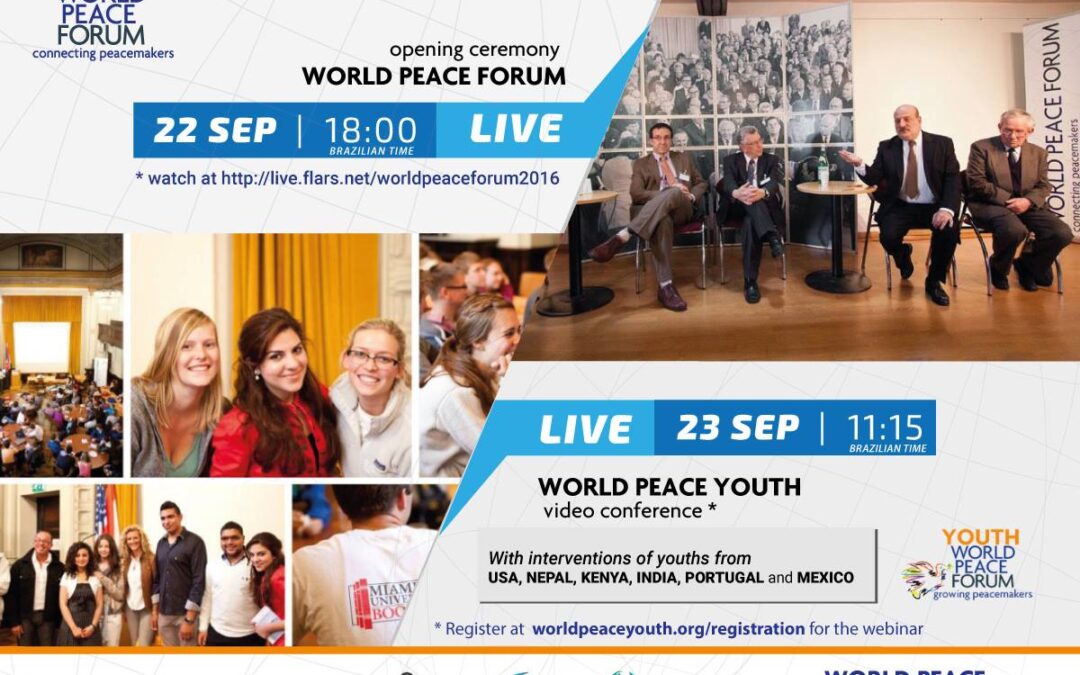
Brazil: World Peace Forum 2016
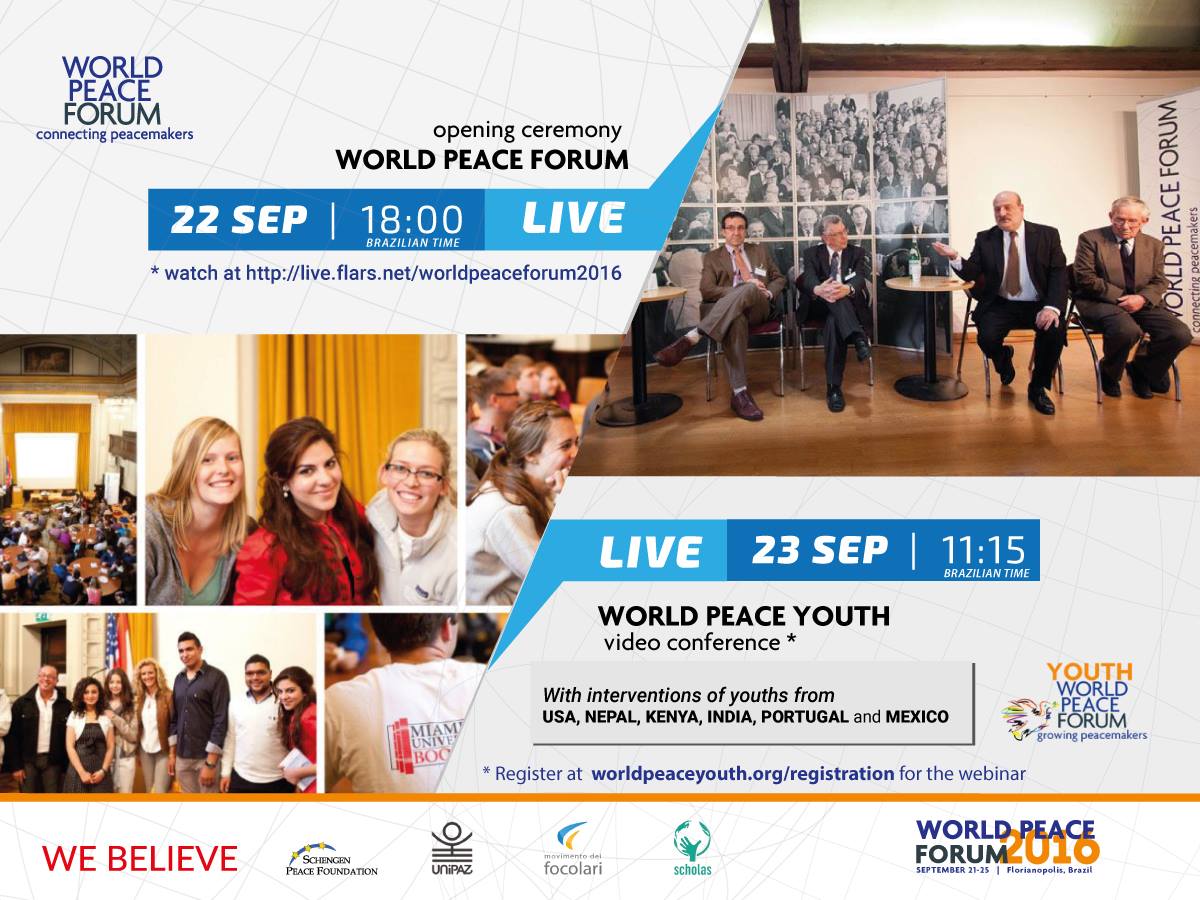 “The World Forum for Peace” will be held in Brazil, in the city of Florianópolis, during 22-25 September.
The opening ceremony of the 10th World Peace Forum and 2nd Youth World Peace Forum will be transmitted life via streaming on Thursday, 22 September, from 6 pm – 8.30pm (Brazil time)
Live transmission: http://live.flars.net/worldpeaceforum2016 On Friday, 23 September, at 11.15 am (Brazil time), there will be a Youth Video Conference. To register for the live webinar: worldpeaceyouth.org/registration Official Website for World Peace Forum 2016
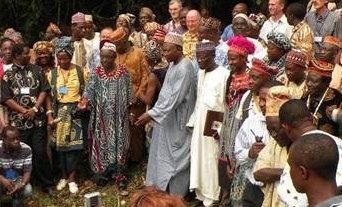
On a pilgrimage to Rome from Cameroon as a sign of mercy and gratitude
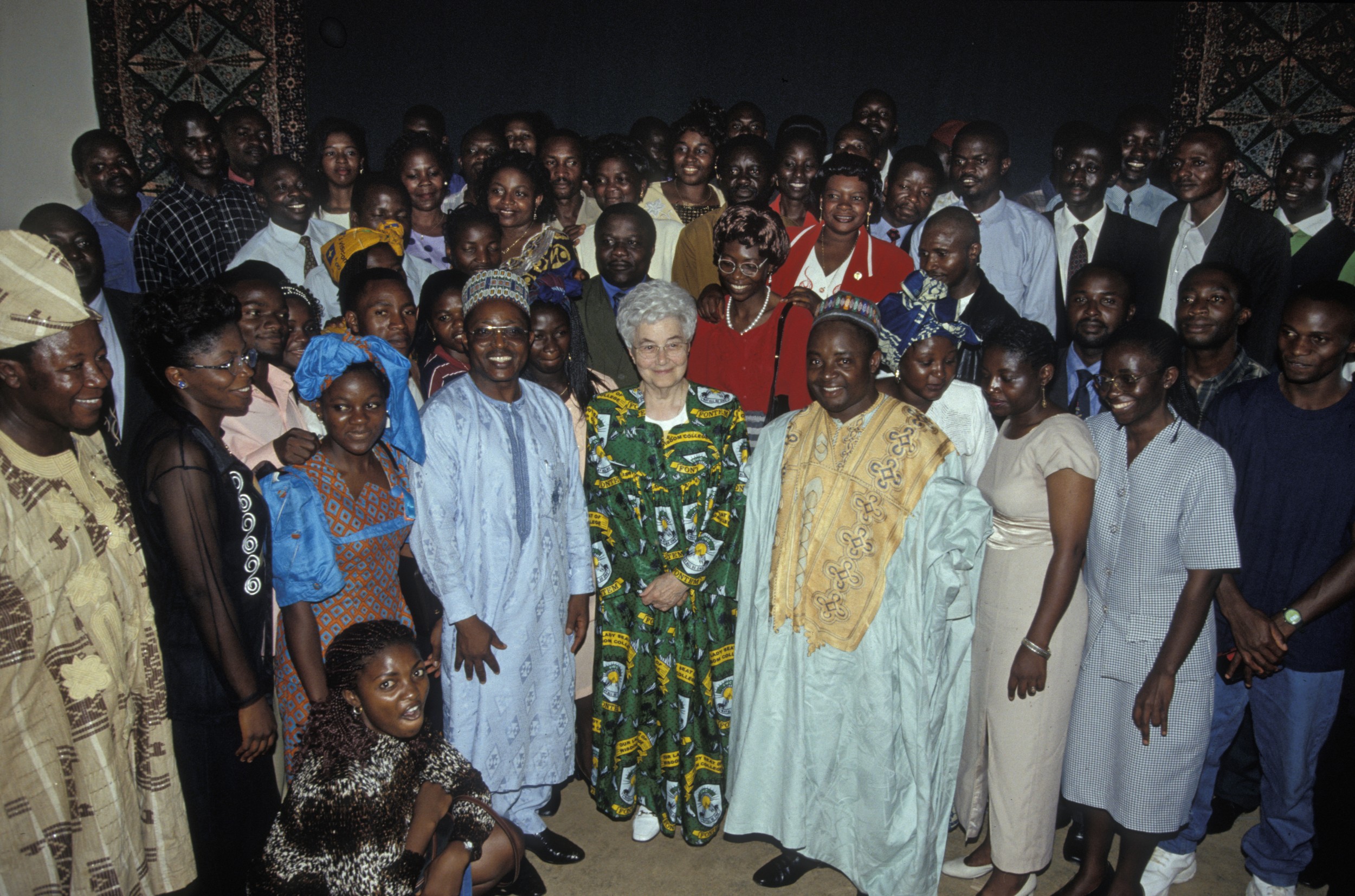 A delegation of 40 people from Cameroon are on their way to Rome. Among them are 9 traditional leaders (Fon), the native Kings of the Bangwa people of Lebialem, South-West Cameroon (Fon-Fontem, Fon-Nwametaw, Fon-Nwangong, Fon- Esoh Attah, Fon-Akum, Fon-Lewoh, Fon-Nkar, Fon-Bamenda and Fon-Douala),who are accompanied by Mafuas (Queens), two Mayors and other distinguished persons. They travel to Italy to celebrate the Jubilee of Mercy with Pope Francis and to thank God for the 50 years that has passed since the Bangwa people and the Focolare Movement met for the first time in Fontem. Their “pilgrimage” starts at the Vatican. They look foward to meet Pope Francis during the General Audience on Wednesday, September 21, when the Fon-Kings will greet the Pope on behalf of the delegation and their peoples, offer gifts typical of their culture and thank him for all that the Church has done for them. During their stay in Italy, they will be guests of the Focolare Movement and they will visit places where Chiara Lubich was born, lived and is buried: Trent, Loppiano (Florence) and Rocca di Papa (Rome). In fact, it was Chiara and the Focolare Movement, who answered the plea of Bangwa people, that came through Msgr Peters, bishop of Buea in the early 60’s, when the endemic sleeping sickness and other tropical diseases provoked a 90% rate of infantile mortality, threatening the extinction of the whole population. Today, these diseases have almost disappeared and the hospital, with its outpatient clinics, laboratory, operating theatre, male and female internal medicine department, surgery, maternity and pediatrics departments and the new department for infectious diseases, excels in the healthcare for the whole region. In the early70’s, a power plant, a carpentry shop, a nursery school and college were also built. The college,which takes more than 500 students, is one of the most popular pre-university insitutions in Cameroon. These 50 years built on facts and involving the whole region of Lebialem, led tens of thousands of people to accept the Christian message, in their personal life and in the life of society. They were supported by the work of the Mill Hill missionaries, the White Fathers and religious men and women of other congregations, who contributed towards the setting up of parishes, of the recent diocese of Manfi, of other schools and of public and administrative State structures. The baggage of the delegation led by the nine Fons contains this story of their people, a story which makes them feel the need to thank God and “Mafua Ndem Chiara Lubich” (queen sent by God), as the Bangwa people call her.
Press Conference with the Bangwa Delegation on Wednesday, September 21 at 12.30 (after the audience with Pope Francis)at J.H. Newman Hall, Urban University.
See also: http://focolare-fontem.org/
Video: General Hospital, Fontem
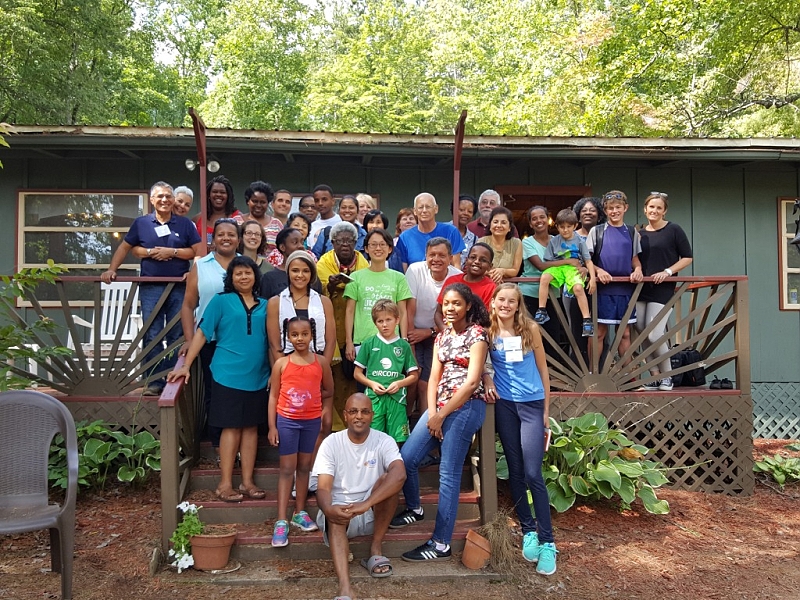
Atlanta (USA): We have a dream
Members of the Focolare community in Atlanta
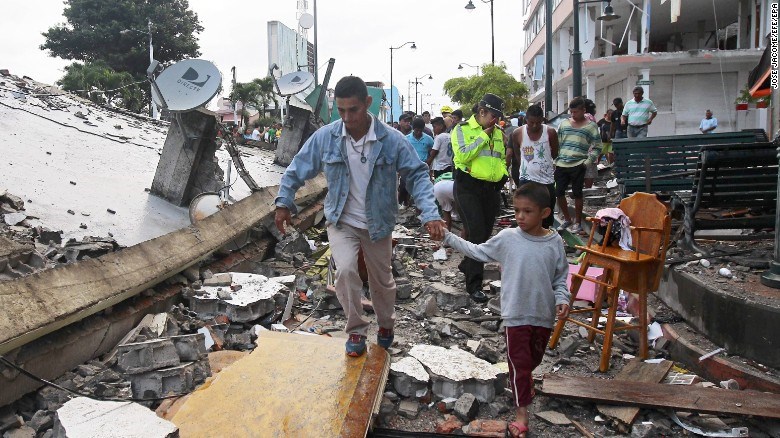
Emergency aid in response to Ecuador earthquake
As the news media reported, a magnitude 7.8 earthquake hit Ecuador on April 16, especially the provinces of Manabi, Esmeraldas, Santo Domingo and Pichincha, leaving nearly 30 people without a roof.
The Focolare Movement immediately got to work in many ways: beginning from the early relief efforts with the many spontaneous volunteers, and morning on to a large-scale fundraiser coordinated by AMU and AFN. Meanwhile a local commission was set up to identify the main priorities for the relief effort and to coordinate over a long term. They write from the commission: “In the past months several of us have gone to visit the different sites of the earthquake, meeting with the communities and seeking to collaborate with agencies that had similar goals. By the end of August the first proposals were ready and we began to collaborate with the Ecuadoran Popolorum Progressio Fund (FEPP) and the Fundación Amiga.” 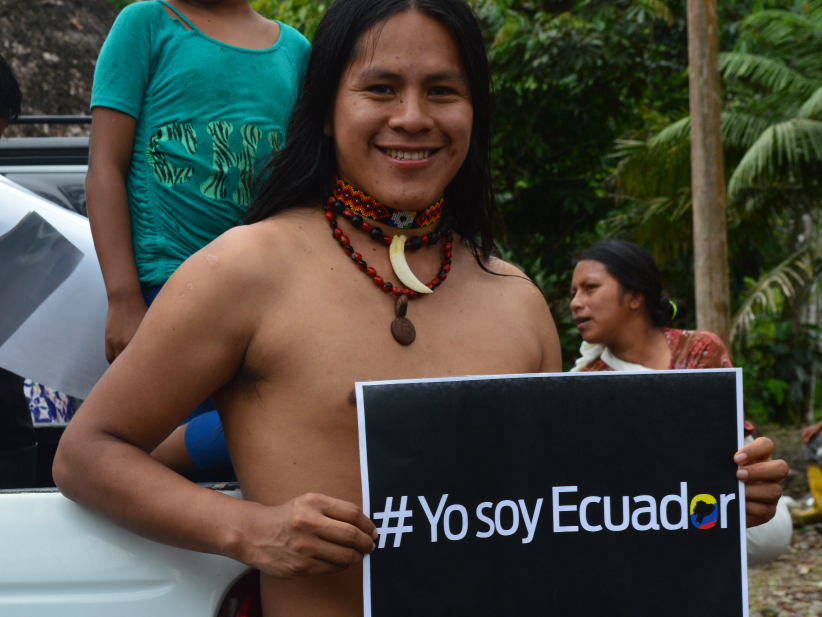 At this stage, the post-emergency interventions that were deemed most serious regarded the production of goods that could be sold and provide economic support for the local populations, and psychological support in overcoming the trauma which – as they write – “is still very quite strong after 5 months.” They also underscored another important point: “We saw the need to offer training in the procedure for applying for assistance from the Ecuador Government for the reconstruction of housing. At first, relief efforts concentrated on three localities, all located in the Province of Esmeraldas: Salima, “10 de Agosto” and Macara, “where projects will carried out to alleviate the consequences of trauma and to reinforce the organizational skills of the community,” they explain. “Moreover, a cooperative bread bakery and a training course in making fishing nets, involving the elderly fishermen as trainers. In the locality known as “10 de Agosto”, handicraft workshops will be held and a group of mothers will be helped in setting up a nursery.” The local commission writes: “this represents the first stage of the project, which corresponds to current funds. As we work with the community, we’ll delve more deeply into the future needs of the people and be able to respond to them. As of today: € 35.502 have been donated by AMU for the Ecuador emergency, € 10.000 of which have already been paid out, whereas the sum of € 10.000 has been donated to the cause by AFN (Action for New Families). Read earlier news: – Ecuador Emergency – Two months after the Ecuador earthquake