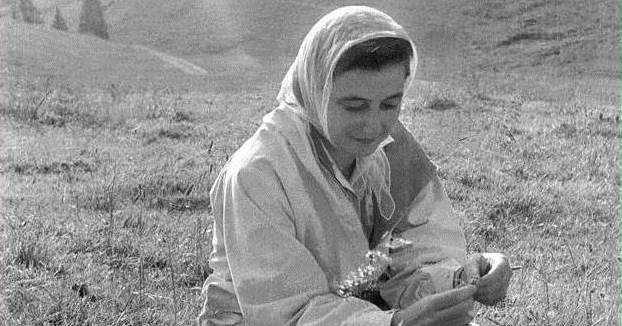
During the summer of 1949Chiara Lubich, who was 29 years old at the time, had an experience of light and life. Leaving that “paradise” up in the mountains was very difficult, but she understood that God wanted her to be immersed in the sufferings of humanity “drying up the waters of tribulation” in those who suffer the most. There and then she wrote these words: “I have only one Spouse on earth:Jesus Forsaken. I have no other God but Him. In Him there is the whole of Paradise with the Trinity and the whole of the earth with Humanity. Therefore what is His is mine, and nothing else. And His is universal Pain, and therefore mine. I will go through the world seeking Him in every instant of my life. What hurts me is mine. Mine the pain that grazes me in the present. Mine the pain of the souls beside me (that is my Jesus). Mine all that is not peace, joy, beautiful, lovable, serene… in a word, what is not Paradise. Because I too have my Paradise, but is that in my Spouse’s heart. I know no other. So it will be for the years I have left: athirst for pain, for anguish, for despair, for sadness, for separation, for exile, for forsakenness, for torment, for… all that is Him, and He is Sin, Hell. In this way I will dry up the waters of tribulation in many hearts nearby and, through communion with my almighty Spouse, in many far away. I shall pass as a Fire that consumes all that must fall and leaves standing only the Truth. But it is necessary to be like Him: to be Him in the present moment of life.” From: Chiara Lubich, The Cry, Ed. New City London (pp. 61-2)
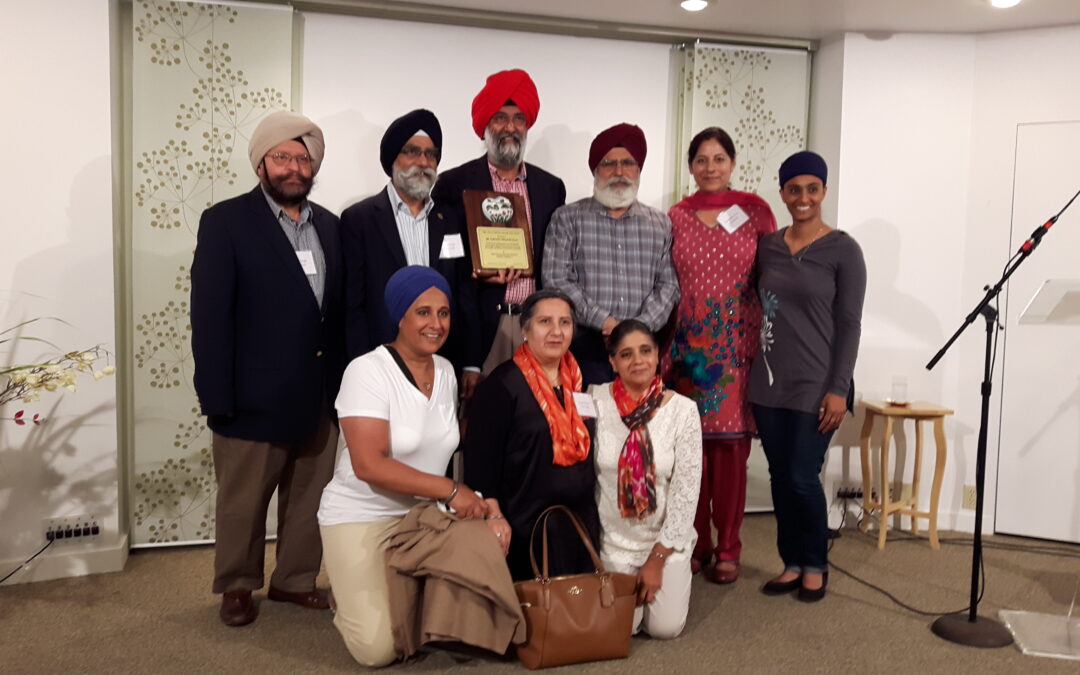
Unity, dialogue, communion – these are words that describe the heart of the mission of the Focolare, and these three words sum up the commitment of Dr Tarunjit Singh Butalia, a scientist at Ohio State University in Columbus, USA. On September 18, 2016 he accepted the 2016 Luminosa Award in Hyde Park, NY. “Your decade-long tireless effort in building bridges on various levels” said Focolare president, Maria Voce, “deserves our admiration and deep appreciation. We feel solidarity and fraternal ties with you and with the Sikh community in the promoting, together with others, peace and care of our common home.” Urged by a strong belief that religions have a crucial role to play in the great work of interreligious dialogue, in 2011 he accepted the invitation of Pope Benedict XVI to participate in the World Day of Prayer for Peace in Assisi. In his acceptance speech the scientist recalled the friendly invitations to interreligious meals and picnics that marked the beginnings of his contacts with the Focolare Movement. A friendship, he explained, that over time developed into trust. He stressed the particular role that religion has always played in American society, precisely because it is a nation of immigrants. While former waves of immigrants seamlessly blended into the people after a few generations, many immigrants from the last 50 years – like Muslims, Buddhists, Sikhs, Hindus, Jains and Baha’i – want to maintain their religious identity. Butalia said “they have made the United States one of the most cosmopolitan countries in the world.” He also observed the importance of acknowledging pluralism as a value “where each part maintains its identity and yet remains part of the harmonious whole.” “We have to focus on building relationships,’ he said; “we need to be able to talk about our differences.” Dr Butalia then proposed to take a step further than the Golden Rule (Do to others as you would want them to do to you,” Mt 7:12). He called his version the “Platinum Rule”: “Do to others as they would want you to do to them,” moving beyond the assumption that the other people would like to be treated the way that you would like to be treated yourself.” He then invited the 130 participants to “listen more than we speak” and to never compare the “best of our religion with the worst of the others.” Referring to Islamophobia, Butalia remembered that all religions are interdependent on each other and that we have to stand up against discrimination against any faith. Closing, he quoted a disciple of the Sikh founder Guru Nanak, “No one is my enemy, and no one is a stranger. I get along with all.”
Dr Tarunjit Butalia with the Sikh delegation
The award ceremony was preceded by the 7th Catholic-Sikh retreat, organized by the Secretariat of Ecumenical and Interreligious Affairs of the U.S. Conference of Catholic Bishops and the Sikh Council of Interfaith Relations. Twenty-five representatives of the Catholic Church and the American Sikh gathered at Mariapolis Luminosa to get to know each other in a deeper way. “This meeting was a great example for the kind of dialogue called for by Pope Francis, which is the dialogue of friendship,” said Anthony Cirelli, Director of the Secretariat of Ecumenical and Interreligious Affairs. The Luminosa Award for Unity has been sponsored by the North American Focolare Center for Education in Dialogue since 1988. Past recipients include the late Cardinal John O’Connor, Archbishop of New York; Norma Levitt, former president of Religions for Peace (RFP) and honorary president of Women of Reform Judaism; Rev. Nichiko Niwano, President of the Japanese lay Buddhist organization,Risshō Kōsei Kai; His Royal Highness Lukas Njifua Fontem, King of the Bangwa People of Cameroon; and Imam Warith Deen Mohammed, American Muslim leader.
Organized by the Umbria Diocese with the Franciscan family and the St. Egidio Community, the event gathered the religious leaders of the world, and was also attended by cultured men and women and representatives of institutions. Also the Focolare Movement was present in both the preparatory and participation phases, especially the communities in Umbria and in the persons of Rita Moussalem and Roberto Catalano, heads of the Focolare’s interreligious dialogue. With his presence on 20 September, Pope Francis continued the work of John Paul II who had felt the need in 1986 to institute a day of prayer for peace, and had foreseen the role religions could play to avoid conflicts and also contribute to resolving them. In 2011, Benedict XVI had presented peace not only as a commitment of men of faith, but also as a cultural project. But the world is no longer that of the 1980s, the bipolar world of the Cold war. The world is now globalized and multipolar, where the wars have multiplied without ever being wars of religion. Pope Francis greeted each of the leaders personally, starting from a group of refugees who represented the challenges of the world today. It was not only a formal act. There were deep moments of intense bonding that were able to establish important ties for the future. A second moment was the luncheon at the Holy Convent, to which the Pope had invited all to be by his side. Having a meal together under the same roof was in itself an act of peace, after which, a common moment of prayer followed, but not together. Each religion had a facility where members could go to pray for world peace, according to their own religious tradition. Each did so distinctly; this fact aimed to cancel the doubt that these moments were an attempt to amalgamate all religions together. The Christians prayed together to demonstrate that unity among the Churches is fundamental in giving important contribution to peace, as followers of Christ. The concluding ceremony took place in the square in front of the Basilica of St. Francis. The leaders of each religion sat in a semicircle around Pope Francis, as a sign that nobody claimed superiority, notwithstanding the esteem and recognition of the Pope of Rome. His name, his example of a measured life, his words and gestures were constantly cited in the course of the 29 panels or round tables that were held during the prior two days in every corner of Assisi. The conclusion was marked by profound and vital considerations by the Christian, Buddhist and Muslim leaders, and also by moving testimonials: that of a young Syrian mother who arrived in Italy through the humanitarian corridors and that of an elderly Jewish Rabbi, who survived the Nazi concentration camps. The evening was heightened by the speech of Pope Francis who traced a peace roadmap. In fact, «Only peace is holy, not war!» The Pope expressed the meaning of peace by speaking of forgiveness, acceptance, collaboration and education as the fundamental elements to make it possible. «Our future is to live together», he affirmed. It is an idea that universalises the interpretation of the great Bauman who, in the opening ceremony, had underlined how humanity is called today to live the dimension of “we,” and forget the “they.” Once again the framework of Assisi was a decisive element. In fact, peace here is present even in the air we breathe. During these days the Franciscan family offered an example of humble, intelligent and respectful hospitality, constantly at the service of the leaders of the different faiths. It was an evident demonstration of how the humbleness of Francis of Assisi spoke out and asked his followers to make this a fundamental condition for dialogue and peace. It was a sign that peace is built by all of us together, and that each one brings a unique and indispensable gift for the processes of peace. by Roberto CatalanoSource: New City
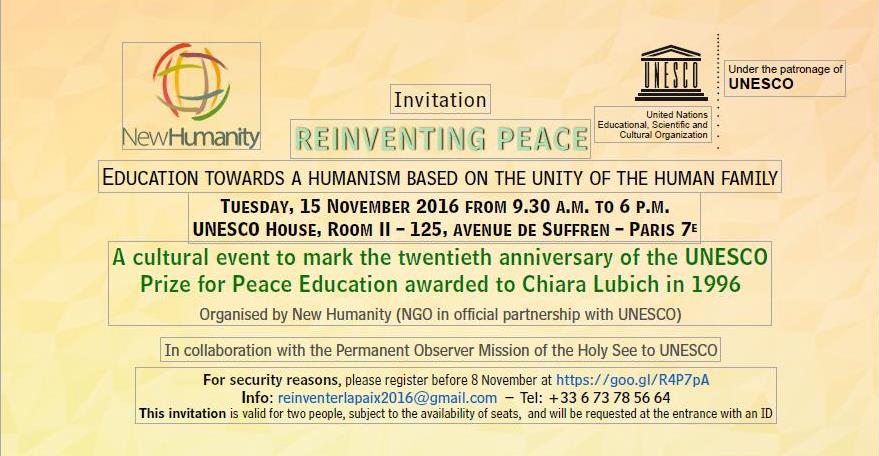
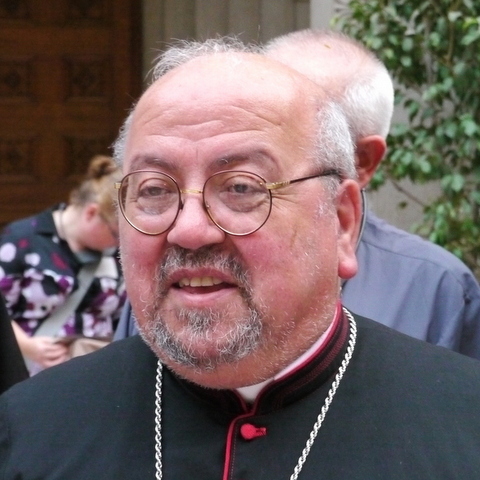
“EDUCATION TOWARDS A HUMANISM BASED ON THE UNITY OF THE HUMAN FAMILY” Paris, 19 December 1996: UNESCO awarded the prestigious Prize for Peace Education to Chiara Lubich, Founder of the Focolare Movement, in recognition of her lifelong efforts in the building of Peace, and education of thousands of people of every creed and latitude, towards this goal. The theme of peace education is more than ever actual today. Promoted by the UNESCO and the New Humanity Movement, the event will be celebrated at the UNESCO Headquarters (Paris, France) on 15 November, from 10.00 am to 6.00 pm. A representative from UNESCO will open the session, to be followed by the speeches of Bishop Francesco Follo, Permanent Observer of the Holy See to UNESCO, and Maria Voce and Jesús Morán, President and Co-President of the Focolare Movement, respectively. Other two focal points will follow: five ideas for peace education today, and dialogue in a united and plural world. Invitation: Unesco EventRegistration “Reinventing Peace” event Read Chiara Lubich’s speech in 1996 Watch video (Italian) https://vimeo.com/77226264
It’s been six years since the beginning of the war in your country. What do you think have been the worst effects on society? Six years of war have shaken the very bulwark of Syrian society: the family, the basic cell that has absorbed the blows and the disgrace of this unending violence. The family was the safeguard of the country and of the Church up until 2014. But the insecurity, intolerance, violence and chaotic destruction have now completely uprooted more than two million families. Without houses and scattered all over the world, how could they have gone on under the weight of such a heavy Calvary? It was common at the beginning of the war – March 15, 2011 – to see the family gathered around a mother. The men go to war and often die. The saying now is: ‘An orphan without a father is not an orphan’. The family is left gathered around its mother who ensures the unity and the survival of the hearth. In the midst of this long and burdensome suffering these heroic mothers live in poverty and in tears. They have honoured their calling, living in tents and dying drowned. Is there any greater suffering? The destruction of the basic cell of society, and the youth? Can we count on them to look towards the future? The general mobilization that was decreed in October 2015 invited all men under the age of 45 to enter military service. It was a decision that also distressed other family members who couldn’t leave and had to stay where they were, waiting for a conclusion to this endless war. This age group that vanished had once comprised the backbone of economic activity that was still being carried out. Some reached the barracks and others chose to flee on the trail of illegal immigrants that is often irreversible. This destabilized the job market and the modest family life that found itself even more deprived of resources. What future is there for a community without young people? How has the war affected the Church? These things have weakened the Church. Families often decide to get up and go to their son who has left the country. Hence, you have the exodus of families resulting in the dizzying drop in the number of the faithful in parishes. There is the demographic imbalance: in the absence of young men, our young women who find themselves alone often marry Muslim polygamists. With fewer marriages, there are fewer baptisms. For the first time the Church finds itself facing another crucial problem as well: one in three priests in Damascus have decided to move to another more peaceful country. What can be done to keep priests in Damascus? What will come of the Church without priests? What do you think is the challenge and the hope of the Christians living in Syria today? The dead cities in the north of Syria are an unsettling photograph of what we could become. How are we to avoid becoming the guardians of brick and stone? It remains to the Christians of the East to reconsider their calling and to live along the lines of the small primitive Church that lived without protection or guarantee. Will we be capable of responding to this apostolic challenge? The Gospel encourages: ‘Fear not, little flock” (Lk 12:32).

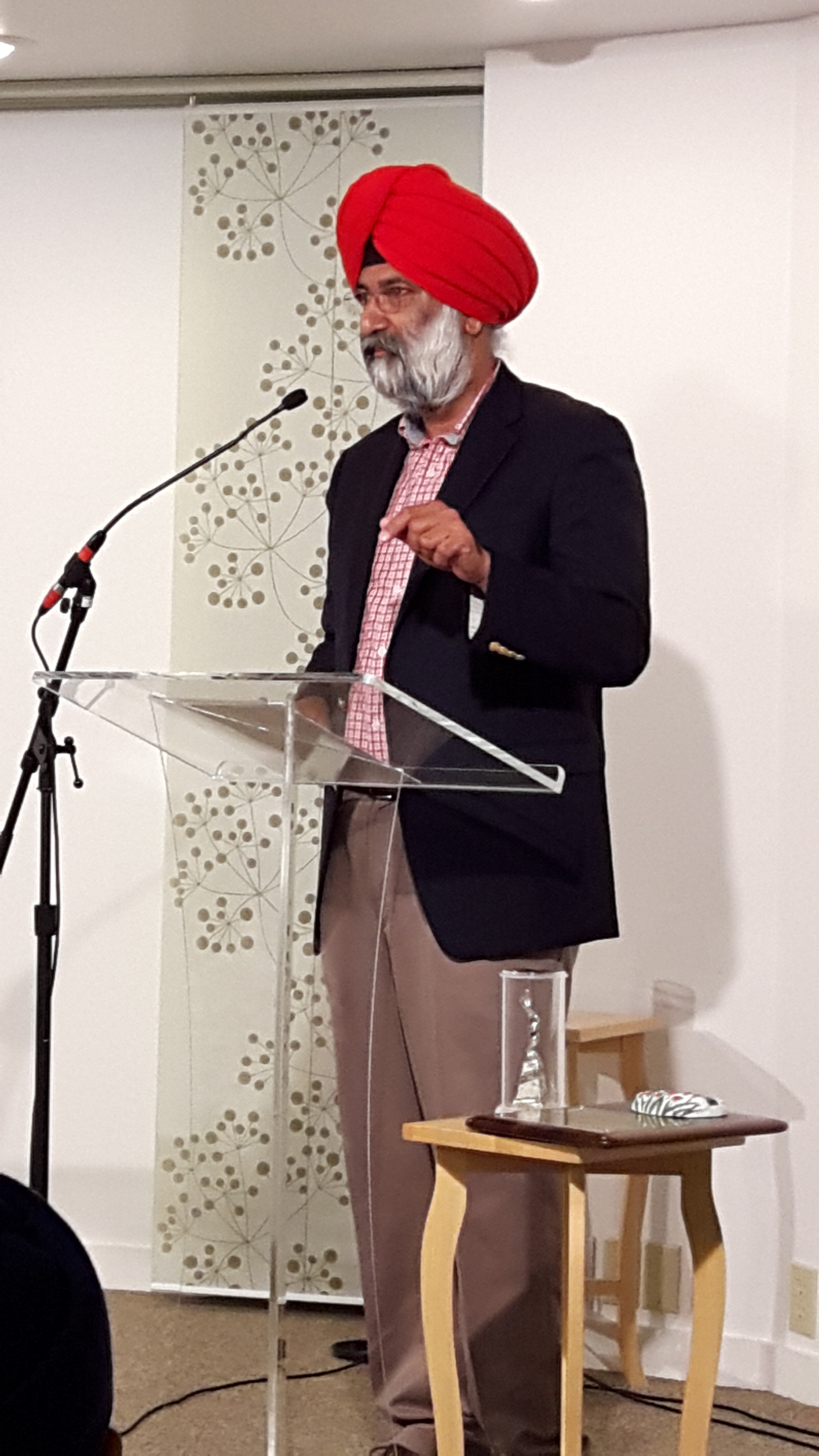 Unity, dialogue, communion – these are words that describe the heart of the mission of the Focolare, and these three words sum up the commitment of Dr Tarunjit Singh Butalia, a scientist at Ohio State University in Columbus, USA. On September 18, 2016 he accepted the 2016 Luminosa Award in Hyde Park, NY. “Your decade-long tireless effort in building bridges on various levels” said Focolare president,
  Dr Butalia then proposed to take a step further than the Golden Rule (Do to others as you would want them to do to you,” Mt 7:12). He called his version the “Platinum Rule”: “Do to others as they would want you to do to them,” moving beyond the assumption that the other people would like to be treated the way that you would like to be treated yourself.” He then invited the 130 participants to “listen more than we speak” and to never compare the “best of our religion with the worst of the others.” Referring to Islamophobia, Butalia remembered that all religions are interdependent on each other and that we have to stand up against discrimination against any faith. Closing, he quoted a disciple of the Sikh founder Guru Nanak, “No one is my enemy, and no one is a stranger. I get along with all.”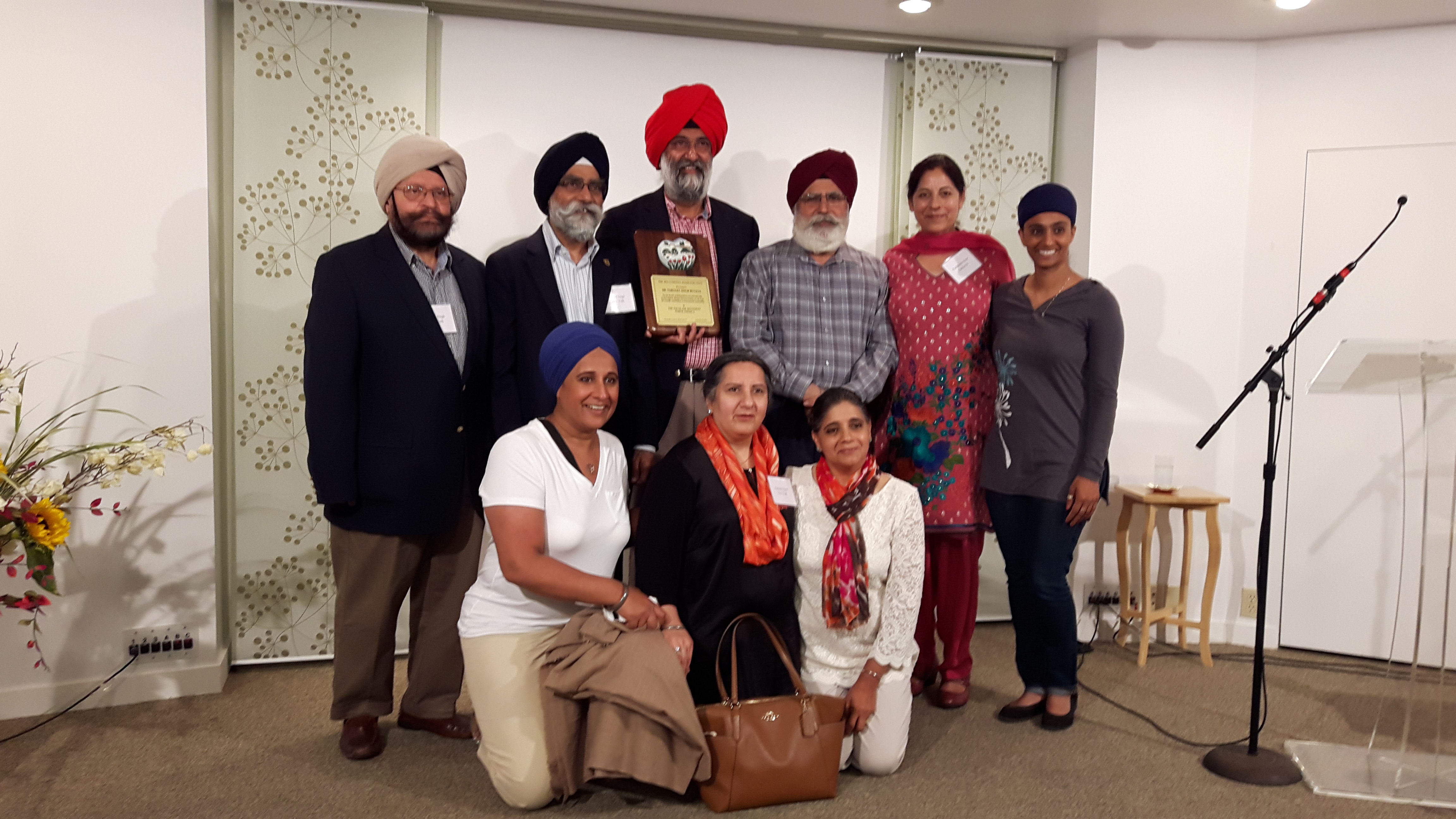
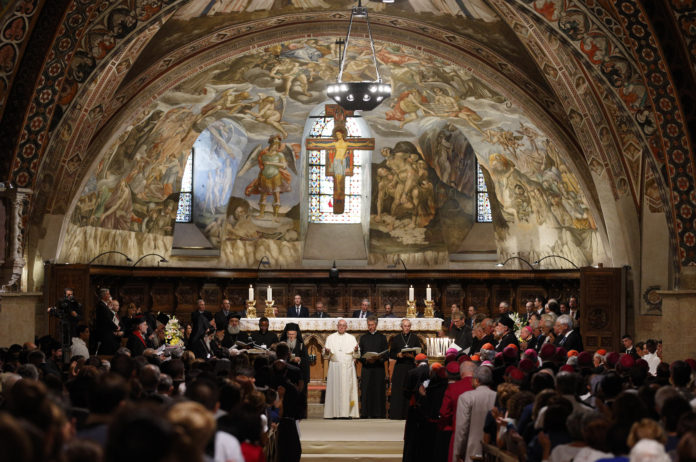
 Organized by the Umbria Diocese with the Franciscan family and the St. Egidio Community, the event gathered the religious leaders of the world, and was also attended by cultured men and women and representatives of institutions. Also the