26 Aug 2022 | Non categorizzato
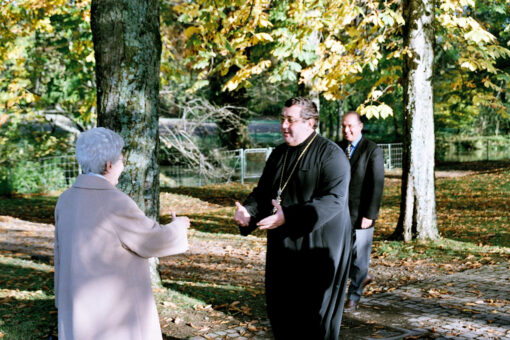
The eleventh Assembly of the World Council of Churches runs from 31 August to 8 September 2022 in Karlsruhe, Germany. The Focolare Movement has long been linked to the WCC by ties of friendship and collaboration, which continue in this latest Assembly. In a world torn apart by conflicts, afflicted by a pandemic which has widened inequalities, overwhelmed by an unprecedented climate crisis, characterized by scientific and technological innovations which often create new disparities between people and regions of the world, does it make any sense to speak of unity? And, if so, what contribution can Christians make to achieve it? These fundamental questions will be at the heart of the 11th Assembly of the World Council of Churches, taking place at Karlsruhr, Germany from 31 August to 8 September 2022. The Assembly, the highest governing body of the World Council of Churches, is normally convened every eight years. 352 Churches now belong to the WCC, in 110 countries, representing around 500 million Christians. The Assembly will gather around 4,000 participants from all around the world. Unity, for Christians, is the fulfilment of Jesus’ prayer “that they may all be one” (John 17:21). Words which inspire confidence in the Assembly’s title: “Christ’s love moves the world to reconciliation and unity”. The work of the Assembly springs from reflecting on the great challenges of the planet which have revealed such vulnerability, as well as ethnic, economic and social divisions and injustices. But which have also highlighted the interdependence of individuals and peoples; the responsibility we have towards others in a world in which no-one can save themselves on their own. In this context, the Christian Churches are gathering together for prayer and celebration, for reflection and action. It’s an opportunity to deepen their commitment to dialogue, visible unity and common testimony. Alongside the official delegates’ program are around 100 workshops and stands hosted by various Churches, Communities and Institutions, including the Focolare Movement sharing its own wide-ranging experience of dialogue. The Focolare stand will be supported throughout the Assembly by the team of “Centro Uno” (which coordinates the ecumenical activity of the Focolare internationally), with Focolare members from Germany, Switzerland, Ireland and Romania. On 5 September at 17:00, they will host a workshop on “Dialogue as a lifestyle: methodology and practice”, offering an experience of dialogue between Christians of different Churches, and between Christians and Muslims. A dialogue involving maximum respect of each one’s identity, prioritizing the engagement of theory with life. The World Council of Churches came into being on 23 August 1948, originally with 147 member Churches. Its principal aim to enable dialogue as the way and characteristic of authentic Christian life. The Focolare Movement’s links with the WCC go back to 1967 when Swiss Reformed theologian Lukas Vischer invited Chiara Lubich to Geneva. On her third visit, in 2002, Chiara also visited the WCC’s Ecumenical Institute at Bossey. WCC General Secretary Rev. Prof. Ioan Sauca has, on more than one occasion, referred to the importance to the Institute of that meeting with Chiara Lubich and her clarity in addressing the often challenging relationship between identity and unity.
Anna Lisa Innocenti
22 Aug 2022 | Non categorizzato
Professor Giuseppe Argiolas has offered his resignation as Rector of the Sophia University Institute “for personal reasons”. The present Vice Rector, Professor Declan O’Byrne has been appointed as Acting Rector and will serve in this capacity until the natural end of the mandate, January 2024. The Vice Chancellor, Margaret Karram, President of the Focolare Movement, has written to the academic community of the Institute saying: “I ask you all to collaborate fully with Professor Declan O’Byrne, who has accepted the role assigned to him by the Congregation for Catholic Education, so that the Sophia University Institute can continue its service of teaching, research and cultural engagement with due professional diligence. I am grateful to Professor Argiolas for his commitment and for the work he has done to develop Sophia, especially during these difficult times of the pandemic, 2020-2022. I entrust to the responsibility of the whole academic body the good outcome of this new academic year”. The teachers and staff at Sophia are united to the Vice Chancellor in thanking Professor Argiolas for his dedicated commitment at the service of the Institute.
22 Aug 2022 | Non categorizzato
During the Fourth World Youth Day, held in Santiago de Compostela (Spain) in 1989, Chiara Lubich gave a talk entitled “Jesus is the way”. We have chosen an extract from it in which she invited everyone to set in motion the transforming power of love as Jesus himself did. He was God’s Son, he was love, and he came to earth out of love. He lived for love, spreading love, giving love, bringing the law of love and he died for love. Then he rose from the dead and ascended to heaven, fulfilling his plan of love. Everything was for love: love for you, love for me, love for everyone. We could say then that the way Jesus followed has a name: love. And we, who want to follow him, must walk along this way – the way of love. Love! Some of you might ask yourselves: what kind of love did Jesus have in his heart? Out of what kind of love did he act? What kind of love did he leave here on earth? The love that Jesus lived and brought on earth is a special and unique love. It is not the kind of love that you might imagine. It is not philanthropy; nor is it simply solidarity or kindness. It is not purely friendship or affection (like the love a boy can have for a girl, or a mother for her son); nor is it only non-violence. It is something exceptional, indeed, divine: it is the same ardent love that burns in God. Jesus has given us a flame of that infinite fire, a ray of that immense sun. It is something extraordinary. We do not think about this very often, but if we were to take it seriously, it would make us strong. … We must make this love become fruitful. How? By loving.
Chiara Lubich
(Chiara Lubich, L’amore al fratello, [Love of Neighbour] Città Nuova, 2012, pp. 50-51)
12 Aug 2022 | Non categorizzato
The Fifth Halki Summit took place in Turkey from 8th-12th June 2022. Sustaining the future of the planet together was the title of the meeting organised by the Ecumenical Patriarchate of Constantinople together with the Sophia University Institute, Loppiano (Florence, Italy). https://www.youtube.com/watch?v=tJ6ZGgiT7YU&list=PL9YsVtizqrYsxCVExqFc_vvuzCKyNbr43&index=1
22 Jun 2022 | Non categorizzato
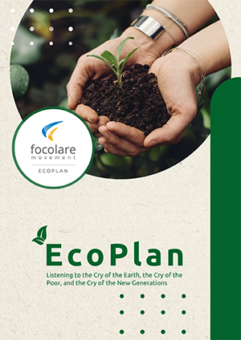
“We are commited to verifying the ecological sustainability of our structures and activities … We are dedicated to the creation of greater environmental awareness that will lead to more sustainable lifestyles.” Ecological conversion was one of the goals set by the Focolare Movement in the 2021 General Assembly. In response to this urgent need, the Focolare EcoPlan was initiated. “The Focolare Movement is deeply committed to ecological conversion through concrete actions and by fostering dialogue with all for the protection of our planet,” said Margaret Karram, at the opening of the fifth Halki Summit a few days ago. “Stimulated by our General Assembly at the beginning of 2021, we have decided to take courageous action through the creation of an ecological plan within our communities to bring about change and make our lives and our activities more sustainable.” 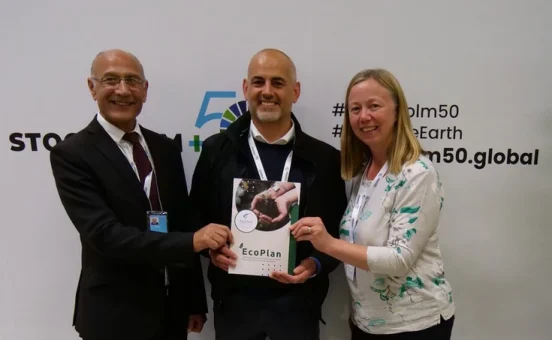 In fact, on 3 June 2022 in Stockholm, acting on behalf of all its communities, the Focolare Movement was able to present its own document – Focolare EcoPlan – which demonstrates its commitment to the environment. The presentation of EcoPlan was motivated by the spirituality that has given life to the Movement. It was officially handed over to Iyad Abu Moghli from Jordan, UNEP Senior Principal Advisor and director of the Faith for Earth Initiative, who said that the EcoPlan is “an ambitious and comprehensive ecological approach.”
Download PDF
Carlos Mana
https://youtu.be/B9SSOE_yzxk
