19 Apr 2021 | Non categorizzato
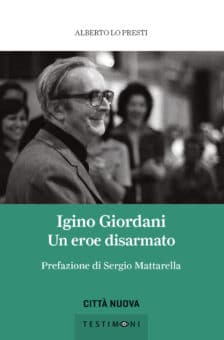
This is the question we asked Prof. Alberto Lo Presti and Dr. Elena Merli, members of the Igino Giordani Centre, editors of “Igino Giordani: an unarmed hero” (Città Nuova Publications). So many biographies have been written about Why another one? Elena Merli: The previous biographies cover a limited time span of Giordani’s life. The first biography was written in 1936; then there was the one written by Tommaso Sorgi, a friend of Giordani who studied him in great depth. Sorgi wrote an inspired and detailed biography that deals with Giordani’s life from birth to 1948. Other biographies analysed Giordani’s life from a particular perspective: historical, spiritual, political…. They are all valuable; they are a great richness, but this biography deals with a holistic perspective of his life. It speaks about aspects that were very little explored until now, namely: his family life, his deep relationship with Chiara, the particular period of intense illumination that was “Paradise ’49”. Even his experience as a member of the Dominican Third Order had not yet been explored in depth. Some of the political background of his life had not yet emerged, nor were some of his intimate choices and delicate passages of his personal life. I would like to point out particularly the novelty of a chapter dedicated to what he jokingly called “Giordania”, that is, his family. I think many will enjoy reading about the secrets of Igino’s lively family situation. The first thing that strikes you in this book is its prestigious preface signed by Sergio Mattarella, the President of the Italian Republic. Why him? Alberto Lo Presti: It is good to know a few things from behind-the-scenes. First of all, Sergio Mattarella knew Igino Giordani personally, and he says something about this in the preface. Then, one must remember that his father, Bernardo Mattarella was the author of the first biography written in 1936. So, all this helped to ask him write the preface. Then, we think that Sergio Mattarella is interpreting the role of President of the Republic as a source of unity in Italy and in the international field. During this health crisis, he has been a figure of stability and high morality. Giordani gave witness to unity in politics and harmony among people. The parts of the book dedicated to his political commitment describe his behaviour during the war and in the post-war period, under bombings and fascism, amidst the rubble of reconstruction and social distress. Those times were not any calmer or more peaceful than the ones of today. Giordani’s steadfastness can still help us to understand where to go today. This volume is the result of intense archival research work. Do we know everything about Giordani now? Elena Merli: We have an impressive amount of material, documents, correspondence, and also audio and video recordings of many of Giordani’s talks, public and confidential ones, transcribed and sorted out. All these proved extremely useful to discover details about his personal life. Who knows how many more new and interesting discoveries we can still make by exploring the archive! Many are already in this book. I’ll mention just one: details about Giordani’s last years, when he lived in this building, the International Centre of the Focolare Movement. At that time, the Focolare community of Antonio Petrilli occupied the first floor of this building, and in 1974, after the death of his wife Mya, Giordani moved to live with this community. These unpublished details reveal Igino’s faithfulness to community life and the depth of his humanity. To whom is this book addressed? Alberto Lo Presti: It addresses all those who want to solve the mystery of mysteries, that is, of how to be totally donated to God while immersed in the ordinary things of the world. Giordani managed to do this and he traced the way for us. He always questioned himself about it ….. but when he met Chiara Lubich he also found the answers. For Igino, Chiara was the answer to all his existential questions. He studied early Christian writers, medieval theologians, modern theologians, great spiritual figures, yet he found the answers in Chiara and in the spirituality of communion. I would like to recount one of the many anecdotes, which many do not know; one can find it in the book. Giordani had such a great desire to donate himself to God that at the end of the 1920’s he joined the Dominican Third Order. But he was not satisfied … the rule for members was at least one Mass a month, a sermon by one of the monks and nothing more. He wanted to be more involved in religious life. So he submitted his idea to the monks: rent a flat where they could all meet: “you in your cassock (the monks’ cassock) and we, (the lay members) in our trousers. Thus, we can have some community life together”. He was told that this was not in the norms of the Dominican order and it stopped at that. What Giordani yearned for at the end of the 1920’s became a realty through Chiara; it was the focolare. Yes, in 1928 when such episodes happened, he was dreaming of the focolare. Incredible, isn’t it?
Edited by Lorenzo Russo
. If you would like to buy the book, please visit the web page of Città Nuova Publications
19 Apr 2021 | Non categorizzato
Referring to a sentence from Scripture, Chiara Lubich reflected on the Holy Journey of life inviting us to check up every now and then, in front of God, on how far we have reached on the journey. Uppermost in my mind today is a desire for to take a closer look at how we are doing in terms of our commitment to reach holiness. A few days ago a focolarina brought to my attention a beautiful sentence from the Psalms, that proclaims a beatitude I’d never heard of: “Blessed are those whose strength is in you, who have set their hearts on pilgrimage” (Ps. 84: 5 NIV). “Pilgrimage?” What pilgrimage is Scripture speaking about? It is of course our journey towards heaven and God; and thus, our journey toward holiness, which will lead us to heaven. … So then, have we really set out on this holy journey? In this present moment, are we moving onward? … Let’s each pause a moment and put ourselves before God; and for his glory alone, let’s take stock of the situation. Have there been any results? Have we improved, for instance, in doing God’s will? Are we any better at loving? What about our mutual love? … If the answer is yes, then let’s give thanks to God and keep going. If the answer is no, let’s thank God that we still have time to start afresh. Then, onward! We really want to experience together the happiness of the Holy Journey!
Chiara Lubich
(From a telephone conference call, Rocca di Papa, 3rd September 1981)
18 Apr 2021 | Non categorizzato
An afternoon dedicated to Igino Giordani (1894-1980) politician, writer, journalist, co-founder of the Focolare Movement. On Sunday, 18 April 2021, at the International Centre of the Focolare Movement in Rocca di Papa, Rome, Italy an event took place remembering Igino Giordani 41 years after his death. Giordani was a rich and multifaceted figure – a politician, a member of the Constituent Assembly and then of the Italian Parliament, a journalist, a writer, and, with Chiara Lubich, co-founder of the Focolare Movement. The event included a presentation of the sculpture by the artist Peter Kostner which is dedicated to Giordani and of the new biography “Igino Giordani: an unarmed hero” edited by Alberto Lo Presti and with a preface by the President of the Italian Republic Sergio Mattarella,. It is published by Citta Nuova’. The programme was live streamed and was enriched by personal testimonies recalling Giordani. https://www.youtube.com/watch?v=ezq3Sak8Pbg
14 Apr 2021 | Non categorizzato
On Sunday, April 18th, Igino Giordani, a politician who inspired the social commitment and ideal choices of many, a writer and journalist, and co-founder of the Focolare Movement, will be remembered through live streaming. The latest biographical book will be presented and a sculpture dedicated to him will be inaugurated. A man of dialogue and deep faith, a supporter of universal fraternity, a builder of peace, a politician, a journalist: Igino Giordani (1894-1980) is all this and much more. April 18th, 2021 will mark the 41st anniversary of his death, and the Igino Giordani Centre has organised an event to commemorate his life. A personality who continues over time to arouse interest in people of different ages, geographical, political and cultural backgrounds calling for commitment to build a better society. The event will be broadcast in live streaming ( https://live.focolare.org/ ) from the International Centre of the Focolare Movement (Rocca di Papa, Italy) on Sunday, April 18th, 2021 at 3:30 p.m. (Italian time) with the possibility of following it in Italian, English, French, Spanish and Portuguese. Giordani was a journalist and writer, but he played a very important role in Italian politics. In fact, after World War II, he made a valuable contribution to laying the foundations for the nascent Italian Republic in a period that was not easy for the country, i.e., close to the world wars. He was also a member of the Constituent Assembly, a witness to politics as a service to peace and to a more just society. With this in mind, there will be some testimonies from those who have translated Giordani’s wisdom into bills or political initiatives in favour of dialogue and the common good, or those who have understood what choices are right to make in order to oppose policies that threaten peace among peoples. During the event, the latest biography by Alberto Lo Presti (ed. Città Nuova Italia), entitled “Igino Giordani. Un eroe disarmato” (Igino Giordani. Igino Giordani, an unarmed hero), with a preface by the President of the Italian Republic Sergio Mattarella. This biography helps to rediscover the sense of an authentic political and social commitment. The biography is as gripping as a novel. Mattarella writes about Giordani: “His lively faith, his evangelical consistency, the fervour with which he fought for social equity, freedom and peace shook many consciences and promoted action and thought, both in the dark times of Fascism and in the years of democratic reconstruction. He became a builder of peace in the dialogue between people, between religious confessions, between peoples and States … He thought of Europe as a continent of peace, after having been the scene of devastating wars. He wanted his country to be a bridge. And he himself tried to become a bridge to bring people closer, connect them, recompose them”. A sculpture dedicated to him by the artist Peter Kostner will also be inaugurated. The work, which will be placed in the garden of the International Focolare Centre, depicts Giordani sitting on a bench. In the last years of his life, in fact, he often sat on a bench in the park. During the international meetings held at the Centre, many young people and adults would come up to greet him and talk to him. And the bench became a place of encounter and dialogue. During the event some testimonies will recall those conversations in which Giordani listened with humility and patience, not sparing advice drawn from his fruitful life experience and enriched by the charism of unity.
Lorenzo Russo
12 Apr 2021 | Non categorizzato
When the efforts we make to overcome our selfishness are done out of love for Jesus crucified in the present moment and we do what God wants of us immediately afterwards, we can experience the fullness of life of the Risen Lord in us. We might ask: is it possible to experience the presence of the Risen Lord and the consequent outpouring of the gifts of his Spirit – life, light, peace, love, consolation, ardour, and so on – not only when there are two or more people united in Jesus’ name, but even when we are alone? How? At what price? By embracing Jesus Forsaken in each present moment. This extraordinary experience prompted us to look deeper into the Scriptures and the Church’s teachings. And they confirmed that it was true. But which Jesus Forsaken – as we would say – should we embrace in each present moment? The one our Christian life requires of us in denying ourselves and taking up our cross, if we want to follow Jesus. Therefore, we need to say yes and quickly embrace every suffering that comes our way – our own cross. But we also need to embrace the suffering that comes from our efforts to deny ourselves and in the struggle against our selfishness and the so-called desires of the flesh (overeating, impurity, quarrelling, jealousy, and so on) so that love triumphs in our hearts. When we love these efforts out of love for Jesus crucified in the present moment and we do what God wants of us immediately afterwards, we can experience the fullness of life of the Risen Lord in us, even on our own. His light comes into each of our hearts. His peace fills us. His love is enkindled in us, and with it, consolation, calmness, a taste of Heaven. In other words, everything changes. Our soul is clothed anew. … This is what we want to do: to love Jesus Forsaken always, immediately, and joyfully; not only in our daily sufferings, but also in the effort involved in overcoming our selfishness. This is exactly what Igino Giordani meant when he wrote the following poem, shortly after he had embraced our spirituality: “Mi son messo a morire e quel che accade non mi importa più, mi sono messo a gioire nel cuore desolato di Gesù”, [I have set about dying, and what happens is of no matter anymore, I have set about rejoicing in the desolate heart of Jesus]. To die to ourselves so as to rejoice with Jesus; to die with Him forsaken, so as to live with Him risen from the dead. So let’s remember these words: “I have set about dying” and let’s welcome the death of our selfishness ten or even a hundred times a day, so as to give the people we meet the joy of encountering the Risen Lord.
Chiara Lubich
Taken from a telephone conference call, Rocca di Papa, 3rd November 1983
