30 Sep 2020 | Non categorizzato
Her smile, her joie de vivre, her commitment towards justice and peace are words that come to mind when one recalls Myriam Dessaivre, 26 years old, who lost her life on Sunday, August 9 in Niger. Myriam and five other French youth were killed, together with the Nigerian driver and guide who accompanied them when they were visiting the Kouré giraffe reserve, 60 km southeast of the capital Niamey. These youth were on a humanitarian mission, with the NGO Acted, in a country that faces multiple crises and ranks at the bottom of the human development index. Myriam, a martyr for peace, obtained a first degree in communication and information at the Catholic Institute of Toulouse and then a Master’s degree in peace studies at the Paris-Dauphine University. She specialized in political conflict resolution and the title of her thesis was: “The Colombian State and the FARC: is reconciliation possible?” She furthered her studies in this field through work in Colombia, Tunisia and Chad. During a Peace Movement national council meeting held on June 18, 2016, Myriam spoke about the choice of her studies. She was then 21 years old. Today, her strong and meaningful words impress us even more. We quote what she said at the end of her talk: “I have the impression that there is a growth in the number of young people of our generation who want to promote peace. I think that social networks are contributing towards this, not only through the abandunce of bad news, but also because of the increase in some sort of “global solidarity”. Anger caused by horrible happenings, such as terrorist attacks, wars in the Middle East and famine, is transmitted instantly through social networks, and we are directly affected. We come to the point of asking ourselves: “When do I go there?” So, I’m not surprised that more young people seek professions that engage in work for peace. May be, we are simply looking for the means to live in a better world”. Myriam learnt more about building this better world through the Focolare spirituality and her commitment as a member of the Focolare Youth Movement. Her father, Jean-Marie, who died in 2014, was a volunteer. Her friend Sophie, who was very upset, said: “She was my best friend. I met her during a Mariapolis in Lourdes, when I was 13. With her, you could have a good laugh about anything”. And she continued to testify: “She had strong convictions and defended the values of peace and justice. Her work was not easy, but she was passionate about it and it fulfilled her. It warms my heart to think that however unfair, terrible and violent her death was, it was not without meaning. She gave her life for what she believed was right.” Carl, another friend of hers, described Myriam “as a radiant, humble and beautiful person who gave her life to serve life, peace and others”. Speaking about what her death meant to him, he said: “I realize that the message she composed through her life is being delivered to us thanks to her departure to heaven. In one way or another, each one of us gets a daily provision of bad deeds and/or the lack of doing something about them; this is the marytrdom of evil”. Anne-Marie, a focolarina who knew her said: “Myriam fulfilled her dream, she satisfied her passion by joining her experience to her commitment in this field”. And she continued: “For the 120 Gen representatives from all over the world, who met for an online congress from August 7 to 14, it was evident that Miriam had to be the precious guardian angel for their Project #Daretocare, aimed at promoting initiatives on active citizenship in the fields of social justice, politics and economics”. Anne-Marie remarked: “It seems as if now Myriam is telling us: ‘Move on! Don’t waste time on useless things!”
Emilie Tévané, for Nouvelle Cité
28 Sep 2020 | Non categorizzato
The way to overcome divergences of any kind and create fellowship and unity is – as Chiara Lubich proposed – the path of dialogue. We can dialogue even when we have to think of ourselves. We are all called to reflect in our lives the Blessed Trinity, where the three divine Persons are in eternal dialogue, eternally one and eternally distinct. In practice, for all of us this means that whenever we have something to do with one or more brothers or sisters, directly or indirectly – on the phone, in writing, or because the work we do or the prayers we say are for them, we all feel we are in an never-ending dialogue, we are called to dialogue. How? By being open to each neighbour, emptying our soul to hear what they want, what they say, what worries them and what they desire. And, after having done that, we too share and give what we desire and what we feel is appropriate. And if there are times when I must think of myself (in order to eat, to rest, to get dressed, and so on), I continue to do everything in view of my brothers and sisters, keeping in mind what others expect of me. In this way and only in this way, by continually living the “spirituality of unity” or of “communion-fellowship”, can I effectively contribute to making my church “a home and a school of communion”, Together with the faithful of other churches or ecclesial communities, we can contribute to Church unity. And with people of other religions and cultures, we can create spaces of universal fraternity.
Chiara Lubich
25 Sep 2020 | Non categorizzato
Jesus freely announces his message to men and women of different nationalities and cultures who are willing to listen to him; it is a universal message, addressed to all and which everyone can welcome to be fulfilled as people, created by God Love in his image. A shared tragedy Several years ago we moved with our four daughters from war-torn Lebanon to Tasmania where we struggled to integrate into a world that was so different to ours: the people here are very reserved and the “nuclear” family is in stark contrast to the “extended” family of our country. Not long after our arrival, one of my husband’s colleagues lost his two-year-old son in a fire. Thereafter, he and his wife refused to receive visitors and meet people, and remained almost segregated at home. We could not understand this attitude because in our culture tragedies are shared. We wondered how to love them, taking that pain on us too. So, for a few weeks, I cooked for them every day, leaving the food outside the door with a note, without disturbing them. One day the door finally opened and since then a friendly relationship has been born between us and them. Over time we have made other friends who enrich us with their culture. And now in our house there is always someone who comes to visit us, a bit like in Lebanon. (Carole – Australia) Inculturation They say that to get under someone else’s skin you need to speak their language but this is not always necessary. I have witnessed this with the many people I have treated (I am a doctor) and with whom I have built a relationship, a message has passed. Once, in Cameroon, I asked a local elder for advice about how to identify with his people. He said: “If you love with your heart, others will understand. It’s enough to love.” He brought me back to the essentials of the Gospel which was confirmation that sharing others’ sufferings and joys comes before everything else. If I also manage to go into depth with the local language and customs, all the better… Wherever we find ourselves, love is the most eloquent word to express God’s paternity. (Ciro – Italy) The support not to let go After our divorce I continued to meet with my children. But over time, my ex-wife’s blackmail, demands and accusations increased… I was afraid she had advisors who were not really helping her. The most painful ordeal was when even the children, especially the oldest, began to accuse me of having ruined their lives. I did not know what to do anymore. Every time we met, it became hell. A priest friend helped me greatly when he suggested I should love without expecting anything. I decided to try and follow his words for a few months. When my mother-in-law fell ill and became bedridden, I took care not only to visit her frequently but also to make things as light as possible for her. One day, as I was keeping her company my daughter arrived. She found her grandmother serene and amused as we were arranging old photo albums. Something must have changed in her because that same evening she called me to ask my forgiveness. It’s a difficult mountain to climb but every time I try to love I find the support I need not to give up. (V.J. – Switzerland) Coloured My husband Baldwyn and I are coloured, a mestizo race that often suffers from serious marginalisation. My mother was African, my father Indian. He died after I was born so my mother and I went to live with her black relatives whose traditions I was familiar with. But as the years went by, I realised that I was different and was often laughed at. When Baldwyn and I decided to get married, it came as a real blow to discover that I was not registered anywhere and so did not exist in the eyes of the state: once again I felt rejected! During that difficult period, circumstances led us to meet different Christian families, black and white: they belonged to the New Families Movement and treated everyone equally. In that environment I felt at ease for the first time, welcomed for what I was. The attention I received from those people made me discover that God loved me. I was able to accept myself with my differences and others as well. I became free. (Gloria – South Africa)
edited by Stefania Tanesini
(taken from Il Vangelo del Giorno, Città Nuova, year VI, no.5, September-October 2020)
24 Sep 2020 | Non categorizzato
Speaking to a group of Focolarini on 19 September, Maria Voce shared what is closest to her heart at this time. Some highlights of this spontaneous reflection: Defining it as “a new step”, Maria Voce is reaching out to Focolare communities worldwide. What is closest to President of the Focolare Movement, Maria Voce’s heart can be summed up in one word: “relationships”. This new invitation seems to complete a trajectory launched 12 years ago, in the early days of her appointment as Focolare President, when she invited everyone to take on a “culture of trust”, building relationships capable of generating peaceful social co-existence respecting diversity. As her second term draws to a close, with the Movement’s General Assembly just a few months away, the world is deeply affected by this long pandemic and economic crisis. In this context, Maria Voce returns to one of the key themes of her presidency: the centrality of relationships, as seen from the perspective of Chiara Lubich’s charism. It is an invitation once more to act as part of a network and in fraternal communion with all those individuals, communities and organizations who are pointing in the same direction, towards fraternity. “I was deeply struck by the thought that Chiara, in 1943, found herself in a devastated world, where everything around her was collapsing. And God said to her heart, ‘It’s not true that everything is collapsing. There’s something that does not collapse. It’s God and God alone!’ And what did Chiara do? She went out with the message: God is, God loves us, this God exists beyond the war. This is what was needed at that time. Jesus came on earth, and He certainly didn’t come alone, because where Jesus – the Son of God – is, the whole Trinity is present. So God the Trinity came on earth to show us the way, to teach us how to live according to the Trinity. To do what? To transform the world. But what does it mean? It means relationships, it means connections, it means equality, it means listening to one another, it means being for one another, in a certain sense knowing how to ‘lose’ oneself in another. This morning I was thinking about this and I asked myself, Jesus came on earth and what did He do? He walked along the roads of Galilea, and what did He find? An official, most probably involved in corrupt tax-collecting practices; a young man fascinated by the words He spoke; a small businessman, Peter, who owned a boat. And He called them. He had the courage to transform them into His apostles, which means into people sent out to continue carrying His message to the furthest corners of the earth. What else did He find? He found people of all types. He found sinners, the dead, those who were hungry. And what did He do? He multiplied the bread, He raised the dead … He got involved in meeting the needs of others, staying among them. He even managed to draw the crowd following Him. What does it mean? He created community. He formed a community capable of listening to one another, to recognize that someone spoke a different language and to listen to them in their own language. What does it mean? It means they were capable of really accepting one another, of understanding each other even when someone speaks differently, they were really capable of accepting each other. He transformed these people into His fraternity, His community. And He got them living solidarity between themselves. You see, when they were hungry, he said, ‘Give them something to eat’; when he cured the woman with a fever, she then got up and started to serve them; He gave the child whom He raised up back to her family so that they could look after her. You see, He did not destroy anything that was already there, but rather He transformed it! So what should we do? We must transform the world by ‘being’ this Jesus. We must bring these Trinitarian relationships. And there’s no other way except by choosing Jesus Forsaken, which means knowing how to lose oneself in the other, knowing how to let the other emerge. Then God the Father will continue to create new things, and the Holy Spirit will continue to illuminate us”.
edited by Stefania Tanesini
23 Sep 2020 | Non categorizzato
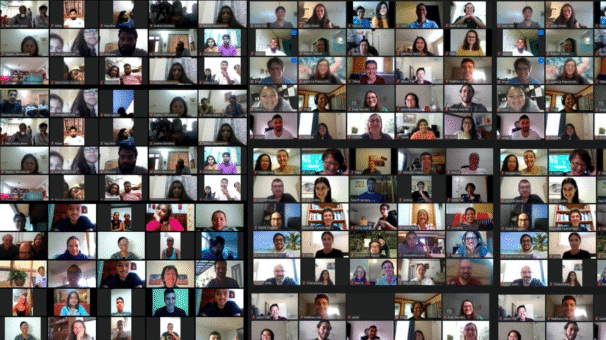
An international formation school entirely online because of Covid with new methodologies and the participation of 115 Gen 2, the young people of the Focolare, from 18 nations. A workshop replicated in various parts of the world. Can the Covid emergency stop our commitment to building a more united world and the possibility to achieve it together? This has been a constant question, in recent months, for many Gen 2, the youth of the Focolare Movement, together with their formators. And so, if the pandemic has prevented them from travelling from one country to another or even from leaving their home, new technologies have allowed the young people to continue to work for peace and unity in the world, indeed, thanks to technology, there have been new and original initiatives, all strictly via the web. And so, looking at the international appointments established some time ago, the young people of the Focolare decided not to cancel even the annual international formation school for youth group leaders scheduled for August 2020 in Italy, but to do so online. Of course, a little more work was needed to transform the 10-day programme for the school, adapting it to a web-based training method and looking for platforms and apps that would allow moments of listening and going deeper, but also allowing for moments of communion, all together and in small groups. This is how the “International School 2020” was born with a completely new format. 82 young people and 33 adult formators participated from 38 countries and in 16 languages. “Learning to work online is a positive thing as a result of Covid “ – said one of the participants from Argentina – “because it facilitates the participation of those who, for financial or time constraints, had never done and would not have been able to make an international experience if it involved travelling”. The school entitled “On earth as it is in heaven” focused on spiritual and current issues, such as peace, social commitment and active citizenship, which were examined in depth in the light of Chiara Lubich’s charism. One of the focuses was: “Dare to Care”, the central theme of Pathways that the young people, with the entire Focolare Movement, have committed themselves to putting into practice. Each year the Pathway is associated with a colour: this year it is the ‘black’, which Chiara Lubich had linked to political, civil and social commitment for the common good. And, as black is the background to all the other colours, this commitment is the background against which the various areas of everyday life stand out: family, society, school. Beginning with Chiara Lubich’s writings, experiences of committed witnesses in the political and social spheres followed; experts such as the theologian Father Fabio Ciardi, a member of the Abbà School, the study centre of the Focolare Movement; Alberto Lo Presti, director of the Igino Giordani Centre; Daniela Ropelato and Antonio Maria Baggio, lecturers at the Sophia University Institute in Loppiano (Italy). The concluding words of Maria Voce, President of the Focolare Movement and Co-President Jesús Morán: “You are people who have decided to give your lives and, in this school, you have tested it in your workshop. Today, the workshop is over, now you are going out to live it”. This school, together with the life commitment it entails, is spreading and multiplying: the 100 participants have made themselves promoters of similar schools in ten different places around the globe.
Letizia Spano
21 Sep 2020 | Non categorizzato
Not having preferences and not expecting anything in return: this is Chiara Lubich’s straightforward but revolutionary formula for a love that can change the world – today too. “So if anyone is in Christ, there is a new creation: everything old has passed away; see, everything has become new!” (2 Cor 5:17). [These words] speak … of the ‘new self’ that, through baptism and by adhering to the fruits of baptism, has been established in us and has a new way of seeing things, of behaving and of loving. … What is this love like? … Since it is a participation in the very love that is in God, which is God himself, it differs from human love in infinite ways. But there are two aspects, above all, in which it is different. Human love makes distinctions, it has preferences, it loves some brothers and sisters, for example blood relatives, people who are educated, rich, good looking, distinguished, healthy or young; it loves those who belong to a particular ethnicity or class, but it does not love others in the same way. Divine love, instead, loves everybody. It is universal. The second difference is the fact that, in human love, we love because we are loved. And even when love is beautiful, we love something of ourselves in the other person. There is always something selfish in human love, or that waits to love only when self-interest prompts us. So if we want to let our ‘new self’ live in us; if we want to let the flame of supernatural love burn in us, we too must love everybody and be the first to love. Basically, we must be like Jesus, other Jesuses. Jesus died on the cross for everybody: his love was universal. And with that death he was the first to love.
Chiara Lubich
Taken from a telephone conference call, Rocca di Papa, 8th January 1987
