15 Jul 2020 | Non categorizzato
The Focolare Youth launched the #daretocare campaign, a new campaign which aims at care of our societies and our planet Earth and at active citizenship that contributes towards building a more united world. Elena Pulcini, professor of social philosophy at the University of Florence, Italy has been interviewed on this subject. Elena Pulcini, Professor of Social Philosophy at the University of Florence, who has dedicated many years of research on the subject of care, was one of the speakers during the first livestreaming #daretocare, organized by the Focolare youth on June 20th How has the experience of the pandemic, we are all going through, influence your vision on the subject of care? “To me it seems that care has emerged mainly as an aid”, Pulcini explained. “Think of all those involved in the medical and health services. This has given rise to positive elements; it has stimulated feelings such as gratitude, compassion, the feeling of our vulnerability, feelings that somehow we have neglected. All this is very positive because we really need it, and it is essential to arouse those which I call empathic emotions. At the same time, however, care has been restricted to its meaning of assistance, to what the English call “cure” and not “care”. Care must become a way of life”. We dream of a society where care is the backbone of local and global political systems. Is this utopia or is it feasible? “Care means responding to something. In this case it means responding to the awareness that others exist. The moment we realize that others exist and we are not closed in the shell of our individualism, the empathic abilities in us function; this means that we are able to identify and understand the emotions of others. But, today, who is the other? New forms are emerging about those we consider as others. Today, the one that is different is considered as the other, and so are future generations, nature, environment and the Earth we inhabit. If in our relationships we manage to care through our empathic abilities, then care can really become the complete answer to the great challenges of our time. I cannot say whether this is really feasible or not, but I think we can’t lose the utopian perspective. Responsibility is not enough, we need to cultivate hope as well”. What do you suggest that we do to behave in this manner and to lead our societies, starting from our institutions, to move towards care? “I believe that wherever we are we have to behave in a way that care does not remain confined to the private sphere (…). I have to live care in my family, in my teaching profession, when I meet a poor outcast in the street, when I go to the beach; I have to take care of everyone and everything. Care must become a way of life, that crushes our unlimited individualism which leads not only to the self-destruction of humanity, but also to the destruction of world life. Therefore, we must try to respond with care to the pathologies of our society, and this means that we have to educate for democracy. Alexis de Tocqueville, a 19th century philosopher I like, used to say: “we must educate for democracy”. This is a lesson we still need to learn, and I think it means that we have to cultivate our own empathic emotions so that we are stimulated to care with pleasure and gratification, and not with compulsion”.
The Focolare Youth

14 Jul 2020 | Non categorizzato
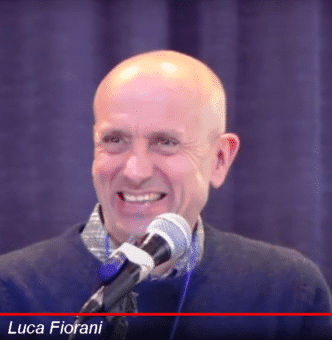
Five years have passed since the publication of Laudato Si’, Pope Francis’ encyclical on the care of the planet. Here we discuss it with Luca Fiorani, professor at the universities of Lumsa, Marconi and Sophia; ENEA researcher; and head of EcoOne, the Focolare Movement’s ecological network. In these times of pandemic, what lessons can come from Laudato Si’ and its paradigm of integral ecology? I am thinking of how “everything is connected”. The pope, before the pandemic, made us savour its positive side, the wonderful relationship that exists between elements of nature, including people. The pandemic, on the other hand, has brought out the dark side of “everything is connected”, because human activity, which led to the destruction of natural habitats, and the virus’s leap of species from animal to man are linked. What is the evangelical foundation of being committed to care for creation? It is “Love thy neighbour as thyself.” One of the key concepts of Laudate is, “Listen to both the cry of the earth and the cry of the poor”. It is true that for the Gospel, nature has value in itself, but it is also true that caring for nature means ensuring a healthy planet for the most disadvantaged and for our children. It means reminding us of the “lower billion” – those billion people who are victims of a “chronic pandemic” due to 17 neglected tropical diseases. Can the concept of integral ecology guide the future? This is the fundamental concept of all Pope Francis’ teaching, which invites us to overcome the current socioeconomic system. Today we still live with the paradigm of the industrial revolution, which considers natural resources unlimited. Yet resources are indeed limited, and therefore we need to find a different model of development that also takes into account the needs of peoples forgotten by so-called “evolved” societies. Laudate calls for a change of attitude. What does it mean to live the principles of integral ecology? Integral ecology concerns not only the environment but all aspects of human life: society, economy and politics. Therefore each of us must try to change our lives, starting, for example, with consumer choices. Then we can choose leaders who are sensitive to caring for nature and campaign to apply pressure to disinvest from fossil fuels in favour of renewable energy. In this special year of Laudato Si’ celebrations, how will the Focolare Movement participate? The movement participates in initiatives of the Catholic Church and in events promoted by the Global Catholic Climate Movement, to which it adheres. In addition, it is organising a “New ways towards integral ecology” conference, to be held at Castel Gandolfo (RM) from 23–25 October, details of which are available at ecoone.org. Your latest book is entitled Francesco’s crazy dream: a small (scientific) manual of integral ecology. Why do you speak of a crazy dream? Because it truly seems impossible to change the course of this planet towards a world where we all feel like brothers and sisters, and build more bridges than walls. But as Focolare’s founder Chiara Lubich said, “Only those who have great ideals make history!”
Claudia Di Lorenzi
13 Jul 2020 | Non categorizzato
Being in lockdown has often tested our love of neighbour. In fact, it is not easy to live shut up in a house and find ourselves always so close to one another. When this happens we push against each other’s limits and this calls for a “supplement of love” called “bearing with”. It is consoling to know that Chiara Lubich also encountered this type of difficulty in her community life. Some days ago I started reading a book called The Secret of Mother Teresa; Teresa of Calcutta of course. I opened it at the chapter that speaks of the “mystic of charity”. I read that chapter and others, immersing myself in those pages with great interest: everything to do with this future saint is of personal interest to me since, for years, she was a very dear friend of mine. I was suddenly struck by the extreme radicalness of her life, by her totally committed vocation, which was awesome, almost frightening. Above all, however, it urged me to imitate her in the particular, radical and total commitment that God asks of me. … Prompted by this conviction, I began to read our Statutes, sure that I would find there the measure and type of radicalness that the Lord is asking of me. I opened it and immediately, on the very first page, I received a small spiritual shock, like when you discover something in that very moment (although I have known it for almost sixty years!). It was the “norm of norms, the premise to every other rule” of my life, of our life: to generate – as Pope Paul VI put it – and maintain first and foremost … Jesus among us through mutual love. … I decided to live this norm first of all in my focolare and with those around me. We know that Jesus said: “Let anyone among you who is without sin be the first to throw a stone at her” (Jn 8:7). Not everything is perfect in our focolare either. There might be an unnecessary word said by me or by others; too long a silence, a rash judgement, a small attachment, a suffering not borne patiently, which undoubtedly makes Jesus among us feel uncomfortable, even if it doesn’t prevent his presence altogether. I understood that I had to be the first to make room for Him, to pave the way, smoothing things over, seasoning everything with the greatest charity, bearing with everything, both in the others and in myself. “Bearing with” is not a term we generally use, but the Apostle Paul advises us to do it (see 1 Cor 13:7). Certainly, to bear with everything requires not just an ordinary kind of love. It is a special love, the essence of love. I began doing this. And there were positive results! Other times, I would have immediately invited my companions to do the same, but not this time. I felt I had to be the first to do all my part, and it worked. Besides, it filled my heart with happiness maybe because, in this way, He came back into our midst and remained. Later on I will tell them, but I still felt the duty to carry on doing this as if I were alone. And my joy was immense when I thought of Jesus’ words: “I desire mercy, not sacrifice” (Mt 9:13). Mercy! This is the super-refined love that is asked of us and that is worth more than sacrifice, because the most beautiful sacrifice is this love that can bear with everything, that can forgive and forget when necessary. This is the radicalness and total commitment we are asked to live.
Chiara Lubich
(From a telephone conference call, Rocca di Papa, 20th February 2003)
11 Jul 2020 | Non categorizzato
Maria Voce, President of the Focolare Movement, says Chiara Lubich’s interreligious dialogue, “was a true prophecy that is now being fulfilled as a concrete response to the needs of humanity”. Co-President Jesús Morán explains how the ethics of care is at the basis of the new Pathway that will be launched on June 20, 2020 by the young people of the Focolare Movement. https://vimeo.com/429994085

10 Jul 2020 | Non categorizzato
Can the two major crises currently rocking the United States – the pandemic and racism –lead to a better future? Susanne Janssen, editor of Living City Magazine, reflects. Racism is a virus that has never been eradicated in the United States. After the Civil War (1861-1865), slavery was legally abolished, but still today people of color and white people are not treated in the same way. The death of George Floyd has shone a light on this problem. The fact that those 8 atrocious minutes of George Floyd pleading for his life were captured on video means it could no longer be blamed on the victim. This video, together with the large number of people (not only Afro-Americans) who united to protest against racism, are a sign that this time something is different. Our hope is all that has happened will not end with a wave of protests but will lead to real change. The role of the Catholic Church After a few days’ silence, the Catholic Church positioned itself alongside the anti-racism protestors. The Cardinal of Boston, Seán O’Malley wrote that the killing of George Floyd “is painful evidence of what is and has been at stake for African Americans – the failure of society in too many ways to protect their lives and the lives of their children. The demonstrations and protests of these days have been calls for justice and heart wrenching expressions of deep emotional pain from which we cannot turn away”. The United States Conference of Catholic Bishops has described racism as the “original sin” of their country, persisting through the nation’s history, festering to this day. Reflection on the issue is now gaining ground in the Church and society. The first steps The slogan “defund the police” calls for something more than a simple restructuring of police departments. It demands a completely new start, to create a police force which is more accountable to its citizens. In recent years much has been said about the increasing militarization of the police; but to tell the truth, much of what they do, should actually be the role of social workers. What differentiates today from the violence suffered by Afro-Americans in the past, is the way many people are striving to learn from, listen and face up to the past, focusing on those structural issues which have lingered since the time of the abolition of slavery and segregation, such as the so-called “Jim Crow laws” and the 1964 Civil Rights Act. Yes, because the first step has to be facing up to those prejudices within everyone, and the social privileges generally afforded to white people. Authors Ibram X. Kendi and Robin DiAngelo declare that “being a good person” is not enough in this regard. The step required is to oppose the very structures of oppression, as even now, in a routine police check, the color of your skin can make the difference between life and death. The contribution of the Focolare Movement Firstly, Focolare communities are looking hard at themselves for traces of discrimination and racism. The Focolare’s thinking on racial justice is an essential starting point before entering in sincere dialogue with one another and with people around us. We create space to listen to the painful testimonies of racism endured, and also to the experience of those raised in predominantly white environments who are striving to engage in a process of recognizing their own limits. These are not easy conversations, but they are necessary in order to build relationships that are more real. “If we’re not careful, we risk reinforcing the principles of popular rhetoric on diversity which too often support the privileged and accentuate the differences,” affirms an academic of color. Another Focolare member now more than 80 years old, he too an academic, admits that throughout his life he has had to learn to become more open, particularly when one of his daughters married a Jamaican. “I was worried their children would suffer discrimination. But now I see they are a shining example for many”. The role of youth Young people are in the front line demanding a change of mentality. One young girl of mixed race said, “I want to help my brothers and sisters to be listened to more, otherwise I will regret it for the rest of my life…” The very “Black Lives Matter” slogan which united many people, drawing them out onto the streets in huge numbers, has itself been targeted to provoke polarization. It’s not rare to come across messages which strive to discredit those campaigning for more justice. However, there are also signs of a gradual change in public opinion. In fact, many have condemned President Donald Trump’s handling of the recent crises: the pandemic and structural racism. At time of writing, the Democratic Party candidate, Joe Biden, has a 13% lead in the polls, but it’s far too early to predict the situation come November when Americans go out to vote.
Susanne Janssen, Editor, Living City magazine

9 Jul 2020 | Non categorizzato
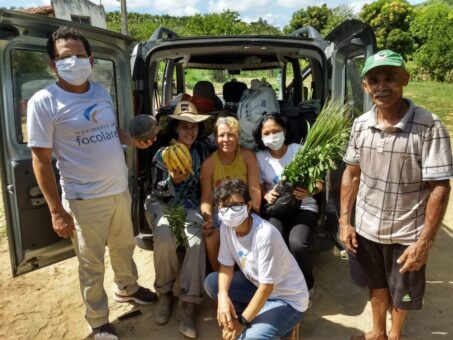
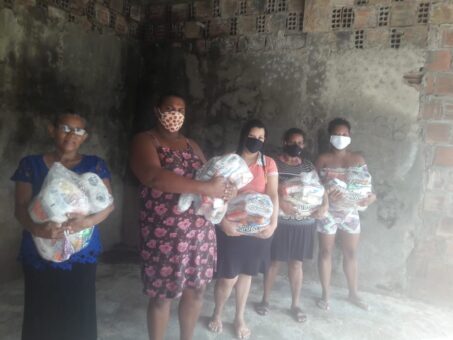
The Focolare social organizations serve more than 3,500 families and create networks of solidarity during the pandemic. Distributed throughout the country, the twenty-one social organizations inspired by the charism of the Focolare Movement are giving an important witness of solidarity and fraternity during this pandemic.
Foto: Obra Lumen
Foto: Instituto Mundo Unido