21 Jul 2020 | Non categorizzato
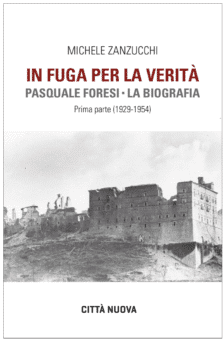
Pasquale Foresi, the first co-president of the Focolare Movement and an avant-garde theologian was a very timid and a highly intelligent person. His first biography, edited by Michele Zanzucchi, has just been published in Italian. It relates the story of a man, the beginning of the Focolare Movement, a cross-section of history that has much to say to the Movement, the Church and society today. The first biography of Pasquale Foresi “In fuga per la verità”, who together with Igino Giordani was defined by Chiara Lubich as co-founder of the Focolari, was published on July 9, 2020. It gives a very well documented account of the first part of his life, from 1929 to 1954. Even Focolare members knew very little about this part of his life because of Foresi’s reserved character and his style of co-governance, as we would say today. It is a very interesting text, published in Italian, but versions in English, French and Spanish are in the pipeline. It is studded with unpublished facts and it flows like a novel, that speaks of Foresi’s life and recounts all about the Movement’s beginnings and Chiara Lubich, as a person, from his point of view. It also makes us reflect on the present life of the worldwide Focolare Movement, almost 80 years after its birth. But who was Pasquale Foresi? Who was he for the very young Focolare foundress? We put this question to Michele Zanzucchi, the author of the biography, a journalist and a writer, former director of Città Nuova. He was well-acquainted with Foresi, but besides, it took him two and half years of research on papers, texts, books and speeches to produce such a thorough and deep piece of work. “Foresi met Chiara Lubich during the Christmas holidays of 1949. He was then a young man in his twenties, but he had already experienced a more adult life than his age; so he was “prepared” to collaborate with the Focolari foundress. He was the son of a Livorno family; his father, a teacher and a Catholic laity leader, later became a member of parliament and his mother was a housewife. He had three brothers and sisters. Since his childhood, Pasquale showed uncommon practical-theoretical intelligence. On September 8, 1943, the day of the armistice, at the age of 14, he escaped from home “to give some service to Italy”. Soon after, he joined the blackshirts, and then, because of the Nazis themselves, he took part in combats and he even fought at Cassino. Before he escaped, he freed deserters who were condemned to death. His philosophical-religious conversion started there. He was with the partisans when the war ended, and then, immediately afterwards he entered the seminary in Pistoia. Two years later he was at the prestigious Capranica in Rome. But he left; he could not accept the incoherent way some clerics lived the Gospel. He found this coherency in Lubich and her friends. Within a month, the teacher from Trent understood that God sent this young man to help her accomplish God’s work that had just started. Foresi cooperated with her in setting up centres of community living for virgins, in the Church’s approval of the Movement, in the building of centres and small towns, in the setting up of publishing houses and launching magazines, in the inauguration of university centres….. From that day on, Lubich remained faithful to the role God entrusted to Foresi, and she never abandoned this, not even when he was struck by a serious cerebral illness in 1967, when he was barely 38 years old and he disappeared from public life. For her, Pasquale always remained one of the two co-founders of the Movement, the one with whom she confronted every decision she had to make”. What kind of priest was he? What was his vision of the Church? “With a very traditional formation on the sacraments and priestly life, I would say neo-school. Foresi helped Lubich to develop an original idea of the application of the presbyterate, the idea of “Marian priesthood” stripped of “power” and animated only by deep rootedness in the kingly priesthood of Jesus. This idea of priesthood is still being applied and experimented today. For Foresi, in particular, the priest had to be a champion in humanity, in being man-Jesus. The underlying vision of the Church is linked to a prophetically conciliar perspective: the Church as the people of God, the Church-communion, naturally synodal and one that gives value (which does not mean in any way devaluing the “sacramental” presence of Christ in his Church) to the presence of Jesus in humanity in more “lay” forms, particularly in the presence promised by Jesus in the Gospel of Matthew: “Where two or three are gathered in my name, there I am in their midst” (Mt 18:20)”. Why did Chiara Lubich entrust Foresi, and not a lay person, with the realization of some of the Focolari‘s works, the so-called “concretizations”, such as the international centre of Loppiano and the launching of the publishing house Città Nuova? “It would be great if this question is asked to the one who could really answer it… However, I note that the other co-founder of the Movement was Igino Giordani, a married lay person, a member of parliament, a journalist, an ecumenist. He met Lubich back in 1948, and the foundress saw in him the presence “of humanity” at the heart of her charism. So for Lubich, Giordani meant a radical opening to the world, following the priestly prayer of Jesus: “Let all men be one” (Jn 17:10). But in Foresi – who was of a more “concrete” nature than the “idealist” Giordani – she saw the one who would give her the practical support needed to achieve her work. We need to say that Foresi was extremely “secular” in this characteristic, even though it was very clear to him that the Movement’s mission was primarily ecclesial, and that it could not be done without the ecclesiastics”. Let’s try to guess: what would Foresi say to the Focolari and what would he invite them to aim at if he were alive today? “A real gamble. I believe he would invite the Movement to do the necessary ‘updating’ , while keeping in mind the nascent state of the Movement. Therefore, he would invite the Movement to go back to the founder’s mystical intuitions of 1949-1951, read them again and apply them. And also to look very carefully into the process of concrete realization that took place especially during 1955-1957, when Lubich received other illuminations that referred to the concretization of the previous mystical intuitions”.
Stefania Tanesini
20 Jul 2020 | Non categorizzato
The following reflection by Chiara Lubich can shed light on how to live the trial that we are all going through, on a worldwide level, according to the Gospel. Because of the pandemic, many people have lost a relative, a friend or an acquaintance and we are all called, in the most varied ways, to respond to the grief and pain that this pandemic is causing everywhere, recognizing in them the face of Jesus forsaken to love. … In the last few weeks, several people in the Movement have left this life … and we who are still here on earth ask ourselves: what did they experience in that moment of passing on to the next life? What would they tell us if they could talk to us? We know the answer: they saw the Lord. They met Jesus. They saw His face. This is a truth of our faith, a truth which is immensely consoling. There is no doubt about it. St Paul himself said “My desire is to depart and be with Christ” (Ph. 1:23). He was referring to life with Christ immediately after death, without waiting for the final resurrection (Cf, 2 Cor. 5:8). This then is the experience of those who have reached the goal to which our Holy Journey leads us: the meeting with the One who cannot help but love us if we have loved Him. We hope to have the same experience. But to ensure that we do, we need to prepare ourselves from now on; in a sense, we need to get used to it. Will we meet the Lord? Will we see His face? We will surely contemplate Him in his glory if here on earth we have recognized, loved and welcomed Him forsaken. St Paul said he knew nothing on earth except Christ, but Christ crucified. This is what we too want to practice doing: we want to seek His face. We want to search for Him forsaken. We can be sure of finding Him in the small or big personal sufferings which are never missing. We’ll find him in the faces of the people we meet, especially those who are most in need of help, advice and comfort; those who need encouragement to make progress on their spiritual journey. We will search for Him in the harder and more laborious aspects of the various activities that are the will of God for us; we will find him in all disunities whether near or far, big or small. … We will also seek His face in the Eucharist, in the depths of our heart and in religious images of Him. Furthermore, He needs to be contemplated and loved in practical ways also in all the great sufferings of the world. Yes, there too, even though we often feel powerless in front of them, but perhaps we are not. We often … hear about disasters that have already happened or that are threatening entire populations or nations! … If the charity of God dwells in our hearts these disasters weigh down on us and leave us dismayed. The reason is because we feel – notwithstanding our good will and all our activities – that we can do nothing that could actually improve these situations. And yet we must convince ourselves that we can do something. Here too, once we have discovered his face in these huge catastrophes, we can, with the strength of children of God who expect all things from their Almighty Father, unload onto Him the worries that crush us and these vast areas of humanity, so that He will move the hearts of world leaders who are still able to do something. And we must be confident that He will do something. He has done this often in the past. … So let’s make this verse from Psalm 27 resound in our hearts as often as possible: “Your face, Lord, do I seek”. Your sorrowful face so as to dry your tears and wipe away your blood as much as we can, and to see his face shining upon us when it’s time for us to have the experience of those who have already arrived.
Chiara Lubich
(Taken from a telephone conference call, Rocca di Papa, 25th April 1991)
18 Jul 2020 | Non categorizzato
What have we learned from the pandemic? Which tools can we use to build a new world? What specific contribution can each of us make? From Maria Voce’s spontaneous words to a Focolare community in Italy on 16th July. For a number of years, July 16th has been a double celebration for the Focolare communities around the world. It’s the anniversary of the special pact of unity between Chiara Lubich and Igino Giordani in 1949 and also the birthday of Focolare President, Maria Voce. Once again this year the celebration became an opportunity for spontaneous and informal dialogue – in which Maria Voce spoke from her heart about the meaning of that special day, about the life of the Focolare in recent months and the contribution the charism of unity can make at this crucial time for humanity. She had received many greetings, good wishes and much affection from all over the world and for this reason she wanted, and wants, to thank each person in a special way. We publish below part of what she said, with extracts from amateur video footage of that occasion. “… The pandemic has taught us a great lesson, hasn’t it? We must recognise this. It has made us suffer and is still making us suffer. We don’t know how many painful consequences will still come from this pandemic, do we? But it has also been a great lesson. The main lesson was telling us ‘you are all equal’. You are all equal: whether rich or poor, powerful or wretched, children, adults, immigrants … you are all equal. That’s the first thing. Second: even though you are all equal, some people are suffering more than others despite this equality. So what makes you all equal? You are all equal because God made you all equal. You are very different from each other but you are all his children. You have all been created by him with the same love, a great love. Then human beings came and began to differentiate between people, and we keep on doing this. So, yes to one person, no to another; one person is worth more, another less. This person can give me something, but that one can’t; this person is exploiting me, that one isn’t … and we start differentiating between people. What happens when we do that? The result is that there are some countries where hospitals are well-equipped and countries where they are not. There are countries where there are enough masks for everyone and others where there are not. There are places, even here in Italy, with very good internet connection and where distance schooling is possible, and other places that don’t have it. So we are all equal before God but not all equal in the eyes of other people, where real care for all is not there. Does this hold true for us too? Perhaps I too am more willing to spend time with one person than with another and I differentiate between one person and another. I’ve seen this too and so am I really living the pact if I am like that, the pact that tells us to be ready to die for one another, not only for people I like, but any person at all? Today people are saying we must create a new world, a new humanity. Everyone says that a new world must be created. However, in a small way, Chiara made a new world. Chiara’s family scattered across the globe is already a new world, at least in a small way. Of course it’s just a start, a model, a small sign, but it shows that it is possible. So, if it has been possible for this little group (which is only relatively little because it numbers hundreds of thousands around the world) to do this in a small way, I ask, is this little people, Chiara’s people, ready to tell everyone that a new world is possible? It is possible: we must be convinced that it is possible and remember the thought for today, “Believe in the power of love.” So, first of all, let’s believe that love is a powerful force. Have we experienced it? Yes, we have experienced it very often. But now, it has diminished a little; the thermometer of love has gone down. Let’s put some more mercury in the thermometer and make it rise. Let’s increase the amount of love in the world and you’ll see that everything else will rise up. We will be a reality that goes through the world doing good to all. And we’ll do this without having to say, “You know, we do things in this way; come with us because we are like this.” No, we are who we are; we are just like the others; we are poor wretches like everyone else, but we live in paradise and we don’t want to leave this paradise. But we want to be with others. We don’t want stay among ourselves in paradise. We want to bring this paradise to others and not keep it for ourselves, because it’s comfortable … and let the world get lost. No! The world must be saved; we must help save the world with our love.”
18 Jul 2020 | Non categorizzato
Dialogue with Vinu Aram, Director of the Shanti Ashram International Centre. By Marco Aleotti, Roberto Catalano, Giulio Mainenti. https://vimeo.com/430298225
17 Jul 2020 | Non categorizzato
Gen Verde’s experience during the lockdown “We were right in the middle of our tour in Spain when we received some very disturbing reports from Italy about Covid-19 and the rising number of new cases. In a very short time we had to decide whether or not we should suspend the tour and return to Italy – and to communicate that decision to the organizers. The next day we boarded the boat, which turned out to be the last passenger ferry from the port of Barcelona.” It all happened a few months ago but for Mileni from Gen Verde the memory is still very vivid and clear. In these last four months, Gen Verde has transformed this difficult situation into an opportunity: “Almost every day we were hearing from friends who had caught the virus. They were asking us to be close to them – says Annalisa – and so we asked ourselves, how can we help them? How can we let them feel they are not alone, while respecting social distancing? Then we had an idea: why not connect with them online from our home?” This is how the first live stream adventure began: with a few instruments and a not-so-stable internet connection, they decided to try even if they weren’t sure how many people would have followed. In the months that followed Gen Verde held many live streams broadcasts, as well as several dozen online appointments through zoom, Instagram, Skype… all of them an occasion to meet young people and adults all over the world: from the Philippines, Argentina, USA, Romania, Italy, Australia. These months also provided space to create new pieces, ranging from the dramatic theatrical piece called Il silenzio (The silence) to the instrumental, Tears and Light, not to mention the new videos produced to be able to celebrate the Easter Triduum together despite the distance. All that was created was shared immediately on their YouTube channel and through social media. Clearly all this required a great deal of work, maybe even more than what is required while on tour, but Gen Verde never held back, and never said no to those who asked to share a moment with them. “We are very happy – says Marita – because during these months, despite the difficulties we faced, we were able to meet hundreds of thousands of people through various on line meetings. Of course, it’s not the same as meeting in person, but I have to admit that we had never met this many people in the space of just 4 months. For those of us in Gen Verde it has been an experience way beyond our expectations.” And now, having concluded the last of this first round of live streams, Gen Verde will dedicate their time to the creation of new projects and ideas, which they will share soon. Gen Verde is always on the go, always looking ahead. What’s their secret? “We try to live not thinking of ourselves but of those around us – explains Sally. What is important to us is to build relationships based on universal fraternity. In these months of the pandemic we have received a lot of feedback after our direct streaming and these impressions are what kept us going forward, always striving to give our best. We are honest with ourselves and with everyone else: this pandemic was no joke and in many countries the situation is still very critical. However we believe that what we have done has been for many, a positive moment from which they could emerge relieved and refreshed. Now, we’re moving on to prepare new programmes, and launch new songs to give hope to a world so badly in need of it.”
Tiziana Nicastro
16 Jul 2020 | Non categorizzato
Chiara Lubich tells of the special pact of unity made with Igino Giordani (whom she called ‘Foco’) on the 16th of July 1949, the prelude to her mystical experience that summer. From an interview with journalist Sandra Hoggett in 2002 https://vimeo.com/438631561
