1 Aug 2020 | Non categorizzato
We are back in Loppiano, at the Sophia University Institute, an innovative academic centre and incubator of new concepts and practices in interreligious dialogue. By Anna Lisa Innocenti and Lorenzo Giovanetti. https://vimeo.com/430380293
31 Jul 2020 | Non categorizzato
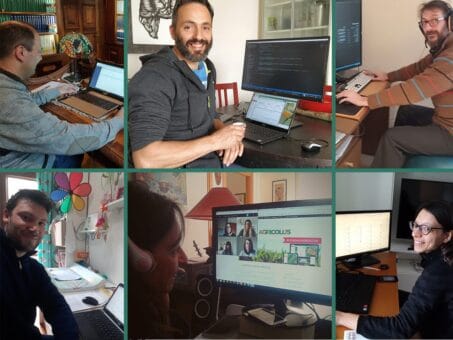
Firms going under, thousands of jobs lost: lockdown has hit the European economy hard. But many entrepreneurs are trying equally hard to keep going. Andrea Cruciani in Italy asked himself what he could do to protect his workers.  How have business people coped in the emergency lockdown phase caused by Covid-19? We spoke with Andrea Cruciani, CEO of TeamDev software consultancy and Agricolus start-up, linked to the Economy of Communion project. How has the lockdown affected you? “Before lockdown things were going well. For the past 12 years, TeamDev has demonstrated 20% annual growth and we now employ a workforce of 50. Halfway through February we took steps to raise money through the bank. But the lockdown meant by the end of March we had no cash liquidity left. For the first time ever, I found myself without money or opportunities. The only option left to us was to start laying off staff. I was so unhappy about this because we have always taken particular care to invest in the welfare of the business. Not surprisingly perhaps, some of our workers took fright and lost confidence in us. To lose the trust of even one employee was extremely painful to me.
  Gradually, however, we found ways to meet the needs of everyone. As soon as the business started generating some income again, we immediately began to supplement their unemployment payments through a special ‘Covid fund’. At the end, we were able to give the same pay to all, and they understood there was no bad-faith on our side”. Have you learnt anything through all this? “I’ve realized how fragile authentic relationships with employees and collaborators can be. It’s so important that authentic relationships are built on trust. We’ve been amazed to see how some of our people have found new energy from the desire to contribute to the common good. In this period the true humanity within our relationships has emerged”. Do you have any advice for other businesses about caring for their human resources? “Let me tell you a story. Three years ago I decided to promote one particular employee to the management of a department. But after a short time, this person quit. I realised that what I want out of life for myself is not necessarily what everyone else wants for themselves. This employee did not want the psychological stress of that management role and was not even ambitious for an increase in salary. Following that experience we began to improve some of our processes”. Improve in what ways? “First of all, we turned to a coach to improve the team spirit among everyone working in the company. Then we began to improve working conditions with some quite simple initiatives like offering fresh fruit for break-times. We also ordered seasonal fruit from a Caritas orchard project, to give everyone the opportunity to take what they needed home, free of charge. We also launched a program of integrated welfare, developing our existing long-standing integrated retirement package and other supports such as flexible working to accommodate family commitments. In this way we protect the interests of those working in our companies. And, clearly, we strive to promote the growth of each person to be able to give the best of themselves”. How do you view the future of the economy in general? “I foresee a future where it will be ever more necessary to read the present moment and share our own perspective for the future. Chiara Lubich is a prophet for us, EoC business people, because she has taught us how to care for our employees and businesses. Some aspects are covered by the law but many other aspects are covered already by one’s conscience and commitment to love”.
by Lorenzo Russo
29 Jul 2020 | Non categorizzato
“Be a family – this was Chiara Lubich’s invitation to people eager to live the Word of God –. And wherever you go to bring the ideal of Christ, (…) the very best thing you can do is create the spirit of family with discretion and prudence but also with decisiveness. It is a humble spirit which wants the good of the other. It is not proud… it is (…) true charity.”[1] The new director In his “programmatic speech” the new director had spoken of the company as a family in which everyone was co-responsible. The atmosphere between us was light and cordial… but when the first difficulties arose, perhaps due to inexperience, he surrounded himself with those he trusted most and excluded practically everyone else from decision-making. I took courage and one day, out of love for both him and the employees, I set out to ask him what worries were crushing him. He seemed so different to how he was at the beginning, like someone who only saw enemies. Perhaps we had done something that was making him act like that? He didn’t answer and dismissed me, by saying he had an urgent commitment. A few days later he called me and apologised. He shared with me how he felt unable to support the kind of solidarity where everything slipped through his fingers. He asked me for help. I encouraged him to open up to all of us and ask whether we really wanted to be part of his project. It was a moment of great understanding. Something began to change. (H.G. – Hungary) At the post office At the beginning of the coronavirus pandemic, I went to the post office to send a package. In the queue for guesthouses, an elderly lady wearing a mask who was clearly not well, collapsed to the floor. I ran towards her but I wasn’t strong enough to lift her up. When I asked for help, I noticed a certain reticence: just one boy covered in tattoos who had witnessed the scene outside the post office responded. I sat the elderly lady down, who managed to come round apart from some pain resulting from the fall, and asked the boy to help her sort out what she needed to do, while I sent my package. Not only did he help me get her into the car, he also wanted to come with us to the lady’s house. Since she had a blood pressure machine, I took her blood pressure. As I left the building, the boy said to me, “I was laughing with my friends seeing how people driven by fear behave. What you did was great.” After a few days I wanted to visit the old woman. I was surprised and even moved when she told me that the boy had brought her some biscuits made by his mother. (U.R. – Italy) Rehabilitating the past Such a shame! My colleague was really competent in her job but she brought everyone down with her pessimism. Because she was jealous of me and other colleagues she always spoke badly about everyone. Consequently, with one excuse or another, no one wanted to work with her. What should I do? Just let things go ahead despite the bad atmosphere? Then I had an idea for her birthday. I organized a collection for her in the office. When we called her to celebrate with cakes people had made, drawings her colleagues’ children had made for her, a beautiful bag as a present, she was deeply moved and incredulous. She never said a word for days. She would just look at us like a wounded bird. Then gradually she began to talk to me about her childhood, her failed relationships, the divisions in her family… We became friends and she comes to our house to help my children with Maths and English. She’s one of the family now and it looks like her past is healing too. (G.R. – Italy)
by Stefania Tanesini
(from The Gospel of the Day, Citta Nuova, year VI, no. 4, July-August 2020) [1] C. Lubich, in Gen’s, 30 (2000/2), p. 42.
27 Jul 2020 | Non categorizzato
We have all suffered because of the coronavirus and many people are still suffering. The pandemic has caused problems and pain in all sorts of ways and we would easily feel discouraged if Jesus did not help us. In fact, we know that He, who is God made man, experienced all our sufferings and that for this reason He can be close to us and support us. … Life can be viewed as being like an obstacle race. But what are the obstacles? How can we define them? It is always a great discovery to see how each suffering or trial in life can in a certain sense be given the name of Jesus Forsaken. Are we gripped by fear? Didn’t Jesus on the cross in his forsakenness seem overwhelmed by the fear that the Father had forgotten him? In some hard trials, the obstacle we might meet is despair or discouragement. Jesus in his forsakenness seemed engulfed by the impression that in his divine passion he was without the Father’s support. It seemed that he was losing the courage to reach the end of his most painful trial, but then, he said: “Into your hands Father I commend my spirit”.[1] Are we in circumstances that make us feel disorientated? In that tremendous suffering, Jesus seemed unable to understand anything about what was happening to him, given that he cried out ‘why?’ [2] Are we being contradicted? In his forsakenness, it seems as though the Father does not approve of what the Son is doing. Are we being rebuked or accused? Jesus on the cross, in his forsakenness, perhaps had the impression of being rebuked or accused even by heaven. Furthermore, in some trials that sometimes come in relentless succession don’t we even reach the point of saying in our affliction – ‘This seems to be too much; this is beyond all measure’? In his forsakenness, Jesus drank a bitter chalice that was not only full but overflowing. His was the trial beyond all measure. And when we are surprised by a let-down, or feel injured, or have an unforeseen accident, an illness, or are in an absurd situation, we can always remember the suffering of Jesus Forsaken who experienced these trials personally and many more. Yes, he is present in everything that smacks of suffering. Every suffering is one of his names. In the world, it’s said that someone who loves calls their beloved by name. We have decided to love Jesus Forsaken. And so, in order to succeed better in this, let’s try to get used to calling him by name in the trials of our life. So we will say to him: Jesus Forsaken-loneliness, Jesus Forsaken-doubt, Jesus Forsaken-injury, Jesus Forsaken-trial, Jesus forsaken-affliction and so on. And because we call him by name, he will see that he is being discovered and recognised beneath every suffering and he will answer us with more love. By embracing him he will become our peace, our comfort, our courage and stability, our health and our victory. He will be the explanation of everything and the solution to everything. Let’s try then … to call Jesus by name when we meet him in the obstacles of life. We will overcome them more quickly and the race of our life will not be paused.
Chiara Lubich
(Taken from a telephone conference call, Mollens, 28th August 1986) [1] Lk 23:46. [2] Cf. Mt 27:46; Mk 15:34.
25 Jul 2020 | Non categorizzato
Chiara Lubich and interreligious dialogue, a way to give a soul to globalisation. https://vimeo.com/429999013
22 Jul 2020 | Non categorizzato
If we love, Jesus will recognize us as his family, as his brothers and sisters. This is a great opportunity: it surprises us; it frees us from the past, from our fears, from our plans. Thus, even our limits and fragilities can lead us to our realization, and we will make a big leap foward. Racism I was a student at the middle school; classes and homework were fine, but the relationship with my classmates wasn’t. One day, while I was finishing my science homework, I was verbally insulted by one them for being an Asian. I didn’t know how to react to his racist abuse. I did not utter a word, but a strong feeling of revenge gripped me. Then a strange thought crossed my mind: “Now is your chance”. It took me a while to understand quite clearly that it was “now my chance to love my enemies”. My first reaction was to ignore this and defend my Asian identity. Loving my enemy seemed as if I would only be contributing towards a more negative situation. I was very uncertain about what to do, but after some time I decided to keep silent. I forced my angry heart to forgive while I offered my personal wound to Jesus, who suffered so much on the cross. After forgiving my enemy, I sincerely experienced a happiness I never felt before. (James – USA) Faith Problems Our third child was born with Down syndrome and I considered this cruelty of nature as a punishment for my marital infidelities. I was ashamed to go round with this child and I carried so many unanswered questions inside me. But as F. grew up, I started to discover primordial goodness and cosmic peace in this child. I cannot explain the relationship between this and my problematic faith, but slowly I acquired other eyes and, I would say, another heart too. The relationship in my family changed as well. Strangely enough, I began to live F’s condition as a gift. I have no more problems about faith and dogmas; everything is grace. Behind the veil of misunderstanding there is innocent and pure truth. (D.T. – Portugal) Back to family life I left my family for someone I had fallen in love with at work. Blinded by passion, I didn’t realize what great hardship I was inflicting on my family. I was still in touch with my children, mainly with my eldest daughter who suffered most because of my absence. When her husband abandoned her and her three little kids and my daughter fell into a depression, I realised that the same suffering I caused was repeating itself. God gave me the grace to be fully aware of this and to repent. I did everything I could to be close to my daughter’s broken family. I looked for my son-in-law and spoke to him at length. He humiliated me when he told me off and pointed out that I had no right to judge because his wife’s traumas were partly my fault: their marriage failed precisely because of her lack of balance. I knelt and wept, asking him for forgiveness. He said that he would think about it. After a few months of anxious uncertainty, there was a ray of hope: my daughter told me that her husband was willing to try and settle into family life once again. (C.M. – Argentina)
Stefania Tanesini
(from The Gospel of the Day, Città Nuova, year VI, no. 4, July-August 2020)
