13 Oct 2019 | Non categorizzato
Don Mario Bodega was a priest from northern Italy and spent thirty years in the diocese of Milan ministering as parish priest, spiritual director of a college and chaplain in the Niguarda Hospital. He also lived at the Focolare Centre in Grottaferrata, Rome, and for the last ten years of his life was parish priest of the parish church of Loppiano, one of the Focolare Movement’s “little towns.” Thinking about Don Mario Bodega makes you recall Beethoven’s “Ode to Joy” for a variety of different reasons. Firstly, joy really was a distinctive characteristic of his, secondly, this piece of music was one of his favourites and thirdly, he often played it on his harmonica. He had learned to play in the seminary and music had been important to him during many phases of his life. As a young hospital chaplain, at Christmas time, he used to go from room to room playing his harmonica. As soon as they heard his first notes, people in the hospital used to say, “Now it really is Christmas.” A prisoner in Bollate, near Milan, wrote, “When you played the ‘Ode to Joy’ for me, I realised that not everyone here comes to make judgements about me – some people just come to love. Thank you for helping me to find God again because I thought he had abandoned me.” Mario Delpini, Archbishop of Milan, also spoke of joy when he announced the news of his death, “Let us accompany this man of God, a priest and friend, to the joy of his meeting with God. A beautiful smile, indicative of deep, personal happiness has been his characteristic throughout life – during the days of his youth and in old age and sickness; when he had many pastoral commitments and during the time when lack of health meant that activity was greatly reduced.” Don Mario was born on 15 September 1942, during the Second World War, in Lecco, in northern Italy. After finishing primary school, he entered the seminary and, through the rector, he got to know the spirituality of the Focolare Movement. He was ordained priest in 1968 and carried out many different ministries during the thirty years he spent in the diocese of Milan. Then, when invited by Cardinal Archbishop Martini, he began to work with the Focolare Movement. During the eleven years he spent in Grottaferrata, Rome, he deepened his relationship with Chiara Lubich, the founder of the Movement. In the course of his life, he wrote 135 letters to her. In one of her answers, she indicated a Word of Scripture that he could particularly focus on living. It was, “Following his mercy, they have abandoned the vain and false realities.” (cf Jonah 2:9) “I Believe in Mercy” is the title of the book he produced. It contains many of his experiences. Bishop Meini of Fiesole gave a copy to all the priests of the diocese on Holy Thursday 2018. In 2009, Don Mario came to Loppiano as parish priest. There, in addition to creating a deeper communion among the inhabitants, he was a sure guide on the spiritual journey for many people. He played an important role in the “Paths of Light” programme for couples experiencing difficulties in their marriage. He also contributed to the development of the Sophia University Institute. The dean, Professor Piero Coda, wrote, “His house and the San Vito parish church in Loppiano are a stone’s throw from our Institute. They became our home and Don Mario’s presence and guidance have been a source of light and balm – a school of life. Our Institute also became his home. So much so that , among the most moving reactions to his death, were those those shared by our Muslim friends who are part of the ‘Wings of Unity’ project.” In 2018 he celebrated the 50th anniversary of his priestly ordination. Shortly before as Loppiano was preparing for Pope Francis’ visit, Don Mario said that, given his very poor health, he did not think it was appropriate to be introduced to the Holy Father. With great paternal love, the bishop convinced him to change his mind. Don Mario told Pope Francis that he was a parish priest who was sick and walked with difficulty. He said he felt he could no longer work. “If you can’t work standing up, work sitting down” was the Pope’s response. And that is exactly what he continued to do, with great tenacity and joy, for his remaining 365 days of life. In fact, he died exactly one year later, on 10 May 2019.
Anna Lisa Innocenti
11 Oct 2019 | Non categorizzato
Every Christian has a “mission” in his or her community. It may be to create a united family, to educate young people, to engage in politics and work, to care for vulnerable people, to bring the light and wisdom of the Gospel to culture or to live a life consecrated to God for the service of others. Holidays My husband and I have different ways of relaxing. I like sports and swimming but he likes to visit new places and museums. This year, as the holidays approached, I felt more than ever the need to rest and recover my strength, but a voice inside me kept telling me not to express and impose my preferences, but rather to adapt to what my husband would like. But he also tried to do the same with me. This meant that both of us were detached from our personal projects and this made our holidays more beautiful and restful than ever before. (B.S. – USA) Setting an example A young migrant man who was trying to sell socks knocked on my door. We were talking and I was trying to get to know him a little when a neighbour of mine passed by. I knew this neighbour had a negative attitude towards migrants but, to my surprise, she invited him to come to her house too because she had something for him. The next day I heard that she had given him shoes and medicine, and she had also promised to provide further support. I really wouldn’t have expected that! (C.V. – Italy) Serving others Our son suffered from depression. We couldn’t help him no matter how we tried and eventually he ran away. One summer afternoon he decided to end his own life. I felt a deep sense of guilt and thought I was being punished. However, slowly, with the support of the parish community, I began to pray and I made myself available to people in need. Sometimes, I offered practical help, a word shared or a smile. One day a mother came to me. She had lost a child just as I had. I told her how I was trying to fill that void by putting myself at the service of others. Although she was not a believer, she too found a certain serenity by doing the same. (G.F. – Italy) From enemy to sister One of my nursing colleagues did everything possible to make my life difficult. Her actions made me suffer. One day, I went to work with a bouquet of flowers and offered them to her with a smile. I will never forget her expression of amazement. It was the beginning of a new phase in our relationship. Now we have become like sisters. (Annamaria – Italy)
Edited by Chiara Favotti

9 Oct 2019 | Non categorizzato
As Peru continues to welcome thousands of refugees, mostly Venezuelan, Gustavo Clarià reflects on the Focolare’s response. I was familiar with the content of Pope Francis’ ‘Message for the 105th Word Day of Migrants and Refugees 2019’. But listening to it being read to a hundred or so migrants, mainly from Venezuela, was something else! The words resonated in a new way, some paragraphs in particular, and it touched me deeply.  I was meeting many of these people for the first time, as they arrived at the Focolare’s “Fiore Centre” in Lima, Peru, which is active in receiving migrants during the current situation. I listened to them explain why they had left their own country, with what suffering, often going through the anguish of leaving a spouse, children or elderly parents behind, their efforts – often futile – to help those relatives by sending money back. They spoke of their loneliness, their experiences of rejection and discrimination, of being condemned by local people for ‘stealing our jobs’, of continually being regarded with distrust and suspicion. They helped me understand the Pope’s message from a new perspective and to recognise its importance more clearly. I started to see what lies behind the so-called migrant phenomenon. According to statistics, 70.8 million people have been forced to flee their countries around the world, of these nearly 26 million are refugees. It’s a shocking number. Pope Francis concentrates the response to the migrant challenge into four verbs: welcome, protect, promote and integrate. They do not apply only to migrants and refugees. They apply to everyone, as the Pope goes on to explain, “the Church’s mission( is) to all those living in the existential peripheries” including “migrants, especially those who are most vulnerable”. The Pope’s full message was read to our group by Silvano Roggero, who is the Venezuelan son of Italian immigrants and a member of the Focolare’s International Commission for Migrants . Koromoto, from Venezuela, expressed his reaction, “We got here through the Lutheran Church. At first we were so frightened about what would happen to us and what we would find. But they gave us such a generous welcome, we were made to feel like family, like we do today among you here with the Focolare”. I saw such gratitude to the county which has welcomed them in, a sincere desire to integrate themselves, while still keeping strong ties with their roots. I’ve understood their anxiety to help the loved ones they have left behind in their home country and to repay the help they have received. Our day together continued in a family atmosphere with a celebratory lunch, accompanied by some of them singing songs from their homelands. We all got to know each other better and hope to meet up again, Peruvians and Venezuelans (and others) , as we continue to vitalize the four verbs proposed by Pope Francis.
Gustavo E. Clariá
http://w2.vatican.va/content/francesco/it/messages/migration/documents/papa-francesco_20190527_world-migrants-day-2019.html
8 Oct 2019 | Non categorizzato
Tonadico in the Dolomite mountains: “Aim high” – voices and faces from the European Mariapolis. People of all ages, from East and West, had an important experience of openness, knowledge of different cultures and dialogue in Europe.
https://vimeo.com/363570650
6 Oct 2019 | Non categorizzato
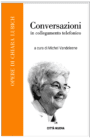
300 telephone conversations made by Chiara Lubich during conference calls with Focolare communities worldwide have been edited into one volume. Maria Caterina Atzori, one of the steering committee members entrusted with the “Works of Chiara Lubich”, at the Chiara Lubich Centre in Rocca di Papa (Rome), is interviewed about this book. Conversations is the second volume in the series “Works of Chiara Lubich”. The first volume, “Words of Life”, was published by the New City Press, in collaboration with the Chiara Lubich Centre, in 2017. Can you tell us more about this second volume? In the book “Conversations” there are 285 spiritual thoughts, which Chiara Lubich wrote between 1981 and 2004. She shared them personally with Focolare communities in various parts of the world during telephone conference calls made from time to time. These rich thoughts speak about life and delineate a spiritual journey in its various stages, lived in the light of the charism of unity. Chiara traces a path to collective holiness, one that opens a new road marked by its communitarian dimension and that leads us to God “together” with our neighbour. She was the first one to embark on this journey, but at the same time she was joined by those, who were led by her example and guided by her “telephone calls”. They accepted her invitation to set out together on this “Holy Journey” of life, an expression Chiara used to define this journey which recalls Psalm 83. Has Chiara Lubich created a “new literary genre”? Chiara had no intention of creating a new literary genre. In fact, the texts in this volume were not meant for a written publication. This came later on. Initially, New City Press published them in small booklets, as they were widely requested not only by Focolare members, but also by others who met the Charism of Unity. These texts were written one at a time; they were written to be “spoken”, to be transmitted through the use of the telephone set. The novum of their “literary genre” lies in the fact that during each telephone call the speaker managed to create an immediate dialogue with her listeners; she formed a family worldwide, a family united in its commitment to walk the “Holy Journey” of life together. Later on, these same texts were put together for publication. So, in this sense, one can say that “Conversations” brought to life a new literary genre: a genre that combines word, communicative methodology and life, and establishes an intimate and profound dialogue between the author and her interlocutors, in a broader sense between broadcaster and listener, writer and reader. What are the characteristics of these texts? The text of each telephone call is presented in the book as a letter. Although each one is contextualized in time and space, yet it is still aims at establishing direct contact with its new readers, who are addressed with the opening words: “Dear all”. These “conversations” are still happening, not through the telephone set but through the pages of a book. Chiara uses a language rich in warmth and colour; that goes well with both young and old, people from different social backgrounds. From time to time, she engages in contemporary reality, interprets man’s life in the light of the Charism of Unity, recounts her experience about the thought she wants to transmit, interacts with her interlocutors, proposes a motto to be lived till the next telephone appointment (in the book: till the next letter). She expresses her spiritual thought through concrete daily images, familiar to her interlocutors. Frequently, she uses similarities, metaphors and slogans that are lively and easy to remember. Thus, her message is clear, engaging and “easy” to live. And each of these texts continues to invite the reader to live the message. We have been told that the “Opera omnia” (the complete work) of the Focolari foundress is to be published in a series of volumes. The first one was “Words of Life”, and now we have the second one. May we know what are the next scheduled publications? We prefer to speak about “Opere” (works) rather than about “Opera omnia”. In fact, the documentary material signed by Chiara Lubich is very substantial and there might be further acquisitions. This material needs to be sorted out and catalogued, a process that takes quite a long time. However, we already have the possibility of editing a corpus of works, drawn from both published and unpublished material, that offer the legacy of her thought in a systematic way. The series “Works of Chiara Lubich” is to meant to achieve this. It will consist of 14 volumes, organized into three main thematic areas:1.The Person; 2. Spirituality (the first two volumes published by New City Press, Words of Life and Conversations, are part of this second section); 3. Work (the next volume, which will contain speeches in the civil and ecclesial spheres, falls under this third section. It is work in progress, expected to be finished within the next year). Are these texts only published in Italian? Are there any publications in other languages? The volume Words of Life is currently being translated into English. We hope that Words of Life and Conversations will soon be translated into several languages. Both the individual spiritual thoughts and the comments on the Words of Life have already been translated into various languages for immediate communication with non-Italians; so we hope that the volumes of the series “Works of Chiara Lubich” will soon be in bookshops in a wide range of languages.
by Anna Lisa Innocenti
4 Oct 2019 | Non categorizzato
The Focolare Movement rejoices with Chiara Amirante and the New Horizons Community she founded, at Pope Francis’ surprise visit to their ‘Sky Citadel’ (‘Cittadella Cielo’) near Frosinone, Italy. “If I start answering your questions, it will be words, words, words… which I think would risk spoiling the sacredness of what you have just said. Because what you’ve spoken are not words but lives, your own lives. Your stories. Your journeys. Quests, yes, but quests of the whole person, flesh and spirit together”. This was Pope Francis’ spontaneous response to five young members of the New Horizons Community who had presented their own powerful testimonies of suffering and rebirth during the Pope’s private visit to the Community’s centre in Frosinone province, Italy on 24 September. “Each of your stories speaks of a ‘glance’, a ‘look’,” continued the Pope. “At a certain moment, you felt a glance, unlike any other: a look gazing on you with love. I too know that glance. With that glance, Someone takes you by the hand and lets you go, without taking away your freedom”. The Pope arrived in the ‘Sky Citadel’ at 9.30 in the morning to an emotional and joyful welcome. It is the headquarters of New Horizons, which offers a Gospel-based approach to healing and self-knowledge that has succeeded in allowing many young people to escape from the infernal tunnel of suffering and dependency and in their own turn become witnesses of hope for other troubled youth. This “fruitful witness” was highlighted by the Pope in his talk. “Your witnessing is sowing, and what you are sowing is not an idea but fact: the fact that God is love, that God loves us, that God is always seeking us out every moment, that God is close to us, that God takes us by the hand to save us. (…) We are women and men of the Magnificat, of Mary’s song, proclaiming how God has looked upon me, has gently touched me, has spoken to me, has won. And He is with me. He has taken me by the hand and brought me out of hell”. The Pope spent time greeting Community members and Centre leaders from Italy and abroad who were gathering for their annual central Assembly. He celebrated Mass with them, shared lunch and planted an olive tree in the garden. There were representatives from all five ‘citadels’ of the New Horizons Community, founded by Chiara Amirante. Chiara got to know the Focolare spirituality as a child, and knew Focolare foundress Chiara Lubich personally. As a young person, Chiara Amirante was struck by the sufferings of the young people she met on the streets and listened to their cries for help to escape from the hell of all they were living through. In response, she felt called to create a community which could welcome them. And New Horizons Community was born. This recent visit by the Pope follows his telephone call and video message in June this year to congratulate the community on its 25 years of life. In her welcome to Pope Francis, Chiara recalled the beginnings of her adventure, when, in contact with ‘people of the night’, she was guided by the certainty that encountering “the Risen Christ would bring life once more to where I could only see death”. In 1994 the first community was formed in Trigoria, Rome. In 1997 a community offering welcome and formation was established in Piglio, Frosinone province, Italy. Today there are 228 centres of reception, formation and re-integration, and many initiatives promoting solidarity, human and social development in different countries. In 2006 Chiara launched “Knights of the Light” (“Cavalieri della Luce”) for people who commit to living the Gospel to renew the world with the revolution of love, and in particular to witness the joy of the Risen Christ to the most desperate in our societies. So far, more than 700,000 have accepted this challenge. As Chiara explained to Pope Francis, “There are new forms of poverty which constitute a real emergency, causing millions of ‘invisible’ deaths ignored by the majority” … the use and abuse of alcohol and drugs, anorexia, bulimia, depression, compulsive gaming and gambling, internet-addiction, bullying, sexual addiction and abuses. “Now more than ever,” concluded Chiara, “we feel the urgent need to do everything possible to respond to the unanswered cry of so many”.
Anna Lisa Innocenti
