
30 May 2019 | Non categorizzato
We asked young members of the Focolare Movement from different countries to give us their own take on Pope Francis’ recent apostolic exhortation “Christus Vivit”. First we hear from Noemi Sanchez, protagonist at the preparatory meeting of the Synod of Catholic Bishops on Young People in 2018.  Noemi (28) is from Paraguay, of Brazilian heritage, currently completing a research doctorate in Philosophy at the University of Perugia, Italy. In March 2018 she participated in the pre-synodal meeting convened by the Pope in order to listen to young people from all over the world and prepare the subsequent Synod on Youth with them and for them. The apostolic exhortation “Christus Vivit” is one of the outcomes of this intergenerational process. Many young people have already read it and spread it among their own groups and peers. – In this document, the Pope repeatedly stresses the need for the Church to listen to young people. Has this been happening? I think the whole process around the Synod of October 2018 has been a clear example of the Church’s sincere desire to listen to us and welcome us wholeheartedly. There were 300 of us at the pre-Synod, from many different countries. We were free to say whatever we thought, as the Pope himself invited us to do. The “adults” listened to us and encouraged dialogue with us. What matters now is that this two-way experience between generations should take place in different environments, in parishes and Christian communities. – More than once, the Pope refers to the restlessness so characteristic of youth. Do you believe that it’s possible to listen to the voice of God in the midst of all the sounds, voices and digital stimuli which bombard us today? The Pope coins the phrase “flying on their two feet” because actually we young people are never really still, but always looking out for something. However, we also hit limits caused by our lack of experience, for example, or the fear of making a big mistake in any decisive choice. “High speed” is not enough, we also need meaning. Encouragement from being around the generations above us is always crucial to achieve this, and never more so than today with all its “false alarms”. Having experienced it for myself, I believe that the voice of God always makes itself heard through the “amplifiers” of love. – Why do you think it is so few young people today want to embark upon a serious journey of faith? What’s lacking and what are they searching for? I think there are many reasons for this: a growing disillusionment, ignorance or even laziness. Many of us don’t have a deep knowledge of the faith, and so we young people can become victims of the “rootless” society the Pope condemns all the time. At the same time, we feel a strong desire to get involved in social causes, there is a widespread sensitivity to the arts, as well as the desire to build lasting and meaningful relationships, to live authentically for something that gives meaning to our life, looking for authentic role models. I definitely think today’s youth are searching for God, it’s just they are not always aware of it. – In your opinion, what is the real contribution the Synod on Youth and this apostolic exhortation are having on the life of the Church, and in particular on the young people in the Church? This Synod has undoubtedly brought to light something new (a novum) in the history of the Church as regards methodology and its realistic approach. What came out most, I think, was inter-religious dialogue and how essential and enriching it is for the whole life of the Church. The Exhortation is a real treasure for all young people, not only Catholics. When I read it, rather than a formal document of the Church, it seemed more like a long letter from your grandfather, or from an old friend who loves you and really knows how to get through to you. Someone who can tell you what you need in this particular moment of your life in order not to fall away but how to get up, and keep on trying again and again. To keep on believing in beauty, in good, in love, in the truest nature of humanity – which is also divine. To believe in the possibility of reaching full happiness whatever sufferings and problems are part of life. To learn how to overcome them with courage and commitment
edited by Stefania Tanesini
27 May 2019 | Non categorizzato
The Risen Jesus invites to go beyond ourselves, our frail insecurities and our borders Passing the test You could hear the noise of a fight between two students down the hallway where, waiting to take a test, I was pacing back and forth nervously. I had the idea to go and calm them down, but I held back because I worried that I’d be called and marked as absent. Better to leave that to others… But the shouts kept getting louder, and I could not just be indifferent to my neighbour, which is something important to me. A moment later I ran down to separate the two and have them cool down. Coming back upstairs, after a while I heard my name called. In the study hall I answered all the questions and passed. A passed exam – and I hadn’t failed the other one, either. (Antonio, Italy) In the convent Following a few enthusiastic years after I entered the convent, a feeling that I was living a life without affection, almost without kindness, crept up within me. One day while I was recovering at the hospital, I was completely alone, while all the other sick people around me were surrounded by tenderness and affection. Later, stressed at having made a big mistake with my life, I centred myself in prayer and understood that God had entrusted me with a mission to be a source for others of that affection that I was looking for myself. When I returned, I was “healed” – I had the strength to begin again. And things were not like they had been before! (G. d. G., Slovenia) Technology My husband is interested in all the latest technology, but some devices leave me feeling hopeless, and I am slow to adapt to what’s new. Over time I began to feel inferior, and he would exacerbate it by pointing out what I didn’t understand and even making fun of me in front of our children. This ended with me throwing out my mobile phone and closing myself off in silence. It was my oldest son who explained to his father that something wasn’t right and, as an example, he reminded him that I had been to the doctor and he hadn’t even asked me how the visit had gone, adding, “If your tech distracts you so much, why did you want a family?” When my husband came to apologise shortly after, I told him we should be grateful for the children we have. (E. d. F., Slovakia) Divorce When our daughter confided to us that she was close to divorce, we once again decided to share her pain, doubts, problems, without judging. We would often call her on the phone so she wouldn’t feel alone. When she came to our house with her children for a few days, we welcomed her with extra affection. Having returned home after those few days, she called to say that she no longer wanted to go ahead with divorce proceedings and wanted to do her part to rebuild her marriage. (J. S., USA)
Chiara Favotti
26 May 2019 | Non categorizzato
Suppose that just for once the media stopped being part of the problem and became part of the solution. This is a story by Austin Kellerman, news director at the local NBC TV station, and his team. They worked to lessen violence in their city. https://vimeo.com/333061434

23 May 2019 | Non categorizzato
Interview with Dr. Pál Tóth: “Applying the principle of fraternity to Europe as a political category means building institutions which pursue collaboration in diversity, to achieve the common good”. European elections are underway for the representatives of the 27 member states of the European Union in the European Parliament. 400 million citizens have the right to vote between 23 and 26 May, considering two opposing ideas of Europe: pro-Europeanism and Euroscepticism. This polarization is identified by some as following the geographical East-West divide of the so-called “Old Continent”. Pál Tóth, originally from Hungary, cultural advisor on the Planning Committee of Together for Europe , a network of over 300 Christian communities and movements promoting a “culture of reciprocity” in the European context and beyond, gives his perspective. “It’s important to realise that as the European Union expands, whereas new member States may quite quickly embrace a market economy and democratic legal system, actually synchronizing all the very different cultural realities present in the Union is a much slower process. I use the word ‘synchronize’ and not simply redressing or adapting after the social and political conquests of the West (of Europe), because I’m personally convinced that East Europe possesses values which are the fruit of a long history of suffering and as such are of great value. We just have to think of the love for truth expressed by the Czech people, from Jan Jus to Vaclav Havel; or the small communities emerging within the “Church of silence” witnessing to the life of the Gospel; or the people who continued to fill the churches in Poland throughout the period of national secularization; or the Orthodox icons which give such unique access to the Christian mystery, especially potent in such an image-dominated era. As I see it, East Europe is not yet capable of expressing these values adequately. It continues to react impulsively to phenomena it identifies as stemming from a moral decline into decadence. But progress is not made by criticism alone; there needs to be a journey of growth together, a ‘synodal process’ – as Pope Francis would call it – involving welcoming, understanding, speaking with clarity but without being offensive, deconstructing our prejudices, and discernment as a community”. The Brexit issue poses an existential question to the remaining States of the European Union: is it better to face present and future challenges alone or in a cohesive unit? “I believe the radical transformation of the world in which we live places challenges before us which we simply cannot manage on a national level. German sociologist Ulrich Beck speaks of a metamorphosis of the world, which calls for a completely different way of thinking than before. Climate change, migration, organized crime, the ‘common evils’ of global capitalism, cannot be addressed effectively on a simply national level, but rather with the force of an integrated political approach.” Chiara Lubich and Igino Giordani, founder and co-founder of the Focolare Movement, were very clear on the idea that a united Europe should promote world peace. In the light of the charism of unity, how do you rate the chances of adopting fraternity as a political category? “Democracy in the modern world has developed as a competitive system, involving the distribution of power, a battle between different parties, a process of checks and balances, civil society curbing the excesses of public power. Applying the principle of fraternity as a political category means building institutions which pursue collaboration in diversity, to achieve the common good. Over the past two centuries, the principles of liberty and equality have been translated into legal and political categories. Now it’s time to work on the category of fraternity, which incorporates the values of reciprocity and mutual responsibility. On the political scene, alongside the political parties as agents of competition, we could see the institutions of civil society emerging to take on public roles. There are alternative models, and movements for spiritual and cultural renewal, such as the Focolare, could play a significant role in this process.” The Focolare’s commitment towards unity in Europe is evident in the Together for Europe project. Ilona Tóth, member of the project’s planning committee, describes how the initiative came about. “At the eve of the Third Millennium, founders and leaders of Christian communities and movements active in Europe (Chiara Lubich, Andrea Riccardi, Helmut Nicklas, Salvatore Martinez and others) pledged to place their charisms at the service of the continent, on a common foundation of mutual love. The aim was to invigorate Europe from a spiritual standpoint, based on Christian values, alongside the established geographical and economic perspectives.” What has been achieved so far? “The Together for Europe network is generating ‘leaven’ for people in Europe with a culture founded on Gospel-based fraternity. These gatherings throughout Europe help to demonstrate unity in diversity. In their own environments, the protagonists launch initiatives promoting peace, the family, protection of the environment, solidarity and a fairer economy etc. They are seeking ways to respond to the demands of a continent in crisis.”
Claudia Di Lorenzi
22 May 2019 | Non categorizzato
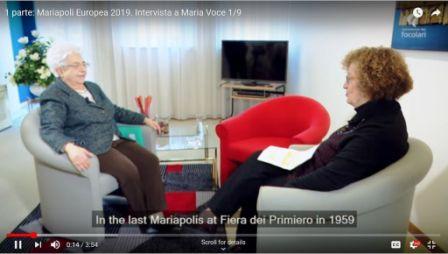
Less than a century has passed since the end of World War II, yet it seems that today’s Europe has somewhat lost sight of its original challenge. The old continent was setting for two world wars, with millions of dead and many cities and communities destroyed, yet in the 1950s it launched a renaissance that could not even have been hoped for. The founding fathers of the present-day European Union saw beyond the special interests of each country and thought on a grander scale: a community of peoples who would be able to design an economic rebirth and future of peace. We talked with Maria Voce, president of the Focolare Movement, in an interview that took the form of nine questions. It was released in time for the European Mariapolis that will take place over the next months of July and August at Tonadico, in the region of Trent, Italy. The interview unfolded into a plain-spoken, frank conversation, taking on topics such as politics, youth, bearing witness as Christians today, the Europe we hope for, and what a European Mariapolis might mean. Diversity between various communities of peoples is valuable, affirmed Maria Voce, and there is no need to give in to superiority or nationalism. At the Mariapolis, diversity becomes a way for everyone to be enriched, becoming a moment in which everyone can show the wealth of their culture. “If everyone stretches themselves to do this,” she continues, “no one feels the need to assert their identity, because everyone’s identity is recognised, valued and enriched by unity.” And this is what the European Mariapolis can give and signify for those participating, fulfilling together a phrase that Chiara Lubich said back in 2004: “The highest dignity for humanity is not to feel like a cluster of peoples who are often at odds with each other, but being one people out of mutual love that is enriched by each person’s diversity, and as a result safeguarding the unity of the different identities.” Another topic that was covered was the role of young people in today’s society and their scarce participation in political life. Maria Voce does not doubt their abilities, and she values the witness of many young people who presently have an influence, for example, on environmental issues. The new generations are committed “to projects that look to the good of humanity, not just the immediacy of the passing day, for projects that require concrete action and that show an authentic life,” affirms Focolare’s president. The task for Christians, as well, is difficult enough, but they can spread values of solidarity, fraternity, love for the last and the least, for the poorest, by personally living a life that follows the light of the Gospel. The questions could not have overlooked her own meeting with the charism of unity, which happened in Rome during her university years and, as a result, her first experience of Mariapolis, which we discovered occurred in 1959 in the Dolomite valleys, where she got to know Chiara Lubich. Maria Voce herself is a witness to that wide variety of people who took a break each year in those enchanting places. They were attracted by being able to experience reciprocal love and fraternity first-hand, thus fulfilling Jesus’ prayer, “May all be one.” The final question drew out a hope and a wish from her. “My hopes for Europe are that it might discover its beauty and calling: peoples who are united, who are recognisable as themselves, yet who see in each other common principles and values. The history of people is also my history, the history of every European people is also my history. It’s part of my story and lives within my story.”
Patrizia Mazzola
20 May 2019 | Non categorizzato
The Risen Jesus wants us to have the experience of new life and peace with Him that we can then share with others. For others Ever since we were young, inspired by our Christian convictions, my husband and I have always tried to live for others. We come from poor families: my parents worked in mining while Ramon’s parents were farmers, and we are well aware of the hardships and needs that result from financial poverty. Our dream came true when we were asked if we would manage a fund for children in an adoption at a distance project. Thanks to the contributions we have received we have been able to follow 23 children and buy a piece of land where we have built a centre that can accommodate about twenty children from poor families, enabling their parents to go to work. There is also a small sewing workshop for mothers. Through many people’s generosity, we will be able to develop this activity for the children’s benefit and for their families. (R. J. – Bolivia) My fourth pregnancy In the ninth week of my fourth pregnancy I discovered I had contracted rubella. The days that followed were the most difficult days we had ever had to face as a married couple. This was a problem that was bigger than both of us. The doctors warned us that there was only a 5% chance of having a healthy baby. Today’s mentality would say that “rejecting” the pregnancy was the right solution. My husband left me free to choose, but I wanted him to tell me he accepted this new creature. This was in fact what I had already done the very first moment I became a mother. I don’t think I’ve ever prayed so intensely in my life. One day my husband said to me: “What if our son has not been affected or has only been slightly affected by the rubella?” It was the sign I had been waiting for. We embraced one another and from that moment on we felt more united. After six months, a handsome, healthy boy was born. (J.O. – Switzerland) Thieves in our home One day, when we returned to the house that we had built with great effort, we discovered that everything in our house had been stolen: the thieves had even taken the sink and the toilet. We couldn’t afford to replace what was missing with new items, so we started looking around second-hand shops when we suddenly recognized some of our things in one of the shops. The shopkeepers said they had bought them from some boys in the neighbourhood whom we knew well because they were our neighbours. We went to their house with the intention of reclaiming what was ours, but also to make the boys understand their mistake. When presented with the facts, they did not deny anything and we went with them to recover our property. On the way, we talked openly about values that give meaning to our lives, while they might have expected a harder reaction. Perhaps this is how we have made our small contribution to peace. (B.O. – Venezuela)
by Chiara Favotti
