
8 May 2019 | Non categorizzato
The Focolare Community is present even in the small Balkan republic visited by Pope Francis from 5 to 7 May. Mato Mikulec spoke to us about the Community’s contribution towards this event. 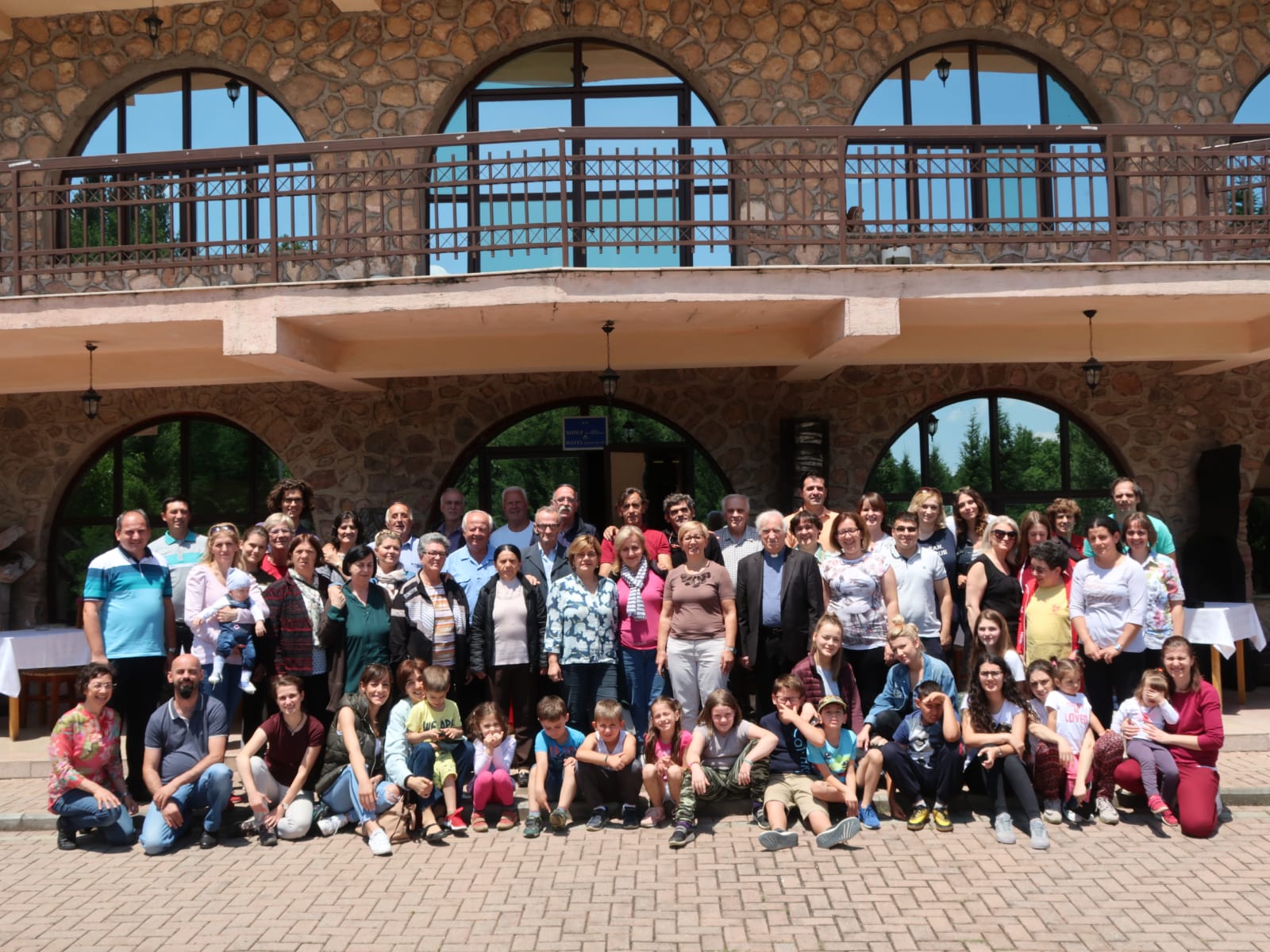 “Dialogue has always been one of this country’s main characteristics, and in the Focolare Community one comes across both Christian (Catholics and Orthodox) and Muslim members”. Mato Mikulec, one of the first Focolare members in Skopje, was born in Croatia, but he moved to Macedonia 30 years ago because of work. He lived the Pope’s visit with anxiety and great joy. He said: “As Francis has peripheries so much at heart, he came to support and encourage this country’s small Catholic community; yet he did not come only for this. He considers all men to be precious and he came as everyone’s friend. The Pope really appreciates the spirit of tollerance and of peaceful coexistence that mark this people”. Mato now considers Macedonia as his homeland; the majority of the population (64%) is Macedonian, then there are also Albanians (25%) and Turks (4%); the rest come from other different countries. The two main religions are Christianity and Islam; 99% of the Christians belong to the Orthodox Church while the remaining 1% are Catholics that belong to the Western and Eastern rites. History tells us that Macedonia’s Christian tradition dates back to the time of the Apostle Paul. Later there were other evangelizers who contributed towards the spread of Christianity; among these, the two brothers, Cyril and Methodius who worked among the Slavs during the ninth century. There were many others who influenced the religious and cultural development of the Slavic peoples, but the Balkan region also experienced the painful division between Churches and the powerful dominion of rulers, such as the Ottomon rule that lasted for more than 500 years. Mato continued:“But the people still managed to preserve certain values, such as religiousness, openness to diversity and a keen aspiration to communion. So it is not surprising that such a beautiful flower as Mother Theresa bloomed in this country”. He related that it was Kiro Stojanov, the local Bishop and state authorities who invited Pope Francis to visit Macedonia, while he explained: “Here, we have a very beautiful tradition; every year a State delegation goes to Rome to visit St Cyril’s tomb which lies at St. Celement Basilica. Representatives of the Catholic and Orthodox Churches also join this delegation, and an audience with the Holy Father is included in the programme. It was on this occasion that the Pope was invited to visit us”. He also spoke to us about the first years of the Focolare Movement in Macedonia and Kosovo. He said that the first contacts started in the 70’s when Antonio Petrilli, one of the first focolarini went there to visit Luka Cirimotić, a friend of his who was a priest. In the 80’s a family from Zagreb went to settle in Skopje and thus the first community started to grow; in it there were youths and adults, families and religious, members of different Churches and religions and also persons with no particular religious conviction. It was thanks to Bishop Kiro Stojanov’s commitment, that the female Focolare in Skopje was set up in 2006. The opening of this focolare was the last one to have Chiara Lubich’s personal approval before she passed away. Mato continued: “We realize that diversity is not an obstacle to sincere communion and fraternity, and that these become more visible and more appreciated even by leaders of various religious communities. For us, Focolare members, the Pope’s visit was a moment of special joy. We think that the Pope felt the love and communion among us, while he conveyed the new face and embrace of a Church where even our community has its place”.
Stefania Tanesini

8 May 2019 | Non categorizzato
Maria Voce to the young Syrians: “Do not let your values be stolen from you. Join all the young people who want a better world. The world is waiting for you.” “Thank you for the hope and the vitality you have given us”. These are the words that Maria Voce addressed to the Focolare communities of Syria through a video message at the end of her visit to Syria from the 1st to the 8th of May. These were intense days in which the Focolare president, together with the co-president, Jesús Morán, visited the cities of Homs, Kafarbo, Seydnaya and Damascus. They met communities, people engaged in parishes or in social works, families, children, young people, priests and religious. They were received by the bishops and by the Apostolic Nuncio – Cardinal Mario Zenari. They experienced first-hand the terrible wounds that the war has left on the structures and on the souls of the Syrian people – traumas and tragedies of all kinds. They got to know the inside story of the difficult, almost desperate situation of a country that had become the puppet of numerous external forces – a country which suffered a heavy economic war, even before the military conflict was over. So how is it possible that Maria Voce ended this visit by thanking the Syrian people for the hope and strength received from them? One of the keys to understanding this is undoubtedly the last stage of the visit. At the invitation of the Melkite Patriarch, Monsignor Youssef Absi, 230 young people -Catholics and those from several other Churches – met on Monday 6 May at the Greek Catholic Cathedral in Damascus. On this occasion while responding to a few questions, Maria Voce made a strong appeal to the Syrian youth: “Do not let your values be stolen from you. Join all the young people who want a better world. The world is waiting for you.” Later the co-president, Jesús Morán, explained the profound motivation of these words: “These young people have experienced that everything collapses; yet they have preserved a deep thirst for God and a true sense of community. Perhaps they are not completely aware of it, but they are in an ideal spiritual situation, from which great things can grow.” What needs to be done, then, to create the conditions in which these seeds of hope can grow and flourish in Syria? Anyone who knows at least a little about the past and recent history of this country, might suggest a double solution for leaving Syria and the Syrians in peace. The first part of the solution would be for all the conflict to cease. The second part of the solution would be for all the great powers of the Middle East and of all the other parts of the world that want to exploit Syria, to leave the country to find its own way. These Syrian people, who, according to Maria Voce, have such strength and such tenderness, are more than capable of taking their destiny into their own hands.
Joachim Schwind
6 May 2019 | Non categorizzato
With the first of May, United World Week (UWW) took off. Many activities already took place on every latitude to accomplish “No One in need,” the title given to this year’s UWW. Imagine looking down on Earth wearing special glasses, capable of highlighting the degree of fraternity experienced in the world among human beings. Certainly, from May 1st to 7th, we would notice an unusual peak, a great fermentation on every latitude of the planet. In fact, “No One in Need“, the 2019 United World Week has already begun and many teens, young people, adults, entire communities are in action, to bear witness that a united world is possible! Let’s start with South America. In Palmas, Brazil, on May 1st, a group of young people invited their friends and all those who wanted to participate, to live for unity and peace. How? By helping a family in economic difficulty with a donation of one kilogram of food. The food collection took place at Cesamar Park, animated by games and music. On the same day, in Loppiano (one of the many international little towns of the Focolare), in the province of Florence, 1400 teens, young people and families participated in the traditional May Day event, this year entitled “Good Vibes.” All were invited to initiate and become leaders of processes of change, overcoming individualism and loneliness with the culture of giving and overcoming prejudice and fear of “the different” with acceptance and fraternity. Proceeding eastward, again on May 1st, in Bandra, India, at Mount Mary Church, the Youth for a United World of that city invited the entire community to a moment of prayer for Sri-Lanka, victim of recent acts of violence, and to commit to peace. Also in India, but in Mumbai, from the 2nd to the 4th of May, a school called “#NoOneInNeed” was held, to discover one’s own needs and those of others, to take on a new life style based on the culture of giving. During the school, many topics were addressed: communication, relational needs, ecology, and peace. There were also various workshops including one work session dedicated to IntotheLABel – the “responsible consumer” laboratory. Among the participants were young people from various parts of India, Nepal and Sri-Lanka. On the island of Cebu, Philippines, on the evening of May 1st, the Youth for a United World launched the #NoOneInNeed campaign at the Bukas Palad Cebu Foundation, Inc. The invitation published on social media was nothing short of original: “Start by bringing your excess valuables or things you no longer use, to share!” Many have already responded to their appeal, like Fred, a player of “Pokemon Go” and a friend of some Youth for a United World who are passionate about the same game. On the evening of May 1st, he brought with him 85 items of clothing that he had worn less than twice and which he no longer considers “his” but of those who need it most. n short, the United World Week consisting of big events and personal gestures, has come alive! And this weekend, it will continue with the race that aims to unite the world – Run4unity (Sunday, May 5th) – also animated by the slogan “No One In Need.” Many cities have already or will be taking part in it. For the third consecutive year, teens, young people and adults will be running on both sides of the border between Mexico and the United States, right next to the wall, in the presence of the mayors of both cities (Mexicali and Calexico). Guests of the Branice Psychiatric Hospital in Poland will also participate in Run4Unity (R4U) for the third time. They wrote, “We are a psychiatric hospital with a century-old tradition. In our hospital we take care of over 500 people with mental illness. Last year around 300 took part in RUN4UNITY and we were the only representatives from Poland.” In New Caledonia and also in Christchurch, New Zealand, the city that suffered two terrorist attacks on two mosques last March, the race will involve young people of different religions. In Italy, R4U will take place in Pisa, Rome, Matera, Ischia, Turin, Foggia, Milan, Abbiategrasso and Perugia, organized by the Maria Montessori International High School together with the Amatori Nuoto cooperative, involving some associations for children with disabilities. Among the various activities, there will also be a hand ball game on wheelchairs, to create an integration experience through sport. To discover other events, just visit the site: Run4unity. Have a great United World Week! And remember to share your stories with the hashtag #NoOneInNeed.
Tamara Pastorelli
Source: United World Project

6 May 2019 | Non categorizzato
On Saturday May 4th the president and co-president of the Focolare met with the Syrian community of the movement. The sharing of their testimonies conveyed their pain and their sense of loss and mourning, but also their wealth of culture and traditions – and their desire to live and to rebuild their homeland. From the very beginning, Saturday 4 May promised to be very intense. Three hundred members of the Syrian Focolare community met at the monastery of St Ephrem the Syrian in Sednaya, about 40 kilometres north of Damascus. The day began with the story of the movement, told with the same words that Chiara Lubich used so many times – words that are known, almost by heart, by members of the Focolare communities around the world: “It was during the war and everything was collapsing…” But what made today’s telling of the story different is that after retelling each episode of Chiara’s life, one of the Syrians illustrated it with their own recent experience in this tormented land. There were those who, on returning to their city, could no longer find their houses, those who had lost their jobs, or their physical or mental health. There were those who felt they had seen their futures, or their faith in God or in relationships, stolen from them. Many have lost loved ones. Up to this moment there has been no compensation for many of these losses. “We are dead inside,” says one of them, encapsulating the mood of so many, perhaps of all who are present.  Yet on the background of the stage, in Arabic, we read “And we have believed in love,” – the phrase that Chiara Lubich and her companions wanted to see written on their graves – ever since those early days when the movement was taking its first steps, in the middle of the Second World War. The final song that expressed the famous “Art of Loving,” which has been explained so many times by Chiara Lubich, underlined this belief in love. It’s the art of loving everyone, of being the first to love, of seeing Jesus in every neighbour, of loving our enemies. Those who were present stood up, began to dance and to express with all their senses a common desire, to turn the page and to make a new start. Right before our eyes we saw once again the two realities that distinguish this journey of the delegation of the International Centre of the Focolare to Syria: on the one hand the encounter with the peoples’ pain: the wounds, the traumas, the despair, the concern for the future, especially for their own children; and, on the other hand, the desire to continue to hope, to take up their lives again with freedom. Both realities are supported by a spirituality centred on a faith that can say: we believed in love.
  This life that unfolds between despair and hope, between death and resurrection, also resounded in the brief intervention given by the apostolic nuncio in Syria, Cardinal Mario Zennari and in the answers of Maria Voce and Jesús Morán. Cardinal Zennari invited those present to welcome the message from 800 years ago, that St. Francis heard addressed to him by the Crucifix – “repair the Church.” The Cardinal added,” But here, it is not just a question of repairing the Church, but of repairing your homeland. It is a question of building a new Syria.” Jesús Morán, co-president of the Focolare, presented to the Syrian community of the movement the example of Mary, the mother of Jesus, who in the greatest desperation “believed in the impossible” and that is, in the strength of the resurrection. But what should they do today in Syria: stay or leave? Maria Voce addressed this fundamental question asked by so many. She pointed out that beyond this choice, which is certainly not easy, there is the issue of living the present moment. She invited those present to seize the moment, to focus on whatever in the present moment seems to be “the will of God,” and then “to live it with authenticity and consistency – even if God occasionally allows us to continue living in mystery.” The day ended with a big celebration. Many different regions were represented and there were large numbers of children and young people present. This might have aroused some confusion in those who, perhaps, had come there thinking they would be meeting people of great poverty. Perhaps there is very little material well-being among them, but there is also a great wealth of life, of traditions, of customs, of dances, of songs, of expressions of joy and of the desire to live. How beautiful these people are, who, despite everything, believe in love!
Joachim Schwind
5 May 2019 | Non categorizzato
No more people in need, no more hunger, starting from our own neighbourhood. This is the challenge that the Teens for Unity in Mumbai have taken on and work for. They have collected used plastics and newspapers to recycle to support a centre for women in need and families hit by HIV. What started with a few children now involves over 200 families in the surrounding neighbourhoods. https://vimeo.com/332638856

3 May 2019 | Non categorizzato
Homs is the first city visited by the President and Co-president of the Focolare Movement during their journey to Syria, and there they met the small community that chose not to abandon the city during the civil war. These people now contribute towards the rebuilding of their country. “People around us think we are weak when we respond to hatred with love; this is neither easy to bear nor to pass on to our children. But they do not know that love is the most powerful weapon”. This was the most overwhelming answer received when we asked about the great challenges these people have to face.  And it was confirmed by a young mother from Homs, the third largest city in Syria that was amongst the worst hit during the war. Homs was the first city that Maria Voce and Jesús Moran, president and co-president of the Focolare Movement visited on their journey to this region where one can still note the scars of war, but also perceive the attempts to resurrect the city after years of conflict. On the afternoon of May 1, about fifteen members, who form part of the oldest Focolare Community in Syria, gathered at the Jesuit Centre. They were very happy to meet the president and co-president of the Movement, who went there to get to know them, to comfort them and give them hope, as Maria Voce said before leaving for Syria. But during this first meeting one could already witness a change of roles; these people, who chose to remain in Syria despite great risks, were the ones offering hope, joy and courage to the ones who were lucky to meet them. They related very clearly and authentically about the hard times they lived during the war. Many of them lost all their belongings, but they kept alive their faith in God who is Love, whilst witnessing it in a daily life shattered with bombs, destruction and death. One of them said: “Through our way of life, we try to be a living Gospel, because the Focolare spirituality has implanted in us a different seed. Those who accompany us have taken good care of this seed which seems to be bearing fruit because people around us realize that there is something different”. And it is not just a question of remaining in the same situation or of having the courage to rebuild one’s own life. Many, who are members of this small community of about fifty people, are now engaged in projects that have been set up to help their people: support to cancer patients, physiotherapeutic and psychological support to those who are victims of war trauma, ethical formation courses to primary and secondary school students. Touched by the life of this community, Maria Voce said to them: “You have kept the flame of the Gospel alive. You have understood one the most fundamental points of our spirituality; you have realized that the secret of true love lies in the love for Jesus crucified and forsaken. This meeting with you has really been a grace for us”.
Joachim Schwind
