12 May 2019 | Non categorizzato
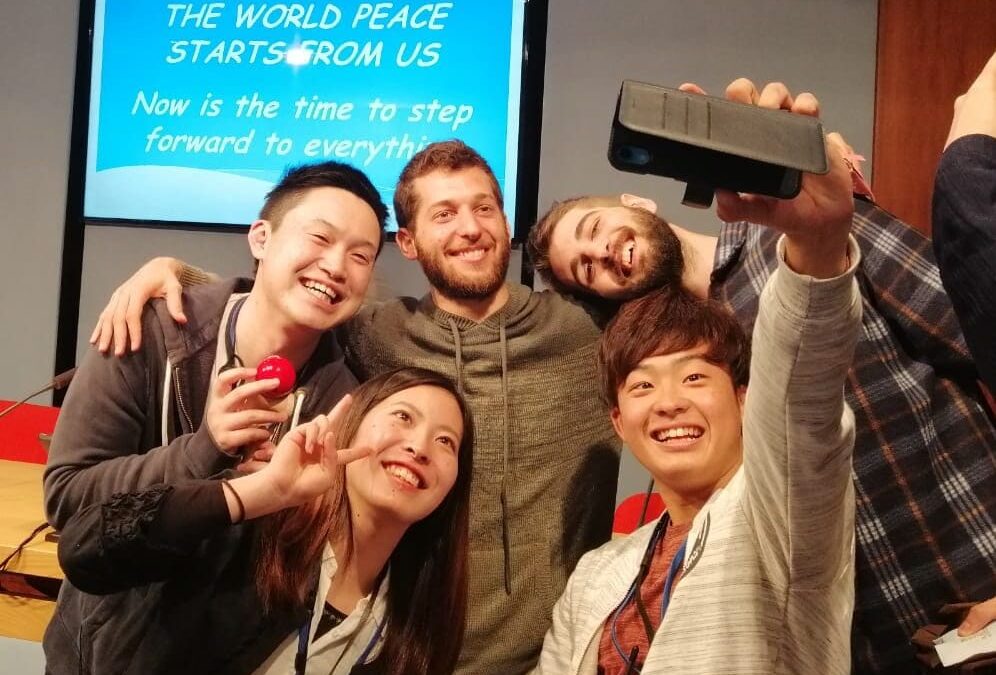
The most recent event for dialogue between the youth of Buddhist movement Rissho Kosei-kai and young people from the Focolare deepened their awareness, friendship and common commitment for world peace. “All these years, wherever we’ve met, immediately the walls of our diversity vanished, and right away we found ourselves united with the same drive to want to work for world peace. This is also logical, since when our founder Nikkyo Niwano and Chiara Lubich originally met, right away they too found they were one, and for both it was a discovery to find someone seriously willing to work for peace in the world.” This is how Yoshie Nishi, vice director of the Rissho Kosei-kai’s youth branch, began to tell the story of symposia between young people from the Buddhist movement and the Focolare that began in 2008. 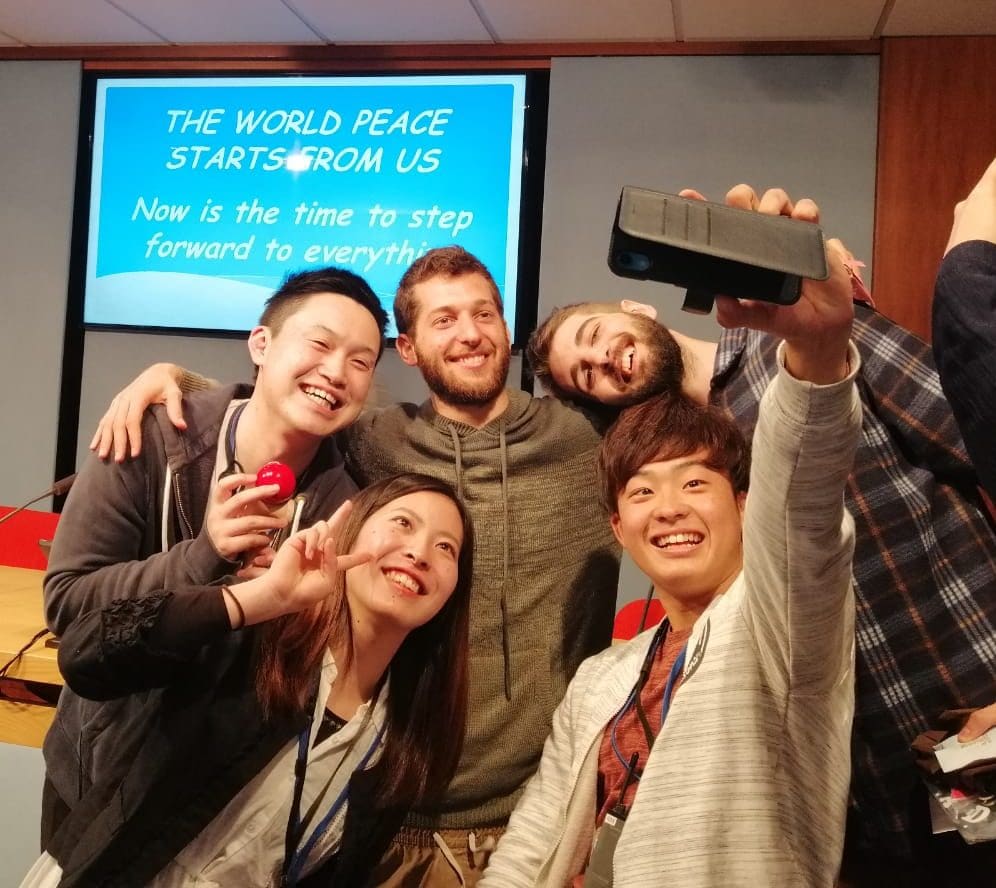 This year’s edition, which happened at the Focolare’s international headquarters in Italy, had the theme “World peace starts from us: now is the time to step forward”. “The world is divided in many places,” explained the Rissho Kosei-kai youth. “Refugees, poverty, economic difficulties, etc, and not just at a national level, but throughout the small world where we live. On one hand, with the spread of the internet, you can create close links with the entire world, but on the other hand, poor relationships exist where conversations with next-door neighbours never happen.” There were many moments to share everyday experiences of peace: changes of lifestyle and actions that involve others and change reality positively. “We want to move forward and always look to each other and the challenges we see in the world,” said Rita and Henrique of the Focolare to their Japanese friends, “contributing to reaching a world that is more united, fraternal, where we can have more peace. But it is a peace that does not exclude people who are outcast, but that makes other people’s needs our own in order to one day arrive at the goal of ‘No one in need.’ This is how the catchphrase that young people in the Focolare have chosen this year reads for the Week of World Unity and for the course Pathways for a United World.” There was also real action in the symposium schedule: preparing and distributing hot meals at Rome’s Ostiense Station together with the RomAmoR ONLUS Association, which helps the homeless, elderly and immigrants. The Japanese delegation then participated in an audience with Pope Francis and experienced a day of sharing and in-depth study at the international centre of Loppiano, with young people at the school of formation and Sophia University Institute.
Paola Pepe

12 May 2019 | Non categorizzato
The Focolare president and co-president returned to Lebanon where they celebrated the fiftieth anniversary of the Movement with the community and various civil and religious leaders. It sometimes happens that the great currents of history are concentrated in the small history of an individual. This happened on Saturday, May 11, during the meeting of the members of the Focolare movement in Lebanon, on the occasion of the fiftieth anniversary of the arrival of the Movement in the Land of the Cedars. In front of the 450 who were present, the presenters had just retraced some of the main stages of those 50 years, when one of them announced: “In the war from 1975 to 1990 my brother died. I was one of those who had a weapon in his hand. Then in 1993 I met the Focolare and the spirituality of unity changed my life.” These few words are a concentration of reality: there is the richness and beauty of Lebanon, the gateway to the Middle East, where three continents and three great religions meet. They say it’s a country that’s been privileged by history. That it lives out the continuous challenge of fraternal coexistence among peoples, religions, Christian rites and denominations. It is referred to as a nation that never gives up and that always finds new resources to start again. This presenter’s announcement expressed the drama and the trauma of a war that lasted 16 years, a war whose origins and roots have never really been addressed. Hidden within this one individual’s story is the seed sown by the first men and women members of the Focolare who arrived in Beirut in 1969. Their witness of a life based on love has not only survived the war but it is manifested in the various expressions of the Movement and in the many ecclesial and social activities that are presented on this day of celebration.  Maria Voce and Jesús Morán, president and co-president of the Focolare, who came to celebrate with the Lebanese community, were not satisfied with a jubilee that started with the past and arrived at the present. In their answers to questions, they challenged the Lebanese Focolare community to look to the future and to never tire of announcing the Gospel in the style that’s typical of the charism of unity – which means, like Christ, to make themselves one with everyone. They encouraged them not to avoid the differences and conflicts that could challenge their own cultural classifications, but to reach a new evangelical mentality. They encouraged them not to live a superficial witness to ecumenism, but to live a true unity in the diversity of rites and denominations and before ecclesial authorities. They asked them to live inter religious dialogue – especially with Muslims – the way that Chiara Lubich lived it. In this way the prophecy inherent within inter religious dialogue would become manifest. Maria Voce summarized all these challenges in her greeting after the Mass on Sunday, May 12th, the official act with which the fiftieth was celebrated. In the Resurrection Cathedral at Antélias near Beirut, Maria Voce expressed the wish that Lebanon’s people could withstand any fragmentation. This way Lebanon could be a living ‘message’ of coexistence and fraternity throughout the world. This is the special characteristic of the Lebanese people that Pope John Paul II perceived in the 1980s. He saw that in Lebanon cultural and spiritual diversity could be found in the journeys of individuals and of peoples. Maria Voce repeated the words of the Pope, who is now a saint: “Lebanon is more than a country, it is a message of freedom and an example of pluralism for the East and the West.” (1) The 50 years of the Focolare in this country show that the spirituality of unity has the capacity to keep this message alive and up to date.
Joachim Schwind
(1) John Paul II., Apostolic Letter to all the Bishops of the Catholic Church on the situation in Lebanon, 7 September 1989.

11 May 2019 | Non categorizzato
The Movement has been in Bulgaria since the 1970s and the community there actively collaborated in various ways during the Papal visit: in the choir, volunteering during the event, in the liturgy and by giving interviews. The two days of the Papal visit went by in a flash, generating enormous interest not only among Catholics, who are only 0.6% of the Bulgarian population, but in all parts of society. Even during the preparations, the media gave great prominence to the event, creating a great sense of expectation in public opinion. During the visit, the main television stations in the country followed everything at it happened. The meeting with His Holiness Patriarch Neophyte of the Bulgarian Orthodox Church was very cordial and the Patriarch welcomed the Pope warmly.  A large number of people took part in the events. The liturgy took place in the square where rallies used to be held by a regime that had harshly persecuted the Church. In fact, the sacristy was in the former Party Headquarters! Fifteen thousand people gathered there, and in other parts of the city they watched the event on large screens, which was unusual for Bulgaria as it is an overwhelmingly Orthodox country. The Pope managed to speak to the hearts of the Bulgarian people, despite the language problems, but through what he did, his very being and his extraordinary capacity to communicate with everyone. An example of this occurred the next day, in Rakovski, a small town which is predominantly Catholic. During the Mass, the Pope, in a surprise change of programme, gave First Communion to all 245 children who were to receive it, not just the 10 who had been chosen. He engaged in a spontaneous dialogue with them, underlining the main points of the faith and the sacredness of what was happening. Then, in the afternoon, at the meeting with the Catholic community, where there were many spontaneous gestures and greetings, Pope Francis delighted the 700 people present in a small church. After experiences from a nun, a priest, a family and the young people, the Pope gave his talk, interrupting it several times to speak off-the-cuff, generating a spontaneous and lively reaction on the part of those present. The Focolare contributed in various ways, wherever they were asked; in the choir, in the distribution of invitations in different areas, volunteering during the events, in the liturgy, giving interviews etc. To sustain the Pope during his visit, they gave him a box of Argentinian tea (mate). The Movement arrived in Bulgaria in the 1970’s. It was the only lay group in the country during the Communist years and the most rooted in the local Church. The women’s Focolare has been in Sofia since 1991 and the Movement’s community is now in 9 cities in the country, comprising Catholics, Orthodox and people without particularly religious beliefs. We have strong bonds of friendship with Orthodox Church leaders at various levels. This visit, amongst other things, has given us the opportunity to deepen relationships built over time, meet new people and renew old friendships.
Majda Šušteršič

10 May 2019 | Non categorizzato
The Pope has signed new norms for the whole Church against those who abuse or cover up. The Focolare, too, has drawn up guidelines and procedures, outlined by Co-President Jesús Morán in a report presented during the recent Focolare “Collegamento” Conference Call. Dated 7 May, entitled Vos estis lux mundi – You are the light of the world – the document is a motu proprio, namely an instrument used when a Pope wishes personally to introduce something new or give new instructions to the faithful. This is Pope Francis’ latest action towards combating abuse against minors and vulnerable people within the Church. It is a vital step along this road. A range of legislative measures regarding the Roman Curia and the Vatican City State were announced at the end of the February Summit in the Vatican on the Protection of Minors. Now this latest normative document is directed at the whole Church. It establishes new procedures for reporting abuse and violence. It ensures bishops and religious superiors are held accountable for their actions. It includes the obligation for clerics and religious to report abuse. It encourages the laity to report abuse and violence to the competent ecclesiastical authorities and at the same time it mandates that each diocese must have a system in place to allow the public accessible ways to submit reports of abuse. The repercussions of this move reach beyond the Church into civil life because, as is well known, the scandal of abuse, both in the past and more recent times, touches the very roots of society, within family, school and sporting environments etc. The document deals with such a grievous issue, yet the Pope has chosen to open it with a phrase from Matthew’s Gospel which expresses hope and light, affirming: “Our Lord Jesus Christ calls every believer to be a shining example of virtue, integrity and holiness”. These virtues are to be lived by all people, and most certainly by those who by embracing the life of consecration to God, should never betray anyone’s trust, should never betray a child. As already reported, the Focolare Movement, with great suffering, has found itself not to be immune from this scandal. In a letter dated 26 March 2019, Focolare President Maria Voce and Co-President Jesús Morán communicated to all members of the Movement throughout the world the Focolare’s commitment to facing this issue. “It deeply pains us – they wrote – to recognise that, also in our own large family of the Focolare, some cases of abuse regarding minors (about 20) caused by people who belong to the Movement or by people who have taken part in meetings organised by us, have occurred. Most of these occurred in the remote past (over 20 years ago), but unfortunately some have occurred in the recent past. Consecrated members of the Movement were also involved in these”. They reiterate the Movement’s “zero tolerance” of any form of violence or abuse, and the duty of every Focolare member to take personal responsibility regarding protection from any form of mistreatment, bullying or cyber-bullying, paying particular attention to minors and vulnerable adults. They urge members to report every suspicion of abuse or violence to the local commissions and the Central Commission for the Wellbeing and Protection of Minors, established in 2015 by the Focolare’s International Centre. They unequivocally warn against the temptation not to report cases “for the good of the Movement, to avoid scandal or protect someone’s good name”. In a recent interview for the Focolare’s international Conference Call, the Co-President emphasized the Movement’s full adherence to the Church’s current approach. Dr Morán explains, “we felt we needed to acknowledge publically the fact that we too have been touched by this tragedy, and so we’re working for the victims to find justice, which also involves embarking on a process of accompanying at a general and practical level”. He recognises this as a great purification for the Movement and points out that our commitment to the protection of minors cannot be confined to Focolare circles. “With this letter we have tried to tell all the members of the Movement that it is important to engage at all levels so that this tragedy, this immense pain, which is a social and moral tragedy, should end as soon as possible and there be no more of these cases of abuse”. The Movement’s commitment is now focussed on prevention and formation of all its members, in particular those involved in children’s activities. Essential to this is collaboration with all the Movement’s agencies working with minors, including the Gen 3 and Gen 4 centres and the New Families Movement. Watch the Conference Call report: Protection of minors: transparency, prevention, training https://vimeo.com/333055363
9 May 2019 | Non categorizzato
May 10th 2018 will remain a historic date for the first Focolare little town as well as for the whole of the Movement. “I want to look to the horizon and invite you to look together with me, to look with trusting faithfulness and generous creativity to the future that has already begun today. The story of Loppiano is only at the beginning. You are at the beginning.” This is how, a year ago, Pope Francis spoke to the inhabitants of Loppiano. More than 6,000 people were present during his visit, the first of a Pope to a little Focolare town. It was a day that marked both the present and the future. In his expansive speech the Pope addressed both the pioneers of Loppiano as well as the youngest present and he encouraged them all to go ahead along the path they have taken by continuing to make Loppiano the place where “everyone feels at home” and in which “there are no borders.” Pope Francis identified in the charism of unity “a providential stimulus” and “powerful help” to live “the evangelical mysticism of “us”, that is, to walk together in the history of the men and women of our time as “one heart and one soul” (see Acts 4:32), discovering and loving each other concretely as “members of one of another “(see Rom 12: 5). “It is not only a spiritual fact,” Pope Francis explained, “ but a concrete reality with tremendous consequences – if we live it and if we proclaim it with authenticity and courage – on social, cultural, political and economic levels… Jesus has redeemed us not only as individuals, but also in our social relationships. (see the Apostolic Exhortation Evangelii Gaudium, 178). “Taking this seriously means shaping a new face of human cities according to God’s design of love. Loppiano is called to this. And you can try, with trust and realism, to always become better and better. This is fundamental and the way to do this is to always start again.” The Pope’s words in their strength and depth have been like a treasure trove to be studied in these past months by members of the Focolare in Loppiano and beyond, to try to understand them thoroughly and bring them to life. But what has changed in Loppiano in these 356 days since that visit? Maria Voce and Jesús Morán, President and Co-President of the Focolare, who recently spent a few days at Loppiano to mark this anniversary, answered this question. As Maria Voce said,”We found it very beautiful. I had the impression of an air of resurrection, I felt that there was a new life that manifested itself in all that was presented to us, with more unity, and with truer, simpler and more direct relationships among everyone.” A little town that was renewed by the visit of the Pope “…who fully understood the point where Loppiano was – and the steps it had to take, and then he helped Loppiano to take them.” As Jesús Morán observed, “You can sense that the Pope has been here, it’s very clear, and it was a fundamental visit which marks the history of Loppiano. We know that the Pope’s words have a grace. They will be fundamental to our thinking about Loppiano today and tomorrow”. The video-summary of Pope Francis’ visit to Loppiano a year ago: https://vimeo.com/275691046

9 May 2019 | Non categorizzato
Founder of L’Arche, Jean Vanier, true apostle of “the least”, has died. The Focolare joins in remembering him with immense gratitude. We recall him together with Chiara and other founders of movements and new communities in St Peter’s Square for the historic meeting of Pentecost 1998. The date 30th May 1998 resounds in many hearts as “the meeting of Pentecost”. On that occasion, Pope John Paul II called all the ecclesial movements and new communities together in St Peter’s Square for the first time ever. Four of the founders were invited to speak in front of the Pope: Chiara Lubich, Kiko Arguello, Don Luigi Giussani, and Jean Vanier, founder of the L’Arche community, who left us on 7 May, at 90 years of age. His great work at the service of people with disabilities and those often considered the “least” in society, began in 1964 and led to the creation of over 150 centres around the world. The Focolare also enjoyed his wonderful capacity for friendship, and appreciates the strong support he gave through his faithful presence at all “Together for Europe” (link) events. Jean Vanier’s words to Pope John Paul II in St Peter’s Square conveyed his passion for the evangelical goal of unity. “Welcoming people with disabilities from different Christian traditions, welcoming Muslims, Jews and Hindus too, we have discovered how much the poor can unite us. Men and women belonging to different churches and different religions have helped us discover the mystery of our common humanity. We discover how, if we welcome a poor person, they lead us to the God of love, they lead us to Jesus”. In November 2013, at Montmartre in France, Jean Vanier addressed a meeting of friends of “Together for Europe”. The main theme of the event was the contribution Christian communities and movements can offer to eliminate poverty and marginalization in Europe. Jean Vanier began by quoting the Gospel: “Jesus said, ‘The Kingdom of God is like a marriage feast’ where everyone was too busy to attend. So the king sent his servants into the byways to seek out the lame and the helpless. And this is what I’ve tried to live all my life”. He dedicated himself particularly to those with intellectual disabilities, whom he defined as “the most oppressed people”. “They have changed me,” he declared, “I have seen that the Kingdom of God is theirs”. We express our condolences to his spiritual family throughout the world, and think of the great welcome that surely awaited him in heaven from the host of “the least” he had welcomed into his home and heart while on this earth.
Stefania Tanesini
