1 Feb 2019 | Non categorizzato
The Word of Life this month is an invitation to be hospitable and generous to everyone. How to listen For me, communication is vital, but because of an illness I have difficulty speaking. I can’t do much but I can welcome and listen to people who come and visit me. Sometimes they tell me about all the problems they have, but when they leave, they seem relieved. That’s why I thank God for my illness. (Marisa, Italy) The pullover My husband was getting ready to leave for a congress and needed a pair of shoes and a pullover. We managed to buy the shoes but there wasn’t time to buy the pullover because we felt it was more important to go a meeting with a group of families that share experiences of living the Gospel. It so happened that one of the women in the group had brought two pullovers for anyone who might need them. My husband tried them on and we were surprised and touched to see how well they suited him. (D.M., Serbia). Prayer My husband and I were looking for accommodation for my brother who was getting married, but prices and other circumstances made it difficult to find the right place. Time passed and I was starting to get anxious. How were we ever going to help him? One day, our youngest child suggested something we hadn’t even thought of: ask God for what we needed. And that’s what we did. A few hours later, my brother called us to say he was thrilled to have found just the right apartment. (M.N., Lebanon)

31 Jan 2019 | Non categorizzato
The desire to share the discovery that has given meaning and joy to their lives – this is what drives someone to set out to give life to a temporary focolare. This way others too can experience the most beautiful of adventures – living for universal fraternity.  They are young people, adults and families, who set off in small groups to visit distant countries where communities and villages await them. For a while they travel along the same road together, experiencing mutual acceptance and an exchange between the different cultures. They give of themselves to the others and they “make themselves one” with the others – in their joys and in their sorrows. They are certain that it is through loving our neighbours that each one of us finds our own full realisation. They believe that fraternity is possible between people of different faiths and beliefs and that the Golden Rule – “Do to others what you would have done to you” – exists for everyone to make it their own. These small groups are the so-called “temporary focolares”, a travelling version of the traditional focolares. They function as central points of the Movement in various territories. They are like beating hearts sharing the life within them. In recent years there have been dozens of them, all following in the wake of the “pioneers” of the Focolare Movement who, ever since the 1950s, were sent out by Chiara Lubich like modern apostles to bring the charism of unity to different continents.
  Nepal is a meeting point between the Mongolian populations of Asia and the Caucasian populations of the Indian plains. There is a profound sense of spirituality there with Buddhism practised side by side with Christianity and Hinduism. In 2018, from October 20 to November 7, a group of focolarini made their way to Nepal, travelling from the capital Kathmandu to Dharan, in the south, and then further north to Pokhara. Their goal was to build relationships. Coming from India, Italy and Great Britain, the members of the focolare group immediately immersed themselves in the Nepalese culture. On their arrival the Dashain Hindu festival was in progress. It’s the largest Hindu festival and it involves the whole country. The group participated in the Tika ritual, and received the traditional blessing. In Daharan, the group was welcomed in parishes where they spoke of the history of the Focolare Movement and of its commitment to universal fraternity. They were met with great enthusiasm from the people and the priests. In the capital, the group was joined by two Nepalese young people who had participated in the 2018 Genfest in Manila. They shared their experience with the students of a school run by Jesuit fathers. In Pokhara they met with some Hindu families. Although they were poor and had very little to live on, harmony and dignity filled their homes. After the focolarini spoke about the ideal of unity, they were invited to have lunch together while listening to traditional music. The group then visited Bishop Paul Simick, the Apostolic Vicar of Nepal, who said he was happy about their presence in the country and invited them to meet the priests. This journey to Nepal was a journey of mutual enrichment, where the ideal of unity met the local cultures. A Buddhist saying describes it effectively: Those who have “high” thoughts are not happy to remain in the same place. Instead, like the swans, they leave their own home and fly towards a higher home.
Claudia Di Lorenzi
30 Jan 2019 | Non categorizzato
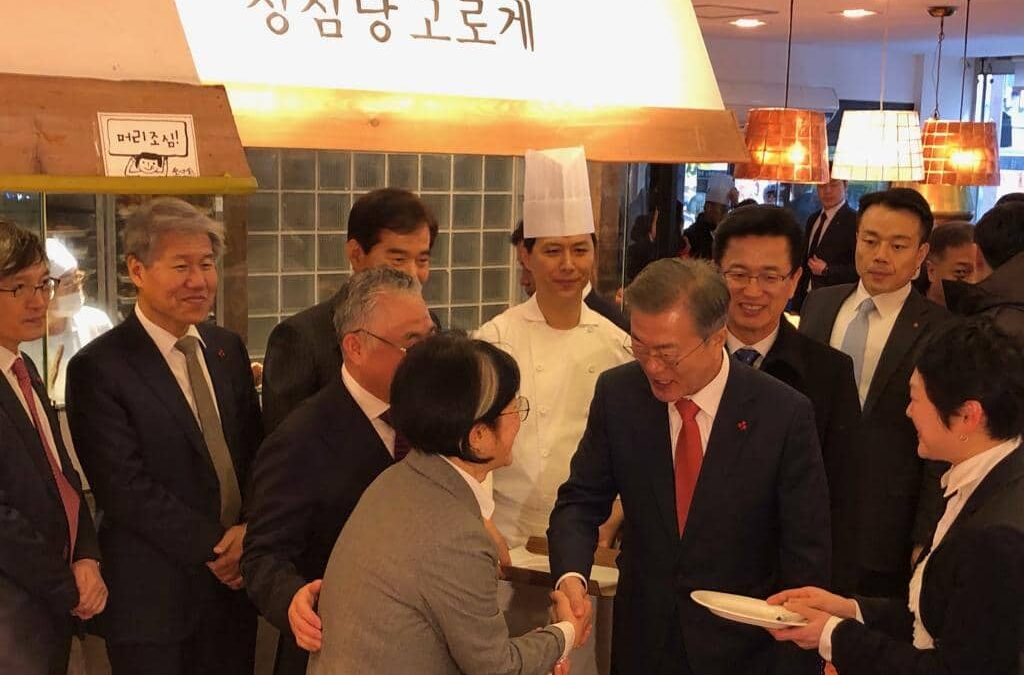
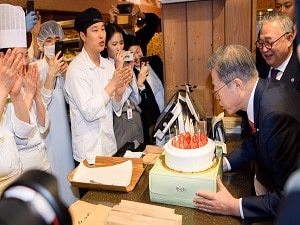
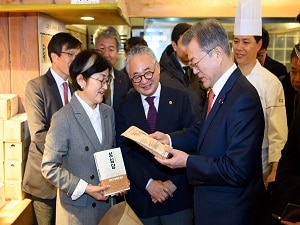
On January 24 Korean President Moon Jae-in visited the Sum Sim Dang bakery, which is part of the Focolare’s Economy of Communion project. 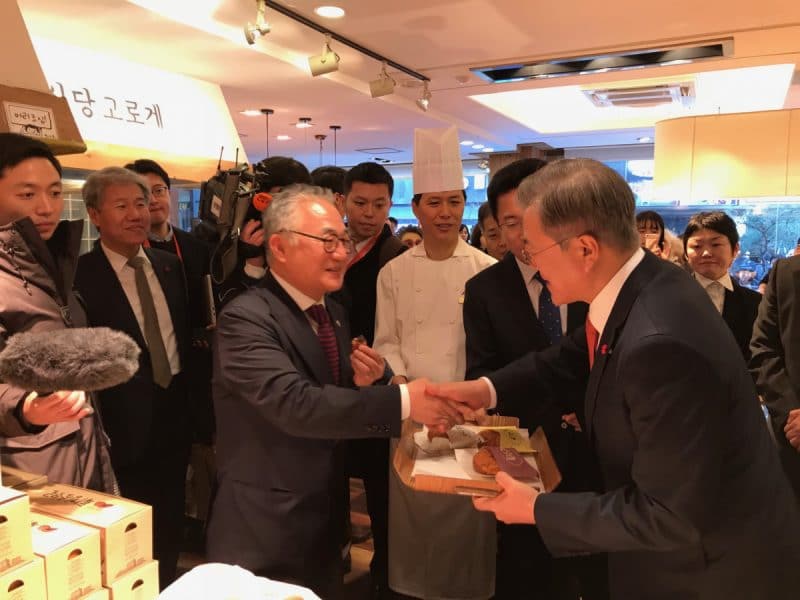
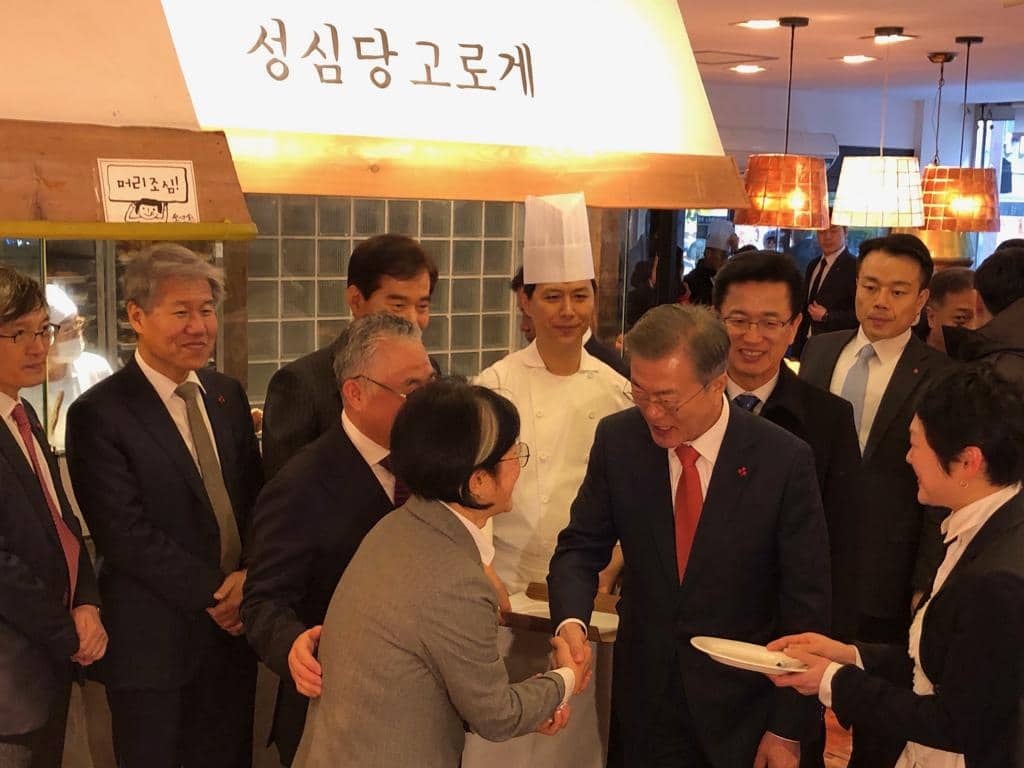 For a business owner, it goes without saying that having the president of the republic visit your business is an exceptional event. But if that visit happens on the president’s birthday, it’s even more so! That’s exactly what happened in Daejeon to Amata Kim and Fedes Im, two Korean entrepreneurs who are part of the Economy of Communion and run the well-known bakery Sung Sim Dang. Moon Jae-in, who has been South Korea’s president since May 2017, is known in the West for starting the peace process with North Korea after almost 70 years of cold war. He celebrated his birthday at Sung Sim Dang with a magnificent cake and was able to get to know the business’s history and reality up close. His Instagram post got more than 76,000 likes in just a few hours. “I was pleasantly surprised today to celebrate my birthday at the Sung Sim Dang bakery in Daejeon,” he said. “During the war in 1950 my father and the bakery’s founder (Fedes’ father) were on the same evacuation ship, Victoria, fleeing North Korea. Remembering this moment of history is for us is something we hold dear and precious. My birthday is a day like any other, but today I am recharged with new strength from the well wishes of so many. Thank you!” The event resonated widely in the media, partly because Sung Sim Dang is universally recognized and highly valued throughout the city of Daejeon. Click here to see video highlights from the visit.
Antonella Ferrucci
Source: www.edc-online.org 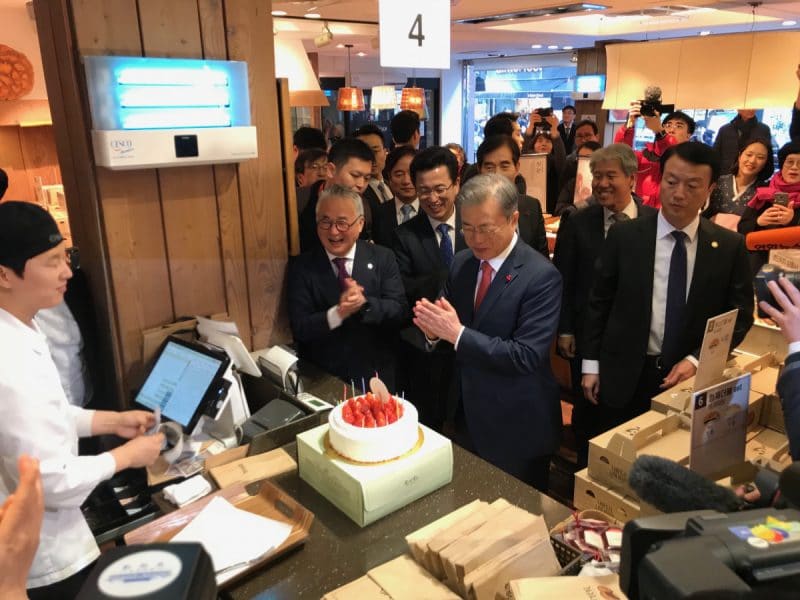

28 Jan 2019 | Non categorizzato
Trieste, Italy – stories related by those who actually live them “Together with members of Caritas and the Italian Consortium of Solidarity (ICS), we support mainly migrant and refugee families and their children, hosted at a reception facility in our city, Trieste, and in the province. For the last three years, we have been organizing regular activities; some of us help mothers with their study of the Italian language to facilitate their everyday life; others play with children and follow them in their homework. Many families have been hosted in our centre, and with almost all them we have managed to build a relationship that lasts even after they leave the centre. Through collaboration with Azione per Famiglie Nuove Onlus (New Families), we set up a project to support a Kurdish family who was in difficulty. This project was financed by some members of the community. After having been supported for two years, the father has now managed to find a job, so the family is self-supporting and lives in a hired apartment. Through other small projects we help other families in their various needs; mothers are assisted to follow specialization courses and thus be prepared for a job, and children are helped to integrate and participate in various activities, as for example sport. We see that these families get the medical care necessary and we also accompany them in their search for a home. We have found small jobs for mothers; and a father, whom we helped with driving lessons, is now employed with a company as a truck driver. With the help of some families, we have managed to offer a “family holiday” to an African widow and her two children, who really needed it. We also try to share with them particular moments in everyday life such as birthdays, Sunday outings to the park, boat-trips, New Year’s Eve festivities, Carnival celebrations and also moments of prayer, as for example during the Ramadam for our Muslim friends. After the appeal by Pope Francis on the World Day of the Poor: “This poor man cried, and the Lord heard him”, we wanted to answer his invitation to all Christians to hear this cry and not let it be in vain. So we thought of organizing a “Friendship Festival”, a lunch for those in need: refugees, migrants, unemployed and poor people of our city. We also managed to involve our Focolare community, and asked members to help with food and with other things needed for preparing the hall. We involved even the friends we invited, asking them to contribute towards our feast – if it were possible – with some typical food of their country of origin. About eighty people participated; they came from Cameroon, Nigeria, Eygpt, Tunisia, Russia, Pakistan, Kurdistan, Kosovo. To our great surprise, we are realizing that Caritas is starting to consider us as a point of reference, a “project” that goes well beyond welfare work. We are being called to share in their programmes and projects and sometimes even to seek solutions. It seems that they are pleased with the way we welcome and support those in need, while we aim at building relationships of reciprocity. In the midst of this chaos, where, maybe, not everyone looks at the welcome given to the least from the same valuable point of view, we feel that we cannot stop, but we must continue to give hope.
Paola Torelli Mosca On behalf of the Trieste welcome and support group to migrants
Fonte: www.focolaritalia.it
26 Jan 2019 | Non categorizzato
An occasion to recall the story of Alberta Levin Temin, speak about the Shoah with secondary school students and propose that the Golden Rule is a way of creating a more united and peaceful world. 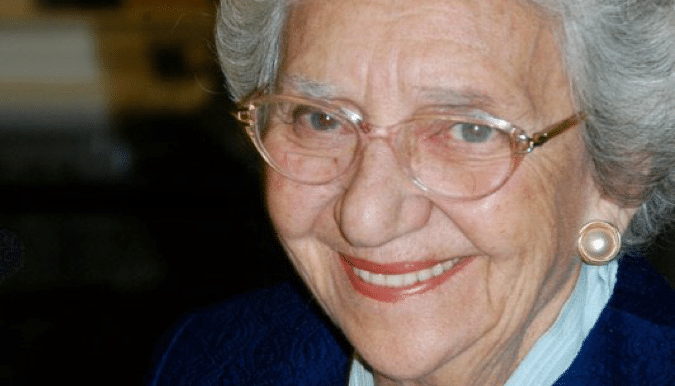 Splendid sunshine provided a background to a special day in Ischia, an island in the Bay of Naples in Italy, when on January 23, a group of students from Giovanni Scotti High School attended the presentation of a book entitled “I Will Speak for as Long as I Live”. At this event, they learnt about Alberta Levi Temin who was a direct witness to the tragedy of the Holocaust and an admirer of Chiara Lubich. The young people listened to an emotional account of her life story in the presence of a group of friends of the Focolare Movement including teachers, students, parents and even the author of the book Pasquale Lubrano Lavadera and Diana Pezza Borrelli. The latter had met Alberta through the “Association of Jewish–Christian Friends” in Naples and had enjoyed a warm relationship with her. Pasquale said, “One day, Alberta came to speak in my school. She was Jewish but she came with her dear friend, Diana, who was Catholic. She had been invited to speak to staff and students about the horrors of the Shoah but also to witness to the fact that dialogue is possible among people of different races, faiths and beliefs. I was very struck by one thing she said, ‘There is only one human family and we are all brothers and sisters.’”
 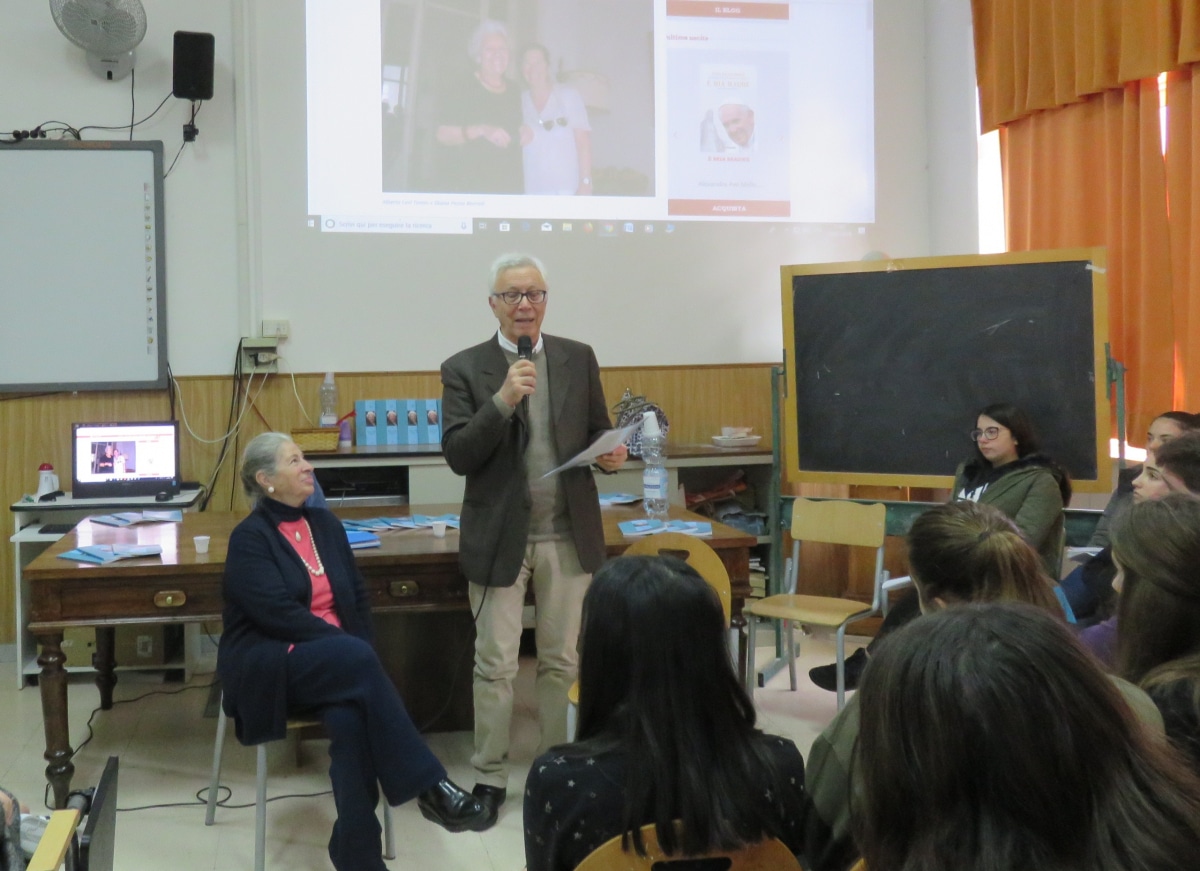 Alberta died in 2016 but throughout her life, she was sustained by one idea. It was the Golden Rule “Do to others what you would like done to you and do not do to others what you would not want done to you.” This idea always filled her with joy. She was committed to creating dialogue at all levels of society. She said, “I understand that today, more than ever, we need to love: as Chiara Lubich says, ‘We need to love another person’s country as much as we love our own.’ We should love the whole of humanity: it is only in this context that dialogue can develop.” “Every school should dedicate an hour or two each week to teaching all classes about the value of relationship. This helps young people to live together in a peaceful way and to collaborate in their studies for the good of all. Their school years are their first experience of being part of society and they should aim at making this a time of mutual support.” Alberta was convinced of this.
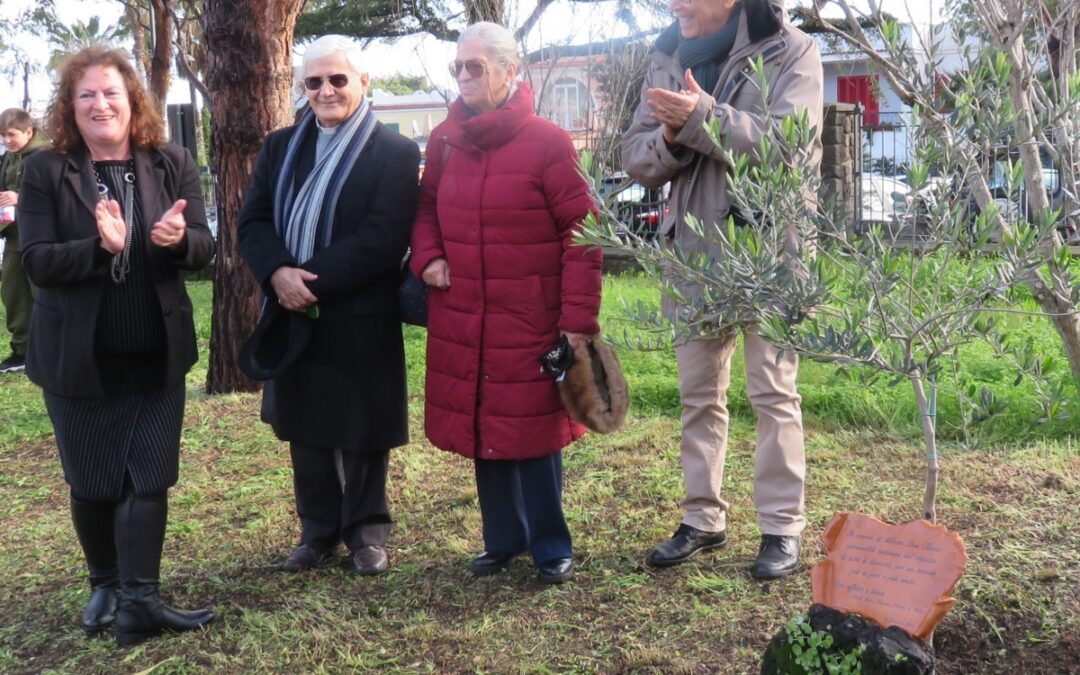
 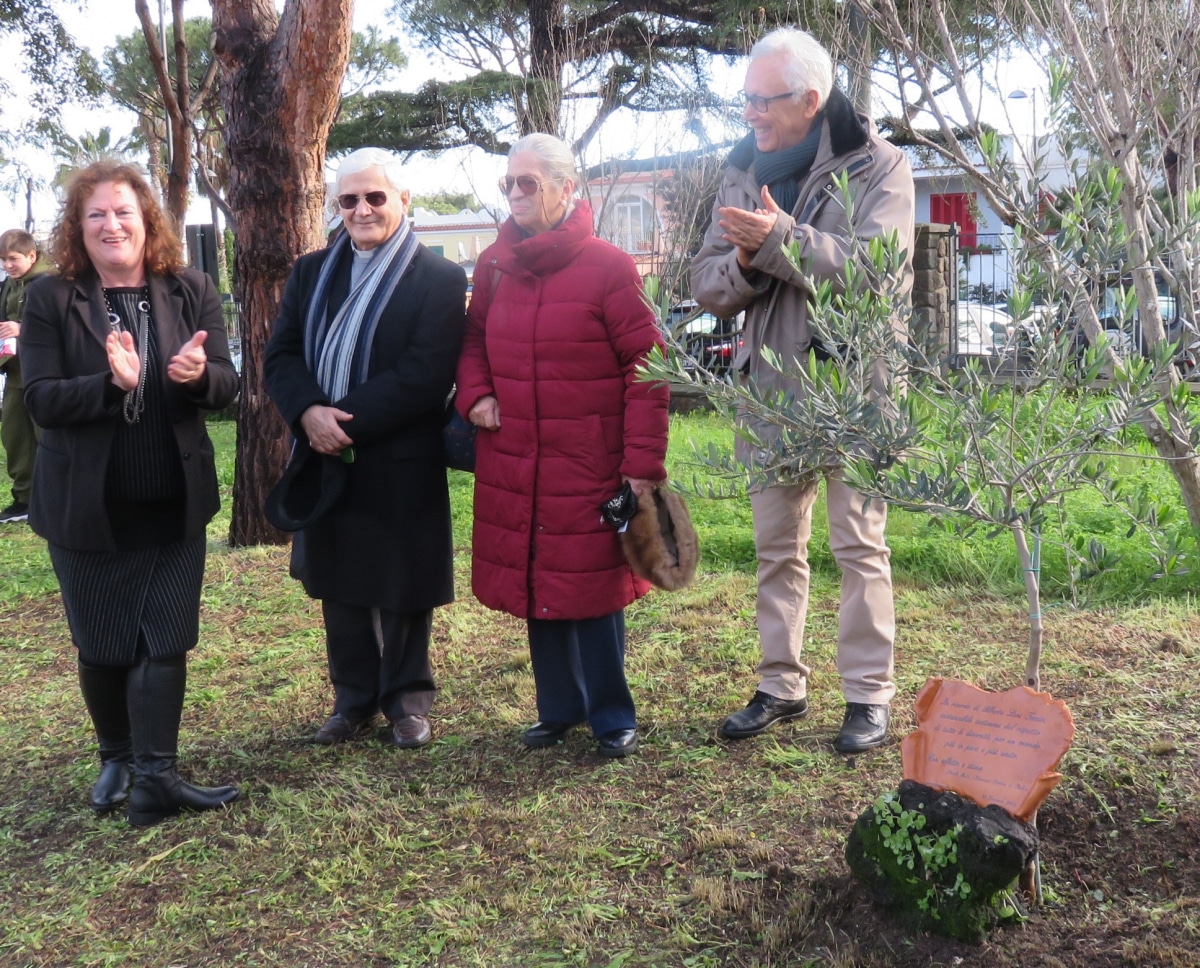 At the conclusion of the presentation, the young people were invited to live the Golden Rule – “do to other whatever you would like done to you” – an instrument of peace and dialogue shared by all religions. To mark the occasion, the director of education, Lucia Monti, put a plaque by the olive tree dedicated to Alberta to express gratitude towards her and to encourage people to remember her example. Chiara, a student from the school, also said, “Thank you for the message of fraternity that you have given us. I am so impressed by the fact that Catholics are meeting with Jews and people of other religions to contribute to building a united world.” Pasquale Lubrano said, “I feel that I should thank Alberta for her life and wisdom. Now that she is no longer among us, I hope that by reading her story, each person here can experience her unique interior “beauty” and share this with others.” He concluded by saying, “Today I have been deeply moved by the attentive way in which the young people have listened, by their enthusiasm and by their searching gaze. In each one of them I have seen the need to live Love for all human beings and the awareness that the human family is one.”
Lorenzo Russo
25 Jan 2019 | Non categorizzato
The 34th World Youth Day organized by the Catholic Church is underway in Panama. We turn to Panamanian journalist and Focolare member, Flor Ortega, for her firsthand comments. The bridges logo of the 2019 WYD – with the main theme “I am the servant of the Lord. May it be done to me according to your word” (Lk 1:38) – represents both the Isthmus of Panama and the spirit of welcome. A small strip of land, measuring just 75 square meters, between the Atlantic and Pacific oceans, Panama links not only the two Americas, but also all continents, through its famous canal frequented by world shipping. It is a welcoming, open-door country, particularly for the many migrants who are, and have ever been, moving South or North. How have you been preparing for this event? “Back in 2016, on 31 July at the ‘Campus Misericordiae’ in Kraków, Poland, Pope Francis announced that the 34th World Youth Day in 2019 would be in Panama. The Focolare Movement in the central American region greeted the news with great enthusiasm,” recalls Panamanian journalist Flor Ortega. “It took a while for updates to get through. We set up commissions to be able to transmit information on the preparation in all its aspects quickly and effectively. Now the WYD has a strong media and social media presence”. On 17 May, in Panama City, during a Eucharistic celebration with thousands of people, Archbishop José Domingo Ulloa launched the idea of a series of Prayer Days on the 22nd of every month leading up to the WYD. The Archbishop then personally asked the youth of the Focolare Movement to prepare the first such day, on 22 June. How did the young people react to this proposal? “With real enthusiasm and commitment. Carmen Cecilia from Panama, told us how this commitment actually helped her to a new understanding of prayer, of the Eucharist and of the Rosary ‘as opportunities to meet Jesus face to face’.” Many young people, members of the Focolare Movement in Panama and other countries, have been working for months on a two-day event at the end of the WYD, 29-31 January, for around 400 youth. “Adults have been offering their support by organizing the meals and accommodation, as well as fund-raising. The young people have been concentrating on creating the online registration system, setting up a consultation service and ‘call center’ connecting people wishing to contribute from outside Panama. The women’s Focolare centre in Panama has become something of a logistics coordination point. Keilyn from Costa Rica described it as ‘as opportunity to get to know the community of Panama which is very united and hard-working, a real example to us all’.” Among those arriving from around the world, Jesús Morán, Focolare Vice President, from the Movement’s international centre in Rome, Italy. And the international Focolare band, Gen Verde travelled from Italy to perform in two pre-WYD events. The first was in Chitré, provincial capital of Herrera, on the Gulf of Panama, the second in Colón on the Atlantic coast. Gen Verde will be performing again on 26 January at the vigil leading up to the concluding Mass to be celebrated by Pope Francis. “Pro mundi beneficio”, “For the Benefit of the World” proclaims Panama’s national motto. What does it mean? «The motto, historically, is linked to the service provided by the canal. But now, ideally, we’d like to extend it to the message that will come out of this World Youth Day!»
Chiara Favotti
