11 Jun 2018 | Non categorizzato
I saw him out of the corner of my eye as I was rushing into the supermarket. He was behind a tree; it was almost as if he wanted to hide from something or someone. I saw him more clearly when I was leaving and he was directly in front of me. I already had two euro in my hand to give to him but I felt uncomfortable at the idea of being the “donor” who was giving some change to the “beggar.” We are both human beings, aren’t we, even if life has treated us differently? As I gave him the money, I spontaneously said, “Hello. I’m Gino. What is your name?” “Sylvester,” he replied with an embarrassed voice. “Have you got a problem?” I asked. There was a moments silence. Later I understood that this was more due to not understanding Italian than to feeling this was a difficult situation. “No. Everything’s fine,” he said. I wasn’t convinced and so I continued, “Look me in the eye and tell me if you have a problem.” Again he answered, “Everything is fine.” As I was approaching my car, I could hear him making his way towards me; “Yes, I have a problem. I want to work.” I shook hands with him as a sign that I had understood. His face and his wounded dignity entered into my heart. We exchanged contact details because we didn’t want to lose touch. That is how Sylvester and I became friends in spite of language and cultural diversity. It was a meeting between two people where each one had his own sense of dignity. From that day onwards, I became increasingly aware that the first thing to do was help him overcome the hurdle of the language barrier. Even if his documents were all in order, it was unrealistic to think he could find a job if he couldn’t express himself in or understand Italian. I didn’t know how to say this because I didn’t speak his language. I remembered that I had a friend from his country and I asked him to be an interpreter. We all met for a beer in the bar near the supermarket and understood more about Sylvester’s situation. Before leaving, I turned to him and said, “Remember Sylvester, nothing is insignificant if it is done with love. You are not here to ask for something but to offer help to whoever needs it – to carry heavy shopping or find a parking space or trolley. God loves you, me everyone. Let’s ask for this together, as the Gospel says. Maybe a door will open but, in the meantime, this is your job. Do it with your head held high – without losing your dignity.” The following evening I received a WhatsApp message from him. “Good evening Gino. How are you? I hope you and your family are well. Thank you for helping me. God bless you for taking care of me. I am longing to begin a proper job but in the meantime I will do as you said and hold my head up high. I am waiting to see you.” I had to use google translate to understand him and reply. “Dear Sylvester. Thanks for your good wishes. Today I tried to find a free Italian language course. I hope I will have good news for you soon.” After that, I began to experience what we already know – it is very difficult to help someone! To this day, I do not understand why there is so much bureaucracy! However, I didn’t give in because other people also began to support Sylvester. I was no longer alone and neither was he. Tomorrow he will begin Italian lessons. This is the first step towards finding a job and being able to send financial support to his wife and two small children who have stayed in the country where he was born. Maybe, one day, they will be able to join him. Dear Sylvester, I pray that this will happen! Gustavo Clariá
11 Jun 2018 | Non categorizzato
Pope Francis’s prayer for the month of June is dedicated to the social networks and the web. This was aired today through a video message in Spanish by the world Network of prayer for the Pope, translated in seven languages and rebroadcasted by Vatican News. In the video the Pope invites all to pray to God so that the social networks “do not annul our personality, but enhance solidarity and respect for others in their differences.” After the title, “May the social networks enhance solidarity and respect for others in their differences,” Francis underlined that “Internet is a gift of God, and is also a great responsibility,” and explained that “communication, its sites, and its instruments imply a widening of horizons for many people.” Francis thus relays the invitation, already expressed in the message for the day 2014, to take advantage of the “possibilities for encounter and solidarity which the social networks offer,” and the wish that the “digital network will not be a place of alienation but a concrete place full of humaneness.” The Pope’s intention is – “Let’s pray together so that the social networks do not annul our personalities, but enhance solidarity and respect for the others in their differences.” Source: SIR https://youtu.be/Tuz6zE4bd9w
10 Jun 2018 | Non categorizzato
Prophetic Economy…between the “already” and the “not yet” : The International Event promoted by the EoC and several associations and movements intending to respond to the cry of the world and the poor. It will take place in Castelgandolfo (Rome)
Our world faces an ecological and social crisis. Climate change and rising inequality are being fuelled by unjust economic structures, short-sighted policies and outdated practices. People all around the world. BELIEVE passionately in human development & sustainability, WORK tirelessly to change the rules and demand justice. It is time to COME TOGETHER and be more than the sum of our part
“Prophetic Economy” stems from the desire to approach those with whom we have a common goal, in order to learn from each other, find new ways of collaboration, send a powerful message of hope especially to those who today are the victims of social and environmental injustice and to understand together how to act on the macro level.  We immediately realized that we couldn’t start such a journey alone, but that we had to do it right away, together with other movements. That’s how the EoC working group was enriched by the presence of ATD Quart Monde, The Pope John XXIII Community (Associazione Papa Giovanni XXIII),, Nomadelfia, the Global Catholic Climate Movement, Slotmob, Mondo Comunità e Famiglia and Wordteens (Ragazzi per l’Unità) who today are our partners. We are convinced that the value of Prophetic Economy is not only represented by the realisation of the event in itself, but also by the process of mutual opening up and enrichment which has already been started by all promoters
CHILDREN will be protagonists too!
In addition to bringing together those who make efforts in this area, this event also proposes a competition of best practices of “Prophetic Economy”, giving visibility and recognition to many of the protagonists of change who transmit a positive energy at the service of the common good.
135 change-makers and organizations from 35 countries have participated with their practices of prophetic economy. The 3 winners and other practices selected in the shortlist, will present live during the event.
Scientific Panel for “Prophetic Economy in Practice” Award 2018 : Dr.Vandana Shiva -India, Dr. Jeff Sachs – USA, Dr.Cristina Calvo – Argentina and Prof. Stefano Zamagni – Italy.
Simultaneously with the event there will be
satellite actions of a different nature organised in several countries around the world: the most important Prophetic Economy will be an international
Bankmob for disinvestment in fossil fuels, armament and gambling.
Info: www.propheticeconomy.org/ Prophetic Economy in practice – Award 2018 – download info e form
8 Jun 2018 | Non categorizzato
“The world is the word of the God who created it. And how does this word sound? Like this: I love you. And to whom is that word addressed? It is addressed to the world that is that word; it is addressed to every individual whom the world sees as someone who knows they are a tiny part of the world, yet, nevertheless, able to soar beyond themselves to the whole. It is a word addressed to every man. The world is God’s word of love towards whoever lives in it; it is a gaze from Divine Love towards that individual. It is what the world is in its totality and in each of its parts: every particular of the world is a glance from the love of God.” (Cosmology, anthropology, sociology and religion) “I can completely dedicate myself to this world, because I am a Christian; in fact, all the love we invest in this world will mark it forever, our love will leave an indelible mark on every single fragment of Creation.” (December 1980) “The primary interest of a Christian should be to bring forward not only those who share his ideals, but all those who have responsibility for the world, building up of a humane world.” (November 1978) “The life and unity of people cannot be considered as the mere sum of individuals, nor as a collective system in which the single is swallowed up and disappears. The alternative is communio. I am myself, but in the measure to which I am for you and with you, and in the measure to which I receive from you. Man can only be explained in this relationship. Only in this Trinitarian relationship does collectivism not dissolve the individual. Only in this Trinitarian relationship is the individual not sacrificed to a communitarian structure. From this, I am certain, new prospects will open in favour of a universal economic order.” (Dreifaltigkeit, p. 131) Source: Klaus Hemmerle, La luce dentro le cose, Meditazioni per ogni giorno, Città Nuova Ed, 1998, p. 287-293.
7 Jun 2018 | Non categorizzato
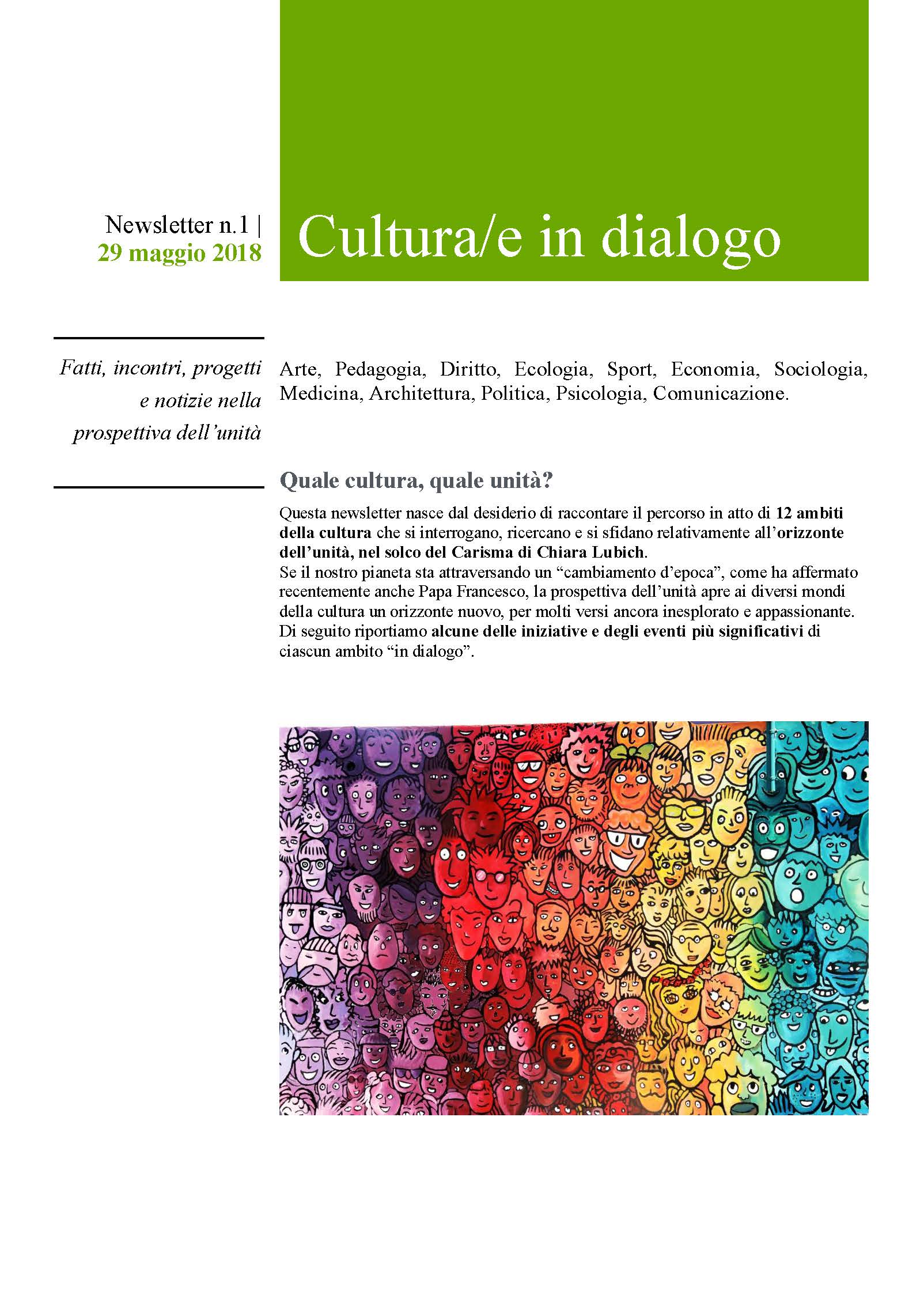 Which culture? What unity? The idea of the newsletter is to tell the story of 12 areas of culture and their journey to seek, question and challenge one another toward a horizon of unity, following Chiara Lubich’s charism. These are Art, Education, Law, Ecology, Sports, Economics, Sociology, Medicine, Architecture, Politics, Psychology and Communication. If our planet is going through a change of era, as Pope Francis recently declared, the point of view of unity opens up new ground for these areas of culture. For many this will be unexplored and fascinating. The first issue features a number of new initiatives and the most significant events occurring in each part of culture that is “in dialogue.” ________________________________________________________ For more information: Centro per il dialogo con la Cultura (Focolare Movement) centrodialogo.cultura@focolare.org tel. +39.06.945407201 – Via Piave, 15 – 00049 Grottaferrata (Roma – Italia) Key contacts: Communion and Law – info@comunionediritto.org Economy of Communion – info@edc-online.org Social-One – info@social-one.org Eco-One – luca.fiorani@gmail.com Dialogues in Architecture – segr.architettura@focolare.org NetOne – netone@net-one.org Political Movement for Unity – info@mppu.org Psychology and Communion info@psy-com.org Health Dialogue Culture – healthdialogueculture@gmail.com Clarté – clarte.international@gmail.com Sportmeet – info@sportmeet.org EDU – pedagogia@focolare.org –
7 Jun 2018 | Non categorizzato
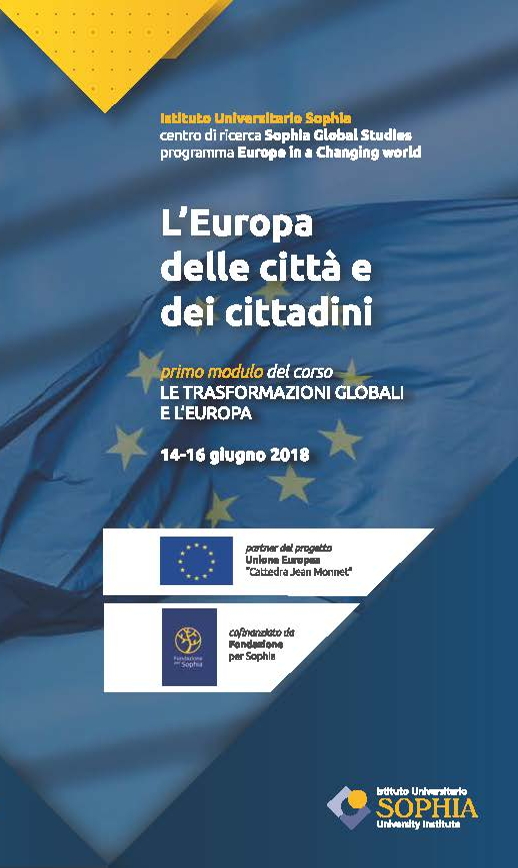 The course will be held from Thursday 14 June to Saturday 16 June 2018 in the Main Hall of the Sophia University Institute, with the opening speech of Prof. Romano Prodi, entitled “Europe today. Which Europe tomorrow?” Co-funded by the Sophia Foundation in partnership with the programme “Jean Monnet Chair” of the European Union, the course aims to analyse the role of the cities as workshops of European integration, and the citizens as protagonists. The lessons will reflect on integration, independence, European citizenship and will introduce the European governance system, with particular focus on the local and regional dimensions. The workshops will be particularly interesting, since the participants will be able to discuss and share competences and experiences in such matters. The key rapporteurs will be Léonce Bekemans of the Padua University, holder of the Chair Jean Monnet ad Personam, and Luc Van den Brande, former President of the Flemish Region and today confidential councillor of the European Commission Presidency, who will expound on “Reaching Out to Citizens,” report presented to President Junker in November 2017, a document which represents the most recent and authoritative analysis on European citizenship. The module will start off othe programme, “Europe in a Changing World,” initiated by the Sophia Global Studies’ Research and Training Centre. “Numerous facts confirm our itinerary, – affirmed Paolo Frizzi, academic coordinator – also the recent visit of Pope Francis to Loppiano, where Sophia is based, underlined the urgency to “trace new paths to be pursued together to give rise to a global civilization of alliance.” Our young Institute was incepted to form leaders who have the capabilities and competencies to face the global challenges and promote dialogue and peace.” The course is open to professionals, scholars, communication administrators and operators, besides teachers of the primary and secondary schools and scholastic directors who may make use of the Teacher’s Card (MIUR 170/2016). There will be 15 scholarships for young people up to 30 years of age. See the complete programme on www.sophiauniversity.org.
