28 May 2018 | Non categorizzato
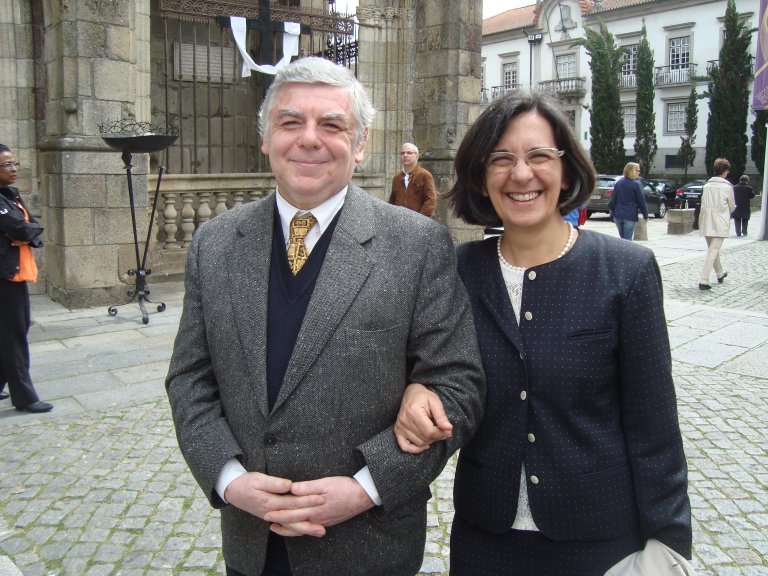 “You, Chiara, are the one who helped us understand what marriage truly is: openness and the fulfilment of the plan of God on us. We will use all our strength for the family and the world to become what they should be”. Maria da Conceição, known to all as São, wrote this to Chiara Lubich at the start of our joint adventure – recalls Zé Maia. We got married in Braga in 1981 and from our union six children were born. Then the grandchildren started arriving, nine so far. Chiara Lubich had proposed to São a particular phrase of the Gospel to guide her life: “He must increase and I must decrease. (John 3:30)’. How many times São repeated this to me over the years!” In 2002 Zé and São, both Portughese, moved with their children to the nascent Focolare town “Arco Iris”, 50 km from Lisbon, to help in its foundation. In November 2016, São went to the Mariapolis Centre of Castelgandolfo near Rome, to participate in the “Together for Europe” event. “Before she left for Rome, she said to me, Zé recounts, ‘I’m happy to be part of this meeting; I believe this is the way we should follow”. It was to be her last act of love, joyfully living her life for others. Completely unexpectedly, on 11th November, she had a heart attack and God called her to himself.” Today, what I am going through is living her, whom I find within me, as “one flesh” but now between heaven and earth. Her last words remain fresh in my mind, when she challenged us to “go ahead together, courageously”. So I start again every day, with the encouragement and help of the Focolare life. At home with my family, we’re discovering a “new us”, and experiencing how all we’ve built with love remains. It continues because eternity is perfect love. I’m constantly seeking how to become both father and mother. I’m living as if São was here with me, welcoming other people to our home, or out doing the shopping. Together with her I go to get flowers, or cook a nice lunch for the children or prepare those special treats the grandchildren love. Together with her I’ll speak to someone to correct them if need be, or support them or encourage them. It’s a constant dialogue between earth and heaven. Since São’s death, I’ve made a new discovery of Jesus in the Eucharist, as the moment in which we meet. Certainly, I feel so sad at times, but I find those moments are helping me to open up my heart towards my neighbours. I do feel the dark shadow of loneliness. But I realise I need to turn away from this and follow the light. At the end of each day I can find gratitude in my heart in the moments I lift up my gaze towards the invisible. Yet fear can still creep up on me like a thief, poised to steal away my peace of mind. And at times it’s as though my soul yearns to fly away to somewhere else. But in those moments I allow that ray of light to speak to me, it greets and welcomes me». “Sometimes I write to my children to tell them what I’m living with their mother. ‘Each day, through the kaleidoscope of the soul, I see her with a new kind of beauty, like a blue sky in which I can contemplate the mystery of he’. Life goes on in the family and in communion with others around me. I most assuredly miss her, I miss her company, I miss her companionship and I miss sharing everything with her. No-one can ever be ready to lose their spouse, to be left alone without the beloved voice and loving glances. The loss is felt at all levels, emotional, psychological and relational, as well as practically with the children, with the family as a whole and at work.” In 1967 Chiara Lubich addressed this issue. “The sacrament of marriage makes of two persons one, spiritually as well as physically”, she said. So when one of a couple “departs” for heaven “the marriage is ‘broken’, in the Will of God. It is a divine something – if you can say this – like a small Trinity that breaks”. So it is a real purification which can be best approached by setting oneself to love the people around. This year I seem to have discovered the meaning of God as Love. Love, more than being “of” God, is God himself. Only love remains. We found a short prayer São had written: “Help us to become the family you want us to be. Give me the grace to overcome all difficulties with wit, wisdom, intelligence and goodness. Help us to see everything in your own light”». Gustavo Clariá
27 May 2018 | Non categorizzato, Word of
for ages 4-8 | for ages 9-17 | Print | Audio
St Matthew’s Gospel begins its account of Jesus’ preaching with the surprising proclamation of the Beatitudes. Jesus proclaims “blessed,” meaning completely happy and fulfilled, all those who in the eyes of the world are considered on the losing side or unfortunate: the humble, the afflicted, the meek, those who hunger and thirst for justice, the pure of heart, those who work for peace. God makes them great promises. They will be filled and consoled by him; they will inherit the earth and his kingdom. This is a real cultural revolution, which overturns our narrow and shortsighted way of seeing things. So often, we see these categories of people as marginal and insignificant in the struggle for power and success. “Blessed are the peacemakers, for they will be called children of God.” From a biblical perspective, peace is a fruit of God’s salvation. It is primarily his gift. Peace is a characteristic of God himself, who loves humanity and all creation with a father’s heart and who desires harmony and goodwill for all people. For this reason, those who endeavor to bring peace bear some “resemblance” to him, as his children. “Whoever possesses inner peace can be a bearer of peace,” Chiara Lubich wrote in 1981, in Città Nuova magazine. “We need to be peacemakers first in our own behavior in every moment, living in harmony with God and his will … ‘They will be called children of God.’ Being given a name means becoming what the name conveys. St. Paul called God “the God of peace,” and when writing to Christians, he said: “The God of peace be with you all.” Peacemakers show their kinship with God and act as children of God; they bear witness to God, who has inscribed an order in human society, whose fruit is peace.” Living in peace is not simply the absence of conflict; nor is it a quiet life in which our values are adaptable so that we will always be accepted somehow. Instead, it is a distinctly Gospel-based lifestyle, which calls for courage in making choices that go against the mainstream. To be “peacemakers” means above all creating opportunities for reconciliation in our own life and that of others, at all levels. First, reconciliation with God and then with those close to us at home, at work, at school, in parishes and associations, in social and international relations. It is therefore a decisive way of loving our neighbor, a great work of mercy that heals all relationships. Jorge, a teenager from Venezuela, decided to be a peacemaker in his school. “One day, when lessons were over, I realized that my classmates were organizing a demonstration, and they were going to use violence, burning cars and throwing stones. I thought this went against my lifestyle, so I suggested that we write a letter to the school principal asking in a different way for what they wanted to obtain through violence. A few of us wrote the letter and gave it to the principal.” “Blessed are the peacemakers, for they will be called children of God.” Today, it is urgent to encourage dialogue and gatherings between individuals and groups whose history, cultural traditions and points of view are different. It is a way of showing appreciation for and acceptance of diversity as a source of enrichment. Pope Francis said in Myanmar last year that “peace is built up by the chorus of differences, and starting from these differences we learn from one another, as members of one family … We have one Father, and we are brothers and sisters. Let’s love each other as such. And if we argue among ourselves, let it be as brothers and sisters, who are immediately reconciled and always go back to being a family.” We can also find out more about the seeds of peace and brotherhood that are already helping to make our towns and cities more open and humane. We can contribute to healing rifts and conflicts by caring for these seeds and making them grow. — Letizia Magri Read more: Lubich, Chiara. “If we were to live the Beatitudes,” Essential Writings, New City Press: Hyde Park, New York, 2002, pp. 125–126. Lubich, Chiara. “Only One Will is Good,” Christian Living Today, New City Press: Hyde Park, New York, 1997, pp. 53–56. Lubich, Chiara. “To be Charged with Love,” On the Holy Journey, New City Press: Hyde Park, New York, 1988, pp. 79–81.
Word of Life for ages 4-8 | for ages 9-17 | Print | Audio
27 May 2018 | Non categorizzato
Holding my position I’m Albanian. After searching long and hard, I found a job as a hospital nurse in Macedonia. One day, trying to stay true to my religious principles, I refused to take part in an abortion procedure. My colleagues were quite surprised, since in doing so I risked being fired. Despite knowing that our family, which depends on my salary, would have hurt because of this, I held my position. After a few days, the head of the hospital privately declared his admiration for what I did. He too wanted to challenge the practice of abortion, but dared not risk his position. S. E. – Macedonia Raising chickens We wanted to start a business to meet the needs of the poor. Putting together some of our resources, we started to raise chickens for their eggs. Our first employee was a 20 year old who I later discovered was dishonest. One time, in fact, he disappeared with a large number of eggs. He had been the only one absent that day. Each time I decided to fire him, however, I stopped myself. “Firing him is easy,” I told myself. “Wouldn’t be better to help him?” I asked God’s help, and I tried to put trust in that young person. A few months ago, many of the chickens were dying, and the veterinarian couldn’t understand why. That young man, observing them, noticed it was because the nests were placed wrong: the chickens who went to lay were not protected from the others’ pecking. We changed things, and there haven’t been problems since. P. L. – Cameroon Night shift A colleague of mine covers the night shift at the digital center of a bank where I work. In the latest of many setbacks, he telephoned me in a panic and asked me to run over to help. Even if it took a lot to leave home and my family, I decided to go and give him a hand. Before anything I tried to take in and absorb his anger, and little by little he calmed down. Together we tried to gather all the data that had gone missing. At that point my job was done, but I thought of Jesus’ words, “If anyone forces you to go one mile, go with him two miles.” I proposed that he go home for the night, telling him that I’d cover the rest of the shift. When he responded that he preferred to stay, I stayed with him until midnight. Beyond my tiredness, I also felt a great joy. F. S. – Switzerland Communication breakdown After years of marriage, my wife and I got to the point of not being able to communicate. Anything we tried to say to each other in order to clarify how we felt, or why we did things, seemed to pour gas on the fire, to the point that we threw in each other’s face that we had really never shared anything. Our life was filled with days of hell. So much so that our children, even if they had already left home, noticed this intense awkwardness as well. One day, when I was feeling particularly overwhelmed inside, I asked God for help. A short while later, as I was looking through a magazine on the tram, an article caught my attention about the importance of trusting each other. That was exactly what I needed! I understood that, instead of analyzing actions and words, I needed to restore faith in my wife, showing that I believed in her. I tried this, and my change in attitude bore fruit. After days of silence, my wife and I have begun a new dialogue. F. T. – Hungary
25 May 2018 | Non categorizzato
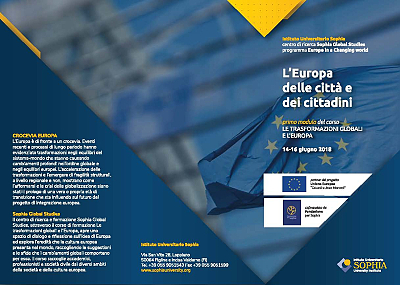
Next June, the Sophia University Institute will inaugurate the first module of the course “Europe and the global transformations.” The 18-hour course, conducted by Léonce Bekemans, Jean Monnet Chair Ad Personam of “Globalization, Europeanisation and Human Development,” proposes the study of the role of cities as workshops of integration and citizens as the foremost actors in the process of the European project relaunch. The lessons will present the state of the integration process, reflecting on concepts such as independence, inclusion and European citizenship. Particular focus will be set on the revolt against governance systems and their local and regional dimensions. The course will be opened with an introductory paper of Romano Prodi entitled: “Europe today. What Europe in the future? The course module addresses professionals, primary and secondary school teachers, scholars, administrators and communication operators. Professors and school directors may make use of the Teacher’s Card (MIUR 170/2016). 15 scholarships are at the disposal of young people up to 30 years of age. For information and registration www.sophiauniversity.org, globalstudies@iu-sophia.org.
24 May 2018 | Non categorizzato
https://vimeo.com/271706391 (2403M) Copyright 2018 © CSC – P.A.F.O.M. – All rights reserved
“Two weeks ago we were with the Pope in Loppiano. Two weeks have gone by and we ask ourselves, “Did it really happen?” It really did! It did not only happen, but now we have something to do. So at the moment I am asking myself, “Have we fully understood what actually happened?” Maybe we are discovering it a little at a time, as we understand his wonderful talk better, because the Pope challenged us. He said we are at the beginning of our journey, at the start of Loppiano, at the start of everything, we might say. This being at the start means that we must look ahead, that we must do something to move forward. And the Pope told us what to do: we must transform society – he said some very strong things – we must not content ourselves with fostering relationships between individuals, in families, between different groups and peoples, but we must even get together to beat the challenge of this society which is going wrong and needs the Gospel, which is in extreme need of seeds of Gospel life that then grow and transform it. We really feel we are at the start, and we truly are at the start, but we cannot stop, precisely because in saying this the Pope gave us this challenge and said, “You can do it”. He also told us how to do it, because he said, “… by handing on to others the spirituality of ‘we’, this ‘culture of we’”, which can foster a global alliance, a universal alliance, a new civilisation, a civilisation born from this ‘we’. He also said that the charism is a powerful help and encouragement for us. The charism is a gift of God, so we mustn’t feel proud about having received this charism, but with the humility he reminded us about, we must be aware of the charism and do all we can to hand it on to society around us. This is a long and tough path, but the Pope said, “We need women and men who are fit for this”. So, do we want to respond to the Pope’s appeal? I think we do, and that we will give the whole of ourselves as we discover, there where we are, how to transform society around us. I think this is the commitment we are taking up today and that will last our whole lives.”

24 May 2018 | Non categorizzato
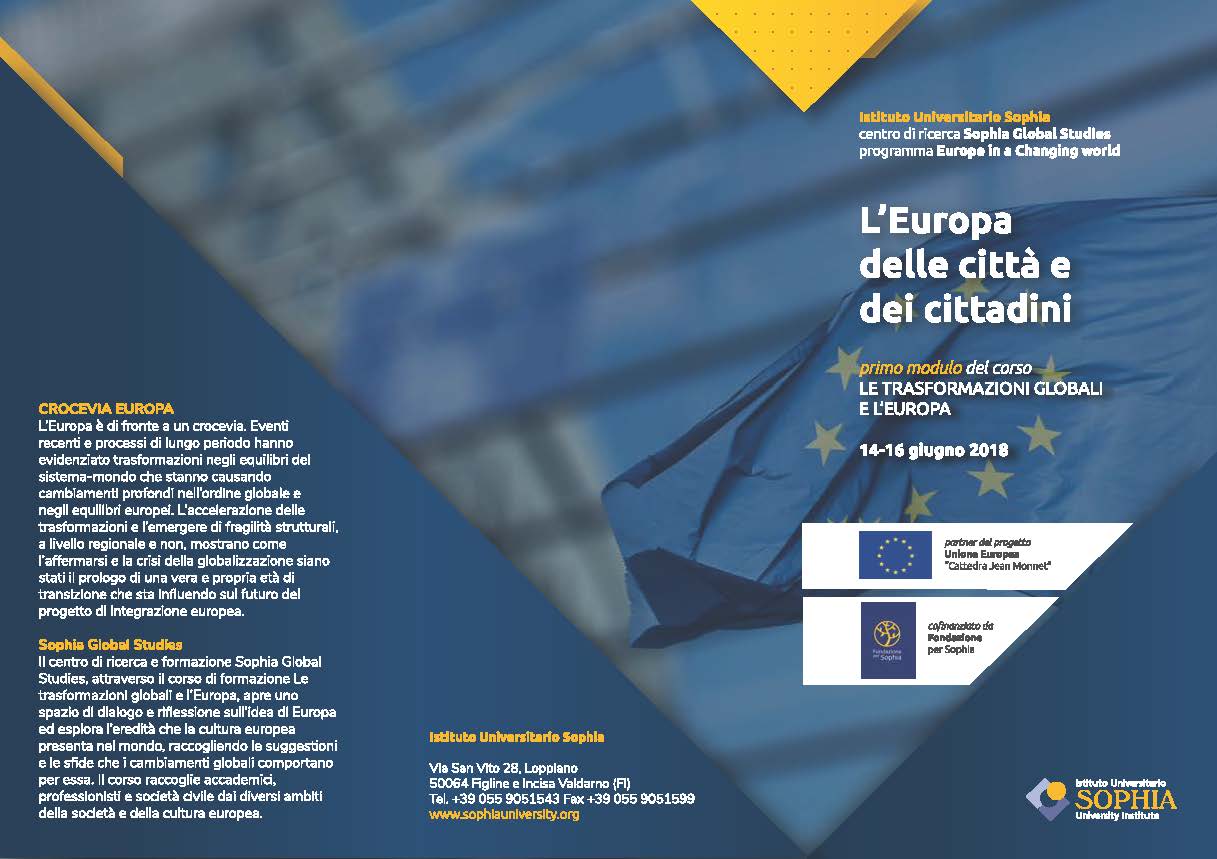 Next June, the Sophia University Institute will inaugurate the course. The 18-hour course, conducted by Léonce Bekemans, Jean Monnet Chair Ad Personam of “Globalization, Europeanisation and Human Development,” proposes the study of the role of cities as workshops of integration and citizens as the foremost actors in the process of the European project relaunch. The lessons will present the state of the integration process, reflecting on concepts such as independence, inclusion and European citizenship. Particular focus will be set on the revolt against governance systems and their local and regional dimensions. The course will be opened with an introductory paper of Romano Prodi entitled: “Europe today. What Europe in the future? The course module addresses professionals, primary and secondary school teachers, scholars, administrators and communication operators. Professors and school directors may make use of the Teacher’s Card (MIUR 170/2016). 15 scholarships are at the disposal of young people up to 30 years of age. For information and registration www.sophiauniversity.org, globalstudies@iu-sophia.org.
