26 Feb 2018 | Non categorizzato, Word of
for ages 4-8 | for ages 9-17 | Print | Audio https://www.focolare.org/gb/files/2018/03/201803WOL.mp3 King David, who was also a prophet, wrote this psalm at a time when he felt weighed down by anguish and poverty and in danger from his enemies. He wanted to find a way out of his painful situation, but realized he was completely unable to do so. Therefore he looked up, with hope, toward the God of Israel, who had always protected his people, and implored him to come to his aid. This month’s Word of Life draws our attention to the fact that he was asking to know the ways and paths of the Lord, to shed light on the choices he had to make, especially at difficult times. “Make me to know your ways, O Lord; teach me your paths.” Sometimes in life we too have to make decisive choices. It can be totally absorbing to have to do so, and it can help us to think deeply about what our conscience suggests is the right way forward. It could be that we have many paths to choose from and are uncertain about which is the best. At other times, we may feel there is no path at all. Wanting to find a way ahead is a strong human need, and so sometimes we ask help from those we consider our friends. Christian faith makes us become friends with God. He is a Father who loves us; he knows us through and through and wants to accompany us on our journey. Every day, God invites us to set out freely on an adventure. Our compass is unselfish love for him and all his children. The ways and paths are opportunities to meet other travelers and find new goals that can be shared. Christians are never isolated individuals, but part of a people travelling towards the fulfilment of the plan of God the Father for humankind. Through all he said and did, Jesus revealed God’s plan to bring about universal fraternity, the civilization of love. “Make me to know your ways, O Lord; teach me your paths.” The Lord’s ways can be daring and, at times, may seem too challenging for us, like rope bridges stretching between high cliffs. They challenge our selfish habits, our prejudices and false humility, and instead create opportunities for dialogue, encounter and commitment to the common good. Above all, they call for a love that is ever new and capable of forgiving, because it is founded on the rock of God’s love and faithfulness to us. This ever-new love is essential if we are to build just and peaceful relationships among peoples and nations. Even the witness given by a simple kind deed, done with love, can give others the light to see their way forward. At a gathering in Nigeria, when both children and adults were sharing their experiences of loving according to the Gospel, a little girl called Maya said, “Yesterday, when we were playing, a boy pushed me and I fell over. He said ‘sorry’ and I forgave him.” Those words touched the heart of a man whose father was killed by Boko Haram. “I looked at Maya. If a little girl like her can forgive, it means that I can do the same.” “Make me to know your ways, O Lord; teach me your paths.” If we want a sure guide on our journey, let’s remember that Jesus said, “I am the Way…” (Jn 14:6). When Chiara Lubich spoke to young people gathered in Santiago de Compostela during the 1989 World Youth Day, she encouraged them: “By describing himself as ‘the Way’, Jesus was saying we must take the same way as he did. We could therefore say that the way Jesus followed has a name: it is love. The love that Jesus lived and brought on earth is special and unique. It is the same ardent love that burns in God … “But who should we love? Our first duty of course, is to love God. Then, to love our neighbor, every neighbor … From the moment we wake up in the morning until we go to sleep at night, every relationship with our neighbor should be lived with this love. Whether we are at home, at college, at work, on a sports field, on vacation, in church or on the street, we should take advantage of every opportunity to love, seeing Jesus in our neighbors, neglecting no one, being the first to love … “This means entering as far as possible into the minds and hearts of others, truly understanding their problems, needs and troubles — as well as their joys, so that we can share everything with them … “In a way, we have to become that other person, just as Jesus, who was God, became a man out of love. Then our neighbors will feel understood and supported because someone is helping them bear their burdens and pain and share in their joys. ‘Living the other person,’ ‘living the others’ – this is a great ideal; this is amazing.” Letizia Magri
25 Feb 2018 | Non categorizzato
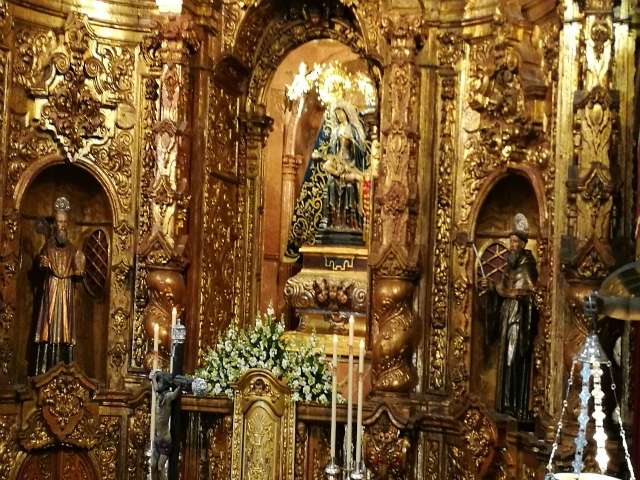
Facing the Mediterranean, to the southeast of the Strait of Gibraltar – a bridge between the two continents and one time end of the world – the city of Ceuta rises, which, along with the nearby Melilla, represents Spanish colonial remnants on the continent of Africa. Because of its strategic location on a piece of privileged coastland, the two cities have for decades have been considered possible entry ways into Europe, in spite of the dividing wall. Every day, men, women and children from the most diverse collection of African countries, escaping wars, poverty and persecutions of every kind, cross entire countries in an attempt to find a shore near the city on which to disembark. Right on this strip of land which, since 1851 has been under the Diocese of Cadice, which is in the midst of getting ready for the 600th anniversary of the arrival of the one who has been called the “Virgin of Africa,” a single block of wood representing the Blessed Virgin seated with the body of the dead Christ between her arms. In 1949, Pope Pius XII wanted her to be named the patroness of the city.
24 Feb 2018 | Non categorizzato
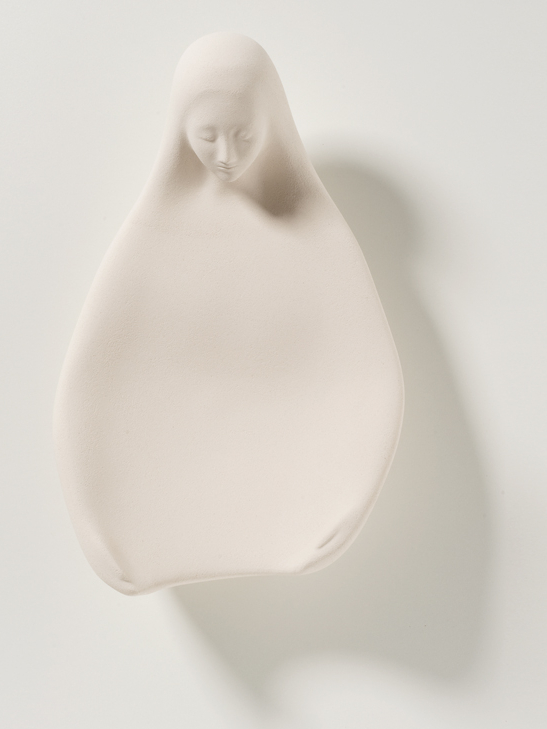
“Madonna della bella-accoglienza” © Centro Ave Ceramica
23 Feb 2018 | Non categorizzato
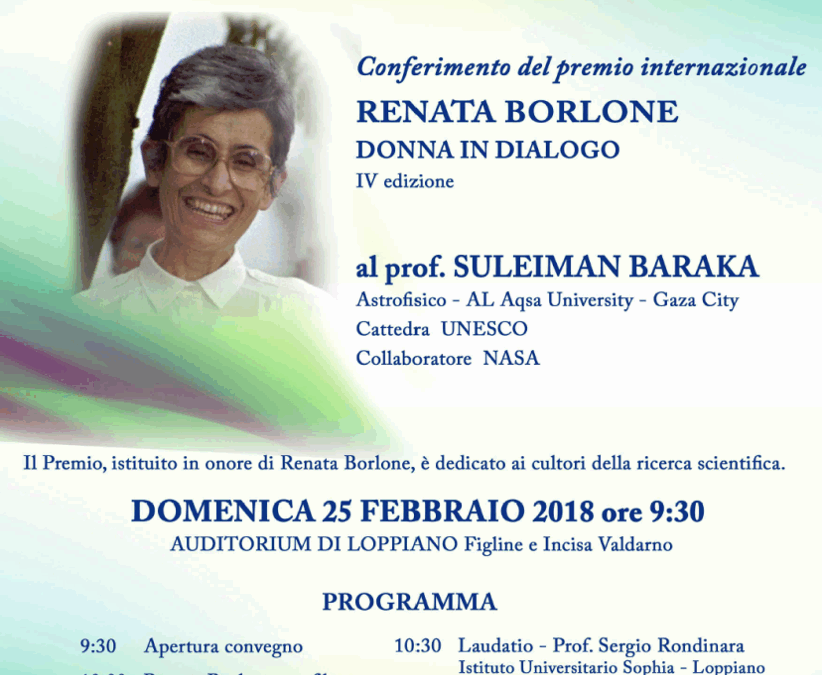
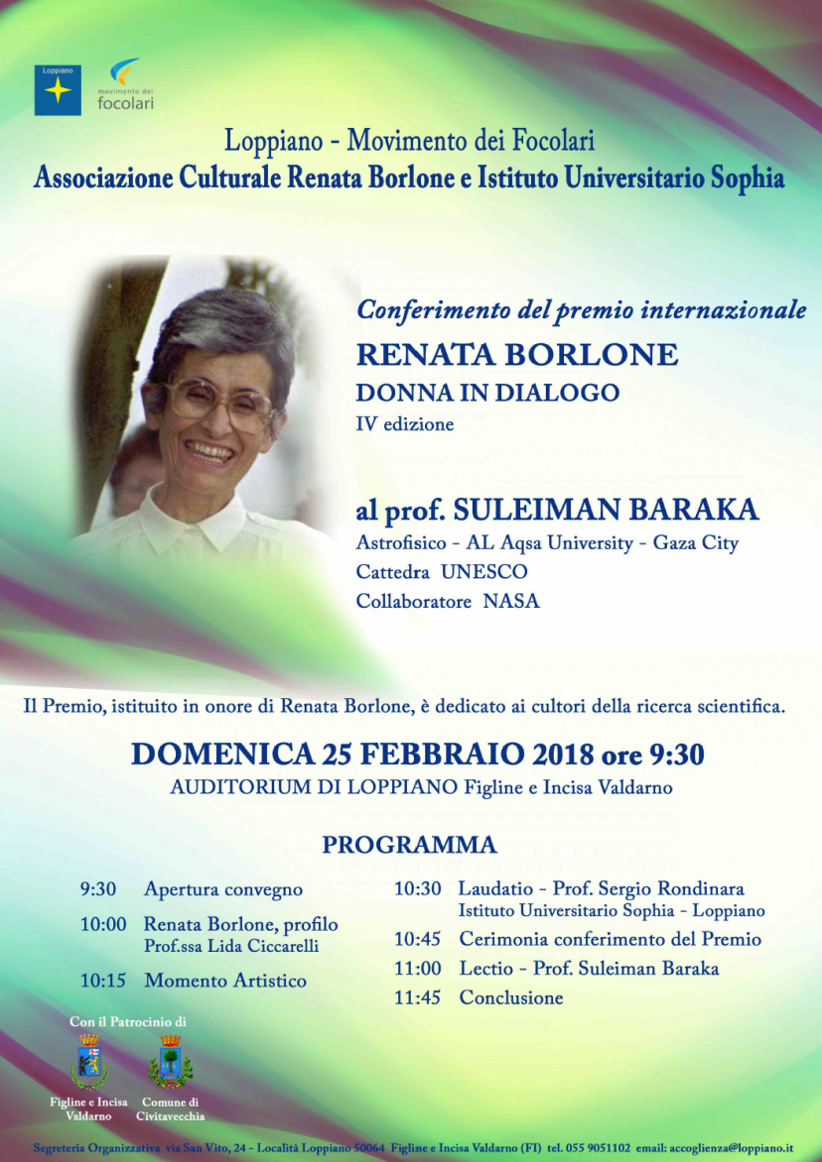 The “Renata Borlone Prize” will be awarded to Prof. Suleiman Baraka, a native of Gaza and an internationally renowned astrophysicist on Sunday 25 February, in the Auditorium of the International Centre of Loppiano (Florence), in the presence of the representatives of the scientific world and civil authorities. Now on its 4th edition, the Prize was instituted by the Cultural Association bearing the same name, to honour the memory of Renata Borlone (1930-1990), who for over 20 years was co-director of the town of Loppiano and is now a Servant of God. Full of human and spiritual values, Renata nurtured a special passion for science, intended as the privileged tool for the construction of unity of the human family. The Prize’s Scientific Committee conferred this recognition to Prof. Baraka for “his scientific research which focuses on human values and peace”. The awardee stated “This prize in honour of Renata Borlone who worked for the good of society – is a further incentive and encouragement to place science and its beauty at the service of humanity, promote peace among peoples, and enable the young generations to open their horizons to hope, despite the difficulties and obstacles they may have to face.”
23 Feb 2018 | Non categorizzato
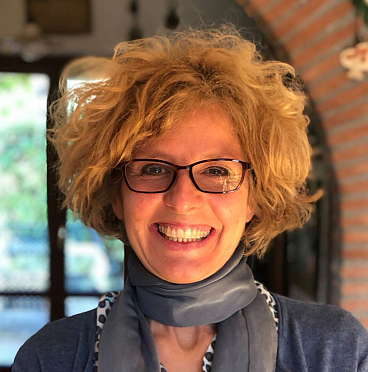
Chiara Favotti
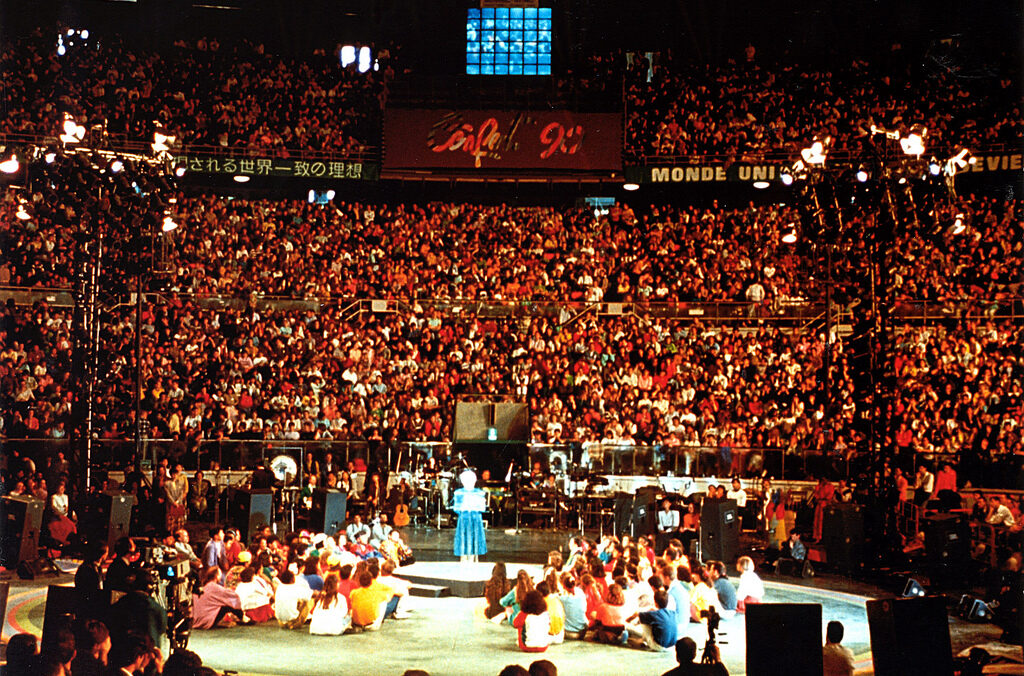
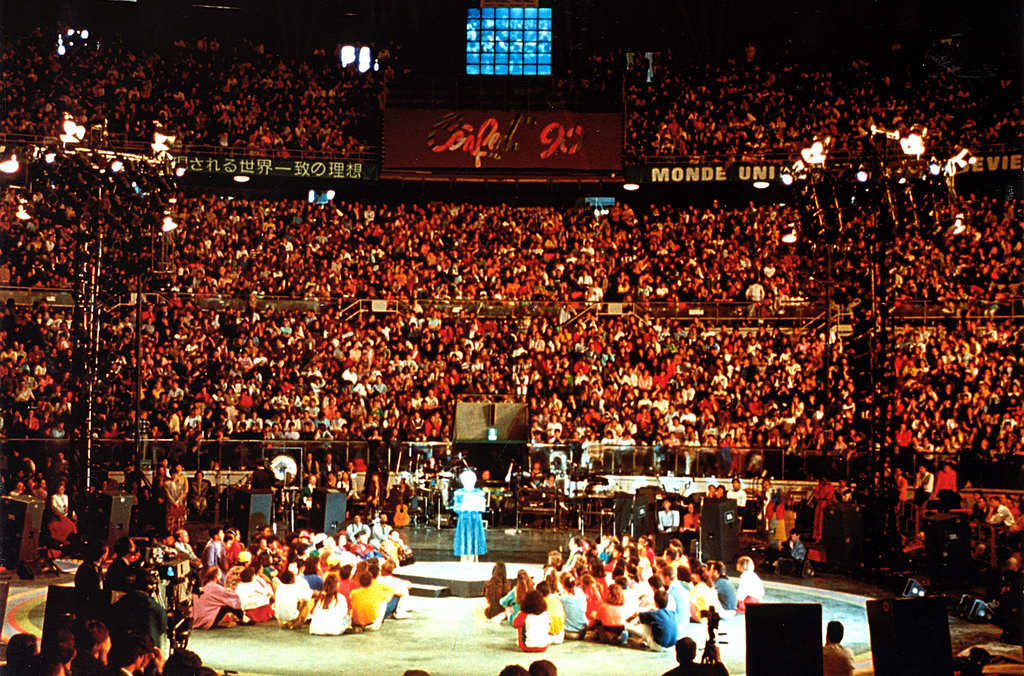 During adolescence, going with the Gen and the young people from the united world project, and the any experiences we shared, opened my heart far beyond the walls I knew. It made me hope and think big, of a truly united world. It wasn’t a fantasy, but a new way of thinking, of moving in a new direction, taking little steps, but made of real and authentic brotherhood. I took part in the 1990 Genfest with them. It was an unforgettable experience. For the first time, there was an explosion of happiness, young people from east and west looked in each other’s eyes and squeezed each other’s hands as television cameras broadcasted the scene in the Paleur Stadium to millions of television viewers around the world. We were given a mandate: to bring love back into the world. “Friendship and kindness aren’t enough,” said Chiara Lubich. “Philanthropy isn’t enough, neither are solidarity or non-violence. We have to change from being people focused on their own small interests, to being small daily heroes who are at the loving service of their brothers and sisters in every neighbor.” The next year I left for Moscow. The iron wall that separated East and West may have fallen, but at a great price, pulverizing ideals and an entire social system. There were no winners, nor losers, only the disillusioned, suffering and widespread poverty. It was clear to me: It’s not enough to bring down a wall to create a free and just society. Now, those words that I heard at the Genfest are the only way forward for me: “Only in harmony with each other and forgiveness toward each other can you build a real future.”
Chiara Favotti
22 Feb 2018 | Non categorizzato
At the mechanic’s I had brought my car to the mechanic’s for a small repair. The young mechanic said he would call me when it was ready. After six hours, no phone call came. I went to the workshop and strangely he pretended not to remember the job to be done and went on to serve other clients. After waiting for an hour he returned with the bill. It was exorbitant for such a small job. Being black, I felt this was evidently an act of discrimination. I paid, but anger and sharp pain got hold of me. When I was about to explode, I stopped to think and wonder how I could live the Gospel in a moment like this. I calmed down and patiently explained the facts to the person in charge. He listened to me and got the message, and ordered a reimbursement. That reimbursement seemed to me like the fulfilment of the promises of the Gospel. Welile – South Africa
Hunger and thirst for justice I was a revolutionary, and hungered and thirsted for justice and I said it in a loud voice, everywhere I went. At a certain point I found an answer in God, and for him, I left everything. One day I was asked to speak in a factory, but now there was a difference: it was no longer I but Jesus who spoke through me, because I tried to find love in my brothers. Looking at all those restless faces on the revolt, thirsty for justice, I got the confirmation that only love can achieve the miracle of changing people, their ideas, and the structures. This love is God in us and among us. Maria Teresa – Brazil Change of plans With my husband’s consent, I thought of enrolling in a course that would have been useful for my work. I was enthusiastic, because I saw that slowly the difficulties smoothed out and all seemed to confirm that I was on the right road. I had started to gather the necessary documents when I discovered I was pregnant, and this confused me. I would have wanted to set aside my project for some time. Upon reading the Gospel with my husband, we understood that God had other plans for us and we prepared to welcome the baby with joy. D.T.B. – Croatia The trump card I am a sales agent. One day I entered the office of a big company to present my products to the head of the purchasing office. Since he showed very little interest, I prepared to leave his office. But during that brief meeting I noticed that I was dealing with a person in suffering. I was already at the door when I felt I had to go back and simply asked: “Are you sure you’re feeling ok?” Wide eyed he asked me: “Why are you asking this?” I answered that I just had that sensation, greeted him again and left. The next day, I received a phone call from him. “I want to thank you, because after you left, your question rang in my mind. So that evening I went to my doctor who confirmed that I could have collapsed at any minute and there was immediate need to intervene with a strong therapy.” That same day, the company made a big order. So I not only found a big client, but had also helped a person to feel better. Putting love before all else in our actions is always the trump card. From Focolare website www.flest.it – Italy
