27 Jan 2018 | Non categorizzato
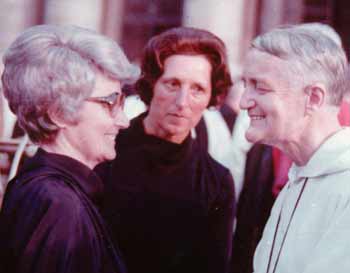
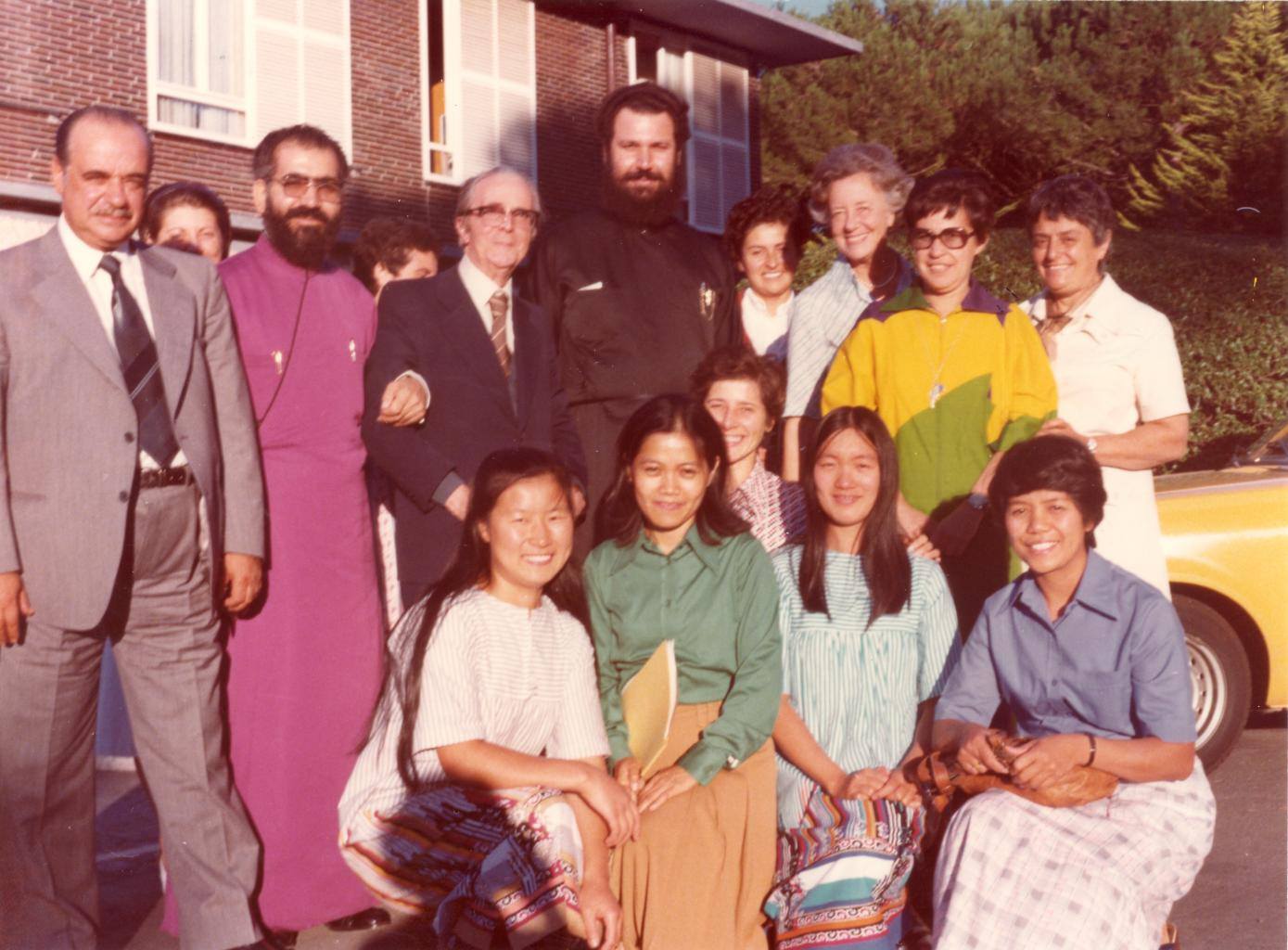 There is one event in the life of Igino Giordani that urges us to pause and reflect: the first biography written about him in 1985 was not written by a Catholic, but by a Scottish Baptist pastor, Edwin Robertson[1]. We should not see this as an irony of history [. . .] if such a friendly gesture towards Giordani had merit in the eyes of Heaven and in front of human history. Giordani had already presided at a conference of ecumenists back in the fall of 1967, at the headquarters of the Movement in Rocca di Papa, Italy. The Very Reverend Archimendrite, Eleuterio Fortino was also present. Years later in 2004, he gave the following testimony: “Because of his own interior serenity, Giordani was able to calm the heated tones of the debates at that conference; and he clarified the theological and pastoral aspects of the Second Vatican Council’s Unitatis redintegratio (1965), bringing down the last resistance of the Italian opposition to common prayer among all Christians during the Week of Prayer for the Unity of Churches[2]. Giordani had already been following the Week of Prayer, which was actually an Octave, beginning on January 18 (feast of the Chair of St. Peter in Rome) to January 25 (feast of the Conversion of St. Paul). In 1940 Giordani writes: “During the preparations of the Octave, news spread that was at first uncertain, that at a certain monastery of Trappist nuns in Rome, they were praying intensely for an end to the divisions among Christians. I came to learn that a young nun of that monastery had offered her life for the unity of the Church and that her sacrificial death had deeply touched a community of separated brothers in England. The news, even though it was so vague, greatly expanded – at least in my eyes – the horizon of the unitary movement and opened new prospects that appeared as patches of blue breaking through the gray and stormy heavens over a brawling humanity. It placed the Octave and its goals in their true light. Those nuns probably didn’t know anything about all the debates and commissions and committees that were held on the topic. Placed in front of the problem of the secession, they had contemplated it in simplicity, in the light of the Rule that never changes: they saw that unity is to be sought where it is found, that is, at its source, at the matrix. In other words it has to be asked of the Father in whom – and only in whom – brothers unite. This means that those humble women whom you’ll never meet at any conference, knew immediately what had to be done, and they placed the unity movement on the most direct path. Some might be tempted to ask it from Hegel, Loisy or even Marx; and in the news and in the conferences the names of such people came up, who had not and can not provide anything but partial solutions. Unity is not the work of men, but of God: not of study, but of grace. Even so, Father, accept this too, above all for your Church, that you might deign to purify her, preserve her, and unify her …”[3]. Chiara Lubich called the ecumenism that has come from her, an “ecumenism of life”. It is still practiced by the Focolare and has well developed experiences of its own experiences, developing in the light of great men like John XXIII, Paul VI, and in the light of the Second Vatican Council. It became one of the main priorities of Igino Giordani during the final years of his life. For Giordani, all Christians were already long-lost brothers and sisters. He lived and spread an ecumenical spirit that was composed of love and aimed at communion, in the certainty that “from the unity of hearts comes unity of minds”.[4]. It is rather touching to see how his article on ecumenism, The Journey Towards Unity, was written by in December 1979, four months before his departure for Heaven. In that gesture he continued to tenaciously cultivate a prophetic vision, in which he set the unity of Christians as the basis and the leaven that would “give an impetus to the ideal of universal unity among all peoples [5]. (Compiled by: Tommaso Sorgi, Il percorso ecumenico di Igino Giordani, “Nuova Umanità” No.199). ________________________________________ [1] E. Robertson, Igino Giordani, Città Nuova, Rome 1985. Ed. English edition entitled: The Fire of love. A life of Igino Giordani ‘Foco’, New City, London 1989. [2] E. Fortino, Igino Giordani e la preghiera per l’unità dei cristiani, in “Besa-Fede”, Greek-Albanese Journal, Rome, February 2004, pp. 7-9. [3] I. Giordani, Questa ottava, in: M. G. Dore, Suor Maria Gabriella (1914-1939), Morcelliana, Brescia 1940, pp. 9-25. [4] I. Giordani, Sette giorni per l’unità, “Città Nuova”, 1978, n. 23, p.30. [5] I. Giordani, Il viaggio verso l’unità, “Città Nuova”», 1979, n. 23, p.27.
26 Jan 2018 | Non categorizzato
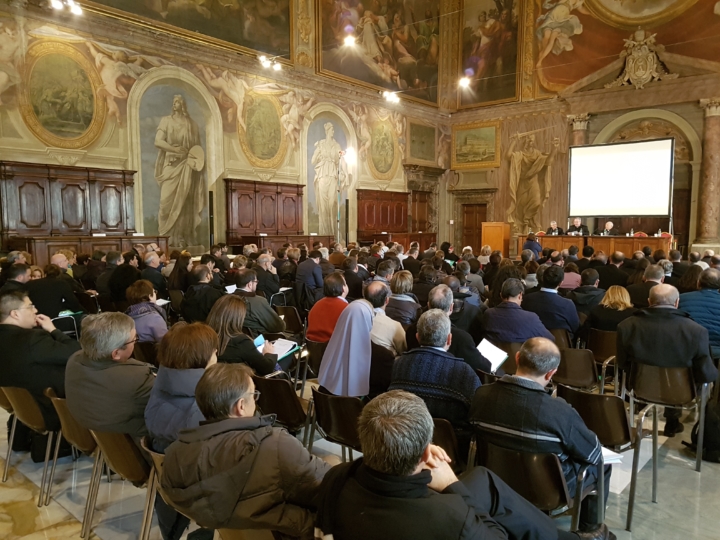
On the first day of the week dedicated to Christian unity (18 – 25 January), under the splendid vault frescoed in just a hundred days by the famed painter Vasari, in the renaissance Roman Chancery building, an invocation to the Holy Spirit opened the study day which the ecclesial Movements and Communities dedicated to “Charism and Institutions.” Promoted by the Focolare Movement, New Horizons, Family of Hope, the Catholic Shalom Community, The Emmanuel Comminity and Pope John 23rd Community, together with upper education Evagelii Gaudium” Centre of the “Sophia” University Institute and under the patronage of the The Canon Law Association of Italy, the day represented a new phase of the deep “affective and effective synergy” between Movements and ecclesial realities, as underlined by opening speech of Maria Voce who represented all the promoters: “We are committed to facing, day after day, coherently with all the charisms received, the challenges that lead the way towards the fullness of Christian life and the perfection of charity, in the effort to enhance communion within our Movements and between us all.” At the same time, the day was the occasion to deepen a specific theme regarding the relationship between charisms, gifts of the Spirit, and the institutional forms, in the light of the document of the Congregation for the Doctrine of the Faith, “Iuvenescit Ecclesia” (May 2016), which defines the charismatic and hierarchic gifts as “co-essential:” while “the presence of the institutions guarantee that the announcement of the Gospel will never be lacking – underlined Cardinal Kevin Joseph Farrell, President of the Council for the Laity, Family and Life – the presence of the charisms guarantee that there will always be those who receive them with openness of heart.” After their birth in the heart of the Church, “with that bit of surprise and upheaval which their unexpected and unprecedented appearance had provoked,” and their approval, often the fruit of a long and painful pathway, now the Movements – said Piero Coda, Rector of the IUS – “are fording a third phase, where charismatic effervescence is committed to finding the suitable channels for a balanced institutionalisation (…) to express at best their own specific contribution.” A still open issue regards the nature of the ecclesial movements, which in force of their founding charism do not demand a new juridical form of association (the Codes of Canon Law in force do not contain the terms “ecclesial movements and communities” and therefore these are lawfully placed under the “associations of the faithful), but also in the distinctions of juridical nature able to support at best the charismatic richness and specificity of each. In fact, we have to take into account, that these “associations” are made up of laity, priests and religious, forming what Bishop Christoph Hegge, Auxiliary Bishop of Münster defines a “communitarian unity,” with reference to the “communitarian testimony” which all the members of the movement, with “resilience and flexibility of belonging,” offer together as the people of God, accepting and living the proclamation of the Church in our time. On the need to differentiate the juridical statutes regarding the variety and specificity of the charisms, His Eminence Luis Navarro, Rector of the Pontifical University of Santa Croce, said “There is no unitary juridical solution. Each needs to tailor a made-to-measure vest.” But to do so, we need to “know and study a charism in its concrete ecclesial life.” “In the history of the Church, the Movements have always been the answer to a need,” affirmed Laurent Landete, married and father of six children, the French leader of the Emmanuele Community, among the participants of the afternoon round table dedicated to the presentation of the Movements and ecclesial realities operating at all latitudes. If the future of their Statutes is the basic theme of the reflection, the freshness, actuality and variety of the ways with which they operate, driven by the Spirit, in the streets of the world, arouse marvel and stupor, as in face of the colours and perfumes of an immense garden in Spring.
26 Jan 2018 | Non categorizzato
The international memorial day on 27 January, designated by the United Nations General Assembly, is held in order to commemorate the victims of the Shoah. On 27 January 1945, the Allied Forces liberated Auschwitz, the Nazi concentration and death camp, and its surviving prisoners. Beyond the prison gate and the sign bearing the slogan “Arbeit macht frei” (Work sets you free), the world witnessed the horror of what had taken place there and came to the know the scale of the mass extermination which had caused the death of six million people. 73 years after the end of the Shoah, in various parts of Europe and the world, every year commemorative meetings, ceremonies, initiatives and moments of narration of events by the survivors are promoted, especially in schools, in order to “never forget ” one of the most terrible examples of racial hatred and so that such atrocities will never be repeated anywhere on the planet.
25 Jan 2018 | Non categorizzato
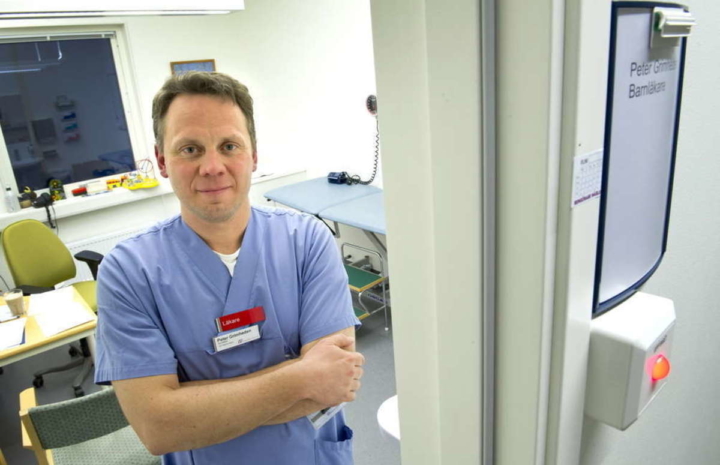
Peter Grimheden has an oval face with two blue, piercing eyes. I met him for the first time in Lund, Sweden, for the historical encounter between Catholics and Lutherans for the 500 years of the Reformation. Peter is a young pediatrician, passionate about his work, to which he is dedicated with great enthusiasm. His singularity is that of being Swedish, Lutheran, a focolarino, and for his having chosen a path of total donation to God. He lives in Stockholm, in a small community with other 4 Catholic focolarinos: a Belgian, an Argentinean and two Italians. Were you raised in a Christian family and environment? I belong to the Swedish Lutheran Church and come from a family which is strongly bound to traditions. As a child, I used to visit my grandparents. We would first go to Mass and then dine together. During dinner, after the women had washed the dishes, we would sit and listen to grandpa who would read one of Luther’s sermons. As if that of the Mass was not enough! The only thing I remember is that I would play at holding my breath. My record was to resist breathing for a minute. It was a strict and severe education. All was either black or white and I could never ever go to the cinema or play ice hockey. How did you meet the Focolare? I was dating a girl who invited me to a concert of Gen Verde, a musical band inspired by the Focolare. I liked the music, the words, and the atmosphere they created. The brother of a singer had been killed in a civil war and she had been able to forgive. I liked positive Christianity, not based on prohibitions and things one shouldn’t do. The people of the Focolare became my friends and I would frequent them with my girlfriend. But after some time, this relationship was too tight for me, so I left her. I continued to frequent the Focolare and I was strongly attracted by the people who gave themselves completely to God, living in a community. For me it was like slipping on a banana peel rather than making a big choice. It was like falling in love. So at 21, I went to Loppiano, Italy, close to Florence to attend the focolarini training school. It was a unique occasion to meet people from all over the world, even if I felt a bit “exotic” since almost all were Catholics. Today you live in a community in Stockholm. Is it difficult to live with people of another Church? Belonging to one Church or the other does not impact on our daily lives since we share the same ideals. We have a Christian life in common and I don’t feel any difference among us. I used to feel lonely upon frequenting my Lutheran Church but now my friends accompany me once in a while since they want to know my Church better, the same way in which I want to know about their church. We try to live in the presence of Jesus in our midst and are all his disciples. Source: New City
24 Jan 2018 | Non categorizzato
House Arrest December 2016 I received a telephone call from a desperate mother who asked help for one of her sons. The lawsuit against him had been heard in court and he was sentenced to 11 month under house arrest. She couldn’t take him in because she didn’t have a house and nobody else wanted to have him. I was her only hope, and I just couldn’t look the other way in front of this request. What to do? Three days later when I was about to make a few phone calls to find somebody who could help me out, someone knocked on the door. It was someone who comes often to see us. I welcomed him in, made him a cup of coffee and we began to talk. Then he asked me: “What were you doing just now?” Something inside me made me tell him about the situation. And he says: “But couldn’t I do it?” He had a small apartment, but he would sleep in the living room and leave his bed to the boy. The next day he took care of all the bureaucratic matters. The months flew by. We took food to them twice a week, since he wasn’t very well-off financially. And all it took for God to perform veritable miracles was a yes from me. (N.C. – Italy) I could look him in the eyes One day, while I was on my way to school, I was mugged by a group of boys in an underpass. They kicked me and punched me and threw me on the ground. They wanted my cell phone. When they finally went away, I couldn’t get up because of the pain in my body and in my soul. I wondered: “Why me?” My anger and resentment mounted. I told some friends at school about the incident, but none of them appreciated my pain, and that bothered me. The next few nights I couldn’t sleep, almost crying with anger as I watched that scene in the underpass playing out over and over again in my mind as if in a film. It was only some time later that I was able to talk about it with some friends who, like me, are trying to live the Gospel. Confiding it to them helped me to do what at first seemed impossible: to my aggressors. When I went to court to identify them at the trial, I felt I had forgiven them in my heart without any difficulty, I could look them straight in the eyes. (From T. Minuta’s blog) Appearances can be deceiving I had to go downtown to do some shopping and didn’t have much time. Suddenly I heard somebody asking me for money. I generally don’t give money. You can’t help everyone, and they might spend it on drugs. The boy’s head was shaven, and he had a dark gaze. I had the feeling he was one of the boys who had mugged me years before. I walked faster. But, a block later, I began to wonder: How can I think I’m cultivating union with God and, at the same time, neglect this boy who asked me for help?” I turned around and looked for the boy. “What is it you need?” I asked him. Totally surprised, he told me that he was thirsty. I invited him to have a seat in a coffee shop. He answered all my questions with a dry “yes” or “no”. I thought I might tell him about my own experiences and effort at getting used to a new country. He didn’t seem interested, and I was a bit discouraged. When I stood up to go, he said: “Why don’t you keep on talking? No one has ever told me the story of their life? It’s a new experience for me, and I have to get used to it. Tell me about your country. Why did you come here?” I ordered another hot chocolate and we sat there for another two hours. In the end we gave each other a hug. On my way home I entrusted to Jesus that kid whose name I didn’t even know. (U.K. – Argentina)
23 Jan 2018 | Non categorizzato
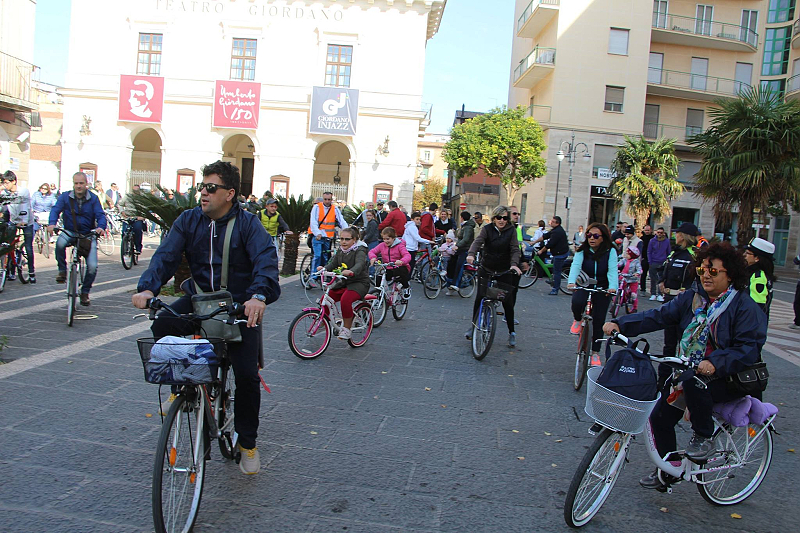
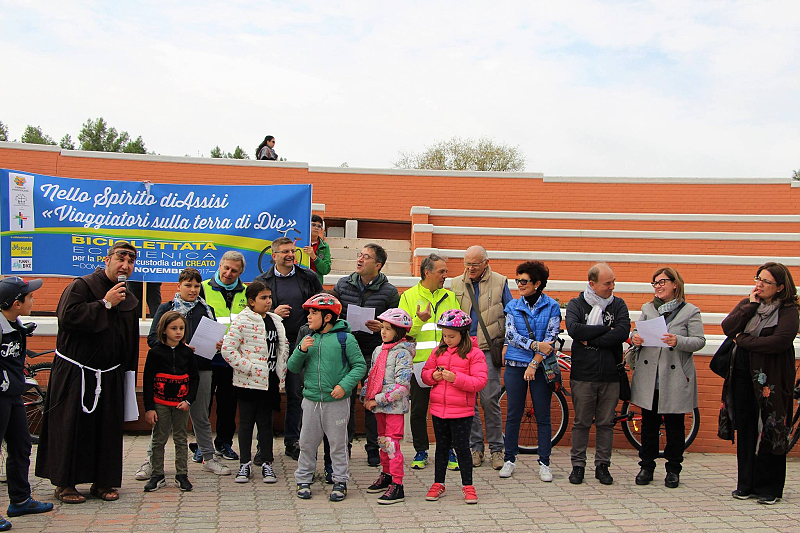 In Foggia, a commercial city in southern Italy an amazing flow of bikes crossing the city’s roads aroused the curiosity of passersby. Many citizens, also due to the sunny day, were on the road on their traditional Sunday outing, while the ladies catering to the feast day lunch watched from the balconies. Family bikes equipped with children’s chairs, tandems with blind people onboard as second paddlers, two wheels equipped with mikes, loudspeakers and banners, bikes of all shapes and sizes, a long trail of hard hats and helmets and a joyful bell: this was the ecumenical biking event organised by the Ecumenical Council of Foggia together with the Franciscans of the parish of Gesù e Maria, and the Group of Lay Associations joined by the Focolare Movement, the Fanny Bike Association and the Bike-lovers’ Association, on the occasion of the anniversary of the Spirit of Assisi and the Day for the Protection of Creation. The initiative which took place some months ago was the occasion for the city of the Puglia region, together with men of good will and the faithful of various religious confessions, to reflect on the importance of protecting creation, the gift of God entrusted to mankind for the good of all, and raise the awareness of citizens in assuming more ecological lifestyles starting from their own daily lives, and make the municipal administration commit to undertake political decisions that would allow the healing of the city, making it more beautiful, liveable and less polluted. The bike itinerary started symbolically from the Square where the Archbishop’s Curia is situated, with the delivery to the Mayor of a pact made between citizens and the administration, containing the mutual commitment. According to the competences of each, inspiring motifs were created for the event, with the route that made stopovers at the places of worship of all the Christian confessions existing on the territory, which adhered to the initiative: the Church of San Domenico for the Greek Orthodox community, the Church of Gesù e Maria for the Romanian Orthodox community, the ADI Evangelical Church, and the Waldensian Church. The event ended up with a brief moment of ecumenical prayer at the San Felice Park, the green lung and meeting place of the city..
