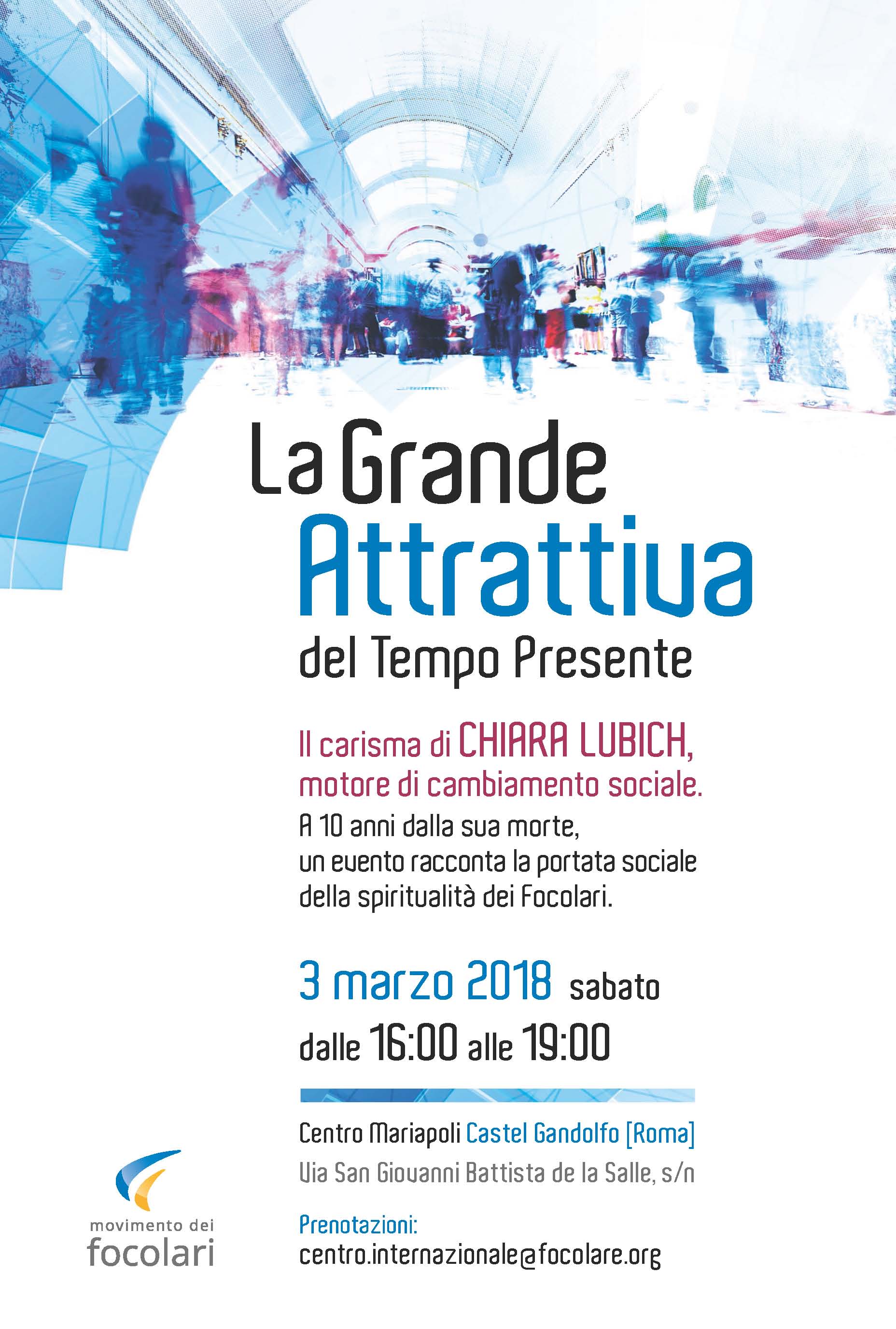
The Great Attraction of Today’s Times

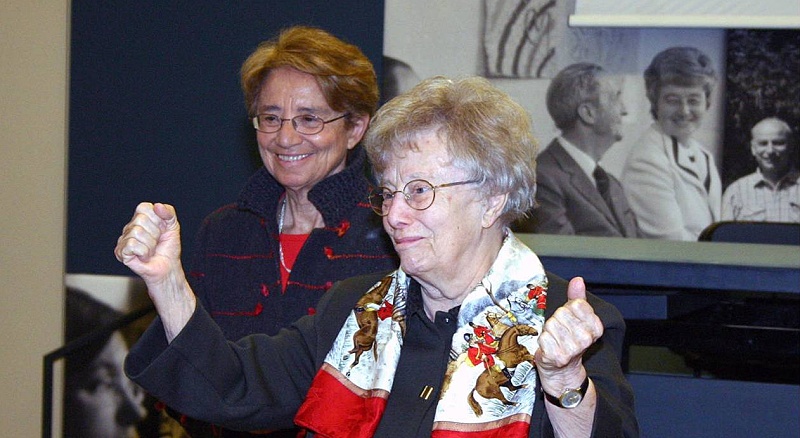
With gratitude for “her example of heroic faithfulness to God’s plan for her,” Focolare president Maria Voce, informed Focolare members around the world of her death following a long life spent in its entirety for unity. “Even in the pain of this huge loss,” said Maria Voce, “we are forever one heart and one soul with her.” Gisella Calliari had been born in Lavis, Trent, Italy on April 18, 1920. She was simply known as Gis, one of the first young women, along with her sister, to follow Chiara Lubich in the “adventure of unity,” which led to the starting of the Focolare Movement and its expansion around the world. She was the youngest of three sisters and met Chiara in 1944 in that tiny apartment that lodged the first hearth in Piazza Cappuccini,Trent. The next day, she decided to follow Chiara along the same path. The first hostile reaction from her family was softened when her mother met Igino Giordani who hired Gisella to be his secretary in Rome. During her long life, Gis spent more than 40 years living with Chiara. After living in several focolares in Italy – in Trent, Rome, Milan and Florence, she took charge of the women’s section of the focolarinas. Then, she worked alongside the foundress and Oreste Basso in following the development of the Work of Mary worldwide. This provided her with the opportunity to visit Focoare communities around the world. Her whole life was very profoundly linkded to the charism of unity, to which she was faithful until the last. Focolare.org will soon publish a more extensive biography.

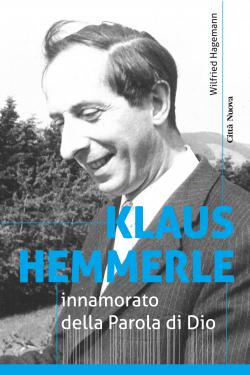 “There’s only one way to be able to have the most unity and communion possible among us right here and now, and I for one can see no other. This way coincides with […] us, you and me, all of you and me and all of us together, day by day, in all the situations of our life and in every situation that comes between us, staying anchored in His Word.” (266) “The Word of God goes beyond the barriers between us and creates communion. […] Nobody can take this away from us. Nobody can prohibit us from doing it. We can never turn back now. This is the essential point where the road opens for us to move on. […] If we live the Word to the extreme and in a spirit of reciprocity so that what you live and what I live are the same Word, both of them His Word, then the unity between us grows […] We can ask ourselves: But how are we to live in the one Spirit which is the deepest and most intimate reality of God, and the deepest and most intimate reality of me? It’s because of the Spirit whom I seek in you with patient endurance, the gifts of the Spirit that lie in you, a believer and a Christian like me. I question you at great length until I find the Spirit in you. I’m never content myself with compromises saying: ‘Deep down you’re not bad, nor am I. I’m able to find a halfway point where we can meet!’ I don’t even say: ‘I take something of yours and something of mine to come up with a formula that we can both agree on without having to change any fundamentals.’ Rather, I ask myself: ‘Where is the Spirit in you?’ The insistence in my questioning never constrains you, limits you, but it frees you, so that you can offer me the gifts of the Spirit in you. I’m prepared to let myself be interrogated by you to extreme, so that, trusting in the Spirit, I can also offer and give to you my gifts as gifts from God. Giving our gifts to one another, discovering in reciprocity the gifts of the Spirit in one another – this is the only path for the one Spirit.” (265, 266) (June 15, 1979, From a dialogue with Evangelical Lutheran pastor Lukas Vischer) Anyone who has been living the spirituality of unity for a long time can never stop and say: Is what the other saying to me appropriate? What isn’t appropriate? In what way is what they are saying compatible with my thinking? And with regard to what isn’t compatible? I try to make myself one with the other person, I try to have the other person as my starting point, not as a way to deny what I affirm with certainty based on Christ, but in the sense that in front of the person, I ask: What light are they trying to convey to me? So, I look at myself from the perspective of that other person. I make myself one with the other, trying to re-read my truth through the light of the other.” (268) (Extracts from dialogue session during the Ecumenical School in Ottmaring, Germany) Winfried Hagemann: KLAUS HEMMERLE, innamorato della Parola di Dio (Città Nuova 2013).
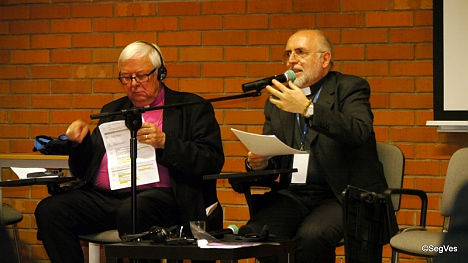
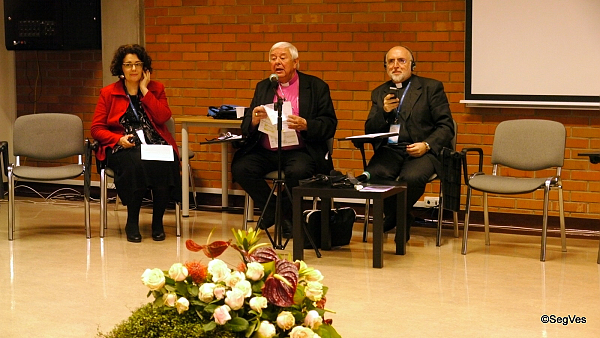 Moran explained: “The charism God had gifted Chiara has its roots in an ecclesial dimension that can be shared by all the confessions, because it draws inspiration from the heart of the Gospel. And this can be related to the nature of the spirituality which arose from this charism: a spirituality that sets a ‘dialogue of life’ as the pre-condition to ecumenical dialogue. It is an ecumenism of ‘love,’ ‘truth,’ and ‘of the heart,’ terms which also recur today to underline a reciprocity of love that does not replace theological dialogue, but gives the opportunity to grow closer, in a profound ‘exchange of gifts’ that enrich one and the other.” Unity and reconciliation start in the heart, in the encounter between people in a warm reception, Morán underlined. But “the unity we live or seek,” he argued “is not uniformity, it is the Holy Spirit himself who generates diversity.” Therefore, it is not a theoretical approach, but a dynamic experience of evangelical love, an ecumenical laboratory which, in the experience of the Focolare, now binds Christians belonging to over 300 Churches, and which spread, at least as a self-awareness within numberless ecclesiastic settings. “Dialogue of life is fruitful” – he added – “also in and among the parishes of various Churches: a twinning that helps to mutually know one another and find new forms of collaboration for social and cultural projects. Also the youths belonging to various Churches are committed in the front line to support primary emergency actions or aid to the most needy.” What are the repercussions at theological level? “Some experts were called to take part in the official theological dialogues. Also at regional and especially diocesan levels, many have personally undertaken the commitment. An example, among many, are the theological symposiums established between the professors of the Rumanian-Orthodox Faculty of Cluj-Naponica (Romania) and the Sophia University Institute of Loppiano (Italy), where last 14 December an ecumenical chair was established, dedicated to Patriarch Athenagoras and Chiara Lubich. Silently but tenaciously, God is tracing an irreversible path to reach universal brotherhood, his design on humanity.” Morán ended his reflection with the words of the “Ottmaring Declaration” with which the Focolare Movement inaugurated the celebrations for the fifth centenary of the Reformation: “With all our hearts we want to support the Churches in the commitment to reach a full and visible communion. We shall do all that is possible to make our activities and initiatives be substantiated by this open and fraternal attitude among Christians.” Read the whole text
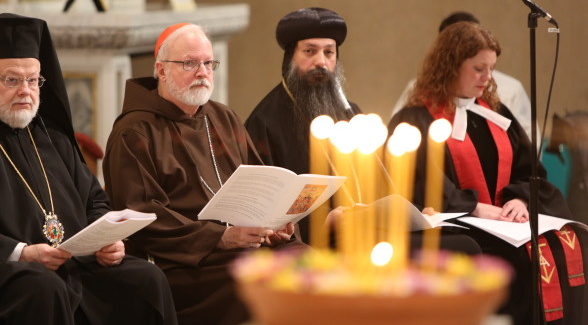
The Week of Prayer for Christian Unity has been celebrated for 110 years. It was an ecumenical initiative held between the feasts of Saint Peter on January 18th and the Conversion of Saint Paul on January 25th. It was first promoted by Reverend Paul Wattson, founder of Graymoor in New York. In the Southern Hemisphere it is celebrated during the Season of Pentecost. The event has a precedent in Scotland, in 1740 with a Pentecostal Evangelical preacher who invited all to a day of prayer for unity. The same invitation was extended by the Ecumenical Patriarch of Constantinople, Joachim III in 1902. In 1894 Pope Leo XIII encouraged an Octave of Prayer for Unity. During the Second Vatican Council the Catholic Church highlighted prayer as the soul of the Ecumenical Movement. In 1966, the Pontifical Council for the Promotion of Christian Unity and the Faith Constitution of the Ecumenical Council of the Church called for the joint preparation of the official texts for the Week of Prayer, a task that has been entrusted for over thirty years to different local ecumenical teams. For 2018, the Churches of the Caribbean were chosen, and the team was comprised of Roman Catholics, Baptists, Anglicans, and Methodists. The Focolare Movement is committed to promoting this important event, which is in accordance with Jesus’s prayer to the Father “that all may be one” (Jn 17:21).
“Various circumstances had pointed out that we could no longer remain in Venezuela, our country. Armando had been fired and a letter from Perù had sparked a glimmer of hope. It seemed that God was calling us there.” With these words Ofelia and Armando started to recount their adventure, forced to leave behind their already adult sons Daniel and Felix, to find a home, work, and a future for all in another country. “Without a dime we started to prepare ourselves. We also received a sum to allow us to cover the costs of the journey. It’s traumatic to leave one’s own country. Our daughter had already left for Peru in October, but at the frontier they had taken away her PC and money. On this premise we headed off for the border.” Armando and Ofelia left everything but brought along a photo of Domenico Mangano: a person of great faith, committed to the Focolare community in central Italy, and a pugnacious politician who died in 2001 and for whom cause for beatification had been initiated recently. “We asked him to take care of our journey.” «Crossing the border incredibly did not cause any particular difficulties. We crossed over almost as if we were invisible, and a young woman, like an angel, instructed us on what we had to do. After just one check on our baggage we passed, without the pressing crowd that had amassed at the border the days before. We could hardly believe it. We thought that it was due to the help of Domenico, and once again we entrusted ourselves to him. Due to a slight mishap we arrived in Quito and spent the night in the women’s Focolare house. Some members of the local community brought us to dinner and a walk in the day time. After a journey of seven days, we finally got to Lima.” In Lima, Ofelia and Armando were hosted in the house of Elba and Mario, besides receiving clothing, a food bag and cash. “We visited both focolare houses, and went to Centro Fiore to help prepare Christmas lunch which the communities of Lima offer to girls saved from white slavery, and are guests of the nuns. They were happy. We also met again, Silvano and Nilde, who had left Venezuela before us. Everyone received us with love, and we felt like a real family.” “On Christmas day a family invited us to their home and after lunch we went for a walk. Now we pray to the Lord to help us find a house and a job. We have undergone so many experiences and we know that Domenico and Chiara Lubich continue to help us from above. “One night, while we were sleeping,” continued Ofelia “a barefooted girl holding a babe in her arms knocked on our door. It was not our house, but we decided to open just the same, since it seemed that Jesus himself was asking our help. It was the neighbour on the floor above, whose husband was drunk and maltreating her. She told us that up until then she had never dared to knock on another door of the condominium, but that she had seen us some day earlier while we were going down the stairs, and in her heart thought that she could trust us. And now there she was before us. Armando went to speak to her husband, while I tried to console the young woman. A few days later she was able to return to her apartment and now Armando and that man are continually in contact. We are overjoyed in having loved Jesus in that family. As to us, God will guide us to understand what he wants from us.” But with a renewed hope: “We are certain that the detachment from our family, our country and friends, will bear fruit.” Gustavo Clariá