16 Jan 2018 | Non categorizzato
“Various circumstances had pointed out that we could no longer remain in Venezuela, our country. Armando had been fired and a letter from Perù had sparked a glimmer of hope. It seemed that God was calling us there.” With these words Ofelia and Armando started to recount their adventure, forced to leave behind their already adult sons Daniel and Felix, to find a home, work, and a future for all in another country. “Without a dime we started to prepare ourselves. We also received a sum to allow us to cover the costs of the journey. It’s traumatic to leave one’s own country. Our daughter had already left for Peru in October, but at the frontier they had taken away her PC and money. On this premise we headed off for the border.” Armando and Ofelia left everything but brought along a photo of Domenico Mangano: a person of great faith, committed to the Focolare community in central Italy, and a pugnacious politician who died in 2001 and for whom cause for beatification had been initiated recently. “We asked him to take care of our journey.” «Crossing the border incredibly did not cause any particular difficulties. We crossed over almost as if we were invisible, and a young woman, like an angel, instructed us on what we had to do. After just one check on our baggage we passed, without the pressing crowd that had amassed at the border the days before. We could hardly believe it. We thought that it was due to the help of Domenico, and once again we entrusted ourselves to him. Due to a slight mishap we arrived in Quito and spent the night in the women’s Focolare house. Some members of the local community brought us to dinner and a walk in the day time. After a journey of seven days, we finally got to Lima.” In Lima, Ofelia and Armando were hosted in the house of Elba and Mario, besides receiving clothing, a food bag and cash. “We visited both focolare houses, and went to Centro Fiore to help prepare Christmas lunch which the communities of Lima offer to girls saved from white slavery, and are guests of the nuns. They were happy. We also met again, Silvano and Nilde, who had left Venezuela before us. Everyone received us with love, and we felt like a real family.” “On Christmas day a family invited us to their home and after lunch we went for a walk. Now we pray to the Lord to help us find a house and a job. We have undergone so many experiences and we know that Domenico and Chiara Lubich continue to help us from above. “One night, while we were sleeping,” continued Ofelia “a barefooted girl holding a babe in her arms knocked on our door. It was not our house, but we decided to open just the same, since it seemed that Jesus himself was asking our help. It was the neighbour on the floor above, whose husband was drunk and maltreating her. She told us that up until then she had never dared to knock on another door of the condominium, but that she had seen us some day earlier while we were going down the stairs, and in her heart thought that she could trust us. And now there she was before us. Armando went to speak to her husband, while I tried to console the young woman. A few days later she was able to return to her apartment and now Armando and that man are continually in contact. We are overjoyed in having loved Jesus in that family. As to us, God will guide us to understand what he wants from us.” But with a renewed hope: “We are certain that the detachment from our family, our country and friends, will bear fruit.” Gustavo Clariá
15 Jan 2018 | Non categorizzato
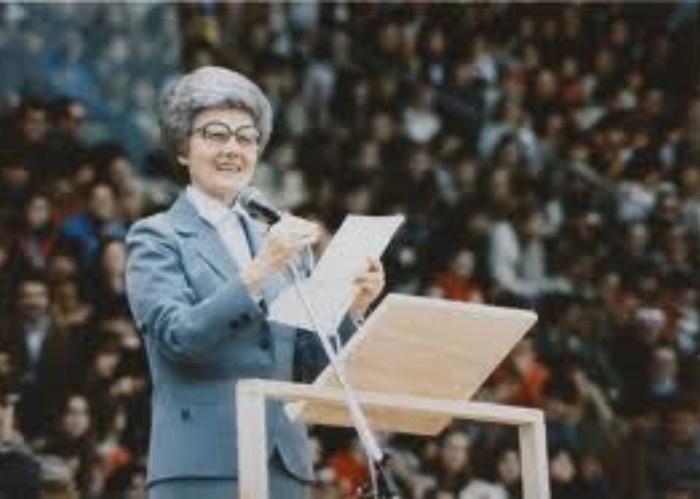
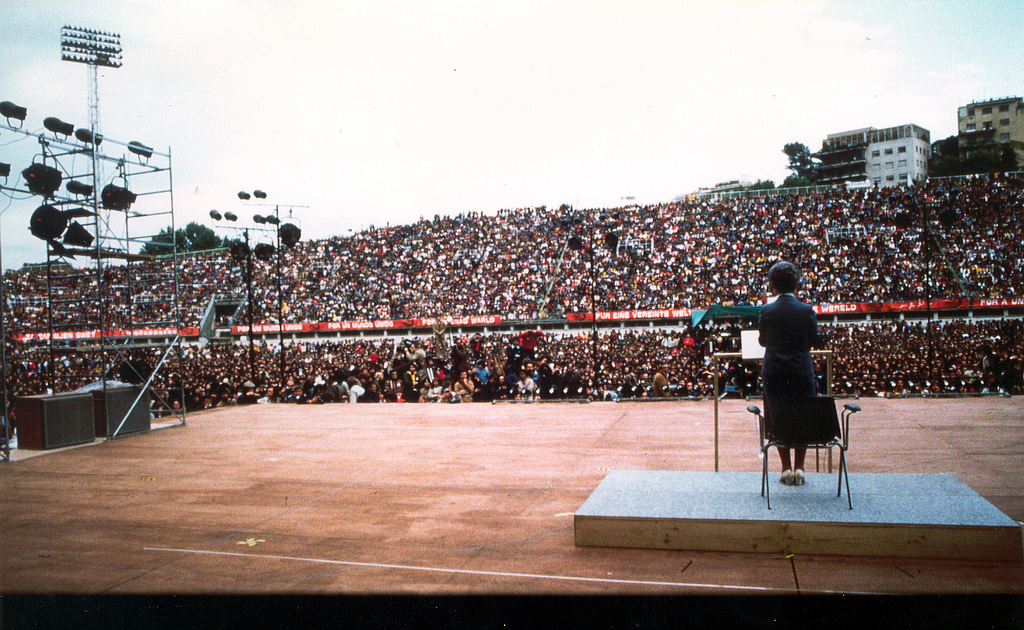 I was born and grew up in Macau, a former Portuguese colony is now part of Continental China, where I got to know the Ideal of unity at a Mariapolis. Macau is a small city that can be visited in few hours, so the invitation to take part in a Genfest in Rome, with thousands of young people from around the world – really appealed to me, even though I didn’t have least idea of what it was. We had just begun to live this ideal of unity, with other young people and a few women focolarini who often came to visit us and bring us the news and the concrete life of the Gospel that is lived in the Movement around the world. That world that I had known only through my geography lessons, but that now, with the Ideal of unity, had become smaller and nearer. Just arrived in Rome, several days earlier, we found ourselves in a house with lots of young people from Philippines, Hong Kong, Australia, Latin America…. How could I live with all of them? We Asians were a bit shy and, not knowing the language, we didn’t know how to communicate. Instead, there was no need to talk in order to understand one another, because we had same joy in common and from the very first, there as a very strong mutual understanding among all of us. After only a couple days, we already felt like we were one family. Then we learned that the title of the Genfest was: For A United World. The Genfest was going to be held at an open stadium, so I remember us praying a lot that it wouldn’t rain. Hundreds of buses from Europe were awaiting us. We learned that Chiara Lubich (whom I had not yet met in person) wanted the Genfest to be a moment of God. More than to the fest, Chiara brought us to the essential.
Chiara Lubich
13 Jan 2018 | Non categorizzato
Foto: Pixabay
12 Jan 2018 | Non categorizzato
© Osservatore Romano
9 Jan 2018 | Non categorizzato
On its 50th birth anniversary, the international Gen Verde band has recorded “TURN IT UP!” “It is an invitation,” they said, “to raise the volume of unity.” And this calls for a concrete, universal love that is able to take the initiative. This idea has toured the globe with the group, echoing in squares, schools and homes throughout the world. It has contaminated many and has become a life commitment. “As the year is about to end,”he artists added, “the idea has returned ’in a million hues’, sung by numberless voices, and danced with the fantasy of different peoples. And these 465 boys and girls from 31 cities of 21 countries in 5 continents are the protagonists of the video clip, ‘TURN IT UP!’ with their passion, enthusiasm and joy.” https://youtu.be/DKoodP6IYqg?t=40
6 Jan 2018 | Non categorizzato
These three wise men from the East, the Magi who hurried across the desert in search of a small boy, prefigure the march of Christianity to rediscover its innocence. That small boy was a king, albeit a king without lodgings. But they went anyway, walking in by starlight, guided by a star. That is the miracle of the Christ, who forces people out from their fixed spots, peels away from their hearts the interests that turn them to stone, pushes them beyond the perceived boundaries of the sacred so as to have them recommence their search for unity among all people, in every circumstance. And so to his crib they come from every plague of prophet, Hebrew and Greek philosophes, art and literature, speculation and custom, stripping from themselves along the way whatever is particularly idolatrous and wrong, unreasonable and inhumane. And everything gathers around Christ, who is the reason for everything. The Magi brought perfume and treasure from the far reaches of Arabia and Mesopotamia: affects and effects. Love drew them out from far away to bring them close to Christ, who was the poor person par excellence and is forever to be found in the poor. That trek of the Magi represents the effort to draw near from every distance, to rise from the rubbish and with an offering of hearts and material goods, through the deserts of egoism, to arrive at unity with God, because “God became what we are so that we could become what God is,” as St Augustine would say: the one who descended so that others might ascend. But it’s a long trek, and it happens at night, amid trials and tribulations: Truth is never achieved without effort. God is a prize for those who put the effort into finding him: but whoever seeks finds. Igino Giordani, I Re magi, La Via n.97, January 6, 1951, p.4.
