
A University Chair for Brotherhood Among Churches
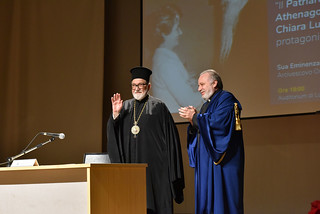
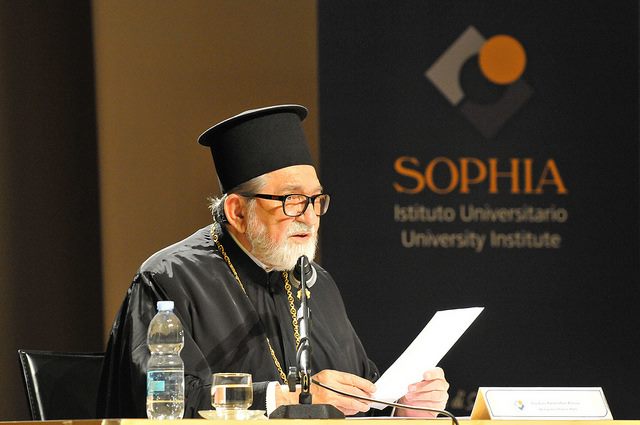
 It is quite unique on the academic, international and cultural landscape and against the backdrop of a crisis of the political, social and religious equilibrium in the Near and Middle East, and between the shores of the Mediterranean: the institution of an ecumenical Chair named for Patriarch Athenagoras and for Chiara Lubich that stands as a sign of that Europe which still wants to breathe with “both lung It was inaugurated last December 14th within the context of the international town of Loppiano, not far from Florence and its call to universalism. The nearby city of central Italy boasts of a long tradition of reconciliation between the East and the West that goes back to the middle of the fifteenth century. Instituted jointly by the Catholic Church, represented by Archbishop of Florence, Cardinal Betori, and by the Orthodox Church, represented by Orthodox Archbishop of Italy and Malta, Gennadios Zervos, the Chair will examine the cultural significance and social implications of the ecumenical journey towards the full unity of the Christian Churches of the East and of the West in highly qualified environment like Sophia University Institute (IUS) where reflection and the dialogue of life are strictly united and experienced.
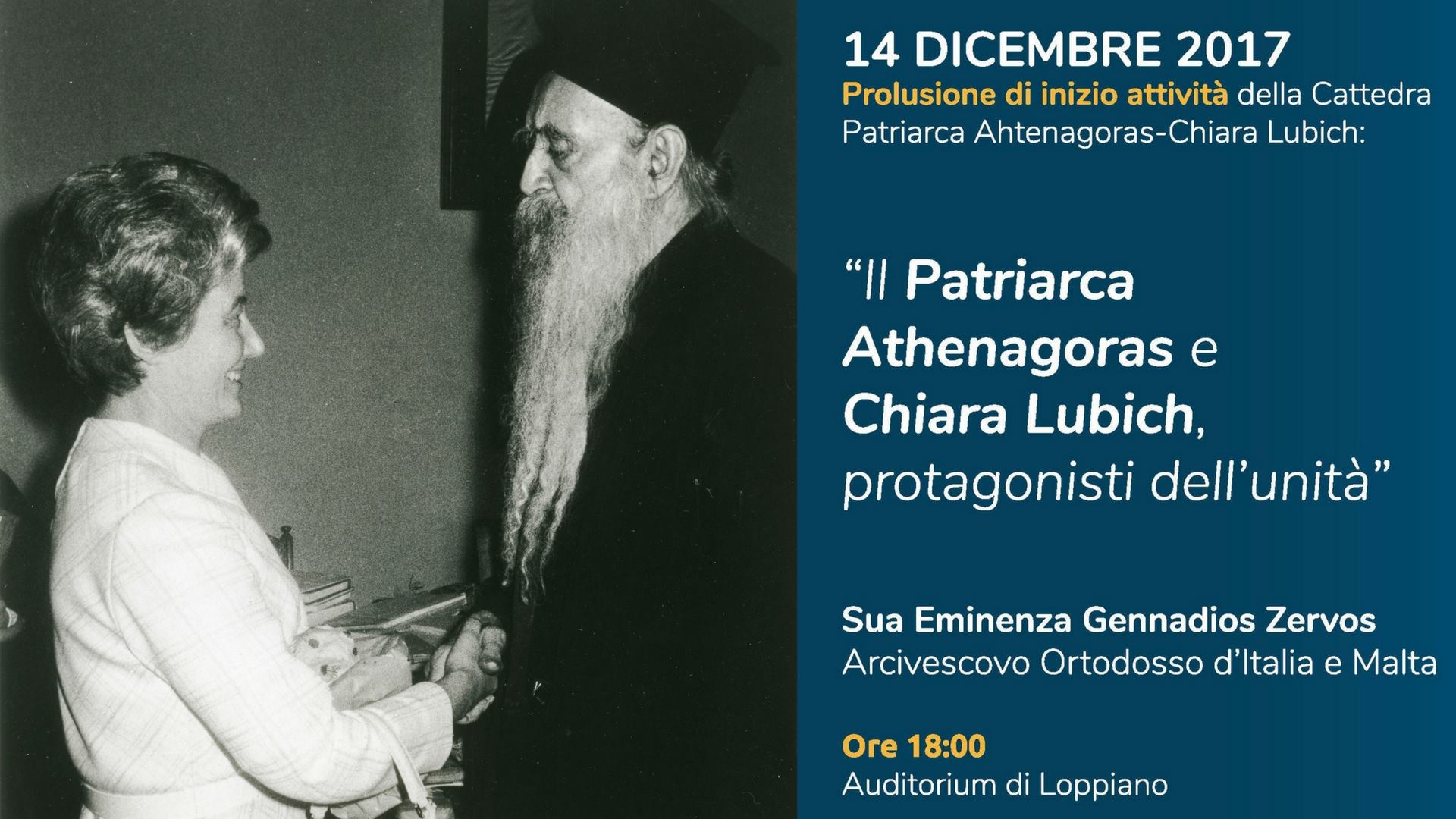
 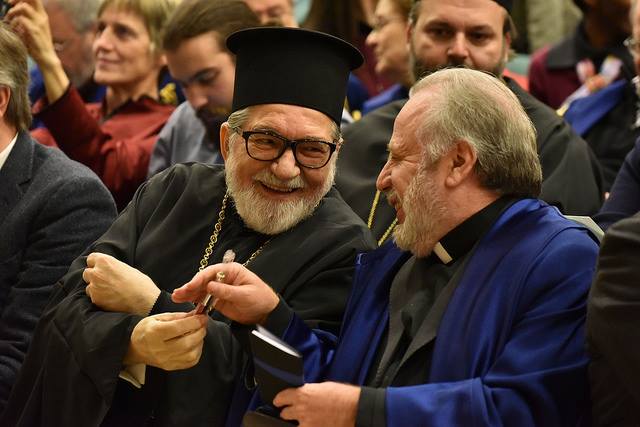 The idea of an ecumenical Chair came up in 2015, when IUS with the approval and applause of Pope Francis, had awarded the first honorary doctorate in the Culture of Unity to the Ecumenical Patriarch of Constantinople Bartholomew I. “On that occasion,” IUS explains, “the desire came out of instituting an Ecumenical Chair named after Patriarch Athenagoras and after Chiara Lubich, which would revisit and actualize that spiritual heritage.” The Chair, of which IUS president, Piero Coda and Metropolitan of Selyvria, Hi Eminence Maximos Vgenopoulos, are co-holders, was inaugurated in the persence of the Metropolitan of Italy and Malta, Gennadios Zervos. “Patriarch Athenagoras and Chiara Lubich are two worthy and blessed personalities that God had illumined,” said the Metropolitan, “to destroy the religious emnities and divisions. With their encounter, they restored the friendship and launched the ‘Dialogue of Charity’.” He went on to say, “I believe that Chiara, with her spirituality, had prepared the two main and most valuable Bridges: the first is Paul VI, the second Athenagoras.”
  Pope Frances sent a message for the occasion: “I rejoice for this praiseworthy initiative, aimed at memorializing the encounter between the Ecumenical Patriarch and the foundress of the Focolare Movement, which fifty years ago marked the beginning of a prolific journey of mutual collaboration and understanding, which boasts of many fruits today, among them, fraternal friendship.” “Such an academic project,” said Focolare president, Maria Voce, “represents an important moment in the ecumenical relations that are in place between the Sister Churches of East and West, and opens fascinating prospectives for the field of study, centered on respectful dialogue, that promises to be even more enriching as a mutual gift on the level of theology and for an anthropology of communion.” The long story of friendship and cooperation with the Ecumenical Patriarchate of Constantinople reaches back to June 1967 when Chiara Lubich first met Patriarch Athenagoras. “It is a great thing to know each other,” the Patriarch had confided to her. “For many centuries we lived isolated, without having brothers, without having sisters – like orphans! The first ten centuries of Christianity were for the dogmas and for organizing the Church. In the ten centuries that followed we had the schisms – the divisions. The third era – this one – is the era of love.” Conferences, classes and a Summer School for young Catholics, Orthodox, Jews and Muslims are scheduled for this academic year. Next March a series of lessons will be given on The Ecclesiology of the Orthodox Church and the Path of Ecumenical Dialogue with the Catholic Church,” for students who would like to contribute to the promotion of the full unity, in service to the encounter between peoples and cultures. Foto Flickr