11 Dec 2017 | Non categorizzato
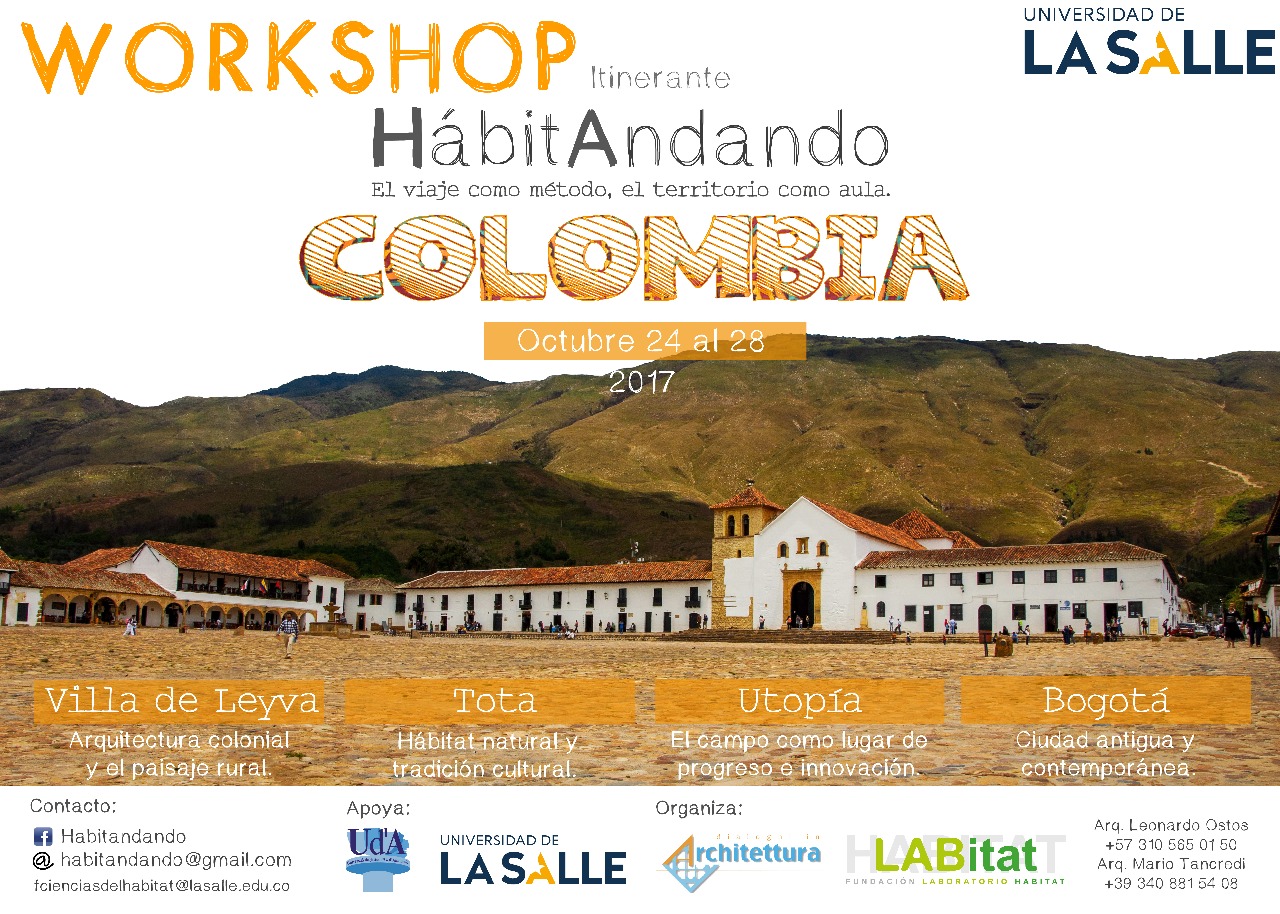 The trip, which is organized by the international Dialogue in Architecture network and the La Salle University of Bogota, isn’t tourism, but an experience of living together, getting to know places, cultures, businesses and associations. The departure was from Bogota, south of the city. The puzzled looks on the faces of the Italians showed that they had to “shift their gaze” in order to place themselves with their heart and mind in this land of many contrast and with a different relationship to the environment. We passed over the eastern Cordillera and reach Villanueva, a colonial town in the mountains where time seemed to have stood still. We helped out in an earthquake evacuation drill as we gathered in square with the locals, which allowed us to share in this communitarian moment with them. The journey continued along a long downhill road that twisted through tunnels and led to the discovery of the intense green of the mountains and fabulous landscape views. We reached the port of Llano, Villavicencio. The temperature was hot, just like the warmth of the people we me. A majestic tree shaded us from the sun. We got back on the road and passed through el llano, a vast expanse of land. Here we visited the l’Università Unitrópico, which has begun an interdisciplinary course on social architecture.
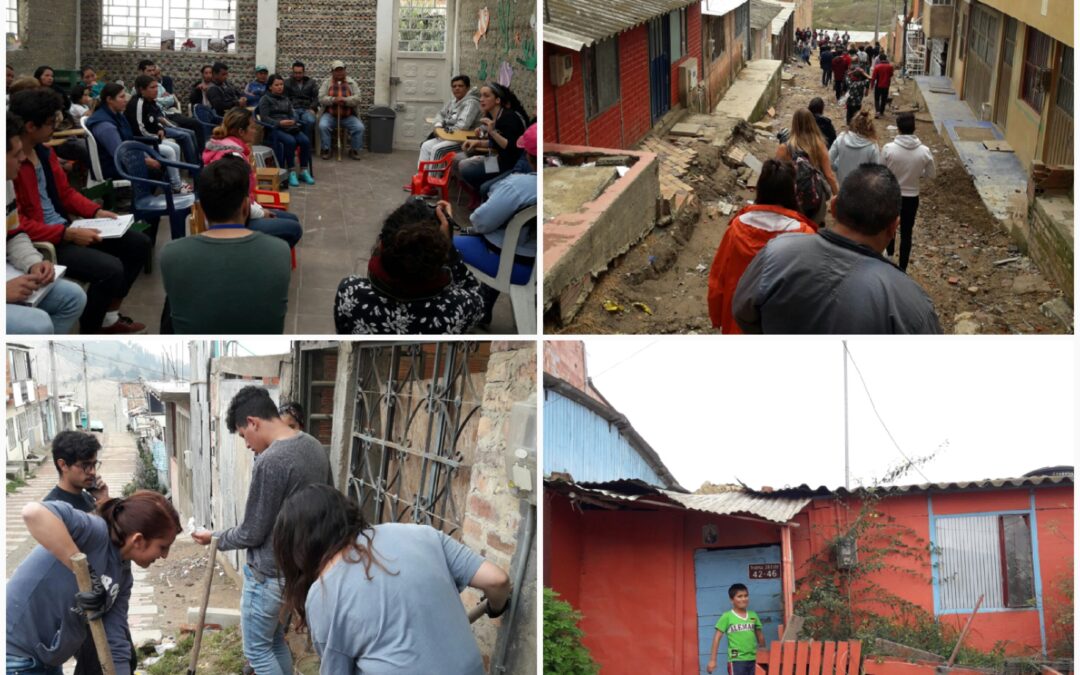
 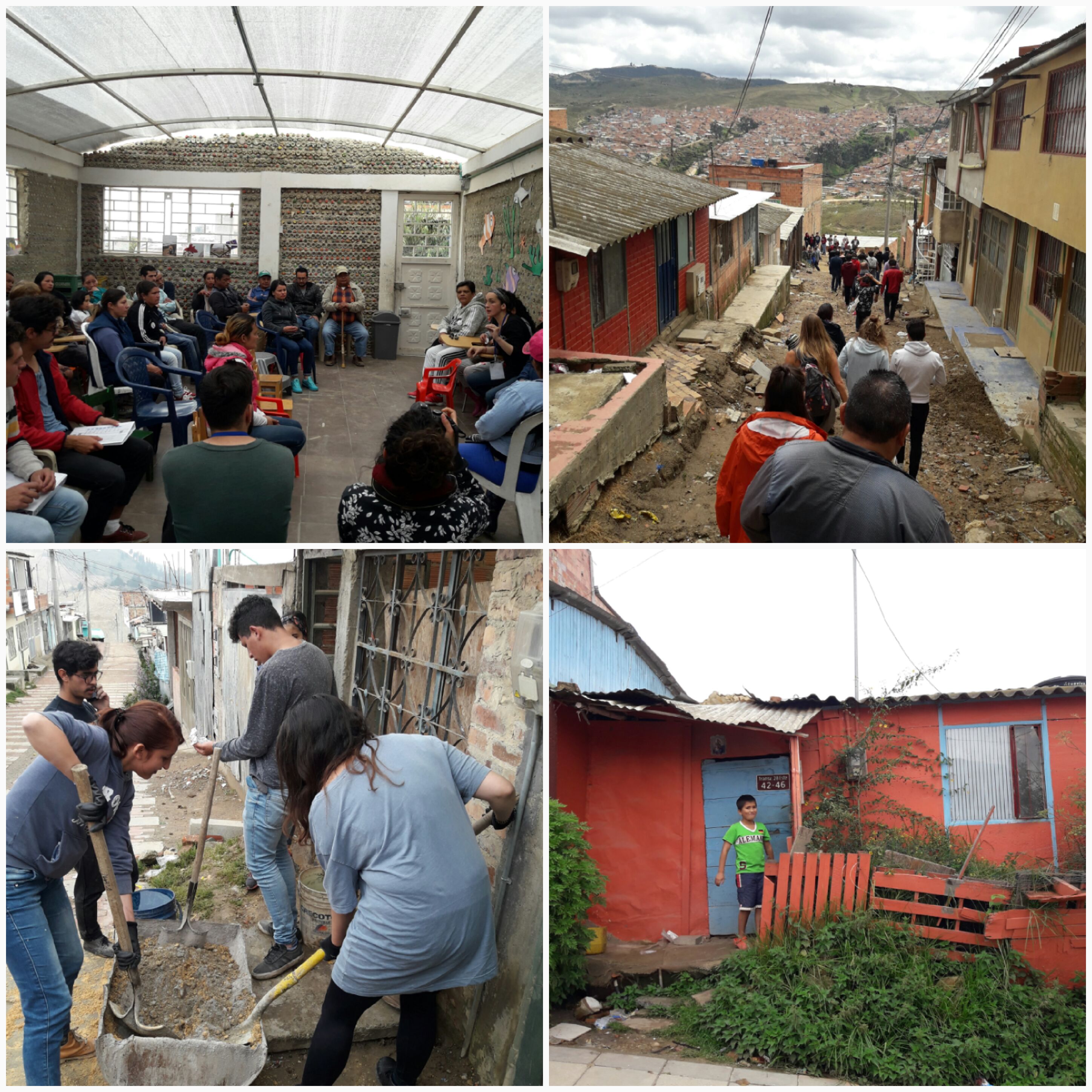 As in all Latin American countries, the architecture in Colombia is an expression of local society and emerges from the relationships with the communities. La Salle’s University’s Utopia Campus can be found in the region of Yopal, a place for young people who come from the rural regions and are often the victims of guerrilla violence. The course provides them with a work-study program that allows them to earn a diploma in Agrarian Sciences, and the possibility to get a job. It’s a concrete peace education experiment that seems to be working. We were halfway through our trip and after a delicious local style breakfast, we headed towards the colonial villages of Mongu and Tunja, Colombia’s original capital. In the grand colonial plazas, like Villa de Lyva, we came face to face with the indigenous populations who convey their strong identity which today is well integrated with their local colonial architecture. We returned to Bogotá in the North. The impact is almost stronger than in the south. We drove through the wealthiest zone that has its houses all surrounded by security walls. The experience continued with the workshop organized by the Urban Observatory of La Salle University on the Altos de Cazucá where we stayed for a week, getting to know families, enjoying their food and sleeping in their homes. It had a strong impact on us. We were in the company of university students from Germany, Bogotá and Yopal. There the poverty level is quite high, but the solidarity and kinds of relationships that exist showed us the real identity of this place. The work experience was quite new to us! We had to finish the exterior work on several houses: gardens, paint work, equipping a library and designing murals that depict the life of the community. An entire family was represented by birds, among them a son who was murdered by local delinquents, a sorrow we shared with them. One of the young people from the neighbourhood said to us: “We’ve worked together and made our neighbourhood beautiful now. We’ll carry on, finishing the roads.” Their gazes penetrated our hearts, and we felt great enthusiasm and hope. The intercultural exchange was real, a true enrichment when doing architecture together. Offering one’s talents as an architect can help to reconstruct the social fabric by providing spaces that help to preserve and grow the identity of a place together with its community.
10 Dec 2017 | Non categorizzato
December 11, 1948 was universally proclaimed Human Rights Day. Since then, on the same day every year this Declaration is commemorated, as adopted by the Human Rights Commission of the U.N. headed in those times by Eleanor Roosevelt, wife of the United States President, Franklin D. Roosevelt, to call attention to the importance and defense of the dignity of the human person. The document is a sort of censorship between the era prior to 1948, in which the indignation for the iniquities of the world was entrusted to some sporadic event, and the following era in which for the first time, the need to counter inequality in all the States of the world was firmly recognised. The recognition of the validity of such a Charter and the literal application of the 30 articles, would obliterate the following from our corrupt society: slavery, torture, racism, violence of all sorts, abuse of minors, man’s exploitation of man, and also impoverishment, abuse and pollution of environmental resources.
9 Dec 2017 | Non categorizzato
In the modern world, obedience is no longer appreciated for what it truly is. The appeal for liberty, equality and fraternity proclaimed during the French Revolution is reflected daily in our newspapers, our homes and streets and even in our parishes, convents and monasteries. … It follows that we often find in our subconscious a veiled sense of distrust concerning this precious virtue, almost as if it were in opposition to the discovery that the Gospel makes us all brothers and sisters in Christ. … Obedience does not imply abdicating our own personality or an inhuman humiliation. Quite the opposite, it helps us be truly ourselves and develop our personality, because it puts us in a social context that is essential, from both a human and a divine point of view, to the true manifestation of our skills. When the will of those who are my legitimate superiors in civil or ecclesiastical governance tells me what to do or what to avoid, even if it contrasts with my projects and ideas, it always raises me up to a broader and more general level, the level of the common good. The sense of hindrance and resistance that I feel, due to this contrast, is the contribution I must make to being raised up. It is then that I become more fully human. The more I find myself united with others, the more I discover we are brothers and sisters. This fraternity is the outcome of fellowship. Far from being in contrast to fraternity, obedience becomes an indispensable means for creating it. … Often, when speaking of this virtue, people talk only of its ascetic side, the progress made by someone who renounces their own will, the freedom from their passions that they acquire, and so on. This is of course true, but obedience gives us something better still. It makes us mystical sharers in Christ’s humanity and allows us to experience the mind of Christ in our lives (cf. Phil 2:5) Mary is the perfect model of this inner obedience. We see this in her reply to the Angel Gabriel, “Here am I, the servant of the Lord”, and when she travelled to Bethlehem following the edict put out by the Roman Emperor. We see it in her “haste” to go and help Elizabeth after she had the inspiration to do so, and when she asked Jesus for a miracle during the wedding feast at Cana. We see it on Calvary, when she gave up the Son of God to stay with John, and later when she prayed with the apostles while awaiting the coming of the Holy Spirit. Her life was in continual obedience to God alone, by obeying people and circumstances. By letting Mary live again in us, we will share in her inner depths and her willingness. An example of this was Andrea Ferrari, a focolarino who was dying [after a road accident]. Someone spoke to him about accepting God’s will and he answered with a wittiness that revealed his deep union with God, “We have learned to recognise God’s will always, even in front of a red traffic light”. Translated from: Pasquale Foresi – Parole di Vita [Words of Life] – Città Nuova 1963 – pp 197-8-9-200
8 Dec 2017 | Non categorizzato
Today, December 8th, is celebrated one of the most heartfelt and popular feasts dedicated by the Catholic Church to the Virgin Mary: the Feast of the Immaculate Conception. It falls on the the day when, in 1854, Pope Pius IX, through the papal bull entitled “Ineffabilis Deus” (Ineffable God), sanctioned that the Virgin Mary, by means of “a singular grace and privilege”, had been preserved from that common heritage of the human race, which is original sin, from the first moment of her conception. This formulation follows a long series of theological disputes about the birth of the mother of Jesus. In the East, from as far back as the sixth century AD, there was a celebration of the conception of Mary, which was widespread in the West from the 10th century onwards. The solemnity of the Immaculate Conception of the Virgin Mary is inserted within the context of Advent and Christmas, thus the expectation of the birth of Christ is awaited through the remembrance of the Mother.
7 Dec 2017 | Non categorizzato
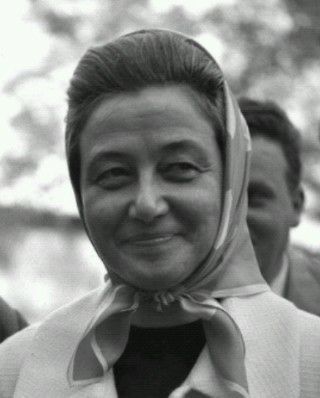
“I believe that God can and wants to make good to be born from everything, even from the worst malice.” These were the words of Dietrich Bonhoeffer at the end of 1943 when the world was in the throes of a global war. That was the historical context in which the Focolare Movement was born. The first stone was set in Trent, Italy, on December 7, 1943 when a young woman in her twenties consecrated her life to God: Silvia Lubich who went by her Third Order Franciscan name of Chiara (Claire). And the weather seemed to make the contrast even more severe, according to the account that Lubich gives of her walk at dawn towards the Capuchin College for a private ceremony, during which she would consecrate herself to God forever. “There was a storm raging, so I had to make my way pushing the umbrella in front of me. Even that wasn’t without meaning. It seemed to say that the action I was about to take would be met with obstacles. The water and wind blowing against me seemed like the symbol of an adversary. When I reached the college, the whole scene changed: A huge door opened in front of me on its own. There was a sense of relief and welcome, almost like God’s arms opening to me, as He was waiting for me.” That change of scene was reflected in her life. The completeness and sacredness of that action that took place in total seclusion and poverty – only three red carnations to celebrate with – were more sonorous in Chiara soul than all the atrocities of the War that stood as the backdrop, almost the “picture frame” of that scene. For her, the real scene was the one that God whom she had discovered to be Love was building around her. “There was an ideal, only one, that would never fall short, not even if we died. It was God-Love. And we were totally stuck on him with all the strength of our being. We didn’t stick to Him because we had nothing else left, but because a Force in us was rendering us happy at having discovered Him in our life as the only All, the only Eternal, the only one worthy of being loved, because love never passes away, the only one, therefore, who would fully satisfy our heart’s needs. For years we had been receiving Holy Communion every day and believed, since we belonged to all the Catholic associations, that we were good Catholics. Only insofar as the Lord God took everything away from us to give us only Him, did we understand the First Command of God for the first time in our life: “Love me with all your heart, all your mind…..” It was only then that we truly felt should love Him like that, so totally, heart, mind and strength, in order not to deceive ourselves.” Lucia Abignente, “Qui c’è il dito di Dio”, (Rome: Città Nuova, 2017), 25-26.
6 Dec 2017 | Non categorizzato
The summer school will take place at Igarassu – Pernambuco, Brazil and is promoted by the Social-One international research network, a team of sociologists and social services experts which is inherently inspired by Chiara Lubich’s charisma of unity. Our scientific reflection has always been enriched by occasions of meeting and dialogue among researcher, scholars and social service professionals. The summer school, organized in partnership with the Department of Sociology of the Universidade Federal de Pernambuco and the Centro Universitário Tabosa de Almeida ASCES – UNITA, represents a special occasion of deep confrontation and scientific exchange. Aim of the summer school is to fathom the perspectives of analysis and actions aroused by the category of agapic love in the framework of the social sciences and humanities, believing that the concept could provide new interpretations and perspectives of interventions for the promotion of a society based on equity, inclusiveness and dialogue. In order to support the participation of young scholars, 18 scholarships are available for covering travel, accommodation and participation expenses. pdf School Programme pdf Call for scholarships pdf Presentation, application form and call for abstract Email contact: info@social-one.org
