13 Nov 2016 | Non categorizzato
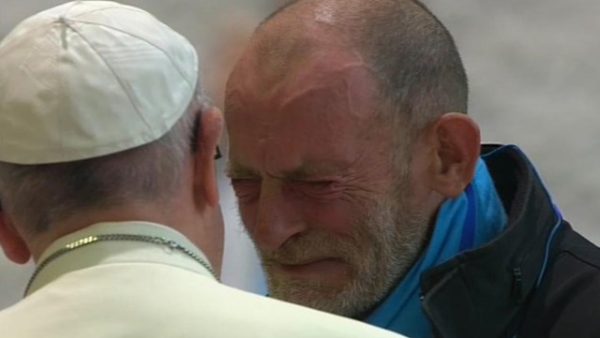 “A Church of the poor means two things mainly: the Church should be poor as Christ was poor, if it wants to proclaim the kingdom of God, if it wants its message to be effective. And all Christians who share in the life of the Church should be poor in spirit. Then the message of salvation would be more easily accepted by the poor; whereas, for the rich it will be difficult to enter the kingdom of Heaven than for a camel to go through the eye of a needle…. This Church of and for the poor should not make us imagine any similar socio-political version of it for the world. (…) When Jesus speaks of the poor, he means those who are being tested, who are humble, who are deprived of reassurance and beyond any real support that they can depend on – yet, they turn to God their just benefactor. The Greek translators of the Bible understood that the poverty of these poor was not merely material deprivation; in fact, they did not translate the Hebrew word anaw (poor), as ‘pauper’ or ‘destitute’ but preferred to use the word praus, which evokes meekness and resignation in the midst of hardship and trial. These poor, according to the Gospel, are also found among the privileged classes. Matthew’s Gospel tells us about Joseph of Arimathea, ‘a wealthy man and disciple of Jesus’ (27:57). He was also detached from his possessions; he was also poor and humble. (…) In his Apologeticum, Tertullian described the Christians of his day as those who did not aspire to or fight for positions in politics, even minor ones, because they were not motivated by personal ambition. On the other hand we find that many, who are economically disadvantaged, turn to messages they receive from outside the Church and support them. (…) This is why the Second Vatican Council invites us to think over our Christian living. Is it genuine? Does it bear the marks of poverty and humility? Poverty should result from love. Love is what will lead us to place our possessions at the disposal of the poor and needy. It is Christian love that banishes egoism and gives birth to communion. (…) Then the Church of the poor becomes the Church of communion between the rich that become poor and the poor that bring their needs, for the building of the Church together. (…) If we want that Church of the poor to return to taking on a role of witnessing in the process of evangelization, it will have to resurface at all levels of Christian life beginning from every point of the Church, from above and from below, from periphery to centre. (…) This will also have a reflection on the social and political level in new reforms that will be fundamentally Christian, if they are inspired by freedom. Some more sensitive spirits are not satisfied and still cry out that the Church must make itself poorer. (…) When someone makes a justified request, even when it is presented in a disorderly or bad manner, it is wise to wonder whether what is being asked might not be a spur to accelerate this process of renewal without which the Good News cannot be brought to all the peoples of the earth in a way that is genuinely helpful. Desiring peace, poverty, communion of goods as the outward signs of a communion of spirits – these are not allegations meant to frighten us: they are what spur us on along the path of the Gospel.” From: Pasquale Foresi, Problematica d’oggi nella Chiesa (Rome: Città Nuova Editrice, 1979).
11 Nov 2016 | Non categorizzato
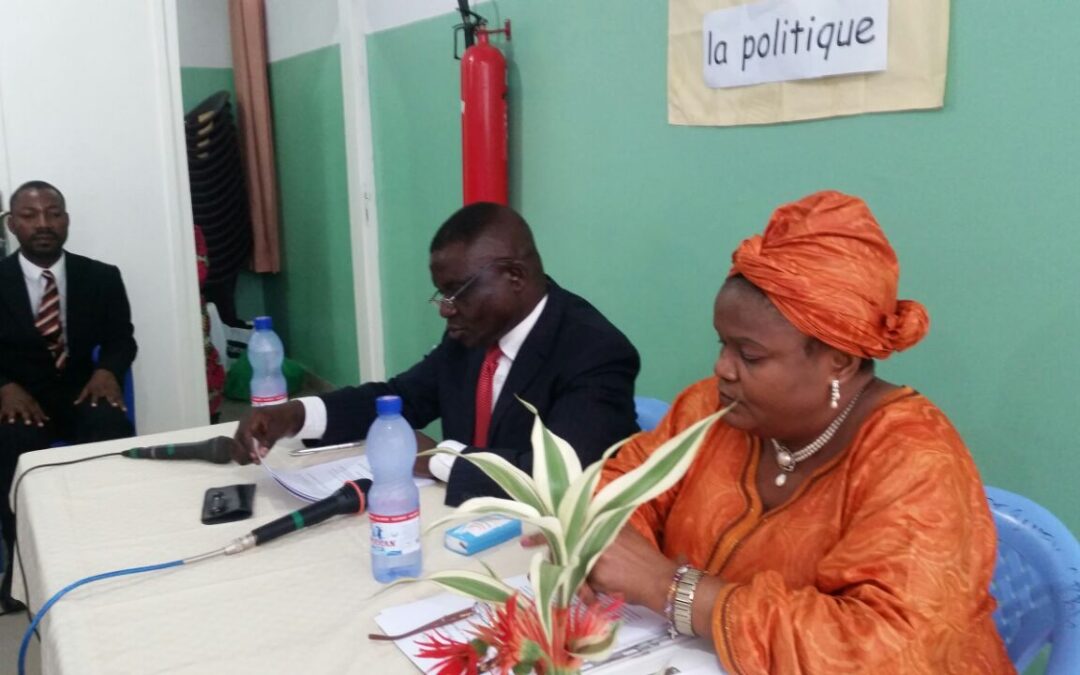
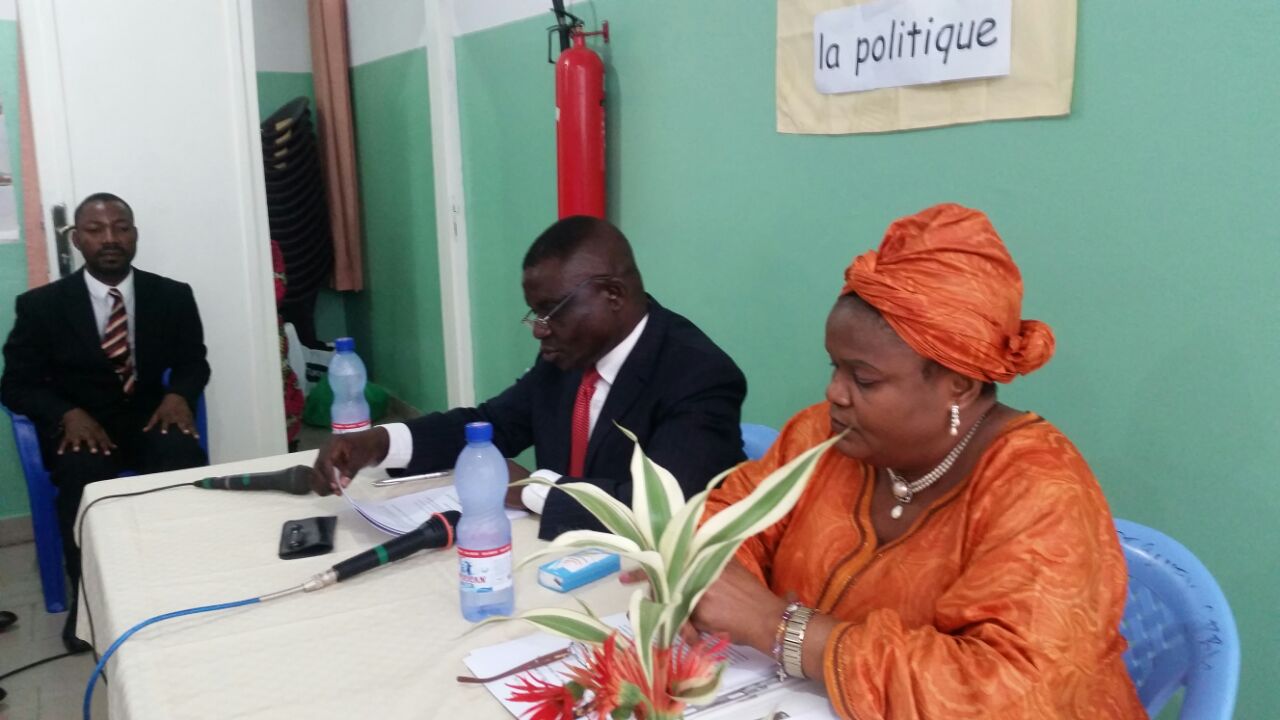 “The Political Movement for Unity has begun in Kinshasa!” With these words Deputy Upira Dieudonné concluded the first meeting of the Political Movement for Unity (PMU) in Kinshasa on Saturday, October 29, 2016. They write: “The current political situation in the RDC is fragile. There are strong political and social tensions. A few months ago, there were violent clashes in which some people died. The powers that be and the opposition sometimes become radicalized.” So how did we reach this day, one could ask. “It was after attending the conference in Rome last June with politicians from around the world. Deputy Dieudonné Upira, national deputy from the opposition in the DRC, and Madam Gorgine Madiko, Honorary Deputy and Member of the National Assembly Office decided to try something in their country.” When they returned from Rome, they deepened their friendship and shared their differing opinions with one another. Now, they dream of forming young people to be leaders in politics. As they said: it’s a matter of “training in the real politics, the politics that is based on values.” Their conversations have convinced them that the first step in such an undertaking in Kingshasa, would be to launch the Political Movement for Unity. “This would allow networking people who are working in the field of politics, to do good through politics,” they suggested. As they organized the event they were also wondering: “Will the people that have been invited have the courage to show up?” Their uncertainty grew as torrential rain began to pour down on Kinshasa on the day of the meeting. Because of the bad road conditions and the poor state of the public transport, most people stay home when it rains! Nevertheless, thirty people responded to their invitation. Among them were deputies and politicians, students, members of citizen movements, lawyers and journalists. The debate provided a platform for deep listening and discussion. “We heard things like: ‘We want to stay in touch with you and have more frequent discussions;’ ‘In front of the loss of values, we need to work at installing positive values in our education system, to train people that can be political leaders tomorrow;’ ‘I feel that if I don’t do something, God will ask me what I did with all that he gave to me;’ ‘We’re young and we expect to learn from our elders. Don’t forget about us’.” Their words reflected the thoughts of the organizers and made the moment of sharing into a sacred moment. During her concluding remarks, Madam Georgina Madiko insisted: “Through our actions we have to be a light in the dark world. We have to show by example. And to those who are surprised by us and ask whether we are doing politics or religion, we’ll answer that politics without values is the ruin of the Nation.” Before leaving one participant suggested: “We should forget about our titles, stay in touch with each other, even if it’s only to ask how we’re doing. I would like each one of us to go home with a list of the participants so that we can all stay in touch with one another.” The next appointment is December 3, 2016. Gustavo Clariá
10 Nov 2016 | Non categorizzato
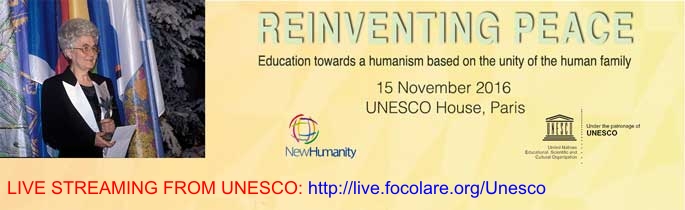
LIVE STREAMING http://live.focolare.org/unesco 15 November 2016. Transmission times (CET, UTC+1): 10.00am – 1.00pm and 3.00 – 6.00pm OFFICIAL SPEECHES: “Reinventing peace” – Speech by Maria Voce “The unity of humankind and a culture of peace” – Speech by Jesús Morán Focolare Information Service: Press Release – October 26, 2016 Press Release – November 10, 2016 Program of the event: “Reinventing peace” – Programme “Reinventing peace” – Declaration Chiara Lubich, 17/12/1996 – Acceptance Speech by Chiara Lubich upon receiving UNESCO prize for Peace Education December 17, 1996 Video (Italian only)
10 Nov 2016 | Non categorizzato
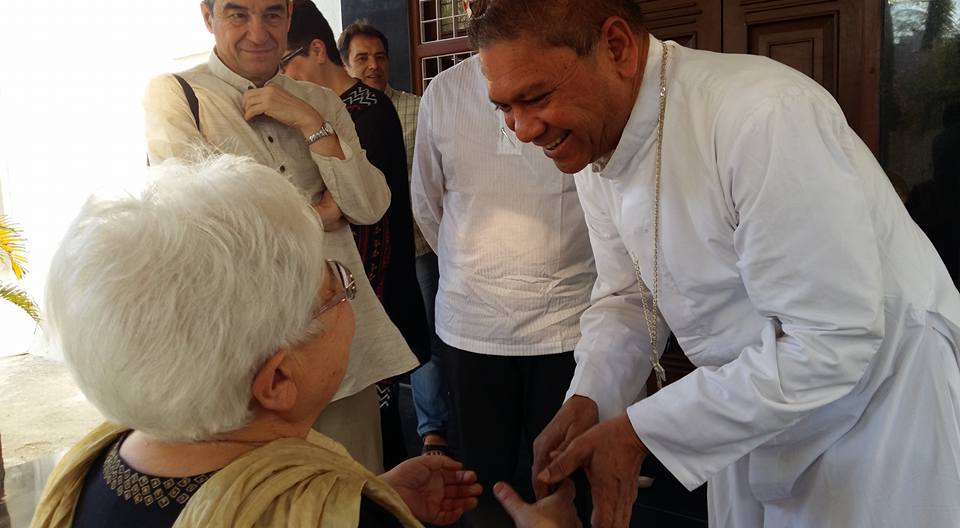
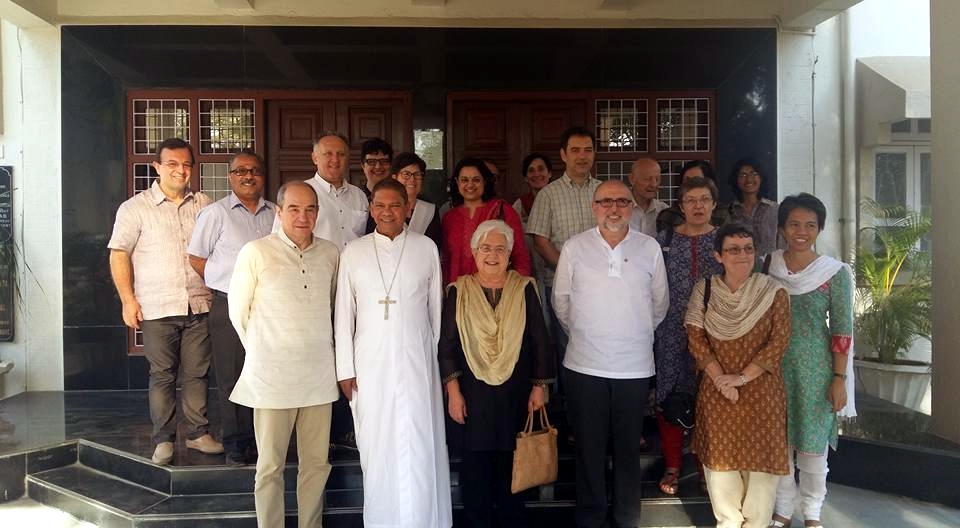 Bishop Felix Machado is a strong advocate of interreligious dialogue. This is proven by the friendship he has with numerous leaders of various religions, among which is that with the great Hindu scholar, Dr. Kala Acharya. These two speak of and refer to each other as “my brother Felix” and “my sister Kala,” in confirmation of the deep relationship which has led them to consider universal brotherhood as a point in common. How do you explain your propensity for dialogue? «I was raised in a rural and cosmopolitan culture. Vasai, in fact, the current seat of my ministry is also my birthplace. After studying theology in France and the United States, from 1999 to 2008 I served at the Pontifical Council for Interreligious Dialogue in the Vatican. There I acquired many elements on this matter and understood that the key lies in establishing real and authentic relationships with the people who differ from us. Thus, even if I am a leader and scholar or a simple farmer or fisherman, it is my duty as a Christian to see each one as a brother or sister in Christ. True dialogue may arise only from deep listening and acceptance of the other, and then, if necessary, one can offer one’s ideals as a gift. That’s why I appreciate the interreligious work undertaken by the Focolare Movement here in India. It is an action based on authenticity, trust and good will with our Hindu brothers and sisters.» After her journey in India at the start of the year, Maria Voce, President of the Focolare, recounted that you had welcomed her very warmly. «It was my pleasure to welcome her to my diocese of Vasai, and to recall with her the first contacts I had with the Movement through the two focolarine who worked in the Pontifical Council for Interreligious Dialogue. I had been impressed by the great love they put in the most simple jobs they performed. It aroused my interest and I desired to know more about the Focolare, and soon I had the privilege to meet Chiara Lubich. She was simple and direct and believed in unity. She offered the path of unity to humanity, through the church. She remained deeply faithful to it and worked for unity of the human family. I was happy to see how in India the Focolare is bringing ahead this legacy through dialogue among religions, cultures and generations.» In the light of the many challenges the human family has to face in various parts of the world, how vital is it to pursue the path of dialogue? «It is a process that requires time and dedication, and at times dialogue may seem useless when we encounter episodes of violence, poverty and social discrimination. But it is not so. Personally I try to draw inspiration from Pope John XXIII, who used to kneel in prayer after a long and difficult day saying: “Lord, I’ve done my best. This is Your Church, now it is you in command.” As human beings it is our duty to be similar to Christ in loving, forgiving and continuing to believe in universal brotherhood also, and above all when all seems inadequate to resolve the current problems. We must remember that we cannot impose our idea of time on God.» Interview by Annabel D’Souza

8 Nov 2016 | Non categorizzato
While undertaking their work regarding the migration phenomenon, and with active participation in the opinion debate in confrontation with ideological battles, a group of journalists and communication experts of various European regions (Italy, Hungary, Germany, Slovenia and Austria) are trying to open an original path towards narratives and interpretation and for journalists and also other professionals. Similar symposiums which gather media professionals have been held up to now in some troubled areas such as Budapest (Hungary), Athens (Greece), Man (Ivory Coast), and Warsaw (Poland). These meetings are promoted by NetOne (an international chain of professionals which works at the service of dialogue and peace among peoples). The aim is to establish a network of collaborators comprising of journalists and other media and communciation experts, NGO representatives, academics and social workers, to better understand the phenomenon in order to interpret it and to provide adequate narrative and communication tools. As of today, the experience has led to the growth of a mutual interest and way of listening (among journalists, between journalists and experts, and between journalist and migrants); the style used helps to understand the historical, cultural and political backgrounds underlying migrations. The professional symposiums were lately held in the migratory hot spots: Budapest (Hungary), Athens (Greece), Man (Ivory Coast), and Warsaw (Poland). The next on the agenda will be in Beirut (Lebanon) from 24 -27 November, Brussels (Belgium) from 26-28 January 2017, and in Chiaramonte Gulfi and Pozzallo (Italy) from 4-5 November 2016. The forthcoming session will be in Beirut-Ain Aar (Lebanon) from 24 – 27 November.
7 Nov 2016 | Non categorizzato
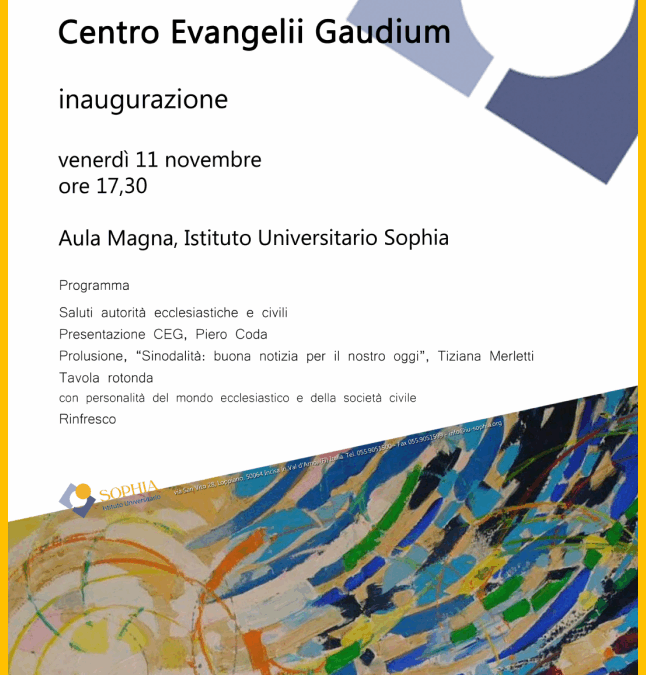
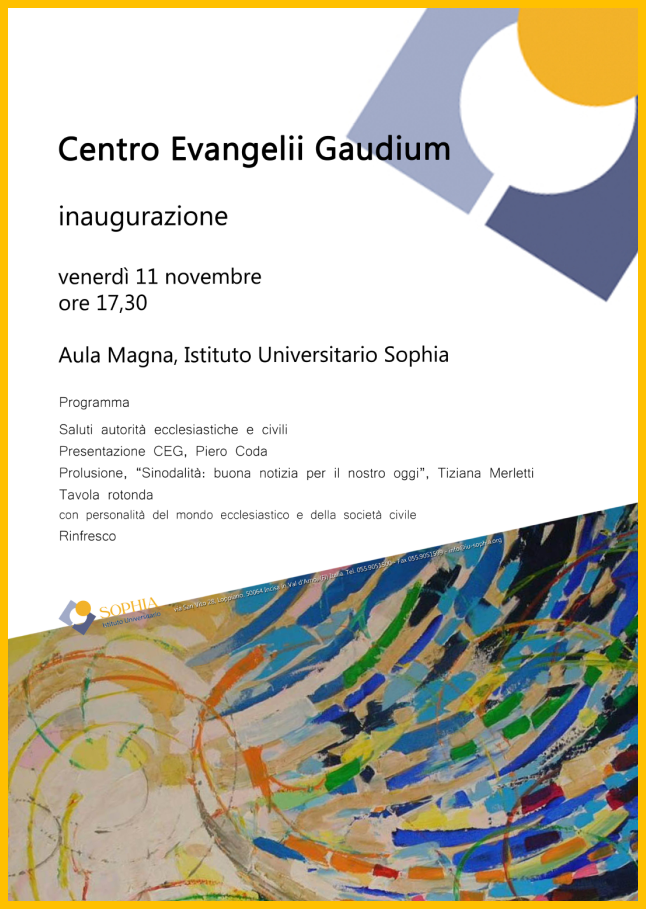 A new “laboratory” promoted by SUI in collaboration with the Focolare Movement Centres of Formation and Pastoral Action: Focolarini Presbyters & Deacons Centre, Volunteer Priests & Deacons Centre, the Gens Centre, Centre for Religious, Centre for Consecrated Persons, the Segretariat of the Parish Movement and the Secretariat of the Diocesan Movement. The Centre is intended to respond to Pope Francis’s invitation to the Church in Italy to take up his Joy of the Gospel Apostolic Exhortation to give content and direction to the work of pastoral renewal that is necessary for the evangelization that the Church is called to in order to “go out” to the existential peripheries of our time. The courses, seminars, workshops and stages that will be activated by the Centre will be directed towards priests, consecrated people, pastoral workers, lay people in ecclesial and social environments and, above, the young. They hope to contribute to this demanding and urgent task, engaging the spiritual impulses and experiences that have emerged from the charism of unity of Chiara Lubich. The mission of the Joy of the Gospel Centre (JGC) is to promote and support formation, research and study in the fields of Ecclesiology, Pastoral Theology and the Mission, Spiritual Theology and Theology of the Charisms and life of the Church today as it goes out on mission. The innauguration will begin with a from Cardinal Joao Braz de Aviz and Archbishop Vincenzo Zani. It will include a presentation of the Centre by the president of IUS, Piero Coda, and a keynote address on the main points of Pope Francis’s Apostolic Exhortation by Dr Tiziana Merletti, Superior General of the Franciscan Sisters of the Poor. Then there will be a roundtable with people from the world of culture, like Massimo Toschi and Damiano Tommasi. “The challenge is to manage to contribute something to that paradigm change in the culture and the relationships among ecclesial and civil communities,” said Piero Coda, “which out times ask for and which the prophecy of Pope Francis forcefully tells us that the moment has come to give a hand in fedelity and with creativity.” Press Conference presenting the Joy of the Gospel Centre of Higher Formation” (CEG): November 8, 2016; 11:30 at Toscana Oggi – Via dei Pucci 2, Florence. Moderator: Father Giovanni Momigli, CEG collaborator. Presentors include: Father Emilio Rocchi, Secretary of the Joy of Gospel Centre, Dr Sergio Rondinara (Epistomology and Cosmology Instructor at IUS) ****************************************************** Info: relazioni.esterne@iu-sophia.org – www.iu-sophia.org Sophia University Institute – Via San Vito 28, Loppiano – 50063 Figline e Incisa Valdarno (FI) ITA Tel. +39 055 9051500 – Fax +39 055 9051599
