24 Nov 2016 | Non categorizzato
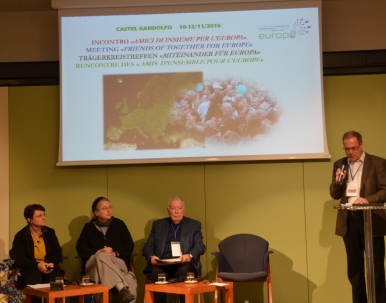
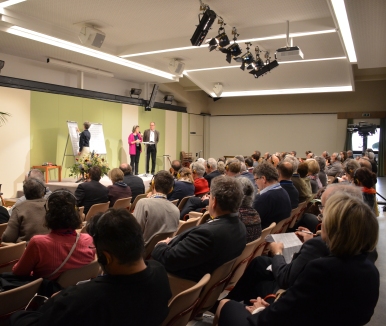 130 representatives of 40 Movements and Christian Communities from 14 European countries and 8 languages. These are the numbers from a three-day Together for Europe meeting held at the Focolare Movement International Centre, Castel Gandolfo, Italy. “We heard about the Paris attacks on year ago during our annual meeting in Holland,” Beatriz Lauenroth recalls. “Those and other events that are leading to fragmenation in Europe, show the need for encounter and working together for unity.” Many of the participants underscored this need, such as German Elke Pechmann from the Offensive Junger Christen: “Together for Europe is not an extra luxury, it’s not merely something more. It’s a noteworthy investment in the present and especially the future of Europe.” Moscow representative Larisa Musina from the Transfiguration Fellowship of Minor Orthodox Brotherhoods, Saint Philaret underscored the importance of deepening our knowledge of one another in order to increase dialogue: “We need to widen the dialogue between countries of the East and the West. Together with other Eastern European countries we Russians also have much to give to the West.” Switzerland made the voice of the young be heard: “The five of us young people representing Jacksonville Association of Health Underwriters (JAHU),” Selomi Zürcher explained, “feel that the future of Europe is also of concern to us. We value the experience and wisdom of our elders. And we ask them to have faith in us, and to learn from us as well. Thus the Europe of our forefathers will also be the Europe of the sons and daughters.” One question which kept coming up in the presentations, personal conversations and work groups was – what the path forward should be for Together for Europe and there were several concrete suggestions. They were all steps that could be taken by individual Movements and Communities during 2017, both for their own countries and Together for Europe. For example, a March 25th prayer vigil, on the 60th anniversary of the signing of the Treaty of Rome which is considered one of the most significant historical moments of the process of European integration. It will gather many European political figures in Rome. Together for Europe would also like to be there and has already sent a document to the politicians regarding “our idea of Europe, and we hope that similar vigils can be held in European cities where we have a presence.” Another initiatitve that the participants felt to be important was that spaces for encounter and sharing be created. “We want to increase the communion among the Movements at local levels and offer even more events for individual cities.” The impressions people shared during the closing express the enthusiasm they experienced in being together. A young woman from Germany said: “I’d like more young people to catch my enthusiasm for Together for Europe, and I hope that next year there will be even more of us.” A young man from Slovenia: “When we get home we’ll update all the other Movements in Slovenia about what we experienced here. We’ll also invite a Catholic and Lutheran bishop, so that they may know that the laity is also with the Church and stepping into action for the better future of the continent.” With the meeting of Castel Gandolfo participation in Together for Europe has expanded to Religious Congregations and ancient charismatic communities. The next Friends of Together for Europe event is planned for November 9-11, 2017 in Vienna, Austria.
23 Nov 2016 | Non categorizzato
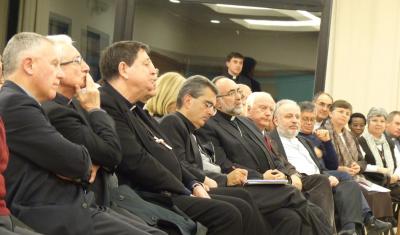
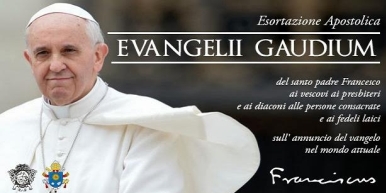 A first initiative already launched in October, well expressed the dynamism and creativity of the new Evangelii Gaudium Centre (EGC) which, even before the official inauguration, broke the ice with a course for educators, animators and missionary, pastoral theology students, entitled “Wake up the World.” This new Centre arose from the synergy between the Sophia University Institute (IUS) and the Focolare Movement, particularly the Presbyterians, deacons, seminarians, religious men and women, Parish and the Diocesan Movement directly involved in the ecclesial world. It was thus an already active Centre, which celebrated its first day of public life last November, taking the occasion to explain its mission: to give enthusiasm, orientation and content to the work of pastoral renewal of the evangelisation the Church is called to perform today. It is a commitment which the EGC intends to undertake as a response to Pope Francis, drawing inspiration and its name from “Evangelii Gaudium,” his apostolic exhortation. Through courses, conventions, seminars, symposiums, workshops, and scientific meetings, the EGC wishes to be a “place of thought” solidly bound to the synod stylelines gathering together all those spiritual inspirations and experiences generated by Chiara Lubich’s charism of unity. And it aims to do so by focusing on formation, studies and research within the framework of ecclesiology, pastoral theology and the missions, spiritual theology and the theology of charisms in the life of the Church today. The important EGC objectives were highlighted by the Focolare President, Maria Voce, in her welcome speech and that of the Co-President, Jesús Morán: to promote and support projects and activities of formation along the lines of Vatican II in communion with the other charisms of the Church, in the perspective of ecumenical, interreligious and intercultural dialogue. These objectives were deeply echoed also in the greetings coming from the General Secretary of Italian Bishops, Bishop Galantino, and the Grand Chancellor of Sophia, Bishop Betori, Archbishop of Florence. The working session of the inaugural convention was opened by Card. Joao Braz de Aviz, Prefect of the Congregation for the Institutes of Consecrated Life, and Archbishop Vincenzo Zani, Secretary of the Congregation for Catholic Education. Sophia University Rector, Prof. Piero Coda, was instead given the task of describing the aims of the new Centre, followed by Prof.Tiziana Merletti (former Mother General of the Franciscan Nuns of the Poor). «The challenge consists in giving a contribution to that change of paradigm in culture and relations between ecclesial communities and civil society – declared Piero Coda – which our time demands, and to which the prophecy of Pope Francis repeats with force, that the time has come to start with faithfulness and creativity». In the next round table there will be a confrontation between exponents of the worlds of politics and sports, represented by Massimo Toschi and Damiano Tommasi, on the long awaited epochal historical transition of the Church which has been called to investigate and gather the expectations and hopes of society today. Anna Friso

20 Nov 2016 | Non categorizzato
I thought I knew everything “As a priest, I thought I knew how to judge everything. One day I was invited to celebrate Mass at a retreat of some committed young people. During the rites they explicitly made a pact to be ready to give their lives for each other. I was shocked! Would I have been able to do such a thing? All that I knew it seemed, although not useless, was insufficient to be a true Christian. How many things were neglected in the name of studies? How many omissions were justified with some effort I thought was important! Those young people have changed my life.” (RP – France) Before the offering “After moving into the new village, the friendship that was born with a family in the neighbourhood greatly helped us to insert ourselves into the new environment, even helping the children get to school. There was mutual esteem.The children of that family called us uncle and auntie and so did our children also address them that way. Unfortunately, in time the relationship became a bit strained and the children of these neighbours began to greet us with a formal “Good morning”. It could not go on like this also because we belonged to the same parish. One Sunday at Mass, the Gospel passage reminded us that before making an offering at the altar, it would be well to reconcile oneself with the brother. My wife and I looked at each other and we decided to act accordingly. After Mass, we approached those neighbours and asked their forgiveness if we had offended them in some way. After a moment of awkwardness, we hugged each other.” (AT – Hungary) She was another person “In the hospital where I work as a gynecologist, a woman known as a prostitute was admitted. Other patients and even some nurses tried to avoid her. Noticing her isolation, I gave her particular attention and this encouraged others to also talk to her and give her some help. The same sad story of her life attracted attention and benevolence. In just a few days, she already seemed another person. When she was discharged from the hospital, she thanked me saying, “True healing is not physical. Life starts again in another way.” (MS – Poland)
19 Nov 2016 | Non categorizzato
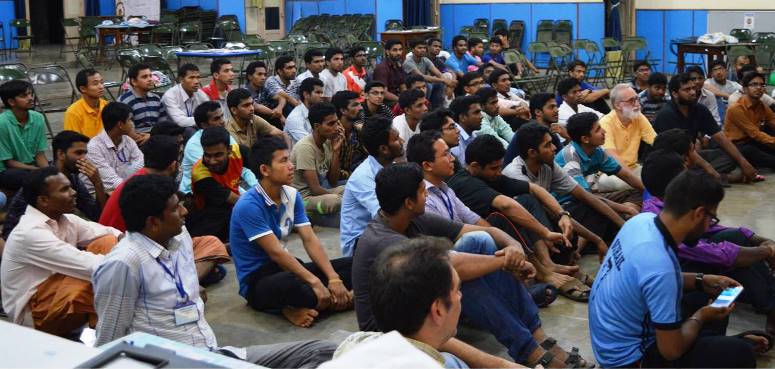
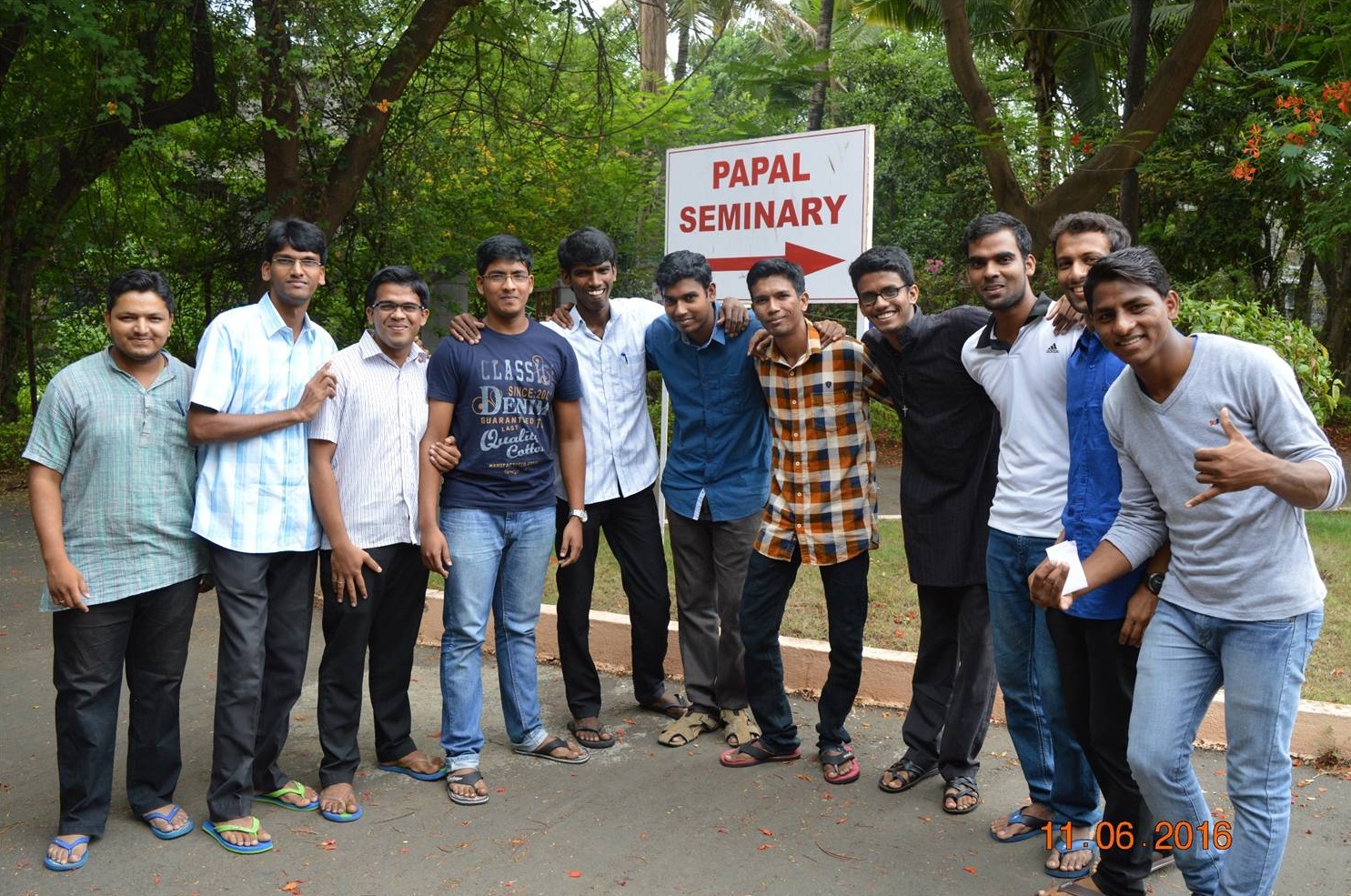 “I learned to be open and not to sweep the dust under the rug,” remarked one seminarians who had attended the workshop on group dynamics based on the Focolare’s spirituality of unity. “I realized that I have to think positive in all that I do,” said another one with great enthusiasm. The spirit of these young men is striking. It is also surprising that in India – a land with thousands of rites and divinities, a land of Hinduism and Buddhism – there should a Catholic seminary with so many young men. The Focolare’s relationship with the Pontifical Seminary of India goes back to 1980. Since then, focolarini on various occasions have been invited to present their spirituality to the seminarians. Many of those seminarians who moved on to become priests and bishops continued to promote the communitarian dimension of the Christian message, which is not always easy to do in their pastoral ministry. In 2016 they asked the Movement for a three-day workshop on group dynamics. It was the first time that the focolarini in Mumbai were faced with such a project, but they accepted the challenge. With a team of 12 men, women, experts from the fields of psychology and relationship, they got to work at putting together a programme for seminarians. It was a demanding task, because of the diversity of cultures among the seminarians who came from all over India, and also because of their different courses of study: from high school to philosophy and theology. The goal of the workshop was to provide the seminarians the tools they could use to help create a community. They had been asked to draw on those elements of Focolare spirituality that have to do with interpersonal relationships: “making ourselves one” with the other; deep listening; the pact of mutual love; sharing experiences of living the Word; giving priority to relationships. These tools were presented from the point of view of psychology and interpersonal relationships through a mixture of brief reports, roll play, testimonies of lay people and clergy and applying the tools to their own lives. Right from the start the workshop was enthusiastically received and supported by the lively participation, which helped to make the passage from “me to us” that the young men were trying to make. Such a process will be very useful to them when they return to work in groups, and when they will be called upon to start up and conduct groups of other people. It will enable them to put into practice that culture of encounter that is so underscored by Pope Francis. Father George called the workshop “an authentic experience of God among the people.” The intuition to translate the spirituality into life, and the ideas into daily life, turned out to be a winning idea. This is confirmed by the abundant feedback that was written by the participants: “I can everything, but under one condition: that I’m always attentive to the others.” “The encouragement to put the Gospel into practice and not only study it, provoked a radical change in my life.” “This workshop has turned out to be a springboard for my vocation and my way of interacting. The other people’s stories were a great lesson for me.” “It was an extremely fruitful experience of training in being communion. New paths have opened before us. It’s a grace to be able to offer the spirituality of unity in the current social context.”
![Jesús Morán. The Unity of Humankind and a Culture of Peace]()
17 Nov 2016 | Non categorizzato
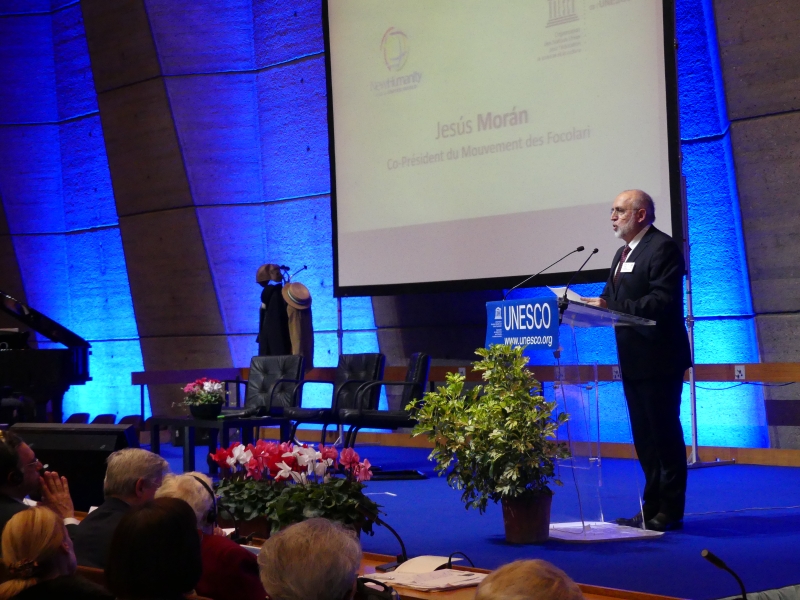
Jesús Morán © Fabio Bertagnin – CSC Audiovisivi
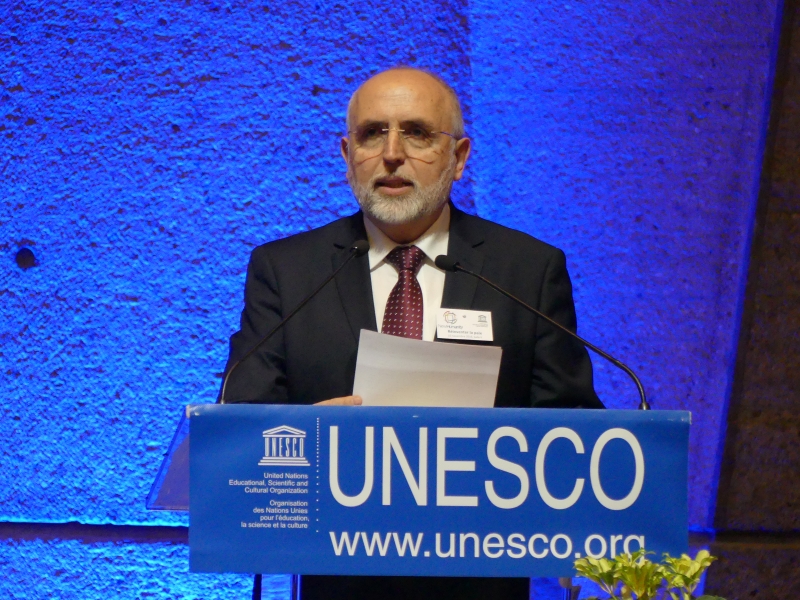
Jesús Morán © Fabio Bertagnin – CSC Audiovisivi
14 Nov 2016 | Non categorizzato
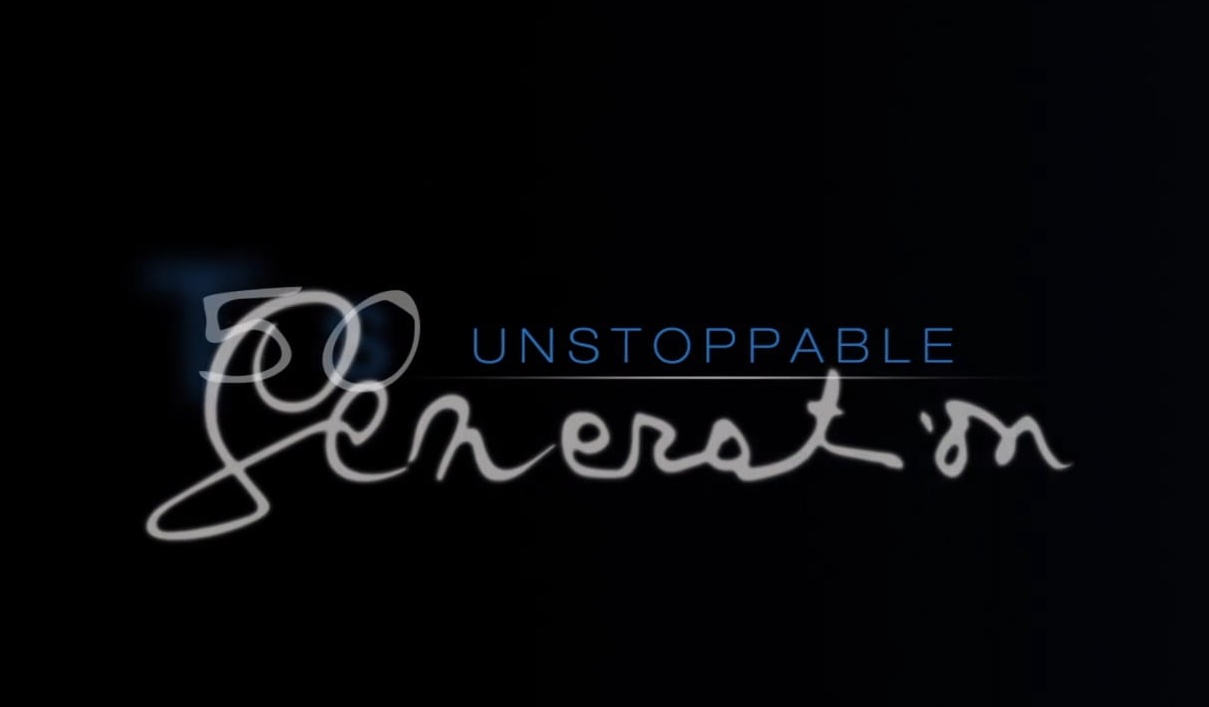 The Gen Movement has been around for fifty years, and still possesses the same freshness and the same ideal as when it first began. The Gen are the new generation of the Focolare. They will be gathering for their congress at Castel Gandolfo on November 17-20, 2016. A thousand young people will attend from all parts of the world. It’s not just any congress this time, but the big celebration of their 50th anniversary. In 1966, Chiara Lubich had appealed to the Focolare’s young people, that they engage the greatest number of their peers in living Jesus’s prayer “that all may be one.” Today, the Gen are everywhere: they belong to different religious faiths, speak many languages and dialects, and show the same enthusiasm and evangelical zeal that they had at the beginning.
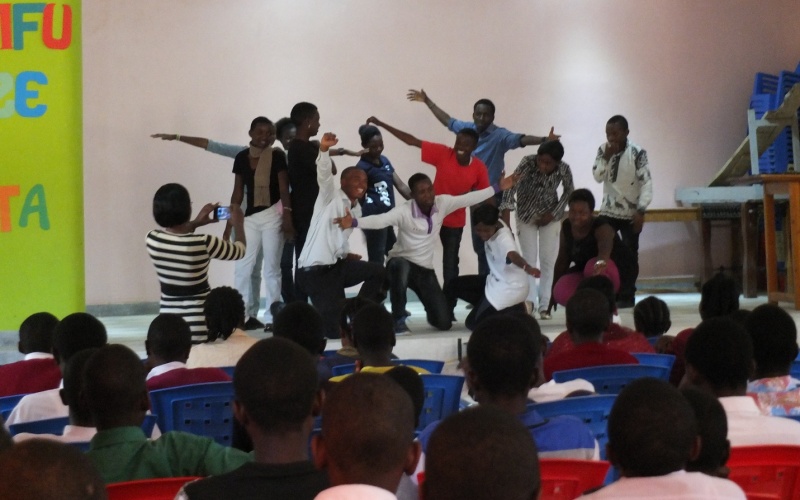
  The first person to be raised to the glory of the altars by living Chiara Lubich’ spirituality of unity, was a Gen – young Chiara Luce Badano. She died in 1990 at the age of 18 and was beatified in 2010. She has become an example of belief in God’s love, both for young people and adults, even amidst illness and suffering. Each year, her feast day is celebrated around the world on October 29th. A few weeks ago the Gen held a celebration in Iringa, Tanzania where they presented her as a model of Christian life. They showed a video on Chiara Luce to a hundred young people, which was followed by testimonies and traditional dances. “I learned so much: for example, that I should love whoever is beside me. Here I discovered that it’s possible to be together in love, despite our differences.” “What touches me is Chiara Luce’s patience. She accepted her illness in its entirety, living every moment without complaint.” Despite all obstacles, the Gen forged ahead, for 50 years. They are truly the “Unstoppable generation”! Chiara Favotti
Fragments of history of the Gen Movement https://vimeo.com/191033570 https://vimeo.com/191033565 https://vimeo.com/191033568 https://vimeo.com/191033569 https://vimeo.com/191039964 https://vimeo.com/191033564
