4 Mar 2023 | Non categorizzato
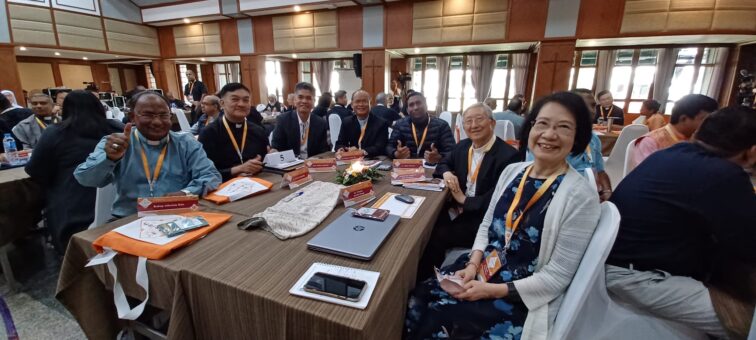
The Asian Continental Assembly for the Synod, which drew up the valuable contribution of the largest and most populated continent in the world, recently concluded in Bangkok (Thailand).We interviewed Vanessa Siu-Wai Cheng, a Chinese focolarina present at the event. The important centre of pastoral formation of the Archdiocese of Bangkok (Thailand) is located in Baan Phu Waan. It’s a beautiful place. About eighty people participated at the Asian Continental Assembly of the Synod that took place from 24th-26th February 2023. 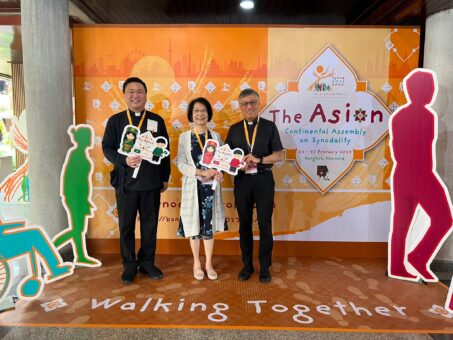 Vanessa Siu-Wai Cheng, a focolarina from Hong Kong, told us about this new continental phase of the Synodal Path in Asia, a pathway that, as the Metropolitan Archbishop of Tokyo (Japan) Tarcisius Isao Kikuchi said in his opening homily: “It is not only a passing event to be celebrated, but rather a change of attitude of the entire people of God so as to make synodality the founding nature of the Church.” Vanessa, how many participants were there? Seventeen Episcopal Conferences and two Synods of Eastern Rite Churches representing the 29 countries of the FABC (Federation of Asian Bishops’ Conferences) sent their representatives to this event, which aimed to give the Asian Churches the opportunity to discuss the way leading to the Synod as Pope Francis has outlined. We were able to share our experiences by focusing on several issues and some challenges that afflict our continent. We spoke about synodality, decision-making, vocations to the priesthood, the role of young people, poverty, religious conflicts and clericalism, with the hope of being able to proceed together on a true path of communitarian growth. We were delighted to have representatives of the Synod Secretariat, the Commission and the Task Force. This indicated the willingness of the universal Church to engage in the synodal process.
  What was the working methodology? They were three intense days of communion and group work. The methodology was always that of spiritual conversation. The various inputs we received were very important and stimulating. First of all, Card. Mario Grech, Secretary General of the Synod of Bishops, brought us the Pope’s warm greeting and assured us that we have not been forgotten. He emphasized that a synodal Church is a Church that listens and discerns. The success of the synodal process depends on the participation of the people of God and the pastors. We must be very attentive to voices, especially those that challenge the Church. What specifically struck you? A very strong impression was from the first day, to see that at every table where a group worked there was an empty chair, representing those who cannot lend their voice and those who do not want to give it. In the centre of the table, there was a candle surrounded by a wreath of beautiful flowers that was lit at the beginning of the day as a symbol of the light of the Holy Spirit, which is necessary to make discernment. We experienced conversion in listening to the others, emptying ourselves, all together: cardinals, bishops, priests, religious and lay people. It was a moment to dig deep, to leave the detail in order to be able to reach, with a broad vision, the continental level. The transformation
  from the “I” to the “we” took place. In addition, it must be said that Asia is home to many religions, including the most ancient and one of the characteristics of Asians is that of spirituality and prayer. The program included 10 minutes of silence during the discussion of a topic and half an hour of prayer in the chapel between two discernment sessions. These moments of silence and prayer really helped all participants to be with God and in God so as to hear His voice both individually and collectively. What do you think is the biggest challenge? It was wonderful to be together as a Continental Church contemplating the complexity and variety of different and common characteristics and challenges. On the first day I thought it was a bit ambitious to think that in three days we could produce a draft that could contribute to the formulation of the instrumentum laboris for the Synod, indicating precise priorities for the Asian continent, but we felt that the Spirit was blowing strongly. Thanks to the work of a drafting group that prepared a “draft framework”, a draft project in order to save us the time to read all the reports ex novo, we were able to work calmly and with a well-ordered text. The last draft of the document expresses a single symphony with many voices that echo the dreams, hopes, aspirations and suffering of the Asian continent.
by Maria Grazia Berrett Foto: © Synodbangkok2023
28 Feb 2023 | Non categorizzato
On 1 February the International Centre of the Focolare Movement had the joy of welcoming Argentine Rabbi Silvina Chemen, a longtime friend committed to interreligious dialogue. In an open and fraternal dialogue, she spoke of her participation in R20, the forum of religious leaders in Indonesia held just before the G20, and her pilgrimage to the Holy Land with a group of Jews and Christians. “If I take a look at my life, my commitment to interreligious dialogue, I can say that all roads begin here, with the Focolare Movement.” These were the extremely happy words that Rabbi Silvina Chemen used to address a large gathering of people, eager to greet her and ask her a few questions, during her visit at the beginning of February to the International Centre of Rocca di Papa in Italy. She is Argentinean, from Buenos Aires, a professor at the Latin American Rabbinical Seminary, and serves in the Bet-El community founded by Rabbi Marshall Meyer. Her commitment to dialogue between faiths is a choice that radically pervades her life and that has led her to get to know Chiara Lubich’s charism deeply, sharing the profound desire of ‘ut omnes’ (‘all be one’) by working intensely in favour of peace and universal brotherhood. In November Chemen participated in R20, the forum of religions in Indonesia, a historic moment that, in the presence of so many religious leaders, proudly defined how religions can truly be partners and help build a more peaceful society. “We, the religious people of the world, are part of society and have so much to offer to such a wounded world,” said Chemen. It is true, at this moment in history, on an international, political and religious level, we are taking the first steps toward a common dialogue. Yet we must take another step: looking further into the problems of ordinary people. It is a long journey, but one that over time, patiently, can bear the most beautiful fruit: valuing each other’s differences, cherishing them, lending an ear with interest and together looking toward a single goal. This, Silvina recalls, is what happened in the early experiences of dialogue between people of different religions that she was able to have. “My tradition, the Jewish tradition, is not just a set of precepts, rituals or a liturgy, but it is mixed with everyday life, with every moment of human life – our behaviour, actions, with what we are. It is a worldview of real life, so Judaism is not only lived inside the synagogue, but outside. “Being a cohesive community and witnessing with our lives: this is what I believe applies to everyone. It is often thought that we of various religions are not an integral part of society and that we must live within the walls of our communities. “Instead, I think we cannot miss this opportunity to speak to the world and to talk about dialogue, about what we have learnt from our experience, not to convince anyone, but to plant seeds of good, to have an impact on reality. “I am in love with this possibility of reading a religion through the eyes of current events. We are here to discomfort the comfortable and to support the uncomfortable. When one is too comfortable, it means one is completely disconnected from reality, which by nature is uncomfortable. Here, our mission is to be uncomfortable.” Silvina recently completed a pilgrimage to the Holy Land, the fruit of a journey that began in her city Buenos Aires some seven years ago, called ‘shared readings’. “Every first Monday of the month we met, Jews and Christians, to study the texts of the Bible,” she says. “It was a space of truth and knowledge, and also saw the participation of a Catholic theologian, José Luis D’Amico, from the Order of the Sisters of Sion, a Bible centre in Buenos Aires. “Other times we also had the joy of having Muslim brothers with us, and we were able to read together the Torah, the Gospel and some passages from the Quran. This experience led each of us to have a dream: a pilgrimage to the Holy Land together to revive the texts in their context.” That is how 45 people, including Jews and Catholic Christians, accompanied by an Israeli guide, had a truly intense experience from 9 to 22 January. They shared each other’s emotions in those places that were of value to each of them, understanding the ultimate message of the texts that were read. “We went between Jericho and Jerusalem,” Silvina says, “to the place where the Good Samaritan is said to have come upon the dying man. It is a text that is somewhat problematic for us Jews, since it could portray Jews as people without pity, as the Levite and the priest of the parable are described. “It was important to take on this text there, to give it another reading and understand that mercy was the key to that Word, as we also read in Ecclesiastes: better two than one, for if one falls, the other helps him (Ecc 4:9–10). “Immediately afterwards we did an exercise, that of talking to someone with whom we had not yet spoken during the trip. It was a truly unique moment: to have the opportunity to listen to each other, compare with each other and find a common message. “We were not a separate ‘we’ and ‘you’, but we were together. It was a precious moment – I would even say prophetic – of a truly united world.”
Maria Grazia Berretta
25 Feb 2023 | Non categorizzato
Give to safeguard. By tracking daily action, the new APP teaches young people and adults, how to take care of the planet and of communities afflicted by climate change Track your consumption, on your own or in groups, learn small-large daily actions to save water and energy and not waste food, and provide concrete help to the poorest countries. These are the goals of EcoGive – Dare to Safeguard, a new App which is available on AppleStore and GooglePlay. It was born thanks to the support of the New Ways for a United World Association linked to the Focolare Movement. Our world is now digitally contained in our mobile phones. Being able to see our daily behaviours reflected in the digital dimension helps us to become aware of how much we really need to consume and how much we waste. This App allows us to track any of the following actions, from the reuse of water used to wash fruit and vegetables to switching off unnecessary lights, to the recycling of used clothes or less wasting of food. Each participant can register their “green deeds”, committing to carry out at least 200 for each school year. There are five thematic areas: electricity, water, gas, recycling/reuse and reduction of food waste. You can then follow the tally of your own deeds and those of your group or school class. You can also see the impact of the project measured in CO2, MWh and water saved. Marco Livia, president of the New Ways for a United World Association (APS), which supported the project and brought it onto an international level, said, “It is a very important project, a contribution to a real cultural change towards a sustainable lifestyle. We are aware of our generation’s great responsibility to the environment and we strongly believe in the power of change that we can transmit to children, and that they can imprint on their peers and in their own contexts.” The idea started in 2008 in Palermo (Italy) on the initiative of Elena Pace, a teacher. The aim is to combine environmental protection and solidarity. The experience then developed over the years thanks to the commitment of the students of various Italian schools. In the 2021-2022 school year, the initiative involved 50 schools worldwide and reached more than 10,000 students. In 2023 its international scope continues to grow. Schools from 12 countries now participate: Italy, Burundi, Benin, Madagascar, South Africa, India, Kenya, Pakistan, Brazil, Colombia, Haiti and the Dominican Republic. The project is inspired by the United Nations 2030 Agenda Goals, focusing in particular on three of them: 13 (fight against climate change), 4 (promote quality education) and 2 (defeat hunger). Support for developing countries The energy-saving measures can also be transformed into concrete support for the populations of the countries most affected by adverse climate-related events. How? Parents, relatives, friends and sponsors are invited to donate. The resources generated will allow the implementation of solidarity actions in developing countries. These actions are chosen by the students, who will learn in this way to give to safeguard the environment. Solidarity projects chosen include the construction of a social vegetable garden in Nairobi, Kenya, the planting of trees in a neighbourhood on the outskirts of Mumbai (India) and the promotion of plant nurseries in the city of Carice (Haiti). The project has been supported by several institutions including the Italian Ministry of Education, the Ministry of the Environment of the Dominican Republic, the Sapienza University of Rome, the Italian Space Agency and the Municipalities of Rome and Priverno. The EcoGive App was created thanks to the support of Mauro Atturo, CEO & Founder of Problem Solving S.R.L. and of Carlo La Mattina, Sole Director of Innovation Lab S.R.L.
Lorenzo Russo

24 Feb 2023 | Non categorizzato
365 days of war in the words and experience of Mira Milavec, a Slovenian Focolarina who has been living in Ukraine for some years and where she works for Caritas Spes. “It has been one year of war, but it seems like an eternity. I never imagined I’d experience such a situation firsthand.” This is how our conversation with Mira Milavec, a Slovenian focolarina who has been living in Ukraine since 2019, began. Mira has been working tirelessly at the frontline during this year of conflict, working with Caritas Spes Ukraine to support the people. Caritas has been supported by the Emergency Coordination Committee of the Focolare Movement through the NGO’s Action for a United World (AMU) and Action for New Families (AFN). Mira told us, “I see a lot of fatigue around me. There are some places in particular where people are still living in very precarious situations. After a year, people’s needs have changed. Before with Caritas Spes we dealt with the distribution of basic necessities, now we have moved on to a new phase in which it is very important to restore dignity to people and also provide socio-psychological support. We are still at the beginning in this area but we are trying to understand how to do it”. Mira, the Caritas operation never stopped… That’s true. I am in contact with our collaborators who are in the most affected places. I think they have never had time to rest but they are there, day and night, personally sharing the sufferings of these people who have lost everything, their loved ones, their houses; their whole life is shattered. I think being in direct contact with these stories, gives our collaborators, no matter how tired they are, the push to continue doing good”. Is there any particular story you carry with you? “Yes, the stories are different, and that’s where hope comes from. I remember a family from Donbass who had to leave their city already in 2014. They had saved all their lives to be able to have an apartment and as soon as they could, they bought one in Kharkiv. Then the war came and they had to leave. They went back to that apartment at the end of 2022 and found it in really disastrous conditions because of the bombing. We brought them wood stoves to keep warm and, despite this tragic situation, it was moving to see immense gratitude in their eyes. It didn’t matter how much it was going to cost to repair the damage to the house. They were happy and grateful to receive that little help, to be alive and still together. ” What have you experienced in this difficult year? “I have seen how in these situations we are all able to do something to help. Above all I feel God’s support and really feel that we are in His hands. Often people here don’t ask for much, it’s enough just to ‘be’, to be there with them. God gives us all different talents and I have to say that in the situation I’m in now, I can really draw on them and they can really help others. Prayer is a real support. I truly hope that this war will end and that each one in our own small way will be able to teach the new generations that such hatred cannot be allowed to exist.”
by Maria Grazia Berretta
Activate English subtitles https://youtu.be/gFOMlUj6axA To continue supporting the people of Ukraine click on the link Ukraine: fundraising to support the population begins – Focolare Movement (focolare.org)
21 Feb 2023 | Non categorizzato
In Hebrew, Nes Ammim means the ‘miracle of the peoples’. This place was created to foster dialogue and understanding between Christians, Jews and Muslims. From 16 to 18 September, “Dare to Care for a Better Future” was held here, a meeting organised by the Focolare Movement in the Holy Land and open to people of every generation, nationality, religious faith or non-religious beliefs. It was an opportunity to share a few days together and discover each other as partners, through mutual understanding, in building a better future together. For testimonies of friendship between believers of different religions, see also Holy Land: stories of dialogue ( https://youtu.be/Cp9MOx5xKvA ). https://youtu.be/MiWZNwrasD8
20 Feb 2023 | Non categorizzato
God chose to convey the grace that saves people through people themselves. That is, he chose to save us through our love for one another, through the charity and care we have for our neighbours. Just when it seems that we have nothing to offer, that we are of no use, he shows us a way to knock on his door as children, to ask and trust. Special request By chance, I had become aware of a patient admitted to hospital in a desperate condition. To save her, a specific blood type was needed, but it could not be found. I did my best to search for it, both among my acquaintances and in my work environment (I am a nurse in the outpatient clinic of a charitable organisation). But nothing could be found. I was about to surrender my arms, heavy in defeat, when a heartfelt prayer to the almighty rose from my soul, a request. My ward duty hours were over, and the specialist doctor I was assisting said goodbye and left. Just a few moments later, a young woman came in for an examination. I asked the lady for her ID and she handed me her Avis card. I almost couldn’t believe my eyes – what if she had that blood type? If he was available? I rushed to call the doctor back and, unlike other times, found him willing to return to surgery. That’s right! That same afternoon, the woman was at the sick woman’s bedside for the direct transfusion. A. M. M., Italy Behind a door Starting with the idea of halving my personal belongings, giving them away to those who might need them, I established new relationships. I began with two expensive jackets that I seldom wear, offering them to my Moroccan neighbour, whose daughter or daughter-in-law might be interested. She liked them, and in turn begged me to accept a new, never-worn beige coat. For me this brought a lot of work to find out whom to give it to, but it served to get to know my neighbours. Two hours later I met a friend who happily accepted the coat for her sister, who only wears beige! The day continued, marked by the phrase, ‘Give and it shall be given to you’. In fact, I happened to receive furniture, dishes, linen for the flat I have recently moved into. For us Swiss, it is difficult to cross the threshold of a neighbour’s house – we are always afraid of disturbing. But how much humanity is hidden behind doors! It only takes a few minutes of entertainment over a coffee and the filters of prejudice fall away, the heart expands and the family space grows. Isabelle, Switzerland
Edited by Maria Grazia Berretta.
From “Il Vangelo del Giorno,” Città Nuova, year IX, no. 1, January–February 2023.

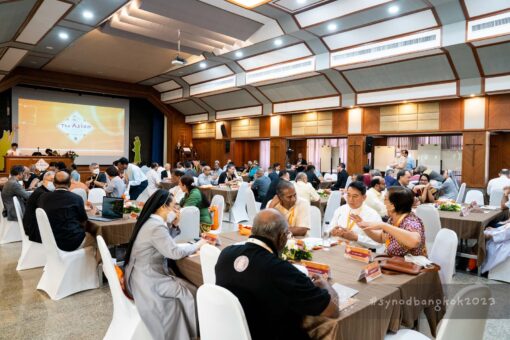 What was the working methodology? They were three intense days of communion and group work. The methodology was always that of spiritual conversation. The various inputs we received were very important and stimulating. First of all, Card. Mario Grech, Secretary General of the Synod of Bishops, brought us the Pope’s warm greeting and assured us that we have not been forgotten. He emphasized that a synodal Church is a Church that listens and discerns. The success of the synodal process depends on the participation of the people of God and the pastors. We must be very attentive to voices, especially those that challenge the Church. What specifically struck you? A very strong impression was from the first day, to see that at every table where a group worked there was an empty chair, representing those who cannot lend their voice and those who do not want to give it. In the centre of the table, there was a candle surrounded by a wreath of beautiful flowers that was lit at the beginning of the day as a symbol of the light of the Holy Spirit, which is necessary to make discernment. We experienced conversion in listening to the others, emptying ourselves, all together: cardinals, bishops, priests, religious and lay people. It was a moment to dig deep, to leave the detail in order to be able to reach, with a broad vision, the continental level. The transformation
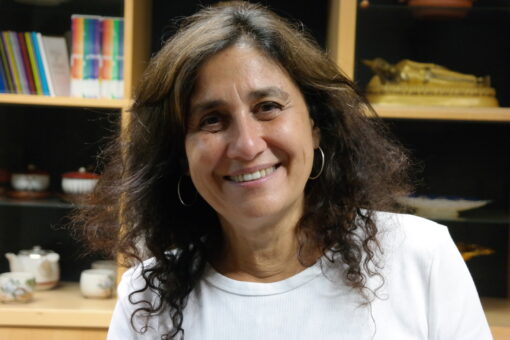 These were the extremely happy words that Rabbi Silvina Chemen used to address a large gathering of people, eager to greet her and ask her a few questions, during her visit at the beginning of February to the International Centre of Rocca di Papa in Italy. She is Argentinean, from Buenos Aires, a professor at the Latin American Rabbinical Seminary, and serves in the Bet-El community founded by Rabbi Marshall Meyer. Her commitment to dialogue between faiths is a choice that radically pervades her life and that has led her to get to know Chiara Lubich’s charism deeply, sharing the profound desire of ‘ut omnes’ (‘all be one’) by working intensely in favour of peace and universal brotherhood. In November Chemen participated in R20, the forum of religions in Indonesia, a historic moment that, in the presence of so many religious leaders, proudly defined how religions can truly be partners and help build a more peaceful society. “We, the religious people of the world, are part of society and have so much to offer to such a wounded world,” said Chemen. It is true, at this moment in history, on an international, political and religious level, we are taking the first steps toward a common dialogue. Yet we must take another step: looking further into the problems of ordinary people. It is a long journey, but one that over time, patiently, can bear the most beautiful fruit: valuing each other’s differences, cherishing them, lending an ear with interest and together looking toward a single goal. This, Silvina recalls, is what happened in the early experiences of dialogue between people of different religions that she was able to have. “My tradition, the Jewish tradition, is not just a set of precepts, rituals or a liturgy, but it is mixed with everyday life, with every moment of human life – our behaviour, actions, with what we are. It is a worldview of real life, so Judaism is not only lived inside the synagogue, but outside. “Being a cohesive community and witnessing with our lives: this is what I believe applies to everyone. It is often thought that we of various religions are not an integral part of society and that we must live within the walls of our communities. “Instead, I think we cannot miss this opportunity to speak to the world and to talk about dialogue, about what we have learnt from our experience, not to convince anyone, but to plant seeds of good, to have an impact on reality. “I am in love with this possibility of reading a religion through the eyes of current events. We are here to discomfort the comfortable and to support the uncomfortable. When one is too comfortable, it means one is completely disconnected from reality, which by nature is uncomfortable. Here, our mission is to be uncomfortable.”
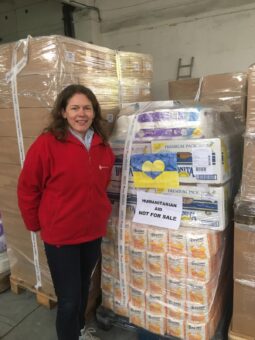 This is how our conversation with Mira Milavec, a Slovenian focolarina who has been living in Ukraine since 2019, began. Mira has been working tirelessly at the frontline during this year of conflict, working with Caritas Spes Ukraine to support the people. Caritas has been supported by the Emergency Coordination Committee of the Focolare Movement through the NGO’s Action for a United World (AMU) and Action for New Families (AFN). Mira told us, “I see a lot of fatigue around me. There are some places in particular where people are still living in very precarious situations. After a year, people’s needs have changed. Before with Caritas Spes we dealt with the distribution of basic necessities, now we have moved on to a new phase in which it is very important to restore dignity to people and also provide socio-psychological support. We are still at the beginning in this area but we are trying to understand how to do it”. Mira, the Caritas operation never stopped… That’s true. I am in contact with our collaborators who are in the most affected places. I think they have never had time to rest but they are there, day and night, personally sharing the sufferings of these people who have lost everything, their loved ones, their houses; their whole life is shattered. I think being in direct contact with these stories, gives our collaborators, no matter how tired they are, the push to continue doing good”.