6 Feb 2016 | Non categorizzato
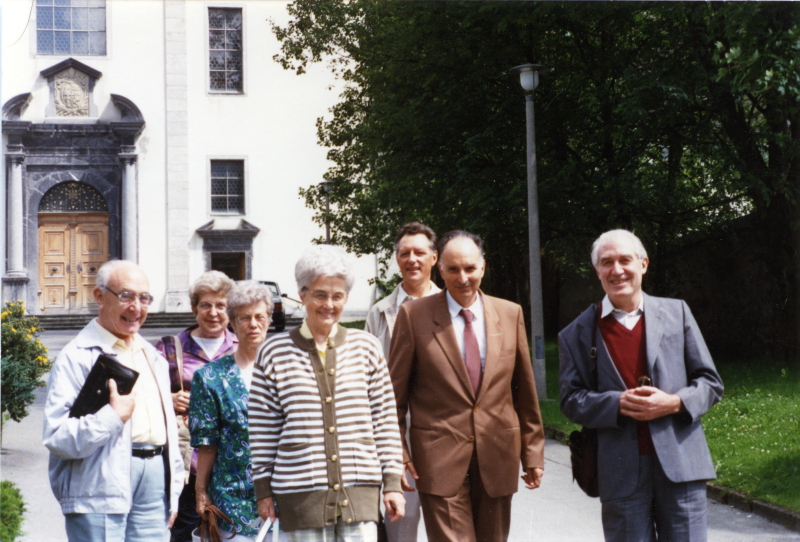
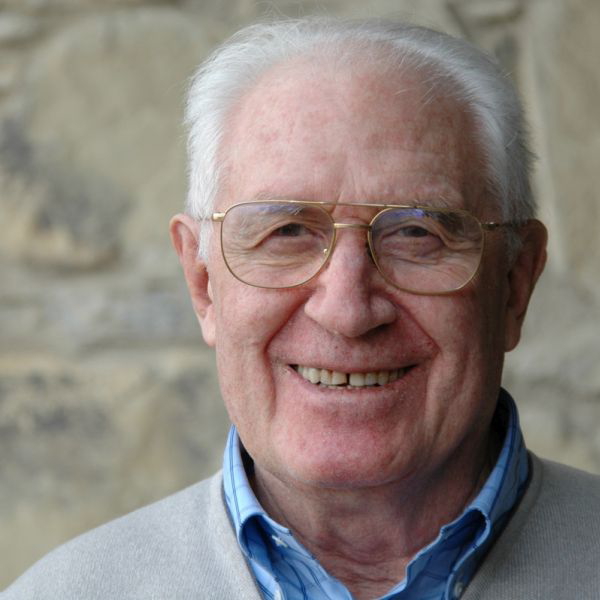 Card. Giuseppe Betori, Archbishop of Florence traced an important phase of his story, and described him as «A promoter of proactive communion between the various groups and associations,» who «interpreted the hope of Cardinal Benelli and Chiara Lubich» for the creation of the Giorgio La Pira International Students’ Centre in Florence at the turn of the 1970s. In fact, Giorgio Martelli, a native of Pistoia, Tuscany, gave a decisive contribution to the birth of this joint project between the Florentine Archdiocese and the Focolare Movement, which up to today continues its commitment to the «youth from all the nations worldwide, especially the developing countries, fostering fraternal acceptance and promoting dialogue between people of all cultures and creeds.» The story of the La Pira Centre is one of the important stories that has crossed the life of Turnea (the name Chiara Lubich gave him and that described his: Turris Eburnea, Tower of Ivory, taken from the Marian litanies). Born into a working-class family, Turnea was brought up with a simple faith, moral rectitude and thirst for justice. As a young man he was active in the Catholic Action where he received a more solid Christian education. During the war, he and his father were caught twice in a round-up which condemned him to forced labour, from which he managed to escape. After the war he started working in the labour union as a clerk in the contracts and litigations office, and at the same time, took up his studies again and graduated as an industrial surveyor. During the Catholic Action period he met other youth active in Christian movements, among whom were Bruno Venturini, and Vitaliano Bulletti who also became focolarini. He himself commented on that period: «Before me were two aspects of Christian life that were alternatively a more personal aspect of the quest for a relationship with God, and a more social one concerning the need for fraternity among men, and the justice and struggles to reach them. But these were two separate spheres!!» His first meeting with the focolare came about in January 1950 when he first met Graziella De Luca, who had gone to his city to speak to some people about the experience of the newborn Focolare Movement. In the following months he went several times to Rome where he met, besides Chiara, the first focolare men and women. After an internal struggle that lasted a few months, he decided to become one of them, and after leaving his fiancée and family – amid great misunderstandings – he moved to Rome, and joined the first men’s focolare house. Subsequently, he lived in various focolare houses in Italy and Holland . In 1968 Turnea he was appointed by Chiara as the first person to take charge of the newborn branch of the Volunteers of God. At their conventions Turnea encouraged moments of debate on issues and queries regarding the concretisation of the spirituality of unity in daily life. He often repeated Chiara’s affirmations: The Volunteers in our time have to take after the first Christians. For many years he dedicated himself to that Focolare aspect called harmony and environment and which concerned the construction works, the towns, the Mariapolis Centres, art and social works. It was a role he covered with passion, love and devotion also in the numerous trips and visits to various countries. Turnea endowed his efforts, tenacity and love also in many other fields: at the start of the Youth for a United World Movement, and in supporting the Santa Chiara Audiovisual Centre and the international Gen Rosso band. Free from specific assignments from 2008, he continued to give his contribution with advice and ideas. As a priest, he stood by many focolarini, especially those in suffering, and for whom he regularly celebrated the Holy Mass. In 2012 he was struck by a disease that caused a motor disability, which he bore, however, with his proverbial grit and his love for Jesus Forsaken and Abandoned. Regarding the last years, his long-time friend, Bruno Venturini recounted: «He would gather all his strength to try to be active, and was still willing to help. At times, after a difficult day he didn’t have the strength to get up and I would find him at the computer, checking his mail. At the same time he was always committed to accepting from God with serenity, this state of weakness and inactivity. He was never resigned and received all those who came to see him with joy. He spoke with great presence of mind and often with great effort, about all the most various topics one or the other was involved in. He never forgot to express his deep thoughts which showed his interior state, his full adhesion to God’s will: his heavenly thoughts.» On 26 January Turnea concluded his earthly journey. Focolare President Maria Voce wrote: We have «another giant» among the first focolarini. Maria Chiara de Lorenzo
5 Feb 2016 | Non categorizzato
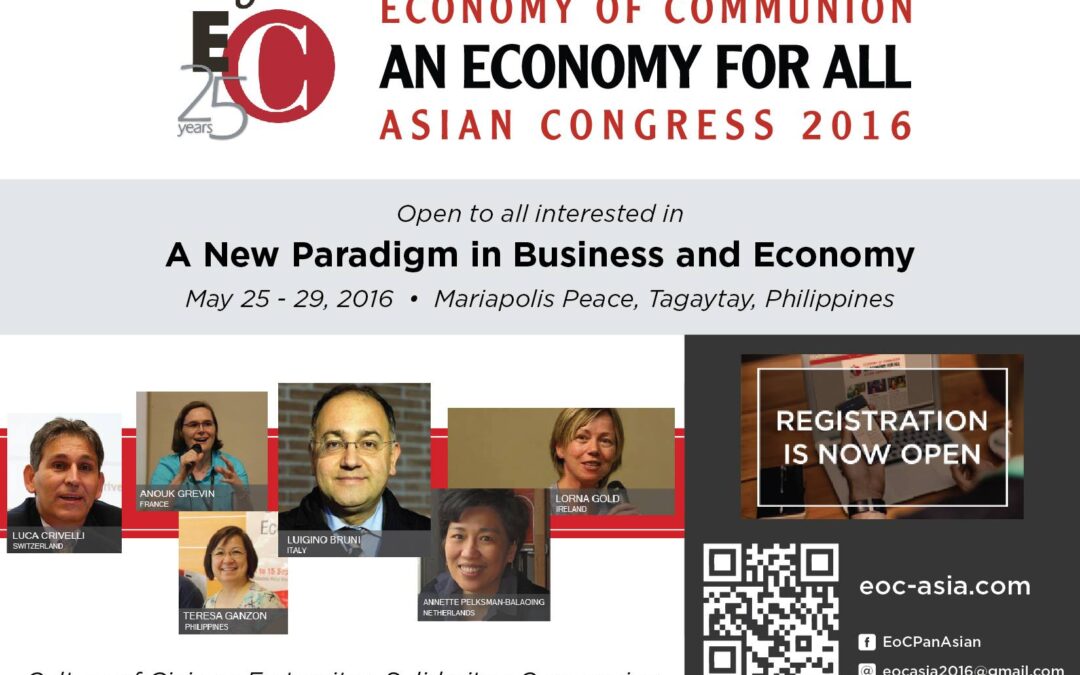
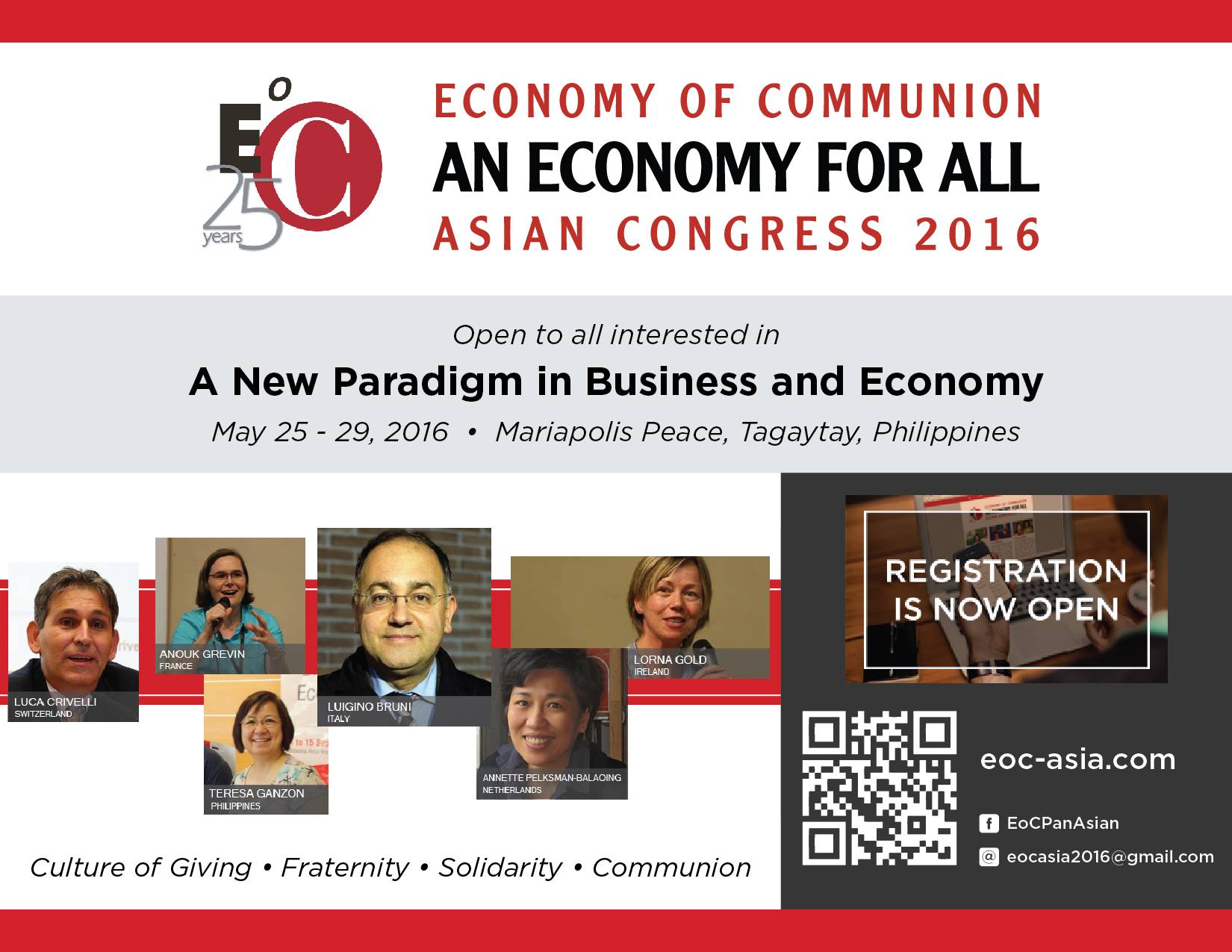 Invited are all interested advocates of a different way of viewing economy and doing business that is characterized by communion, fraternity and solidarity, especially with the weakest sectors of society. The congress hopes to bring together entrepreneurs, professors, young people and members of civil society with a passion for changing the business world, understanding in depth the challenges facing Asian nations despite the unprecedented economic growth of the past years, due to a continued adherence to the capitalist model and concept of economics – and what the economy of communion can offer to make the changes more meaningful and inclusive. Economists expected to be give their inputs in the congress include members of the international commission – Luigino Bruni (Italy), Anouk Grevin (France), Lorna Gold (Ireland), Teresa Ganzon (Philippines) and Luca Crivelli (Switzerland). Invited as a guest lecturer also is Dr. Annette Pelksman-Balaoing of the University of Rotterdam, Netherlands, to give a perspective on Globalization and how it has affected Asian nations in the past decade. It is expected to draw participants from different nations in Asia, as well as Australia. Live streaming playlist 25-29 May The EOC Pan Asian Congress will also have a celebration of EOC’s 25th anniversary on May 28th, even of the actual anniversary date on the 29th. Go to the EoC Asia web-site Register: More info: eocasia2016@gmail.com
The YouTube links are: For Day 1, 25 May to Day 5, 29 May: Link to the playlist of the whole meeting: https://www.youtube.com/playlist?list=PLseXirhCvXpHfSeiIcXBqicR4Hfl4dxuB EoC 25° Anniversary Event – EoC Asian Congress 2016 (9:00PM – 10:00 PM Philippines time) https://youtu.be/pQpqh4REvWc
2 Feb 2016 | Non categorizzato
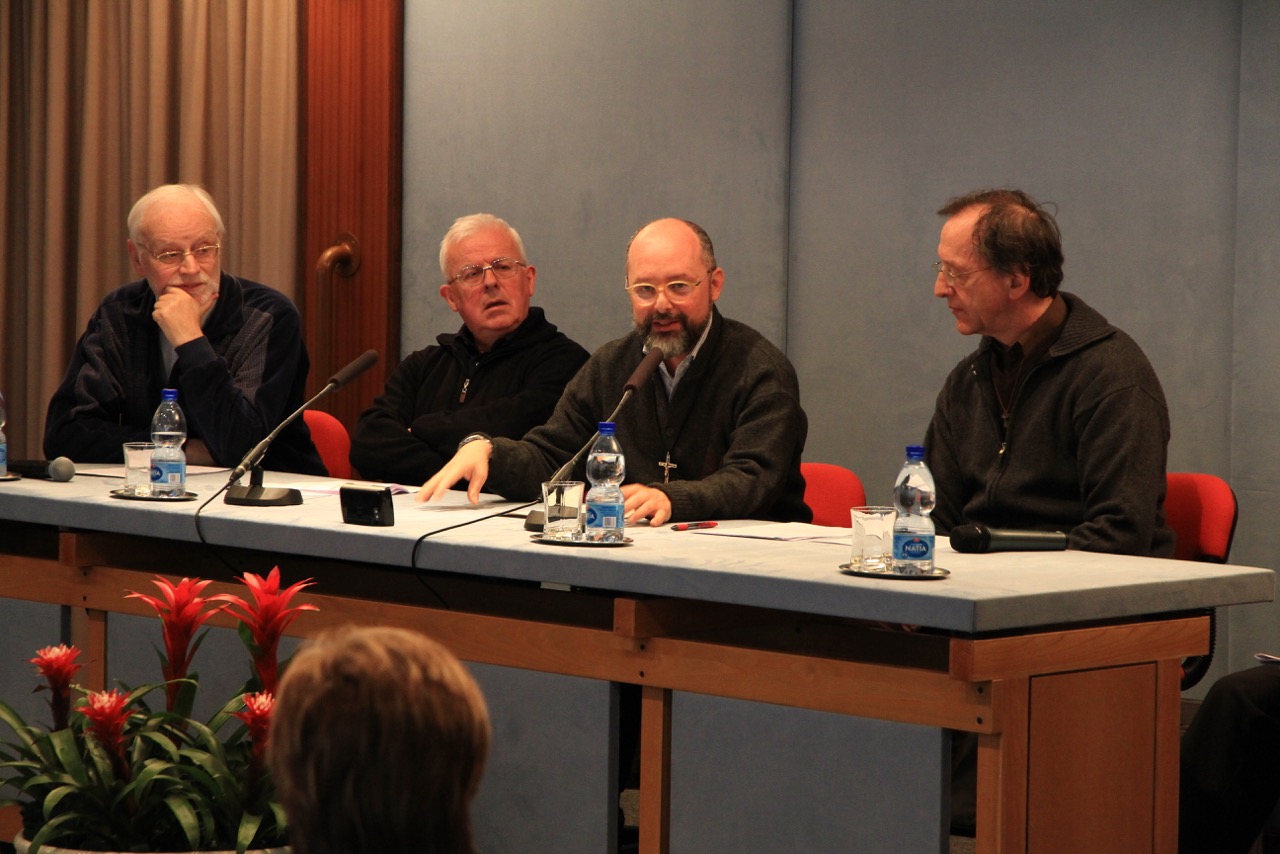 Fr Salvo, could you draw a conclusion to this regard? «It was the endowment of a very strong grace that touched also the ample strata of the Church, besides of course, affecting all the consecrated members. Pope Francis imbued this year with particularly inspiring thoughts and events also through the Congregation for the Institutes of Consecrated Life and the Apostolic Life Societies (CIVCSVA). Of course it is still too early to take stock of everything, since I am convinced that it was an in-depth event and the fruits will be fully seen as time passes.» What role did the Religious members of the Focolare play? «The particular sensitivity to unity, typical of Chiara Lubich’s spirituality, offers to the members of the Movement, a sort of know-how that inspires them to give priority to relationships and transform them into communion. The religious men and women belonging to the Focolare committed themselves to the initiatives of their communities and dioceses, or to national activities and those of the universal Church, giving their imprint of communion, a spirit the Church hoped would develop more and more as the “home and school of communion.” In one of the European countries, it was precisely the religious and consecrated people of the Movement who proposed the project of an encounter for consecrated youth, to the Conference of Major Superiors. The heads highly appreciated the contents and methods, so as to make it their own initiative. Around 250 young religious participated, with really important impressions and results.» And with regard to the initiatives set up by the Holy Father and the Congregation of Consecrated Life? Great importance was given to Pope Francis’s invitation to show the joy of consecrated life and to prophetically act in the “existential outskirts,” as expressed in his Apostolic Letter to all the consecrated men and women: “I expect you to «wake the world up», because the typical feature of consecrated life is prophecy.” He thus underlined a specific attribute of Religious Life characterised by that of being harbingers of charismas, that is, of gifts for the good of the entire Church. TCIVCSVA then developed the thoughts of Pope Francis with three letters: one dedicated to Joy which must distinguish the consecrated religious (Rejoice); another dealing with their capacity to be prophets for the world (Keep Watch); and the third, a contemplative dimension of their life (Contemplate). These three documents are a reference point for the future of Consecrated Life in the Church. As to the events, we certainly must note the meeting in Rome of the young religious last September. It was a convention of great impact, with 5,000 participants from all over the world, and lasted 4 days. It is not something we see often. It also impressed me because of the significance of the ecumenical Dialogue of religious men and women held from 22 to 25 January 2015. This was an absolute “first” in the Vatican, which Pope Francis wanted so much, and a sign of the progress of the journey among Christians of various denominations. Fr. José M. Hernández, a Claretian, said that each one is called to “be a bridge and not a trench” among Christians. I think this is a good augur which well expresses the rest of the journey we still have to undertake.»
29 Jan 2016 | Non categorizzato
«I’m African and studying in Northern Italy. Some time ago I read an article in a magazine, in which the author said that a “dark night” is pervading every aspect of western culture, leading to a loss of the authentic Christian values. Sincerely, I did not understand what this meant, until something happened to open my eyes. It was a Saturday afternoon. Some kids, neighbours of mine, invited me to go out with them and spend an evening together. They wanted to do something different. There were six or seven of us and we started the evening dancing in a local disco. Initially I enjoyed it and they said music ran in my blood, and I danced well. But soon I noticed that the people around me were dancing without any respect for themselves or for the others. They were not dancing for pure enjoyment but were launching ambiguous messages. A small voice inside me told me to go against the current and dance with dignity and out of love. After a few hours, my friends suggested we go to another club. I trusted them since they were my friends, and so I accepted. In this other club it did not take long for me to realize where we had landed. The music was very loud, psychedelic lights pulsed to the rhythm, an acrid smell started to diffuse, and I was astonished. This was not a normal disco, and the girls prostituted themselves. I was disappointed and angry. Without saying a word, I turned on my heel and left. One of my friends came after me. He insulted me, saying I was slow in the head. I did not answer. After a few minutes, another one came, but this time he did not insult me, but said I was right. Lastly, another sneaked out of the club and also he said I was right. I was surprised. I had created a countercurrent chain. Without even speaking of the Christian ideals I believe in, or of God, the others had seen and understood. A few months passed and I had completely forgotten that episode. One day, a boy, who had been with us that evening, came to me saying he regretted it and would never again frequent that type of club. I was astonished. Evidently, Jesus was working on him. This experience has helped me to see in a more radical way, the need to risk and say “no” to certain proposals of the world, because it is our testimony that strikes people, even though we are unaware of it.» (Yves, Cameroon) From “Una buona notizia, gente che crede gente che muove”, Chiara Favotti, Ed. New City 2012
28 Jan 2016 | Non categorizzato
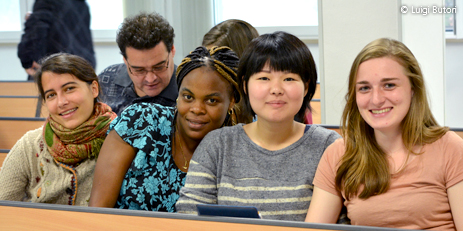
Sophia University Institute and the insertion of its graduates in the employment world: a more or less difficult relationship with respect to other academic programs? Eight years after the inauguration of the Sophia University Institute (SUI), the Italian professor of Social Research Methodology, performed a survey starting from these interrogatives. Some observations taken from the survey. The survey sample consisted in the first 80 SUI graduates, those who attended and concluded a two-year course with the achievement of a degree within the year 2014. In the first two months of 2015 this group was asked to respond to a semi-structured questionnaire, drafted to get some essential information on the professional pathways and lifestyles undertaken after their studies in Sophia. Out of a total of young graduates 61 gave their response (75% out of the total) coming from 30 different countries; their collaboration enabled to focus on the value their studies in Sophia played in their quest for a job. Above all the study programme concluded in the foreseen period of two years in 91% of the sample; 81% found a job within six months, and 96% within a year. Today 51% of the degree holders have a stable job, 26% have a temporary job; 62% of the cases have a full-time job, and 26% work part time, while for 13% have a second job. Most of the graduates (63%) are assigned roles of responsibility in companies, public administrations, universities and in other cultural, non-profit agencies: 28% are freelance professionals, entrepreneurs, consultants; 7% are top directors and managers, and 28% work in the field of scientific-cultural education and research. Effectiveness of the educational program, compared to the actual job placement seems to have been confirmed: more than two-thirds of the graduates (68%) think that the SUI programme offered is aligned with the job they now hold. This effectiveness is set in relation to some specific transverse skills the graduates retain to have achieved or strengthened during their studies in Sophia. They mention in particular the capacity to interact in a “plural” context under the cultural and disciplinary profile , and problem-solving skills through the integration of different perspectives and competences, and managing situation of conflict, working in synergy in with other social and cultural players, promoting innovative solutions. To note, lastly, that none of the graduates regretted having undertaken the chosen pathway: 72% would willing redo the course as is, while 28% would redo it and suggest some changes. Among these, they highlighted the lack of apprenticeship and internship available in the two-year programme, a priority targeted by the Institute’s competent Offices. “The analysis of the strong points is very interesting,” Licia Paglione commented, “above all studying at Sophia meant getting involved in a programme of discovery and maturation of one’s own relational identity, a pathway that includes and upholds intellectual resources and at the same time imbues the psychological, affective, spiritual and operational dimensions and urges each toward commitment.”
27 Jan 2016 | Non categorizzato, Word of
[soundcloud url=”https://soundcloud.com/user-958772872/word-of-life-february-2016″ params=”color=ff5500&auto_play=false&hide_related&visual=false&show_comments=true&show_user=true&show_reposts=false” width=”100%” height=”166″ iframe=”true” /]
This Word of Life is an invitation to believe in God’s loving action even where his presence is not felt. It is a proclamation of hope and challenge that we too might we become instruments of consolation. Who hasn’t seen a crying child throw itself into its mother’s arms? Whatever the matter is, important or not, the mother dries its tears, covers it with tenderness and, bit by bit, it starts to smile again. Her presence and loving kindness are enough. God behaves like this with us, and compares himself to a mother. These words are how God speaks to his people on their return from exile in Babylon. They had seen their homes and the Temple demolished and had been deported to a foreign land where they felt lost and grief-stricken; now, returning to their homeland, the people had to rebuild from the rubble of destruction. The tragedy Israel had lived through is repeated by many war-torn peoples, victims of terrorist atrocities or inhuman exploitation. Houses and streets ripped apart, sites symbolic of a cultural identity razed to the ground, goods pillaged, places of worship destroyed. How many people kidnapped, millions forced to flee, thousands dying in deserts or at sea! It looks like an apocalypse. This Word of Life is an invitation to believe in God’s loving action also where his presence is not felt. It is a proclamation of hope. He is beside the one who suffers persecution, injustice, exile.
He is with us, with our family, with our people. He knows our personal pain and that of the whole human race. He became one of us, to the point of dying on a cross. This is why he knows how to understand us and comfort us. Just like a mother who takes her child onto her lap and comforts it. We need to open our eyes and hearts to ‘see him’. To the extent that we experience the tenderness of his love, we will be able to transmit it to those who live in pain and under trial, so that we become instruments of consolation. Paul, too, suggests it to the Corinthians: ‘console those who are in any affliction with the consolation with which we ourselves are consoled by God’ (2 Cor. 1:4).
This was also a deeply personal and specific experience of Chiara Lubich: ‘Lord, give me all who are lonely … I have felt in my heart the passion that fills your heart for all of the forsakenness in which the whole of the world is drifting. I love everyone who is sick and alone. Who consoles their weeping? Who mourns their slow death? Who presses to their own heart, the heart in despair? My God, let me be in this world the tangible sacrament of your love; let me be your arms that press to themselves and consume in love all the loneliness of the world.’ 1
Edited by Fabio Ciardi
This Word of Life was chosen by an ecumenical group in Germany. We are living it together with brothers and sisters from many different Churches. Our hope is that our lives throughout the year may be accompanied by the promise from God that it contains. 1 Chiara Lubich, Meditations (London : New City, 2005), 24
