18 Dec 2015 | Non categorizzato
This year, the usual appointment promoted by the youth of the Focolare and aims to involve the greatest number of people and institutions in their journey towards fraternity, will be cantered in Quito, Ecuador. The theme of inculturality, with a manifestation of the youth at the so-called “Other half of the world,” where one can enter with one foot in the boreal hemisphere and the other in the austral hemisphere. There will be days of dialogue among young people of different cultures, through work sessions, sharing and community tourism in a setting of exuberant nature. Complete information on the Ecuador programme is given on the site, www.munodunido2016.com. “Link Cultures – un camino para la paz” is the title that expresses the core of all the fraternity initiatives that will ensure simultaneously throughout the world, uniting generations and cultures in a unique workshop and can be traced through the hashtag #4peace. Run4Unity – Another novelty this year is the involvement of the kids: the wold sports event, Run4Unity, the world relay race for peace which in the previous editions saw the participation of thousands of teens, which will be held annually from now on, and will be inserted in the United World Week. The La Run4Unity 2016 will take place next 8 May. The Youth for a United World hope that this on-the-road International Expo, now running on its 20th anniversary be also recognised by the UN. The initiatives that come about during the year, and on which the United World Week focuses its spotlight, are all part of the United World Project.
18 Dec 2015 | Non categorizzato
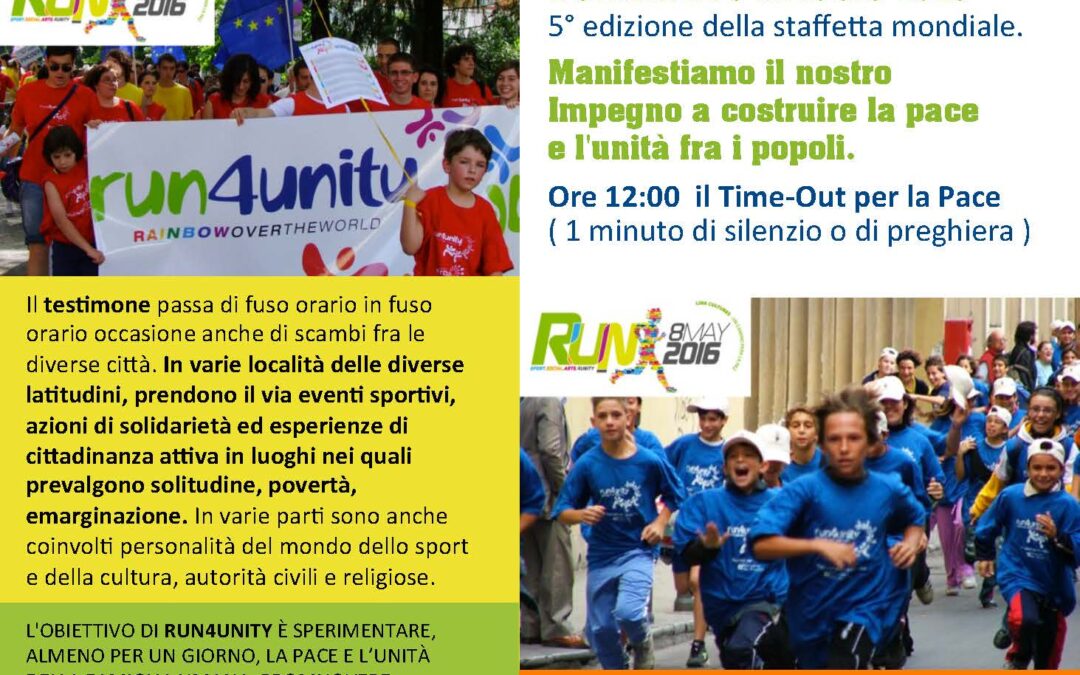
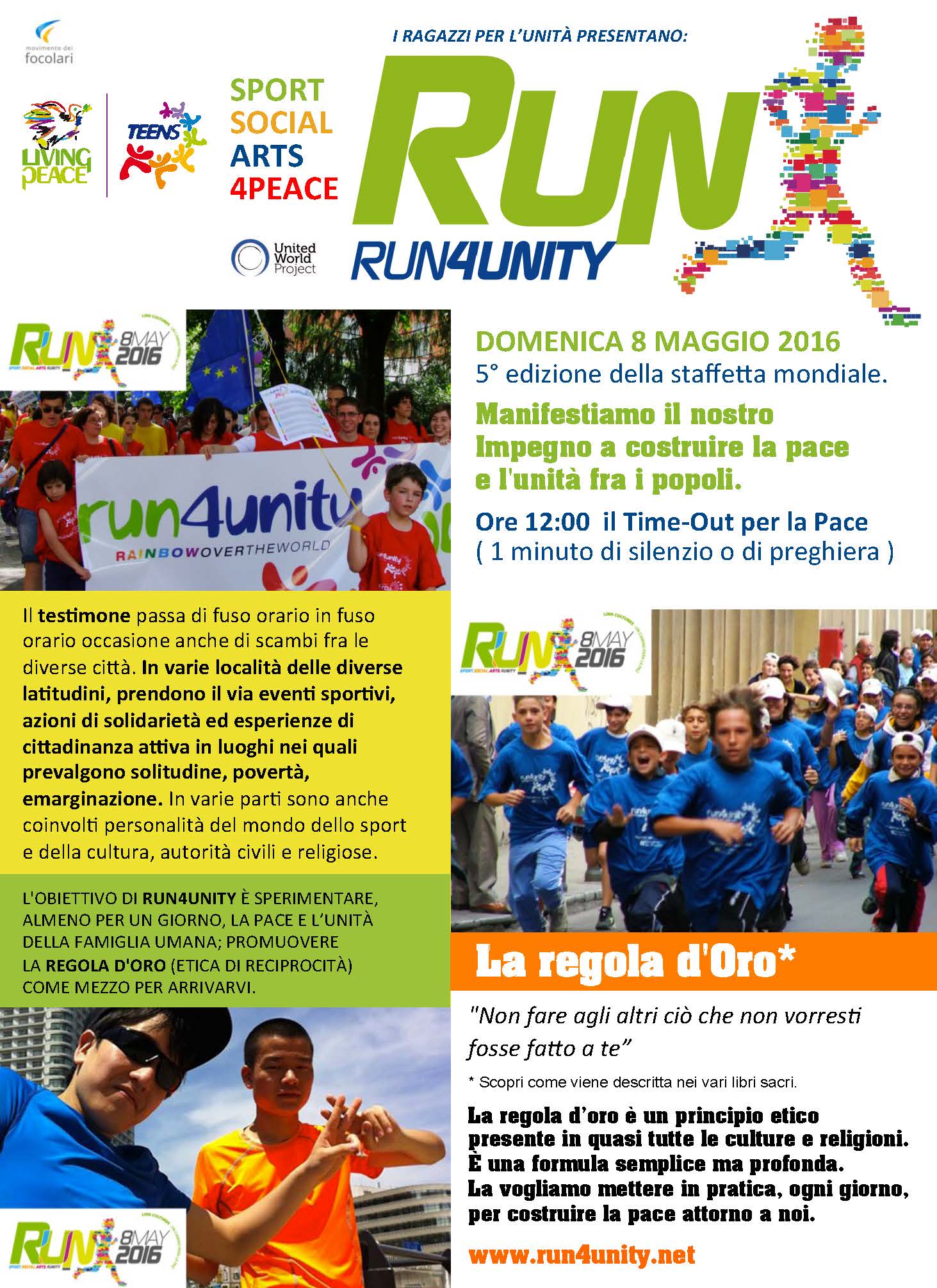 From 11 am to 12 noon in all the time zones, children throughout the world will run for peace (a stretch of the itinerary will be done on foot or by bike, roller skates, and canoe) with an extraordinary passing of the baton, from the cities situated in a preceding time zone to another. How? Through a phone call, or text message or at least “ideally linking up” with the others. 12 noon is the Time-Out, a minute of silence or prayer for peace. The day on which the Run4unity will be held will be called “World Day of the Golden Rule”: upon putting it into practice and promoting it, we will silently but effectively build Peace and a more united world. The web site http://www.run4unity.net is the tool which will highlight the world demonstration, in continual connection with social media, to allow all the boys and girls to be active in building and spreading the Event. There have been four international editions of this project: in 2005, 2008, 2012 and 2015. The R4U event is really quite unique since it links kids throughout the world, and who in a time span of 24 hours, from one time zone to the other, undertake to achieve a sole objective: unity of the human family. This explains the great interest of the mass media, and civil, religious and political authorities. Run4Unity is part of the activities of the United World Week and United World Project. Info: http://www.run4unity.net/ https://www.youtube.com/watch?v=SYR8R-_Rg_M
18 Dec 2015 | Non categorizzato
“Unity”, the basic point of the spirituality of the Focolare Movement, will be deepened during this meeting, with experiences of people from various cities, where the spirituality lived by many has affected the life of those regions. This is the case of the community of Szeged, Hungary, or Loppiano, in Valdarno, Tuscany and again on ecumenism in Great Britain, and the social field in Brazil. One of the many themes to be discussed is the aspect of communications as a tool used to reach unity; dialogue especially in the ecumenical and interreligious field, and the Focolare Movement’s commitment for peace. The great majority of those participating will be from Italy but also from France, Hungary, Greece and England. For information and bookings: info@focolare.org www.centromariapoli.org
18 Dec 2015 | Non categorizzato
«Unity» the basic point of the spirituality of the Focolare Movement, will be deepened during this meeting, with experiences of people from various cities, where the spirituality lived by many has affected the life of those regions. This is the case of the community of Szeged, Hungary, or Loppiano, in Valdarno, Tuscany and again on ecumenism in Great Britain, and the social field in Brazil. One of the many themes to be discussed is the aspect of communications as a tool used to reach unity; dialogue especially in the ecumenical and interreligious field, and the Focolare Movement’s commitment for peace. The great majority of those participating will be from Italy but also from France, Hungary, Greece and England. Another congress on the same themes will be held from 3- 5 March. Info: info@focolare.org www.centromariapoli.org
18 Dec 2015 | Non categorizzato
About 60 Bishops from all over the word will meet in Castel Gandolfo to go deeper in mutual communion, and share and reflect on the theme of «unity,» the element which is central to the charism of the Focolare. For those who are interested, the program will continue up to the 28th with a visit to the international town of Loppiano.
17 Dec 2015 | Non categorizzato
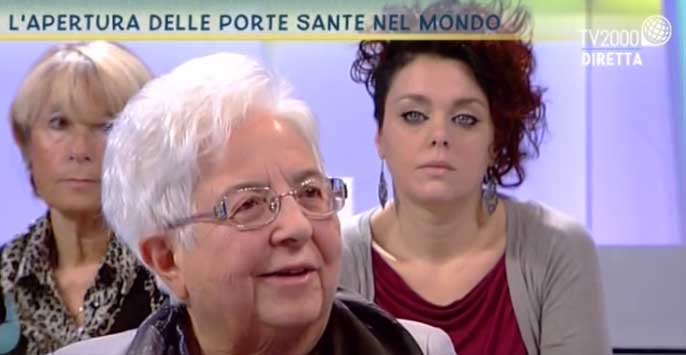
“Bel tempo si spera”, [Hoping for good times] is a programme broadcast by the Catholic Television Company TV2000. The programme on 14th December focused on subjects concerning the Jubilee, taking the viewers on a journey to several Cathedrals in the world, on the day after the opening of their Holy Doors. Maria Voce was in the studio, at the invitation of the presenter Lucia Ascione. Between one stage and another of this symbolic tour a dialogue took place on various subjects, starting with the meaning of the Jubilee. Maria Voce said, “The Year of Mercy gives us new courage to believe that God is Love. Now, when it seems that everything has become relative, we need to go back to what really matters, to believe in Love”. Later on, she added: “Unfortunately, modern culture speaks of anger, revenge, rights that have been trampled on, things that lead to sadness and despondency. We want to bring trust, forgiveness and mutual love. We want to look at the world as one family, the family of God’s children. And God is mercy, God is love.” “I like to recall – she went on – that the Pope did not open “the” Holy Door” but many holy doors. Pope Francis has said even the door of a prison cell can be a Holy Door. The door is a sign of the merciful love of the Father who is waiting for us all to come home, no-one excluded.” Lucia Ascione referred to Pope Francis’ words at the Angelus the previous day concerning the Focolare’s dialogue with Muslims. Maria Voce affirmed, “This harmonious encounter between people of different faiths that we experience did not happen yesterday, but has been built up day by day, over the years and in many places, through friendships; respecting difference.” Ascione insisted: “If it is so simple for you, why is it so hard for the world?” Maria Voce: “The Pope has said that unfortunately there is much self-interest. Instead we need to learn how to go beyond ourselves and be ready to welcome others, even if they are different. It is a love that we learn by loving, going towards others. Certainly, differences can make us fearful, that is true for everyone. It is a fear that can only be overcome with love. Taking up arms is of no use.” The presenter asked “You went to the United Nations and spoke there. What did you say to them? “I said that we need to convert ourselves, but not superficially. I said we must not see dialogue as one of many ways but as the only real way forward. It is difficult to accept this viewpoint because the “scandal of the cross” has not been understood. Mercy makes us do the part that the other should do, as Jesus did who died for each one of us.” Maria Voce explained “It is the experience that we have on a daily basis with those who knock on our doors. Recently 170 unaccompanied minors stayed in our little town in Holland and were made welcome”. Recalling the words of the press release that Maria Voce had issued after the Paris attacks, Ms Ascione asked: “What did you mean when you said we should ask ourselves whether everything that could have been done to avoid such violent reactions had been done?” “Very often we are affected by things that happen nearby, forgetting those that happen in other places where the horror of war is lived every day. We have communities in those places and we know that it is still possible to build something positive. We have doctors who don’t check to see whether a wounded person is a Christian or a Muslim; people who make their wells available to others when water is scarce, regardless of the religion they practice. Maybe we don’t know how to ask ourselves the right questions. That is why we questioned ourselves first of all. Perhaps we did not follow through with these things in the past. Being able to make an examination of conscience can open us up to hope. Seeing those who suffer, who are poor, we must not be afraid to open our hearts. We must not be afraid to empty our pockets and our wallets, to live simply and with respect for creation, seeing other people as brothers and sisters, part of the same family.”
