12 Nov 2015 | Non categorizzato
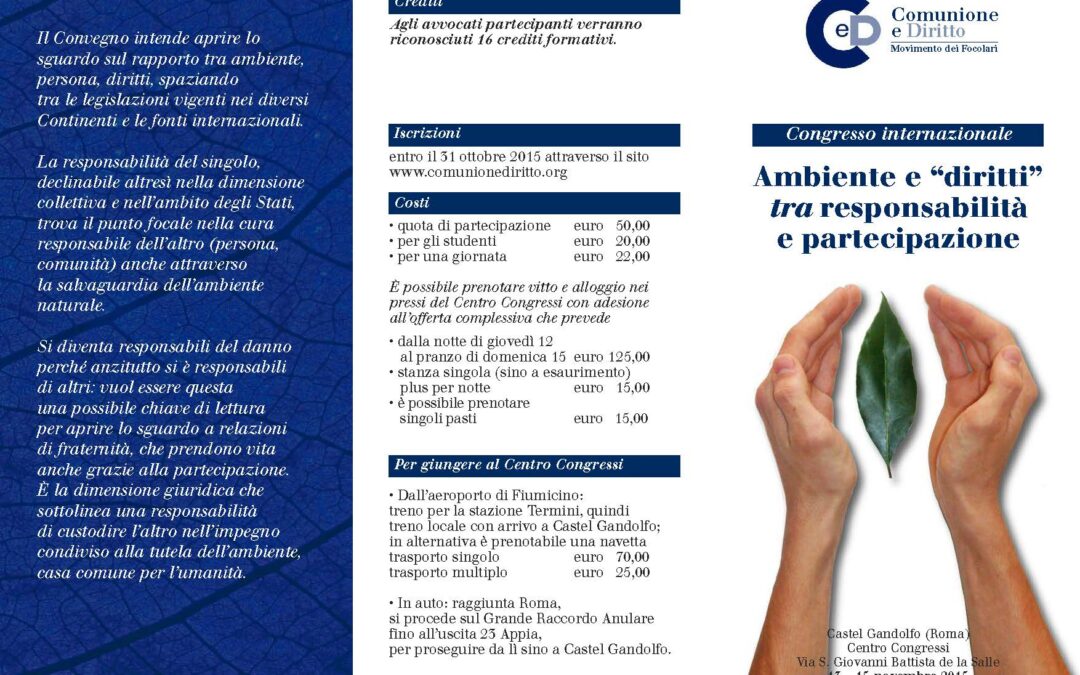
 Environment and Human Rights: A very topical issue only a few months after Laudato Si’, the Encyclical of Pope Francis on the environment, and on the vigil of the COP 21, the United Nations Conference in Paris on climate change. How was the idea born? “We have been working on this project for two years, which happens to fall at an extremely favourable moment for focusing on the environment. The Congress titled “Environment and ‘Rights’ Between Responsibility and Participation”, was born from the shared experience of a judge involved for many years in the court cases that arose from the tragic consequences and serious harm caused by the irresponsible use of the natural resources. Cognizant of the far reach of the Communion and Law network that extends to all parts of the world, he thought it could be a means of sharing and giving visibility to the problems and difficulties of the most distant and forgotten regions of the world. The idea was born of doing something that would bring a positive global response.” The programme indicates a heavy involvement of young people. What was the background process? “It was all the result of the encounter between European and African young people that took place during the March 2014 International Seminar at Castel Gandolfo, Italy. Those young people studied the theme of the environment in the perspective of responsibility and participation, and they committed themselves to continue their research up until the Congress that is scheduled for November 13-15, 2015.” Those attending will come from 4 continents, representing 21 countries. Therefore, there will be an international perspective from which to examine the laws that are in force in the environmental field, but to what end? “We would like to highlight the concept of relatedness that is inherent to being human. Our relatedness to others, in a relationship of care and attention demands responsibility in our relations both with other people and with nature. If we live in this way, those relationships will enable us to also gather the relationships of Love that underpin Creation. Another goal is to reinforce the concept of participation in legislative activity. During the congress we will evaluate a proposal of popular law that moves in that direction. The proposal comes from a Sicilian regional law concerning the territory of Pachino, which reveals the contrast between ‘legislative procedure’ and ‘participatory power’. Actually, communication with the interested parties is fundamental so that they can evaluate the current legislative and regulatory proposals.” “Moreover, we would like to give a voice to near and distant lands that are also different from one another, often forgotten or in the spotlight only because of dramatic situations, like the Central African Republic, for example. The discussion will not only be theoretical but will include stories and testimonies: on-going investigations into the damage to the environment because of irregularities, ‘halts’, the powers that be in the state apparatus, the problem of deforestation and desertification in Sub-Saharan Africa.” It is also a meeting with an interdisciplinary approach. Amongst the participants is EcoOne, for example, which is a network of researches in the field of Ecology and the Environment that shows the years of attention given to the environment by the Focolare. . .
“Scholars in ecology, environmental physics, but also economists, educationists, political scientists, architects will also join us. With them particularly during the roundtable on Sunday morning, our reflection will shift to the prospect of a unitary vision that could reconcile the terms: people and nature. During the last session, there will be an address by Focolare president, Maria Voce who was one of the initiators of Communion and Law, the network of scholars and law workers that was begun in 2001 because of an intuition of Chiara Lubich. In a nutshell, Communion and Law promotes and accompanies a variety of initiatives for elaborating and spreading a new culture founded upon relatedness as a juridcal category, but also key in the relations amongst law workers. Press releases
Program

7 Nov 2015 | Non categorizzato
There has never been so much talk about labour rights as in our times; and there has never been so much worker abuse as in our times. They have provided the crowds for the rallies and the piles for all the massacres, and the flesh for all the reprisals. Those that do survive are often left homeless on the streets, without family. Once again, we are called to bounce back, to reconquer death: to do what Peter the fisherman did, who said to the Master: “We have been hard at it all night, but have not caught anything; but at your word I will cast the nets.” At the word of Jesus, with hope, after a night of blood and ruin, we need to begin again. And the Father will reward our trust. All of us are engaged in this great enterprise, both labourer and intellectual, of repairing the great social wreck, with courage and responsibility. Let us never look back and never be afraid. Behind us stand the exploiters, the tyrants that have burned our homes and jammed our freedoms, the demigods that have waged war: they are the executioners and gravediggers. We are moving forward, even with the cross on our shoulders, towards the Redemption that means freedom: freedom from every evil, and therefore from the need of fear.” (Igino Giordani, Fides, June 1951) “You strip work of its value when you disassociate the economic value from the spiritual value. When God came amongst us He did so as a worker amongst workers. For thirty years He performed manual labour to help the people within the circle of his family and neighbours. Then, for three years, He did spiritual work whose fruits have benefited the human family of every age. Work is innate to us humans and as necessary to life as eating and breathing. Forcing a human being to be idle is like forcing a bird not to fly. With the advent of the Redeemer – a manual labourer who was God – labour and fatigue became the divinely manufactured ordinary means of sanctification. Anyone who works in accordance with the order of God, bearing with the fatigue out of love for God, becomes holy. The work in the fields, in the office or in the Church has the same value as prayer does. The salary is also doubled. On the human level, you are paid for the economic value produced by your handiwork and genius; on the divine level, you are paid for the merits of your patience, asceticism and detachment. As you build you bear with the fatigue, transforming it into the raw material of redemption, and you also build another stretch of the road to your eternal destiny. The prodigal son began his recovery when he began to work, just as he had begun his deterioration when he began to be idle. The real exploitation of work and of the worker comes about in proportion to the materialistic pretence of denying participation of the spirit in the works of the hand or of the mind: pulling apart the divine and the human, the spirit and the corporal, the moral and the economic, Our Father in Heaven the daily bread that needs to be served to us every day on earth. A person does not only live on bread for the stomach, but is also in need of nourishment for the soul. Pressing someone into a merely economic existence is like feeding only half of him while destroying him by starving the other half. The God Man saw and always sees the divine and the human not only one or the other, but both. Since the fishermen and their guests have not caught a single fish during an entire night of hard effort, and since the norm Jesus follows is ‘whoever does not work, does not eat,’ He invites them and their hungry families to go back to work, to recast the nets into the waters of the lake. God continually invites us not to be discouraged, not to despair but to get back to work again, always in His name. Like a human person, society also needs both works so that it can breathe with both lungs and live healthy and free. If not, it languishes, since it suffers either from bodily hunger or from spiritual hunger: one hunger brings the other. If there is no Father in Heaven, the bread on earth also becomes scarce because, without Him, the labourers are no longer brothers and sisters. They fight and steal, as happened and continues to happen to many of our immigrants who are opposed and rejected by other workers.” (Igino Giordani La Via, 1952)
6 Nov 2015 | Non categorizzato
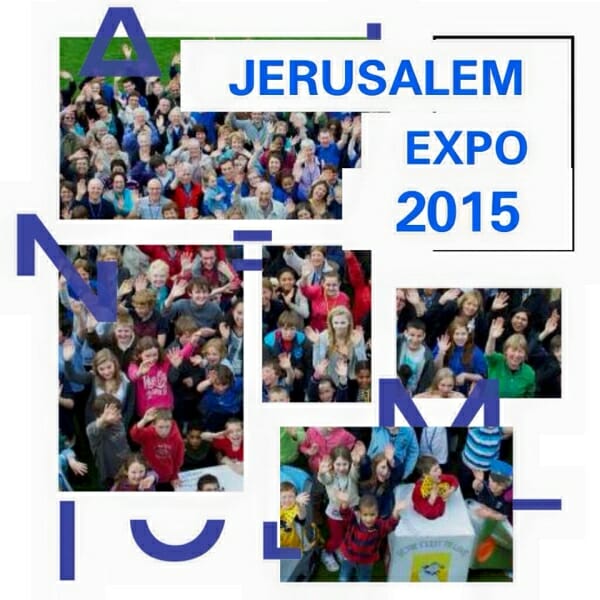
To celebrate the 50th anniversary of the Vatican Document “Nostra Aetate” Music, art, dance and live demonstration of the Jewish, Christian and Muslim communities in Jerusalem. Live streaming of the event Website: http://www.jerusalemexpo2015.com/ Facebook: https://www.facebook.com/NostraAetateJerusalem/
6 Nov 2015 | Non categorizzato
The event will include a Conference (June 30-July 1, 2016) and a public outdoor rally on the following day (July 2, 2016) that will send a strong message of hope. Through testimonies, prayers and songs, the event would like to show that unity is possible and that reconciliation is the door to unity in diversity. This has been the experience of the Communities and Movements from many Churches who participate in Together for Europe for more than 15 years. Unity is possible. Living the Gospel of Jesus Christ can overcome the divisions amongst individuals, populations, parties, cultures and even Churches and non-denominational groups. The Seven Yeses offers a summary of the commitments of Together for Europe 2016. Event Program
5 Nov 2015 | Non categorizzato
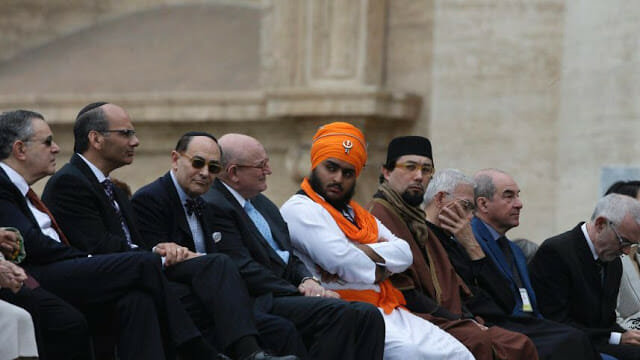 On 28 October 1965 at the conclusion of the historical assembly of bishops of the Catholic Church, the Council Fathers promulgated Nostra Aetate, the shortest document ever to be issued by the council’s working sessions. Half a century has passed since then, and the impact of those few pages revealed to be prophetic considering that the Catholic Church had passed centuries in the more or less firm conviction that there was ”no salvation outside the Church” – the famous Latin adage extra ecclesiam nulla salus. In February 2013, a few days before announcing his ”retirement” and upon reflecting on the Council at the end of the celebration of its 50th anniversary, Benedict XVI defined this document as a « trilogy that revealed its importance only in the course of decades,» along with Gaudium et Spes and religious freedom. In effect Nostra Aetate opened the Christian world’s horizon towards the others in their ”otherness,” but the management of which, according to the council’s procedures was not at all easy. At the personal suggestion of the French-Jewish historian, Jules Isaac to John XXIII, the Pope entrusted the initial scheme to Cardinal Bea. The idea was to draft a document that would contribute to prevent the repetition of tragedies like the Shoà, but after long and complex debates, the Council laid down a few pages addressing all the religions of the world. In effect, through a laborious and difficult process, the document opened to all the main religious faiths, undoubtedly and particularly stressing the confrontation with Judaism and Islam. Nostra Aetate underlines how the Jews should be presented in a positive manner: “They should not be presented as God’s rejects or as accursed, almost as if this came from the Holy Scriptures.” Above all, it excludes Israel’s collective responsibility for the death of Jesus. Therefore, this radically changed the views the Christian and Catholic world had of Israel for two millenniums. Likewise, a great respect emerged also towards Islam. “The Church regards Muslims with esteem” – declared the document – and “if in the course of the centuries, many disagreements and hostilities arose between Christians and Muslims, the Holy Council urges all to forget the past and sincerely practice mutual understanding, and together defend and promote social justice, moral values, peace and liberty for all.” As earlier said, also the recognition of the traditions of Hinduism and Buddhism is clearly highlighted, without forgetting the traditional religions. In fact, the document also affirms that “the Catholic Church does not reject what is true and holy in these religions.” What history often has not recognised as religions are now valued by Catholic tradition which acknowledges the presence of truth and sanctity also in their traditions.
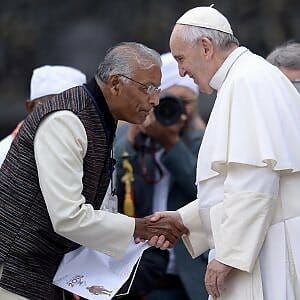
 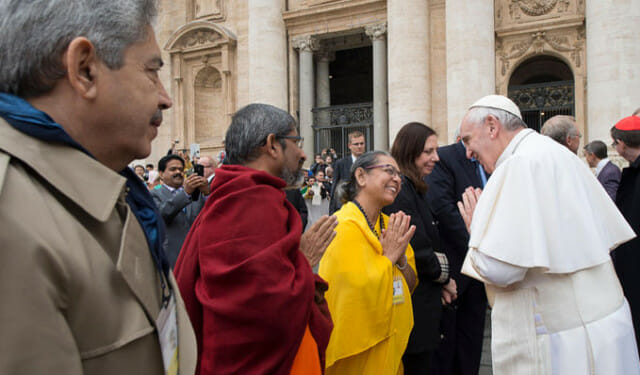 Today, a great variety of events are being celebrated in various parts of the world to reflect on the value of Nostra Aetate and the consequences it has brought about between men and women of different religious traditions. Amongst all is the particularly important event held at the Pontifical Gregorian University and organized by the Pontifical Council for Interreligious Dialogue. For three days, from 26 to 28 October, about 400 people of diverse geographic, cultural and religious areas met and reflected together on what has come about over the last 50 years. There were representatives of all the major religions of the world (Jews, Muslims, Hindus, Jainists, Buddhists, and Sikhs and those of the Tenri-kyo and the traditional African religions). They reflected on highly relevant themes today, violence, commitment to peace, the challenge of religious freedom, education and transmission of values. The convention was opened by Card. Jean-Louis Tauran, President of the Pontifical Council for Interreligious and by Card. Kurt Koch President of the Pontifical Council for Dialogue for the Promotion of Unity among Christians, and ended with a valuable and articulated reflection on ”Educating toward peace” by the Secretary of State, Card. Pietro Parolin. The participants then took part in the Audience in St. Peter’s square where Pope Francis dedicated his catechesis precisely to Nostra Aetate. He proposed a road-map for the future of dialogue, and encouraged all to work together for the poor, justice, the environment, and of course, peace. Rita Mousalem and Roberto Catalano, co-directors of the Centre for Interreligious Dialogue of the Focolare Movement, participated in the convention and conveyed the greetings of Maria Voce and the Movement when they briefly presented the important features of the Focolare’s interreligious dialogue and ensured the commitment of its members in continuing to work for the encounter and friendship between men and women of diverse faiths. Roberto Catalano
2 Nov 2015 | Non categorizzato
