26 Nov 2015 | Non categorizzato
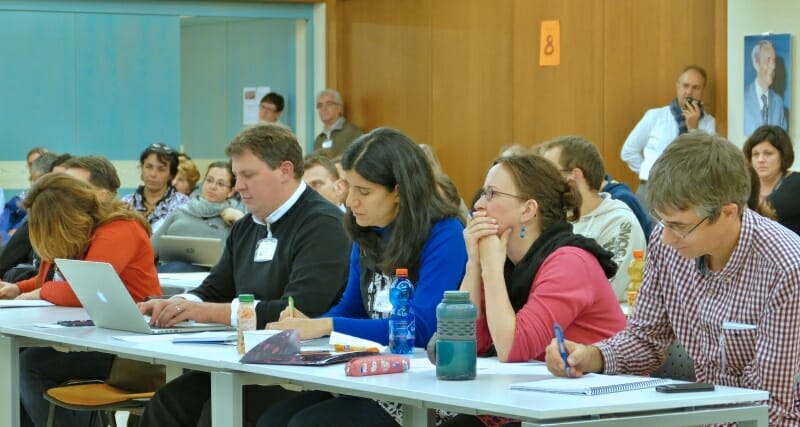
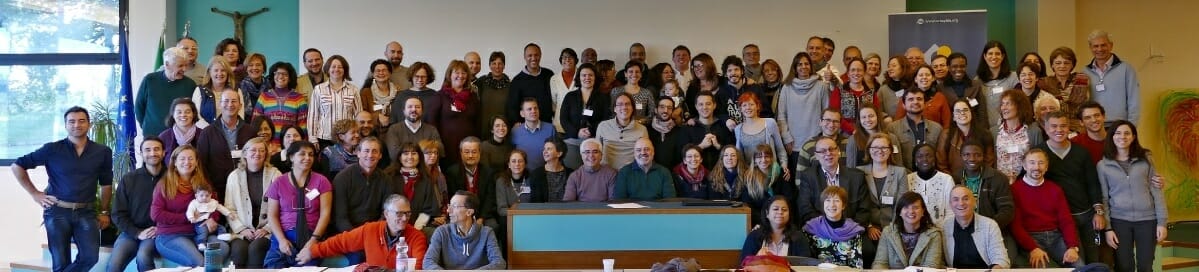 The launching of this innovative project took place recently with the first “train the tutor course”. The course gathered a hundred people at the Focolare town of Loppiano, Italy from a variety of fields: teachers, psychologists, medical doctors and youth directors from eight European countries, Brazil, Argentina, India, Burkina Faso and Cameroon. Many of them were parents or involved in child education. The prerequisite for acceptance into the course was that a man and a woman from the same region enroll together. The organisers suggested that it might be more beneficial if the topic of physical affection were presented to children and young adolescents by a man and a woman.
  The project stems from cooperation between families, youth group leaders and experts from various fields within the framework of the Focolare, including scholars from Sophia University Institute, Loppiano. The purpose of the project is to provide a holistic program to adolescents, in which human sexuality is illuminated by a vision of the human person as someone in relationship, with his or her capacity to love and be loved, to give and to receive. The ones who are most pleased with the project are the parents who, in the face of the complexity of such topics, are feeling the need for updated tools. These were the assumptions that guided the group which came up with the content, phases and methodology of the course to create a moral conscience in the teenagers, which would help them to account for their choices and express them. The trained tutors will begin operating in January 2016. There are already children in their countries who with their parents’ consent, are already planning on attending Up2me. The course will include twelve classes for three age groups: 9-11; 12-14; 15-17. It will examine the many dimensions of the human person (corporal, emotional, intellectual, social, spiritual, historical environment); and the lessons will range from knowledge of the human body to the concept of the human person; from stereotyped images in publicity and the media, to sexual identity; from managing emotions to conflict with parents; from dangerous behaviours, to the influence of Internet. Age appropriate dynamics (role play, video clips, life experiences) will be utilised to discuss bigger topics relate to the transmission of life, contraception, abortion, pornography. This will hopefully help the children in their relationship with themselves and in the discovery of the plan for their lives. Meetings and opportunities for collaboration are also scheduled for parents. The course was tested by two pilot courses in Italy. The 2016 course will be a year-long experiment with the first group of children from other European countries. Meanwhile, experts from the continents of the world will translate and adapt the program to local needs. Based on that experience the course for tutors will be presented again so that Up2me can be taken to other regions of the world. Info: up2me@afnonlus.org
22 Nov 2015 | Non categorizzato
“For I consider that the sufferings of this present time are not worth comparing with the glory that is to be revealed to us. For the creation waits with eager longing for the revealing of the sons of God.” [Letter of St Paul to the Romans, 8] There are many wars being fought on our planet, in our cities, in our neighbourhoods. The weapons are many and varied, but all of them produce only dead or wounded people and destruction. The millennia pass, but a brother continues to repeat to his brother “we go to the fields.” But whenever we start building peace again after conflicts, Abel returns to life, Adam walks again with Elohim in the garden of the earth, we can look “eye to eye” at each other in full reciprocity and with absolute gratuitousness. Every time we build and rebuild peace, our action also extends to creation, nature, the earth. And when we stop being its “keepers” (guardians) and deny peace, then the earth, animals, plants are injured, killed, humiliated, dragged into the vortex of our violence innocently. We see this more and more clearly every day. Peace, shalom, is a great biblical word. It is among the most common, severe and exacting ones. The first covenant of Elohim with men comes to restore an original peace-happiness that was denied, in order to regenerate the primordial shalom betrayed by Cain’s sin and by those of his equally atrocious children. It took a first peacemaker, Noah, for the rainbow to shine again over the earth, to make the re-creation of the world and of men possible. Peacemakers are always builders of arks to save a failed humanity. They are righteous men who feel a call to leave their land to save the land of all. If the world still lives despite all the evil that we generate, it is because Noah has never stopped building arks. The prophets and the many “blessed ones” in history have kept the rainbow in the sky by never stopping to build peace on a ground that has always been bathed by the blood of brothers. Noah’s hand and that of the boat builders of peace has until now been far stronger and more creative than the hands of Cain and the owners of warships. Peacemakers are not promised the earth, or the vision of God, or mercy. They are promised only a name: “They shall be called sons of God.” It is, however, an immense name, the biggest of all, and only used for them. Peacemakers are conciliators, those who reunite broken relationships, those who spend their lives solving the conflicts generated by others. They leave their own peaceful life behind in order to make other people’s lives more peaceful. Peacemakers, the builders of this biblical shalom, become what they are by vocation only. It is not just a matter of generosity or altruism. One can dedicate one’ own life for the shalom of others and of all only if a strong voice calls them to do so from deep inside. Building peace is never just a job, even when the construction and reconstruction of peace is part of our job. These voices, these calls within cannot be resisted: they are highly effective. And we cannot resist even when we do not know by whom and where the voice that calls us comes from: to be peacemakers it is enough to hear and respond to it (Read more). by Luigino Bruni
20 Nov 2015 | Non categorizzato
https://vimeo.com/140815700 Copyright 2015 © CSC Audiovisivi – All rights reserved
18 Nov 2015 | Non categorizzato
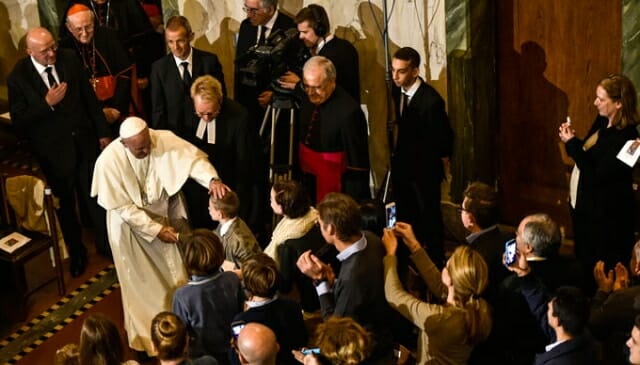
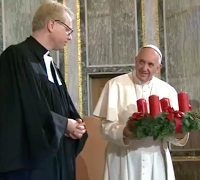 Home of Lutherans in Rome, the Christ Church welcomed Pope Francis on Sunday, November 15. Before Francis, John Paul II was the first Pontiff to enter a Lutheran Church and, in 2010, Benedict XVI was the second. “Our 500-member community is relatively small, all of us on the front lines in the field of ecumenism. We are active as a parish at various levels in the cit, but also in our own family, with colleagues at work, with neighbours or, like me someone who has lived in a Focolare community for more than thirty years,” says Heike Vesper. She was there on Sunday along with Catholic women focolarini who often accompany her to the Sunday liturgy. Heike called the Bishop of Rome an “evangelical Pope”, a pastor who focused his remarks that day on our common witness to Jesus Christ, “both in Lutheran expressions and in Roman Catholic expressions” on the importance of life and not so much interpretation. He spoke from his heart as he confided to us what he likes: to visit the sick and the incarcerated. The meeting and the prayer service with the Pope was new in its kind, you could say that it was a lesson on what should be of importance among Christians of different Churches: dialogue and deep listening, mutual trust, sincere and truthful answers, common prayer and listening to the Gospel.” Jens-Martin Kruse, Pastor of the Evanglical Lutheran Church, gave a warm welcome while remembering the victims of the Paris attacks: “Let us trust that Jesus has conquered the world and therefore not allow ourselves to be conditioned by fear.” “My brother Pastor mentioned the tragic events in Paris,” the Pope remarked. “Even God’s name is being used to close hearts.” “Pope Francis’s freedom and sincerity was very touching,” writes Heike. “He gave his answers from the perspective of a fellow pilgrim on the same road as the listeners. He stressed the importance of following one’s conscience, of living for the neighbour; and that with faith, that is with love, all the walls will crumble.” The fraternal tone of the dialogue created a family atmosphere that was “more and more deep and encouraging.” Three questions were posed to Pope Francis: What does it mean to be Pope? What is the duty of Christians towards the needy? What must be done so that we can celebrate the Eucharist together, the Lord’s Supper, when husband and wife belong to different Churches? “Those who find themselves in this situation,” Heike explained, “suffer from the division even more. It was not easy for the Pope to answer, in fact, in spite of the steps that have already been taken, theological questions remain open concerning the Magisterium, the vision of the Church, that are still an impediment to a common celebration. The Pope mentions a few possible paths for sharing the Lord’s Supper. He referred to the Gospel, to Saint Paul: “There is one Lord, one faith, one baptism” (Eph 4:5). He invited everyone to listen to his or her own conscience, to give more importance to life, to the common journey – more than to the different interpretations. His words instilled hope and peace. Even the gift he brought had a prophetic dimension: a chalice and paten for the celebration of the Eucharist.” The Gospel of the day was the Final Judgement (Mt 23) that reminds us that we will be judged on our love for the poor and needy. The Pope brought to the attention of those who say “our books say one thing and yours say another,” the words of a Lutheran idea: “There’s the hour of reconciled diversity.” And he concluded saying: “Today we ask the grace of this diversity reconciled in the Lord, the reconciliation of that God who came amongst us to serve and not to be served.”

15 Nov 2015 | Non categorizzato
“There is an infinite number of rays, all coming from the same sun: a single will, particular for each person. The closer the rays come to the sun, the closer they come to one another. “We too . . . the closer we come to God, by doing the will of God more and more perfectly, the closer we come to one another. “Until we are all one!” (Chiara Lubich, L’unità, Città Nuova, Roma 2015, a cura di D. Falmi e F. Gillet, p. 48-49).
14 Nov 2015 | Non categorizzato
That evening with friends I have some very close friends, most of them agnostics, with whom I had never explicitly spoken about my spiritual life. This had always left me with a certain sense of incompleteness. One evening we were taking a walk. Passing a church, I felt a strong desire to enter for a moment and greet Jesus. Being in the company of the others, this action seemed out of place, but I wanted to follow the impulse. During my brief visit in the church, I felt I had to say to Jesus: “Stay with me, because I am with you.” Shortly thereafter, at dinner, I felt I had to “reveal” myself to the others, but I didn’t know where to start! But then they spontaneously began to confront the topic of faith. It was a beautiful moment of communion. They expressed their perplexities to me, and words that even I hadn’t expected came out of my mouth. And all of this with mutual respect! Nothing of the kind could ever have happened if there hadn’t been that profound relationship between us. S. – Italy Sensitivity I am a nurse in the radiology department. In the corridors some patients wait their turn in their beds. One of them, with her arms bandaged, had been left uncovered. I greeted her, and with tact I covered her with the sheet. Years passed. One day, at a book presentation, a very elegant lady approached me: “I thank you for that day when you respected my dignity.” I almost didn’t recognize her. She continued: “It is when we suffer that we need even more to be respected as men and women. Thank you, because your service hasn’t made you insensitive.” E.M. – Hungary The embrace Seated at the desk of the charity center where I work, I was listening to a refugee whose appearance and clothing betrayed a past full of suffering. He was desperate because, having long been without work, he would be evicted from his lodging within a few days for not having paid the rent. I asked him, as I do with many like him, if he had friends here in the city who could help him. His reaction was unexpected: he burst into convulsive sobs, repeating: “I’m alone, alone! I have no one!” I was speechless, overwhelmed by a sense of powerlessness. Then, on impulse, I got up and went to embrace him. Slowly, he calmed down. He got up too, and with a tranquil tone of voice he said, “Now I know I am no longer alone,” and he made to leave, as if that simple brotherly gesture were enough to give him hope again. At that point I stopped him to show him how to procure himself clothing, make use of the Caritas dining hall and also a bed in our dormitory. By the time we separated, he was completely serene S. – Italy
