
Who are the saints?
Klaus Hemmerle
Reformation Day
It was in a spirit of ecumenism that 80 Christians from different denominations gathered on September 12th in the German town of Zwochau.  During her visit to Zwochau in 2013, on behalf of the Movement Maria Voce expressed the desire to know Martin Luther better and also the faithful of the Lutheran Church. More recently, because of an exchange of letters last May between Cardinal Marx, president of the German Catholic Bishops Conference and Bishop Bedford Strohm, Chairman of the Evangelische Kirche in Deutschland (EKD), the idea was put forward of promoting more cooperation between Christian confessions in view of the 500th anniversary of the Reformation that will be celebrated in 2017. There were two points for reflection. The first, given by Lutheran theologian Florian Zobel, focused on Luther and his life, highlighting several little known aspects, and concluded with the words of Pope Benedict XVI: “For Luther theology was not an academic issue, but the interior struggle with himself. […] The question: ‘Where does God stand in relation to me? How do I stand before God?’ […] I think that this is the first summons we should hear from Luther.” The second point presented by Catholic theologian and researcher on Luther, Hubertus Blaumeiser, focused on the spirituality of the reformer monk and, in particular, the “theology of the cross” and the meaning of “Reform” that followed: “Not merely a transformation, a change or improvement in accordance with one’s personal plans,” he said, “but a new beginning, starting from the roots; that is, the return to the Scripture, […] to the Gospel of God’s grace and to the new choice of a life with, for and through the Crucified Christ.” In the afternoon a roundtable was held, moderated by Hermann Schweers and Lutheran pastor, Axel Meissner of Schkeuditz, and Emeritus Bishop Joachim Reinelt of Dresda. There were numerous interventions from the audience that touched upon topics such as the importance of the ecumenical effort in a society of non-believers, and the meaning of the Reform for today’s world. The day concluded with an ecumenical celebration.
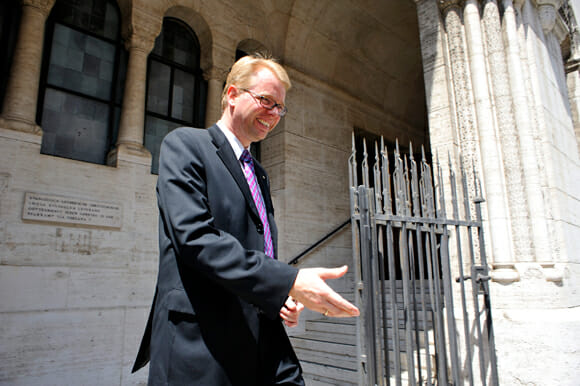
Pastor Jens-Martin Kruse. Photo: Harald Krille
Rome, Italy. World Congress on Catholic Education
On the 50th anniversary of Gravissimum educationis, the Second Vatican Council document on Education, a World Congress promoted by the Congregation for Catholic Education will held in Rome, Italy. The title of the conference: Educating Today and Tomorrow. . . .A Renewing Passion The congress will be attended by people engaged in the educational mission in Catholic schools and universities around the world. They will give a global glance to see what the contribution of the Christian community can be in multi-cultural and multi-religious contexts that are rapidly changing. The present educational and social emergency demands a review of educational approaches that are capable of transforming reality and are within the reach and the needs of children, teenagers and young people. The congress will include reports, testimonies and roundtables with experts from around the world. The congress will have three sessions:
- Opening Session(November 18, in Paolo VI Hall, Vatican City, Italy)
- The Main Session divided into Subsections: “School and University” (November 19-20, at the Mariapolis Centre of Castel Gandolfo, Italy); and OIEC Congress (at l’Auditorium di Via della Conciliazione, Rome, Italy)
- Closing Session (November 21, at Paul VI Hall, Vatican City, Italy) with an address by Pope Francis.
During the Closing Session in the presence of the Pope, the Service Learning Educational Model will be presented, which borrows several of its philosophical and methodological foundations from Chiara Lubich’s Education for Communion proposal as a proven educational approach that the Congregation for Catholic Education will recommend to educational institutions of the whole world.
Istanbul – 34th Meeting of Bishops from Different Churches
“Within a month, I will receive in Constantinople the Bishop Friends of the Movement:” The Ecumenical Patriarch of Constantinople himself announced to the press the news of the upcoming Meeting of Bishops from Different Churches, Friends of the Focolare that will be held in Istanbul on November 25-30, 2015. He made the announcement during an interview following the Ceremony of the Honorary Degree in the Culture of Unity, October 26, 2015 at Sophia University Institute, Loppiano, Italy. “We will have a meeting in Halki,” he continued, “at the school of theology, and there we will have the opportunity to remember Chiara Lubich and pray for the repose of her soul, and express our experiences and our will to work for the unity of the Churches. We, as the Church of Constantinople, are happy and ready to welcome them, to exchange our experiences and the Kiss of Peace between East and West.”
Protagonists in building a world of peace
 This is the title, but also the wish of the European Assembly of Religions for Peace (RfP), the organism that gathers the unites religious leaders of the world in walking together in the search for peace and justice, and Maria Voce is the co-president. Religions for Peace is currently involved in a global campaign called the Faiths for Earth project. “A very important initiative,” said Voce, because “humankind is facing an unprecedented challenge of global proportions, with little time left before it is too late. I see a providential synergy with the Pope’s Encyclical Laudato si’, which has generated such great interest around the world. In her opening address, on October 29, the Focolare’s president recalled the recent events that have changed the face of Europe. In front of the “tide of immigrants and migrants without historical precedent,” […] “Numerically speaking this phenomenon is far greater than the one million stateless people after the Second World War,” Maria Voce highlighted the dramatic situation that make us feel “dismayed, at a loss, and sometimes very uncomfortable, perhaps also deeply ashamed at our own powerlessness.” Among the causes she pointed to, also the “dramatic and questionable military interventions which destabilised whole nations in North Africa, the Middle East and Sub-Saharan Africa and other ongoing conflicts. Our European nations are certainly not completely blameless with regard to these conflicts. ” Great concern: “What is most worrisome about our continent is the deep identity crisis which prevents these emergencies from being addressed in a co-ordinated and united way; and the “people fleeing from hunger and war becoming often the cause of strife and nationalistic backlashes. They continue to be victims of selfish exploitation, and become tools in political strategies to win favour and promote dangerous populist action.” And so, “believers, as members of varied religious traditions, together with all men and women of good will” join the cause. “We are certainly different,” Maria Voce acknowledges, “but we are all united by the same imperative, so well expressed by the Golden Rule put in many different ways in all our scriptures. We can sum it up in these words: “Do to others as you would have them do to you.” (Luke 6:31). The Golden Rule is an ethical and spiritual norm that is too often forgotten. It has been put forward by Pope Francis as a true socio-political paradigm in his speech before Congress in the United States a few weeks ago.” The Golden Rule “calls us to respond to these crises, inviting us as leaders, as communities and as individuals to a shared commitment, one that is concrete, constant and heroic, even, so as to come to the aid of the mass of suffering people who plead for help, who are weeping and struggling and who, despite everything, carry on hoping. And it opens a window: “In fact, religion itself, which for centuries has been relegated to the private life of individuals and communities, and was considered by many as finished with until a few decades ago, has now become more accepted within the public life of our countries and our continent. It is needed today to give meaning and a soul, as well as true and satisfying answers, to humankind which is so confused and lost and traumatised today. It is enough to think of Pope Francis and the effect he is having in the world.” “This is the extraordinary adventure that we are called to live in our day and Religions for Peace is a providential platform: each one of us has a clear role in its immense workings. We are a wonderful international, intercultural and interreligious community, made one family above all by the shared ideal,” based on several basic points: Unity in diversity; Reciprocity in our relationships; and equality in our shared human dignity.” “On this solid foundation” it will be possible to “offer an effective contribution to peace and reconciliation in Europe;” and to set a final goal for ourselves: “humankind living according to God’s design fulfilled, which means universal fraternity.”