‘That they may all be one’ (Jn 17:21). We can share God’s own dream and, as Jesus did, live and pray for unity. It will lead us down his path of death and resurrection together with him. This is the last, heartfelt prayer that Jesus spoke to the Father. He knew he was asking the thing closest to his heart. God, indeed, created humanity as his family, to give it every good thing, sharing his very own divine life. What do parents dream for their children if not that they should care for one another, help one another, live united with one another? And what saddens them more than seeing their children divided by jealousy or money matters, even to the point of not speaking to each other? God too has dreamt from all eternity of a family of his own living united as children in a communion of love with him and with one another. The Bible’s dramatic origin story speaks to us of sin and of the progressive break-up of the human family. As we read in the book of Genesis, the man accused the woman, Cain killed his own brother, Lamech took pride in his exaggerated vendetta, Babel generated misunderstanding and the separation of peoples… God’s project looked like a failure. Nonetheless, he did not give in and with determination sought the reunification of his family. The story begins again with Noah, with the choice of Abraham, with the birth of the chosen people. And so it goes on, to the point of deciding to send his Son to earth entrusted with a great mission: to gather into one family the separated children, to welcome the lost sinners into a single fold, to break down the walls of separation and the hostilities among peoples to create one new people (see Eph 2:14-16). God does not cease to dream of unity, and for this reason Jesus asks it of him as the greatest gift he can implore for all of us – ‘Father, I pray That they may all be one.’ Every family looks like its parents. So too the family of God. God is Love not only because he loves what he creates; but he is Love in himself, in mutual giving and communion, lived out by each of the three divine Persons with the others. Therefore when God created the human race he made it in his image and likeness and he impressed upon it the same capacity for relationship, so that every person may live in mutual self-giving. A more complete version of the words in the prayer of Jesus that we want to live this month, in fact, says: ‘that they may all be one. As you, Father, are in me and I am in you, may they also be in us.’ The model for our unity is nothing less than the unity that exists between the Father and Jesus. It seems impossible, so profound is it. It is, however, made possible by that ‘As’, which means also ‘Because’. We can be united as the Father and Jesus are united because they draw us into their own unity, they give it to us as a gift. ‘That they may all be one.’ Precisely this is the work of Jesus, making all of us one, as he is with the Father, one single family, one people. To do this he made himself one of us, took upon himself all our divisions and our sins, nailing them to the cross. He himself pointed out the way he would take to bring us to unity: ‘And I, when I am lifted up from the earth, will draw all people to myself’ (Jn 12:32). As the High Priest had prophesied, he had to die ‘to gather into one the dispersed children of God’ (Jn 11:52). In his mystery of death and resurrection, he has gathered up all things into himself (see Eph 1:10), has recreated the unity broken by sin, has remade the family around the Father and has made us again brothers and sisters of one another. Jesus has completed his mission. What is left now is our part, our participation, our ‘yes’ to his prayer: ‘That they may all be one.’ What is our contribution to fulfilling this prayer? In the first place we have to make it our own. We can offer our lips and heart to Jesus so that he can continue speaking these words to the Father and with trust we can repeat his prayer every day. Unity is a gift from above, to be asked with faith, without ever growing tired. More than this it must be constantly at the forefront of our thoughts and wishes. If this is God’s dream, we want it to be ours as well. Periodically and before every decision, every choice, every action, we can ask ourselves: does this help to build unity, is it the best thing to do to bring about unity? And finally we ought to run to wherever disunity is most evident and take it upon ourselves as Jesus did. There may be friction in our family or among people we know, tensions in our neighbourhood, disagreements at work, in the parish, among the Churches. Never shy away from dissension and incomprehension, never be indifferent, but take to them our love that becomes listening, attention to the other person, sharing in the pain that results from that open wound. And above all live in unity with whoever is open to sharing Jesus’s ideal and prayer, without giving weight to misunderstandings or contrasting ideas, but content with ‘what is less perfect in unity more than what is more perfect in disunity’, accepting the differences with joy, indeed considering them richnesses for a unity that is never a reduction to uniformity. Yes, at times this will put us on the cross, but is it precisely the way Jesus chose to remake the unity of the human family, the way we too wish to walk with him. Fabio Ciardi
Patriarch Bartholomew I has pursued the history of an ecumenical journey, what in your opinion is the novelty of his achievements? “There are substantially two new aspects: firstly, the testimony of fraternity between Pope Francis and Patriarch Bartholomew. The message which the Holy Father sent to Bartholomew touched the Patriarch in a particular way, and he answered with the invocation of the prayer multos annos for Pope Francis, so as to take a further step towards unity. And the second novelty which struck me is “unity in diversity,” which besides other things is a leitmotif of many of Pope Francis’s discourses that underline how the Gospel is not uniformity but upholding the differences. They stand for unity precisely inasmuch as they spring from a sole source. They relate to one another and are able to reciprocally discover the gifts each of them conveys, due to which diversity is the gem of unity, especially when it is lived in relationship, that is, in fraternity and communion. To my mind these are two strong and new messages, that echo in a particularly effective manner, and are underlined by the way they touched the hearts of the great crowd present – 1,400 people – who responded to the fundamental parts of their speeches with intense rounds of applause that really came from the heart.” In a world that raises barriers in the name of diversity and the refusal of the other, what responsibility do Christians have today? “A unique responsibility, since in reality, only Jesus brought into the history of mankind a model of unity that is able to hold differences together and that is able to make it valuable. No other human vision or human ideology has ever been able to bind unity and diversity as one. It either ended up in uniformity or anarchy. Jesus has shown us the way which is narrow, difficult and in the end, also entails a taking up of the cross. But it leads to the resurrection and transfiguration of the differences into unity. This is the pearl of the Gospel, unity in diversity, communion, and the Holy Trinity incarnated in the relationships with all, starting from the poor and the derelicts, as the Pope reminds everyone.” Your continual reference to the Trinity to see what direction should be followed to achieve unity in diversity, strongly resembles the charism of Chiara Lubich and her vision of the “Trinitarian relationships” as the paradigm to be followed… “The Sophia University Institute was the fruit of Chiara Lubich’s inspiration, when she understood that the time had come for the charism, given to her by God and which had established the Focolare Movement, to become also a cultural expression. There is always need for mediations, paradigms – as Pope Francis says, a cultural revolution – so as to channel existence towards new frontiers. This is why Sophia University Institute was born: a new and tiny reality which is aware of all the limits of its initial stages and of human forces, but which is experiencing also the greatness of God’s Spirit, the charism of unity –the ut unum sint which is the key of our time. That is why our effort is to culturally draw forth with prophetic vision, concreteness, and realism, the significance of this paradigm of unity in diversity in politics (the politics of fraternity), and in economics (the Economy of Communion), at the level of philosophy (respect for the other), in all fields. I see the importance of such a deep harmony between what Pope Francis says (the mysticism of all as one, a Church that breaks its confines), and what Patriarch Bartolomew says (unity in diversity), the charism of unity given to our time … so as to make the journey together. The Holy Spirit is an artist, and infinitely disseminates gifts of all sorts but aims at one very precise project: today it may consist in the healing of these conflicts and gaps that divide humanity, to allow all the positive aspects existing to germinate, and infinite things already exist. So it has to be a laboratory of hope.” Source: interview with various newspapers, after the conferment of the Doctorate to the Ecumenical Patriarch of Constantinople, Bartholomew I.
“Everyone was so touched by the brotherly affection that joins the Holy Father Francesco to His Holiness Patriarch Bartholomew. The Pope recognizes the Patriarch’s commitment in the journey of unity, which he describes as our common journey. Not only that: he very courageously says that this Honorary Degree is a step ahead in that journey.” You know the Patriarch very well, you have lived and now live even more intensely, this moment in a long history of closeness between the Focolare Movement and the Orthodox Church and its Patriarchs. What are your views on this Patriarch and the significance of this recognition? “Patriarch Bartholomew is the heir of the great Patriarch Athenagoras who really possessed this passion for unity which, in him, was almost a prophetic vision that he was not able to realize. This passion was transmitted particularly to Patriarch Bartholomew who never misses an opportunity to press for unity in the heart of the Orthodox Church, so that they can talk to one another to the Church of Rome with a voice that is already in a certain sense synodal. He tries in many ways to emphasise how much this journey together is alive. I think we are truly at a happy moment because there is gentle pressure being given by two heads of our two Churches, and that cannot but produce fruit. There will be resistance as Pope Francis pointed out at the conclusion of the Synod, but in the end there is the Holy Spirit who will help us, who pushes the Church securely towards the unity of the Churches. We think that this is a happy moment and that this recognition might be an important step, a concrete step on this journey.” In his speech the Patriarch spoke precisely about what unity is and that it is different from union, which is different from uniqueness – diversity as richness, a concept that is quite present in the charism lived by Chiara Lubich. Could you explain to us a little more, in what way? “Chiara was always reminding us that the Church’s journey is guided by the Holy Spirit, and therefore He was surely maturing gifts in all the Churches of Christianity that would serve unity, that would serve if they were put in common. These gifts do not flatten but respect the diversity, precisely because they recognize a great richness in these diversities that only makes the Church more beautiful as Jesus wanted it. No uniformity therefore, but unity in diversity. Chiara would tell us that the highest model is the unity that joins the Most Holy Trinity where the Father is Himself because He is not the Son; the Son is Himself because He is not the Father; but the love that there is between the Father and the Son generates none other than the Holy Spirit who is the Third in this Trinitarian dimension, but is also the First since He links the Father and the Son. And this can happen because each of the Three Divine Persons of the Most Holy Trinity completely loses Himself in the other. This is precisely what is required for the Church’s journey; that is, that each one be able to completely lose himself in the other church; which means being able to reach all the way down to the bottom of one’s own richness and give it all to the other, to the others. Therefore, it requires knowing how to be love in order to build that Church of Christ in which each Christian, no matter what Christian community they belong to, feels like a sharer in the Body of Christ.” With this award, are there any new prospects that might open? “We were actually talking with the Patriarch himself about the possibility of eventually instituting a Chair at Sophia University Institute that would be part Roman Catholic and part Orthodox and would study such figures as Chiara Lubich and Patriarch Athenagoras, trying to sort out and understand the contribution they made and can continue make, through the encounter of their two charisms, to this journey of unity.” (From Vatican Radio)
Their “ethical statute” defines them as people who are immersed in «the contradictions and difficulties of the present time, and who take on themselves the burdens and sufferings of the world of work …in the perspective of universal brotherhood.» In this tension one can see the signs of that essential “new school of thought” indicated by Pasquale Foresi (“life itself makes us comprehend”), co-founder of the Focolare Movement who affirmed: «work is not only a means of sustainment, but is something inherent to our human nature, and is thus also a means to get to know reality and understand life. » It was a working method revealed through the experience of the employees of the former CGlobal company of Pisa involved in one of the usual restructuring and delocalization of businesses, and the story of the “bonds of solidarity” trade union fund of Pomigliano d’Arco, Naples, created thanks to the Parish of San Felice in Pincis, to give mutual aid to a community on the verge of collapse due to the lack of jobs caused by the international division of work steered by the multinational corporations. This scenario was completed by the dissertation of Alberto Botto, Secretary General of the trade union Luz y Fuerza in Rosario, Argentina, on the resistance of the labour unions in a confrontation with the power of military dictatorships and the liberalist privatisation formulas that risked to dissolve their country. In the light of the paradigm of “this economy that kills,” to cite the Pope, precisely those who decided to take action in the trade union out of a “thirst for justice” are experiencing the fragility and limits of their organizational methods compared to the commercialization of all aspects of life. The three days thus aimed to create an “unarmed” zone, where each could express the reasons for his/her commitment. It was a mutual sharing that highlighted sharing sessions and moments of a challenging dialogue with Maurizio Landini and Marco Bentivogli, national secretaries of two Italian metalworkers’ unions (Fiom Cgil and Fim Cisl), and also with Giorgio Cremaschi of the radical, critical area. The programme included the confrontation with Cecilia Brighi who has worked years in the international employment organization of the trade unions, and with professors, Antonio Maria Baggio, Barbara Sena and Alberto Lo Presti, who presented the actuality of a fundamental text re-edited by Città Nuova (“Labour issues and Christianity,” by Von Ketteler). The working sessions under the guidance of Antonella Galluzzi and Stefano Biondi, “Made in The World” contact persons and followed up by the Focolare Movement’s leaders of cultural dialogue, Caterina Mulatero and Joao Manuel Motta, saw the participation of the president of the Movement, Maria Voce, who remarked: «the truth is that jobs are not lacking. God did not leave us without work; just look around and see the needs and emergencies of civil society! What seems to be lacking is money. Where has it gone? Corruption and thirst for unlimited profits has created a gap between work and money, and its usage.» This is why we have to «take on the wounds of humanity together» with our “expertise” which is « universal brotherhood, reconciling man with man.» The participants departed with the great desire to share what they had experienced in order to promote opportunities for dialogue with other trade unions. «We understood that we are not alone – one of the Argentinean union members said – and that it is vital to remain united to give a spirit to the unionist struggle, in order to convey it to everyone.»
His Holiness Bartholomew I, Ecumenical Patriarch of Constantinople, a pioneer in ecumenical dialogue and a peacemaker, will be receiving the first honory doctoral degree in the Culture of unity conferred by the Sophia University Institute, situated in Loppiano (Florence) and founded by Chiara Lubich to deal competently and effectively with the cultural transition taking place. The theologian Piero Coda, President of the University Institute said: “Today, the world needs people who seek the unity of the human family, and the Patriarch is constantly rendering a valuable service towards a culture that aims at placing fraternity at the heart of human history”. […]. Diretta streaming See more: Patriarch Bartholomew I visits the Focolare’s little town of Loppiano
“God created the family, and he formed it in this way. He wants there to be love between husband and wife. If love is missing, there’s no marriage, no matrimony. Unfortunately, because of sin, this love has been spoiled to some extent. This love has been clouded over because sin entered humanity. So Jesus came and healed the situation, bringing a stronger love, a greater love, the very love that comes from God, the love which is God himself. So, we must take advantage of what Jesus brought, use this love in order to maintain natural love as well. For example, if you didn’t love your husband any more, you would have to love him because he is Jesus, because he is another Jesus, because you have to be the first to love, because you have to love everyone, because you have to make yourself one, because you have to love him as yourself. In other words, you bring supernatural love into the situation, with all that it means, in order to safeguard human love too. This is what to do and this way of doing things is the foundation of our New Families Movement.” Source: Chiara Lubich Center Video (italian soundtrack) https://vimeo.com/142517715

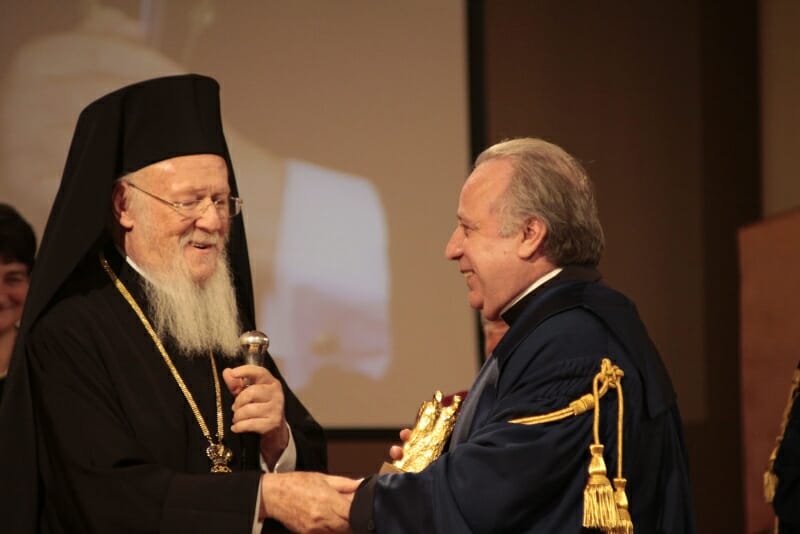
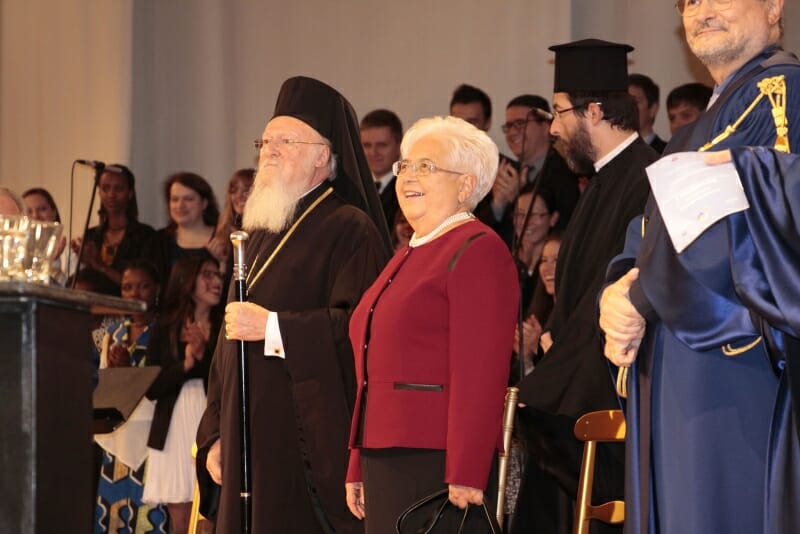
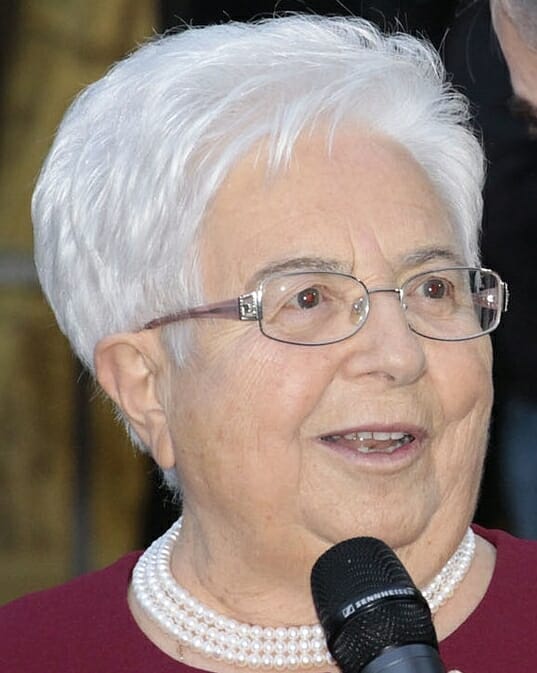 “Everyone was so touched by the brotherly affection that joins the Holy Father Francesco to His Holiness Patriarch Bartholomew. The Pope recognizes the Patriarch’s commitment in the journey of unity, which he describes as our common journey. Not only that: he very courageously says that this Honorary Degree is a step ahead in that journey.” You know the Patriarch very well, you have lived and now live even more intensely, this moment in a long history of closeness between the Focolare Movement and the Orthodox Church and its Patriarchs. What are your views on this Patriarch and the significance of this recognition? “Patriarch Bartholomew is the heir of the great Patriarch Athenagoras who really possessed this passion for unity which, in him, was almost a prophetic vision that he was not able to realize. This passion was transmitted particularly to Patriarch Bartholomew who never misses an opportunity to press for unity in the heart of the Orthodox Church, so that they can talk to one another to the Church of Rome with a voice that is already in a certain sense synodal. He tries in many ways to emphasise how much this journey together is alive. I think we are truly at a happy moment because there is gentle pressure being given by two heads of our two Churches, and that cannot but produce fruit. There will be resistance as Pope Francis pointed out at the conclusion of the Synod, but in the end there is the Holy Spirit who will help us, who pushes the Church securely towards the unity of the Churches. We think that this is a happy moment and that this recognition might be an important step, a concrete step on this journey.”

