26 Jun 2015 | Non categorizzato
published in Avvenire on 24/06/2015  The cries of many victims, of many who have been ‘discarded’, raises a question of justice which weighs heavily upon our capitalist system; a question that is all the more serious because it is no longer being seen or heard. Pope Francis is the only figure of authority on global moral issues, who due to his particular charism, is giving recognition and ear to today’s pressing ethical question (corporate social responsibility), in the face of which he is not afraid to raise radical questions (generated by his fraternal concern and love – agape ). No other ‘world organisation or body’ exists that is as free as he is from powerful economic and political forces, a freedom that not even the United Nations or the European Commission can lay claim to, let alone politicians at national level, who continue on in their practice of “selling a poor person for a pair of sandals – (Book of Amos), as indeed Italy is at risk of doing with its introduction of new gambling laws. A number of commentators, self-professed supporters of the free market economy, claim that the Encyclical Laudato si’ is opposed to it ; that not only is it a statement against modernism, but a reflection of the Pope’s own Marxist views, going almost as far as predicting a global environmental catastrophe. But far from it. In fact, it does just the opposite. Pope Francis focuses on reminding us that both markets and business enterprise are precious allies of the common good as long as they do not become the ‘only rule’; or that the ‘part’ (the market) does not try to become the whole (life itself). The global market is a necessary part of the life of society which contributes to the common good (there are many examples quoted of responsible business owners and technology being used at the serving of the economy and providing employment). However, it is not the full story, nor the most important. Pope Francis also seeks to remind all participants of the global economy of their vocation to reciprocity and “mutual benefit“. It is on this basis that he criticises companies who exploit (all too often) people and land; by doing so, they negate the very nature of what the global economy is supposed to be, increasing their wealth at the expense of impoverishing other weaker players. On a second level, Pope Francis raises an issue that has been systematically neglected: the notion of “efficiency“, globalization’s new “in-word”, as being solely about technology and therefore ethically neutral, cannot be upheld (34). The calculation of cost-benefits (cost justifications), which underpin every ‘rational’ decision by companies and public administration, depends precisely upon what we choose to include in the costs and perceive in the benefits. For decades we have considered companies ‘efficient’ who neglected to include in their costs any damage done to the sea, rivers or atmosphere. The Pope invites us to enlarge our calculations to all types of species, including them as part of our cosmic fraternity, extending this reciprocity to all creatures, giving them a voice in our economic and political budgets. But there is still a third level. Even after acknowledging “mutual benefit ” as the fundamental law of civil society, extending it to include our relationship with all living species and with the earth, it cannot and must not be regarded as the only law in respect of life. Though important, it is not all there is. Indian economist and philosopher Amartya Sen, refers also to “duties of power“. We have a responsibility towards creation because technology is new form of power, the outcome of which can have unilaterally serious consequences for other living creatures to which we are all linked. The universe is filled with living things and this calls for responsibility. Moreover, there are times when moral duties come before benefits; the concept of “mutual benefit” does not cover the full spectrum of responsibility and justice. Even the best market, if it becomes the only criteria, may grow into a monster. There is no economic logic that convinces us to leave forests intact for those to come in thousands of years’ time, and yet we have moral obligations towards the future generations who will inherit and inhabit our earth. The question of ‘ecological debt‘ (51), is one of the most significant and most prophetic passages of the whole Encyclical. The widespread indiscriminate accumulation of national debt can bring entire nations to their knees (as in the case of Greece), and hold many others to ransom. Much aggression is used in the name of debt and credit. Yet a great ‘ecological debt‘ exists between North and South, between the 10% of humanity which has increased its wealth, whilst burdening everyone with the cost to the atmosphere, and continuing to contribute to “climate change”. The term “climate change” is itself misleading, as it is ethically neutral. The Pope, instead, speaks of “pollution” and the deterioration of that common good which is our climate (23). Climate deterioration contributes to the desertification of entire regions, having a direct impact on poverty, causing deaths and the migration of peoples (25). It is this ‘debt of ecology and justice’ that we fail to take into account when we close our borders to the many thousands who arrive because we have burned their houses as a result of our actions. This ecological debt seems to count for nothing in the political world order, there is no Troika to condemn one country for polluting or causing the desertification of another country and so the ‘ecological debt‘ to which the great and the powerful are increasingly indifferent, continues to rise. Lastly, a word of advice, to whoever has yet to read this wonderful encyclical, do not be tempted to read it sitting at your desk or relaxing on the sofa. Go out into the middle of a field or into the woods, to begin your meditation on this canticle of Pope Francis. The earth he speaks of is real and tangible, filled with the sights, sounds and scents of an earth that is loved. Then, go to a poor area on the margins of society, to conclude your reading, surrounded by poor people, and look at the world with its rich and greedy living, with poor beggars on its doorstep and embrace at least one of them, like Pope Francis. It is from such places as these that we will learn once again to be ‘in awe‘ (11) of the marvels of the earth and of fellow human beings. Perhaps then we will understand and pray the words “Praise be to you“.
26 Jun 2015 | Non categorizzato
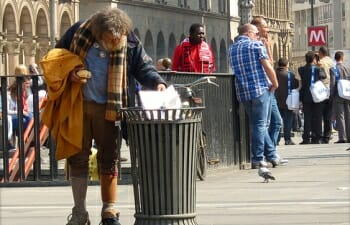
Sobriety “Every morning, before taking the bus, I walk part of the way on foot and am often drawn by the same scene: men and women, children and elderly, dressed with dignity, all equipped with shopping carts and rods, fishing for a bit of everything from the rubbish bins. They teach me something in their own way. As a Christian, I try to remain attentive to what is essential and to avoid waste: to opt for sobriety, recycling, answering with a firm ‘no’ every time consumerism tempts me with its offerings.” (Emilie – Italy) The Grandmother “’Love your enemies.’ This sentence from the Gospel shocked me because – thinking about it – I also have an enemy: the Grandmother whom my family hasn’t visited in because of old misunderstandings. When I heard that she wasn’t well, I thought I would go to visit her. My parents were amazed that I had suddenly remembered her. They didn’t feel like going after so many years, but I wanted to be able to see her. When I went into her home, everyone looked at me amazed and treated me with coldness. It wasn’t easy, but I stepped up. Grandmother was not at all well. She was dozing, but when she awoke, I was able to say hello, and she embraced me. “You’re my grandson, I know you. I’m happy, happy. . . We both wept for joy. When I returned home, I convinced my parents, and we went back altogether to visit her. It was a very emotional moment! Not even a week later, Grandmother left us for Heaaven.” (S. A. – Pakistan) It was me “We were in the countryside. There was a little boy next door, named Tino who was living in a difficult environment; perhaps for this reason he is so violent towards our Andrea. One afternoon, I found Andrea’s new bicycle broken. Losing patience, I wanted to know who it had been. Shortly afterwards Andrea came in, downcast and dejected. ‘Mamma, I broke the bicycle.’ Greatly surprised, I had to shout at him before I forgave him. The next day, when we were alone talking, the boy confessed: “You know, Mamma, it was Tino who broke the bicycle. But you were so angry yesterday that I was frightened for him. They’re always shouting at him in his house. . .’”(I.P. – Brazil)
25 Jun 2015 | Non categorizzato
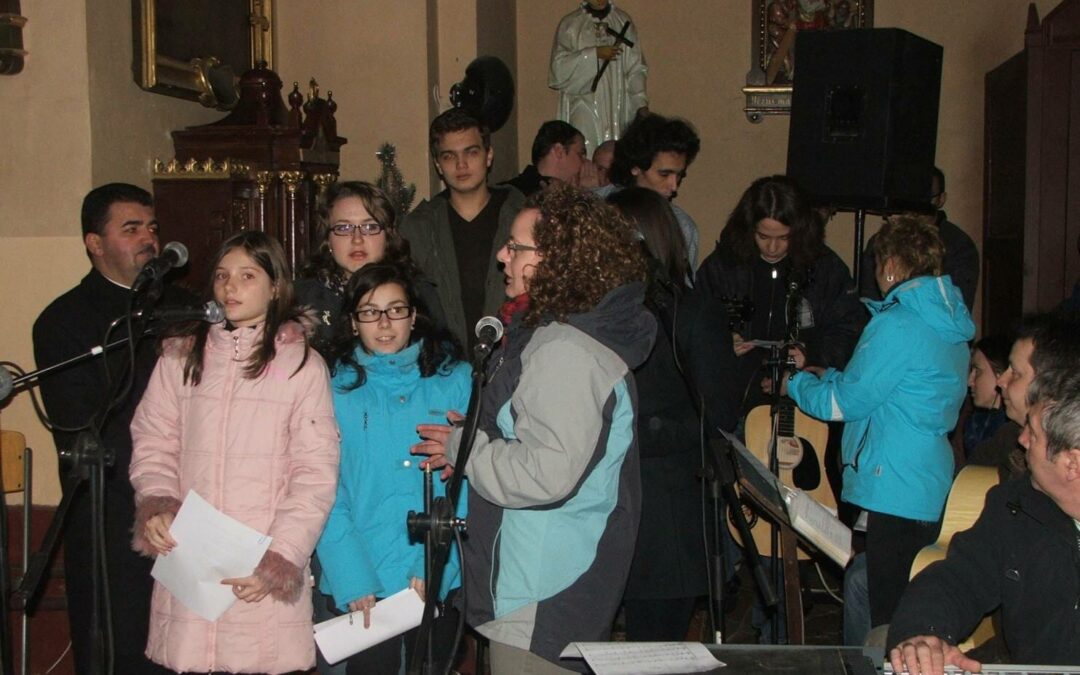
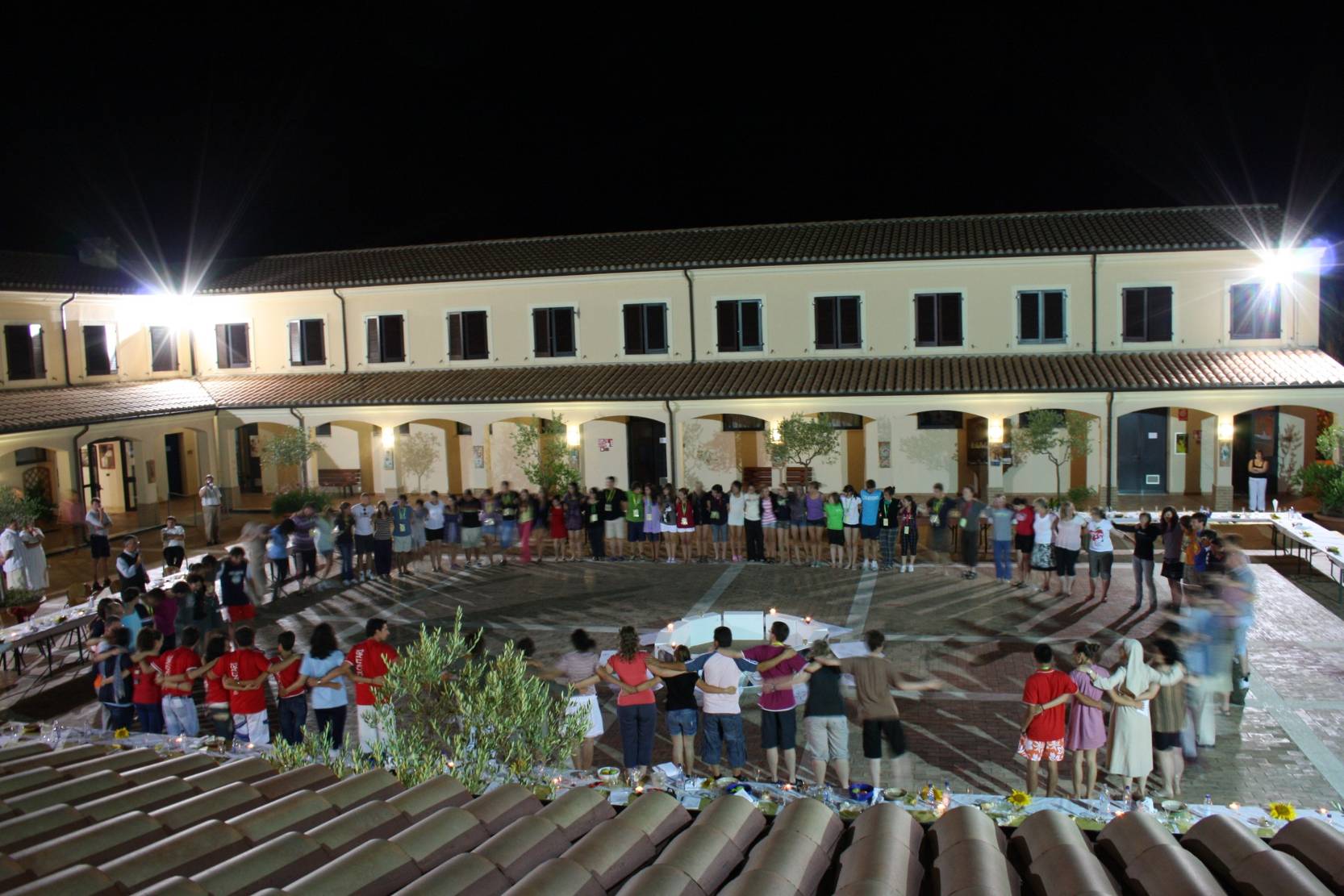 “The Bishop had assigned me to work in the council for ecumenism and dialogue. Fifteen years ago, when a priest-friend of mine from the nearby diocese of Fano came up with the proposal of an inter-diocesan project to promote Ecumenical Twinning between European parishes, I had said no.“As Fr. Giorgio Paolini recounts, this hesitation was soon resolved when he recalled that in London in 1996, Chiara Lubich launched an invitation to live an “ecumenism of the people,” an “ecumenism of life” (video). “So I resumed my contacts with my friend from Fano and together with other priest-friends we threw ourselves into the ecumenical twinning experience.” The first parish they contacted was the Orthodox parish of Fr Nicu in Romania. «The fraternal relationship among us generated an educational cooperation between the youth of the Diocesan Movement of the Marche region and his youth, and which spread out in concentric rings with the sharing of the Word of Life and the spirituality of unity between the Catholic and Orthodox youth through frequent meetings. The two important yearly meetings each year were held at Christmas in Rumania and in summer in Italy Then came the annual experience of the Ecumenical Youth Meeting in Loreto, organised together with the Head of the John Paul II Centre of Montorso (Loreto), who had proposed the creation of an ecumenical camp with all the youth contacted through the ecumenical twinning, but also open to all, to allow us to share the mutual wealth of our churches of origin. This year, from 29 July to 4 August, the seventh edition will take place and which foresees the participation of over 200 Orthodox and Greek Catholic youth from Rumania, Lutherans from Denmark and Sweden, Anglicans from England and Catholics from Italy.”
 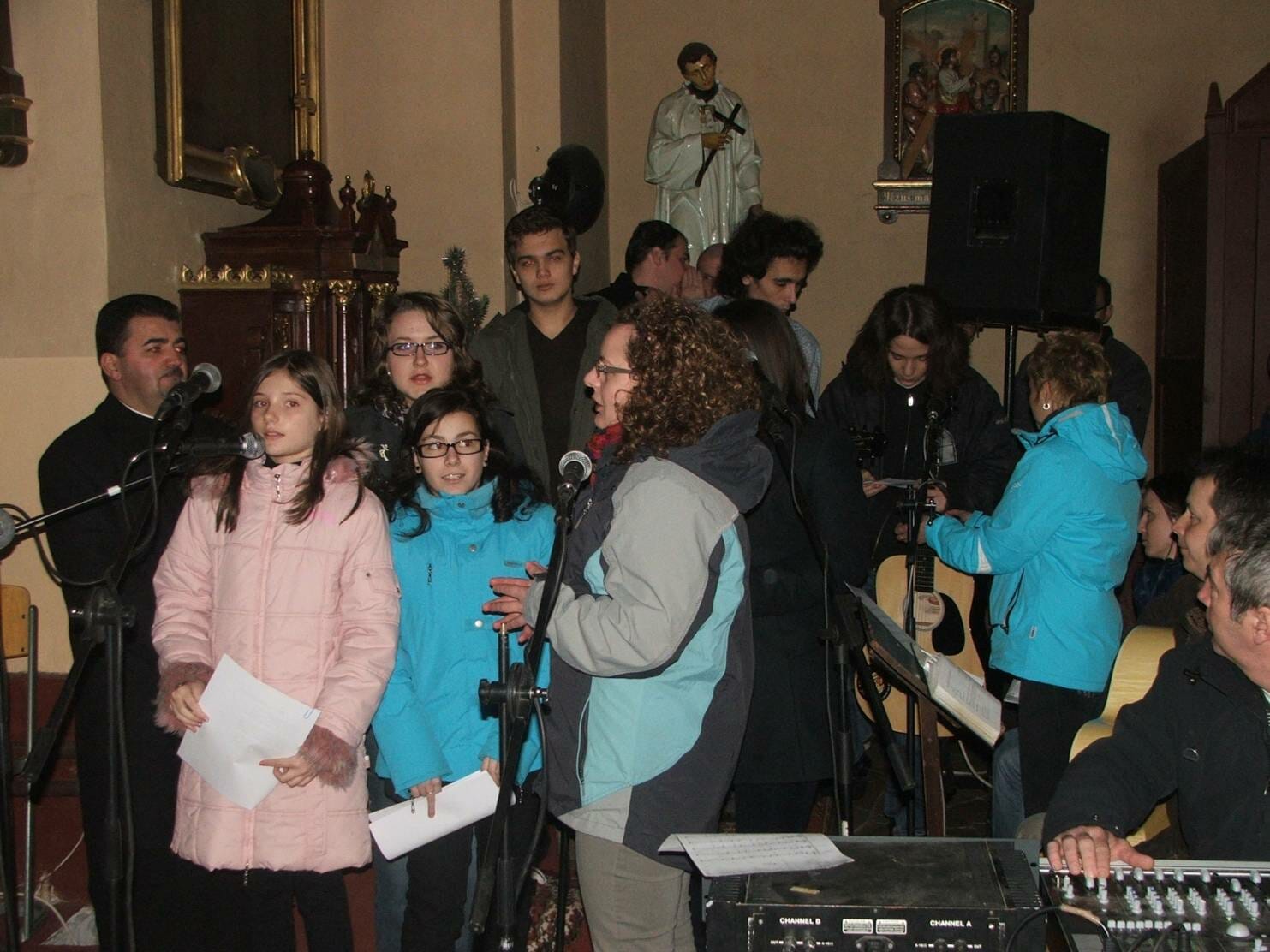 Lastly, the promotion of the “culture of dialogue” among the youth. In January this year, during the Week of Prayer for Unity of Christians, for example, the parish of Borgo Santa Maria hosted around 20 Rumanian boys and girls of a parish it is twinned with. Together with the Italian youth of the Ecumenical Meeting, they then met with the students of four high schools in the provinces of Pesaro and Urbino. Barbara, spokesperson for a family of the parish continued with the story: “In a world oppressed by wars, divisions and terrorism, these boys and girls wished to propose and offer a message of joy and hope, and certainly a new culture of relationships and encounter that help us to comprehend that in the diversity of others we can discover that richness which brings unity and not division. After watching a film and listening to the testimonials of the youth, the Ecumenical Meeting broke up into groups to get to know the Romanian youth better, through a question-and-answer session. Despite language difficulties they did their best to communicate with one another. As a family we participated in these meetings as observers, but we feel that we have to thank all those who believed in this project, and continue to do so. I thank the parish priests and the Deans of the high schools, but above all God, who in his immense love made us come across such youth, motivated and determined to change things. They can count on our support and we have faith that they will be able to involve more and more young people, and create a better world where all can live in peace and harmony.”

24 Jun 2015 | Non categorizzato
 Love is our mission: This is the title of the 8th World Meeting of Families (WMOF), which will begin with a Congress (from September 22nd to 25th) held by experts from all over the world and which will take place at the Pennsylvania Convention Center, a structure which can hold up to 50,000 people. In the meantime, Pope Francis will travel to the headquarters of the UN in New York City and to that of the U.S. Congress in Washington, D.C., having been invited, for the first time in his pontificate, to speak in such important civil locations. The Holy Father will arrive on the stage of the WMOF, which will be set up on the spectacular stairs of the Philadelphia Museum of Art, on Saturday, September 26th. With this evocative backdrop, he will meet with families from all over the world, in a sequence of life experiences interposed with performances by international artists: a Festival-Testimonial which will be shown on TV worldwide and will culminate with the words of the Pope. The WMOF will conclude the following day, Sunday September 27th, with the solemn Eucharistic celebration, at which the pope will preside. More than one million people are expected to participate. Besides the numerous families of the Focolare from all over America, Marly and Hans-Peter Stasch from the International Office of New Families, and Anna and Alberto Friso, members of the Pontifical Council for the Family, will participate at the event.
24 Jun 2015 | Non categorizzato
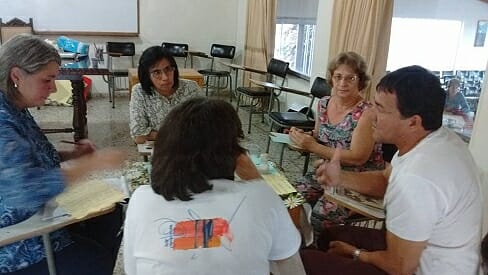
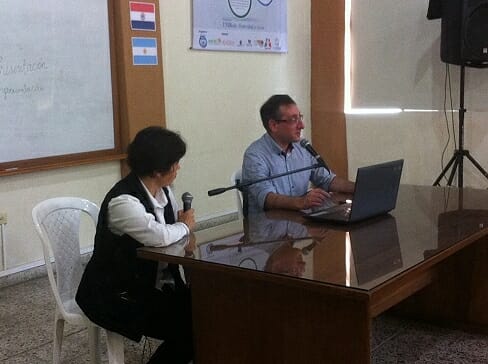 In 2013 the Colombian city of Medellín, with its 2.4 million inhabitants, was recognised as the city that achieved the most rapid modernisation process in the world, also due to the developments undertaken over the last years, like for example, the drop in carbon dioxide emissions, creation of cultural areas, and reduced criminality. The Mundo Mejor Foundation operates in Medellin and due to this was chosen as the seat of the 3rd UNIRedes Seminar, that was held from 3 – 7 June. There were representatives of over 30 organisations from Brazil, Mexico, Argentina, Bolivia, Paraguay, Venezuela and Colombia, with the addition of other 10 countries that participated via streaming. During this seminar the various social organisations inspired by the spirituality of unity accepted the challenge to strengthen their joint efforts. Anabel Abascal, member of the Coordinating Committee affirmed: “As social associations members of the UNIRedes believe that, in society today, working within a network is the only way in which we can call attention to universal fraternity which is our source of inspiration.” The discussions of the four-day meeting revolved around the tools available to be able to best respond, with daily work, to the great social challenges. Susana Nuín, of the Episcopal Conference of Latin America (CELAM) illustrated the Regional Church’s viewpoint, by presenting the 4-crossroads for social intervention: care of nature, building of peace, migration and social justice. An Italian Professor, Giuseppe Milan, expounded on intercultural pedagogy based on the spirituality of Chiara Lubich – a pedagogy that recognises and takes upon itself the sufferings and needs present in social diversity. Milan affirmed: “The principle of education is fraternity, education of universal-men who centre on dialogue to build new societies. The methodology is the art of loving. Accepting all and respecting the different cultures.” The other themes undertaken were related to the institutional consolidation of the organisations and network management. To this end, Francesco Tortorella of AMU (Action for a United World), explained how the projects are designed, starting from the funding phase up to direct participation of the protagonists. To conclude, the working groups formed a new Coordinating Committee and the various working commissions that will have to pursue the various UNIRedes objectives: develop new communication strategies to intensify communion and diffusion of the various actions, giving visibility to the hope of diffusing the small, but important changes our actions generate in the lives of people; achieve a greater impact in the local public policies; weave new bonds of cooperation between organisations; work in such a way so as to give the beneficiaries of the project an active, leading role; incentivise reciprocity; promote social volunteer work as a strategy to improve the management of organizations and form a new humanity. The various discourses of the 3rd Seminar can be view via streaming and in the web page Sumá Fraternidad.
20 Jun 2015 | Non categorizzato
“Mercy: the word reveals the very mystery of the Most Holy Trinity. Mercy: the ultimate and supreme act by which God comes to meet us. Mercy: the fundamental law that dwells in the heart of every person who looks sincerely into the eyes of his brothers and sisters on the path of life. Mercy: the bridge that connects God and man, opening our hearts to the hope of being loved forever despite our sinfulness.” These are the words of Pope Francis in the Bull of Indiction with which he announced the Jubilee Year of Mercy on April 11, 2015. God “does not limit himself merely to affirming his love, but makes it visible and tangible. Love, after all, can never be just an abstraction. By its very nature, it indicates something concrete: intentions, attitudes, and behaviours that are shown in daily living.” Pope Francis clearly does not intend to exclude fidelity to the truth and doctrinal clarity, but rather combine them with the reality which people live. And not to yield to compromise, but to be faithful to the God whose Truth fulfilled is Love. A freeing message which leaves no one out. This is the platform upon which the two Synods of Bishops on the family are moving forward. A path to be lived — as stated in the Lineamenta, sent to the dioceses in view of the upcoming Assembly– ” to read both the signs of God and human history, in a twofold yet unique faithfulness which this reading involves,” facing with realism the family of today and keeping at the same time, ” our gaze fixed on Christ to ponder, with renewed freshness and enthusiasm, what revelation, transmitted in the Church’s faith, tells us about the beauty, the role and the dignity of the family:” The Gospel of the family. Fidelity, on the one hand, to God’s design which “is to be understood not as a “yoke” imposed on persons but as a “gift”, ” as “good news” which places itself in the service of the deeper fulfillment and happiness of people; but fidelity, on the other hand, to people in what they live and often suffer in a complex society with an interiority -one’s own and that of others- not less complex, from which numerous vulnerabilities originate. The key phrase is the art of accompaniment. In this regard, Pope Francis highlights in Evangelii gaudium: ” without detracting from the evangelical ideal, they need to accompany with mercy and patience the eventual stages of personal growth as these progressively occur.” It is always necessary to learn to ” remove our sandals before the sacred ground of the other (cf. Ex 3:5). The pace of this accompaniment must be steady and reassuring, reflecting our closeness and our compassionate gaze which also heals, liberates and encourages growth in the Christian life.” In fact, ” Someone good at such accompaniment does not give in to frustrations or fears. He or she invites others to let themselves be healed, to take up their mat, embrace the cross, leave all behind and go forth ever anew to proclaim the Gospel.” A demanding agenda which the Church is called to carry out–as the Lineamenta states–” with the tenderness of a mother and the clarity of a teacher (cf. Eph 4:15).” That’s right, “The Church:” not only the bishops and the priests, but the entire People of God. ” Without the joyous testimony of married people and families, domestic churches, proclamation, even if done in its proper way, risks being misunderstood or lost in a flurry of words that is characteristic of society today.” The complete text in Italian, with reflections and testimonies, is found in: Periodical of Church life: Gen’s.
