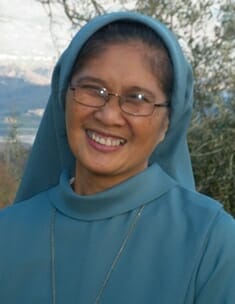
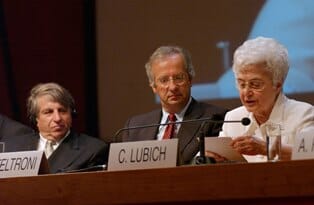
“I found myself in the hospital due to a serious accident. It was the first time I ever experienced such pain.” Sr Felicitas from the Philippines recounts . However, it was precisely in the hospital that I experimented God’s love through the people who came to visit me. Some priests brought me the Eucharist which in that moment was everything to me. The chaplain was warm and helpful. Surrounded by so much love I responded in the same way: it was a chain of reciprocity.” Sr Felicitas’ experience stresses theimpact of the spirituality of communion as a possible answer to the demands of community apostolic life in the world: “It is an extraordinary coincidence between what the Church and the world ask of consecrated life,” Sr Antonia Moioli, head of the consecrated of the Focolare Movement affirmed. “The seed Chiara has sowed inside us germinates and at times blooms and become a prophetic voice that indicates the way to humanity that has gone astray and becomes an “exterior castle,” irradiating love. “Grow and live in the spirituality of unity,” is what the Prefect for the Congregation of the Institutes of Consecrated Life Associations, Cardinal João Braz de Aviz, asked of the religious men and women members of the Focolare, “because when charisms meet, they become vigorous and the Work of Mary (Focolare Movement) make charism shine, it enlightens them. Words are not needed – he continued – just be witnesses of the Gospel lived; this is the road to change. The specific vocation of the consecrated religious men and women is to open the prophetic roads while testifying to the values of the Kingdom. This is what the Church and humanity expects today, and to fulfil this we must return to our own charisms and liven it up.” Giuseppe Zanghì (Peppuccio), philosopher and scholar, regards Chiara Lubich as a bring of a light that has created the conditions for a new culture, that flowed from Jesus Forsaken: He is the God of contemporary man. «His reflections – again Sr Antonia explains – spurs us to be a light in the darkness, sentinels that announce the dawn. Will we be able to fulfill the prophetic vocation typical of consecrated life? In the past, monasteries and communities were the prestigious centres of culture and spirituality ; can we still look to this ancient-and-new reality as a challenge?” “Right here today we have found a treasure chest,” Maria Voce, Focolare President affirmed, “and together we can give this treasure to the entire Church and all the world, which, in order to believe in Christ, needs to see how Christians love one another. These riches God has given us, making of us his family, is for the benefit of humanity. This is the sense of that “going all out” Pope Francis continues to underline., and the universal brotherhood of humanity begins with the fraternity among us, in every convent, every community, every congregation and order and in the entire Church.” The Congress of the consecrated opens out to a future to be built, not alone, but together with many others, that makes of us the testimonials to a love that defies all differences.
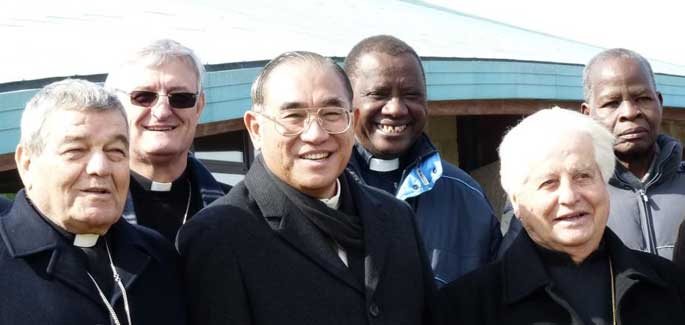
The Bishop does not gather the population around himself as a person or his ideas, but around Christ, Pope Francis said in the meeting with the Bishop-Friends of the Movement. The charism of unity which is the Focolare Movement’s main characteristic – the Pope said – “is strongly anchored to the Eucharist, which confers it a Christian and ecclesiastic feature.”
“Without the Eucharist unity would lose its attraction pole and be just a sentiment and a solely human, psychological and sociological dynamics. Instead the Eucharist ensures that all centres around Christ, his Spirit, it is the Holy Spirit that guides our steps and our initiatives towards encounter and communion.”
The fundamental service of the bishops – Pope Francis went on – is to gather “the communities around the Eucharist, at the dual banquet of the Word and the Bread of life.”
“The Bishop is a principle of unity in the Church but this would not occur without the Eucharist: the Bishop does not gather the population around himself as a person, or his own ideas, but around Christ present in his Word and in the Sacrament of his Body and Blood.”
“In this way the Bishop, one with Christ– the Pope affirmed – becomes a living Gospel, become Bread shared to give life to many with his preaching and testimony. Whoever partakes of Christ the Living bread with faith is spurred by his love to lay down his life for his brothers, and go out, towards an encounter with those who are outcast and despised.”
And then the Pope thanked especially the bishops who came from “the bloodstained lands of Syria and Iraq, and also from Ukraine.”
“In the sufferings you are undergoing with your people you experience the strength that comes from Jesus Eucharist, the strength to go ahead in faith and hope. In our daily celebrations of the Mass we are one with you, we pray for you and offer the Sacrifice of Christ, which also strengthens and gives a meaning to the many initiatives of solidarity for the benefit of your Churches.”
Pope Francis concluded by encouraging the Bishop-Friends of the Focolare to continue with their commitment to enhance ecumenism and interreligious dialogue” and thanked them for contributing to “greater communion between the various ecclesiastical movements.”
Francis Xavier Kriengsak Kovithavanij, the new Cardinal who is the Archbishop of Bangkok and the moderator of the Bishops’ meeting, addressed Pope Francis on behalf of the group. Among other things he said: «We feel that in today’s world, we and our particular churches must be able to listen and to dialogue. It is not just by accident that God has put us in contact with people who suffer from the wounds of many evils. Even today, we bring before you the signs of so many tears, cries of despair and search signals which we carry in our hearts».
He continued: “When facing today’s enormous challenges, we feel small and at times helpless, but we confide in a greater love that called us and loved us so much that gave us the divine measure of love, which is ready to give one’s life for others, and, if necessary, to die for them. This is what our brother, Bishop-friend of Libya, Mons. Innocenzio Martinelli is doing;he is not here with us because he wants to remain there despite the real danger of death. This was the step taken by Mor Gregorios Yohanna Ibrahim, Syrian Orthodox and Metropolitan Boulos Yazigi, Greek Orthodox of the Patriarchate of Antioch, two Bishop-friends of Syria, seized about two years ago and almost forgotten by the public».
Pope Francis greeted Maria Voce, president of the Focolare Movement, who was present with the Bishops at Paul VI Audience Hall. Having just returned from a meeting in Germany with 150 representatives of evangelical movements, she brought to the Pope their greetings and their hope in a common commitment towards unity. The Pope thanked her saying: «Good! The ecumenical work you do is very important».
Pope Francis had before him a glimpse of the world because these Bishops come from 35 countries; from Asia (Thailand, Myanmar, India), from the Middle East ( Lebanon, Syria, Iraq, Algeria), from Africa (Cameroon, Ethiopia, Uganda, Madagascar, Tanzania, South Africa), from the Americas (USA, Haiti, Panama, Ecuador, Brazil, Uruguay), from Europe (Germany, Spain, France, Italy, Luxembourg, Netherlands, Austria, Switzerland, Czech Rep., Rep. Moldova, Romania, Slovenia, Slovakia, Ukraine).
The president of the Focolare Movement, Maria Voce and the co-president Jesús Morán will also intervene during the Bishops’ meeting that is currently taking place (3-6 March 2015) at Castelgandolfo. They will also listen to experiences and projects about pastoral work that promotes more attention to the relationship between bishops and the faithful, commitment towards unity between various movements that exist both in the Catholic Church and in other Churches, and dialogue with other Christians and with different religions.
A municipal counselor, group leader of the majority party of Mar del Plata, Argentina, found herself face to face with two young people who introduced themselves as activists of the opposition. Curious, she received them in her office. The two simply explained that they wanted to assure her of their respect for her opinions, but that they wanted to exercise their role in the opposing party in a constructive manner. Surprised by the rather unusual declaration she asked them where they had learned to carry out this type of politics. The two explained that they were students of a school of the Political Movement for Unity Politico (MPPU). A short time later, also the municipality counselor started to attend the MPPU’s local school of politics.
Chiara Lubich may not have come to know about this tiny episode, amid the thousands of incidents many other MPPU members of many countries could recount. And yet, we could surely consider this as a typical effect of the encounter with the ideas and spirit of the charism of unity Chiara had spread and which has taken as its paradigm, the ideal of universal brotherhood. In what way? By preparing citizens, and thus civil society, sensitive to the life of the political community they are part of, in short, through active citizenship.
Going back the Movement’s history, in the “Mariapolis” held in Primiero Valley in summer 1959, for two months. At different moments, a total number of 12,000 people from 27 countries of the five continents had spent some time in the Mariapolis, and in those days, Chiara had affirmed: “These are the times in which all peoples will have to cross their confines to look beyond, and the time has come for us to love the country of others as our very own.” Given the fact that the effects of the tremendous world conflict were still visible, those were ardent words that inspired new relationships between peoples and governments. Even today, loving the other’s country as one’s own is a daring idea, a guideline for action, starting from the weakest and the poorest.
Philadelphia (USA), 2003. During “Interdependence Day” that took place in that city, Chiara wrote in her message: “From different points of the earth, today we hear the cries of abandonment of millions of refugees, millions of starving people, millions of exploited and unemployed people who are excluded and “cut off” from the political body. It is this division, and not only the hardships and economic difficulties, that makes them even poorer, and augments their desperation. Politics will not reach its aim if it does not respond to its vocation, and for as long as it will not rebuild unity and heal the open wounds in humanity’s political body. »But to reach this goal, fraternity is necessary, because «liberty and equality, in face of the present challenges and the future of humanity alone are not sufficient (…). For as long as fraternity will not be an integral part of the political plans and processes in every region of the world, equality and liberty will always be incomplete and unstable.»
Chiara’s ideas are not just mere words, but the fruit of experience of a Movement which, in developing, extended its gaze over the world, and made the “joys and hopes, the sadness and the anguish of man today, its very own.”
It is therefore civil society, founded on the citizens driven by the spirit of fraternity, that will give the extents and contents to liberty, equality and fraternity, the three pillars of our civilization.
While visiting the north of Galilee, in the villages around Caesarea Philippi, Jesus asked his disciples what they thought of him. Peter, speaking for them all, declared his belief that he was the Christ, the Messiah awaited for centuries. To avoid misunderstandings, Jesus explained how his mission should be understood. He would indeed free his people, but in an unexpected manner, paying in person. He would suffer greatly, be condemned, killed and, after three days, rise again. Peter did not accept this vision of the Messiah. As many others of his time, he imagined the Messiah to be someone who would act with power and strength, defeating the Romans and putting the nation of Israel in its proper place in the world. He reprimanded Jesus, who in turn said to Peter: ‘You are not thinking in God’s way, but as humans do’ (see Mk 8:31-33). Jesus set off again, this time in the direction of Jerusalem, where he was to fulfil his destiny of death and resurrection. Now that his disciples knew he was going to his death, would they want to carry on following him? Jesus’ conditions are clear and demanding. He called the crowd and his disciples together and he said to them:
‘If any want to become my followers, let them deny themselves and take up their cross and follow me.’
They had been fascinated by him, the Master, when he walked by the lakeside, as they cast their nets to fish, or at the tax booth. Without hesitation they had left their boats, nets, booth, father, house, family to go running after him. They had seen him work miracles and had heard his words of wisdom. Until that moment they had followed him in a spirit of joy and enthusiasm. Following Jesus, however, was something that required far more. Now what it meant to share fully in his life and destiny became clear: failure and hostility, even death, and what a death! It was the most painful, the most shameful of deaths; the one reserved for murders and the most vicious criminals. A death the Scriptures called ‘cursed’ (see Dt 21:23). Just mentioning the ‘cross’ caused terror. It was almost unspeakable. This is the first time the word appears in the Gospel. Who knows what impression it made on his listeners? Now that Jesus had clearly affirmed his own identity, he could demonstrate with equal clarity the identity of someone who was his disciple. If the Master is one who loves his people to the point of dying for them, taking their cross upon himself, so too his disciple, to be such, must set aside his or her own way of thinking and share in the entire way of the Master, starting with the cross:
‘If any want to become my followers, let them deny themselves and take up their cross and follow me.’
Being Christian means being another Christ, to have ‘the same mind that was in Christ Jesus’ who ‘humbled himself and became obedient to the point of death—even death on a cross’ (Phil. 2:5,8), to be crucified with Christ, to the point of being able to say with Paul: ‘it is no longer I who live, but it is Christ who lives in me’ (Gal. 2:20), knowing nothing ‘except Jesus Christ, and him crucified’ (1 Cor. 2:2). It is Jesus who continues to live, die, rise again in us. This is the greatest desire and the ambition of the Christian, the thing that has created the great saints: being like the Master. But how can we follow Jesus and become like this? The first step is to ‘deny yourself’, distance yourself from your own way of thinking. It was what Jesus asked of Peter when he reprimanded him for thinking in the manner of human beings and not God. We too, like Peter, wish at times to assert ourselves in an egotistical manner, or at least according to our own criteria. We look for easy and immediate success, with every difficulty smoothed away; we look with envy at those rising up the career ladder; we dream of having a united family and of building around us a caring society and a Christian community without our having to pay a high price. Denying ourselves means entering into God’s way of thinking, which is how Jesus thought and is displayed in his way of doing things: the logic of the grain of wheat that must die to bear fruit, of finding more joy in giving than in receiving, of offering one’s life out of love, in a word, of taking up the cross:
‘If any want to become my followers, let them deny themselves and take up their cross and follow me.’
The cross, the ‘daily’ cross as Luke’s gospel calls it (Lk 9:23), can have a thousand faces: an illness, a job loss, the inability to sort out family or work problems, the sense of failure in being unable to create genuine relationships, the feeling of impotence before the world’s massive conflicts, indignation at the recurrent scandals of society… The cross does not need to be sought, it comes on its own, perhaps when we least expect it and in ways we would never have imagined. Jesus invites us to ‘take it up’, not resigning ourselves to endure it as an evil we cannot avoid, not letting it come down on us and crush us, not even putting up with it by acting with stoicism and detachment. Instead welcome it as a sharing in his cross, as a possibility of being his disciples even in those situations and live in communion with him even in that suffering, because he first took our cross on his shoulders. In every suffering, whatever it may be, we can thus find Jesus who has already made it his own. Igino Giordani saw in this an instance of role reversal with Simon of Cyrene who bore Jesus’ cross: the cross ‘weighs less if Jesus becomes our Cyrenian.’ And it weighs still less, he goes on to say, if we bear it together. ‘A cross borne by one person ends up as crushing; a cross borne together by several persons with Jesus in their midst, which is to say with Jesus taking it up as a Cyrenian, grows lighter: an easy yoke. A climb, with many climbers roped together, in agreement with one another, becomes a joy, even while the ascent is being made.’ So we are to take up the cross and bear it with him, knowing that we are not alone in carrying it because he bears it with us. This is relating, it is belonging to Jesus, even to the point of full communion with him, to the point of becoming another him. And this is the way that we follow Jesus and become true disciples. The cross will then become for us, as for Christ, ‘the power of God’ (1 Cor. 1:18), the way of resurrection. In every weakness we will find strength, in every darkness light, in every death life, because we will find Jesus.
For Chiara Lubich politics was actually a vocation, “a personal calling that emerges from external circumstances and speaks through the conscience.” Answering to this vocation “is first and foremost an act of brotherhood: it acts in favour of something public, something concerning others, desiring the good of others as if it were one’s own.” Such an act, which creates the conditions for “an ongoing relationship with every sphere of life” – economy, health, communication, art, justice administration, and so on – sets the conditions so that society can fulfill its purpose.”
The global event will include a variety of local events across the globe, all of which will highlight the ideals of Chiara Lubich’s charism as it relates to politics, through stories of personal change and involvement in public affairs, raninge from addressing problems at the district, national and international levels. It will be an opportunity to welcome with renewed awareness the “dream” that inspired the life and thought of Chiara Lubich: “universal brotherhood.”
Italy. A meeting is scheduled on March 12, 2015 at the Parliament in Rome. In the morning, 300 young people of the Focolare from around the world will meet in the Auletta dei Gruppi of the Italian Parliament, for an open dialogue with politicians, scholars and representatives of international institutions. In the afternoon, the “Chiara Lubich: Unity and Politics” event will be held in the same Hall.
France. On March 13-15, 2015 at the Headquarters of the Council of Europe, in Strasbourg, a seminar titled: «Fraternité en politique: s’investir autrement dans la cité», an invitation to discover new paths that favour living together.
Canada. On March 13, 2015 a debate will be held at Glendon College of the York University of Toronto, titled: “Politics for Unity. Making a World of Difference.” Brazil. In Curitiba, the «Política pela unidade, fazendo toda a diferença no mundo» will explore how doing politics in function of unity, makes the difference. South Korea. On March 14, 2015, at the Parliament which in the past was a theatre of fierce fighting, “On the journey towards universal brotherhood.” Events will also be held in Nairobi, Kenya, Dar es Salaam, Tanzania, Madrid, Spain, Budapest Hungary, Prague, Czech Republic, and more. An online map of events and further information can be found at: www.politicsforunity.com. To join the online discussion the hashtag is: #politics4unity.
Reflection on the theme “Chiara Lubich: Unity and Politics” in the plurality of cultural and geographical areas will be an opportunity to further explore the heritage left to history by Chiara, whose Cause of Beatification was opened on January 27, 2015.
“It’s 7:00 in the morning of 28 April at the central station. A day and place that the students of Campus will never forget. Something unexpected is about to happen and… they have to make their choice: this is the moment!” A scene of great emotive and theatrical impact opens CAMPUS, the new musical of Gen Rosso, in a preview on 14 and 15 March 2015 in Loppiano, at the International Centre’s Auditorium. The first world Tour will start in Naples on 28 and 29 March 2015 at the Mediterraneo Mostra d’Oltremare Theatre.Prompted by an original idea of Chiara Lubich, the work in fact is drawn from real events and staged after 10 years of thematic and artistic research. The campus is like the cities we live in Valerio Ciprì says: «It immediately appeared to me that the campus environment is really a metaphor of the daily life co-existence of our globalised cities. Today cities are the settings of dramatic contradictions that range from decline to delinquency, drug addiction to corruption, and places of redemption in which citizens repossess their space for solidarity and humanity. This is precisely the message Campus conveys: we cannot build a united society by annulling our differences, but by facing the challenges and rolling up our sleeves to create authentic relationships. Against the background of an era, our present time, marked by the drama of fear and terrorism, the stories of a group of students unravel on stage, each with his dreams and projects for the future, and a present heavily burdened with wounds, anguish and queries.» A daring show, amid engaging sounds and pressing issues The musical is composed of 23 pieces, choreographic transitions interacting with film sequences, theatre actions and movement. «The artistic project is the result of the team work of international professionals» – Beni Enderle explains. «The sounds are forceful and rich in style contaminations and harmonic inter-wefts, with melodies that range from the buoyancy of Latin atmospheres to the pathos of Afro rhythms, in a synthesis of forceful and captivating sounds.» «As we delve deeper into the story and the atmosphere of the show – Josè Manuel Garcia continues – one feels the onset of a global reality that emerges from a narrative layout that goes straight into the heart of contemporary challenges, within an original and strictly live sound track that covers the rhythms and sounds of Rock, Pop, Reggae, Samba-axe, Contemporary electronic, Hip-hop and up to Dubstep…». The stage scenery is avant garde. Jean Paul Carradori says: «I have worked in many international productions. Campus for me was an unexpected challenge due to its strong drama and theatrical layout. We had to create a setting that highlights the contents and at the same time leads the spectator to immerse into the story. » Produced by the Gen Rosso International Performing Arts Group (16 artists from 9 nations) in an innovative, artistic, technical, directive and managerial work methodology, the Musical is the fruit of the convergence and synergy of an international team. Pre-sales tickets: CLICK HERE (tel.055 9051102 – mail genrosso.campus@loppiano.it) On-line: tickets can be bought on the Internet at: concerto 14/03 – concerto 15/03Download the poster