1 Nov 2021 | Non categorizzato
On the feast of All Saints, Chiara Lubich invites us to seek holiness together in order to bear witness to mutual love even beyond the limits of our earthly life. We understood that we have been called to love our neighbours, but we can love a little or we can love a lot. People who love a little are those who limit themselves to loving their neighbours only in their own lifetime. People who love a lot are those who find the way to love their neighbours even after this life, for years and centuries afterwards. Since Christ was living in them, they remain here on earth as models that many can imitate. This is what the saints did. People are still meditating on their lives, their writings and their works even many centuries after their “departure” from this earth. Following their example, we can do the same. We can become saints out of love for our contemporaries and for those who will come in the future, to give them light and encouragement along their path in life for a very long time, and to fill their hearts with the flame of love. Therefore, we should strive towards holiness, certainly not for our own benefit but – as well as for the glory of God – for the sake of our neighbours.
Chiara Lubich
(Chiara Lubich, in Conversazioni in collegamento telefonico, [Telephone conversations] edited by Michel Vandeleene, Opere di Chiara Lubich, Città Nuova, 2019, pag. 430-431)
29 Oct 2021 | Non categorizzato
“Family Love: A Vocation and a Path to Holiness” is the theme of the Tenth World Meeting of Families promoted by the Catholic Church, to take place June 22-26, in 2022. Two married Focolarini, Marcelo Chávez and Pia Noria who coordinate the New Families Movement in part of South America (Argentina, Chile, Uruguay and Paraguay) share their own story and the build up to this event. “As a child I felt God calling me to follow Him, even though I didn’t know what way I should take. After a time of discernment I understood marriage would be my way”, explains Marcelo Chávez, husband to Pia and father to three wonderful daughters. With Pia he found a vocation born from long years of friendship in which they shared the same ideal of life, leading to a a beautiful engagement journey and the great adventure of matrimony. They form a family which hopes to be a “living Church” alongside many other protagonists of the tenth World Meting of Families in Rome, Italy, from 22 to 26 June, 2022. The theme: “Family Love: A Vocation and a Path to Holiness” How are you preparing for this event which, in his introductory message Pope Francis has described as, due to the pandemic, bearing a “multicentered and widespread format”? When Pope Francis inaugurated the Year of Amoris Laetitia Family in March 2021 and announced that there would be a concluding World Meeting of Families in Rome, we immediately felt called to be present at this event. Then in July 2021, the Pope invited everyone to participate using a new format with all dioceses gathering families together for a local experience. In this, we saw how Rome was opening wide its arms to the world, towards all families no matter how far away, so no-one need be excluded. We realised we could experience this miracle of unity among families as protagonists and not as distant observers. So we’ll now participate in the Meeting in our own place, supporting the initiatives of our Archdiocese of Santiago del Cile, together with other ecclesial movements. As a family, what does it mean to follow a way towards holiness? On 6 September 2021 we celebrated 18 years of marriage. And we’ve never had any doubts, not even in the hardest of times. Our calling is and always will be to love one another as God wants. God has taken our “yes” at our word, and He helps us to go ahead. We see this way towards holiness in marriage as a shared journey, something we do together, united, both of us contributing to the sanctification of each other. How does Jesus support you in your life and what role does prayer have, particularly in this period of the Covid pandemic? Day by day, throughout the past 18 years, we’ve come to realise that the measure of married love is truly to give our lives for one another. Making ourselves available for this, with Christ’s grace, has allowed us to discover how our very differences can take on a new dimension. Naturally, there’ve been plenty of situations when we found it more or less difficult to resolve our differences. But whenever we found ourselves in conflict, we experienced a strong desire to be faithful to the sacrament of marriage and to continue to love Jesus in these challenges. We need courage and great strength of will, entrusting ourselves to God, to the Holy Family, in order to face all the complex situations life can and does present. Prayer has always sustained us and keeps on sustaining us along the journey. It gives us strength and conviction that everything is the Love of God. Throughout the pandemic, in particular, praying as a family has been so important, as well as praying with the Focolare community and with other families. Even if we’ve been unable to receive Jesus in the Eucharist, we’ve understood that we still meet Him and His love can manifest itself among us. In the press conference to launch the Meeting, Cardinal Kevin Farrell, Prefect of the Vatican Dicastery for the Laity, Family and Life said “Families are the seed to be sown in the world in order to make it fertile with real and credible witnesses of the beauty of family love.” How can this witness reach beyond the walls of the family home? We look to the Holy Family of Nazareth. The greatness and importance of being a family today is still to be found there: to become the place where Jesus can be born and be given to the world. We experience how the love of God manifest in our lives can never remain within our own families, but must radiate outwards as the basis for meeting other families, other married and engaged couples. Everything is an opportunity to love and to give God’s love. Journeying together with other families means building community, sharing goods, needs, worries and taking care of the needs of all.
Maria Grazia Berretta
28 Oct 2021 | Non categorizzato
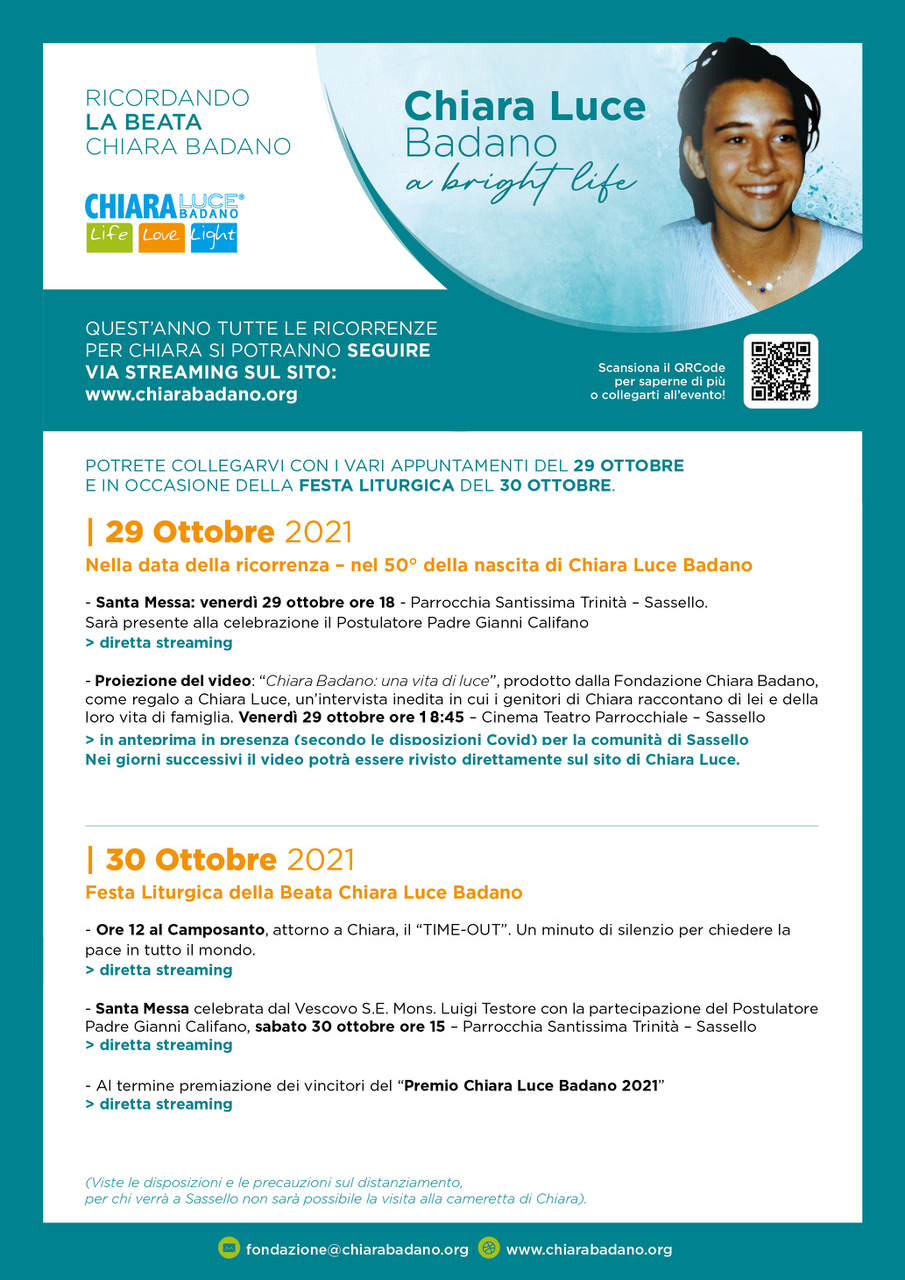
Blessed Chiara Luce Badano was born on 29th October 1971. Events held in various parts of the world will mark this day. In her birthplace Sassello (Italy), Holy Mass will be celebrated and there will also be the Timeout and the projection of an unpublished video interview with her parents, compiled by the Chiara Badano Foundation. Blessed Chiara Luce Badano would have been 50 years old today. She was born 50 years ago, on 29 October1971, and today she is a role model for thousands of young people. Chiara passed away just a few days before she was 19. ‘Luce’ (Light), the name added to her original one, was given to her by Chiara Lubich, wishing her a life in which she would be a bearer of that light which comes from God’s love. She met the Ideal of unity when she was a teenager and she became a Gen, a member of the young generation of the Focolare Movement. She always cared for others and she lived as a normal young girl, perhaps never imagining that she would have to face a very serious illness at the age of 17. If Chiara Luce were alive today, what would she be like and what would she have lived for? This is a question many of us ask ourselves because we feel that Chiara Luce is still so close to us, that she is one of us, even today. So we put this question to three of her closest friends, Chicca and Franz Coriasco and Cristina Cuneo, from the Chiara Badano Foundation. Chicca answered: “Based on the experience we lived with her, we imagine that she would absolutely be a normal young girl, but aware of the fact that by living the Gospel and Chiara Lubich’s ideal, one can do great things”. What would have been her priorities in life? Cristina emphasised: “We believe that it is today’s young people who can answer this question. In fact, in one of Chiara Badano’s last messages, that was almost a testament, she spoke of ‘handing over’ the torch to young people ‘like at the Olympics’. And this is what so many are doing today by their commitment to diminish inequalities and social injustice, to care for the environment, to safeguard the common good, in the most painful situations each one encounters. All the more so during this period of the pandemic emergencies. They try to heal open wounds as she tried to do throughout her life: in her own small way, but always very concretely”. Franz added: “In one of her essays she wrote: ‘Often, man does not live his life because he is immersed in times that do not exist: he is immersed either in the memory or regret of the past or projected into the future. In reality, man possesses only the present moment, that must be lived in its fullness, exploiting it to the full… In this way we become aware of the value of life, a precious gift that cannot and must not be wasted or burnt by sterile selfishness and useless ambitions’. The Timeout was a daily appointment for her; every day at midday she stopped to join many others in the world and pray for peace. This was a fundamental urgency for her, and we believe it remains so for all of us even today”. Chiara Luce was beatified on September 25, 2010 after the Church acknowledged the miracle of the sudden healing of a boy from Trieste (Italy). The first celebration to mark this event is to be held on October 28 at 20.00. (Easter Time – United States and Canada) and organised by New City Press, Living City and YCNA (Youth Center for North America). It consists of artistic pieces, interactive moments and speeches by people touched by Chiara’s testimony of life. The programme also includes a message from a witness who met Chiara directly. During this event, two new books in English are to be launched: “Blessed Chiara Badano. Her Secrets to Happiness‘ , addressed particularly to children, with its text by Geraldine Guadagno and its illustrations by Loretta Rauschuber, and ‘In my staying is your going. The Life and Thoughts of Chiara Luce Badano“, edited by the Chiara Badano Foundation. On October 29 at 18.00 (Italian time), Holy Mass will be celebrtated at her hometown, Sassello (Italy). This will be live streamed on the website chiarabadano.org. It will be followed by the projection of the video “Chiara Badano: a life of light” (directed by Marco Aleotti). In this video, which one can watch in the coming days on the website dedicated to her, there are unpublished interviews with her parents who talk about her and their family life. On Saturday 30th October, the liturgical feast will be held. At 12.00 (Italian time), the meeting place will be the cemetery of Sassello, where in unity with Chiara Luce there will be the Timeout: one minute silence to ask for peace in the world. This event will be live streamed. At 15.00 p.m. (Italian time) Bishop Luigi Testore will celebrate Mass at the Holy Trinity Church in Sassello. Father Gianni Califano, the postulator will also participate. At the end of the Mass, the award ceremony of the Chiara Luce Badano 2021 Prize will take place .
Lorenzo Russo
25 Oct 2021 | Non categorizzato
Chiara Lubich wrote that “Life can be a divine adventure,” and she suggested ways in which this can become true. We can learn to look at all that happens to us believing that everything is a sign of God’s love and that everything that happens to us can contribute to our good. All things work for the good of those who love God. God has his own plan of love for each one of us. He loves us personally, and—if we believe in this love and respond with our own love (this is the condition!)—he makes all things contribute to the fulfilment of his plan for us. It is enough to think of Jesus. We know how much he loved the Father and, if we think of him even for moment, we can see how he lived the Word of Life for this month to the full throughout his life. For him nothing happened by chance. Everything had a purpose. However, we see this Word personified in him in a unique way during the last days of His life; nothing in his passion and death happened by chance. For him, even the extreme trial of feeling forsaken by the Father worked for what is good, because, by overcoming this trial Jesus brought his Work to completion. The causes were perhaps not obvious. Those who made him suffer and die did not know exactly what they were doing. They did not know who it was they tortured and crucified. They were not aware of conducting a sacrifice, the sacrifice par excellence that would bring about the salvation of humanity. Jesus suffered at the hands of people who acted without this intention, but since Jesus loved the Father he transformed all these things into means of redemption, seeing in those terrible moments his ‘hour’ that had at last come, the fulfilment of his divine and earthly adventure. Jesus’ example sheds light on our own life: everything that comes to us, all that happens, all that surrounds us and all that causes us to suffer, can be understood as the Will of God who loves us or as being permitted by God, who loves us still. By doing this, everything will be more interesting for us in life, everything will have meaning; everything will be extremely useful. Let’s take heart. Our lives are still before us. We are still on the road. Life can still be transformed into a divine adventure. It’s enough to keep on loving and keep our eyes open for his ever marvellous will.
Chiara Lubich
(Chiara Lubich, Conversazioni in collegamento telefonico, [Telephone conversations] edited by Michel Vandeleene, Città Nuova, Roma, 2019, pp. 160-161)
21 Oct 2021 | Non categorizzato
“Truly I tell you, just as you did it to one of the least of these who are members of my family, you did it to me.” (Mt 25:40). Gustavo Clarià, an Argentinean focolarino in Lima, recounts an experience that makes this Gospel passage come alive. It’s a story that communicates a sense of joy that comes from small gestures that break down walls between people and make others happy. The first time I saw him he was standing there, motionless, with something in his hands which, from a distance, I couldn’t quite make out. The double mask and the hat only allowed me a glimpse of his eyes. He caught my attention because he seemed to have no expression at all and was just staring into space. As I drew closer, I saw that he was holding a box of sweets. There was no doubt he was there to sell them, yet he did nothing, not even a gesture to offer them to the people who were passing by. I greeted him, but got no reply. When I left the church at the end Mass, I greeted him again, but there was no response. “This sad man must be my age,” I thought, “how unfair life seems sometimes. Yet God loves him immensely as he loves me.” I promised myself that I would always greet him, but was this really what he expected? After all, he was there to do his job and obviously hoped that someone would notice. I decided to buy something. I’m not in the habit of spending money on sweets or eating them at any time, but I had to start somewhere. I stopped in front of him and took an interest in the variety of his products as if I were in a big sweet shop. After careful consideration, I chose a mint chocolate. I paid, thanked him and said goodbye, without eliciting any reaction. Exactly the same thing happened for several days. I went away for about a month but then I returned and went to the parish Mass. He was still there, in the same place. I greeted him without expecting any response, but surprisingly, as he recognised me, a smile escaped his lips and he seemed happy to see me again. I could not believe it. During Mass, when it was time for the collection of offerings, I rummaged in my pocket and found a two euro coin. I was about to put it back in the basket when I thought: “Jesus identifies with the people who suffer the most. With two euros I can buy some more sweets.” On the way out I went to him and said, “What can you offer me today?” For the first time he looked at me and, with a complicit gesture, began to search in his box until he found what he wanted me to taste: “You will like it, it is a very good strawberry-flavoured chocolate and it costs two euros.” It didn’t seem real to me. It was the longest dialogue in the world. He had uttered a complete sentence just for me. I thanked him infinitely for his kindness and left happily. I can’t wait to see him again to confirm his choice: that strawberry chocolate was really good.
Gustavo E. Clarià
19 Oct 2021 | Non categorizzato
Signing a blank cheque, making a leap in the dark … trusting in God can often appear just too big a challenge to us and we don’t find the courage or strength to try. By recognising how small we are, asking help and allowing someone to take care of us with tenderness, we can find a way to recognise the providential Love of a Father who will never abandon us. And we in turn can circulate this love in the world. Sharing Our house was half-destroyed by an earthquake, so my children and I were sleeping out in the open air and we had next to nothing to eat. One morning I had literally nothing to cook, but placing my trust in God who is our Father, I set a pot of water on the fire. Just as it was about to boil, someone arrived carrying a bag full of fruit and vegetables. No sooner had I started to cook soup than another friend knocked at the door bringing us some meat and a little rice! When my children came home from school they couldn’t believe it and asked, “What’s happened, Mum? You told us there wouldn’t be anything to eat today”. So I told the whole story to them, and even though they claim not to believe in God any more, they heard how my prayers had been answered. However, it didn’t end there. After lunch, I felt drawn to ask Jesus to send me someone in need so I could share the food we’d received with them. The very next day I met a young man who asked me if I could give him a piece of bread. I welcomed him with love, and even if he was anxious not to abuse our hospitality because he could see how poor we were, I made him sit down at our table and I served lunch to him. (Lusby – Colombia) A circuit of Love Arriving at university one day, I bumped into an old man dressed in rags, nearly blind, covered in open wounds because he kept falling over. And he was so dirty. In him, I saw the image of Christ on the cross. I helped him up and asked if he’d like to take a bath. I went into the university compound and somehow found the courage to ask the Rector, a devout Muslim, for permission to use his own personal bathroom because it was the only one with a bathtub, so that the old man could take a bath with my assistance. He was certainly surprized by my request! But he not only agreed but also personally provided the old man with soap. I then escorted the old man to his home, bought him some food and gave his room a much-needed clean up. The next day the Rector called me to his office to explain my motivation for what I had done. I told him how the choice to love our neighbour united millions of people of all religions. He was very interested in getting to know more, and he gave a contribution to buy some essentials for the old man. That’s not all. Some of my fellow students who had witnessed the whole scene put some money together to buy new clothes for him. (Bassam – Iraq) Three cows For a while I’ve been helping a boy from a poor family I’d met during our mission to the Kakuma refugee camp in the north east of Kenya, paying his school fees. Sadly the moment arrived when I couldn’t sustain this help anymore and I told him of my own financial difficulties. A little while later this same boy appealed to me again for help, which made me suffer even more because I couldn’t help him. So I took the decision to sell the one cow I was keeping at my parents’ house and use the money for his schooling. Naturally he was delighted to get back to school. One day in the parish I’ve been serving for nearly a year, a group of parishioners arrived to visit me because they’d heard my father was unwell. Among the gifts they brought were not one but three cows! I couldn’t believe my eyes. I thought of the promise of the Gospel: “a good measure, pressed down, shaken together and running over, will be poured into your lap. (Father David – Kenya)
collated by Maria Grazia Berretta
(from Il Vangelo del Giorno, Città Nuova, anno VII, n.4, settembre-ottobre 2021)