
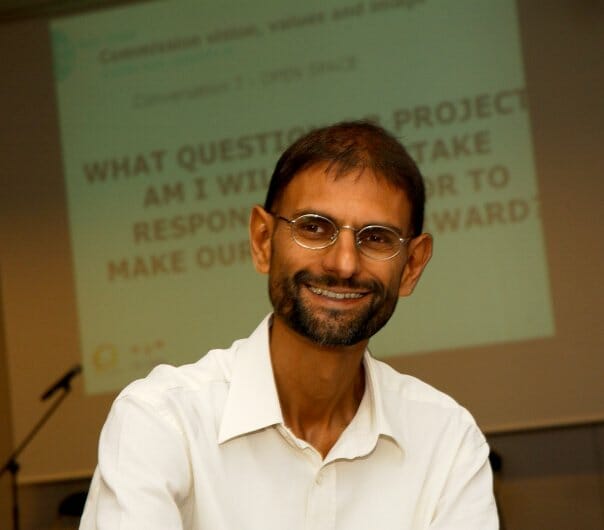
Paolo Giusta
“The life and ideas of Chiara Lubich have introduced a radical novelty that totally surpasses the concept of power as dominion. The idea of power seen as the solitary peak of a pyramid is always present and dominant at times: we often tend to think that one man alone in command, with a clear vision and the strength to impose it is the best and more reassuring solution […]. Chiara has always had a great and absolute respect for power […]. At the same time, her relationships with people at the top of the civil hierarchical ladder (heads of states and governments, presidents of European institutions) or religious (popes, patriarchs…) never showed any sign of servitude. On the contrary, her respect for authority was expressed in a creative way, by offering ideas and suggestions in an attitude of dialogue and stimulus, and placing herself and the resources of the Focolare Movement at the disposition of projects for the benefit of society, especially the poor.
Co-responsibility. Upon exercising power within the Movement she had founded, Chiara set the basis […] for a collective management of responsibility, in line with the spirituality of communion, typical of her charism. At the presidency of the movement, especially for juridical motives, there is only one person, and Chiara wanted this person to be a woman, taking as the model, Mary, the mother of Jesus, who did not have any power except for that of love […]. This is one of the key concepts of Chiara’s charism: the hierarchy exists, and its role is irreplaceable, but stands in the background; what emerges is that we all are first and foremost, brothers and sisters, children of an only God who is love […]. And all of us learn from the example of Jesus, the sole and real master.
Collective leadership. I had the chance to personally see the way Chiara exercised her role of leader when in Stuttgart, 2004 and 2007 we prepared the two meetings of the movement and Christian communities of different Churches […]. I was struck by the way in which she gave room to each one, his ideas and questions. It was as if she was listening to a word God could have pronounced through the words of one of the participants. […]. She took each word seriously and asked the entire group to make their common decision, a true example of collective leadership in action […].
Exercising one’s own role and making room for the other. This was the essence of Chiara’s concept of power, as likewise the contrasting features: the person who holds a position of power has to fully exercise this role (being), and at the same time totally make room for the other, including the subordinates (nonbeing). Likewise, whatever their role and position in the hierarchical ladder, all give their own indispensable contribution (being) and in donating it, lose it since they cannot impose it (nonbeing). This dynamics creates communion, unity in diversity. In fact, for Chiara unity is never static, or something which cancels the components, but is new and surprising each time, because always in vital movement, it is an image of God and the relationship of love among the persons of the Trinity […].
Resolving conflicts together. A practical example of the power exercised as love, in Chiara’s view, is the management and resolution of conflicts. In face of a conflict there are different options: avoid the difficulties of facing it, letting the head decide for all, or else, undertake a journey together with all those involved in the conflict. It would be a long and probably painful journey to face the conflict and emerge with a solution, not with an individual decision, but through a group experience. This solution is not handed down either from the top or given from below, but is the result of a common effort in which each gives his version of truth, in order to reach a common solution.”
See complete text (in Italian)
Chiara Lubich
Politics for Unity
Making a world of difference
March 2015
Info: http://www.politicsforunity.com/


0 Comments